


Community hub
Recent from talks
Contribute something
Nothing was collected or created yet.
Richard Winters
View on Wikipedia
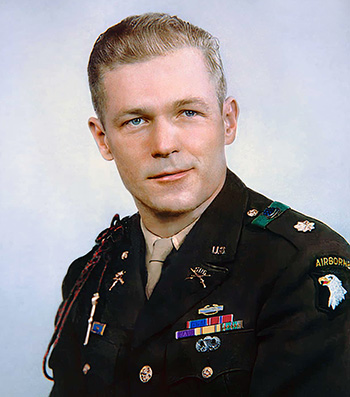
Richard Davis Winters (January 21, 1918 – January 2, 2011) was a United States Army officer who served as a paratrooper in "Easy Company" of the 506th Infantry Regiment within the 101st Airborne Division during World War II. Winters was awarded the Distinguished Service Cross for his successful command of the assault on Brécourt Manor during the invasion of Normandy.
Key Information


His exploits were featured in numerous books and in the 2001 HBO mini-series Band of Brothers, in which he was portrayed by actor Damian Lewis.
Early life and education
[edit]Winters was born in New Holland, Pennsylvania,[3]: 4 to Richard and Edith Winters on January 21, 1918.[4] The family soon moved to nearby Ephrata, and then to Lancaster when he was eight years old.[3]: 4 He graduated from Lancaster Boys High School in 1937 and attended Franklin and Marshall College.[4][3]: 6
At Franklin and Marshall, Winters was a member of the Upsilon chapter of Delta Sigma Phi fraternity and participated in intramural football and basketball. He had to give up wrestling, his favorite sport, and most of his social activities in favor of his studies and the part-time jobs that paid his way through college. He graduated in June 1941 with a bachelor's degree in economics, earning the highest academic standing in the business college.
Military service
[edit]Second World War
[edit]Training
[edit]
Winters wrote in his memoirs that he chose to volunteer for induction under Selective Service after graduating from college and complete the required one year of service rather than waiting for a conventional call-up at a later date that might "interrupt a promising business career," subsequently availing himself of any future service commitment should the United States remain neutral; though Winters "felt a strong sense of duty," he "had no desire to get into the war." Winters was inducted into the Army on August 25, 1941, at the New Cumberland Reception Center near Harrisburg, Pennsylvania.[5][6][7] In September, he was assigned to Camp Croft, South Carolina, for basic training.[3]: 7 While the rest of his fellow trainees were deployed to units stationed in the Panama Canal Zone in early December, Winters remained at Camp Croft to help train draftees and other volunteers. In April 1942, four months after the United States entered World War II, he was selected to attend Officer Candidate School (OCS) at Fort Benning, Georgia.[3]: 8–9 There he became friends with Lewis Nixon, with whom he would serve throughout the war.[3]: 13 He was commissioned as a second lieutenant in the infantry after graduating from OCS on July 2, 1942.[3]: 13
During his officer training, Winters decided to join the parachute infantry, part of the U.S. Army's new airborne forces.[3]: 12 Upon completing training, he returned to Camp Croft to train another class of draftees as there were no positions available in the paratroopers at that time. After five weeks, he received orders to join the 506th Parachute Infantry Regiment (506th PIR) at Camp Toccoa in Georgia.[3]: 14 The 506th was commanded by Colonel Robert Sink.
Winters arrived at Toccoa in mid-August 1942 and was assigned to Company E, 2nd Battalion, 506th PIR,[3]: 16–17 which later became better known as "Easy Company" in accordance with the contemporaneous Joint Army/Navy Phonetic Alphabet. Serving under First Lieutenant Herbert Sobel, Winters was made platoon leader of 2nd Platoon, earning a promotion to first lieutenant in October 1942[8]: 25 [3]: 39 and made acting company executive officer,[4] although this was not made official until May 1943.[3]: 39 The 506th PIR was an experimental unit, the first regiment to undertake airborne training as a formed unit.[8]: 18 The training at Toccoa was very tough. Of the 500 officers who had volunteered, only 148 completed the course; of 5,000 enlisted volunteers, only 1,800 were ultimately selected for duty as paratroopers.[8]: 18 [3]: 18
On June 10, 1943, after more tactical training at Camp Mackall, North Carolina, the 506th PIR was attached to Major General William Lee's 101st "Screaming Eagles" Airborne Division.[8]: 39 Later in the year, they embarked on the Samaria, and arrived in Liverpool on September 15, 1943.[8]: 44 They proceeded to Aldbourne, Wiltshire, where they began intense training for the Allied invasion of Europe planned for spring 1944.[8]: 45
In November and December 1943, while Easy Company was at Aldbourne, the tension that had been brewing between Winters and Sobel came to a head.[8]: 47–52 For some time, Winters had privately held concerns over Sobel's ability to lead the company in combat. Many of the enlisted men in the company had come to respect Winters for his competence and had also developed their own concerns about Sobel's leadership.[8]: 48 Winters later said that he never wanted to compete with Sobel for command of Easy Company; still, Sobel attempted to bring Winters up on trumped-up charges for "failure to carry out a lawful order".[8]: 51 Feeling that his punishment was unjust, Winters requested that the charge be reviewed by court-martial. After Winters' punishment was set aside by the battalion commander, Major Robert L. Strayer, Sobel brought Winters up on another charge the following day. During the investigation, Winters was transferred to the Headquarters Company and appointed as the battalion mess officer.[8]: 52
In the wake of this incident, several of the company's non-commissioned officers (NCOs) delivered an ultimatum to the regimental commander, Colonel Sink, threatening to surrender their stripes unless Sobel was replaced. Winters tried unsuccessfully to talk them out of taking this step.[8]: 53 Sink was not impressed by the threat, and several of the NCOs were subsequently demoted or transferred out of the company. Nevertheless, he realized that something had to be done and decided[8]: 54 to transfer Sobel out of Easy Company, giving him command of a new parachute training school at Chilton Foliat.[3]: 57 Winters' court-martial was set aside and he returned to Easy Company as leader of 1st Platoon. Winters later said he felt that despite his differences with Sobel, at least part of Easy Company's success had been due to Sobel's strenuous training and high expectations.[3]: 287 In February 1944, First Lieutenant Thomas Meehan was given command of Easy Company.[3]: 57
Summer 1944
[edit]Meehan remained in command of the company until the invasion of Normandy, when at about 1:15 a.m. on June 6, 1944, D-Day, the C-47 Skytrain transporting most of the company Headquarters Section was shot down by German anti-aircraft fire, killing everyone on board.[3]: 78–79 Winters jumped that night and landed safely near Sainte-Mère-Église.[3]: 80 Losing his weapon during the drop, he nevertheless oriented himself, assembled several paratroopers, including members of the 82nd Airborne Division, and proceeded toward the unit's assigned objective near Sainte-Marie-du-Mont.[8]: 76 With Meehan's fate unknown, Winters became the de facto commanding officer (CO) of Easy Company, which he remained for the duration of the Normandy campaign.[8]: 92
Later that day, Winters led the Brécourt Manor Assault which successfully destroyed a battery of German 105mm howitzers,[9] which were firing onto the causeways that served as the principal exits from Utah Beach.[8]: 78–84 The Americans estimated that the guns, which were south of the village of Le Grand-Chemin, were defended by about a platoon of 50 German troops, while Winters had 13 men.[8]: 78–84 The attack has since been taught at West Point as a textbook example of an assault on a fixed position by a numerically inferior force. In addition to destroying the battery, Winters also obtained a map that showed German gun emplacements near Utah Beach.[3]: 88
On July 1, 1944, Winters was told that he had been promoted to captain.[3]: 112 The next day, he was presented with the Distinguished Service Cross (DSC) by Lieutenant General Omar Bradley, then the commander of the U.S. First Army.[3]: 112 Shortly after, the 506th Parachute Infantry was withdrawn from France and returned to Aldbourne, England, for reorganization.[3]: 112 The citation for his DSC reads as follows:
The President of the United States of America, authorized by Act of Congress, July 9, 1918, takes pleasure in presenting the Distinguished Service Cross to First Lieutenant (Infantry) Richard D. Winters (ASN: 0-1286582), United States Army, for extraordinary heroism in connection with military operations against an armed enemy while serving with Company E, 2d Battalion, 506th Parachute Infantry Regiment, 101st Airborne Division, in action against enemy forces on 6 June 1944, in France. First Lieutenant Winters with seven enlisted men, advanced through intense enemy automatic weapons fire, putting out of action two guns of the battery of four 88-mm. that were shelling the beachhead. Unswerving in his determination to complete his self-appointed and extremely hazardous task, First Lieutenant Winters and his group withdrew for reinforcements. He returned with tank support and the remaining two guns were put out of action, resulting in decreased opposition to our forces landing on the beachhead. First Lieutenant Winters' heroic and determined leadership exemplify the highest traditions of the military forces of the United States and reflect great credit upon himself, the 101st Airborne Division, and the United States Army.[1]
Autumn 1944
[edit]In September 1944, the 506th PIR parachuted into the Netherlands, near the village of Son, north of Eindhoven, as part of Operation Market Garden, a combined airborne and armored operation. On 5 October 1944, a German force attacked the 2nd Battalion's flank and threatened to break through the American lines. At the same time, four men in an Easy Company patrol were wounded.[3]: 136–137 Returning to headquarters, they reported they had encountered a large group of Germans at a crossroads about 1,300 yards (1,200 m) to the east of the company command post.[3]: 137 Realizing the seriousness of the situation, Winters took one squad from 1st Platoon, and moved off toward the crossroads, where they observed a German machine gun firing to the south, toward the battalion headquarters, from a long distance.[3]: 137 After surveying the position, Winters led the squad in an assault on the gun crew.[3]: 138 Soon after taking the position, the squad took fire from a German position opposite them. Estimating this position was held by at least a platoon, Winters called for reinforcements from the rest of the 1st Platoon and led them, and a platoon from Fox Company in a successful assault. Later it was discovered there had been at least 300 Germans.[3]: 145
On October 9, Winters became the battalion executive officer (XO), following the death of the battalion's former XO, Major Oliver Horton.[3]: 147 Although this position was normally held by a major, Winters filled it as a captain. The 101st Airborne Division was withdrawn to France soon afterward.
Winter 1944–1945 and spring 1945
[edit]On December 16, 1944, German forces launched a counter-offensive against the Western Allies in Belgium, starting the Battle of the Bulge. The 101st Airborne Division was trucked to the Bastogne area two days later. Still serving as XO of the 2nd Battalion, Winters helped defend the line northeast of Bastogne near the town of Foy.[8]: 179–212 The entire 101st Airborne and elements of the 10th Armored Division battled about 15 German divisions, supported by heavy artillery and armor, for nearly a week before Lieutenant General George Patton's U.S. Third Army broke through the German lines surrounding Bastogne, reopening ground supply lines.[8]: 179–212
After being relieved by Patton, the 2nd Battalion attacked Foy on January 9, 1945.[8]: 205 On March 8, 1945, the 2nd Battalion was moved to Haguenau in Alsace, after which Winters was promoted to major.[3]: 200 Shortly afterwards, Robert Strayer, now a lieutenant colonel, was elevated to the regimental staff and Winters took over as acting commander of the 2nd Battalion.[8]: 221 [3]: 202
In April, the battalion carried out defensive duties along the Rhine before moving to Bavaria later in the month.[3]: 209–213 In early May, the 101st Airborne Division received orders to capture Berchtesgaden.[3]: 216 The 2nd Battalion set out from the town of Thale through streams of surrendering German soldiers and reached the alpine retreat at noon on 5 May 1945.[3]: 217 Three days later, the war in Europe ended.[3]: 224
Post-war assignments
[edit]After the end of hostilities, Winters remained in Europe as the process of occupation and demobilization began. Even though he had enough points to return to the United States, he was told that he was needed in Germany.[3]: 243 Later, he was offered a regular (non-reserve) commission, but declined it.[8]: 283 He finally embarked from Marseille aboard the Wooster Victory on 4 November 1945.[3]: 254 He was separated from the Army on November 29, 1945,[3]: 254 although he was not officially discharged until January 22, 1946, and he remained on terminal leave until then.[3]: 255
Winters was recommended for the Medal of Honor for his leadership at Brécourt Manor, but instead received the U.S. Army's second-highest award for combat valor, the Distinguished Service Cross.[8]: 85 After the release of the Band of Brothers television miniseries, Representative Tim Holden (D-PA) introduced a bill asking the President to grant the Medal, but the bill died in the House Armed Services Committee Subcommittee on Military Personnel in 2007.[10]
Korean War
[edit]After his discharge from the Army, Winters worked as a production supervisor for his close wartime friend Captain Lewis Nixon at Nixon's family business, Nixon Nitration Works of Nixon, New Jersey (now Edison Township),[3]: 257 rising to become general manager in 1950.[8]: 306 On May 16, 1948, Winters married Ethel Estoppey[4][3]: 256 and continued to pursue his education through the GI Bill, attending a number of business and personnel management courses at Rutgers University.[3]: 256 In 1951, he and his wife bought a small farm where later they built a home and raised two children.
In June 1951, Winters was recalled to active duty in the Army during the Korean War.[3]: 256 He was ordered to join the 11th Airborne Division at Fort Campbell, Kentucky, but he was given six months to report and in this time he traveled to Washington, D.C., to speak to General Anthony McAuliffe, in the hope that he could convince the Army not to send him to Korea.[3]: 256 He explained to McAuliffe that he had seen enough of war and apparently McAuliffe understood his position, but explained that he was needed because of his command experience. Winters then reported to Fort Dix, New Jersey, where he was assigned as a regimental planning and training officer.[3]: 257
While at Fort Dix, Winters became disillusioned with his job, finding that he had little enthusiasm for training officers who lacked discipline and did not attend their scheduled classes. As a result, he volunteered to attend Ranger School, where he passed and became a Ranger.[3]: 257 He then received orders to deploy to Korea and traveled to Seattle, where, during pre-deployment administration, he was offered the option of resigning his commission, which he accepted.[3]: 257
Later life
[edit].jpg)
In 1972, Winters went into business for himself, starting his own company and selling animal feed products to farmers throughout Pennsylvania.[3]: 257 Soon afterward, he moved his family to Hershey, Pennsylvania.[4] He retired in 1997, aged 79.[3]: 258
During the 1990s, Winters was featured in a number of books and television series about his experiences and those of the men in Easy Company. In 1992, Stephen Ambrose wrote the book Band of Brothers: Easy Company, 506th Regiment, 101st Airborne from Normandy to Hitler's Eagle's Nest, which was subsequently turned into an HBO mini-series Band of Brothers, with Damian Lewis portraying Winters.[4]
Winters also attended the 54th Primetime Emmy Awards on September 22, 2002 at the Shrine Auditorium in Los Angeles when the Band of Brothers miniseries was nominated in multiple categories. When it won Outstanding Miniseries (one of seven wins), Winters spoke at co-creator and executive producer Steven Spielberg's invitation on behalf of Easy Company while other surviving members of the company watched from the Los Angeles St. Regis Hotel.[11]
I want to represent myself here as representing all the men of Company E that are present and accounted for and on behalf of all the men who have passed on before us. And we want to thank Steve Ambrose for listening to our stories and our memories and telling the story of Band of Brothers. We don't want to forget Tom Hanks, Steven Spielberg and his entire crew that did a wonderful job in telling our memories. And I also want to thank every one of you (Points at audience) for your support. I salute you! (Salutes)
Winters was the subject of the 2005 book Biggest Brother: The Life of Major Dick Winters, The Man Who Led the Band of Brothers, written by Larry Alexander. His own memoir, Beyond Band of Brothers: The War Memoirs of Major Dick Winters, co-written by military historian and retired U.S. Army Colonel Cole C. Kingseed, was published in early 2006. He also gave a number of lectures on leadership to cadets at the United States Military Academy at West Point.
On May 16, 2009, Franklin and Marshall College conferred an honorary doctorate in humane letters upon Winters.[12]
Despite the many accolades he had received, Winters remained humble about his service.[3]: 289 During an interview for Band of Brothers that was both the miniseries' final scene and included in the official HBO companion documentary We Stand Alone Together, Winters quoted a passage from a letter he received from Sergeant Myron "Mike" Ranney:
"I cherish the memories of a question my grandson asked me the other day when he said, 'Grandpa, were you a hero in the war?' Grandpa said 'No...but I served in a company of heroes'."
Death
[edit]
Winters died on January 2, 2011,[13] at an assisted living facility in Campbelltown, Pennsylvania, aged 92. He had suffered from Parkinson's disease for several years.[14] Winters was buried in a private funeral service, which was held on January 8, 2011. He was buried in the Bergstrasse Evangelical Lutheran Church cemetery in Ephrata, Pennsylvania,[15] next to his parents in the Winters' family plot. His grave is marked "Richard D. Winters, World War II 101st Airborne". His wife Ethel died on April 11, 2012 at Country Meadows, Hershey. She was 89 years old.[16]
Memorials
[edit]On June 6, 2012, the 68th anniversary of the D-Day landings, the Richard D. Winters Leadership Monument, featuring a 12-foot (3.7 m) bronze statue of Winters by sculptor Stephen C. Spears[17] was unveiled near the village of Sainte-Marie-du-Mont, France 49°23′29″N 1°12′48″W / 49.3915°N 1.21345°W.[18] Winters agreed for the statue to bear his resemblance on the condition that the monument would be dedicated to all junior officers who served and died during the Normandy landings.[19] Among the attendees were World War II veterans, former Pennsylvania governor and first Secretary of Homeland Security Tom Ridge and Maj. Gen. James C. McConville, the 101st Airborne's commanding officer.[20] During celebrations of the 70th anniversary of the landings in 2014, a party including Lewis, fellow Band of Brothers cast members Ross McCall (Technician 5th Grade Joseph Liebgott) and James Madio (Technician 4th Grade Frank Perconte) and Private 1st Class Jim "Pee Wee" Martin of G Company, 3rd Battalion of the 506th Parachute Infantry Regiment laid a wreath there.[21]
A cast of the sculpture was placed in Ephrata, Pennsylvania, in a plaza on the Ephrata-to-Warwick linear trail park near Railroad Avenue and East Fulton Street, where Winters lived with his family from ages two to eight.[22] That statue was dedicated on May 25, 2015.[17]
Some of Winters' World War II uniforms and memorabilia are on display at two museums:
- December 44 Museum (Battle of the Bulge – La Gleize, Belgium)
- Gettysburg Museum of History (Gettysburg Pennsylvania)
In 2019, a US merchant vessel owned by Sealift Incorporated, was renamed the M/V Maj Richard Winters.
Awards and decorations
[edit] | ||

|
  |

|

|

|
   |

|

|

|

| ||

|
 |
| Badge | Combat Infantryman Badge | ||
|---|---|---|---|
| 1st row | Distinguished Service Cross | Bronze Star Medal
with 1 Oak leaf cluster |
Purple Heart |
| 2nd row | American Defense Service Medal | American Campaign Medal | European–African–Middle Eastern Campaign Medal
with Arrowhead Device and 4 Campaign stars |
| 3rd row | World War II Victory Medal | Army of Occupation Medal
with 'Germany' clasp |
National Defense Service Medal |
| Badge | Parachutists Badge
with 2 Combat Jump Stars | ||
| Tab | Ranger Tab | ||
| Unit awards | Presidential Unit Citation
with 1 Oak leaf cluster | ||

| ||

|

|

|
| 1st row | Croix de Guerre
France | ||
|---|---|---|---|
| 2nd row | Liberation Medal
France |
Croix de Guerre
Belgium |
World War II Service Medal
Belgium |
 Five Overseas Service Bars for serving 2½ years overseas in Europe.
In 2001, Winters, as a representative on behalf of the U.S. Army, was one of five World War II veterans to be awarded the Freedom Medal & Freedom from Fear Medal from the Roosevelt Institute.

References
[edit]- ^ a b "Richard D. Winters". Military Times.
- ^ WWII Army Enlistment Records
- ^ a b c d e f g h i j k l m n o p q r s t u v w x y z aa ab ac ad ae af ag ah ai aj ak al am an ao ap aq ar as at au av aw Winters, Richard D.; Kingseed, Cole C. (February 7, 2006). Beyond Band of Brothers. Waterville, Maine: Large Print Press. ISBN 978-1594132360.
- ^ a b c d e f Boland, Timothy (2007). "Richard Winters". The Pennsylvania Center for the Book. Retrieved June 2, 2009.
- ^ Lancaster New Era (Lancaster, Pennsylvania), August 7, 1941
- ^ Lancaster New Era (Lancaster, Pennsylvania), August 25, 1941
- ^ WWII Army Enlistment Records
- ^ a b c d e f g h i j k l m n o p q r s t u v w Ambrose, Stephen E. (1992). Band of Brothers: Easy Company, 506th Regiment, 101st Airborne from Normandy to Hitler's Eagle's Nest. New York: Simon & Schuster. ISBN 978-0-7434-6411-6.
- ^ Perl Finkel, Gal (June 12, 2019). "75 years from that long day in Normandy – we still have something to learn". The Jerusalem Post.
- ^ "H.R. 3121 (111th)". Govtrack.us. Retrieved May 16, 2015.
- ^ The Primetime Emmy Awards (February 20, 2007). "Band of Brothers wins Primetime Emmy Award for Outstanding Miniseries". YouTube. National Broadcasting Corporation. Retrieved July 20, 2023.
- ^ "Honorary Degree Recipients". Franklin & Marshall College. Retrieved June 2, 2009.
- ^ Shapiro, T. Rees (January 10, 2011). "Obituary: Richard 'Dick' Winters, courageous WWII officer portrayed in 'Band of Brothers'". Washington Post. Retrieved January 7, 2018.
- ^ Hurdle, Jon (January 10, 2011). "Band of Brothers leader Richard Winters dies". Reuters. Retrieved January 10, 2011.
- ^ Brenckle, Lara (January 12, 2011). "Memorial service for Dick Winters, 'Band of Brothers' inspiration, will be held at Hershey Theatre". Harrisburg Patriot News. Retrieved February 20, 2011.
- ^ "Ethel Winters, 89, 'Band of Brothers' contributor". LNP Media Group. April 18, 2012.
- ^ a b "Major Richard D. Winters Leadership Memorial and Veterans Plaza". Lancaster County Magazine. Retrieved August 30, 2019.
- ^ Strassmann, Mark (June 6, 2012). "D-Day: Statue of 'Band of Brothers' hero Richard Winters unveiled". CBS News. Retrieved June 6, 2012.
- ^ "Who Was The Real Dick Winters? The Man Who Led The Band Of Brothers - Timeline". YouTube. January 29, 2019. Archived from the original (Video) on January 31, 2019.
contains detailed reminiscences by the sculptor of the statue, both about Winters and the making and dedication of the statue in 2012; Narrated by Damian Lewis
- ^ Staff Sgt. Rick Scavetta (June 12, 2012). "Normandy monument dedicated to Maj. Richard Winters". US Army. Retrieved August 22, 2023.
- ^ Private 1st Class Jim Martin (June 18, 2014). "Jim "Pee Wee" Martin & "Band Of Brothers"". YouTube. Retrieved August 25, 2023.
{{cite web}}: CS1 maint: numeric names: authors list (link) - ^ "France: Statue honors D-Day's junior U.S. officers". San Francisco Chronicle. Associated Press. June 7, 2012.
External links
[edit]

- Richard Winters at Find a Grave
- Richard Winters at IMDb
- Beyond Band of Brothers : The war memoirs of Major Dick Winters
- Winters' military records, courtesy of the national Archives
- Presentation by authors Erik Dorr and Jared Frederick on Hang Tough: The WWII Letters and Artifacts of Major Dick Winters, July 2, 2021, C-SPAN

Richard Winters
View on GrokipediaEarly life
Childhood and family
Richard Winters was born on January 21, 1918, in New Holland, Pennsylvania, to Richard N. Winters and Edith Esbenshade Winters.[3][5] His family background traced to Pennsylvania Dutch roots, descendants of 18th-century German immigrants who settled in the region.[6] Winters had two sisters, Beatrice and Ann Sheehan.[5] The family resided briefly in New Holland before relocating to Ephrata, where Winters spent much of his early years.[7] They later moved to Lancaster, Pennsylvania.[7] Growing up in rural Lancaster County, Winters experienced a conservative community heavily influenced by Mennonite traditions, though his mother, raised in a Mennonite family, did not formally practice the faith in adulthood.[6] These surroundings emphasized values such as hard work, thrift, modesty, and community service, which shaped his character from a young age.[6] As a child, Winters enjoyed outdoor activities in the Pennsylvania countryside, often playing in farm fields and stockyards near his home in Ephrata.[8] His upbringing in this agrarian setting fostered an early appreciation for farming and physical pursuits, including sports, amid the modest, working-class environment of his family.[8] Winters had no significant exposure to military matters during his childhood or early teens, reflecting the peaceful rural life of the area before his later pursuit of higher education.Education
Richard Winters attended Lancaster Boys High School in Lancaster, Pennsylvania, graduating in 1937.[9] In the fall of 1937, Winters enrolled at Franklin & Marshall College, a private liberal arts institution in Lancaster, where he pursued a Bachelor of Science degree in economics with an emphasis on business principles, aspiring to a career in the field.[3] During his college years, he was an active member of the Upsilon chapter of the Delta Sigma Phi fraternity and participated in intramural football and basketball, balancing these pursuits with part-time jobs—such as delivering newspapers and working in a local grocery store—to support his studies amid his family's modest circumstances.[9][8] His experiences at Franklin & Marshall, including interactions with professors and peers, instilled key values of leadership and ethics, reinforced by the college's liberal arts curriculum that stressed mental preparation, honor, integrity, and honesty.[10] Winters graduated from Franklin & Marshall in June 1941, as global tensions escalated with the ongoing lead-up to World War II.[9] Shortly after, on August 25, 1941, he enlisted in the U.S. Army to complete the mandatory one-year service and avoid future conscription, but the Japanese attack on Pearl Harbor on December 7, 1941, propelled the nation into full-scale war, solidifying his commitment to extended military duty.[11][12]Military service
World War II training and preparation
Richard Winters enlisted in the United States Army as a private on August 25, 1941, motivated by a desire to serve and complete his military obligation efficiently before pursuing a civilian career.[13] In April 1942, while stationed at Camp Croft, South Carolina, he was selected for Officer Candidate School (OCS) at Fort Benning, Georgia, due to his strong performance and leadership potential.[13] Winters completed the 12-week OCS program successfully and was commissioned as a second lieutenant on July 2, 1942.[13] Following his commissioning, Winters volunteered for parachute duty and was assigned to the newly formed 506th Parachute Infantry Regiment (PIR) of the 101st Airborne Division, then training at Camp Toccoa, Georgia, under Colonel Robert Sink, the regiment's commander.[14] The training at Camp Toccoa was notoriously demanding, emphasizing physical endurance through daily "Currahee" runs—three-mile uphill marches to the summit of Currahee Mountain followed by a descent, which built unit cohesion and resilience among the paratroopers.[15] Winters also honed weapons proficiency and tactical skills in simulated combat scenarios, preparing for airborne operations.[15] In December 1942, he attended Jump School at Fort Benning, where he completed five qualifying parachute jumps to earn his paratrooper wings, qualifying him for assignment to an airborne unit.[16] Upon returning to the 506th PIR, Winters was promoted to first lieutenant in October 1942 and appointed platoon leader of the 2nd Platoon in Easy Company, 2nd Battalion.[13] In this role, he focused on developing the platoon's capabilities while fostering strong bonds with his men, including soldiers like William "Babe" Guarnere and Donald Malarkey, through shared hardships and mutual trust that would later prove vital in combat.[15] As preparation for overseas deployment intensified, Easy Company participated in large-scale maneuvers in Tennessee during June and July 1943, simulating airborne assaults and coordinating with other units to refine operational tactics.[14] These exercises culminated in the regiment's readiness certification, leading to their rigging for shipment abroad; Easy Company departed New York Harbor on the SS Samaria in early September 1943, arriving in England on September 15 to begin final staging for the European invasion.[16]D-Day and Normandy campaign
First Lieutenant Richard Winters, serving as executive officer of Easy Company, 2nd Battalion, 506th Parachute Infantry Regiment, 101st Airborne Division, parachuted into Normandy shortly after midnight on June 6, 1944, during the D-Day invasion.[4] His C-47 transport faced intense German anti-aircraft fire, causing the paratroopers to be scattered across the countryside west of Sainte-Mère-Église, far from their intended drop zone near Sainte-Marie-du-Mont.[17] Winters landed alone in a field, having lost his main weapon during the jump but retaining his compass and bayonet; he quickly oriented himself by following the path of his aircraft and linked up with scattered paratroopers from the 101st and 82nd Airborne Divisions.[17] Assuming command of Easy Company remnants after their commanding officer, 1st Lieutenant Thomas Meehan III, was killed when their C-47 was shot down, Winters rallied approximately 20 men by dawn at a command post along Le Grand Chemin, a key causeway southwest of Utah Beach.[4] Ordered to neutralize reported enemy fire along a nearby hedgerow, he assembled a volunteer assault force of 13 paratroopers—mostly from Easy Company but including some from other units—and led them against a battery of four German 105mm howitzers at Brécourt Manor, positioned to shell landing forces on Utah Beach.[18] Employing small-unit tactics from prior training, Winters directed a flanking maneuver through a drainage ditch for cover, with two Browning Automatic Rifles providing suppression fire against the German positions manned by about 60 soldiers and machine guns.[19] The assault succeeded in destroying three guns with thermite grenades and C-4 explosives, while a fourth was silenced by reinforcements; the action also yielded a captured map of German artillery emplacements on the Cotentin Peninsula, disrupting beach defenses and saving numerous lives.[18] American casualties were four killed and two wounded, compared to around 20 Germans killed and 12 captured.[18] For his leadership, Winters was awarded the Distinguished Service Cross on July 2, 1944, after an initial recommendation for the Medal of Honor. He was promoted to captain on July 1, 1944.[20] Promoted to captain on July 1, 1944, Winters assumed full command of Easy Company and led the 2nd Platoon through the bocage hedgerows of Normandy, where dense earthen banks and thick foliage favored defensive German positions and intensified close-quarters combat.[20] In the push toward Carentan, a vital junction for linking Utah and Omaha Beaches, the company advanced amid supply shortages that forced soldiers to scrounge for food and equipment, such as canned goods and transport from abandoned sites.[21] On June 12, Winters rallied his approximately 100 men for an assault on the town despite their exhaustion from prior fighting and lack of armored support, personally urging them forward under withering machine-gun and mortar fire to secure a key Y-intersection and breach the defenses.[22] The hedgerow terrain split the platoons, leading to heavy casualties—10 wounded that day, including Winters himself grazed in the leg—and what he later described as the company's "tightest spot" of the campaign, marked by the irreplaceable loss of experienced comrades in the relentless attrition.[23]Operation Market Garden
On September 17, 1944, as part of Operation Market Garden, the largest airborne assault in history, Captain Richard Winters led Easy Company, 2nd Battalion, 506th Parachute Infantry Regiment, 101st Airborne Division, in a parachute drop near Son, Netherlands.[12] The company's primary objective was to secure key bridges along "Hell's Highway," a vital corridor for advancing Allied ground forces, including the capture of the Wilhelmina Canal bridge at Son to prevent its demolition by German defenders.[12] Drawing on assault tactics refined during the Normandy campaign, Winters directed his paratroopers in rapid advances to seize these crossings, enabling British XXX Corps to push northward toward the Rhine.[24] Following the initial drop, Easy Company moved southward to Veghel to reinforce defenses against German counterattacks aimed at severing the supply line.[25] By early October, the 101st Airborne had shifted to "The Island," a narrow strip of farmland between the Waal and Lower Rhine rivers north of Nijmegen, where Winters coordinated with British XII Corps, including the 43rd Wessex Division, to hold a six-mile front.[26] On October 5, facing elements of the German 363rd Volksgrenadier Division, Winters led a patrol that eliminated a machine-gun nest, routed two enemy companies estimated at over 300 troops, and captured 11 prisoners, inflicting around 50 casualties while suffering 22 in Easy Company (one killed, 21 wounded).[24] These actions, involving bayonet charges and coordinated artillery from British units, prevented a breakthrough toward the battalion headquarters amid repeated German probes.[25] Amid mounting casualties across the battalion, Winters assumed the role of executive officer for the 2nd Battalion on October 9, 1944, following successful engagements, while Lieutenant Colonel Robert Strayer remained in command.[12] His leadership emphasized patrols, outposts, and leapfrog advances to maintain positions, as the unit endured shallow foxholes dug into dike sides that offered limited protection against artillery and infiltrations.[26] Troops faced cold, rainy conditions that flooded defenses and exacerbated food shortages, relying on limited rations and occasional interactions with Dutch civilians who provided intelligence or shelter despite the risks of reprisals.[24] Easy Company was relieved from the line in November 1944 after weeks of static defense, having helped stabilize the sector but at the cost of significant attrition.[12] Operation Market Garden ultimately failed to secure the Rhine bridges at Arnhem, stalling the Allied advance into Germany due to underestimated German resistance and logistical delays.[26] Winters' experiences underscored critical lessons in combined arms coordination between airborne, ground, and supporting artillery forces, highlighting the challenges of sustaining isolated positions in contested terrain.[24]Battle of the Bulge and final campaigns
The German Ardennes Offensive, known as the Battle of the Bulge, commenced on December 16, 1944, with a surprise attack that encircled the 101st Airborne Division, including the 2nd Battalion of the 506th Parachute Infantry Regiment (PIR), around Bastogne, Belgium. Easy Company, part of the 2nd Battalion, arrived in the area on December 18 after a grueling truck ride through retreating columns and immediately reinforced the defense, enduring subzero temperatures, artillery barrages, and shortages of supplies that led to widespread frostbite and trench foot among the troops.[27] Under Captain Richard Winters' leadership as acting battalion executive officer—having assumed the role for the 2nd Battalion, leaving command of Easy Company, on October 9, 1944—the unit held foxholes in the Bois Jacques forest near Foy, repelling German probes and contributing to the perimeter's resilience despite the harsh winter conditions that tested the endurance built from prior campaigns like Operation Market Garden.[28] On January 13, 1945, Winters coordinated a critical assault on the village of Foy, directing Easy Company and supporting elements to clear German positions in deep snow, securing the objective with minimal casualties and enabling the 2nd Battalion's advance amid ongoing counteroffensives that relieved Bastogne by late January.[27] The prolonged combat exacted a heavy personal toll on Winters, including frostbite injuries to his feet from the unrelenting cold and the emotional strain of leading men through relentless fighting, where he later reflected on the psychological weight of command decisions in his memoir.[1] His promotion to major was confirmed on March 8, 1945, recognizing his tactical acumen during these operations.[29] As the Allies pushed into Germany, the 506th PIR crossed the Rhine River near Worms on March 25, 1945, using assault boats in a rapid operation that bypassed major defenses and accelerated the advance toward the heartland.[20] In April, the 2nd Battalion, under Winters' executive oversight, participated in the liberation of the Kaufering IV subcamp of Dachau on April 28, 1945, where troops encountered emaciated prisoners and evidence of atrocities, prompting immediate aid efforts amid the shock of the discoveries.[30] The final campaigns culminated in early May 1945, as the 506th advanced into the Bavarian Alps, capturing Berchtesgaden on May 4 and securing Adolf Hitler's Eagle's Nest retreat the following day, where Winters and Easy Company men famously posed for photographs amid the symbolic end of the Nazi regime.[31] With victory in Europe declared on May 8, the battalion began demobilization preparations, marking the close of Winters' active combat leadership after nearly a year of continuous operations.[28]Postwar occupation duties
Following the surrender of German forces in May 1945, Major Richard Winters continued serving with the 101st Airborne Division during the Allied occupation of Austria and Bavaria. Assigned as executive officer of the 2nd Battalion, 506th Parachute Infantry Regiment in July 1945, Winters oversaw administrative and logistical operations amid the chaotic postwar environment. His role involved coordinating the unit's relocation to the Austrian Alps near Zell am See, where the battalion established camps and maintained order in a region teeming with surrendering troops and civilians.[32] Winters' responsibilities encompassed disarming remaining German forces, processing thousands of prisoners of war, and curbing black market activities that threatened supply lines and local stability. He interacted extensively with displaced persons—millions of refugees, forced laborers, and concentration camp survivors—facilitating their basic needs for food, medical care, and temporary shelter while preventing unrest in overcrowded assembly areas. Winters led repatriation efforts, organizing the movement of displaced persons back to their homelands through coordinated logistics with Allied commands, and briefly assumed command of the 1st Battalion to ensure smooth transitions during personnel rotations. These duties highlighted the battalion's pivot to humanitarian and stabilization missions, with Winters personally overseeing peaceful surrenders, such as when a German major handed over his sidearm as a symbol of cooperation.[32] The occupation marked a profound shift for Winters from frontline combat to administrative peacekeeping, which he later described as frustrating and monotonous, evoking the restlessness of a "retired fire horse" yearning for the adrenaline of battle. This war fatigue, compounded by the emotional toll of witnessing widespread devastation, influenced his decision to leave active duty and embrace civilian life. Winters received an honorable discharge on January 22, 1946, at Camp Shelby, Mississippi, while retaining his commission in the Army Reserve as a major.[1][32]Korean War service
In June 1951, during the Korean War, Richard Winters was recalled to active duty as a major and initially ordered to join the 11th Airborne Division at Fort Campbell, Kentucky.[13] He requested a delay and assignment change, citing his World War II combat experience and desire to avoid overseas deployment, and successfully petitioned General Anthony McAuliffe in Washington, D.C., for reassignment to Fort Dix, New Jersey, where he reported after a six-month deferral.[13] There, Winters served as the regimental planning and training officer (S3), overseeing operations for a training battalion focused on preparing paratroopers through rigorous instruction in jump techniques and airborne readiness.[13] Winters' role emphasized stateside contributions to military preparedness, drawing directly on his extensive World War II leadership to mentor new recruits and officers in airborne tactics and unit cohesion.[33] He became disillusioned with the quality of some trainees, many of whom he viewed as undisciplined, prompting him to volunteer for Ranger School to refresh his skills and seek more challenging duties.[13] Despite these efforts, Winters saw no combat during the Korean War, instead prioritizing behind-the-scenes training that enhanced U.S. Army airborne capabilities without frontline exposure.[33] In 1952, while undergoing pre-deployment processing in Seattle, Winters accepted an offered resignation from active duty, motivated by family priorities and his aversion to further warfare after World War II.[13] He transitioned to the Army Reserve, maintaining involvement until 1955, thereby concluding his formal military obligations while preserving his legacy of service.[33]Civilian career
Business roles
Following his discharge from active duty in 1946, Richard Winters transitioned to civilian life by joining Nixon Nitration Works in Edison, New Jersey, a chemical manufacturing firm owned by the family of his wartime colleague Lewis Nixon, where he served as a production supervisor and advanced to general manager by 1950 by applying his military-honed leadership skills to operational efficiency.[34] After his reactivation for the Korean War and subsequent return to civilian employment in 1954, Winters found his prior position filled and took on various sales roles, including work at Johnson & Johnson in New Jersey and as a sales representative for Whitmoyer Laboratories in Myerstown, Pennsylvania, specializing in animal nutritional products.[5] In the late 1950s, Winters served as a grain broker and distributor of animal nutritional products for Poorbaugh Grain in Lancaster, Pennsylvania, leveraging his growing expertise in agricultural sales to build networks among farmers and feed mills. His wife Ethel served as office manager for his subsequent ventures.[5] By 1971, he established his own venture, R.D. Winters Supply Company Inc., focused on distributing animal feed products and nutritional supplies to feed mills across Pennsylvania, followed by the creation of R.D. Winters Inc. to handle the sale of Hershey Chocolate Company by-products repurposed as livestock feed, which formed the core of his long-term executive responsibilities in international and domestic distribution through the 1970s.[5][1] Throughout his career, Winters emphasized military discipline in fostering business efficiency, such as structured team management and decisive problem-solving. He achieved modest success in the competitive animal feed sector without pursuing publicity, maintaining a low profile that aligned with his preference for substantive contributions over recognition, until his retirement from executive positions in 1996 after over two decades leading his firms.[5][8]Authorship and publications
Winters initially resisted publicizing his wartime experiences, considering interviews a form of bragging unless conducted with utmost accuracy.[35] Despite this, he collaborated closely with historian Stephen Ambrose starting in the late 1980s, providing over 13 hours of interviews in 1990 and eight detailed letters, including one in 1996 outlining leadership under fire, to shape the narrative of the 1992 book Band of Brothers: Easy Company, 506th Regiment, 101st Airborne from Normandy to Hitler's Eagle's Nest.[36] This cooperation ensured a faithful depiction of Easy Company's actions, drawing directly from Winters' recollections during Ambrose's research at veteran reunions.[37] In 2006, Winters co-authored Beyond Band of Brothers: The War Memoirs of Major Dick Winters with retired U.S. Army Colonel Cole C. Kingseed, basing the account on his wartime diary and personal notes to expand on untold aspects of Easy Company's campaigns.[38] The memoir delves into Winters' leadership philosophy, articulating ten core principles such as striving for character, competence, and courage; leading from the front with a "Follow me!" ethos; and maintaining physical and mental fitness to inspire troops.[39] It underscores his belief in humility as essential to effective command, prioritizing team cohesion over individual glory, and reflects on the moral responsibilities of officers akin to parental guidance in crisis.[40] Following the book's release, Winters delivered lectures and interviews at institutions like the U.S. Military Academy at West Point, where he addressed the Corps of Cadets in 1998 on frontline leadership, emphasizing humility, mutual trust within units, and the value of collective effort over personal acclaim.[41] These talks, often drawing from his memoirs, reinforced themes of resilient teamwork and ethical decision-making under duress, influencing military education on small-unit dynamics.[42] In 2020, the posthumous collection Hang Tough: The WWII Letters and Artifacts of Major Dick Winters, compiled and edited by Erik Dorr and Jared Frederick, appeared, featuring Winters' preserved correspondence, photographs, and mementos from the war.[43] Among the highlights are intimate letters to his fiancée Ethel Estoppey, revealing personal reflections on combat stresses, homesickness, and his evolving sense of duty during training and deployments.[44] Winters' literary contributions, alongside Ambrose's foundational work, markedly increased scholarly and public fascination with the 101st Airborne Division's role in World War II, illuminating Easy Company's endurance and strategic impacts through primary perspectives.[15] He authored no additional books after Beyond Band of Brothers.[38]Later years
Family life
Richard Winters met Ethel Estoppey while working in New Jersey after returning from World War II, and the couple married on May 16, 1948, in New Brunswick, New Jersey.[45] Their union lasted over 62 years until Winters' death in 2011, marked by mutual support and a commitment to family.[46] The couple had two children: a daughter, Jill, and a son, Richard T. Winters.[5] In 1951, shortly after the birth of their son, the family purchased a 300-acre farm in Fredericksburg, Pennsylvania, where they built a home and raised their children amid a rural setting that emphasized outdoor activities and self-reliance.[47] They relocated to Hershey, Pennsylvania, in 1972, seeking a quieter life closer to community ties.[3] Winters' postwar business roles in animal feed manufacturing provided financial stability that allowed the family to focus on domestic harmony.[1] Home life revolved around privacy and instilling core values of service, modesty, and hard work, with Winters drawing from his military experience to guide his children without public fanfare.[48] Ethel was pivotal in this dynamic, offering steadfast support during Winters' reserve obligations, including his 1951 recall for the Korean War, while managing the household and farm responsibilities.[13] The family's low-profile approach extended to limited disclosures about the children's professional paths, reflecting Winters' deliberate choice for a private domestic existence over publicity.[48] In later years, family bonds grew to include grandchildren, such as Jake, the son of Richard T. Winters and his wife Diana.[5] Winters also nurtured enduring relationships with his Easy Company veterans, treating them as an extended family through regular reunions and shared reminiscences that reinforced their lifelong camaraderie.[15]Retirement activities
Upon retiring from his animal feed business in 1997, Winters embraced a serene rural lifestyle at his 300-acre farm near Fredericksburg, Pennsylvania, focused on farming activities such as raising cattle.[47] He enjoyed the quiet pursuits of farm maintenance, which aligned with his preference for a low-key existence away from public attention.[49] Winters maintained strong ties to his Easy Company comrades through annual reunions that began shortly after World War II and continued for decades, often organized by fellow veteran Bill Guarnere.[50] These gatherings provided opportunities for reflection and camaraderie, and Winters participated in commemorative trips to key battle sites, including Normandy for D-Day anniversaries and Bastogne for Battle of the Bulge remembrances, such as the 50th anniversary in 1994 and a 2001 visit tied to the Band of Brothers miniseries premiere. Despite increased recognition following the publication of Stephen Ambrose's book and the HBO miniseries, Winters selectively engaged in public speaking, delivering lectures on leadership principles to cadets at the United States Military Academy at West Point and at corporate events drawing from his military and business experiences.[34] He deliberately avoided celebrity status, prioritizing privacy and shunning the spotlight to focus on personal integrity over fame.[51] In his later years, Winters managed health challenges stemming from war-related wear, including a several-year battle with Parkinson's disease that contributed to his death on January 2, 2011, at age 92.[52] He relished a tranquil life with his wife Ethel, who survived him until her passing in 2012.[53]Death and legacy
Death
In the late 2000s, Richard Winters was diagnosed with Parkinson's disease, leading to a gradual decline in his health over several years.[54] He passed away on January 2, 2011, at the age of 92 in Hershey, Pennsylvania, with the cause attributed to natural causes related to his advanced age and the progression of Parkinson's disease.[49][55] A private funeral service, honoring Winters' wish for privacy, was held on January 8, 2011, and included military honors; he was subsequently buried in the family plot at Bergstrasse Evangelical Lutheran Church Cemetery in Ephrata, Pennsylvania, alongside his parents.[56][57] Longtime family friend William Jackson, who confirmed the details of Winters' passing, described him as an intensely private individual whose quiet heroism defined his life, while surviving members of Easy Company paid tribute to his leadership and the enduring bonds formed during their service.[54][58] News of his death prompted widespread media coverage, with outlets emphasizing his central role in the Band of Brothers narrative and his legacy as a World War II icon.[49][55][59]Memorials and tributes
Following Winters' death in 2011, a series of memorials and tributes were established to honor his leadership and service. One prominent example is the Richard D. Winters Leadership Monument at Brécourt Manor in Normandy, France, unveiled on June 6, 2012, featuring a 12-foot bronze statue by sculptor Stephen Spears depicting Winters in an assault pose with his M1 Garand rifle at the ready.[4][60] The monument, dedicated to all junior U.S. officers who led on D-Day, includes granite plaques with bilingual text in English and French, and stands along the causeway to Utah Beach near the site of the Brécourt Manor assault.[61] In 2019, the U.S.-flagged cargo ship Maj. Richard Winters was renamed by Sealift Inc. in tribute to Winters, with permission from his daughter; the multipurpose vessel, built in 2000, operates in international trade and honors his legacy through its name.[62] Various exhibits and displays commemorating Winters also exist at key sites, including the Currahee Military Museum at Camp Toccoa, Georgia—where he trained with the 506th Parachute Infantry Regiment—and the 101st Airborne Division Museum at Fort Campbell, Kentucky, which feature inscriptions and displays recognizing his role in Easy Company. In his hometown of Ephrata, Pennsylvania, the Major Richard D. Winters Leadership Memorial and Veterans Plaza was dedicated on May 25, 2015, featuring a duplicate 12-foot bronze statue by Stephen Spears as the centerpiece, honoring Winters and all U.S. veterans.[63] Annual tributes continue to mark Winters' contributions, particularly during D-Day commemorations in Normandy, where veterans and descendants participate in wreath-laying ceremonies at the Leadership Monument and other sites.[64] At Franklin & Marshall College, his alma mater, the Dick Winters '41 Award for Perseverance and Leadership—established in 2013—annually recognizes a senior student exemplifying determination and character, perpetuating his values of quiet leadership.[65] From 2020 to 2025, Winters' memory featured prominently in the 80th anniversary D-Day events in 2024, including special remembrances in Pennsylvania and Normandy that highlighted his Brécourt Manor assault and overall service.[66][64] While no major new books emerged in this period, artifact exhibits expanded, such as the recreation of Winters' personal office at the Hershey History Center using donated items, and ongoing displays of his WWII memorabilia—including letters, uniforms, and equipment—at the Gettysburg Museum of History.[67][68]Cultural depictions
Richard Winters is a central figure in Stephen Ambrose's 1992 book Band of Brothers: E Company, 506th Regiment, 101st Airborne from Normandy to Hitler's Eagle's Nest, which chronicles the experiences of Easy Company during World War II, drawing heavily on Winters' leadership and actions. The book served as the primary source for the 2001 HBO miniseries Band of Brothers, where Winters is portrayed by actor Damian Lewis as the company's resolute commander, emphasizing his tactical decisions and moral compass in key battles like the assault on Brécourt Manor. Winters' personal memoir, Beyond Band of Brothers: The War Memoirs of Major Dick Winters (2006), co-authored with Colonel Cole C. Kingseed, contributed additional firsthand details to the narrative foundation of these works. Winters appeared in several documentaries that highlight his wartime role and reflections. The 2001 HBO companion documentary We Stand Alone Together: The Men of Easy Company, directed by Mark Cowen, features extensive personal interviews with Winters and other Easy Company veterans, providing unscripted accounts of their service from D-Day to the war's end. He also contributed to History Channel programming, including archival footage in specials like The Last Days of World War II (2005), where he discussed leadership challenges faced by paratroopers.[69] Winters' story has extended to other media portrayals of the 101st Airborne Division's exploits. The Brothers in Arms video game series, developed by Gearbox Software starting with Road to Hill 30 (2005), incorporates events from Easy Company's campaigns, with Winters' real-life assault on Brécourt Manor inspiring mission designs that recreate paratrooper tactics in Normandy. In films depicting 101st Airborne operations, such as A Bridge Too Far (1977), elements of Winters' command style are echoed in portrayals of airborne leaders during Operation Market Garden, though he is not directly depicted. Throughout the production of the HBO miniseries, Winters served as a technical advisor, visiting the set in England to ensure authenticity in uniforms, tactics, and dialogue, though he expressed some reservations about dramatized elements that altered timelines or personal interactions for narrative flow.[36] He voiced discomfort with the ensuing fame, preferring to avoid the spotlight as it shifted focus from his comrades' collective efforts, yet he appreciated the series' role in educating younger generations about World War II sacrifices. The cultural depictions of Winters have had a lasting impact, inspiring leadership studies that analyze his emphasis on discipline, humility, and small-unit cohesion as models for modern military and corporate training programs. Additionally, the popularity of Band of Brothers has boosted tourism to World War II sites associated with Easy Company, such as Brécourt Manor in France, where visitor numbers surged post-2001, drawing history enthusiasts to trace Winters' path.Awards and honors
Military decorations
Richard Winters earned several distinguished military decorations during his service in World War II, primarily for acts of valor and leadership with the 101st Airborne Division, while his Korean War service resulted in standard campaign and service ribbons due to his non-combat training role.[13] His awards reflect participation in key airborne operations, including D-Day and Operation Market Garden, though he received no additional valor medals after World War II.[70] The most prominent honor was the Distinguished Service Cross (DSC), awarded on July 2, 1944, for extraordinary heroism during the Brécourt Manor assault on June 6, 1944, where, as a first lieutenant leading a small detachment from Easy Company, 2nd Battalion, 506th Parachute Infantry Regiment, he neutralized four German 105mm howitzers threatening Utah Beach, destroying two under heavy fire and coordinating the elimination of the others with tank support.[71] The DSC, the U.S. Army's second-highest award for combat valor, was presented to Winters the same day by Lieutenant General Omar N. Bradley in Normandy, shortly after his promotion to captain. Winters also received the Bronze Star Medal twice for heroic actions in combat, including one award tied to his D-Day leadership and a second via oak leaf cluster for subsequent valor citations during engagements such as the Battle of Carentan.[70] These recognized his repeated demonstrations of combat leadership amid intense fighting in Normandy and beyond. He was awarded the Purple Heart for wounds sustained in Normandy, specifically a bullet to the leg during the fighting at Carentan in June 1944.[70] Additionally, he earned the Parachutist Badge with two combat jump stars for airborne assaults into Normandy and the Netherlands during Operation Market Garden.[13] Other World War II decorations included the European-African-Middle Eastern Campaign Medal with four campaign stars—for Normandy, Northern France, Ardennes (Battle of the Bulge), and Central Europe—plus an arrowhead device for the assault landing in Normandy; the Good Conduct Medal; the Presidential Unit Citation (with one oak leaf cluster) for unit actions in Europe; and the Army of Occupation Medal (with Germany clasp) for postwar occupation duties.[70] He received foreign awards such as the French Croix de Guerre with Palm and the Belgian Oorlogskruis with Palm for contributions to Allied liberation efforts.[13] During the Korean War, after being recalled to active duty in June 1951 and serving in a stateside training capacity until 1952, Winters received no valor decorations but was entitled to the National Defense Service Medal.[13] Following his death in 2011, Winters' full rack of medals was donated to museums for public display, including items at the Gettysburg Museum of History, where his Distinguished Service Cross and Bronze Star are exhibited alongside related artifacts from his service.[72]| Decoration | Service Period | Context/Reason |
|---|---|---|
| Distinguished Service Cross | WWII | Heroism at Brécourt Manor, D-Day (June 6, 1944) |
| Bronze Star Medal (with 1 Oak Leaf Cluster) | WWII | Multiple acts of valor in Normandy and subsequent campaigns |
| Purple Heart | WWII | Wounded at Carentan, Normandy (June 1944) |
| Parachutist Badge (with 2 Combat Jump Stars) | WWII | Jumps into Normandy and Netherlands |
| European-African-Middle Eastern Campaign Medal (4 stars + arrowhead) | WWII | Participation in four major campaigns plus assault landing |
| Good Conduct Medal | WWII | Meritorious service |
| Presidential Unit Citation (with 1 Oak Leaf Cluster) | WWII | Unit valor in European Theater |
| Army of Occupation Medal (Germany clasp) | WWII | Postwar occupation in Germany |
| National Defense Service Medal | Korean War | Active duty during national emergency |