Hubbry Logo
search
logo
2120157

Robot Monster

logo
Community Hub0 Subscribers
Read side by side
from Wikipedia

Robot Monster
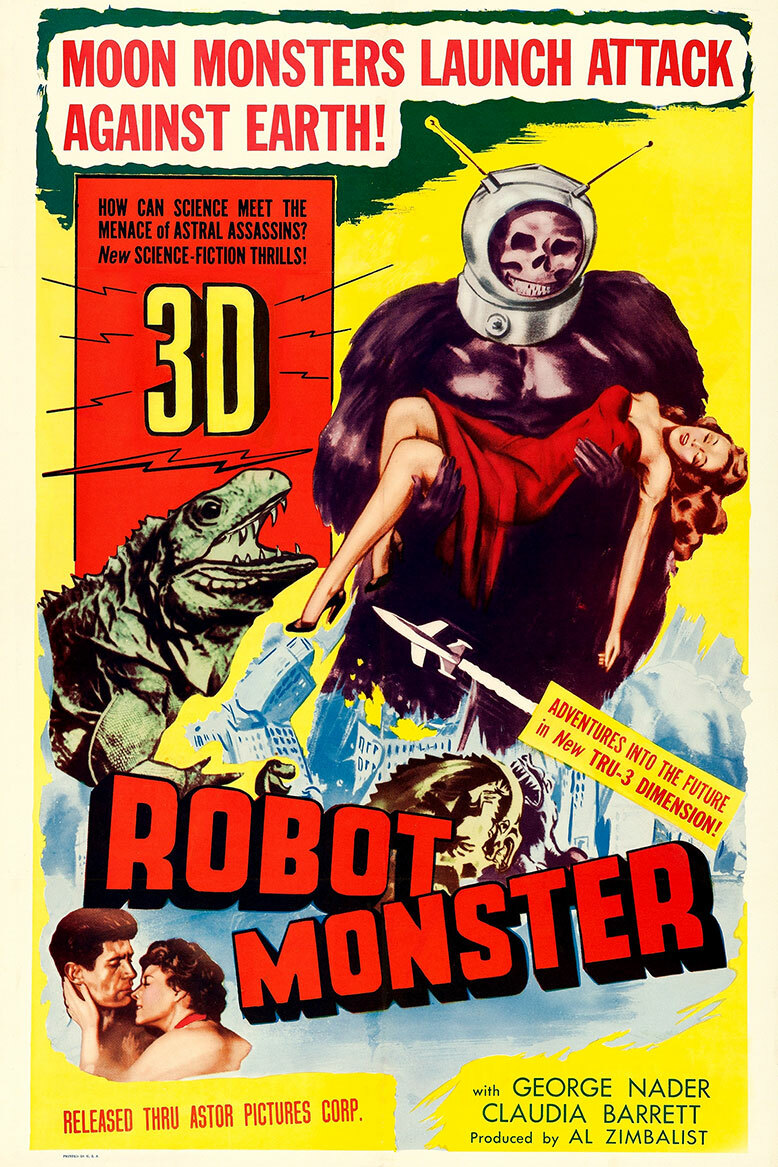
Theatrical release poster
Directed byPhil Tucker
Written byWyott Ordung
Produced byPhil Tucker
Al Zimbalist
Starring
CinematographyJack Greenhalgh
Edited by
  • Bruce Schoengarth
  • Merrill White
Music byElmer Bernstein
Production
companies
Three Dimension Pictures, Inc.
Distributed byAstor Pictures
Release date
  • June 24, 1953 (1953-06-24)
Running time
66 minutes
CountryUnited States
LanguageEnglish
Budget$16,000
Box office$1 million
Trailer

Robot Monster (also released as Monster from Mars)[1] is a 1953 American independent[2] 3D science-fiction horror film produced and directed by Phil Tucker, and starring George Nader, Claudia Barrett, and George Barrows. The film follows an alien robot who, while on a mission to destroy Earth and humanity, betrays the orders of his master, the Great Guidance, by protecting a woman he was tasked to murder.[3]

The film's production lasted only 4 days and took only $16,000 to produce. Production subsequently wrapped on March 23, 1953. Due to the constraints of the film's minuscule budget, Tucker opted to hire Barrows who had made his own Gorilla Suit, along with other adjustments. It was shot in only a handful of locations including Bronson Canyon. The finished film was also printed in a dual strip, polarized 3D, which many critics found to be very high quality, and also added an additional $4,000 to the budget. While containing numerous stock footage found in other productions, Robot Monster notably also beared plot similarities to Invaders From Mars (1953), a film that was distributed by 20th Century Fox a month earlier.

The film was distributed in the United States by Astor Pictures on June 24, 1953. The film received mixed reviews from contemporary critics, and was a box-office success, grossing $1 million. However in later decades, Robot Monster is often remembered as one of the worst films of all time[4], with its plot and production values receiving criticism.

In December of that year following the film's release, Tucker attempted suicide due to his lack of compensation for his work on the film. Tucker survived following detectives responding to his suicide note which he had posted in a newspaper prior. The reason why Tucker was not compensated remains unclear.

Plot

[edit]

Ro-Man Extension XJ-2, referred to as just Ro-Man (a creature with an ape-like body and an antenna-equipped helmet covering its head and emitting electric flashes), has destroyed all human life on Earth with a Calcinator death ray to prevent Humanity from challenging his race, except for eight humans who remain alive in a protected facility. The survivors are a professor, whose name is never mentioned; his wife; their two daughters, Alice and Carla; their young son, Johnny; the professor's assistant, Roy; and space pilots Jason and McCloud (neither of whom is seen or heard). Both pilots depart in a rocket ship for an orbiting space platform. All eight have developed an immunity to Ro-Man's death ray, having received an experimental antibiotic serum developed by the professor intended to cure all diseases.

Ro-Man must complete the destruction of all humans, even if it means his physically killing them one by one, before his mission to subjugate the Earth is complete. After fruitless negotiations, Ro-Man destroys Jason and McCloud's spaceship that had been sent into space to escape, along with the space platform. The Professor uses the machine intended to contact Jason and McCloud to instead contact Ro-Man, pleading for him to let them go as they pose no threat to him. Ro-Man instead demands to talk to Alice alone, who agrees despite her family's protests. When Johnny leaves to find Ro-Man, Alice ventures out with Roy to find him. Johnny confronts Ro-Man and reveals his immunity to the death ray, causing Ro-Man to begin planning a method to counteract this immunity.

Alice and Roy find Johnny, and after inexplicably kissing each other while still in danger, return to the facility. Alice and Roy announce to the professor their desire to marry. The Professor then declares it the biggest event of the year. Ro-Man contacts Great Guidance (referred to as "The Great One"), leader of the Ro-Man Empire, to announce his plan, and is told that he must complete this goal before the Earth finishes revolving. The marriage is conducted, with the Professor asking the Lord for a victory in Mankind's struggle. Ro-Man discovers Carla outside the facility and strangles her.

Ro-Man's mission is waylaid, however, when he develops an illogical attraction to Alice and cannot bring himself to eliminate her, asking the Great One if he may keep one human, but the Great One demands that he continue the mission. Ro-Man rediscovers Alice and Roy, and throws Roy off a cliff. He explains to Alice that the source of his energy lies in his cave, where he takes her and attempts to woo her before being interrupted by the Professor's broadcast. They ask for a quick death at the ravine, and Ro-Man agrees. Immediately after this, the Great One contacts him, angry at him for thinking up the plan to keep the girl and accusing him of bearing free will in violation of Ro-Man law. He gives Ro-Man one last chance to destroy the girl, which Ro-Man refuses to. Johnny distracts him, allowing the family to save Alice. Both Johnny and Ro-Man are suddenly killed by the Great One with a Calcinator blast. The Great One continues the genocide with Cosmic Q-Rays, which cause prehistoric reptiles to appear; and psychotronic vibrations, which "smash the planet Earth out of the universe".

But Johnny is alive, having just awakened from a concussion-induced fever dream. Up to now, all that has happened has just been his nightmare. His sisters, their mother, and the two scientists, whom the family met while picnicking in Bronson Canyon, rejoice at finding him. Johnny and his family invite the scientists home for dinner; they accept.

Suddenly, the Great One, his arms raised in a threatening manner, walks out of his cave directly toward the audience.

Cast

[edit]

Production

[edit]
Drive-in advertisement from 1953.

25-year-old writer/director Tucker made Robot Monster in four days for an estimated $16,000 (equivalent to $190,000 in 2024),[5] although film journals from the time reported that it cost $50,000. Except for a few scenes at a house in Los Angeles and a building site near Dodger Stadium,[6] most footage was filmed outdoors in Bronson Canyon, the site of innumerable motion pictures and TV settings.[7] It also included stock footage from Flight to Mars (1951) and One Million B.C. (1940). Its working titles were Monsters from the Moon and Monster from Mars.[8] Principal photography on Robot Monster wrapped on March 23, 1953.[9]

Robot Monster's very low budget did not allow for a robot costume as first intended, so Tucker hired his friend George Barrows, who had made his own gorilla suit, to play Ro-Man; Tucker then added a space helmet similar to those used in Republic serials such as Radar Men from the Moon.[3]

Robot Monster is similar in its plot to Invaders from Mars, released a month earlier by 20th Century Fox. Both films contain a young boy, stumbling upon an alien invasion, who is captured as he struggles to save his family and himself. As the alien commences the final destruction of Earth, the boy awakens to find it was all a dream. Barrett recalled in an interview that the film's original screenplay was designed as reality, but director Tucker changed his mind and then shot a new twist ending that showed the film's story has been a boy's dream that is about to come true.[10]

In Robot Monster's opening credits, "N. A. Fischer Chemical Products" is given prominent credit for the "Billion Bubble Machine", used as part of Ro-Man's communication device for reporting to his superior, the Great Guidance.[11]

The film was preceded in theatres by Stardust in Your Eyes, a one-reel 3D monologue by comic/impressionist Trustin Howard, performing under his stage name "Slick Slavin."[12]

Casting

[edit]

While George Barrows physically portrayed Ro-Man, the character's voice was dubbed by veteran radio actor John Brown.

The leading man role was played by George Nader, a 20th Century Fox and RKO Pictures contract player who had mainly played minor roles. Robot Monster was his first leading role, and two years after its release he would win a Golden Globe Award for New Star of the Year – Actor for the film Four Guns to the Border. He thereafter signed with Universal Studios, where he starred mostly in secondary features. [citation needed]

Selena Royle was a longtime MGM stock player, who had a durable film career beginning in 1941, but it ended in 1951 when she was branded a Communist sympathizer. She refused to appear before the House Committee on Un-American Activities and eventually cleared her name. By then, the damage to her reputation had already been done; she made only two additional films, Robot Monster being her second-to-last.[13]

Claudia Barrett accepted the part of Alice against the advice of her agent.[14] She said the following about her role:

When you decide to make a movie, the decision is made for various reasons: money, fame, or working with a particular star or director. I just wanted to act. I was a professional actress for 14 years, and I really loved the business. And Robot Monster was a movie I enjoyed making.

3D

[edit]

Robot Monster was shot and projected in dual-strip, polarized 3D. The stereoscopic photography in the film is considered by many critics to be high quality, especially for a film whose crew had little experience with the newly developed camera rig.[15] Producer Al Zimbalist later told The New York Times that shooting the film in 3D (which involved using another camera) added an extra $4,510.54 to the budget.[16]

Special effects

[edit]

Robot Monster's special effects include stock footage from One Million B.C. (1940), Lost Continent (1951), and Flight to Mars (1951);[5] a brief appearance of the Rocketship X-M (1950) spaceship boarding; and a matte painting of the ruins of New York City from Captive Women (1952).[3]

Film score

[edit]

Robot Monster's music score was composed by Elmer Bernstein, who also composed Cat Women of the Moon for producer Al Zimbalist the same year[17] Bernstein recalled he was stuck in a period where he was "greylisted" because of his left-wing politics and only offered minor films,[18] but said he enjoyed the challenge of trying to help such a low-budget film.[19] Wyatt Ordung stated that Bernstein scored the film with an eight-piece orchestra, and Capitol Records expressed interest in producing an album.[20]

One critic told how he had watched the film as a teenager when it was first shown on television in 1954 and said it was "one of Elmer Bernstein's best very early scores."[21]

Release

[edit]

Robot Monster was released by Astor Pictures on June 24, 1953,[22] at a runtime of 62 minutes.[23] It was originally released with the Three Dimension Pictures short Stardust in Your Eyes, starring nightclub comedian Trustin Howard as Slick Slavin.[15] It grossed $1,000,000 (equivalent to $12,000,000 in 2024) during its initial theatrical release, more than 60 times its original investment.[5]

Reception

[edit]

Contemporary

[edit]

The December 1952 review in Variety noted, "Judged on the basis of novelty, as a showcase for the Tru-Stereo Process, Robot Monster comes off surprisingly well, considering the extremely limited budget ($50,000) and schedule on which the film was shot".[24]

In June 1953, the Los Angeles Times called it "a crazy mixed up movie ... even children may be a little bored by it all"[25] and Harrison's Reports, the following month, called it "the poorest 3-D picture that [has] been made so far." Adding, "the story is completely illogical, and the supposed monsters from another planet are laughable. Even the acting, at times, is ridiculous".[26]

In December 1953, the Los Angeles Times reported that "theater men" considered the film "one of the top turkeys of the year."[27]

Legacy

[edit]

The film holds a 36% approval rating at the film review aggregator website Rotten Tomatoes, based on 14 reviews, with an average rating of 4.15/10.[28]

The film is frequently considered one of the worst movies ever made,[29][30] with film historian Leonard Maltin writing in his 2009 Movie Guide, "[Robot Monster is] one of the genuine legends of Hollywood – embarrassingly, hilariously awful [...] just dig that bubble-machine with the TV antenna."[31]

Aftermath

[edit]

In December 1953, it was reported that Tucker tried to commit suicide at the Hollywood Knickerbocker Hotel. He was saved only because he had written a suicide letter and sent it to a newspaper, which sent a reporter and some detectives to the hotel. He was discovered with a pass in his pocket from the psychopathic ward of a veteran's hospital. In the letter, Tucker said he had not been paid for Robot Monster and was unable to get a job. "When I was refused a job – even as an usher", Tucker wrote, "I finally realized my future in the film industry was bleak." It was revealed that Tucker and the producer had quarreled, and film exhibitors had instructions not to let Tucker in to see the film unless he paid admission.[27]

In Keep Watching the Skies!, a comprehensive history of 1950s and early 1960s American science-fiction films, author Bill Warren claimed that Tucker's attempted suicide was due to depression and a dispute with the film's distributor, who had allegedly refused to pay Tucker his contracted percentage of the film's profits.[32]

In his autobiographical book Hollywood Rat Race, Ed Wood refers derisively to Tucker, claiming his suicide attempt was actually a publicity stunt to draw attention to failing film projects, and that he made multiple such attempts over the years.[33]

[edit]

Mystery Science Theater 3000

[edit]

Robot Monster was featured in episode #107 of Mystery Science Theater 3000, which premiered on the Comedy Channel on December 23, 1989. The episode also included two Commando Cody shorts, episodes 4 and 5 from Radar Men from the Moon.[38] MST3K Kevin Murphy complains about many things in the movie but especially the treatment of the lead female character, "a brilliant scientist [who] turns into a blubbering imbecile at the sight of her boyfriend ... The woman constantly gets carried around by her father, her boyfriend, and ultimately Ro-Man."[39]

Like most of Mystery Science Theater 3000's first-season episodes, Robot Monster has a poor reputation. In Paste, writer Jim Vorel placed the movie #183[a] in his ranking of episodes from the series first twelve seasons. Despite the movie's reputation, Vorel calls Robot Monster "pretty harmless fun all on its own," even if the monster was created "as a combination of laziness and budget." Vorel contends the worst parts of the episode are the two Commando Cody shorts that precede the film and the lower-density and lower-sophistication jokes made about the movie.[40] Writer Chris Morgan, however, listed Robot Monster as one of the ten worst movies shown on MST3K[41] and ranked Ro-Man as the second-worst monster in movies featured on MST3K; still, despite Ro-Man's design — "He’s a robot, but he looks like a gorilla ... [with] an old-school diving helmet with antennae attached to it" — Morgan calls him "one of the most iconic bad movie monsters" and "the only fun thing in an otherwise incredibly boring movie."[42]

The MST3K version of the film was included as part of the Mystery Science Theater 3000, Volume XIX DVD collection, released by Shout! Factory on November 9, 2010. Special features with the film include an interview with filmmaker Larry Blamire about Robot Monster, "Larry Blamire Geeks Out," and the movie's theatrical trailer. The other episodes in the four-disc set include Bride of the Monster (#423), Devil Doll (#818), and Devil Fish (#911).[43]

See also

[edit]

References

[edit]

Bibliography

[edit]
[edit]
Revisions and contributorsEdit on WikipediaRead on Wikipedia
from Grokipedia
Robot Monster is a 1953 American independent black-and-white 3D science fiction horror film directed and produced by Phil Tucker from a screenplay by Wyott Ordung.[1] The story centers on Ro-Man, an extraterrestrial conqueror from the planet Ro-Man tasked with eliminating the last eight human survivors after deploying a virus that has wiped out the rest of humanity.[2] The titular monster is portrayed by actor George Barrows in a modified gorilla suit topped with a diving helmet and antennae, embodying the film's rudimentary special effects.[1] Filmed in four days on a budget estimated at $16,000, Robot Monster capitalized on the early 1950s 3D fad but became infamous for its stilted dialogue, illogical plot elements, and visible production shortcuts, such as stock footage dinosaurs substituting for alien threats.[2] Released on June 25, 1953, by Astor Pictures, it starred George Nader as scientist Dana Beale and Claudia Barrett as his romantic interest Alice.[1] Despite contemporary reviews highlighting its technical ambitions relative to costs, the film earned derision for amateurish execution, with Variety noting it "comes off surprisingly well" given constraints but ultimately faltering in coherence.[3] Robot Monster grossed approximately $1 million at the box office, a substantial return on investment that underscored the era's appetite for low-budget genre fare amid atomic age anxieties.[4] Its enduring legacy stems from inclusion in compilations of cinematic failures, such as William K. Everson's references in bad film canon discussions, cementing its status as a "so-bad-it's-good" cult classic rather than any artistic merit.[5] Tucker, only 25 at the time, faced personal turmoil post-release, including an alleged suicide attempt amid financial disputes, though the film's notoriety overshadowed such events.[6]

Synopsis

Plot Summary

In Robot Monster, the narrative unfolds in a post-apocalyptic setting following an alien invasion orchestrated by the Great Guidance, an extraterrestrial leader who deploys the robot servant Ro-Man to eradicate humanity using a calcinator death ray. Ro-Man reports that most of Earth's population has been destroyed, but a small number of survivors—initially fewer than eight individuals—remain immune due to an antidote derived from prehistoric animal serums, illustrated through integrated stock footage of dinosaurs such as triceratops.[7][8][9] The primary survivors include scientist Dr. John Steele, his wife, their adult daughter Alice, young son Johnny, and Steele's associate Roy, who take refuge in mountain caves while evading detection. Ro-Man, a hulking figure resembling a gorilla clad in a helmet and operating a bubble-emitting device, communicates with the Great Guidance via a calcinator apparatus and begins systematically hunting the group, resulting in the deaths of Steele and other adults through direct confrontations and ray blasts. Johnny observes Ro-Man's activities covertly, while the remaining humans attempt countermeasures, including plans leveraging the antidote's properties.[8][10][7] Ro-Man captures Alice but develops an inexplicable attraction to her, leading to hesitation and defiance against the Great Guidance's orders to eliminate her immediately, prompting reports of insubordination and threats of replacement. This internal conflict culminates in Ro-Man's destruction by a retaliatory ray from his superiors, followed by an escalation involving cosmic Q-rays intended to annihilate all terrestrial life. The plot concludes with a twist revealing the preceding events as a dream experienced by the injured Johnny, though the appearance of Ro-Man and stock footage of a pterodactyl attack introduce ambiguity regarding the boundary between dream and reality.[8][9][7]

Cast and Characters

Principal Actors

George Nader played Roy, the film's male lead and a young survivor aiding the family against the alien threat. Born in Pasadena, California, in 1921, Nader's appearance in Robot Monster marked his debut starring role, following minor parts in earlier films like Phone Call from a Stranger (1952) and Monsoon (1952); he subsequently gained prominence in Universal Pictures features, including Away All Boats (1956) and The Unguarded Moment (1956).[11] Claudia Barrett portrayed Alice, the eldest daughter in the surviving family. Born in 1929, Barrett had a sparse film career, with Robot Monster as her most prominent role; her subsequent credits included A Life at Stake (1955), Chain of Evidence (1957), and Seven Ways from Sundown (1960), after which she largely retired from acting.[12] Selena Royle acted as the Mother, the matriarch protecting her children. An established performer in stage productions and films such as The Woman of the Town (1943), Royle faced professional repercussions from the Hollywood blacklist amid McCarthy-era investigations, which curtailed her U.S. opportunities; Robot Monster was among her final screen appearances before she relocated to Mexico in 1957.[13] John Mylong depicted the Professor, a scientist central to the human resistance. The Austrian-born actor (1892–1975), who emigrated to the United States, had appeared in over 100 films, including For Whom the Bell Tolls (1943) and His Kind of Woman (1951), often in authoritative roles leveraging his European training.[14] Gregory Moffett, a child performer at the time of filming, played Johnny, the young son. Moffett's early credits encompassed Let's Dance (1950) and Saddle Tramp (1950); Robot Monster represented one of his few feature film roles before he shifted away from acting.[15] John Brown provided the voice for Ro-Man and the Great Guidance, the extraterrestrial antagonists. A radio veteran (1904–1957) known for character voices on programs including Fibber McGee and Molly, Brown's dubbing concealed the physical performer's identity, aligning with his background in uncredited vocal work for films like Strangers on a Train (1951).[16]

Character Analysis

Ro-Man, identified as Ro-Man Extension XJ-2, embodies the antagonist archetype as an extraterrestrial agent dispatched by the Great Guidance to annihilate humanity with a calcinator death ray following Earth's refusal to submit to the Ro-Men. His campaign devastates the planet, eliminating all but a small cadre of survivors, whom he methodically hunts in their cave refuge. This role underscores a narrative function of inexorable mechanical obedience, posited as superior to human frailty through emotionless efficiency.[8][17] Yet Ro-Man's capture of survivor Alice introduces a pivotal conflict, wherein he develops an irrational attachment, culminating in his admission, "I must, but I cannot," when commanded to execute her. This duality—ruthless destroyer versus hesitant suitor—exposes causal inconsistencies: the script's alien logic, premised on devoid-of-emotion robotics, falters as unprompted empathy emerges without mechanistic explanation, eroding the foundational rationale for Ro-Men's conquest and highlighting improvised motivational shifts over coherent extraterrestrial causality.[8][17] The human survivors—Professor, Alice, Johnny, Roy, and the mother—operate within 1950s nuclear family dynamics, leveraging interpersonal bonds and scientific ingenuity for endurance. The Professor's synthesis of an immunity serum against the death ray represents a core survival mechanism grounded in rational experimentation, positing human progress as a counterforce to alien absolutism. Familial interdependence manifests in collective decision-making, such as restraining Alice to avert capitulation to Ro-Man, prioritizing group viability over individual impulse.[8] Roy functions as the archetypal hero, exhibiting post-World War II masculine resolve through proactive defense and strategic restraint, thereby preserving the group's operational integrity amid peril. Johnny, the juvenile element, injects fantastical disruptions via dream sequences featuring dinosaur confrontations, integrated through stock footage that disrupts causal flow; his post-crisis remorse over limited sibling playtime further illustrates the script's abrupt fusion of childish reverie with apocalyptic stakes, devoid of transitional logic.[8][17]

Production

Development and Pre-Production

Phil Tucker, a 26-year-old aspiring filmmaker born in 1927, directed and produced Robot Monster as his feature debut, collaborating with executive producer Al Zimbalist to capitalize on the early 1950s surge in 3D filmmaking following successes like Bwana Devil (1952).[18][19] The project originated as an independent low-budget venture, with working titles including Monsters from the Moon and Monster from Mars, reflecting pulp science fiction conventions of extraterrestrial invasion amid post-World War II anxieties over advanced weaponry.[20] The screenplay, credited to Wyott Ordung under Tucker's oversight, centered on a post-apocalyptic scenario where the alien antagonist Ro-Man deceives humanity into self-destruction via atomic warfare, incorporating themes of nuclear devastation that echoed contemporaneous fears of atomic escalation during the Cold War's early phases, though rooted in standard genre tropes rather than original geopolitical analysis.[21] Script development emphasized survival elements in a resource-scarce production environment, prioritizing narrative simplicity to accommodate independent constraints like limited sets and effects capabilities.[22] Casting decisions favored available, lesser-known performers over established stars to minimize costs and scheduling conflicts, with Tucker drawing from accessible talent pools; leads George Nader and Claudia Barrett, both relative newcomers without major credits at the time, were selected for their suitability to the roles of scientist and survivor, respectively, aligning with the film's expedient pre-production timeline.[23][24]

Filming and Logistics

Principal photography for Robot Monster was completed in just four days in early 1953, a compressed schedule necessitated by the film's shoestring budget of approximately $16,000.[2] This rapid timeline contributed to logistical inefficiencies, as director Phil Tucker, then 25 years old, simultaneously served as writer, producer, and editor, juggling multiple responsibilities without a large professional crew.[17] The use of inexperienced personnel and minimal equipment further exacerbated on-set challenges, resulting in hasty setups and visible seams in the production's execution, such as inconsistent lighting and blocking in outdoor sequences.[3] Exteriors were primarily shot in Bronson Canyon, a former quarry in Griffith Park, Los Angeles, whose rugged terrain and artificial cave tunnel served as versatile backdrops for the film's alien invasion scenes.[25] A few interior shots were filmed at a private house in Los Angeles, limiting set construction to basic props and relying on the location's natural features to stand in for post-apocalyptic human hideouts.[26] These choices reflected budget-driven compromises, avoiding costly builds or distant travel while capitalizing on accessible, frequently used low-budget filming spots.[2] To compensate for the abbreviated shoot and financial constraints, the production incorporated stock footage for key action elements, including dinosaur attacks and explosion effects, sourced from preexisting libraries rather than original filming.[27] This approach minimized on-site pyrotechnics and creature work but introduced visual mismatches, such as outdated or low-quality clips that clashed with the live-action footage, underscoring the causal link between resource limitations and the film's technical amateurism.[17] Tucker's oversight of these integrations, amid the breakneck pace, prioritized speed over seamless editing, amplifying the project's patchwork quality.[3]

Technical Aspects and Special Effects

Robot Monster employed the Tru-Stereo dual-strip polarized 3D process, utilizing two synchronized 35mm cameras operated by cinematographer Jack Greenhalgh to capture stereoscopic footage over a four-day shoot.[28] This independent implementation prioritized depth cues through foreground elements, such as rocks and debris positioned to project toward the audience, enhancing immersion in a manner consistent with the era's 3D conventions where physical props were hurled or extended into the camera's convergence plane to exploit binocular disparity.[29] Despite budgetary limitations that precluded elaborate rigging, the resulting parallax effects demonstrated effective separation of planes, with outdoor sequences yielding spatial realism that archival restorations confirm rivaled higher-budget productions like those from major studios in 1953.[30] The titular Ro-Man character's design exemplified low-cost improvisation, comprising a rented gorilla fur suit worn by actor George Barrows, topped with a modified surplus diving helmet equipped with antennae and connected to a portable bubble machine for simulating energy emissions.[1] This hasty assembly from readily available materials—gorilla suits being a staple of B-movie effects and diving gear post-World War II surplus—prioritized functionality over aesthetics, resulting in limited mobility and visible human contours under the ill-fitting fur, which undermined the intended robotic menace but aligned causally with the film's rushed timeline and resource scarcity.[31] Filming relied on minimalist exteriors in Bronson Canyon, leveraging the site's existing rock formations and quarry-like caves as stand-ins for extraterrestrial terrain without constructed sets, supplemented by basic optical composites including stock footage of dinosaurs and rocket launches from prior films.[32] Matte work was sparse, confined to simple extensions of rocky horizons via painted glass inserts, which, while rudimentary and prone to edge artifacts under scrutiny, sufficed for the 3D format's emphasis on midground depth over seamless integration, as verified in restored prints where parallax reveals the composites' planar limitations.[33]

Music and Sound Design

The music score for Robot Monster was composed by Elmer Bernstein, marking one of his earliest film scoring efforts in 1953, prior to his later acclaimed works.[34] Recorded with a modest eight-piece ensemble, the score features a memorable theme for the antagonist Ro-Man, emphasizing dramatic swells to convey alien threat and urgency.[35] Bernstein incorporated period-specific electronic elements, such as an electrified flute, to produce eerie, otherworldly tones that heightened the film's sense of menace amid its constrained production.[36] Sound effects were drawn primarily from stock library recordings, a common cost-saving measure for low-budget productions of the era. These included repurposed animal and creature noises, such as dinosaur roars adapted for Ro-Man's vocalizations and the film's robot dinosaurs, sourced from established libraries like Universal Studios' effects catalog.[37] This approach contributed to an auditory palette that blended prehistoric ferocity with mechanical menace, though the reuse often resulted in mismatched or incongruous results given the creature designs. Ro-Man's dialogue was voiced by actor John Brown, whose performance underwent electronic modulation to simulate a robotic timbre, creating a warbling, distorted quality.[38] This vocal processing, combined with Brown's theatrical delivery, inadvertently amplified the film's campy elements, transforming intended intimidation into unintended humor. Overall, the audio components—score, effects, and modulation—served a causal function in amplifying tension and alien otherness, effectively bridging gaps left by the rudimentary visuals and limited effects budget.[36]

Release and Formats

Initial Distribution

Robot Monster was released theatrically on June 25, 1953, by Astor Pictures, following a Los Angeles-area premiere on June 24.[24] Produced by Three Dimensional Pictures, the film was designed for dual-strip polarized 3D projection to capitalize on the brief 1950s 3D novelty surge initiated by Bwana Devil in late 1952.[7] Distribution emphasized bookings in theaters equipped for 3D, often as the second feature in double bills with other stereoscopic sci-fi or horror attractions, targeting audiences seeking immersive gimmick experiences.[2] Marketing campaigns featured lurid posters depicting the ape-suited Ro-Man as an existential threat to humanity, with taglines and artwork accentuating 3D "depth" effects like protruding claws and rays to lure thrill-seekers amid postwar atomic anxieties reflected in the film's post-apocalyptic premise.[39] Advertisements, including drive-in promotions such as the July 3, 1953, screening at San Bernardino's Mount Vernon Drive-In, highlighted the monster's invasion narrative to evoke Cold War fears of technological annihilation without nuclear specifics.[40] Nationwide rollout remained limited due to the film's independent status, focusing on regional circuits rather than major studio chains. By late 1953, as public fatigue with 3D glasses and projection complexities grew—evidenced by declining attendance for subsequent 3D releases—distributors shifted to flat 2D prints for broader accessibility, extending playdates into 1954.[7] This adaptation aligned with the rapid dissipation of the 3D fad, prioritizing volume of screenings over specialized format exclusivity.[41]

Modern Restorations and Availability

In 2023, the 3-D Film Archive completed a high-definition restoration of Robot Monster from original 35mm archival 3D elements to commemorate the film's 70th anniversary.[42] This version premiered in New York at Film Forum as part of a retrospective on 1950s 3D cinema and in Los Angeles at the Velaslavasay Panorama.[43][44] The restored print supports viewing in 2D, anaglyph 3D, or full-color 3D, demonstrating improved depth and clarity compared to prior degraded copies.[45] Bayview Entertainment released the restoration on Blu-ray and DVD on July 25, 2023, including over two hours of bonus features such as trailers and interviews.[46][42] The edition features uncompressed LPCM 2.0 mono audio preserved from the original theatrical elements, allowing clearer appreciation of composer Elmer Bernstein's score, which had been muddied in earlier public domain transfers.[47][48] As a public domain title since the 1980s, Robot Monster has proliferated on free streaming platforms like YouTube and Archive.org, often in colorized or unrestored variants, contributing to its sustained cult following among B-movie enthusiasts.[49][50] These digital accesses, combined with the 2023 physical release, have expanded viewership beyond niche audiences. The restoration efforts spurred related media, including a 64-page 3D graphic novel anthology, Robot Monster Comics in 3-D, crowdfunded via Kickstarter in 2024 and promoted at San Diego Comic-Con in July 2025.[51][52] Produced by 3-D Film Archive collaborators with contributions from film cast alumni and comic creators, it expands the film's lore through illustrated stories inspired by the original screenplay.[53]

Commercial Performance

Budget and Box Office Earnings

Robot Monster was produced on an estimated budget of $16,000, funded independently by producer Herman Cohen and backers without support from major studios, allowing for rapid, low-cost assembly using stock footage, minimal sets, and a cast of unknowns.[2] Some accounts place the total cost slightly higher, around $20,000, reflecting the era's shoestring independent filmmaking practices that prioritized quick turnaround over polished production values.[54] The film grossed over $1 million domestically, delivering a return on investment exceeding 50 times the production cost through extensive bookings in drive-in theaters and second-run houses, capitalizing on the 1953 surge in 3D sci-fi demand amid post-war audience appetite for spectacle-driven entertainment.[2] This profitability stemmed from high-volume, low-rental-fee distribution strategies rather than prestige engagements, ensuring no significant investor losses and underscoring the viability of high-risk, low-entry independent ventures in exploiting temporary market trends like 3D novelty.[55]

Reception

Contemporary Critical Response

Robot Monster elicited mixed responses from 1953 trade publications, which generally dismissed its narrative and production values while conceding merits in its technical execution. Variety's review on June 11, 1953, critiqued the scripting as underdeveloped and the majority of performances as uneven, positioning the film as routine B-movie fare, yet commended its deployment of the Tru-Stereo 3D process for delivering effective depth and novelty in scenes involving thrown objects and spatial effects.[56][17] The Hollywood Reporter's assessment on the same date echoed these reservations, lambasting the incoherent plot—centered on an alien conqueror in a rudimentary costume—and cheap special effects as emblematic of hasty independent filmmaking, though it acknowledged the picture's brevity at 62 minutes as a minor virtue for undemanding audiences.[57] Amid the derision, reviewers noted strengths in ancillary elements, including the original score by Elmer Bernstein, whose tense cues and motifs lent unintended gravitas to the proceedings despite his limited $800 budget for the assignment.[24] Trade coverage in outlets like Boxoffice underscored the film's viability for double bills in smaller venues, reflecting indie distributors' reliance on genre appeal over critical acclaim to navigate booking constraints.[58]

Modern Reassessments and Debunking Myths

The Mystery Science Theater 3000 episode featuring Robot Monster, aired on December 23, 1989, significantly elevated the film's cult following by highlighting its absurdities through comedic riffing, yet subsequent analyses emphasize its inherent entertainment merits, such as a brisk 62-minute runtime and rapid pacing that sustain viewer engagement despite production shortcomings.[59][60] This contrasts with ironic appreciation tropes, as the film's structural efficiency—evident in its concise narrative progression from planetary destruction to interpersonal drama—provides value independent of flaws like rudimentary effects.[47] In 2020s reevaluations, critics have defended Robot Monster for its surreal imagery and resourceful low-budget creativity, challenging blanket dismissals as the "worst film ever" by noting how elements like the incongruous Ro-Man design contribute to unintended dreamlike absurdity rather than mere incompetence. For instance, a 2024 Collider review describes it as a "preposterous affront to cinema" that charms through its "hilarious villain" and earnest sci-fi horror attempts, while a 2022 analysis frames its existential themes of isolation and rebellion as prescient amid 1950s cultural anxieties, elevating it beyond camp novelty.[8][61] These perspectives prioritize the film's ingenuity in utilizing stock footage and minimal sets to evoke cosmic stakes, countering narratives of total artistic failure. Claims of creative bankruptcy are refuted by its commercial viability, with a reported production budget of approximately $16,000 yielding over $1 million in domestic grosses during initial release, demonstrating audience appeal and refuting notions of inherent unmarketability.[62][63] The 2023 70th-anniversary 3D restoration by the 3-D Film Archive further validates its technical foundations, recovering original stereoscopic elements to showcase viable depth effects and color grading that enhance its visual experimentation, proving the production's foundational competence when viewed through modern preservation lenses.[64][45] Persistent critiques highlight logical inconsistencies, such as unresolved plot holes in Ro-Man's directives and human survival mechanics, alongside wooden performances and disjointed editing, which undermine narrative coherence without mitigation by nostalgic irony.[65] These flaws remain empirically evident in scene transitions and dialogue delivery, sustaining debates over whether the film's merits stem from intentional minimalism or unavoidable constraints.[47]

Legacy and Controversies

Cultural Impact and Parodies

Robot Monster gained renewed visibility through parody in television and video riffing series dedicated to mocking substandard films. The Mystery Science Theater 3000 episode 107, syndicated in syndication starting November 1989, featured hosts silhouetted against the screen providing comedic commentary on the film's amateurish effects, such as the Ro-Man costume and improvised props, which amplified its reputation as a prime example of inept 1950s science fiction.[66] In a similar vein, RiffTrax produced an audio riff track released on November 18, 2022, by ex-MST3K performers Michael J. Nelson, Kevin Murphy, and Bill Corbett, followed by a live theatrical presentation in July 2023 that drew audiences interested in the film's absurdities.[67] The film's distinctive visual style, including its black-and-white 3D format and minimalistic monster design, has been echoed in later low-budget productions parodying mid-century sci-fi tropes. For instance, The Lost Skeleton of Cadavra (2001) mimics the era's cheap practical effects and stilted acting, with its skeletal alien evoking Robot Monster's gorilla-suited antagonist in a deliberate homage to B-movie conventions.[68] Brief references appear in mainstream animations, such as a nod to Ro-Man in Megamind (2010) and Looney Tunes: Back in Action (2003), where the creature's iconic helmet and suit are visually alluded to amid broader sci-fi satire.[53] In 2024, the 3D Film Archive crowdfunded Robot Monster Comics in 3-D, a 64-page graphic novel anthology returning the story to its comics-inspired origins with contributions from industry creators and original cast member Pamela Paulson, funded to $23,895 on Kickstarter as a limited-edition homage blending new narratives with the film's lore.[69] This project underscores niche fan engagement rather than widespread adaptation. As an independent 3D production shot in four days on a $16,000 budget, Robot Monster exemplifies early indie horror's reliance on accessible effects like rented gorilla suits and household items for extraterrestrial threats, influencing aesthetic choices in subsequent low-budget genre films where simplicity prioritizes spectacle over polish during 1950s 3D experiments.[30] Restorations highlighting its original stereoscopic photography have fueled archival discussions on reviving vintage 3D for modern indie projects, positioning it as a cautionary yet inspirational artifact in B-movie historiography.[70]

Claims of Being the "Worst Film" and Empirical Counterpoints

Claims that Robot Monster ranks among the worst films ever produced trace back to early critical compilations, including the Medved brothers' 1978 book The Fifty Worst Films of All Time, which spotlighted its rudimentary effects and dialogue for ridicule.[71] These assessments gained traction in 1980s fan-driven "worst of" lists, often emphasizing the film's gorilla suit augmented with a diving helmet as emblematic of incompetence, a trope perpetuated despite the picture's commercial viability.[72] Director Phil Tucker himself contributed to the narrative in a 2016 interview excerpt, describing it as "probably the worst film ever made," though this self-deprecation overlooked its era-specific constraints.[73] Empirical counterpoints undermine the absolute "worst" designation, beginning with financial metrics: produced for approximately $16,000, the film grossed over $1 million at the box office, yielding a return on investment exceeding 6,000% and contradicting narratives of outright failure.[74] Structurally, the plot maintains basic causal logic—a rogue alien robot, Ro-Man, executes a planetary extinction protocol, spares a family of survivors due to a logic error, and confronts human ingenuity—primitive yet functional, avoiding the non-sequiturs plaguing contemporaries like certain Ed Wood productions.[75] Its 3D presentation amplifies tension through deliberate "reaching" effects, such as thrown rocks and thrusting weapons, which reviewers note enhance immersion in the format despite minimalism.[76] The score by composer Elmer Bernstein, an early career effort, stands out for its atmospheric cues, surpassing the stock music in many peer B-movies and even earning isolated praise for evoking dread amid the film's absurdities.[77] While valid critiques persist—such as the costume's implausibility evoking laughter over fear and occasional script inconsistencies like unresolved family dynamics—these flaws align with 1950s low-budget sci-fi norms, where props were improvised and narratives prioritized spectacle over polish, as seen in films like Cat-Women of the Moon.[78] Ironists highlight the unintentional comedy as disqualifying merit, yet defenders counter that the film's earnest ambition in tackling themes of technology versus humanity yields inadvertent entertainment value, substantiated by its enduring cult following rather than dismissal.[63]

References

User Avatar
No comments yet.