Hubbry Logo
Root of the lungRoot of the lungMain
Open search
Root of the lung
Community hub
Root of the lung
logo
8 pages, 0 posts
0 subscribers
Be the first to start a discussion here.
Root of the lung
Root of the lung
from Wikipedia
Root of the lung
Mediastinal surface of right lung.
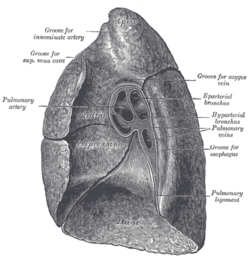
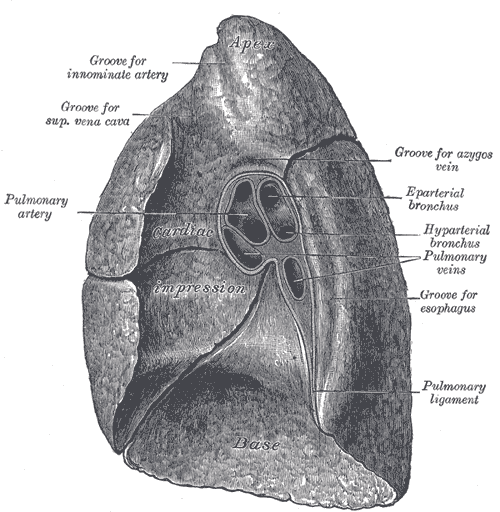
Mediastinal surface of left lung.
Details
Identifiers
Latinradix pulmonis
TA98A06.5.01.016
TA23278
FMA268155
Anatomical terminology

The root of the lung is a group of structures that emerge at the hilum of each lung, just above the middle of the mediastinal surface and behind the cardiac impression of the lung. It is nearer to the back (posterior border) than the front (anterior border). The root of the lung is connected by the structures that form it to the heart and the trachea.[1] The rib cage is separated from the lung by a two-layered membranous coating, the pleura. The hilum is the large triangular depression where the connection between the parietal pleura (covering the rib cage) and the visceral pleura (covering the lung) is made, and this marks the meeting point between the mediastinum and the pleural cavities.

Location

[edit]

The root of the right lung lies behind the superior vena cava and part of the right atrium, and below the azygos vein. That of the left lung passes beneath the aortic arch and in front of the descending aorta; the phrenic nerve, pericardiacophrenic artery and vein, and the anterior pulmonary plexus, lie in front of each, and the vagus nerve and posterior pulmonary plexus lie behind.[1]

Structures

[edit]

Neurovascular

[edit]

The root is formed by the bronchus, the pulmonary artery, the pulmonary veins, the bronchial arteries and veins, the pulmonary plexuses of nerves, lymphatic vessels, bronchial lymph nodes, and areolar tissue, all of which are enclosed by a reflection of the pleura. The chief structures composing the root of each lung are arranged in a similar manner from the front to the back on each side. This means that the upper of the two pulmonary veins are located anteriorly, the pulmonary artery is in the middle, and the bronchus and bronchial vessels are located posteriorly.[1] The arrangement on the two sides is not symmetrical.[2]

Right side: (superior to inferior) eparterial bronchus, pulmonary artery, hyparterial bronchus, and inferior pulmonary vein.[2]

Left side: (superior to inferior) pulmonary artery, main bronchus, and inferior pulmonary vein.[2]

Lymphatic

[edit]

On each hilum, there are hilar bronchopulmonary lymph nodes.

Pulmonary ligament

[edit]

The visceral-parietal reflection surrounding the root of the lung extends downwards from the hilum to near the base of the lower lobe in a sleeve-like fold called the pulmonary ligament. The lower rounded edge of this is sometimes referred to as the inferior pulmonary ligament. At the lower edge of each lung, the pleural layers come into contact with each other, and terminate in a free curved edge. The pulmonary ligaments serve to anchor the larger lower lobes of the lungs in position and prevent potential torsion.

Clinical significance

[edit]

On chest X-ray, hilar enlargement can be due to lymphadenopathy and tumours (tuberculosis, bronchogenic carcinoma, lymphoma, and sarcoidosis), pulmonary hypertension or simply due to increased lung blood flow.[3]

Additional images

[edit]

References

[edit]
[edit]
Revisions and contributorsEdit on WikipediaRead on Wikipedia
from Grokipedia
The root of the lung, also known as the pulmonary hilum, is a triangular, depressed area on the medial (mediastinal) surface of each that serves as the point of attachment for the lung to the and through which key structures enter and exit the . It is located anterior to the T5 through T7 and superior to the cardiac impression on the lung's mediastinal surface. The root consists of a collection of structures including the principal , one , two pulmonary veins, bronchial vessels, lymphatic vessels and nodes, and branches of the pulmonary plexus of nerves, all enclosed within a sleeve of visceral pleura that extends inferiorly as the pulmonary ligament. These components are arranged in a consistent anterior-to-posterior order—veins anteriorly, artery intermediately, and posteriorly (mnemonic: VAB)—facilitating the lung's suspension and vascular, airway, and neural connections to the central . While the overall composition is similar bilaterally, subtle differences exist between the left and right roots due to mediastinal asymmetry. The right root is slightly more vertical and contains the right main (shorter and wider than the left), right positioned more horizontally, and two right pulmonary veins; it lies posterior to the and right atrium. In contrast, the left root is more horizontal, featuring the longer left main , left arching over the left main , and two left pulmonary veins; it is situated below the and anterior to the . The hilum is surrounded by parietal pleura medially, forming a continuous pleural reflection that separates the lung root from adjacent mediastinal structures and helps maintain the of the . This anatomical configuration is critical for efficient and systemic oxygenation, as it bundles the conduits for air, blood, and innervation in a compact pedicle-like formation.

Overview

Definition and Function

The root of the lung, also known as the pulmonary hilum, is defined as the triangular depressed area on the mediastinal surface of each where key structures enter and exit the organ. It serves as the primary site of connection between the lung and the , comprising a bundle of conduits including the main , pulmonary arteries and veins, nerves, lymphatics, and bronchial vessels. This region is enclosed by a of visceral pleura that extends inferiorly as the pulmonary . Functionally, the root anchors the within the , providing its sole point of attachment to surrounding structures and maintaining positional stability during respiration. The bundled structures within the root enable essential physiological processes: the bronchi convey air to the alveoli for oxygenation, while the pulmonary vessels transport deoxygenated blood for and return oxygenated blood to the systemic circulation; supply autonomic innervation to regulate bronchial tone and vascular flow, and lymphatics facilitate drainage of interstitial fluid and immune surveillance. Collectively, these components support the lung's core role in pulmonary ventilation and .

Location and Relations

The root of the lung, also known as the hilum, is located on the medial surface of each , presenting as a wedge-shaped depressed area superior to the cardiac impression and oriented obliquely from the levels of the fifth to seventh (T5-T7). The right root is positioned slightly lower than the left, primarily due to the elevated position of the heart within the . On the right side, the lung root lies posterior to the and right atrium, while being situated inferior to the . In contrast, the left lung root is positioned inferior to the and anterior to the descending , with close adjacency to the phrenic and vagus nerves. These spatial relationships position the lung roots in direct continuity with the , facilitating the transmission of essential structures while maintaining separation from adjacent organs. The root is enclosed by a short tubular extension of the pleura, where the visceral pleura covering the reflects onto the parietal pleura lining the , thereby forming the hilum and establishing a conduit between the mediastinal and pleural cavities. This pleural arrangement anchors the securely within the and prevents direct contact between pulmonary and mediastinal contents.

Anatomical Components

Airway and Vascular Structures

The root of the lung, or hilum, serves as the entry and exit point for key airway and vascular structures that facilitate and blood circulation within the . These structures are arranged in a consistent anterior-to-posterior order: pulmonary veins anteriorly, centrally, and principal posteriorly. This organization is observed on both sides, though subtle asymmetries exist between the right and left lungs due to differences in bronchial and vascular branching patterns. The principal bronchi form the primary airway conduits entering the hilum. On the right side, the right principal bronchus is shorter and more vertical, dividing into three lobar branches: an eparterial branch to the upper lobe (arising superior to the right ) and hyparterial branches to the middle and lower lobes (arising inferior to the artery). In contrast, the left principal bronchus is longer and more horizontal, serving as a direct continuation of the trachea after its bifurcation, with all branches (to the upper and lower lobes) positioned inferior to the left , making them hyparterial. These bronchi are enveloped by peribronchial and rings that maintain airway patency as they penetrate the hilum posteriorly. Pulmonary arteries deliver deoxygenated blood from the right ventricle to the lungs for oxygenation. The right emerges anterior to the right principal at the hilum, coursing horizontally before descending between the intermedius and superior to divide into lobar branches that follow the bronchial tree. The left , larger in diameter, passes superiorly over the left principal before entering the hilum and branching into 2 to 7 upper lobe divisions, with lower lobe branches arising posteriorly. These arteries occupy the central position in the hilar structure, branching into pulmonary arterioles that terminate in alveolar capillaries. Pulmonary veins collect oxygenated blood from the alveolar capillaries and drain it to the left atrium. Typically, one superior and one inferior exists on each side, converging at the hilum in an anterior and inferior position relative to the arteries and bronchi. The superior veins lie most anteriorly, while the inferior veins are positioned more posteriorly within the hilum, forming a total of four veins that empty directly into the left atrium without intermediate confluence in most cases. This anterior placement facilitates their unobstructed return of oxygenated blood. Bronchial arteries and veins provide systemic nourishment to the 's supportive tissues, distinct from the gas-exchange function of pulmonary vessels. Bronchial arteries arise from the descending , with two on the left and one on the right (the latter sometimes originating from the first right posterior intercostal ), entering the hilum to supply the bronchi, pleura, and nodes via an anastomotic network that interconnects with pulmonary arteries. Bronchial veins, accompanying these arteries, primarily drain deoxygenated blood from the parenchyma into the azygos or hemiazygos veins, with a portion shunting into pulmonary veins to contribute to mixed venous return. These vessels are smaller and more variable in number but are essential for maintaining bronchial wall integrity.

Nervous and Lymphatic Components

The nervous components of the lung root primarily consist of the anterior and posterior pulmonary plexuses, which provide autonomic innervation to the lung parenchyma, bronchi, and associated vasculature. These plexuses are formed by parasympathetic fibers from the vagus nerve (cranial nerve X) and sympathetic fibers from the upper thoracic sympathetic chain (segments T1-T5), converging at the hilum to create a mixed network that surrounds the root structures. The anterior pulmonary plexus lies superficially in front of the root, while the posterior plexus is positioned deeper behind it, facilitating the distribution of efferent and afferent fibers for sensory feedback and regulatory functions such as bronchoconstriction (parasympathetic) and bronchodilation (sympathetic). Additionally, the , arising from the C3-C5 , passes anterior to the lung root without direct contribution to the pulmonary plexuses, instead providing somatic motor and sensory innervation to the diaphragm and portions of the adjacent visceral pleura. This positioning separates diaphragmatic control from the intrinsic pulmonary innervation, ensuring coordinated respiratory mechanics. The lymphatic components of the root involve a network of vessels and nodes that ensure unidirectional drainage from the pulmonary periphery toward the , supporting immune surveillance and fluid . Lymphatic vessels form superficial subpleural and deep peribronchovascular plexuses, accompanying the bronchi and pulmonary vessels through the hilum with valves that direct flow centrally and prevent reflux. These vessels collect interstitial fluid from the and transport it to the hilar bronchopulmonary lymph nodes, a group of nodes located at each hilum adjacent to the main bronchi and vessels. From the hilar bronchopulmonary nodes, lymph progresses to the tracheobronchial nodes at the tracheal bifurcation and then to the mediastinal nodes, ultimately joining the bronchomediastinal trunks that empty into the venous system via the or right lymphatic duct. This sequential pathway, with its valve-directed flow, facilitates efficient clearance of antigens and pathogens from the tissue toward central lymphatic processing centers.

Supporting Structures

The visceral pleura envelops the root of the lung, forming a continuous covering over the hilar structures including the bronchi, pulmonary vessels, and nerves, while seamlessly transitioning to the parietal pleura at the hilum. This reflection ensures that the remains sealed as these elements enter and exit the lung, maintaining the integrity of the and facilitating smooth respiratory movements. At the hilum, the pleura extends as sleeve-like bronchovascular sheaths around the bronchi and associated pulmonary arteries and veins, providing a protective enclosure of and serous layers that shields these structures from adjacent mediastinal contents and allows relative mobility during lung expansion and contraction. These sheaths, derived from the of the visceral pleura, extend peripherally along the bronchovascular bundles, supporting the branching pattern without restricting or blood flow dynamics. Inferior to the hilum, the mediastinal pleura reflects upon itself to create the pulmonary ligament, a slender double-layered fold that descends from the inferior aspect of the root to the mediastinal surface of the diaphragm, typically spanning the levels of the fifth to eighth . Composed primarily of two apposed layers of visceral pleura with minimal intervening areolar tissue, the ligament anchors the lower lobe of the to the , thereby preventing torsional displacement during respiratory excursions or positional changes. Additionally, its loose and elastic nature accommodates expansion of the pulmonary veins and allows for increased vascular volume without undue tension on the hilar attachments.

Development and Variations

Embryological Development

The embryological development of the root of the lung, or pulmonary hilum, begins during the fourth week of gestation with the formation of the respiratory as an outpouching from the ventral wall of the . This elongates to form the laryngotracheal tube, from which the trachea arises cranially and the caudally; by the end of week 4, the caudal end of the tube bifurcates into right and left primary lung buds that invade the surrounding splanchnic . These buds grow laterally and caudally into the pericardioperitoneal canals, which later become the pleural cavities, while the concurrent caudal descent and 180-degree rotation of the developing heart—driven by embryonic folding—reorients the lung buds relative to the , establishing the oblique positioning of the future hila. Vascular components of the lung root develop concurrently during the embryonic stage. The pulmonary arteries arise from the sixth pair of pharyngeal aortic arches, which elongate and connect to the dorsal aortas before regressing proximally to form the main pulmonary artery and its branches that encircle the developing lung buds. Pulmonary veins originate from a primitive vascular plexus in the splanchnic mesoderm surrounding the lung buds; initially, multiple channels from this splanchnic plexus drain into the cardinal and umbilicovitelline veins, but by weeks 5 to 7, selective incorporation into the posterior wall of the left atrium results in the four definitive pulmonary veins connecting directly to the heart, defining the venous aspect of the hilum. By the pseudoglandular stage (weeks 5 to 17), bronchial branching morphogenesis establishes the airway framework of the root, with the primary buds dividing into secondary (three on the right, two on the left) and then tertiary bronchi by week 6, forming the 10 bronchopulmonary segments. Pleural separation occurs between weeks 5 and 7, as the visceral pleura (derived from splanchnic mesoderm covering the lung buds) differentiates from the parietal pleura (from somatic mesoderm lining the body wall), with the two layers meeting at the hilum to create a and anchor the root structures via the pulmonary ligament. By the end of fetal month 3 (approximately week 12), these processes—combined with ongoing vascular integration—solidify the positional architecture of the lung root, with major bronchi and vessels entering obliquely through the hilar depression.

Anatomical Variations

The root of the lung exhibits several anatomical variations that can alter its structural composition and positional relationships, primarily arising from deviations in tracheobronchial branching, vascular drainage patterns, and overall thoracic situs. These variations are typically congenital and may influence surgical planning or diagnostic interpretations, though many remain asymptomatic. Bronchial variations in the lung root include anomalies in the tracheobronchial tree, such as the accessory cardiac bronchus and tracheal bronchus. The accessory cardiac bronchus is a rare congenital anomaly originating from the medial wall of the right intermediate bronchus, often ending in a blind pouch, with a reported prevalence of 0.07% to 0.5% in the general population. This variation stems from incomplete resorption of embryonic bronchial buds but does not typically supply functional lung tissue. The tracheal bronchus, also known as a pig bronchus, arises directly from the right lateral tracheal wall above the carina and supplies the right upper lobe, occurring in up to 2% of individuals on the right side, with a lower incidence of 0.1% to 1% on the left. Vascular anomalies affecting the lung root encompass deviations in pulmonary venous and arterial supply. Partial anomalous pulmonary venous return (PAPVR) involves one or more pulmonary veins draining into systemic veins instead of the left atrium, with an overall prevalence of 0.4% to 0.7%; a specific example is the left superior pulmonary vein draining into the left innominate vein, which accounts for approximately 0.5% of cases and represents about 10% of left-sided PAPVR instances. Pulmonary arterial sequestration, where a segment of lung parenchyma receives anomalous systemic arterial supply (often from the thoracic or abdominal aorta) entering at the root without bronchial connection, has a prevalence of 0.15% to 6.4% among congenital pulmonary malformations. Positional shifts in the lung root occur in conditions like totalis and , where thoracic organs are mirrored or the heart is right-sided. In totalis, a rare condition affecting about 1 in 10,000 individuals, the lung roots are reversed such that the left root assumes a higher position analogous to the normal right hilum, altering mediastinal relationships. Similarly, in with , the elevated left root position reflects this mirroring, potentially complicating thoracic procedures.

Clinical and Diagnostic Aspects

Pathological Significance

The root of the lung, or hilum, is a common site for , where enlargement can arise from infectious, inflammatory, or neoplastic processes. In (TB), hilar often features caseating granulomas within the nodes, leading to symptoms such as , , and systemic signs like fever and due to the inflammatory response and potential bronchial compression. This presentation can mimic , as TB nodes may appear as irregular masses on imaging, complicating differentiation without . Malignant causes, particularly from bronchogenic , involve tumor infiltration of hilar lymph nodes, resulting in node enlargement that may cause bronchial obstruction, , and symptoms including dyspnea and recurrent . Vascular pathologies at the lung root significantly impact pulmonary circulation and can manifest with acute or chronic symptoms. Pulmonary embolism (PE) originating from deep vein thrombosis can lodge in the main pulmonary arteries at the hilum, obstructing blood flow and inducing acute right heart strain, with clinical features such as sudden dyspnea, chest pain, and tachycardia; massive PE may elevate pulmonary artery pressure, leading to hemodynamic instability. Chronic thromboembolic disease at this site contributes to pulmonary hypertension, where persistent vascular occlusion and remodeling cause progressive hilar enlargement due to dilated pulmonary arteries, resulting in exertional dyspnea, fatigue, and cor pulmonale. Inflammatory conditions like frequently target hilar lymph nodes, causing non-caseating granulomatous inflammation and bilateral symmetric enlargement, which may be asymptomatic or produce dry cough and fatigue from node pressure on adjacent bronchi. Neoplastic hilar masses, often from primary bronchogenic , can distort bronchial architecture through direct or extrinsic compression, leading to obstructive symptoms such as wheezing, , and post-obstructive infections; these effects arise from tumor growth encasing vascular and airway structures at the .

Imaging and Surgical Considerations

The root of the lung, or hilum, is visualized on posteroanterior (PA) chest X-rays as bilateral hilar shadows primarily formed by the pulmonary arteries, veins, and bronchi, with normal contours appearing as K- or C-shaped structures; the left hilum is typically 1-2 cm higher than the right, and the right descending pulmonary artery measures ≤16 mm in men and ≤15 mm in women, indicating no enlargement. Hilar shadows exceeding these dimensions or showing asymmetry may suggest pathology, prompting further evaluation. Computed tomography (CT) provides detailed assessment of hilar structures, particularly for lymph node evaluation in staging lung cancer, where nodes with a short-axis diameter >10 mm are considered suspicious for malignancy. Magnetic resonance imaging (MRI) is utilized for evaluating pulmonary vascular flow dynamics at the hilum, offering functional insights into perfusion and blood flow without ionizing radiation, especially in cases of suspected vascular anomalies or pulmonary hypertension. In surgical procedures involving the lung root, such as or for early-stage non-small cell , dissection of the hilum requires meticulous isolation of the , veins, and bronchi while preserving critical structures like the to avoid diaphragmatic . (VATS) approaches to hilar minimize tissue trauma compared to open , enabling precise ligation of vessels and bronchi through smaller incisions, with equivalent oncologic outcomes and reduced postoperative pain. Key considerations include the risk of intraoperative bleeding during hilar clamping, a technique used prophylactically to control hemorrhage in complex , which can lead to pulmonary ischemia-reperfusion injury if prolonged beyond 30 minutes. sampling or systematic at the hilum (stations 10-14) is essential for accurate pathologic staging, guiding decisions and improving survival prognostication in resection.

References

Add your contribution
Related Hubs
User Avatar
No comments yet.