Hubbry Logo
Massachusetts Route 2Massachusetts Route 2Main
Open search
Massachusetts Route 2
Community hub
Massachusetts Route 2
logo
8 pages, 0 posts
0 subscribers
Be the first to start a discussion here.
Massachusetts Route 2
from Wikipedia

Route 2 marker
Route 2
Map
Route 2 highlighted in red
Route information
Maintained by MassDOT
Length142.29 mi[1] (228.99 km)
Existed1927, 1971 (current alignment)–present
Major junctions
West end NY 2 at the New York state line
Major intersections
East end Route 28 in Boston
Location
CountryUnited States
StateMassachusetts
CountiesBerkshire, Franklin, Worcester, Middlesex, Suffolk, Norfolk
Highway system
Route C1 Route 2A
Route 6BN.E. Route 8

Route 2 is a 142.29-mile-long (228.99 km) major east–west state highway in Massachusetts, United States. Along with Route 9 and U.S. Route 20 to the south, these highways are the main alternatives to the Massachusetts Turnpike/I-90 toll highway. Route 2 runs the entire length of the northern tier of Massachusetts, beginning at the New York border, where it connects with New York State Route 2, and ending near Boston Common in Boston. Older alignments of Route 2 are known as Route 2A.

Route description

[edit]

Berkshire and Franklin counties

[edit]

Route 2 proceeds east from the New York state line on a winding, scenic path in Berkshire County through Williamstown, where it serves the Williams College area, and through North Adams, where it serves the Massachusetts College of Liberal Arts. East of North Adams, Route 2 ascends via a hairpin turn into the Hoosac Range along what is known as the Mohawk Trail.

Route 2 then enters Franklin County, meeting Interstate 91 at an interchange in Greenfield and briefly runs concurrently with I-91. While the old Route 2 becomes Route 2A and goes through downtown Greenfield, Route 2 joins I-91 in a short concurrency before leaving it and becoming a two-lane freeway. Outside Greenfield, Route 2A temporarily ends and merges with Route 2, and Route 2’s freeway section ends. Route 2 remains a two-lane surface road in Gill and Millers Falls (though it does have an interchange with Route 63). The road in Erving was routed to the north and straightened to avoid the paper mill next to the river. This rerouting led to the road being shortened by less than one-tenth of a mile.

Orange–Cambridge

[edit]

As the route approaches Orange, Route 2A resumes and diverges from Route 2. At this point, Route 2 again becomes a two-lane freeway. In Orange, Route 2 runs concurrently with U.S. Route 202. The road at this point enters the town of Athol in Worcester County. After its eastern interchange in Phillipston when US-202 departs to the north, Route 2 becomes a four-lane freeway, though not to Interstate standards at most points. It continues through Gardner into Fitchburg where Route 2 has several at-grade intersections with Oak Hill Rd, Palmer Rd, Mt. Elam Rd and Abbott Ave. At the intersection with Mt. Elam Rd, a traffic light remains in use on the eastbound side. Continuing east into Leominster, Interstate 190 splits off, heading south to Worcester.

Route 2 continues east to Middlesex County and enters Boston's outer loop at the interchange with Interstate 495 in Littleton. It continues into Acton, where Route 2 reduces its speed to 45 miles per hour, and becomes a four-lane expressway with at-grade intersections. At the Concord Rotary, a major traffic choke point, Route 2 becomes a four-lane surface road and intersects with Route 2A and the eastern terminus of Route 119 (which is concurrent with Route 2A). After the rotary, the road passes by the State Police (who have an emergency-only traffic light) and over the Assabet River. Route 2A formerly broke away from Route 2 at the next traffic light to go left into Concord but is now overlaid with Route 2, where it becomes a four-lane expressway again. At Crosby's Corner, the sixth intersection after the rotary, Route 2A exits under the highway while Route 2 veers right (but still heads east). After a signalized at-grade intersection with Bedford Road in Lincoln, the highway becomes a four-lane arterial road.

Convergence of Routes 2, 3, and 16 in Cambridge.

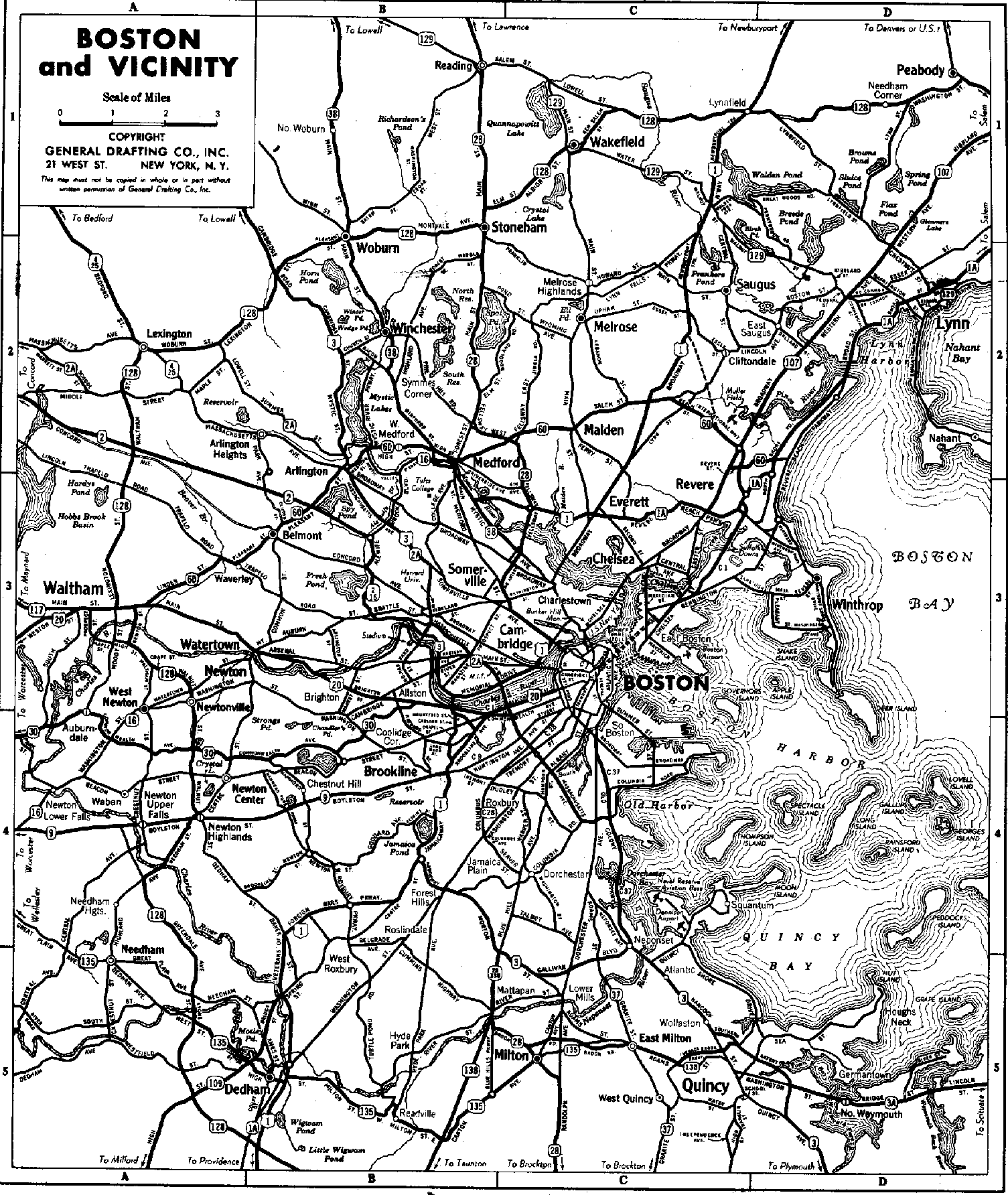
Route 2 enters Lexington and heads to Boston's inner belt, and as it crosses Interstate 95/Route 128, it becomes a six-lane freeway with a speed limit of 55 miles per hour. In Belmont, Route 2 remains a six-lane freeway, and then becomes an eight-lane freeway at Exit 132 (formerly 57) in Arlington, where U.S. Route 3 would have joined it from the north. At Exit 135 (formerly 60), the freeway narrows in width to six lanes. The section of freeway from Route 128 to the Cambridge line meets the standards of an interstate highway.[citation needed] The highway enters Cambridge, the highway reduces its speed limit back to 45 miles per hour and becomes a five-lane freeway (three lanes heading east, two lanes heading west), with a strip of residential and transit-oriented development on its eastbound side, including an off-ramp that serves the MBTA Alewife Station, Cambridge Discovery Park and development to the south and west of the station. After the Alewife exit, the highway narrows again to four lanes.

Cambridge and Boston

[edit]
The shield for Massachusetts Route 2, located across from Boston Common

The highway then meets a large at-grade intersection with Routes 3 and 16, where Route 2 east merges with U.S. Route 3 south and Route 16 and continues as a four-lane, 35 mile per hour arterial road — managed by the Department of Conservation and Recreation — for the rest of its time in Cambridge. Route 2 follows Alewife Brook Parkway and Fresh Pond Parkway along its wrong way concurrency with Routes 3 and 16, before Route 16 heads west into Watertown. Route 2 and Route 3 concurrently start paralleling the Charles River as Memorial Drive, passing by Harvard University’s campus. It then heads southward on the Boston University Bridge into Boston proper, as it separates from Route 3. It winds through the Boston University campus as Mountfort Street and crosses over both the Massachusetts Turnpike and Commonwealth Avenue before heading due east towards Kenmore Square, while running parallel to U.S. Route 20. Immediately east of the Boston University campus, it crosses into Kenmore Square, which is also the eastern terminus of U.S. Route 20. From Kenmore Square, Route 2 follows Commonwealth Ave to Arlington St. It circles the Boston Public Garden, using Arlington, Boylston, and Charles Streets. Route 2 east goes along northbound Route 28 north at the intersection of Charles and Beacon Streets between Boston Common and the Boston Public Garden. As Route 28 north joins Storrow Drive, which shortly after would join Route 3, Route 28 south joins Route 2 and completes the loop around Boston Public Garden.

History

[edit]

The route amalgamates and supersedes various named highways in some cases going back to the pre-automobile era. For example, parts of Route 2 are sometimes known as the Cambridge and Concord Turnpike and the Mohawk Trail.

In the early 1920s, Route 2 was known as New England Interstate Route 7 (NE-7), a major road in the New England road marking system connecting Boston with Troy, New York. NE-7 ran roughly where Route 2A (the original surface alignment of Route 2) does now except near the New York state line. NE-7 used current Massachusetts Route 43, New York State Route 43 and New York State Route 66 to reach Troy. Current Route 2 from Williamstown to Petersburgh was previously numbered as Route 96.

Route 2 connected as a highway in its current right-of-way at Alewife Brook Parkway at some point before 1937.[2]

An upgraded Route 2 was originally planned to continue as Boston's Northwest Expressway (merging with a re-routed U.S. Route 3 at the Arlington-Lexington or Arlington-Cambridge border) to a junction with Interstate 695, the Inner Beltway, but this, along with the Inner Beltway itself, was cancelled in 1970, accounting for the abrupt narrowing at Alewife.[3][4] In place of the highway project, the MBTA Red Line was extended from Harvard to Alewife in the 1980s.[citation needed]

The Leominster to Ayer section opened on July 3, 1953, completing the expressway portion from Westminster to West Concord.[5]

Crosby's Corner intersection

[edit]

This major project has been planned since 1999. The intersection had an average of 90 accidents a year. The project was intended to solve the traffic and safety problems that had long occurred at the Crosby's Corner intersection (junction of Route 2 and 2A) in Concord. The project, which was expected to cost $71.9 million, widened Route 2 from Bedford Rd in Lincoln to 300 feet west of Sandy Pond Rd in Concord. The project eliminated the at grade intersection, realigned Route 2, and constructed new entrance and exit ramps along with new service roads next to Route 2.

The full project included building a new overpass bridge over Route 2 and building multiple service roads next to Route 2. Work also consisted of a new signalized intersection. The project was put out to bid for contractors on September 19, 2011. A contractor was expected to be chosen over the winter and construction was expected to begin in Spring 2012 on the estimated $55 million project.

The Army Corps of Engineers published a notice[6] for this project, because of its impact on wetlands at Crosby's Corner. During the summer of 2012, activity on this portion of Route 2 included surveying and the installation of orange-painted stakes. Signs were added in January 2013 indicating that construction would start on January 14. As of April 2014 the project was underway and predicted completion was spring 2016.[7] The project was completed in 2016, with a large improvement in traffic flow.[citation needed]

Future

[edit]

A project to improve the Concord Rotary, at the convergence of Route 2, Route 2A/119 (Elm Street), Barrett's Mill Road and Commonwealth Avenue, has been in planning since 2003 or even earlier. More than 61,000 cars use this rotary on a typical day, and the backed up traffic can be significant. The improved intersection would include overpasses for local streets, while Route 2 traffic would continue unimpeded at grade. However, the project was removed from the funded portion of the Boston Region Metropolitan Planning Organization's (MPO) Long Range Transportation Plan (LRTP) in August 2009 and is currently on hold.[8]

Major intersections

[edit]

MassDOT was scheduled to replace the old sequential exit numbers with the new milepost-based exit numbers beginning in summer 2020,[9][10] which had been delayed since 2016.[11][12] On March 16, 2021, MassDOT announced that the Route 2 exit numbers would get renumbered for four weeks starting on March 23.

CountyLocation[13]mi[13]kmOld exit[14]New exit[10]DestinationsNotes
BerkshireWilliamstown0.0000.000
NY 2 west – Troy, NY
Continuation into New York
3.8246.154
US 7 south – Pittsfield
Western end of concurrency with US 7
6.22110.012
US 7 north – Pownal, VT, Montreal, Que
Eastern end of concurrency with US 7
6.74610.857
Route 43 south – Hancock, Stephentown, NY
Northern terminus of Route 43
North Adams11.57118.622
Route 8 south – Adams[15]
Western end of concurrency with Route 8
11.74018.894
Route 8A south
Northern terminus of Route 8A "U" segment
12.40519.964
Route 8 north – Clarksburg, Stamford, VT
Eastern end of concurrency with Route 8
FranklinCharlemont29.80747.970
Route 8A south – Hawley, Windsor
Western end of concurrency with Route 8A
30.448.9
Route 8A north – Heath, Jacksonville, VT
Eastern end of concurrency with Route 8A
Buckland37.39060.173
Route 2A east – Shelburne Falls
Former western terminus of Route 2A
37.80660.843
Route 112 south – Buckland, Ashfield
Western end of concurrency with Route 112
Shelburne38.06261.255
Route 112 north – Shelburne Falls, Colrain
Eastern end of concurrency with Route 112
38.94262.671
Route 2A west – Shelburne Falls, Buckland
Former western end of concurrency with Route 2A
Greenfield47.39876.280Western end of freeway section
2643

I-91 south / Route 2A east – Springfield, Greenfield Center
Western end of concurrency with I-91; western terminus of Route 2A
50.13980.6912746
I-91 north – Brattleboro, VT
Eastern end of concurrency with I-91; exit number not signed westbound
50.78981.737 US 5 / Route 10 – Greenfield, Bernardston
51.48082.849Eastern end of freeway section
52.24284.075
Route 2A west – Greenfield Center
Western end of concurrency with Route 2A
Erving57.191.9
To Route 63 – Northfield, Millers Falls
Access via Gateway Drive
57.492.4
To Route 63 – Northfield, Hinsdale, NH
Access via Forest Street
57.792.9
To Route 63 – Millers Falls
Access via Prospect Street
64.865104.390

Route 2A east to Route 78 – Orange, Wendell[16]
Eastern end of concurrency with Route 2A
65.060104.704Western end of limited-access section
Orange66.571107.1361467West River Street – Orange, Lake Mattawa
69.788112.3131570 Route 122 – Orange Ctr, Worcester
70.676113.7421671
US 202 south / Daniel Shays Highway – Belchertown, Athol
Western end of concurrency with US 202
WorcesterAthol75.155120.9501775 Route 32 – Athol, Petersham
Phillipston76.474123.0731877 Route 2A – Athol, Phillipston
79.009127.1531979
US 202 north / Route 2A – Baldwinville, Winchendon, Phillipston
Eastern end of concurrency with US 202
Templeton81.915131.8292082Baldwinville Road – Templeton, Baldwinville
83.459134.3142183 Route 2A / Route 101 – East Templeton, Ashburnham
Gardner86.500139.2082286 Route 68 – Gardner, Hubbardston
87.253140.4202387Pearson Boulevard – Gardner
Westminster89.738144.4192490
Route 140 north / West Main Street – Winchendon, Westminster
Western end of concurrency with Route 140; signed as exits 90A (MA 140 south) and 90B (MA 140 north) westbound[10]
91.764147.6802592
Route 2A / Route 140 south – Westminster
Eastern end of concurrency with Route 140
92.568148.9742693Willard Road / Village Inn RoadEastbound exit only
93.479150.4402794Narrows Road / Depot Road
Fitchburg94.495152.0752895 Route 31 – Fitchburg, Princeton
FitchburgLeominster line96.279154.94629Mount Elam RoadRight-in/right-out connections only
98.007157.7273098Merriam Avenue / South Street
Leominster99.269–
99.278
159.758–
159.772
3199 Route 12 – Fitchburg, LeominsterSigned as exits 99A (MA 12 south) and 99B (MA 12 north) westbound[10]
100.355161.50632100 Route 13 – Leominster, Lunenburg
101.125162.74533101
I-190 south / Mechanic Street – Worcester, Leominster
Northern terminus and exits 19B and 19A on I-190
Lancaster102.429164.84334102Mechanic Street / Harvard StreetExit partially in Leominster
103.497166.56235103
Route 70 south (Lunenburg Road) – Lancaster, Lunenburg
Northern terminus of Route 70
104.917168.84836105Shirley Road – Shirley
106.419171.26537106Jackson Road – Devens, Reserve Forces Training AreaSigned as exits 106A (no public access) and 106B westbound; exit partially in Harvard[10]
Harvard109.348–
109.357
175.979–
175.993
38109 Route 110 / Route 111 – Harvard, AyerSigned as exits 109A (MA 110 south/MA 111 west) and 109B (MA 110 north/MA 111 east)[10]
MiddlesexLittleton113.050181.93639112Taylor Street – Littleton
113.285–
113.317
182.315–
182.366
40113 I-495 – Marlboro, LowellSigned as exits 113A (I-495 south) and 113B (I-495 north);[10] exits 78A and 78B on I-495[17]
Boxborough115.505185.88741115Newtown Road – West Acton, Littleton
Acton117.612189.27842117 Route 27 – Maynard, Acton
118.013189.92443118
Route 111 north – West Acton
Westbound left exit and eastbound entrance; western terminus of concurrency with Route 111
Concord120.465193.870Eastern end of limited-access section


Route 2A west / Route 119 west – Littleton

Route 111 ends
Rotary; western end of concurrency with Route 2A; eastern terminus of Route 119; southern terminus of Route 111
Western end of limited-access section
121.691195.843 Route 62 (Main Street) – West Concord, Maynard, Concord Ctr, BedfordAt-grade intersection
123.901199.399

Route 126 south (Walden Street) to Route 117 – Walden Pond, Waltham
At-grade intersection; northern terminus of Route 126
124.824200.88550125
Route 2A east – Concord, Lincoln
Eastern end of concurrency with Route 2A
Lincoln126.256203.18951Bedford RoadAt-grade intersection; to Route 2A
Eastern end of limited-access section
Lexington128.527206.844Western end of freeway section
52127 I-95 / Route 128 – Attleboro, PeabodySigned as exits 127A (I-95 south) and 127B (I-95 north); exits 45A and 45B on I-95
129.010207.62153128Spring Street – LexingtonNo westbound exit
130.002209.21854129Waltham Street – Lexington, WalthamWestbound exit and eastbound entrance; signed as exits 129A (Waltham south) and 129B (Lexington north)[10]
130.894210.65355130Pleasant Street – LexingtonEastbound exit and westbound entrance
131.435211.52456131Winter Street – BelmontNo westbound exit


Route 4 north / Route 225 west – Lexington, Bedford
No eastbound exit; southern terminus of Route 4; eastern terminus of Route 225
ArlingtonBelmont line131.990212.41757132Dow Avenue – Arlington, Belmont
Belmont132.711213.57858133Park Avenue – Arlington
BelmontArlington line133.690215.15359134 Route 60 – Belmont, Arlington
ArlingtonBelmont
Cambridge tripoint
134.130215.86160135Lake Street – East Arlington
Cambridge134.649216.697 Alewife stationEastbound exit only
134.915217.125Eastern end of freeway section
135.005217.269

US 3 north / Route 16 east (Alewife Brook Parkway) – Medford, Woburn
Western end of concurrency with US 3 / Route 16
136.354219.440
Route 16 west (Huron Avenue) – Watertown, West Newton
Eastern end of concurrency with Route 16
139.280224.149
US 3 south (Memorial Drive)
Eastern end of concurrency with US 3
Charles River139.349224.260Boston University Bridge
SuffolkBoston139.531224.553 US 20 (Commonwealth Avenue) – Brighton, Kenmore Square
Norfolk
No major junctions
SuffolkBoston140.446226.026
US 20 west (Commonwealth Avenue)
Kenmore Square; eastern terminus of US 20
140.881226.726
Route 2A west (Massachusetts Avenue)
Eastern terminus of Route 2A
141.556227.812
Route 28 south (Clarendon Street)
One-way southbound
142.35229.09Beacon StreetEastern terminus
1.000 mi = 1.609 km; 1.000 km = 0.621 mi

See also

[edit]

References

[edit]
[edit]
Revisions and contributorsEdit on WikipediaRead on Wikipedia
from Grokipedia

Massachusetts Route 2 is a major east-west state highway spanning 142.29 miles (228.99 km) across the northern tier of Massachusetts, from its western terminus at the New York state line in Williamstown—where it continues as New York Route 2—to its eastern terminus at the junction with U.S. Route 3 near Alewife in Cambridge. The route traverses diverse terrain, beginning in the rural Berkshires region, passing through cities such as North Adams, Greenfield, Fitchburg, and Leominster, before transitioning into a suburban freeway northwest of Boston. It functions as a key alternative to Interstate 90 (Massachusetts Turnpike) for east-west travel, facilitating commuter and freight movement while avoiding the tolled pike.
Designated in 1927 with its modern alignment solidified by 1971, Route 2 incorporates sections built as early as the 1930s, including bypasses around congested areas like Concord. In its western portions, it aligns with the historic , offering scenic views through mountainous areas, while eastern segments feature limited-access expressway design with interchanges for major routes like , , and Interstate 95/Route 128. The highway has undergone exit renumbering to mile-based standards, with new numbers ranging up to 135 near Lexington. Despite its utility, Route 2 has faced safety challenges, particularly at at-grade intersections and rotaries; for instance, the Concord rotary recorded over 300 crashes and 61 injuries between 2013 and 2019, leading to state-led redesign efforts including restricted crossing U-turns. Local opposition has historically blocked extensions, such as a proposed rerouting through Wendell in the , preserving rural landscapes but contributing to persistent congestion in some segments. Ongoing MassDOT projects focus on pavement preservation, intersection improvements, and multi-modal enhancements across 16 municipalities to address these issues.

Route Description

Western Segment: Berkshire and Franklin Counties

Massachusetts Route 2 enters the state from New York at the Williamstown town line in County, marking the start of its western segment as a continuation of New York Route 2. This rural corridor follows the historic , designated a , winding through the Berkshire Mountains and serving as the principal east-west artery for northwestern communities with limited alternative highway options. In Berkshire County, the route traverses Williamstown, , , Pittsfield, Dalton, Hinsdale, and , characterized by two-lane alignments with occasional passing lanes amid hilly terrain and forest cover. Notable engineering challenges include steep grades and curves, such as the on the eastern descent from the near North Adams, which offers panoramic views but requires cautious navigation due to its sharp radius. Traffic volumes remain modest, averaging under 10,000 vehicles per day in these western Berkshire sections, supporting primarily local residents, agriculture, and seasonal tourism to sites like State Reservation. Transitioning into Franklin County via Windsor and Cummington, Route 2 continues eastward through Plainfield, Hawley, Buckland, and Shelburne, paralleling the Westfield and Deerfield rivers while integrating with local roadways in small villages like Charlemont. A key feature is the three-span continuous steel over the Deerfield River in Charlemont, constructed in 1955 with a 444-foot length to span the valley and accommodate the route's alignment through narrow flood-prone areas. Average daily traffic here drops to approximately 2,000–5,000 vehicles, underscoring the segment's function as a low-volume link for rural connectivity and access to recreational areas like State Forest, rather than regional thoroughfares.

Central Segment: Orange to Cambridge

Route 2 east of Orange follows a primarily two-lane alignment through rural northern Worcester County, traversing Athol with a bypass around the downtown core constructed during the to alleviate congestion in the historic village center. The highway then enters Erving, incorporating the 1932 Montague bypass that reroutes traffic through the western portions of Erving and , including grade-separated crossings such as at Route 63 and the dramatic span of the French King Bridge over the , engineered with styling and opened to traffic in 1931 to improve east-west connectivity while avoiding older toll road alignments. Continuing eastward into Phillipston, Route 2 features a partial interchange with US 202 and Route 2A, facilitating regional north-south access. The route skirts south of Fitchburg before reaching , where it upgrades to a four-lane divided limited-access highway, coinciding with the northern terminus interchange of I-190, which channels traffic from Worcester northward. This configuration supports increasing suburban development and industrial zones, with the corridor serving as a key link between manufacturing hubs and the metropolitan area. Beyond , Route 2 maintains its four-lane profile through Harvard, Acton, and Concord, passing adjacent to the Minute Man National Historical Park, where Battle Road and related Revolutionary War sites are accessible via local connectors like Route 2A, underscoring the highway's proximity to preserved 1775 conflict landscapes without direct traversal. The segment culminates in Lexington, Arlington, and , where rising commuter volumes reflect the transition from rural bypasses to a high-capacity artery integrating with denser residential and employment centers east of the Route 2A historic parallel.

Eastern Segment: Cambridge to Boston Area

The eastern segment of Massachusetts Route 2 extends from the Alewife area in Cambridge eastward through urban parkways to its terminus in Boston, characterized by dense residential and institutional development along the Charles River corridor. West of this segment, Route 2 achieves full freeway standards, but entering Cambridge, it transitions to the Alewife Brook Parkway, a historic parkway multiplexed with U.S. Route 3 northbound and Massachusetts Route 16, featuring partial grade separations and connections to local arterials including the Mystic Valley Parkway. This alignment supports high commuter volumes, with average daily traffic (ADT) on Route 2 near Alewife measured at approximately 53,000 vehicles between 1998 and 2013. Key interchanges in Cambridge include the complex at Alewife Brook Parkway and Route 16, where recent bridge replacements over the MBTA Red Line tunnel have enhanced structural integrity without altering the parkway's limited-access nature. The route passes north of , providing indirect access via nearby arterials like Massachusetts Avenue, amid neighborhoods such as Highlands, before aligning with Soldiers Field Road and Memorial Drive along the . This proximity facilitates urban access but contributes to congestion at signalized intersections and merges, contrasting the freer-flowing central segments. Eastward, Route 2 diverges from Memorial Drive to cross the via the Boston University Bridge, a steel truss structure built in 1927 and carrying an estimated 41,000 vehicles daily into 's Fenway-Kenmore area. The segment lacks direct elevated freeway sections from the , as proposed extensions into were abandoned amid urban opposition, preserving at-grade characteristics integrated with metropolitan infrastructure. While not featuring a dedicated spur to , the route links to 's core network, enabling connections via Route 1A or for airport access. High-traffic conditions persist, with bottlenecks at the BU Bridge and urban entries exacerbating delays in this commuter-heavy corridor.

Engineering and Infrastructure

Design Standards and Construction History

Massachusetts Route 2 originated from pre-1920s local roads that were upgraded to standards, with significant construction in featuring paving for enhanced amid the region's hilly and variable soils. These early pavements provided a stable base capable of handling increased automobile traffic, transitioning from or surfaces common in prior decades. By the 1950s, realignments incorporated bituminous concrete resurfacings over the original concrete foundations to accommodate higher design speeds, including superelevation on curves to counteract centrifugal forces, particularly in the western where sharp turns and grades up to 6%—such as the ascent of Greenfield Mountain—necessitated adaptations for vehicle stability and sight lines. This superelevation followed principles outlined in contemporary directives, banking the roadway cross-section to balance lateral forces without excessive side demands. Lane widths reflect and functional classifications, with 12-foot standard in rural western segments to support wider turning radii for trucks and provide buffer against errant vehicles, contrasting with 11-foot in denser eastern areas to fit constrained rights-of-way while meeting minimum safety clearances. These dimensions align with criteria derived from vehicle tracking widths and operational needs, ensuring compliance with AASHTO policies for horizontal and vertical alignments. The inconsistent divided highway status stems from 1940s state master plans that projected higher traffic densities near population centers, directing limited federal and state funding toward full median separation and controlled access in the east, while western rural portions retained undivided profiles due to lower forecasted volumes and higher construction costs in rugged topography. Guardrails, initially basic concrete barriers in early builds, evolved to meet MUTCD specifications for signage and edge protection, with updates emphasizing crash-tested systems in high-risk curves. Overall, these choices prioritized cost-effective terrain adaptation—favoring shallower cuts and fills in the west—over uniform freeway geometry, reflecting causal trade-offs between engineering feasibility, budget constraints, and projected utilization.

Notable Structures and Interchanges

The bridge carrying Route 2 over the in Buckland and Charlemont (bridge no. B-28-009 = C-05-013) represents a key element in the highway's western segment, spanning a significant prone to flooding and requiring periodic rehabilitation to maintain load-bearing integrity. MassDOT initiated rehabilitation work on this to address deterioration, with design public hearings held in 2019 focusing on preservation measures such as repairs and deck resurfacing. Further east, the Route 2 crossing of the Hoosic River in North Adams (bridge no. N-14-016), known as the Veterans Memorial Bridge, has faced structural deficiencies in its , leading to replacement initiatives aimed at restoring full capacity for heavy vehicular loads. This steel bridge has undergone evaluation for deterioration, with MassDOT approving superstructure replacement in 2023 to prevent further degradation and ensure compliance with modern safety standards. Among interchanges, the Concord Rotary stands out as a high-volume junction where Route 2 meets Routes 2A and 119, configured as a circle that has contributed to elevated crash frequencies, including at least 61 injuries from 2013 to 2019 according to state analyses. This , while facilitating multi-road convergence, has prompted MassDOT studies on capacity constraints and upgrades without altering its core rotary form. The Piper Road-Taylor Road intersection with Route 2 and Route 111 in Acton exemplifies a signalized at-grade crossing targeted for geometric enhancements, including new turning lanes and signals to optimize merge flows and reduce conflict points. Route 2 incorporates interchanges, which feature four ramps connecting to a single signalized or crossroad, offering efficient entry-exit patterns with lower construction costs compared to full cloverleafs; federal safety evaluations indicate generally outperform partial cloverleafs in reducing severe crashes due to fewer weaving sections. Partial cloverleaf elements appear in select locations to handle higher turning volumes, though they introduce loop ramps that can limit sight lines and throughput under peak loads.

History

Origins and Early Bypasses (1920s-1940s)

The , a historic path tracing Native American trade routes along the northern frontier of , served as the primary precursor to Route 2, with significant improvements beginning in the early to accommodate automobiles. In 1914, the Massachusetts legislature designated the improved road from Williamstown to Greenfield as the state's first official scenic tourist route, promoting it to attract motorists amid the growing popularity of auto travel following the widespread adoption of the . This designation capitalized on the trail's picturesque terrain through the and Connecticut Valley, fostering tourism that boosted local economies reliant on visitor traffic. Massachusetts formally established Route 2 as a state-numbered in 1926, aligning it with the Interstate marking system to provide consistent signage across state lines from New York to . The route largely followed the Mohawk Trail's alignment eastward from the New York border through North Adams, Shelburne Falls, and Greenfield, then extending toward and Boston via existing local roads. This numbering reflected the shift from named trails to systematic state highways, driven by increasing vehicle registrations—which rose from under 100,000 in 1910 to over 500,000 by 1925—and the need for reliable east-west connectivity bypassing rail-dependent paths. Early bypasses in the 1930s addressed bottlenecks in rural villages along the western and central segments, rerouting traffic to reduce congestion and eliminate hazardous at-grade crossings where rising auto volumes intersected rail lines and local streets. In 1931, construction of the French King Bridge over the between Erving and enabled a new alignment south of Montague, bypassing the village center and its ferry-dependent crossings, while concurrent bridges around Ervingside village streamlined the Fifth segment. The 1932 completion of the Montague bypass directed Route 2 through the western portions of Erving and , incorporating grade separations at intersections like Route 63 to minimize collision risks from cross-traffic. These projects, funded amid the through state and federal relief efforts, prioritized safety and efficiency for tourist and commercial vehicles, as at-grade rail crossings had contributed to a marked uptick in accidents following the 1920s auto boom.

Postwar Expansions and Realignments (1950s-1970s)

In the postwar era, rising automobile usage and federal highway funding under the Interstate Highway Act of 1956 prompted Massachusetts to upgrade Route 2 for higher speeds and capacity, positioning it as a competitive alternative to the newly opened , which siphoned southern traffic after its 1957 completion but left Route 2 as the principal northern corridor through the and central hills. Realignments emphasized straighter alignments over hilly terrain, reducing curves and grades to support faster travel. Key western improvements included the 1955 construction of a new bridge spanning the Deerfield River in Charlemont, accompanied by realignments to bypass sharp turns and improve sight lines. Similar realignment work occurred around the Florida-Savoy town line that year, facilitating smoother passage through the Mohawk Trail's rugged sections. These efforts added safety and efficiency without substantially extending mileage, focusing instead on modernization of existing paths. Central expansions accelerated with the 1957–1960 development of roughly 12–15 miles of two-lane limited-access highway from eastern Erving through Wendell and Orange to the Route 202 junction, converting former rural roads into divided, controlled-access segments to handle projected freight and tourist volumes. Near Boston, 1960s upgrades introduced freeway standards in segments approaching Cambridge, including partial realignments to integrate with emerging suburban interchanges, though the Crosby's Corner at-grade junction with Route 2A retained its basic configuration amid initial traffic pressures that foreshadowed future overhauls.

Modern Era Challenges and Improvements (1980s-Present)

In the and , Massachusetts Route 2 faced escalating congestion pressures from suburban development and commuter growth without corresponding capacity expansions, as earlier master plans for widening and extensions—such as those envisioned in the postwar era—were curtailed by revolts, including Wendell's successful campaign against a proposed alignment routing the highway through the town center, which preserved rural character but perpetuated bottlenecks. Funding shortfalls at the state level compounded these issues, resulting in deferred maintenance that accelerated pavement deterioration; MassDOT reports from the period highlight how chronic underinvestment in resurfacing contributed to higher long-term repair costs, with regulatory reviews under environmental laws adding years to even routine projects. These hurdles stemmed from causal factors like fragmented local opposition and bureaucratic permitting, prioritizing preservation over throughput in a corridor serving over 50,000 daily vehicles by the late . Incremental fixes dominated responses, including resurfacing initiatives and targeted shoulder additions to enhance recovery lanes amid tight budgets; for instance, short-term projects in the Athol-Orange segment incorporated shoulder widening and centerline barriers to mitigate run-off-road risks without full reconstruction. By the , safety audits drove further upgrades, such as the 2004 Route 2 West Study, which pinpointed high crash concentrations at rotaries and intersections, prompting implementations like the $900,000 Greenfield Rotary overhaul completed in 2008 with added lanes, markings, and signage to improve flow. Guardrail refurbishment efforts, including delineation projects spanning Littleton to Phillipston, addressed erosion and barrier failures through replacement and reinforcement, though business resistance to access modifications—such as proposed left-turn prohibitions—delayed some measures and underscored regulatory friction from stakeholder vetoes over empirical gains. These adaptive, low-cost interventions reflected pragmatic adaptation to sprawl-induced demand but fell short of systemic widening, as environmental and neighborhood concerns repeatedly stalled broader realignments.

Economic and Strategic Importance

Connectivity and Commuter Role

![Massachusetts_Route_2_at_Alewife,_Cambridge.jpg][float-right] Massachusetts Route 2 functions as a key non-tolled east-west highway, connecting rural and manufacturing areas in to the Boston metropolitan region and serving as a primary alternative to the tolled (I-90). This connectivity supports daily worker commutes from locations such as Pittsfield and Fitchburg to tech and biotech employment hubs in and , with empirical traffic data indicating heaviest eastbound flows during morning peak hours (typically 6:00-9:00 AM) and westbound flows during evening peaks (4:00-7:00 PM). The route's role in commuter patterns is evident in its directional volume imbalances, where eastbound morning reflects inbound travel to urban centers and westbound evening indicates outbound returns, alleviating pressure on parallel tolled . By bypassing I-90 tolls, which range from $5.70 to $11.85 for passenger vehicles depending on entry points and can be higher for commercial trucks, Route 2 enables cost reductions for regular commuters and shippers, fostering economic integration between western industrial bases and eastern innovation clusters. In , Route 2 contributes to ' east-west goods movement as part of the state's highway freight network, handling truck-based shipments that avoid Turnpike constraints and supporting regional supply chains without the added expense of tolls. This utility underscores its causal importance in maintaining efficient daily flows of labor and materials, distinct from long-haul interstate reliance, thereby bolstering local economic productivity through reduced operational costs for non-tolled alternatives.

Economic Impacts and Tourism Contributions

Route 2 facilitates access to historic and cultural sites that drive substantial tourism revenue in , particularly through its eastern segment near the and its western extension as the Scenic Byway. Visitor spending at , which aligns with Route 2 in the Concord-Lexington corridor, totaled amounts supporting $102 million in cumulative local economic output and 836 jobs in 2023, with lodging, food, and retail sectors experiencing amplified effects from seasonal influxes. These contributions stem from the park's role in drawing history enthusiasts, whose expenditures create multiplier impacts estimated at 1.5 to 2 times direct spending in nearby communities. In , Route 2's alignment through the enhances connectivity to attractions like in Lenox, accessible via the route's Pittsfield interchange and adjacent highways. The festival generates over $103 million in annual economic impact across , including the , through visitor spending on accommodations, dining, and events that peaks during summer seasons and sustains jobs numbering over 4,000 regionally. This scenic corridor, designated as a byway from North Adams to Millers Falls, promotes fall foliage tours and , contributing to broader state tourism growth where visitor expenditures reached $24.2 billion in 2024. Route 2's bypass configurations have indirectly bolstered local commerce by shielding town centers from heavy through-traffic, preserving pedestrian-friendly historic districts that attract and sustain small businesses in areas like Lancaster, where the Visitors Center on the route welcomes more than 165,000 annual visitors and amplifies regional promotion. Prior to major postwar realignments, the route functioned as a primary for early automobile heading west, laying groundwork for enduring multipliers observed in modern data.

Safety and Operational Analysis

Traffic Patterns and Congestion Data

Massachusetts Route 2 exhibits significant variation in average daily traffic (ADT) across its length, reflecting its transition from rural western segments to urban commuter corridors in the east. In the western County portions, ADT generally ranges from 10,000 to 20,000 vehicles, based on historical counts from data adjusted for seasonal factors by MassDOT. Central segments, such as near Fitchburg and Acton, see higher volumes of 30,000 to 50,000 vehicles per day, serving regional travel between Worcester County and County. Eastern sections approaching Lexington and Concord experience the highest loads, with two-way ADT exceeding 39,000 vehicles as recorded west of the Concord Rotary in 2008, though subsequent counts indicate sustained or elevated levels due to commuter demand. Traffic patterns on Route 2 are dominated by bidirectional commuter flows, with eastbound volumes peaking in the morning hours (typically 7-9 AM) toward Boston-area employment centers and reversing to westbound dominance in the afternoon (3-7 PM), comprising up to 10% of daily totals in observed peak hours near Concord. Bottlenecks at the Concord Rotary and Lexington interchanges exacerbate these patterns, where peak-hour flows can approach 3,000 vehicles in either direction. MassDOT's automated traffic recorders (ATRs) provide historical benchmarks, while from integrated sensors and partnerships like enable comparisons showing consistent diurnal surges tied to work and school schedules. Post-COVID traffic volumes on Route 2 have increased by approximately 20-30% from lows, aligning with broader trends of rebounding congestion as declined by 2023, pushing volumes toward or above pre-2020 baselines in suburban corridors. For instance, westbound segments between Concord and Acton saw PM peak travel times extend by 30-50% from 2018 levels by 2024, with midweek delays reaching 12 minutes for short spans. Eastern endpoints like Alewife Brook Parkway, contiguous with Route 2, report up to 14 hours of daily congestion, underscoring persistent peak-period pressures monitored via MassDOT's statewide network.

Accident Statistics and Causal Factors

Massachusetts Route 2 has been associated with elevated crash rates at specific locations, particularly eastern interchanges and rotaries, where data from MassDOT identifies persistent hotspots. The Concord rotary, for example, recorded crashes causing at least 61 injuries between 2013 and 2019, positioning it as the most hazardous Route 2 intersection in state analyses due to frequent merging conflicts and multi-vehicle collisions. Similarly, intersections like Route 2 at Taylor and Piper Roads in Acton have been flagged as high-crash areas in road safety audits, with patterns of T-bone and rear-end incidents linked to inadequate sight lines and ramp configurations. These sites underscore a concentration of risks in the more urbanized eastern corridor, where traffic density amplifies design vulnerabilities over the route's full 150-mile span. Causal analysis from MassDOT safety studies reveals that intersection-related factors, including rotaries with limited capacity and abrupt merges, contribute substantially to incidents, often involving failure-to-yield or sideswipe maneuvers rather than primary attributions to excessive speed alone. In western segments, curvilinear geometry through hilly terrain promotes single-vehicle run-offs, where superelevation deficiencies and roadside hazards exacerbate deviations from intended paths, independent of intent. While behaviors such as or impairment feature in reports, empirical breakdowns prioritize infrastructural contributors—like insufficient deceleration zones at exits—that create conditions for errors, challenging narratives overemphasizing behavioral enforcement without addressing geometric constraints. Multi-vehicle pileups, as in a 2025 Phillipston incident involving a , highlight how sudden stops from capacity overloads propagate rear-end chains. Targeted interventions post-audit have demonstrated efficacy in mitigating these factors; for instance, crash comparison analyses following safety projects on Route 2 segments show reduced incident frequencies attributable to enhanced , barrier additions, and ramp realignments, validating investments in causal remediation over generalized speed-focused measures. Such data-driven adjustments yield measurable declines in high-risk collision types, emphasizing design refinements as key to long-term risk reduction along the corridor.

Controversies and Criticisms

Opposition to Expansions and Infrastructure Upgrades

In the late and early , plans for the Inner Belt Expressway, an eight-lane highway intended to connect to Route 2 in the Cambridge-Somerville area, faced intense opposition from community activists concerned about neighborhood destruction, displacement of thousands of residents, and urban disruption. This project, part of broader interstate expansions, was ultimately canceled in 1972 following protests including a 1969 State House demonstration attended by over 2,000 people, reflecting a national wave of "highway revolts" prioritizing community preservation over traffic capacity gains. More localized resistance emerged during a 2013 overhaul project in the Arlington-Lincoln stretch, where protested the removal of trees and buffers, arguing it exposed homes to increased headlights, , and visual intrusion from the . The initiative aimed to add lanes and shoulders for safety amid chronic congestion, but abutters described the environmental and quality-of-life impacts as disproportionate, with greater-than-expected tree loss amplifying concerns over and aesthetic degradation. Opposition has intensified in recent years amid climate priorities, as seen in public feedback on the Massachusetts Department of Transportation's (MassDOT) Route 2 Corridor Study, released in June 2024 for the Fitchburg-to-Concord segment spanning 16 communities. The study identifies high-crash zones like the Concord rotary—deemed Route 2's most dangerous intersection—and proposes enhancements including potential lane additions for congestion relief and multi-modal improvements. Critics, including environmental advocates, submitted comments through the July 25, 2024, deadline decrying widening as exacerbating emissions and , where added capacity draws more vehicles without net congestion reduction. Proponents counter that upgrades address verifiable safety deficits, with the corridor logging elevated accident rates in congested areas, and short-term analyses projecting travel time reductions of up to 20% in peak periods through smoother flow. Lifecycle assessments of similar widenings indicate initial emissions dips from idling cuts—potentially offsetting construction impacts via efficiency gains—but long-term vehicle miles traveled (VMT) increases often negate these, fueling debates over habitat preservation versus economic costs of delays estimated at millions annually in lost productivity. Public input revealed a divide, with some favoring targeted infrastructure for commuter reliability while others prioritize alternatives like rail enhancements to curb sprawl.

Eminent Domain Disputes and Community Effects

During the construction of the Route 2 bypass in Concord in the 1930s, the Department of Public Works initiated land takings as early as 1933 to acquire rights-of-way for the approximately 4.5-mile four-lane highway segment along the town's southern margin. These takings affected agricultural properties, including portions of Allen Farm, Intervale Farm, and Old Brooks Farm, displacing farming operations and requiring the razing of structures such as Charlie Emerson's house. Community disruptions were compounded by construction-related flooding in March 1936 near the Sudbury River crossing, which impacted local residents and delayed progress. In the mid-20th century expansions, similar actions facilitated realignments through rural and semi-rural areas west of , converting farmland into highway corridors and fragmenting remaining parcels, though specific parcel counts for Route 2 remain undocumented in beyond individual case mentions. These acquisitions, conducted under Chapter 79 of Massachusetts General Laws, provided compensation to owners based on appraised at the time, but often led to relocation challenges for farm families reliant on contiguous land holdings. More recent projects, such as the Route 2 improvements completed in Lincoln around 2017, involved takings of several private houses to widen the roadway and construct new access roads like Emerson Road and Red Maple Lane. In Concord, the ongoing rotary reconstruction at the Route 2/2A intersection has required partial land takings from historic properties, including the National Register-listed Dr. John Cuming House, balancing infrastructure needs against preservation concerns through state environmental reviews. No major lawsuits over these takings in Acton or Lincoln were resolved in court records, but negotiations with property owners preceded forced acquisitions where voluntary sales failed. These eminent domain actions have drawn critiques for prioritizing state transportation goals over individual property rights, contributing to community fragmentation by bisecting neighborhoods and reducing local cohesion in towns like Concord and Lincoln. However, post-construction data from comparable highways indicate that improved access correlated with property value increases of 10-20% in adjacent areas within five years, as enhanced connectivity spurred suburban development and commercial growth offsetting initial displacements. Relocation assistance under state law mitigated some human impacts, though empirical studies highlight persistent socioeconomic strains on displaced rural households.

Future Developments

Ongoing Projects and Recent Initiatives

The (MassDOT) is conducting the Route 2 Corridor Study, a conceptual planning effort spanning from Fitchburg to Concord, to assess existing conditions and recommend enhancements for traffic flow, safety, and multi-modal accommodations across 16 municipalities. Completed in June 2024, the study proposes widening Route 2 to three lanes in each direction in select segments, along with ramp improvements and intersection modifications, and remains open for public input to inform future implementation. At the Piper Road and Taylor Road intersection with Route 2 and Route 111 in Acton, MassDOT advanced design work in 2025, presenting an updated concept at a June 25 public meeting to enhance mobility, reduce delays, and improve safety through new traffic signals, adjusted roadway geometry, and a . The project, focused on and signal upgrades, is in the phase with construction targeted for 2030. Upgrades to the Concord Rotary, where Routes 2, 2A, and 119 intersect, are in the design phase as part of broader corridor improvements, addressing its identification as the corridor's highest-risk location with an average of 51 crashes annually. The effort includes major widening and reconstruction to mitigate traffic conflicts, building on study recommendations for signalized options or flow adjustments. Pavement preservation along Route 2 in Acton, Boxborough, and Littleton entered in 2024, accelerated from prior plans, involving resurfacing of non-interstate segments with a budget of approximately $7.56 million funded through the National Highway Performance Program. This initiative targets maintenance to extend roadway life amid ongoing usage demands.

Proposed Expansions and Long-Term Challenges

The (MassDOT) has proposed widening Route 2 from two to three lanes in segments through Concord and Lincoln as part of its Route 2 Corridor Study, which evaluates conceptual improvements between Fitchburg and Concord to address capacity constraints and improve safety at interchanges like the Concord Rotary. These expansions aim to accommodate growing commuter traffic from northwestern communities to , where current bottlenecks contribute to delays averaging 20-30 minutes during peak hours in the studied corridor. Parallel to highway enhancements, advocates for the Northern Tier Passenger Rail Restoration Project seek to revive service along tracks shadowing Route 2, connecting North Adams through Fitchburg to with new stops to reduce reliance on automobiles and lower from regional travel. This integration could shift up to 10-15% of Route 2 commuters to rail, based on similar East-West Rail projections, thereby easing highway congestion while aligning with ' Global Warming Solutions Act targets for transportation sector decarbonization. Funding these initiatives faces persistent shortfalls, with state transportation revenues strained by flat gas tax growth and competing demands, prompting 2017 legislative proposals like Senator Thomas McGee's bill to impose electronic tolls on non-tolled highways including portions of Route 2 east of Interstate 495. Environmental reviews under the Massachusetts Environmental Policy Act often extend timelines by 5-10 years for corridor projects, inflating costs and deferring benefits like reduced productivity losses estimated at $500 million annually from regional congestion. Pro-growth advocates argue such yields net economic gains through faster goods movement and access, outweighing anti-sprawl concerns that prioritize over expanded capacity, as evidenced by stalled federal for Route 2-adjacent rail due to regulatory hurdles.

References

Add your contribution
Related Hubs
User Avatar
No comments yet.