Hubbry Logo
Russia DayRussia DayMain
Open search
Russia Day
Community hub
Russia Day
logo
8 pages, 0 posts
0 subscribers
Be the first to start a discussion here.
Russia Day
Russia Day
from Wikipedia

День России
Russia Day
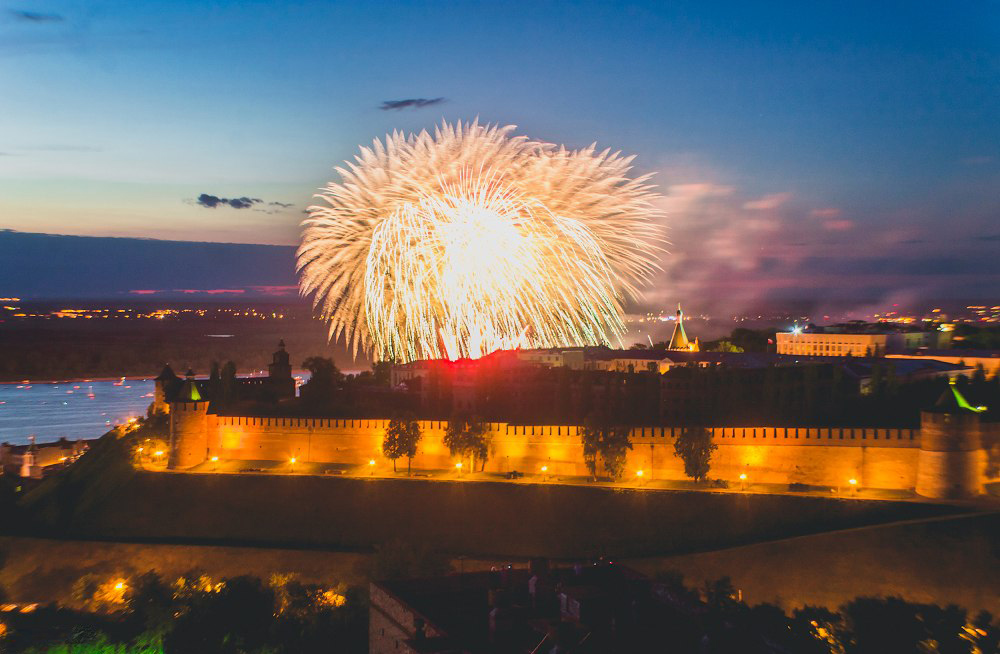
Fireworks during celebrations in Nizhny Novgorod Kremlin, 2015
Observed byRussians
TypeNational Day
CelebrationsFlag hoisting, parades, fireworks, award ceremonies, singing patriotic songs and the national anthem, speeches by the President, entertainment and cultural programs
Date12 June
Next time12 June 2026 (2026-06-12)
FrequencyAnnual
Related toDeclaration of State Sovereignty of the Russian Federation

Russia Day (Russian: День России, romanizedDen' Rossii) called Day of adoption of the Declaration of State Sovereignty of RSFSR (Russian: День принятия Декларации о государственном суверенитете РСФСР, romanizedDen' prinyatia Declaratsii o gosudarstvennom suvernitete RSFSR) before 2002, is the national holiday of Russia. It has been celebrated annually on 12 June since 1992;[1] the day commemorates the adoption of the Declaration of State Sovereignty of the Russian Soviet Federative Socialist Republic (RSFSR) on 12 June 1990. The passage of this Declaration by the First Congress of People's Deputies marked the beginning of constitutional reform in the Russian Soviet state, culminating in outright independence in 1991.

Etymology

[edit]

According to some surveys, many Russians think that this holiday is Russia's Independence Day, but the holiday has never had such a name in official documents. According to the survey of Levada Center in May 2003, 65 percent of the respondents named the holiday as the Independence Day of Russia.[2]

History

[edit]

With the creation of the post of the President of the Russian Federation and the adoption of the new Russian Constitution to reflect the new political reality, the national flag, anthem, and emblem of the Russian Federation were major landmarks in the consolidation of Russian statehood. The country's new name, the Russian Federation, was adopted on 25 December 1991. In 1992, the Supreme Soviet of Russia proclaimed 12 June as a national holiday.[1] By presidential decree on 2 June 1994, the date was again proclaimed Russia's national holiday. Under a subsequent presidential decree on 16 June 1998, the holiday was officially named "Russia Day". In 2002, the new Labour Code gave its official seal to this title.

Russia Day celebrations in Saint Petersburg, 2007.

In 2019, the self-proclaimed Donetsk People's Republic proclaimed Russia Day a "state holiday".[3]..

Customs

[edit]

People may attend concerts and fireworks that take place in many cities throughout the country. Prominent Russian writers, scientists and humanitarian workers receive State Awards from the President of Russia on this day. Most public offices and schools are closed on 12 June. If the day falls on a weekend, the public holiday shifts to the following Monday.[citation needed]

However, many Russians see Russia Day only as a day off. As it commemorates the Soviet Union's dissolution, it brings back bitter memories for some. This is because the dissolution coincided with severe unemployment, high crime and poverty within Russia and other former Soviet republics.[4]

In 2002, about 5000 representatives from across the country took part in the pageantry from Tverskaya Zastava to Manezh Square. The highlight of the Day of Russia-2003 was the air show, which included aerobatic teams "Russian Knights" and "Swifts". Sukhoi and MiG planes left a trail forming the Russian flag. On 12 June 2004 at Red Square a historical military parade was held. Its members, soldiers of the Russian army and representatives of 89 regions, dressed in national costumes, presented the audience the most significant milestones of Russian history. In 2007 celebrations occurred in a hundreds of cities. For example, in Krasnoyarsk action thousands of people in white, blue and red robes formed more than a kilometer long tricolor.[5]

Russia Day in 2008 was celebrated for three days from 11 to 14 June. In Tomsk a "Wooden Carnival" displayed a huge wooden Russian ruble, one hundred times the size of the coin. In Samara enthusiasts reconstructed forces of Minin and Pozharsky in 1612 with Polish–Muscovite War.[5] In Moscow, the holiday included a three-hour concert and concluded a six-month contest over the "Seven Wonders of Russia". In Red Square 20 lines of stage pyrotechnics, confetti cannon in the colors of the Russian flag and 100 guns.[6]

In 2009 residents of Volgograd formed a map of the country covering 127 square meters. In Sevastopol, youths passed through the city center carrying a 30-meter flag of Russia. In Moscow, at Revolution Square that day a two-meter Khokhloma doll was painted. For the first time at the Ostankino Tower the state flag was displayed.[5]

References

[edit]
[edit]
Revisions and contributorsEdit on WikipediaRead on Wikipedia
from Grokipedia
Russia Day is the national holiday of the Russian Federation, observed annually on to commemorate the adoption of the Declaration of State Sovereignty of the by the First Congress of People's Deputies on that date in 1990. This declaration asserted the republic's supreme authority over its territory and laws, marking a pivotal step toward from the Soviet and contributing to the USSR's eventual dissolution in 1991. The holiday was instituted in 1992 as the Day of Adoption of the Declaration of State Sovereignty of Russia and officially renamed Russia Day in 2002 to emphasize national unity and statehood rather than separatist connotations. On June 12, 1991, the same date, was popularly elected as Russia's first president, further embedding the day in the narrative of post-Soviet . Official observances include presidential addresses, award ceremonies for labor heroes, and public events such as concerts, , and military demonstrations in major cities, fostering patriotic sentiment and reflection on Russia's historical transformations. While celebrated as a symbol of and democratic beginnings, the holiday has faced criticism for its ambiguous ties to the Soviet breakup, with some viewing it as insufficiently representative of deeper Russian identity or imperial heritage, though state narratives prioritize its role in establishing modern Russian institutions.

History

Origins in the Late Soviet Period

In the late 1980s, Mikhail Gorbachev's policies of perestroika and glasnost unleashed centrifugal forces within the Soviet Union, encouraging republics to assert greater autonomy amid economic stagnation and political liberalization. This period saw the emergence of a "parade of sovereignties," beginning with the Baltic states in 1988–1989, as union republics sought to redefine their relationship with the central Soviet government in Moscow. Russia's own sovereignty movement gained momentum following Boris Yeltsin's dismissal from the Politburo in 1987 and his subsequent rise as a critic of Gorbachev, culminating in his election to the Congress of People's Deputies of the USSR in 1989, where he advocated for Russian interests. Elections to the Russian Congress of People's Deputies occurred between March 4 and April 1, 1990, marking the first competitive polls in the RSFSR under partially reformed Soviet electoral laws, which allowed independent candidates and reduced dominance in some districts. The movement, a loose coalition of reformers, played a key role in supporting anti-establishment candidates, including Yeltsin, who won overwhelmingly in . On , 1990, the inaugural session of the Congress elected Yeltsin as Chairman of the of the RSFSR with 535 votes out of 1,061, positioning him to lead efforts toward Russian autonomy. The First Congress convened in Moscow from May 28 to June 12, 1990, where delegates debated sovereignty amid growing inter-republic tensions and the USSR's New Union Treaty proposals. On June 12, 1990, the Congress adopted the Declaration of State Sovereignty of the Russian Soviet Federative Socialist Republic by a vote of 907 to 13, proclaiming the RSFSR a sovereign state formed by its peoples, with supreme authority vested in its constitution and laws taking precedence over conflicting Soviet Union legislation. The document also asserted ownership of natural resources, economic independence, and the right to determine foreign policy, framing sovereignty not as outright secession but as a rebalancing of powers within the federation. This declaration, the sixth in the sovereignty parade, intensified conflicts with the central authorities and laid the groundwork for Russia's eventual dominance in the USSR's dissolution.

Establishment as a National Holiday

Russia Day commemorates the adoption of the Declaration of State Sovereignty of the (RSFSR) on June 12, 1990, by the First Congress of People's Deputies of the RSFSR, which asserted the republic's supremacy of its laws over Union-level legislation and laid groundwork for its independence from the . This declaration, signed under as RSFSR leader, marked a pivotal step in the dissolution of the USSR, prioritizing Russian and economic control. Following the Soviet Union's collapse and the RSFSR's renaming to the Russian Federation in December 1991, June 12 was designated a on June 11, 1992, via Decree No. 2981-I of the of the Russian Federation, establishing it as a day of remembrance for the 1990 sovereignty act. On September 25, 1992, the holiday received its initial official name: Day of Adoption of the Declaration of State Sovereignty of Russia, reflecting the post-Soviet emphasis on national amid economic turmoil and political under President Yeltsin. President Yeltsin further formalized its status as a national holiday through Decree No. 1113 on June 2, 1994, explicitly naming it the Day of Adoption of the Declaration of State of the and designating it a non-working day to honor the sovereignty milestone that preceded full . This decree aligned with Yeltsin's broader efforts to consolidate Russian statehood, including the 1993 resolution, by institutionalizing June 12 as a symbol of continuity from Soviet-era republican autonomy to federal sovereignty. underscored a causal link between the 1990 declaration—driven by ethnic and economic grievances against central Soviet policies—and the emergent Russian state's need for foundational legitimacy.

Evolution During the Yeltsin and Putin Eras

During Boris Yeltsin's presidency from 1991 to 1999, the holiday commemorating the June 12, 1990, Declaration of State Sovereignty of the (RSFSR) was formalized as a symbol of Russia's emergence as an independent democratic state separate from Soviet communist control. The first designated June 12 as a via on June 11, 1992. Yeltsin elevated its status on June 2, 1994, through presidential No. 1118, establishing it as a off named the "Day of the Adoption of the Declaration of State Sovereignty of the RSFSR," intended to mark the beginning of Russia's sovereign path and rejection of centralized Soviet authority. Celebrations remained modest and regionally varied, often limited to official speeches and small gatherings, amid the 1990s economic crisis, peaking at 2,500% in 1992, and political turmoil including the 1993 , which underscored the holiday's ties to Yeltsin's reformist, pro-Western vision. In late 1998, as Yeltsin's term waned amid declining popularity and health issues, he proposed renaming the holiday "Russia Day" to broaden its appeal beyond the specific 1990 declaration, aiming to cultivate national pride detached from partisan associations with his sovereignty push. This reflected efforts to stabilize national identity during a period of oligarch influence and NATO expansion, with Russia's GDP contracting by about 40% cumulatively from 1991 to 1998. However, the renaming was not immediately enacted into federal law, leaving the holiday's observance transitional at the end of Yeltsin's era. Vladimir Putin's ascension in 2000 marked a shift toward centralizing and reinterpreting the holiday, with federal law No. 7-FZ on February 1, 2002, officially designating it "Russia Day" and embedding it in the Labor Code as a fixed national holiday. Under Putin, celebrations expanded significantly, incorporating state-orchestrated events such as flag-raising ceremonies, military salutes in major cities, mass concerts on , and fireworks displays, with participation growing to millions annually by the ; for instance, the 20th-anniversary events drew over 1 million attendees in alone. This evolution emphasized Russia's historical continuity and unity across eras, rather than the 1990 break from the USSR, aligning with Putin's "" framework and narratives of restoring state power post-1990s chaos, as evidenced by GDP growth averaging 7% yearly from 2000 to 2008. Putin has publicly framed the day as embodying the "inextricability of the thousand-year history of Russian statehood," downplaying anti-Soviet connotations amid rising for Soviet achievements, with polls showing only 44% associating it with by 2009. The Putinite emphasis on spectacle and patriotism transformed Russia Day into a de-politicized "summer festival," with regional adaptations like folk festivals and youth patriotic programs, contrasting Yeltsin's era by integrating it into broader efforts to consolidate vertical power structures, including the 2000 creation of federal districts. Critics from liberal circles, such as former dissidents, contend this diluted the holiday's original sovereignty focus, substituting it with state-centric symbolism that avoids confronting the USSR's dissolution as a rupture, though official narratives prioritize empirical continuity in Russian territorial and cultural identity.

Significance and Symbolism

Declaration of Sovereignty and Sovereignty Claims

The Declaration on the State Sovereignty of the (RSFSR) was adopted on June 12, 1990, by the First Congress of People's Deputies of the RSFSR, marking a pivotal assertion of amid the Soviet Union's unraveling under Mikhail Gorbachev's reforms. This document, drafted in the context of a "parade of sovereignties" where other Soviet republics like had already proclaimed similar declarations, positioned the RSFSR—then the largest and most populous union republic—as a sovereign entity with priority for its own laws and constitution over those of the USSR. The declaration explicitly outlined the RSFSR's sovereignty claims, beginning with the assertion that "the RSFSR is a created historically by the peoples combined therein," and enumerated including of its political, economic, and social development; ownership of natural resources, industrial and agricultural production, and banks; and the establishment of its own , taxes, and foreign economic relations. It further claimed over its , , and , as well as the right to form its own armed forces and intelligence services, while stipulating that RSFSR laws would take precedence in cases of conflict with Union . These provisions effectively challenged the centralized power of the Communist Party of the (CPSU), enabling the RSFSR to negotiate treaties with other republics and pursue economic independence, such as through the creation of its own and plans. While the declaration acknowledged respect for the USSR's sovereignty and the rights of other republics, it reserved the RSFSR's right to secede via a future treaty, a clause that foreshadowed the USSR's dissolution. Boris Yeltsin, who had been elected chairman of the Supreme Soviet of the RSFSR days earlier on May 29, 1990, championed the measure, framing it as essential for democratic renewal rather than outright separation at the time. This sovereignty framework facilitated subsequent events, including the RSFSR's refusal to recognize the August 1991 coup against Gorbachev and its role in the Belavezha Accords of December 1991, which formally ended the USSR and elevated Russia as its legal successor state. The claims were not immediately enforced as full independence but provided the legal and political basis for Russia's emergence as a sovereign federation, influencing its post-Soviet constitution adopted in December 1993.

Role in National Identity and Patriotism

Russia Day functions as a central platform for cultivating and in , emphasizing the country's and historical resilience. Officially commemorating the adoption of the Declaration of State Sovereignty on June 12, 1990, the holiday has been reframed under President to symbolize civic unity, freedom, and pride in Russian achievements, moving away from its original connotations of independence from the . In his 2004 speech at Russia Day celebrations, Putin highlighted the holiday's alignment with "values of , freedom and democracy," positioning it as a foundation for modern Russian statehood. Subsequent addresses, such as in 2016, have reinforced this by praising citizens' "civic, labour and feats" as sources of national pride. This narrative integrates Russia Day into a broader state ideology that promotes loyalty to the motherland and collective identity over regional or ethnic divisions. Public observance reinforces these themes through nationwide events like concerts, , and award ceremonies that evoke emotional attachment to national symbols. A 2019 VCIOM survey found that 20% of associated Russia Day with pride in the , while 14% cited national unity as a key source of pride, reflecting its role in fostering a sense of shared purpose. These celebrations, often featuring the tricolor and hymns, aim to instill from an early age, with educational programs linking the holiday to Russia's path toward and prosperity. By 2024, amid heightened geopolitical tensions, the day has increasingly underscored defensive , portraying Russia as a bulwark against external threats, which aligns with polls showing 94% of identifying as patriots. While state media and official rhetoric present Russia Day as a unifying force embodying civil peace and mutual respect among citizens, its promotion of a centralized has drawn scrutiny for prioritizing state-centric over pluralistic interpretations of . Analysts observe that the holiday's evolution reflects efforts to construct a cohesive identity rooted in claims and historical continuity, potentially sidelining narratives of Soviet-era grievances. This approach, evident in Putin's recurring emphasis on securing through patriotic resolve, contributes to a meta-narrative where national pride is tied to support for policies.

Comparisons to Other National Days

Russia Day bears resemblance to other national holidays that commemorate foundational declarations of sovereignty or independence from a supranational entity, most notably the United States' Independence Day on July 4, which celebrates the Continental Congress's adoption of the Declaration of Independence in 1776, asserting separation from British rule. In parallel, Russia Day marks the Russian Soviet Federative Socialist Republic's (RSFSR) Declaration of State Sovereignty on June 12, 1990, which asserted primacy of Russian laws over Soviet ones and laid groundwork for the USSR's eventual dissolution in December 1991. Both events represent pivotal assertions of autonomy—America's from colonial oversight and Russia's from centralized Soviet control—but differ in outcome and emphasis: the U.S. declaration directly precipitated war and nation-founding, whereas Russia's sovereignty claim preserved the RSFSR's dominant role within the dissolving union, positioning it as the USSR's legal successor state. Unlike the U.S. holiday's revolutionary connotations and mass public spectacles, such as fireworks displays attended by millions and evoking armed struggle, Russia Day's observances are more restrained and state-centric, featuring military in 's , free concerts, and regional fireworks, but without overt anti-Soviet rhetoric following its 2002 rebranding from "Independence Day" to emphasize national unity over separation. This shift reflects causal priorities in post-Soviet identity: while American celebrations reinforce rupture from the metropole, Russian ones prioritize continuity of statehood, as the 1990 declaration did not immediately sever ties but initiated leading to the Belavezha Accords. Attendance at central events, like the 2023 Moscow drawing over 10,000 participants, underscores official rather than grassroots festivity, contrasting with the decentralized, civilian-driven U.S. barbecues and picnics that engage broader populations. Comparisons extend to other post-communist sovereignty holidays, such as Slovenia's Sovereignty Day on , which honors the 1991 withdrawal of Yugoslav forces after a brief independence war, mirroring Day's focus on legal and territorial assertion over military triumph. Similarly, Argentina's National Sovereignty Day on November 20 commemorates 1845 Anglo-French naval withdrawal from the , symbolizing resistance to foreign intervention rather than internal separation, akin to Day's of reclaiming decision-making from Moscow's Soviet overlay. However, Day uniquely navigates successor-state dynamics, avoiding full endorsement of USSR breakup—evident in its lower public resonance compared to 's (), which mobilizes greater sentiment through victory symbolism—highlighting how national days encode selective historical causal chains rather than comprehensive independence timelines.

Observance and Customs

Official National Events

The President of Russia traditionally presents state awards, including the golden medals "Hero of Labor of the Russian Federation" and recipients of state prizes, during a ceremony in the Georgievsky Hall of the Grand Kremlin Palace on June 12. This event honors individuals for exceptional contributions in labor, science, culture, and other fields, with the 2024 ceremony recognizing 18 Hero of Labor medalists and state prize winners across categories such as education, healthcare, and technology. The awarding underscores the holiday's emphasis on national achievement and continuity of state recognition established since the early 2000s. Public festivities center on Red Square in Moscow, featuring large-scale concerts, performances by artistic ensembles, and flag-raising ceremonies accompanied by the national anthem. These events draw thousands of attendees and are broadcast nationally, promoting unity through cultural displays rather than military parades, distinguishing Russia Day from Victory Day observances. The program typically culminates in an evening fireworks display over the Moskva River, visible from central locations and symbolizing celebratory renewal. A dedicated at the forms another key official component, with a three-hour program in 2025 featuring Russian pop artists and orchestral performances to evoke patriotic themes. These national events are coordinated by federal authorities, including the Presidential Administration and city government, ensuring synchronized timing and security for high-profile participation.

Regional and Local Celebrations

Regional and local celebrations of Russia Day adapt national observances to local contexts, featuring parades, concerts, folk performances, and in cities and towns across Russia's 85 federal subjects. These events emphasize through flag-raising ceremonies, speeches by regional governors, and community gatherings that highlight local history and alongside federal themes. Since 2001, have become a staple in numerous cities beyond , with festive programs expanding to over 2,000 settlements by 2003. In , festivities include over 150 events annually, such as major concerts at the , open-air entertainment in parks like Gorky Park, and evening , drawing crowds to venues like for patriotic programming. St. Petersburg hosts concerts, festivals, exhibitions, flower festivals, and brass band performances along the Neva River, with options for boat cruises offering views of illuminated landmarks. Other regions feature diverse activities, including street theatrical performances, creative festivals, and local award ceremonies in places like and Siberian cities such as , where events align with broader national broadcasts but incorporate regional ethnic dances and music. In annexed territories like in Zaporozhye region, celebrations mark initial observances with tricolor raisings on central squares, reflecting extended federal integration efforts. Rural areas and smaller towns often host modest gatherings with anthem sing-alongs and veteran honors, contrasting urban spectacles but unified by shared sovereignty motifs.

Media and Cultural Expressions

State-controlled media outlets provide comprehensive coverage of Russia Day events, broadcasting official ceremonies, presidential addresses, and nationwide festivities from major cities like and St. Petersburg to remote regions. Channels such as Channel One emphasize unity and through live reports of concerts, , and public gatherings, often framing the holiday as a symbol of national pride. Cultural programming includes televised concerts featuring patriotic and , with events like the "Kantata. Russia" marathon of classical compositions performed in urban parks to evoke historical continuity. In , parks such as Zaryadye, Gorky, and VDNKh host free live performances, blending contemporary artists with traditional ensembles to draw crowds for open-air celebrations. Festivals and exhibitions form a core of cultural observance, with thematic displays in museums highlighting the 1990 Declaration of Sovereignty and Russian heritage; for instance, St. Petersburg features flower festivals and brass band processions alongside art installations. Regional events incorporate street theater, ethnic festivals, and interactive master-classes, promoting local customs within a national patriotic framework. These activities, often supported by municipal budgets, extend to decorative initiatives like window adornments with tricolor motifs in cities such as Kamyshin. Media and cultural outputs occasionally reference historical films or documentaries on Russia's path to , though primary emphasis remains on contemporary productions reinforcing state narratives of resilience and statehood. International Russian cultural centers abroad host photo exhibitions and piano recitals tied to the date, aiming to project through events.

Controversies and Criticisms

Debates Over Historical Authenticity

The Declaration of State adopted on , 1990, by the First Congress of People's Deputies of the (RSFSR) asserted the primacy of Russian laws over all-union Soviet legislation and proclaimed the RSFSR's as a natural historic state entity, but it did not result in immediate separation from the USSR, which persisted until the Belavezha Accords of December . Critics contend that this event lacks full historical authenticity as a marker of , viewing it instead as a preliminary legal maneuver amid perestroika-era centrifugal forces rather than a decisive break, with true emerging only later through Yeltsin's on the same date in and the USSR's formal dissolution. This perspective holds that the 1990 declaration's causal impact on statehood is overstated, as Russia retained subordinate status within the Soviet framework for another 18 months, rendering a symbolic rather than substantively transformative milestone. Under , the holiday's renaming from "Day of Independence" or "Day of Sovereignty" to "Russia Day" in 2002 obscured its original linkage to the 1990 declaration, fostering debates over diluted historical meaning amid official ambivalence toward the Soviet collapse, which Putin described as the "greatest geopolitical catastrophe of the century" in 2005. State narratives have shifted toward vague patriotism emphasizing Russia's 1,150-year continuity, contrasting with earlier Yeltsin-era framing of liberation from , leading scholars to argue that the date now lacks a coherent or national hero, unlike holidays tied to military victories. Levada Center polls from 2012 indicated that fewer than half of Russians correctly identified the holiday's basis, with 44% associating it loosely with "independence" but evasive leadership statements exacerbating perceptions of artificiality. Nationalist critics, including ideologue Alexander Dugin, challenge the date's authenticity by arguing it commemorates no "great victory" but rather a rational-legal assertion unfit for mass reverence, proposing instead events rooted in imperial or pre-Bolshevik history to affirm deeper continuity. This view posits that enjoyed statehood for centuries prior to 1917, making a 1990 intra-Soviet declaration anachronistic and disconnected from empirical traditions of or expansion. Conversely, some analysts highlight ideological tensions, where the holiday's association with USSR disintegration clashes with regime-promoted Soviet nostalgia, creating a "propaganda schizophrenia" that undermines claims to seamless historical inheritance. Historians like Maksim Artemyev have questioned its legitimacy, attributing inconsistencies to selective heritage narratives that blend post-perestroika rupture with imperial and Soviet glorification without resolving the 1990 event's role in precipitating the "catastrophe" of empire loss. Former President Medvedev's 2011 remark framing modern as approximately 20 years old aligned with the post-1991 lens but conflicted with Putin's emphasis on millennia-spanning statehood, illustrating fractured elite interpretations that prioritize political utility over verifiable causal origins. By 2016, official speeches avoided referencing or Yeltsin, recasting the day as a generic nod to "transformation with difficulties," which op-ed analyses interpret as erasure of the declaration's anti-centralist intent in favor of continuity myths. These debates persist due to the absence of empirical consensus on whether June 12 authentically encapsulates 's state genesis, with public surveys reflecting ongoing confusion over its precise historical warrant.

Political Opposition and Protests

Opposition to Russia Day celebrations has manifested primarily through unsanctioned protests leveraging the holiday's public gatherings and symbolic date, often framing the occasion as an opportunity to critique government corruption and rather than sovereignty. On June 12, 2017, opposition leader organized nationwide anti-corruption rallies coinciding with Russia Day, drawing tens of thousands of participants across more than 100 cities, including , St. Petersburg, and . These demonstrations disrupted official festivities, such as street fairs in , prompting the to accuse Navalny of deliberately "spoiling the holiday." Authorities responded with mass detentions, arresting Navalny at his Moscow home before the rallies began and detaining over 1,000 protesters nationwide, with figures reported as high as 800 in Moscow alone. Protests highlighted grievances beyond , including and urban redevelopment policies like the razing of Soviet-era apartments, but were unified in challenging the Putin administration's legitimacy. Earlier precedents include June 12, 2012, when opposition marches in and other cities protested amid the broader 2011–2013 movement, leading to Red Square's closure and clashes with police. Subsequent years saw diminished large-scale protests on the holiday due to intensified crackdowns, including anti-extremism laws designating Navalny's organizations as extremist post-2021. Independent monitoring groups like OVD-Info documented sporadic detentions during Russia Day events in 2019 and 2021, often for displaying anti-war symbols or unauthorized gatherings, though turnout remained low compared to amid pandemic restrictions and war-related repression. The Kremlin's portrayal of such actions as foreign-influenced disruptions contrasts with opposition claims of genuine civic discontent, underscoring the holiday's dual role as both patriotic showcase and flashpoint for dissent.

International Perceptions and Geopolitical Context

Russia Day receives limited international media coverage compared to other Russian holidays like , with perceptions in Western countries often framed through the lens of ongoing geopolitical tensions stemming from Russia's 2014 annexation of and full-scale invasion of in February 2022. In the United States, official statements on the holiday emphasize support for the Russian populace distinct from the government, as evidenced by the State Department's 2025 message congratulating the Russian people on their aspirations for a brighter future while omitting endorsement of state policies. Similarly, U.S. Marco Rubio's June 12, 2025, remarks highlighted the holiday's historical roots in the 1990 Declaration of Sovereignty but pivoted to calls for a "durable " in , reflecting a conditional diplomatic posture amid sanctions and expansion debates. Analyses from Western think tanks portray the holiday's theme of as ironic or obscured by Russia's post-Soviet trajectory, including centralized power under President and military assertiveness that challenges neighbors' . For instance, observers note that while Russia Day commemorates separation from Soviet control, its contemporary observance reinforces narratives of historical continuity and resilience against Western pressure, as articulated by Putin in 2023 when he described it as marking the "inseparable" nature of Russia's past and present amid the conflict. This framing aligns with Russia's pivot to partnerships in the Global South and Asia, where the holiday elicits neutral or supportive acknowledgments in bilateral contexts, contrasting with European skepticism tied to energy dependencies and security threats. Geopolitically, Russia Day underscores Russia's self-positioning as a sovereign pole in a multipolar world, celebrated during a period of economic sanctions—imposed by the EU and U.S. following the 2022 invasion, totaling over 16,000 measures by mid-2025—and military mobilization that has strained relations with the West while bolstering ties with nations like China and North Korea. The holiday's low profile abroad, with sparse foreign leader attendance at Moscow events post-2022, highlights Russia's partial isolation from Euro-Atlantic institutions, yet it serves domestically to project unity and defiance, as seen in 2023 state media videos emphasizing natural and cultural symbols over explicit wartime rhetoric. This dynamic reflects causal pressures from mutual deterrence, where Western containment strategies amplify Russia's emphasis on the 1990 declaration as foundational to resisting perceived encirclement.

References

Add your contribution
Related Hubs
User Avatar
No comments yet.