


Community hub
Recent from talks
Contribute something
Nothing was collected or created yet.
Spirit of St. Louis
View on Wikipedia
The Spirit of St. Louis (formally the Ryan NYP, registration: N-X-211) is the custom-built, single-engine, single-seat, high-wing monoplane that Charles Lindbergh flew on May 20–21, 1927, on the first solo nonstop transatlantic flight from Long Island, New York, to Paris, France, for which Lindbergh won the $25,000 Orteig Prize.[1]
Key Information


Lindbergh took off in the Spirit from Roosevelt Airfield in Garden City, New York, and landed 33 hours, 30 minutes later at Aéroport Le Bourget in Paris, a distance of approximately 3,600 miles (5,800 km).[2] He also flew this aircraft on numerous occasions, delivering mail in and out of the United States. One of the best-known aircraft in the world, the Spirit was built by Ryan Airlines in San Diego, California, owned and operated at the time by Benjamin Franklin Mahoney, who had purchased it from its founder, T. Claude Ryan, in 1926. The Spirit is on permanent display at the Smithsonian Institution's National Air and Space Museum in Washington, D.C. The exhibit, Pioneers of Flight, has reopened following extensive renovation and modernization.[3]
Development
[edit]Officially known as the "Ryan NYP" (for New York to Paris), the single-engine monoplane was designed by Donald A. Hall of Ryan Airlines and named the "Spirit of St. Louis" in honor of Lindbergh's supporters from the St. Louis Raquette Club in his then hometown of St. Louis, Missouri. To save design time, the NYP was loosely based on the company's 1926 Ryan M-2 mailplane, the main difference being the NYP's 4,000-mile (6,400 km) range. As a nonstandard design, the government assigned it the registration number N-X-211 (for "experimental"). Hall documented his design in "Engineering Data on the Spirit of St. Louis", which he prepared for the National Advisory Committee for Aeronautics (NACA) and is included as an appendix to Lindbergh's 1953 Pulitzer Prize winning book The Spirit of St. Louis.
B.F. "Frank" Mahoney and Claude Ryan had co-founded the company as an airline in 1925 and Ryan remained with the company after Mahoney bought out his interest in 1926, although there is some dispute as to how involved Ryan may have been in its management after selling his share. It is known, however, that Hawley Bowlus was the factory manager who oversaw construction of the Ryan NYP, and that Mahoney was the sole owner at the time of Donald A. Hall's hiring.
The Spirit was designed and built in San Diego to compete for the $25,000 Orteig Prize for the first nonstop flight between New York and Paris.[4] Hall and Ryan Airlines staff worked closely with Lindbergh to design and build the Spirit in just 60 days. Although what was actually paid to Ryan Airlines for the project is not clear, Mahoney agreed to build the plane for $6,000 and said that there would be no profit; he offered an engine, instruments, etc. at cost. After first approaching several major aircraft manufacturers without success, in early February 1927 Lindbergh, who as a U.S. Air Mail pilot was familiar with the good record of the M-1 with Pacific Air Transport, wired, "Can you construct Whirlwind engine plane capable flying nonstop between New York and Paris ...?"
Mahoney was away from the factory, but Ryan answered, "Can build plane similar M-1 but larger wings... delivery about three months." Lindbergh wired back that due to competition, delivery in less than three months was essential. Many years later, John van der Linde, chief mechanic of Ryan Airlines, recalled, "But nothing fazed B.F. Mahoney, the young sportsman who had just bought Ryan." Mahoney telegraphed Lindbergh back the same day: "Can complete in two months."

Lindbergh arrived in San Diego on February 23 and toured the factory with Mahoney, meeting Bowlus, chief engineer Donald Hall, and sales manager A. J. Edwards. After further discussions between Mahoney, Hall and Lindbergh, Mahoney offered to build the Spirit for $10,580, restating his commitment to deliver it in 60 days. Lindbergh contributed $2,000 toward the cost of the Spirit that he had saved from his earnings as an Air Mail pilot for Robertson Aircraft Corporation. The rest was provided by the Spirit of St. Louis Organization.
Lindbergh was convinced: "I believe in Hall's ability; I like Mahoney's enthusiasm. I have confidence in the character of the workmen I've met."[citation needed] He then went to the airfield to familiarize himself with a Ryan aircraft, either an M-1 or an M-2, then telegraphed his St. Louis backers and recommended the deal, which was quickly approved.
Mahoney lived up to his commitment. Working exclusively on the aircraft and closely with Lindbergh, the staff completed the Spirit of St. Louis 60 days after Lindbergh arrived in San Diego. Powered by a Wright Whirlwind J-5C 223-hp radial engine, it had a 14 m (46-foot) wingspan, 3 m (10 ft) longer than the M-1, to accommodate the heavy load of 1,610 L (425 gal) of fuel. In his 1927 book We, Lindbergh acknowledged the builders' achievement with a photograph captioned "The Men Who Made the Plane", identifying: "B. Franklin Mahoney, president, Ryan Airlines", Bowlus, Hall and Edwards standing with the aviator in front of the completed aircraft.[5]
Design
[edit].jpg)
Lindbergh believed that multiple engines resulted in a greater risk of failure while a single-engine design would give him greater range. To increase fuel efficiency, the Spirit of St. Louis was also one of the most advanced and aerodynamically streamlined designs of its era, as detailed by Popular Science magazine in 1957: "The fuselage curved from spinner to tail in one unbroken line. All struts were faired with balsa, then covered with sheet aluminum. The shock absorbers were streamlined. Even the wheels were covered with a doped fabric. The gap between fin and rudder was sealed with a strip of fabric. And the engine cowling was faired into the fuselage. The result of this unheard-of streamlining was a maximum speed ten m.p.h. higher than that of the M-2--even though The Spirit of St. Louis weighed twice as much!"[6]
Lindbergh believed that a flight made in a single-seat monoplane designed around the dependable Wright J-5 Whirlwind radial engine provided the best chance of success. The Ryan NYP had a total fuel capacity of 450 U.S. gallons (1,700 L; 370 imp gal) or 2,710 pounds (1,230 kg) of gasoline, which was necessary in order to have the range to make the anticipated flight non-stop. The fuel was stored in five fuel tanks, a forward tank – 88 U.S. gal (330 L; 73 imp gal), the main – 209 U.S. gal (790 L; 174 imp gal), and three wing tanks – total of 153 U.S. gal (580 L; 127 imp gal).[7] Lindbergh modified the design of the plane's "trombone struts" attached to the landing gear to provide a wider wheelbase in order to accommodate the weight of the fuel.[8]

At Lindbergh's request, the large main and forward fuel tanks were placed in the forward section of the fuselage, in front of the pilot, with the oil tank acting as a firewall. This arrangement improved the center of gravity and reduced the risk of the pilot being crushed to death between the main tank and the engine in the event of a crash. This design decision meant that there could be no front windshield, and that forward visibility would be limited to the side windows. This did not concern Lindbergh as he was accustomed to flying in the rear cockpit of mail planes with mail bags in the front. When he wanted to see forward, he would slightly yaw the aircraft and look out the side. To provide some forward vision as a precaution against hitting ship masts, trees, or structures while flying at low altitude, a Ryan employee who had served in the submarine service installed a periscope which Lindbergh helped design. It is unclear whether the periscope was used during the flight. The instrument panel housed fuel pressure, oil pressure and temperature gauges, a clock, altimeter, tachometer, airspeed indicator, bank and turn indicator, and a liquid magnetic compass. The main compass was mounted behind Lindbergh in the cockpit, and he read it using the mirror from a women's makeup case which was mounted to the ceiling using chewing gum.[8] Lindbergh also installed a newly developed Earth Inductor Compass made by the Pioneer Instrument Company which allowed him to more accurately navigate while taking account of the magnetic declination of the earth.[9] Lindbergh's ultimate arrival in Ireland deviated from his flight plan by just a few miles.[8]
Lindbergh sat in a cramped cockpit which was 36 in × 32 in × 52 in (91 cm × 81 cm × 132 cm) in width, length, and height. It was so small, Lindbergh could not stretch his legs, nevertheless it was to be his home for nearly two days and nights over the Atlantic. The Spirit of St. Louis was powered by a 223 hp (166 kW), air-cooled, nine-cylinder Wright J-5C Whirlwind radial engine, by most accounts an exceptionally engineered powerplant by engineer Charles Lawrance. The engine was rated for a maximum operating time of 9,000 hours (more than one year if operated continuously) and had a special mechanism that could keep it clean for the entire New York-to-Paris flight. It was also, for its day, very fuel-efficient, enabling longer flights carrying less fuel weight for given distances.[Note 1] Another key feature of the Whirlwind radial engine was that it was rated to self-lubricate the engine's valves for 40 hours continuously. Lubricating, or "greasing," the moving external engine parts was a necessity most aeronautical engines of the day required, to be done manually by the pilot or ground crew prior to every flight and would have been otherwise required somehow to be done during the long flight.[10]
The engine was built at Wright Aeronautical in Paterson, New Jersey, by a 24-year-old engine builder, Tom Rutledge, who was disappointed that he was assigned to the unknown aviator, Lindbergh. Four days after the flight, he received a letter of congratulations from the Wright management.[10][11]

The race to win the prize required time-saving design compromises. Donald A. Hall decided that the empennage (tail assembly) and wing control surfaces would not be altered from his original Ryan M-2 design, thus minimizing redesign time that was not available without delaying the flight. The result was less aerodynamic stability; nevertheless, the experienced Lindbergh approved the unaltered design.[12] This setup resulted in a negatively stable design that tended to randomly introduce unanticipated pitch, yaw, and bank (roll) elements into its overall flight characteristics. There is a dispute regarding whether Hall and Lindbergh also preferred this design because they anticipated that the continuous corrections to the random movements of the aircraft would help to keep Lindbergh awake during the estimated 40-hour flight. Whether or not the unstable design was deliberately retained to help fight fatigue, Lindbergh did later write how these random unanticipated movements helped keep him awake at various times during the flight.[13] The stiff wicker seat in the cockpit was also purposely uncomfortable, although custom-fitted to Lindbergh's tall and lanky frame.

Lindbergh also insisted that unnecessary weight be eliminated, even going so far as to cut the top and bottom off of his flight map. He carried no radio in order to save weight and because the radios of the period were unreliable and difficult to use while flying solo. Also, although he was an airmail pilot, he refused to carry souvenir letters on the transatlantic journey, insisting that every spare ounce be devoted to fuel. The fuselage was made of treated fabric over a metal tube frame, while the wings were made of fabric over a wood frame. The plywood material that was used to build most of Lindbergh's plane was made at the Haskelite Manufacturing Corporation in Grand Rapids, Michigan.[14]
A small, left-facing Indian-style swastika was painted on the inside of the original propeller spinner of the Spirit of St. Louis along with the names of all the Ryan Aircraft employees, including Dapper Dan, who designed and built it. It was meant as a message of good luck prior to Lindbergh's solo Atlantic crossing as the symbol was often used as a popular good luck charm with early aviators and others.[Note 2] The inside of the original propeller spinner can be viewed at the National Air and Space Museum. This propeller spinner was found to be cracked when Lindbergh arrived at New York prior to his transatlantic flight. A replacement was hastily made in New York to replace the cracked original and was on the aircraft during the transatlantic flight.
Later history and conservation
[edit]
Lindbergh's New York-to-Paris flight made him an instant celebrity and media star. In winning the Orteig Prize, Lindbergh stirred the public's imagination. He wrote: "I was astonished at the effect my successful landing in France had on the nations of the world. It was like a match lighting a bonfire."[15] Lindbergh subsequently flew the Spirit of St. Louis to Belgium and England before President Calvin Coolidge sent the light cruiser Memphis to bring them back to the United States. Arriving on June 11, Lindbergh and the Spirit were escorted up the Potomac River to Washington, D.C., by a fleet of warships, multiple flights of military pursuit aircraft, bombers, and the rigid airship Los Angeles (which was itself a veteran of one of the earliest transatlantic flights), where President Coolidge presented the 25-year-old U.S. Army Reserve aviator with the Distinguished Flying Cross.[16]
On the same day, the U.S Post Office issued a commemorative 10-cent "Lindbergh Air Mail" stamp depicting the Spirit over a map of its flight from New York to Paris, and which was also the first stamp issued by the post office that bore the name of a living person.
Over the next 10 months, Lindbergh flew the Spirit of St. Louis on promotional and goodwill tours across the United States and Latin America. According to the published log of the Spirit, during his 3-month tour of the US, he allowed Major Thomas Lamphier (Commander of the 1st Pursuit Squadron, Selfridge Field) and Lieutenant Philip R. Love (classmate in flight school and colleague of Lindbergh's in the airmail service of Robertson Aircraft Corporation) to pilot the Spirit of St. Louis for ten minutes each on July 1 and August 8, 1927, respectively. These two are apparently the only persons other than Lindbergh who ever piloted the Spirit of St. Louis.[17]
One year and two days after making their first flight at Dutch Flats in San Diego, California, on April 28, 1927, Lindbergh and the Spirit of St. Louis flew together for the final time while making a hop from St. Louis to Bolling Field, in Washington, D.C., on April 30, 1928. There he presented the plane to the Smithsonian Institution where for more than eight decades it has been on display, hanging for 48 years (1928–76) in the Arts and Industries Building, and since 1976 hanging in the atrium of the National Air and Space Museum alongside the Bell X-1 and SpaceShipOne. At the time of its retirement, the Spirit had made 174 flights, totaling 489:28 hours in the air.[18]
The Spirit of St. Louis appears today much as it appeared on its accession into the Smithsonian collection in 1928, except that the gold color of the aircraft's aluminum nose panels is an artifact of well-intended early conservation efforts: Not long after the museum took possession of the Spirit, conservators applied a clear layer of varnish or shellac to the forward panels in an attempt to preserve the flags and other artwork painted on the engine cowling. This protective coating has yellowed with age, resulting in the golden hue seen today. Smithsonian officials at some point planned to remove the varnish and restore the nose panels to their original silver appearance when the aircraft was to be taken down for conservation,[19] but later decided that the golden hue on the engine cowling will remain, as it is part of the aircraft's natural state after acquisition and during its years on display. The effort to preserve artifacts is not to alter them but to maintain them as much as possible in the state in which the Smithsonian acquired them.
In 2015 the aircraft was lowered to the floor of the museum's Milestones gallery, and the tires were temporarily replaced with "forklift" style tires. This was done to preserve the Spirit's original tires which, due to age and lessening of vulcanization, are unable to sustain the aircraft's weight without disintegration (conservation was also likely undertaken on the wheel assembly itself).[20][21]
Further developed types
[edit]NYP-2, an exact duplicate of the Spirit of St. Louis, was built 45 days after the transatlantic flight, for the Japanese newspaper Mainichi. The NYP-2 carrying serial number 29 was registered as J-BACC and achieved a number of record-breaking flights early in 1928 before a crash ended its career.[22]
Although Ryan capitalized on the notoriety of the NYP special, further developments were only superficially comparable to the Spirit of St. Louis. An offshoot of the Ryan B-1 Brougham emerged as a five-seater with the same J-5 engine but modified with a conventional cockpit layout and a shorter wingspan. Under the newly restructured B.F. Mahoney Company, further development continued with the six-place Model B-7 utilizing a 420 hp (310 kW) engine and the Model C-1 with the basic 220 hp (160 kW) engine.
Shortly after the original Spirit was retired in April 1928, the Mahoney Aircraft Corporation presented Lindbergh with a Mahoney Ryan B-1 "Brougham".[23] In 1928, Mahoney built a B-1X (NX4215) as a gift for Charles Lindbergh.[22][24]
Pilot Frank Hawks purchased a Mahoney Ryan B-1 Brougham (NC3009) with money from his wife, naming the plane the "Spirit of San Diego."[25] In the aftermath of the media exposure surrounding Lindbergh's transatlantic flight, he flew to Washington with his wife on board to greet the triumphant Lindbergh. Due to the ensuing publicity, Hawks was hired by the Ryan Aircraft company to be its official representative. Hawks went on to tour the country, selling rides in the aircraft "like Lindy flew."[26]
Reproductions
[edit]Airworthy examples
[edit]The Mahoney Ryan B-1 "Brougham" was also used as the basis of a reproduction of the Spirit of St. Louis. The reproduction was used in the 1938 Paramount film Men with Wings starring Ray Milland.[5]
All three reproductions from the Warner Bros. film The Spirit of St Louis (1957) have survived with B-153 on display at the Missouri History Museum, in St. Louis, B-156 is part of the collection at The Henry Ford museum in Dearborn, Michigan, and B-159 belongs to the Cradle of Aviation Museum located in Garden City, Long Island, New York, not far from the site of Roosevelt Field from which the original departed in 1927.[27] According to information at the Henry Ford Museum, their copy (B-156) was actually owned by James Stewart, who portrayed Lindbergh in the film. Stewart is credited as having donated the aircraft to the museum. Lindbergh was reputed to have flown one of the reproductions during the film's production, however, the connection to Lindbergh is now considered a myth.[28]

On the 40th anniversary of Lindbergh's flight, a new reproduction named Spirit 2 was built by a movie stunt pilot, Frank Tallman. It first flew on April 24, 1967, and appeared at the 1967 Paris Air Show where it made several flights over Paris. In 1972, Spirit 2 was bought for $50,000 by the San Diego Air & Space Museum (formerly San Diego Aerospace Museum) and placed on public display until it was destroyed by arson in 1978. The museum built a replacement named Spirit 3 which first flew on April 28, 1979; it made seven flights before being placed on display. In August 2003, the Spirit 3 was removed from display and was flown as a 75th Anniversary tribute to Lindbergh. The aircraft is now on display in the museum's rotunda.[29]
Through the efforts of both staff and volunteers, the Experimental Aircraft Association in Oshkosh, Wisconsin produced two reproductions of the Spirit of St. Louis, powered by Continental R-670-4 radial engines, the first in 1977 (of which was to be based on a conversion from a B-1 Brougham; the aircraft proved to be too badly deteriorated to be used in that manner), flown by EAA founder Paul Poberezny to commemorate the 50th anniversary of Lindbergh's flight across the Atlantic Ocean and subsequent tour of the United States. This example is now on display in the main museum gallery. A second reproduction, started from scratch in 1977 and first flown in November 1990, continues to fly at air shows and commemorative events. Both of the EAA reproductions were registered under the original's N-X-211.[30]
Another airworthy reproduction was built by David Cannavo and first flown in 1979, powered by a Lycoming R-680 engine. In 1995, it was bought by Kermit Weeks for his Fantasy of Flight Museum in Polk City, Florida.[31]
A reproduction of the Spirit (Registration ES-XCL), which had been built and certified in Estonia in 1997, was written off on May 31, 2003. Shortly after takeoff at an air show in Coventry, England, structural failure occurred, resulting in a fatal crash, killing its owner-pilot, Captain Pierre Holländer.[32] [Note 3][34]
A recently completed Spirit reproduction, intended for airworthiness is owned by the Old Rhinebeck Aerodrome (ORA), fulfilling a lifelong dream of its primary founder, Cole Palen (1925–1993). The reproduction project had been started by Cole before his own death and has mostly been subsequently built by former ORA pilot and current vintage aircraft maintenance manager Ken Cassens, receiving its wing covering, completed with doped fabric in 2015. A restored Wright J-5 Whirlwind radial was obtained by Palen in the 1970s for the project's start, with original, and still-functional 1920s-era flight instruments being incorporated — including the same basic type of earth inductor compass used by Lindbergh — matching the ones in the original Spirit at the NASM.[35]
This reproduction aircraft successfully flew in early December 2015 in upstate New York, piloted by aircraft restorer/builder Ken Cassens of Stone Ridge, New York. The aircraft made its public debut flight on May 21, 2016, the 89th anniversary of Lindbergh's flight.[36][37]
JNE Aircraft's reproduction
Over a period of 7 years and 3 months, John Norman of Burlington, Washington crafted to-date the most authentic Spirit reproduction ever built. With the intention of creating a copy of the aircraft "as it sits now," with all the patches, updates or modifications recreated in pains-taking detail and the added bonus of being airworthy Norman completed the project in 2019.[38] The maiden flight was performed July 28, 2019 and the public debut flight was September 8, piloted by John's friend and seasoned pilot, Ron Fowler.[39][40][41]
In 2015, with coordinated efforts by fellow Spirit researcher Ty Sundstrom and the National Air & Space Museum, Norman took detailed measurements to correct errors he had discovered in the existing "Morrow" drawings. During the same trip, in an attempted search for Lindbergh's missing logbook, Norman used a video boroscope to inspect never-before seen areas of the fuselage and discovered an original pair of pliers thought to have been used by Lindbergh to adjust the fuel valves during flight.[42]
In late 2021, a documentary feature film centered on the project and its builder began production. A tentative summer 2023 release is expected.[43]
Static display examples
[edit]A 90% static reproduction, built in 1956 for The Spirit of St Louis film by studio employees, is now on display at the Wings of the North Air Museum in Eden Prairie, MN.[29] In 1999, the San Diego Air & Space Museum built a non-flying example that was fitted with an original Wright J-5 engine. It is on display at San Diego International Airport.[29] A static reproduction of the Spirit of St. Louis was built in 2002 and is on display at St. Louis Lambert International Airport.[44] The Octave Chanute Aerospace Museum at Rantoul, Illinois also has a static reproduction built by museum volunteers.[29] Two reproductions are also found in Germany, one at the Frankfurt International Airport with the second in the "Luftfahrtmuseum Hannover".[45] [Note 4]
Specifications (Ryan NYP)
[edit]
General characteristics
- Crew: 1
- Length: 27 ft 7 in (8.41 m)
- Wingspan: 46 ft (14 m)
- Height: 9 ft 10 in (3.00 m)
- Wing area: 320 sq ft (30 m2)
- Airfoil: Clark Y[49]
- Empty weight: 2,150 lb (975 kg)
- Gross weight: 2,888 lb (1,310 kg)
- Max takeoff weight: 5,135 lb (2,329 kg)
- Fuel capacity: 450 US gal (375 imp gal; 1,703 L)
- Powerplant: 1 × Wright J-5C Whirlwind 9-cylinder air-cooled radial piston engine, 223 hp (166 kW)
- Propellers: 2-bladed Standard Steel fixed pitch metal propeller
Performance
- Maximum speed: 133 mph (214 km/h, 116 kn)
- Cruise speed: 100–110 mph (160–180 km/h, 87–96 kn)
- Range: 4,100 mi (6,600 km, 3,600 nmi)
- Service ceiling: 16,400 ft (5,000 m) [48]
- Wing loading: 16 lb/sq ft (78 kg/m2)
- Power/mass: 0.0435 hp/lb (0.0715 kW/kg)
See also
[edit]Related development
Aircraft of comparable role, configuration, and era
Notes
[edit]- ^ The "History Detectives" (Season 3, Episode 1; Season 4, Episode 5) PBS program confirms through three documents and interviews of several experts that the uncle of two brothers, now in possession of the letter (image on first reference), did indeed build the J5 rotary aeronautical engine of the Spirit of St. Louis.[10]
- ^ During this period, the swastika (which has neolithic origins) was a widely used symbol of good luck and was not yet associated in the United States with the German Nazi Party which was still a largely unknown organization outside of Europe.
- ^ Even though the airframe only had 191 total hours, the accident investigation revealed the cause of the crash to be a metal fatigue failure of the starboard wing's "wishbone" strut resulting from a faulty weld. Captain Pierre Holländer was a veteran (22,000+ hours) Swedish Saab 340 pilot.[33]
- ^ Not truly a reproduction, but the cut-away flight simulator at the History Center of the Charles A. Lindbergh Historic Site in Little Falls, Minnesota provides visitors with a computer-assisted experience of sitting in and flying the Spirit of St. Louis.[46]
- ^ Schiff's article gives history of the Spirit and Lindbergh's transatlantic flight, technical details of the aircraft, and a pilot's narrative of flying a replica.[48]
References
[edit]- ^ "Ryan NYP Spirit of St. Louis". National Air and Space Museum. Archived from the original on July 15, 2017. Retrieved July 31, 2017.
- ^ Jackson 2012, pp. 512–516.
- ^ "The National Air and Space Museum is Transforming!". National Air and Space Museum. February 1, 2024. Retrieved September 22, 2025.
- ^ Belfiore 2007, pp. 15–17.
- ^ a b Tekulsky, Joseph D. "B.F. Mahoney was the 'mystery man' behind the Ryan company that built Lindbergh's Spirit of St. Louis". Archived September 15, 2008, at the Wayback Machine Charles Lindbergh – An American Aviator. Retrieved: July 31, 2017.
- ^ Tozer, Eliot. "Lindbergh's Amazing Plane." Popular Science 170:5 (May 1957), 58-59.
- ^ Bak 2011, p. 134.
- ^ a b c Buck, Rinker. "How Lindy Did the Hop". Archived May 23, 2018, at the Wayback Machine Wall Street Journal. May 26, 2017.
- ^ Bak 2011, p. 135.
- ^ a b c "Investigations: Lindbergh Engine" Archived May 23, 2018, at the Wayback Machine History Detectives (Season 3, Episode 1; Season 4, Episode 5). PBS, first airdate: May 11, 2008.
- ^ "Photos from the estate of Tom Rutledge, who is credited with building Lindbergh's J5". Archived May 12, 2008, at the Wayback Machine Charles Lindbergh – An American Aviator. Retrieved: May 11, 2008.
- ^ Cassagneres 2002, p. 44.
- ^ Lindbergh 1953, p. 362.
- ^ "Haskelite Used on Lindbergh's Plane", Grand Rapids Spectator, XVI (11), Grand Rapids, Michigan: Grand Rapids Association of Commerce: 11, June 18, 1927,
"Made in Grand Rapids" is the tag on the material forming the important structural part of the "Spirit of St. Louis," the airplane which Col. Charles Augustus Lindbergh flew from New York to Paris. The backbone of this monoplane, which made the 3,600-mile non-stop voyage across the Atlantic, was formed from haskelite plywood, made at the large plant of the Haskelite Manufacturing Corporation, 1850–1950 Broadway Avenue, NW. In the Lindbergh plane the cabin, wing ribs, wing beams, leading edges and practically all parts of the ship in which plywood was used were of haskelite.
- ^ Nevin 1980, p. 99.
- ^ Lindbergh 1927, pp. 267–268.
- ^ Lindbergh 1953, pp. 455-456.
- ^ Reynolds, Quentin. "The Bold Victory of a Man Alone". Archived December 1, 2016, at the Wayback Machine The New York Times (Books), September 13, 1953.
- ^ Direct correspondence with Dr. F. Robert van der Linden, Chairman, Aeronautics Division at the National Air and Space Museum of the Smithsonian Institution in response to a direct inquiry to their Archives department about this matter. Dr. van der Linden is the curator responsible for the Spirit of St. Louis. His response verbatim:
The nose of the Spirit of St. Louis is a golden color because of a well-intentioned but mistaken attempt by us to preserve the markings on the cowling. We don't know exactly when, but soon after the Smithsonian acquired the Spirit in May 1928, we sought to preserve the markings by applying a clear coat of varnish or shellac. Unfortunately, over the years, this coating has yellowed with age. While it has taken on a beautiful golden hue, the color is wrong. The aluminum cowling should be in its natural silver color.
- ^ "An Inside Look at the Spirit of St. Louis." Archived March 4, 2016, at the Wayback Machine Air & Space magazine, May 20, 2015. Retrieved: October 24, 2015.
- ^ "Visitors to the National Air and Space Museum in Washington will get a rare up-close look at the Spirit of St. Louis." Archived March 12, 2016, at the Wayback Machine Youtube video (AP Archive), August 3, 2015. Retrieved: October 24, 2015.
- ^ a b Bowers 1967, p. 71.
- ^ Cassagneres 2002, p. 140.
- ^ "Charles Lindbergh and his Ryan Brougham B-1X (NX4215)." Archived March 9, 2009, at the Wayback Machine DigitalimageServices.com.
- ^ Forden 1973, p. 175.
- ^ Daniels 1969, p. 45.
- ^ Cassagneres 2002, pp. 142–143.
- ^ Cassagneres 2002, p. 143.
- ^ a b c d Simpson 2003, p. 66.
- ^ "Spirit of St Louis Replica Takes to the Sky." Air Progress, April 1991, p. 24.
- ^ "1927 Spirit of St. Louis". Archived August 1, 2017, at the Wayback Machine Fantasy of Flight Retrieved: July 31, 2017.
- ^ "Pilot killed in air show crash." Archived May 28, 2006, at the Wayback Machine BBC News, June 1, 2003.
- ^ "Accident Report, Spirit of St Louis Replica (Ryan M1/M2 NYP), ES-XCL." Archived June 25, 2008, at the Wayback Machine Civil Aviation Authority, February 12, 2004.
- ^ Unsworth, David. "Ryan NYP (Replica) - Untitled". Archived March 4, 2016, at the Wayback Machine Coventry, England, May 31, 2003. Airliners.net. Retrieved: September 27, 2010. "Caption: Photographed a couple of seconds before the aircraft broke up and fell out of the sky. The wing folded upwards and the aircraft broke into pieces just as it reached the end of the runway. This aircraft was a replica in which Charles Lindbergh made his first solo transatlantic crossing from New York to Paris on the 20th/21st May 1927. The Ryan monoplane was named 'Spirit of St Louis' and was to be the star of the air show. The pilot was killed. Our thoughts go to his family."
- ^ "Ryan NYP – Spirit of St. Louis." Archived August 1, 2017, at the Wayback Machine Old Rhinebeck Aerodrome, May 28, 2013. Retrieved: July 31, 2017.
- ^ Collins, Bob. "'The Spirit of St. Louis' flies again." Archived December 10, 2015, at the Wayback Machine NewsCut Minnesota Public Radio, December 7, 2015. Retrieved: December 7, 2015.
- ^ Pope, Stephen (December 8, 2015). "Old Rhinebeck Aerodrome's Spirit of St. Louis Replica Flies". Flying. Archived from the original on August 18, 2016. Retrieved July 31, 2017.
- ^ "Background". JNE Aircraft, LLC. Retrieved June 15, 2022.
- ^ Podsada, Janice (August 11, 2019). "This might be the best Spirit of St. Louis replica ever made". HeraldNet.com. Retrieved June 15, 2022.
- ^ Podsada, Janice (September 7, 2019). "Spirit of St. Louis replica to make its first public flight". HeraldNet.com. Retrieved June 15, 2022.
- ^ "Living History: Ryan NYP". www.key.aero. November 29, 2019. Retrieved June 15, 2022.
- ^ Magazine, Smithsonian; Goss, Heather. "Look What Lindbergh Left Inside the Spirit of St. Louis". Smithsonian Magazine. Retrieved June 15, 2022.
- ^ "Aircraft Restoration | JNE Aircraft, LLC | Washington". JNE Aircraft, LLC. Retrieved June 15, 2022.
- ^ Cassagneres 2002, pp. 143–145.
- ^ Cassagneres 2002, p. 146.
- ^ "Charles Lindbergh House and Museum". Minnesota Historical Society. Archived from the original on August 5, 2017. Retrieved July 31, 2017.
- ^ Hall 1927
- ^ a b Barry Schiff: Schiff, Barry. "The Spirit Flies On by Barry Schiff: Remembering the flight that changed the course of history". Charles Lindbergh – An American Aviator. Archived from the original on June 7, 2002. Retrieved May 22, 2018.
{{cite web}}: CS1 maint: bot: original URL status unknown (link)AOPA, May 2002. Retrieved: May 18, 2007 (photocopied at BarrySchiff.com).
Schiff, Barry. "The Spirit Flies On by Barry Schiff: Remembering the flight that changed the course of history". Charles Lindbergh – An American Aviator. Archived from the original on June 7, 2002. Retrieved May 22, 2018. - ^ Lednicer, David. "The Incomplete Guide to Airfoil Usage". m-selig.ae.illinois.edu. Archived from the original on March 26, 2019. Retrieved April 16, 2019.
Sources
[edit]- Bak, Richard. The Big Jump: Lindbergh and the Great Atlantic Air Race. Hoboken, New York: John Wiley & Sons, 2011. ISBN 978-0-471-47752-5.
- Belfiore, Michael. Rocketeers: How a Visionary Band of Business Leaders, Engineers, and Pilots is Boldly Privatizing Space. Archived May 15, 2015, at the Wayback Machine Washington, D.C.: Smithsonian, 2007. ISBN 978-0-06-114903-0.
- Bowers, Peter M. "The Many Splendid Spirits of St. Louis." Air Progress, Volume 20, No. 6, June 1967.
- Cassagneres, Ev. The Untold Story of the Spirit of St. Louis: From the Drawing Board to the Smithsonian. New Brighton, Minnesota: Flying Book International, 2002. ISBN 0-911139-32-X.
- Daniels, C.M. "Speed: The Story of Frank Hawks." Air Classics, Vol. 6, No. 2, December 1969.
- Forden, Lesley. The Ford Air Tours: 1925–1931. Alameda, California: Nottingham Press, 1973. ISBN 978-0-9725249-1-9.
- Gill. Brendan. Lindbergh Alone. New York: Harcourt, 1980. ISBN 978-0-1515-2401-3.
- Hall, Donald A. Technical Preparation of the Airplane "Spirit of St. Louis" N.A.C.A. Technical Note #257 Archived April 11, 2007, at the Wayback Machine Washington, DC: National Advisory Committee for Aeronautics, July 1927. Retrieved: May 18, 2007.
- Hall, Nova S. Spirit and Creator: The Mysterious Man Behind Lindbergh's Flight to Paris. Sheffield, Maryland: ATN Publishing, 2002. ISBN 0-9702964-4-4.
- Hardwick, Jack and Ed Schnepf. "A Viewer's Guide to Aviation Movies." The Making of the Great Aviation Films. General Aviation Series, Volume 2, 1989.
- Jackson, Joe. Atlantic Fever: Lindbergh, His Competitors, and the Race to Cross the Atlantic. New York: Farrar, Straus and Giroux, 2012. ISBN 978-0-37410-675-1.
- Lindbergh, Charles A. Spirit of St. Louis. New York: Scribners, 1953.
- Nevin, David, ed. The Pathfinders (The Epic of Flight, v. 2). Alexandria, Virginia: Time-Life Books, 1980. ISBN 0-8094-3256-0.
- Simpson, Rod. "Preserving the Spirit". Air-Britain Aviation World, Volume 55, no. 4, 2003. ISSN 0950-7434.
- Wohl, Robert. The Spectacle of Flight: Aviation and the Western Imagination, 1920–1950. New Haven, Connecticut: Yale University Press, 2005. ISBN 0-300-10692-0.
External links
[edit]
- The Spirit of St. Louis, Charles Lindbergh – An American Aviator
- Lindbergh's Transatlantic Flight: New York to Paris Timeline, May 20–21, 1927, Charles Lindbergh – An American Aviator
- Photo Archive by Donald A. Hall: Designer of the Spirit of St. Louis, Charles Lindbergh – An American Aviator
- Raymond Orteig-$25,000 prize, Charles Lindbergh – An American Aviator
- "Lindbergh's Great Partner", Popular Science, August 1927 pp. 12–13/123-125, one of earliest articles on Spirit of St. Louis.
- B.F. Mahoney was the "mystery man" behind the Ryan company that built Lindbergh's Spirit of St. Louis Charles Lindbergh – An American Aviator
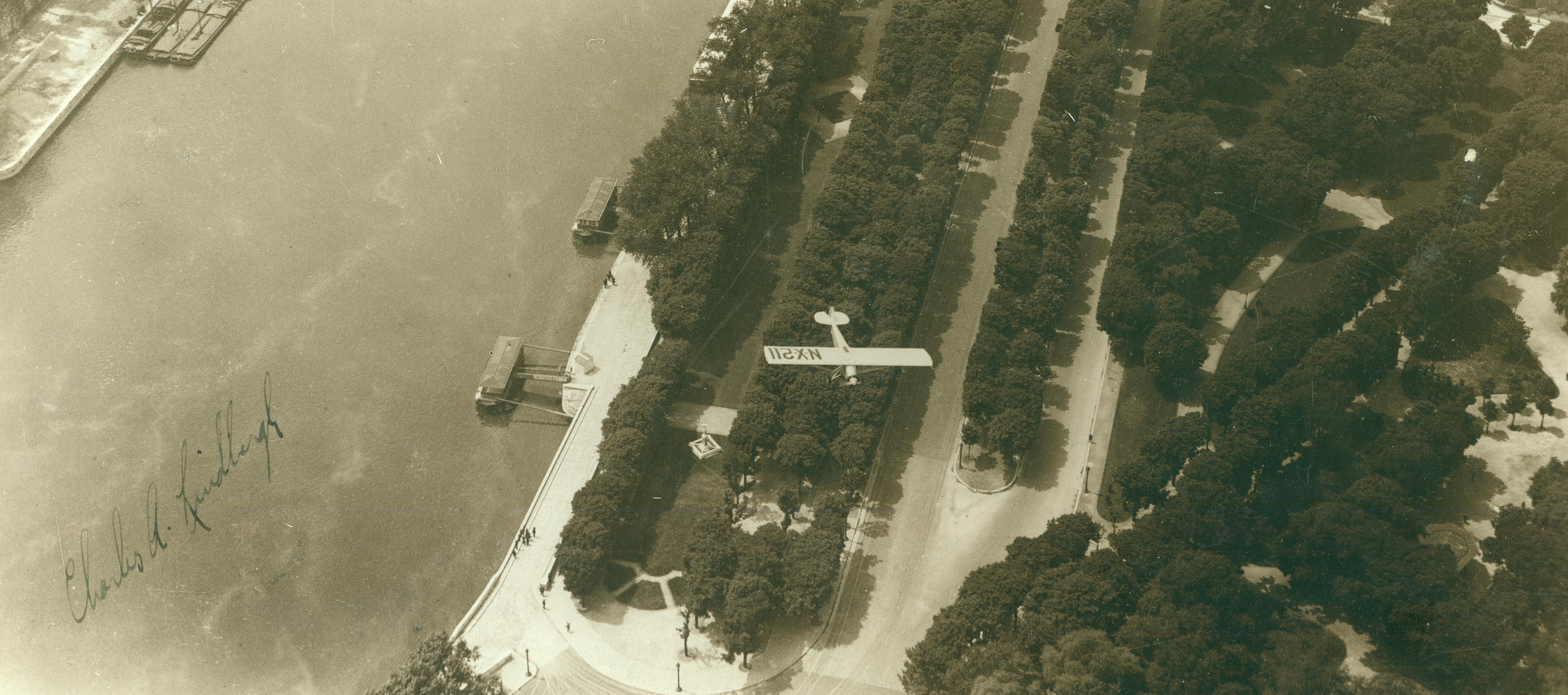
- The Spirit of St. Louis airborne over Paris as Lindbergh leaves for Belgium, the next stop after a few days in France(flickr)(large detailed picture, if it won't reduce just hit 'refresh' button)
- Scott, Phil. "Doing the Lindy Hop". September 2017. AOPA. Video, photo, and article links detail this flying reproduction for the Spirit's 90th Anniversary.
- "The Spirit Flies On," (replica pilot report, detailed and illustrated; analytical comparisons to original Spirit), Barry Schiff, May 2002, AOPA Pilot, p. 93., photocopied at BarrySchiff.com
| International | |
|---|---|
| National | |

Spirit of St. Louis
View on GrokipediaDevelopment
Lindbergh's Initiative
Charles Lindbergh, a 25-year-old U.S. Air Mail pilot employed by the Robertson Aircraft Corporation, developed a strong interest in aviation records during 1926 while flying the challenging route between St. Louis and Chicago. His experiences with night flights, adverse weather, and precise navigation fueled his ambition to attempt a transatlantic crossing, inspired by the era's growing advancements in long-distance aviation. Lindbergh was particularly drawn to the Orteig Prize, a $25,000 reward offered by New York hotelier Raymond Orteig since 1919 for the first non-stop flight from New York to Paris, a challenge that had eluded aviators amid several failed group efforts in the preceding years.[7][10] Convinced that a solo flight would minimize risks associated with crew conflicts and weight, Lindbergh set his sights on achieving the Orteig Prize alone, a radical departure from the multi-person teams that had dominated prior transatlantic bids.[11] To fund the estimated $12,000 needed for a custom aircraft capable of the 3,600-mile journey, he committed his personal savings of $2,000 and sought backing from St. Louis business leaders familiar with his reliable airmail service.[12] In February 1927, Lindbergh formalized his initiative by establishing the Spirit of St. Louis Corp., a syndicate that raised the remaining $10,000 through contributions from nine local investors: Harold M. Bixby, Harry F. Knight, Harry H. Knight, Albert Bond Lambert, J.D. Wooster Lambert, E. Lansing Ray, Frank H. Robertson, William B. Robertson, and Earl C. Thompson—including an initial $1,000 pledge from aviation enthusiast Major Albert Bond Lambert.[5][13] Major aircraft manufacturers, including the Lambert Corporation in St. Louis and Buhl-Verville Aircraft in Detroit, declined to build a single-engine plane for Lindbergh's solo endeavor, deeming it too hazardous and unproven for such a distance.[12] Undeterred, Lindbergh turned to smaller firms and, on February 23, 1927, traveled by train to San Diego at the urging of his St. Louis backers to negotiate with the Ryan Airlines Corporation, marking the formal inception of the project just months before his historic departure.[14]Collaboration with Ryan Aeronautical
Ryan Airlines Company, founded by T. Claude Ryan in 1925 and based in San Diego, California, had established itself as a manufacturer of mail planes, including the Ryan M-1, which was used for early airmail services.[15] Under the leadership of president B.F. Mahoney after Ryan's departure in 1926, the company focused on custom aircraft designs for emerging aviation challenges.[16] On February 25, 1927, Charles Lindbergh, supported by a group of St. Louis businessmen, signed a contract with Ryan Airlines for the construction of a custom single-engine monoplane, designated NYP for "New York to Paris," to attempt a solo transatlantic flight.[17] The agreed price was $10,580, with a demanding 60-day construction deadline to meet Lindbergh's timeline for the Orteig Prize competition.[18] Lindbergh arrived in San Diego shortly before, on February 23, to oversee the project personally.[12] The design was led by chief engineer Donald Hall, who modified an existing Ryan M-2 airframe to accommodate the flight's requirements.[3] Lindbergh collaborated intensively, attending daily meetings with Hall and the Ryan team to refine specifications, including an increase in fuel capacity to 450 U.S. gallons distributed across wing and fuselage tanks for extended range.[5] Construction commenced on February 28, 1927, involving all 35 employees working extended hours; the aircraft was completed on schedule in 60 days, with Ryan absorbing minor cost overruns to ensure timely delivery.[19] The Spirit of St. Louis made its maiden flight on April 28, 1927, a short local test piloted by Lindbergh from Dutch Flats airfield near the Ryan factory in San Diego.[20] On May 10–11, 1927, Lindbergh flew it approximately 1,500 miles to St. Louis, Missouri, in 14 hours and 25 minutes as part of the delivery to New York, inspiring the aircraft's name in honor of his backers there.[6][21] Follow-up test flights over the next two weeks revealed handling issues, such as aileron binding due to wing flexing, which were promptly addressed by reinforcing the structure before the plane's arrival in New York on May 12, 1927.[22]Design
Airframe and Configuration
The Ryan NYP Spirit of St. Louis employed a high-wing monoplane configuration optimized for endurance, featuring fixed landing gear, single-bay strut bracing, and a fabric-covered fuselage constructed from welded steel tubing.[3][19] This layout drew from the Ryan M-2 design but was modified under Charles Lindbergh's input to prioritize fuel capacity over forward visibility and agility, with the fuselage elongated by 2 feet (0.61 m) to integrate large fuel tanks.[3][23] The wings, mounted above the fuselage with no dihedral or sweep, had a span of 46 feet (14.02 m), a constant chord of 7 feet (2.13 m), and a total area of 319 square feet (29.6 m²), utilizing the Clark Y airfoil with a cambered upper surface and flat lower surface aft of the leading edge for efficient lift at low speeds.[19] Plywood leading edges and fabric covering completed the structure, which was braced by interplane struts in a single-bay arrangement to support the extended span and heavy fuel load while maintaining structural simplicity.[3] The fuselage design positioned the enclosed single-seat cockpit aft of the main fuel tanks, eliminating forward visibility through a traditional windshield; this rearward placement enhanced pilot safety in the event of a forward crash, while the engine was positioned forward to permit central fuel tank placement for maintaining proper weight and balance as fuel was consumed. Instead, a 90-degree periscope mounted on the left side and small side windows provided the pilot with external cues during takeoff, landing, and navigation.[19][3][23] Fuel tanks were strategically integrated—450 U.S. gallons (1,704 L) primarily in the forward fuselage and wing leading edges—to ensure center-of-gravity stability as fuel was consumed, minimizing trim changes over long distances.[23][19] With an empty weight of 2,150 pounds (975 kg) and a maximum takeoff weight of 5,250 pounds (2,381 kg) for the overloaded historic flight, the airframe balanced lightweight construction against the demands of transatlantic range, sacrificing retractable gear and streamlined features for reliability and ease of production.[23][24][3] This configuration emphasized fuel efficiency and stability, enabling the aircraft to carry over half its takeoff weight in gasoline while drawing on proven Ryan Aeronautical elements adapted for non-stop flight.[3]Engine, Instrumentation, and Modifications
The Spirit of St. Louis was equipped with a Wright J-5C Whirlwind radial engine, a nine-cylinder, air-cooled unit that delivered 223 horsepower at 2,000 rpm and weighed approximately 510 pounds.[25][26] This engine, displacing 788 cubic inches, was chosen for its demonstrated reliability in U.S. Air Mail Service operations, where it had powered long-duration flights without failure.[27] Its simple design, lacking water-cooling components, contributed to the aircraft's overall dependability for extended nonstop operations. Instrumentation in the cockpit was kept minimal to prioritize weight savings and reliability, featuring essential gauges such as an altimeter, airspeed indicator, turn-and-bank indicator, tachometer, oil pressure gauge, and temperature indicator.[28] Navigation relied on an earth inductor compass, a drift sight for determining wind effects, and a stopwatch for dead reckoning, supplemented by precomputed maps and celestial observations.[29] No radio was included, as Lindbergh deemed it unnecessary for the solo flight and opted to eliminate its 90-pound weight to accommodate more fuel.[12] Key modifications centered on enhancing fuel capacity and safety while reducing weight. The aircraft incorporated five interconnected metal fuel tanks with a total capacity of 450 gallons—exceeding the 360-gallon standard of Ryan M-2 models by about 25%—comprising a forward tank of 88 gallons positioned in place of the windshield, a main fuselage tank of 209 gallons ahead of the cockpit, and three wing tanks of 51 gallons each.[23][3] A Lunkenheimer distributor valve in the cockpit allowed selective fuel feed from any tank, with consumption tracked manually via stopwatch rather than installed gauges to save additional weight.[23] The forward fuel tank's placement acted as a protective barrier in a potential crash, and a small periscope was added after initial test flights to provide forward visibility through a roof-mounted port.[23] Other alterations included removing parachutes, brakes from the fixed landing gear, and extraneous fittings; simplifying the control system; and reinforcing the fuselage and wings to support the added fuel load without compromising the monoplane's structural integrity.[3][18] Pre-flight testing validated these changes, with prolonged ground runs of the engine confirming its endurance for over 33 hours of continuous operation at full power, as later demonstrated in actual use.[30]Transatlantic Flight
Preparations and Departure
Following the completion of test flights in San Diego, Lindbergh piloted the Spirit of St. Louis from there to New York, departing on May 10, 1927, and arriving at Curtiss Field on Long Island on May 12 after a single refueling stop in St. Louis.[3] The aircraft's design, featuring extra fuel tanks that increased its capacity to 451 U.S. gallons, was essential for enabling the planned nonstop transatlantic attempt.[3] Upon landing, Lindbergh was thrust into a media frenzy as reporters and photographers swarmed the field, drawn by the high-stakes Orteig Prize competition for the first nonstop flight between New York and Paris.[31] Competing aviators, including Richard E. Byrd, who was preparing a three-engine Fokker trimotor at nearby Hasbrouck Heights, heightened the tension, with Byrd's team offering Lindbergh hangar space at Curtiss Field amid the shared pursuit of the $25,000 prize.[32] Persistent bad weather, including fog and storms, grounded Lindbergh and other contenders from May 14 through May 19, forcing repeated postponements as conditions over the Atlantic remained hazardous.[6] On the evening of May 19, Lindbergh consulted U.S. Weather Bureau forecasters, who indicated a narrow window of improving conditions the next day, though not ideal; he opted to proceed despite the risks, as further delays could allow competitors to launch first.[33] For the final setup, the aircraft was loaded with 451 gallons of gasoline—approximately 2,775 pounds—along with 28 gallons of oil, five ham sandwiches, and a canteen of water, configured for Lindbergh's solo operation with no radio or parachutes to save weight.[34] Despite concerns from Roosevelt Field's owners about the overload exceeding the Ryan NYP's rated gross weight of 5,200 pounds—the fully fueled plane tipped the scales at 5,250 pounds—Lindbergh secured takeoff permission after demonstrating the aircraft's stability in ground tests.[35] On May 20, 1927, at 7:52 a.m. EDT, Lindbergh initiated takeoff from Roosevelt Field's muddy east-west runway, which had been extended by rolling across the adjacent Curtiss Field to gain extra distance for the heavily laden plane.[36] The Spirit of St. Louis lumbered down the 4,000-foot path in 40 seconds, barely clearing the telephone wires at the end by 10 feet as it climbed slowly at under 40 mph, banking northeast over Long Island.[31] From there, the flight proceeded east-northeast toward Nova Scotia before crossing the open Atlantic.[36]The Crossing and Arrival
Lindbergh departed from Roosevelt Field, New York, on May 20, 1927, embarking on a solo nonstop transatlantic flight to Paris in the Spirit of St. Louis, covering approximately 3,610 miles over 33 hours and 30 minutes.[3] He navigated primarily using dead reckoning, supplemented by sun sightings and a magnetic earth inductor compass to maintain his great circle route across the North Atlantic.[29] Early in the flight, Lindbergh encountered icing conditions at around 10,000 feet, which forced him to descend to warmer altitudes to avoid buildup on the wings and prevent loss of lift.[12] As the journey progressed into the night, severe drowsiness posed a major threat; to combat sleep, he stood on the rudder pedals, allowing cold air to rush through the cockpit and stimulate alertness, while also battling fatigue from over 24 hours aloft.[31] Fuel management remained critical throughout, with Lindbergh monitoring consumption meticulously to ensure the 450 gallons aboard sufficed for the crossing, though headwinds occasionally increased demand.[31] Mid-flight highlights included sightings of fishing boats off the Irish coast about 26 hours after departure, where Lindbergh circled low in hopes of obtaining a position fix but found the decks empty.[31] Later, in a moment of optical illusion amid low visibility, he mistook ocean waves for land, briefly heightening tension before correcting course.[37] After 28 hours, with fuel reserves dwindling and warning lights indicating low levels, Lindbergh sighted the Irish coast, confirming he was on track despite the strain.[18] As dawn broke over Europe on May 21, Lindbergh descended toward Paris, jettisoning excess fuel to reduce weight for a safer landing.[6] He touched down at Le Bourget Field at 10:22 p.m. French time (5:22 p.m. New York time), after circling the Eiffel Tower en route, only to nearly collide with an estimated 100,000 spectators who surged onto the runway in excitement, forcing him to brake abruptly on the soft grass.[38] The crowd lifted Lindbergh triumphantly from the cockpit, hailing him as a hero for completing the unprecedented solo crossing.[38] In the immediate aftermath, French officials presented Lindbergh with the $25,000 Orteig Prize, recognizing his success in the transatlantic challenge.[38] Inspectors examined the Spirit of St. Louis, confirming only minor damage from the bumpy landing, with sufficient fuel remaining for an additional 900 miles of flight.[6]Later History
Exhibitions and Tours
Following its triumphant arrival in Paris on May 21, 1927, the Spirit of St. Louis remained there briefly for celebrations before Lindbergh flew it to London on May 31, landing at Croydon Airport amid massive crowds.[3] Over the subsequent weeks, the aircraft toured various sites in the United Kingdom, including flights carrying dignitaries such as the Prince of Wales, showcasing aviation's potential to European audiences.[39] These European engagements highlighted the plane's role in immediate post-flight diplomacy and public inspiration, with Lindbergh piloting short hops that drew thousands despite logistical challenges from enthusiastic spectators.[40] The aircraft was then shipped back to the United States aboard the USS Memphis, arriving in Washington, D.C., on June 11, 1927, where it received a hero's welcome.[3] Sponsored by the Daniel Guggenheim Fund for the Promotion of Aeronautics, Lindbergh embarked on an extensive 82-city tour across 48 states from July 20 to October 23, 1927, covering approximately 22,000 miles and attracting an estimated 30 million viewers through parades, demonstrations, and flyovers.[41] Lindbergh piloted the majority of the legs himself, using the tours to advocate for commercial aviation while the plane's durable design, featuring reinforced structure and efficient fuel systems, proved essential for the demanding schedule.[42] Public fervor often led to safety concerns, with crowds overwhelming fields and runways, prompting increased security measures.[39] In late 1927, the Spirit of St. Louis undertook a major international goodwill tour of Latin America, departing Washington, D.C., on December 13 for a nonstop flight to Mexico City, followed by visits to approximately 15 countries including Guatemala, British Honduras, El Salvador, Honduras, Nicaragua, Costa Rica, Panama, Colombia, and Venezuela.[3] This 9,500-mile journey, extending into early 1928 with additional stops in the Caribbean and South America, promoted hemispheric relations and aviation advancement, with Lindbergh meeting leaders and fostering goodwill amid rapturous receptions.[43] By 1928, accumulating approximately 26,000 miles in post-flight operations, the Spirit of St. Louis showed signs of wear from intensive use, leading to the conclusion of its flying exhibitions.[3] On April 30, 1928, Lindbergh piloted it on its final flight from St. Louis to Washington, D.C., where he formally donated the aircraft to the Smithsonian Institution, transitioning it to static display while preserving its legacy as a symbol of aviation progress.[39]Conservation and Current Status
Following its donation to the Smithsonian Institution on April 30, 1928, the Spirit of St. Louis was initially housed in the Arts and Industries Building, where it remained on public display until 1976.[44] During this period, the aircraft was exposed to uncontrolled environmental conditions, including dust accumulation and fluctuating humidity levels, which contributed to gradual deterioration of its doped fabric covering and other organic components.[45] These factors prompted early preservation concerns, as noted in Smithsonian assessments of historic aircraft susceptibility to such elements.[45] In preparation for the opening of the National Air and Space Museum, the aircraft underwent significant restoration work in the mid-1970s at the Paul E. Garber Preservation, Restoration, and Storage Facility in Suitland, Maryland.[46] This effort included detailed inspections of the steel-tube frame, which was found to be structurally sound, along with replacement of deteriorated doped fabric and repainting to restore its original silver finish.[47] The restored aircraft was then relocated and suspended in the museum's Boeing Milestones of Flight Hall upon its 1976 debut, marking a shift to a more protected display environment.[44] Subsequent conservation has emphasized non-invasive techniques to maintain integrity without altering historical authenticity. In the 2000s and early 2010s, non-destructive evaluations, including X-ray imaging and structural scans, confirmed the airframe's ongoing stability with no critical issues identified.[48] A major conservation phase occurred in 2015, when the aircraft was lowered to the floor for the first time in nearly two decades to facilitate detailed examinations, cleaning of the Wright J-5 Whirlwind engine (found in excellent condition), and repairs to minor fabric tears using reversible adhesives.[47] Stabilizing faded enamel flags on the cowling with synthetic resin was also performed, alongside high-resolution inspections via 3D microscopy, all within a climate-controlled setting to mitigate corrosion risks.[47] The aircraft was returned to suspended display later that year following these treatments.[48] As of November 2025, following the National Air and Space Museum's renovation and reopening of five galleries on July 28, 2025, the Spirit of St. Louis remains in static display in the renovated Barron Hilton Pioneers of Flight gallery, with continuous monitoring ensuring its preservation as a non-flyable historical artifact.[3][49] Recent digital initiatives, including comprehensive 3D scanning completed in the 2020s, provide virtual access and aid future conservation planning without physical intervention.[50] Public engagement continues through occasional close-up viewings and educational programs, underscoring its enduring role as a cultural icon.[47]Reproductions and Variants
Further Developed Types
Following the success of the Ryan NYP, which demonstrated the efficacy of a simple, high-wing monoplane design for long-range flight, Ryan Aeronautical and its successors developed several commercial and military variants that built on these principles of reliability and structural efficiency. These evolutions prioritized enclosed cabins for passenger comfort, enhanced powerplants for versatility, and adaptations for diverse roles, while retaining core elements like fabric-covered wings and steel-tube fuselages from the original lineage.[3] The Ryan B-1 Brougham, introduced in 1928, represented an immediate commercial derivative as a four- to five-seat cabin aircraft with an enclosed cockpit for improved pilot protection. Powered by a 220-horsepower Wright J-5 radial engine, it accommodated one pilot and up to four passengers in wicker seats, achieving a top speed of approximately 123 miles per hour. Primarily used for executive passenger transport and aerial photographic reconnaissance, approximately 150 units were produced in total, with sales peaking at three aircraft per week at a price of $9,700 each; one example was even flown by Charles Lindbergh himself post-transatlantic flight.[51][52][53] An improved iteration, the Ryan B-5 Brougham of 1930, featured a more powerful 300-horsepower Wright J-6 Whirlwind engine for better performance, maintaining the 42-foot wingspan and 27-foot-9-inch length of its predecessor while incorporating refinements for export markets. Approximately 61 were built between 1930 and 1931, with several exported to Peru for military observation and training duties, underscoring the design's adaptability to international military needs.[51][54] In the 1930s, the Ryan ST series marked a significant evolution into military trainers, shifting to a low-wing, tandem two-seat configuration while drawing on the NYP's proven reliability for structural simplicity and endurance. Exemplified by the PT-22 Recruit adopted by the U.S. Army Air Corps, the series powered by a 160-horsepower Menasco engine achieved widespread use in primary flight training, with over 1,200 PT-22 variants alone produced during World War II; total ST production exceeded 1,400 units across civilian and military roles.[51][55] Later derivatives included the Ryan FR-1 Fireball, a 1940s U.S. Navy fighter with mixed piston-jet propulsion, reflecting an indirect lineage through Ryan's accumulated monoplane expertise in aerodynamics and lightweight construction originating from the NYP era. Only 66 were built, serving briefly in one squadron for carrier-based operations before jet advancements rendered it obsolete.[15][56] Although T. Claude Ryan sold the original company in 1928—leading to its renaming as Mahoney-Ryan Aircraft—the core design philosophies of simplicity and range persisted in subsequent iterations under the refounded Ryan Aeronautical, established in 1931, influencing production through World War II and beyond without major agricultural variants emerging in the 1950s.[51][57]Replicas and Examples
Several notable replicas of the Spirit of St. Louis have been constructed since the original aircraft's historic flight, serving educational, commemorative, and display purposes while adhering closely to the Ryan NYP design specifications. These reproductions vary from airworthy flying examples to static displays and modern digital models, with approximately ten major instances documented across museums and private collections.[58][59] An early non-flying mockup was built in 1956 by Warner Brothers Studios as a sound-stage prop for the 1957 film The Spirit of St. Louis, starring Jimmy Stewart as Charles Lindbergh; this full-scale replica featured an aluminum frame but lacked operational capabilities. Following the film's production, Stewart donated it to The Henry Ford Museum in Dearborn, Michigan, where it remains on static display, notable for its authentic exterior detailing despite internal simplifications for cinematic use.[60][61] Among airworthy examples, the Experimental Aircraft Association (EAA) constructed its first replica in 1977 to commemorate the 50th anniversary of Lindbergh's flight, powered by a Continental R-670-4 radial engine and designed for demonstration flights; this aircraft is preserved in flying condition at the EAA Aviation Museum in Oshkosh, Wisconsin. A second EAA replica, completed in 1991, serves as a static exhibit at the organization's Pioneer Airport, both models emphasizing fidelity to the original's single-seat, high-wing monoplane configuration. Another flying replica, known as the NYP-3, was built in the early 1980s by the San Diego Air & Space Museum after their prior Spirit II reproduction was destroyed in a 1978 fire; this version, constructed with volunteer labor, has conducted numerous educational flights and is maintained in airworthy status at the museum's facilities. The 1967 Spirit 2, built by Tallmantz Aviation under stunt pilot Frank Tallman for the 40th anniversary celebrations, was the first post-war airworthy replica, completing its maiden flight on April 24, 1967, from San Diego's Lindbergh Field; it featured a Wright J-6 Whirlwind engine and participated in transatlantic commemorative events before being retired.[58][59][62] Static displays include a full-scale reproduction at the Missouri History Museum in St. Louis, acquired in 1962 and originally suspended at Lambert-St. Louis International Airport from 1975 until its removal for restoration in 1998; this aluminum-framed model, on long-term loan from the museum, highlights the aircraft's role in local aviation history and was returned to the museum's Grand Hall for public viewing. Internationally, a full-scale static replica is housed at the Cradle of Aviation Museum in Garden City, New York, based on a 1928 Ryan B-1 Brougham built to the same lines as the original NYP to promote the design commercially; it features period-accurate fabric covering and instrumentation for interpretive exhibits. A flying reproduction is maintained at the Old Rhinebeck Aerodrome in Rhinebeck, New York, constructed with high accuracy to original blueprints but without long-range fuel tanks; it made its first flight on December 5, 2015, and is used for airshows.[63][64][65][66] In the 2010s, efforts shifted toward precision replicas for educational purposes, such as John Norman's project at JNE Aircraft in Burlington, Washington, completed around 2019 and hailed for its exact adherence to original dimensions and materials, including a custom-fabricated Wright J-5 engine; this airworthy model has been featured at fly-ins but grounded post-initial tests due to maintenance costs. No new full-scale airworthy builds have emerged after 2010, primarily owing to escalating expenses for authentic components and regulatory hurdles. Modern interpretations include the Smithsonian Institution's 2025 digital 3D model of the original aircraft, created via high-resolution scanning for virtual exploration and educational simulations in museums worldwide, allowing interactive study of the design without physical replication.[67][68][50]Specifications
General Characteristics
The Ryan NYP Spirit of St. Louis was a single-engine, high-wing monoplane designed specifically for long-distance flight, featuring a crew of one pilot seated in a rearward cockpit to balance the heavy forward fuel load.[3] Its construction utilized a welded steel-tube fuselage covered in fabric, with wings built from wood spars and ribs also covered in fabric for lightweight strength.[3][2]| Characteristic | Specification |
|---|---|
| Crew | 1 pilot |
| Length | 27 ft 8 in (8.43 m) |
| Wingspan | 46 ft (14.02 m) |
| Height | 9 ft 10 in (3.00 m) |
| Wing area | 319 sq ft (29.6 m²) |
| Empty weight | 2,150 lb (975 kg) |
| Gross weight | 5,250 lb (2,381 kg) |
| Fuel capacity | 450 U.S. gal (1,703 L) |
| Powerplant | 1 × Wright J-5C Whirlwind 9-cylinder air-cooled radial piston engine, 223 hp (166 kW) |
| Propeller | 2-bladed fixed-pitch metal |
Performance
The Ryan NYP, known as the Spirit of St. Louis, demonstrated operational capabilities optimized for long-range endurance rather than high performance, with its design prioritizing fuel efficiency over speed or agility. Its maximum speed was 125 mph at sea level, while the cruise speed was 95 mph, allowing for economical operation during extended flights.[70][28] Key performance metrics included a theoretical range of 4,100 miles, a service ceiling of 16,400 ft (5,000 m), reflecting the aircraft's heavy fuel load and conservative power-to-weight ratio. The power/mass ratio was 0.042 hp/lb, and wing loading stood at 16.5 lb/sq ft, contributing to stable but unremarkable climb characteristics under full load.[24]| Performance Parameter | Value |
|---|---|
| Maximum speed (sea level) | 125 mph |
| Cruise speed | 95 mph |
| Theoretical range | 4,100 miles |
| Service ceiling | 16,400 ft (5,000 m) |
| Wing loading | 16.5 lb/sq ft |
| Power/mass | 0.042 hp/lb |