Hubbry Logo
SAMHOSAMHOMain
Open search
SAMHO
Community hub
SAMHO
logo
8 pages, 0 posts
0 subscribers
Be the first to start a discussion here.
SAMHO
SAMHO
from Wikipedia

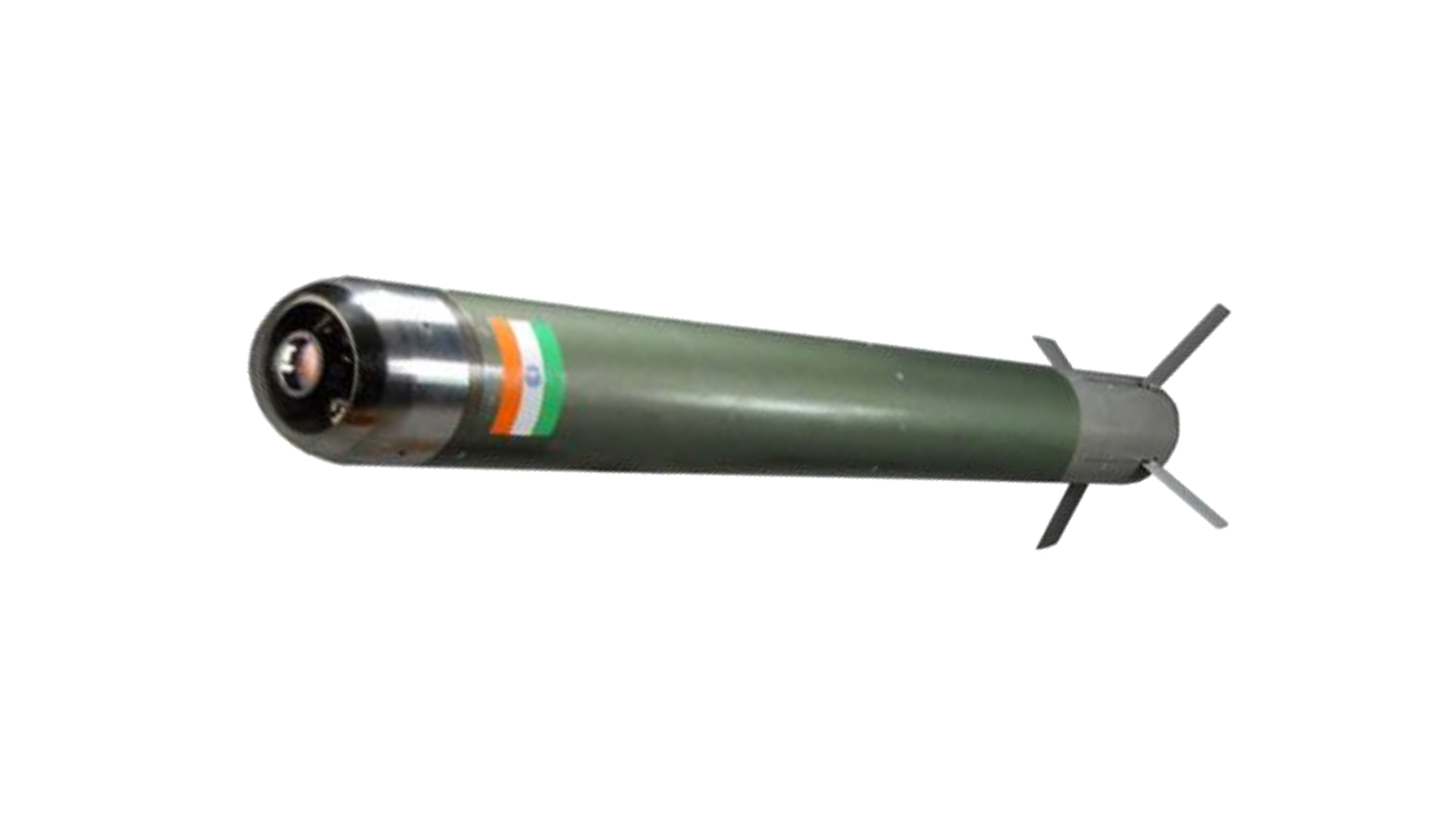
The SAMHO (or Semi-Active Mission Homing) is an Indian gun-launched anti-tank guided missile (ATGM) developed by the Armament Research and Development Establishment (ARDE) of DRDO for the Arjun tanks of the Indian Army under the Cannon Launched Missile Development Programme (CLMDP). The SAMHO has a high-explosive anti-tank (HEAT) tandem-charge warhead designed to defeat explosive reactive armour (ERA) protection of modern armoured vehicles and tanks. The SAMHO is a multi-purpose anti-armour guided missile effective against tanks and low flying attack helicopters.[2] Originally intended to be fired from the 120 mm rifled gun of Arjun, the DRDO plans to make it compatible with the T-90 tanks of the Indian Army, which have a 125 mm smoothbore gun.[3]

Key Information

Development

[edit]

The development of SAMHO gun-launched anti-tank guided missile was announced in 2014.[4] The SAMHO missile was developed under the Cannon Launched Missile Development Programme (CLMDP) by the Armament Research and Development Establishment (ARDE) and High Energy Materials Research Laboratory (HEMRL) under Armament and Combat Engineering (ACE) cluster along with Instruments Research and Development Establishment (IRDE) of Defence Research and Development Organisation (DRDO).[2][5] The missile is intended to enhance the firepower of the indigenous Arjun tanks in service with the Indian Army.[5][6]

The missile has 2 modes of attack: the Top Attack Lifted Trajectory and the Direct (Flat) Trajectory. In the Top Attack mode the missile will have a range of 2–5 km (1.2–3.1 mi) enabling the missile to target the most vulnerable part of the target and avoiding most of its countermeasure systems. The Direct or Flat mode, with a range of 1.5–2 km (0.93–1.24 mi), shall be used for rapid or immediate engagements at short notice in close proximity.[7]

On 2 February 2024, news reports suggested that DRDO has completed all trials for the missile and it is now ready for production.[7]

Testing

[edit]
SAMHO missile firing from Arjun
  1. The first trial occurred successfully on 22 September 2020, from an Arjun tank with an inert warhead at KK Range, Armoured Corps Centre and School (ACC&S), Ahmednagar. The missile engaged a target kept at a distance of 3 km.[6]
  2. Another successful missile firing occurred on 1 October 2020 from the same platform at the KK Range.[8]
  3. On 28 June 2022, DRDO successfully tested the missile engaging a target at minimum range at the KK Range, ACC&S, Ahmednagar. Engaging a target at minimum range by an ATGM is particularly difficult given the dimensional constraints of tank launched ATGMs. The ATGM's performance was tested for maximum ranges in the previous trials, hence, establishing the capability of the missile from minimum and maximum range.[9][10][1]
  4. On 4 August 2022, another successful test was conducted at the KK Range, engaging a target from minimum to maximum range to check performance consistency. Telemetry systems recorded the satisfactory flight performance of the missile.[11][12]

See also

[edit]

Related development
  • Nag – (India)
Comparable weapons
Related lists

References

[edit]
Revisions and contributorsEdit on WikipediaRead on Wikipedia
from Grokipedia
The SAMHO is an indigenous (ATGM) developed by India's (DRDO) through its (ARDE), designed primarily to neutralize armored vehicles equipped with explosive reactive armor. Launched from the 120 mm rifled gun of the Arjun , it employs semi-active laser homing guidance for precise targeting, enabling engagement of main battle tanks, low-flying attack helicopters, and hardened point targets at ranges of 1.5 to 5 km depending on the firing mode. The missile features a tandem high-explosive anti-tank (HEAT) warhead optimized to defeat modern armor protections, with two operational modes: a direct flat trajectory for shorter ranges (1.5-2 km) and a top-attack lifted trajectory for extended engagement (2-5 km) that allows it to strike from above vulnerable tank tops. Development began as part of DRDO's Cannon-Launched Missile Development Programme to enhance the Indian Army's anti-armor capabilities, with the first trial firing conducted on September 22, 2020, from an Arjun tank, followed by successful tests in October 2020, June 2022, and August 2022. By February 2024, SAMHO had completed all developmental trials and was declared ready for user evaluation and production, marking a significant step toward self-reliance in India's defense technology ecosystem. Future integration with the T-90 Bhishma tank's 125 mm gun is under consideration to broaden its deployment across Indian armored formations. As of November 2025, DRDO has initiated groundwork on a 105 mm variant for integration with the Zorawar light tank.

Overview

Description

The SAMHO (Semi-Active Mission Homing) is an Indian gun-launched (ATGM) developed by the Defence Research and Development Organisation's (DRDO) (ARDE) in collaboration with the High Energy Materials Research Laboratory (HEMRL) and Instruments Research and Development Establishment (IRDE). Designed for launch from the 120 mm rifled gun of main battle tanks like the Arjun, the missile employs semi-active laser homing guidance for precise targeting. It allows seamless integration as a multi-purpose munition alongside conventional tank rounds. The SAMHO targets armored vehicles, including modern tanks equipped with explosive reactive armour, as well as low-flying attack helicopters. Its top-attack mode enables the missile to approach targets from above, exploiting thinner upper armour for superior penetration effectiveness. This dual-role functionality—serving both anti-armour and limited anti-air purposes—distinguishes the SAMHO from conventional tube-launched ATGMs, enhancing the versatility of tank-based firepower.

Strategic Role

The development of the SAMHO missile represents a key contribution to India's initiative, promoting self-reliance in defense technology by reducing dependence on imported gun-launched anti-tank guided missiles such as the Israeli LAHAT. As an entirely indigenous system engineered by the (DRDO), SAMHO enables the production of advanced weaponry domestically, minimizing vulnerabilities associated with foreign supply chains and licensing royalties. Tactically, SAMHO significantly bolsters the firepower of the indigenous Arjun (MBT), allowing it to engage modern threats including tanks equipped with explosive reactive armor (ERA) and low-flying helicopters through its semi-active homing guidance and (HEAT) . Its gun-launched design ensures seamless integration with the Arjun's 120 mm rifled gun, providing a versatile top-attack or direct-trajectory mode for precise, standoff engagements. This capability enhances battlefield effectiveness by enabling armored units to neutralize heavily protected targets at ranges up to 5 km, surpassing the limitations of unguided tank ammunition. Within India's armored warfare doctrine, SAMHO supports high-mobility offensive operations along the western borders, particularly in the plains of Punjab, Rajasthan, and Gujarat, where rapid armored advances are critical against potential adversaries. By facilitating beyond-line-of-sight engagements, it aligns with the emphasis on integrated mechanized maneuvers, allowing Indian tank battalions to maintain superiority in contested environments while also adapting to mountainous terrains in regions like Jammu & Kashmir. Compared to predecessor systems like the Russian 9M119 Refleks, SAMHO offers superior integration with indigenous platforms such as the Arjun MBT, optimizing performance without the compatibility issues arising from differing gun calibers and fire control systems. As of November 2025, DRDO has begun development of a 105 mm variant for integration with the Zorawar light tank, further expanding SAMHO's deployment options across Indian armored formations.

Development

Background and Requirements

The SAMHO program emerged in the early 2010s amid the Indian Army's push for indigenous capabilities to enhance the firepower of its main battle tanks, particularly the Arjun Mk-1 and Mk-1A variants, which previously relied on foreign systems like the Israeli missile. In 2014, the (DRDO) decided to abandon the integration due to strategic preferences for self-reliance, opting instead to develop a native gun-launched (ATGM) under the Cannon Launched Missile Development Programme (CLMDP). This shift addressed vulnerabilities in supply chains and operational dependencies on imports, aligning with broader national goals to indigenize critical defense technologies. Key requirements for SAMHO were shaped by the need to integrate seamlessly with the 120 mm rifled bore of the Arjun tank while providing versatile anti-armor capabilities against modern threats protected by explosive reactive armor (ERA). The missile was specified to achieve an operational range of 1.5 to 5 km, employ a tandem high-explosive anti-tank (HEAT) warhead for enhanced penetration, and incorporate a multi-purpose profile effective not only against armored vehicles but also low-flying attack helicopters. These parameters were driven by ongoing border security challenges and the imperative to equip Indian armored units with standoff engagement options superior to legacy munitions. The project was initiated by the (ARDE), a DRDO laboratory specializing in armament systems, which led the efforts to ensure compatibility with existing tank platforms developed by the Combat Vehicles Research and Development Establishment (CVRDE). Sanctioned around 2015-2016 as part of accelerated initiatives following high-profile acquisitions like the Rafale jets, SAMHO represented a pivotal step in reducing foreign dependency in precision-guided munitions for .

Design and Engineering

The SAMHO missile's design prioritizes integration with existing tank platforms while incorporating advanced guidance and warhead systems to neutralize heavily armored targets. Led by the (ARDE), a laboratory of the (DRDO), the project focused on creating a compact, gun-launched system compatible with the 120 mm rifled gun of the Arjun . Central to the engineering is the semi-active homing (SALH) guidance , which directs the toward a laser-designated spot illuminated by the firing tank's or an external designator. This approach enables precise terminal homing and mid-course adjustments, supporting operational ranges from 1.5 km to 5 km while countering threats like tanks fitted with explosive reactive armor. A pivotal lies in the tandem high-explosive anti-tank (HEAT) , engineered with a precursor charge to trigger and neutralize explosive reactive armor followed by a main shaped-charge penetrator to breach underlying composite armor. This dual-stage design addresses the limitations of single-charge warheads against modern protections, maintaining lethality within the missile's constrained dimensions. The overall engineering emphasized , achieving a 120 mm canister that fits gun tubes without reducing warhead effectiveness or guidance reliability. The missile's multi-role capability extends to low-flying attack helicopters, broadening its utility beyond ground targets through adaptable trajectory profiles, including top-attack and direct-fire options.

Technical Specifications

Missile Components

The SAMHO 's warhead consists of a tandem (HEAT) configuration, with a precursor charge to detonate and defeat explosive reactive armor (ERA) on target vehicles, followed by a main charge to penetrate the underlying armor. This dual-stage design enables effective engagement of modern armored threats equipped with spaced or reactive protection systems. The is optimized for high-velocity impact from launch, ensuring reliable upon contact. Guidance and control are achieved through a semi-active laser homing seeker, which tracks reflected laser energy from the designated target, providing line-of-sight precision over the missile's flight path. The includes aerodynamic control surfaces for stability and maneuverability during , supported by onboard electronics that process seeker signals and maintain alignment. These components interact seamlessly to correct deviations in real time, ensuring the missile homes on the target until impact. The guidance setup integrates briefly with the Arjun tank's for initial target illumination. The structural framework features a cylindrical aerodynamic body with a 120 mm , tailored for compatibility with 120 mm tank guns such as that on the Arjun . Lightweight materials contribute to the overall compact design, facilitating high-speed ejection from the gun while maintaining structural integrity against launch stresses. These elements collectively ensure the subsystems—, guidance, and —function as an integrated unit during powered and coasting phases.

Performance Parameters

The SAMHO demonstrates effective operational range of 1.5 to 5 kilometers, enabling of armored in both direct and top-attack trajectories. In top-attack mode, the range extends to 2–5 km, allowing the to strike from above to exploit weaker upper armor on tanks. This capability supports its dual-role design for neutralizing tanks and low-flying helicopters. Lethality is provided by a tandem high-explosive anti-tank (HEAT) warhead, optimized to penetrate explosive reactive armor (ERA) on modern armored vehicles. The warhead's configuration ensures defeat of ERA-protected targets. Guidance employs semi-active laser homing, achieving textbook precision in trials, with hits confirmed at both minimum and maximum ranges. The missile supports launch from the 120 mm rifled gun of the Arjun , with compatibility planned for the T-90's 125 mm smoothbore gun. It exhibits robust maneuverability for evasive targeting in dynamic battlefield conditions. As of November 2025, DRDO has initiated development of a 105 mm variant for integration with the .

Testing and Trials

Developmental Testing

The developmental testing of the SAMHO missile, part of the Cannon Launched Missile Development Programme (CLMDP) initiated in 2014 by the (ARDE), High Energy Materials Research Laboratory (HEMRL), and Instruments Research and Development Establishment (IRDE) under DRDO, focused on validating key subsystems like , guidance, and in-barrel stability during the R&D phase. Initial proof-of-concept trials began with the first flight test on September 22, 2020, when the missile was launched from an Arjun Main Battle Tank (MBT) using its 120 mm rifled gun at the KK Range of the Armoured Corps Centre and School (ACC&S) in Ahmednagar, Maharashtra; equipped with an inert warhead, it successfully engaged a stationary target at a range of 3 km, confirming basic aerodynamics and laser guidance functionality. A follow-up test in October 2020 further validated propulsion performance and trajectory control under similar conditions. Subsequent flight envelope tests expanded the evaluation, with a key trial on June 29, 2022, at the Karakoram Range, where the SAMHO achieved precise hits from minimum to maximum ranges (establishing 1.5-5 km capability), addressing prior dimensional constraints that limited engagement at closer distances for tank-launched systems. This test, supported by telemetry data, demonstrated reliable semi-active laser homing and tandem (HEAT) warhead effectiveness against armored targets. An additional developmental firing on August 4, 2022, at KK Ranges, , confirmed multi-range precision against moving targets, with the missile launched from the Arjun MBT and destroying designated threats using its 120 mm gun. These iterative tests resolved integration challenges, such as barrel compatibility and guidance stability, paving the way for full-profile validation; by early , all developmental trials were completed, confirming the missile's readiness for production while highlighting its dual-role potential against tanks and low-flying helicopters.

Evaluation and Validation

The evaluation and validation phase of the SAMHO missile system involved comprehensive field trials to confirm its operational readiness for induction into the . Building on earlier developmental tests, these trials included a successful test-firing from an Arjun main battle tank on August 4, 2022, at the KK Ranges in , , demonstrating accurate guidance and impact against armored targets and validating the system's laser-guided semi-active homing capability in real-world scenarios. Subsequent evaluations in 2023 and early 2024 encompassed a series of firings to assess performance across various conditions, including day and night operations and engagement of moving targets, with a key milestone being successful live-fire trials on Arjun Mk1 prototypes in 2023 that earned production clearance. These user-oriented trials, jointly executed by the (DRDO) and the , achieved consistent results, confirming the missile's effectiveness against modern armored threats within its operational envelope of 1.5 to 5 kilometers. The trials highlighted the system's reliability, with successful intercepts validating its tandem () warhead design. By February 2024, all required trials had been completed successfully, paving the way for production clearance and potential integration into service. As of November 2025, no further trials have been reported, with focus shifting to production and variants. No formal international evaluations have been reported to date, though the system's indigenous development positions it as a candidate for future export demonstrations.

Deployment and Future

Integration with Platforms

The SAMHO anti-tank guided missile is primarily integrated into the Arjun main battle tank (MBT) series, including the Mk-1 and Mk-1A variants, where it is launched from the indigenous 120 mm rifled gun to enhance anti-armor capabilities alongside conventional ammunition such as APFSDS rounds. This integration allows the missile to be fired in a semi-active laser-guided mode, leveraging the tank's existing electro-optical , which includes thermal sights and a for target acquisition and designation. Successful developmental trials from the Arjun platform, conducted since 2020, have validated this compatibility and paved the way for operational incorporation. The (DRDO) is actively pursuing adaptations to make SAMHO compatible with the T-90 Bhishma tanks, which feature a 125 mm gun, through modifications to ensure seamless launch and guidance integration with the vehicle's fire control suite. In November 2025, DRDO initiated groundwork for a 105 mm variant of SAMHO tailored for the light tank's rifled gun, aiming to provide versatile anti-tank capabilities for lighter armored platforms. Logistically, the integration emphasizes modular ammunition handling within the Arjun's ready-use stowage, allowing crews to mix SAMHO rounds with standard projectiles while adhering to established tank loading protocols developed by DRDO and the Indian Army.

Operational Prospects

The SAMHO anti-tank guided missile, following the completion of developmental trials in early 2024, was declared ready for user evaluation and production as of February 2024, with induction into the Indian Army anticipated thereafter. As of November 2025, mass production has not yet commenced, but the progression aligns with India's push for self-reliance in defense technologies, enabling enhanced anti-armor strike potential against tanks and low-flying helicopters. Future enhancements to the SAMHO system may include refinements to its guidance mechanisms, building on its current laser-guided configuration, though specific timelines for upgrades remain under evaluation by DRDO. While the missile lacks real-world deployment, and simulations demonstrate its efficacy in defeating modern armored threats equipped with explosive reactive armor. Production scaling could face hurdles related to precision manufacturing of guidance components and integration constraints for tank-launched systems, as noted in developmental feedback.

References

Add your contribution
Related Hubs
User Avatar
No comments yet.