Hubbry Logo
SPOT (satellite)SPOT (satellite)Main
Open search
SPOT (satellite)
Community hub
SPOT (satellite)
logo
8 pages, 0 posts
0 subscribers
Be the first to start a discussion here.
SPOT (satellite)
SPOT (satellite)
from Wikipedia
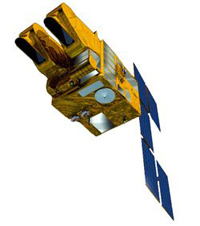
Spot-5 Satellite
Athens as seen by the SPOT 5 satellite in 2002

SPOT (French: Satellite Pour l’Observation de la Terre,[1] lit. "Satellite for observation of Earth") is a commercial high-resolution optical Earth observation satellite system operating from space. It is run by Spot Image, based in Toulouse, France. It was initiated by the CNES (Centre national d'études spatiales – the French space agency) in the 1970s and was developed in association with the SSTC (Belgian scientific, technical and cultural services) and the Swedish National Space Board (SNSB). It has been designed to improve the knowledge and management of the Earth by exploring the Earth's resources, detecting and forecasting phenomena involving climatology and oceanography, and monitoring human activities and natural phenomena. The SPOT system includes a series of satellites and ground control resources for satellite control and programming, image production, and distribution. Earlier satellites were launched using the European Space Agency's Ariane 2, 3, and 4 rockets, while SPOT 6 and SPOT 7 were launched by the Indian PSLV.[2][3]

List of satellites

[edit]

SPOT Image is marketing the high-resolution images, which SPOT can take from every corner of the Earth.

  • SPOT 1 launched February 22, 1986 with 10 panchromatic and 20 meter multispectral picture resolution capability. Withdrawn December 31, 1990.
  • SPOT 2 launched January 22, 1990 and deorbited in July 2009.
  • SPOT 3 launched September 26, 1993. Stopped functioning November 14, 1997.
  • SPOT 4 launched March 24, 1998. Stopped functioning July, 2013, orbit lowering was performed.
  • SPOT 5 launched May 4, 2002 with 2.5 m, 5 m and 10 m capability. Decommissioned in March 31, 2015, then orbit lowering was performed.
  • SPOT 6 launched September 9, 2012.
  • SPOT 7 (Azersky) launched on June 30, 2014. Stopped functioning March 17, 2023.

Orbit

[edit]

The SPOT orbit is polar, circular, Sun-synchronous, and phased. The inclination of the orbital plane combined with the rotation of the Earth around the polar axis allows the satellite to fly over any point on Earth within 26 days. The orbit has an altitude of 832 kilometers (517 mi), an inclination of 98.7°, and completing 14 + 5/26 revolutions per day.

Generations

[edit]

SPOT 1, 2, and 3

[edit]

Since 1986 the SPOT family of satellites has been orbiting the Earth and has already taken more than 10 million high quality images. SPOT 1 was launched with the last Ariane 1 rocket on February 22, 1986. Two days later, the 1,800 kg (4,000 lb) SPOT 1 transmitted its first image with a spatial resolution of 10 or 20 meters (33 or 66 ft). SPOT 2 joined SPOT 1 in orbit on January 22, 1990, on the Ariane 4 maiden flight, and SPOT 3 followed on September 26, 1993, also on an Ariane 4.

The satellite loads were identical, each including two identical HRV (High Resolution Visible) imaging instruments that were able to operate in two modes, either simultaneously or individually. The two spectral modes are panchromatic and multispectral. The panchromatic band has a resolution of 10 meters (33 ft), and the three multispectral bands (G, R, NIR) have resolutions of 20 meters (66 ft)s. They have a scene size of 3,600 km2 (1,400 sq mi) and a revisit interval of one to four days, depending on the latitude.

Because the orbit of SPOT 1 was lowered in 2003, it will gradually lose altitude and break up naturally in the atmosphere. Deorbiting of SPOT 2, in accordance with Inter-Agency Space Debris Coordination Committee (IADC), commenced in mid-July 2009 for a period of two weeks, with a final burn on 29 July 2009. SPOT 3 is no longer functioning, due to problems with its stabilization system.

SPOT 4

[edit]

SPOT 4 launched March 24, 1998 and stopped functioning July, 2013. In 2013, CNES lowered the altitude of SPOT 4 by 2.5 km (1.6 mi) to put it on a phased orbit with a five-day repeat cycle. On this orbit, SPOT4 was programmed to acquire a time-lapse series of images over 42 sites with a five days revisit period from February to end of May 2013. The data set it produced is aimed at helping future users of the Sentinel-2 mission to learn working with time-lapse series. The time-lapse series provided by SPOT4 (Take5) have the same repetitiveness as those that will be delivered by the Sentinel-2 satellites, starting in 2015 and 2016.

SPOT 5

[edit]

SPOT 5 was launched on May 4, 2002, and has the goal to ensure continuity of services for customers and to improve the quality of data and images by anticipating changes in market requirements.

SPOT 5 has two high resolution geometrical (HRG) instruments that were deduced from the HRVIR of SPOT 4. They offer a higher resolution of 2.5 to 5 meters in panchromatic mode and 10 meters in multispectral mode (20 metre on short wave infrared 1.58 – 1.75 μm).[4] SPOT 5 also features an HRS imaging instrument operating in panchromatic mode. HRS points forward and backward of the satellite. Thus, it is able to take stereopair images almost simultaneously to map relief.

SPOT 6 and SPOT 7

[edit]

SPOT 6 was launched by India's Polar Satellite Launch Vehicle on flight C21[2] at 04:23 UTC on 9 September 2012, while SPOT 7 was launched on PSLV flight C23[3] at 04:42 UTC on 30 June 2014. They form a constellation of Earth-imaging satellites designed to provide continuity of high-resolution, wide-swath data up to 2024. EADS Astrium decided to build this constellation in 2009 on the basis of a perceived government need for this kind of data. Spot Image, a subsidiary of Astrium, funded the satellites alone and owned the system (satellites and ground segments) at time of launch. In December 2014, SPOT 7 was sold to Azerbaijan's space agency Azercosmos, who renamed it Azersky.[5]

  • The architecture is similar to that of the Pleiades satellites, with a centrally mounted optical instrument, a three-axis star tracker, a fiber-optic gyro (FOG) and four control moment gyros (CMGs).
  • SPOT 6 and SPOT 7 are phased in the same orbit as Pléiades 1A and Pléiades 1B at an altitude of 694 km (431 mi), forming a constellation of 2-by-2 satellites - 90° apart from one another.[6]
  • Image product resolution:
    • Panchromatic: 1.5 m
    • Colour merge: 1.5 m
    • Multi-spectral: 6 m
  • Spectral bands, with simultaneous panchromatic and multi-spectral acquisitions:
    • Panchromatic (450 – 745 nm)
    • Blue (450 – 525 nm)
    • Green (530 – 590 nm)
    • Red (625 – 695 nm)
    • Near-infrared (760 – 890 nm)
  • Footprint: 60 km × 60 km
  • Responsive satellite tasking, with six tasking plans per day, per satellite
  • Capacity to acquire up to 3 million km2 daily

References

[edit]
[edit]
Revisions and contributorsEdit on WikipediaRead on Wikipedia
from Grokipedia
The SPOT (Satellites Pour l'Observation de la Terre) program is a French initiative for high-resolution optical satellites, developed by the (CNES) in collaboration with international partners, aimed at providing detailed imagery for mapping, , , and disaster management. Launched between 1986 and 2014, the program deployed seven satellites—SPOT-1 through SPOT-7—in Sun-synchronous orbits at altitudes of approximately 832 km (SPOT 1–5) and 694 km (SPOT 6–7), featuring steerable telescopes for off-nadir viewing and resolutions ranging from 10 meters (early models) to 1.5 meters panchromatic (later models), enabling global coverage of up to 60 km swaths in panchromatic and multispectral bands. The satellites supported applications such as digital elevation modeling, land-use analysis, and vegetation assessment, marking a pioneering effort in commercial with data distributed via Spot Image (now part of ). SPOT 7 ceased operations in March 2023 following an in-orbit failure, while SPOT 6 remains operational as of 2025, extending the program's legacy to nearly 40 years and advancing technologies and international .

Program Overview

Development History

The SPOT (Satellite Pour l'Observation de la Terre) program was established in February 1978 by the French space agency CNES as the first European commercial Earth observation initiative, aimed at providing high-resolution optical imagery for civilian applications. Developed in collaboration with Belgian and Swedish institutions, the program marked a pioneering effort in international cooperation for operational satellite remote sensing. Initial funding came from the French government through CNES, which oversaw the design and early missions to ensure technological advancement and data accessibility. In 1982, Spot Image was formed as a private company by CNES, the French National Geographic Institute (IGN), and the space industry to handle the commercialization and distribution of SPOT data products, enabling global market access and revenue generation. This structure supported the program's shift toward sustainability, with the first major milestone being the launch of SPOT 1 on February 22, 1986, aboard an Ariane 1 rocket from Kourou, French Guiana, inaugurating operational high-resolution Earth imaging from space. Subsequent milestones included the launches of SPOT 2 in 1990, SPOT 3 in 1993, SPOT 4 in 1998, and SPOT 5 in 2002, all financed and managed by CNES, which expanded the constellation's capabilities for applications in agriculture, urban planning, and environmental monitoring. The program evolved through distinct phases: government-funded operations dominated the 1980s and 2000s with SPOT 1 through 5, focusing on technological proof-of-concept and public-sector priorities. By the , it transitioned to fully commercial operations with SPOT 6 launched in 2012 and developed and operated by following its acquisition of a majority stake in Spot Image in 2008; SPOT 7, also launched in 2014, was developed by but transferred to Azercosmos of in December 2014 and renamed Azersky. The core launch phase concluded in 2014 with seven satellites deployed, with SPOT 6 continuing to provide imagery as of 2025, while SPOT 7 ceased operations in March 2023.

Objectives and Operators

The SPOT (Satellite Pour l'Observation de la Terre) program was designed to provide high-resolution optical imagery for applications including land mapping, , , , and disaster management, while promoting the global commercialization of data. The satellites enabled detailed analysis of and cover changes, vegetation health, and the impacts of , such as the 1986 Chernobyl incident where SPOT-1 imagery supported rapid assessment efforts. Secondary objectives encompassed support for scientific research in and , defense applications through enhanced capabilities, and fostering international cooperation in via agreements. These goals facilitated broader studies of human activities and natural phenomena, contributing to global environmental and security insights. The program was led by the French space agency , which handled development, operations, and launch coordination using Ariane rockets, in collaboration with international partners including and for initial design contributions. Data commercialization was managed by Spot Image, founded in 1982 by and other French entities to distribute worldwide, with the company joining the group in 2008; ESA served as a key partner for data access and distribution through its Third Party Missions Programme. For SPOT 6, assumed full ownership and operation, ensuring continuity, with the satellite still operational as of 2025; SPOT 7 was transferred to Azercosmos in 2014 and operated until its cessation in 2023. As the first fully commercial Earth observation system, SPOT introduced a model of data sales through archives and on-demand tasking starting in 1986, providing an economically viable alternative to programs like Landsat amid rising costs. By 2016, the satellites had achieved over 700 global coverage cycles of Earth's land areas, demonstrating sustained operational success. This public-private partnership pioneered commercial viability in high-resolution satellite imagery, influencing subsequent initiatives such as enhanced commercialization in Landsat and the collaborative data policies of Europe's Sentinel program.

Technical Specifications

Orbital Configuration

The SPOT (Satellite Pour l'Observation de la Terre) satellites are designed to operate in sun-synchronous orbits (SSO), which are near-polar, dawn-dusk paths that maintain a consistent angle relative to the Sun throughout the year. This configuration ensures stable lighting conditions for and enables regular repeat coverage of the Earth's surface. For the first and second generations (SPOT 1–5), the satellites are positioned at an altitude of 832 km with an of 98.7°, crossing the descending node at 10:30 a.m. local . This setup provides a 26-day repeat cycle, allowing global coverage every 26 days with a swath width of up to 60 km per pass. In contrast, the third-generation satellites (SPOT 6 and 7) orbit at a lower altitude of 694 km, with an inclination of 98.2° and a descending node at 10:00 a.m. local time, also featuring a 26-day repeat cycle but optimized for higher revisit frequencies when combined with other assets. These parameters support a swath width of approximately 60 km, enhancing resolution and coverage efficiency. SPOT 6 and 7 are phased to be co-orbital with the Pléiades high-resolution satellites, forming a 2x2 constellation that enables complementary coverage and reduces revisit times to as little as 1 day for priority areas. The SSO rationale across all generations minimizes seasonal variations in solar illumination, which is critical for consistent and long-term .

Spacecraft Design

The SPOT satellites employ a modular bus platform derived from the SPOT 1 heritage for the first and second generations, featuring an aluminum structure designed for robustness during launch and operations. The platform's body dimensions are approximately 3.4 m × 3.1 m × 6 m for second-generation models like SPOT 5, with launch masses ranging from 1,800 kg for early satellites to 3,000 kg for later ones in the series. Third-generation satellites, such as SPOT 6 and 7, utilize a more compact AstroBus-L platform with dimensions of 1.55 m × 1.75 m × 2.7 m and a launch mass of 714 kg, maintaining modularity for payloads. Power is provided by deployable solar arrays using silicon or gallium arsenide cells, generating between 1,000 W for first-generation models and up to 2,400 W at end-of-life for second-generation satellites, ensuring sufficient energy for imaging and housekeeping in sun-synchronous orbits. These arrays are supported by rechargeable batteries, including nickel-cadmium packs with capacities up to 160 Ah in early designs and lithium-ion in later ones, configured for eclipse tolerance during orbital passes. Propulsion systems across the series rely on monopropellant thrusters for maintenance, inclination adjustments, and deorbit maneuvers, with loads of 80–158 kg depending on the generation. Attitude and control achieve three-axis stabilization using momentum or reaction wheels, supplemented by trackers and gyroscopes, delivering pointing accuracies of ±0.1° in early models and down to 0.05° or 500 µrad in subsequent ones. Data and communications utilize X-band for high-rate downlink, with rates of 50 Mbps in dual channels for second-generation satellites and up to 300 Mbps in later designs, enabling efficient transmission to ground stations. S-band handles command uplink and housekeeping , providing reliable low-rate links throughout the mission. Thermal management employs passive control via and surface coatings, augmented by electrical heaters for critical components, ensuring operational temperatures during varying orbital thermal environments. is implemented through dual-string architectures for , power distribution, and lines, along with one-failure-tolerant designs in later buses, supporting mission lifetimes of 5–10 years.

Imaging Capabilities

Instruments Across Generations

The SPOT satellite program featured a progressive evolution in its primary imaging instruments, beginning with the High Resolution Visible (HRV) sensors on SPOT 1 through 3, which consisted of two identical pushbroom imagers per satellite designed for high-resolution optical Earth observation. These HRV instruments utilized linear array charge-coupled device (CCD) detectors to scan the Earth's surface in a pushbroom configuration, enabling efficient data collection across a nominal swath. The second generation transitioned to the High Resolution Visible and Infrared (HRVIR) instrument on SPOT 4 and the High Resolution Geometry (HRG) instrument on SPOT 5, which built upon the HRV design by incorporating an additional shortwave infrared (SWIR) channel while maintaining the dual-camera setup for enhanced spectral capabilities. Accompanying the HRVIR/HRG was a dedicated Vegetation instrument, providing low-resolution, wide-swath coverage specifically for global vegetation and biomass monitoring in four bands: blue (0.43–0.47 μm), red (0.61–0.68 μm), near-infrared (0.78–0.89 μm), and shortwave infrared (1.58–1.75 μm). The third generation introduced the New AstroSat Optical Modular Instrument (NAOMI) on SPOT 6 and 7, featuring two identical high-resolution pushbroom imagers with modular optics based on a silicon carbide (SiC) Korsch telescope for improved compactness and performance. A key common feature across all SPOT generations was the use of pushbroom linear detectors, which allowed for simultaneous along the satellite's track without mechanical scanning, contributing to high data rates and consistent geometric fidelity. Additionally, the instruments supported off-nadir pointing up to ±27° via steerable mirrors, facilitating stereoscopic pairs and extended coverage up to 950 km for targeted observations. This capability was integral to the program's design for flexible revisit times and multi-angle views. The evolution of these instruments was driven by the need to address growing commercial demands for finer in data, including enhanced resolution, broader swath widths, and superior radiometric accuracy to support applications in mapping, , and environmental management. Early HRV systems prioritized proof-of-concept for commercial viability, while subsequent upgrades like HRVIR/HRG and NAOMI incorporated advancements in detector technology and spectral range to deliver more actionable insights for users. For instance, the addition of capabilities in later generations responded to market needs for vegetation and land-use change detection. Calibration efforts across the SPOT series ensured high precision, employing onboard lamps for periodic radiometric checks and ground truthing via vicarious methods at test sites to maintain accuracy. These techniques achieved geometric errors below 0.5 pixels and radiometric stability within 2-3% over the mission lifetimes, supporting reliable data products for commercial distribution. In terms of data modes, SPOT instruments operated in panchromatic mode for high-detail monochrome imaging and multispectral mode using bands—covering green (0.50-0.59 µm), red (0.61-0.68 µm), and near-infrared (0.79-0.89 µm)—to capture indices and variations. The channel on 4 and 5, operating at coarser resolution with a 2200 km swath, was optimized for near-daily global monitoring of and conditions.

Resolution and Spectral Bands

The SPOT satellite series delivers high-resolution optical imagery through its High Resolution Visible (HRV) instruments on the first generation (SPOT 1–3), High Resolution Visible and Infrared (HRVIR) on SPOT 4, and High Resolution Geometry (HRG) on SPOT 5, achieving spatial resolutions of 10 m in panchromatic mode and 20 m in multispectral mode for SPOT 1–4, with SPOT 5 improving panchromatic resolution to 5 m (or 2.5 m in super-mode via dual-image combination). These resolutions enable detailed mapping of land features, urban areas, and vegetation, while the third generation (SPOT 6–7) with New AstroSat Optical Modular Instrument (NAOMI) provides enhanced 1.5 m panchromatic and 6 m multispectral product resolutions, supporting finer-scale applications like infrastructure monitoring. Spectral coverage across generations focuses on visible and near- wavelengths for , with panchromatic bands capturing broader visible light. For SPOT 1–3, SPOT 4 (HRVIR), and SPOT 5 (HRG), the multispectral bands include B1 (green: 0.50–0.59 μm), B2 (red: 0.61–0.68 μm), and B3 (near-: 0.79–0.89 μm), while panchromatic spans 0.48–0.71 μm (adjusted slightly across models). SPOT 4–5 additionally feature a B4 shortwave band (1.58–1.75 μm) at 20 m resolution for enhanced material discrimination, and a dedicated instrument with four bands—blue (0.43–0.47 μm), red (0.61–0.68 μm), near- (0.78–0.89 μm), and shortwave (1.58–1.75 μm)—at approximately 1 km resolution for global monitoring. In the third generation, NAOMI offers four multispectral bands—blue (0.45–0.52 μm), green (0.53–0.60 μm), red (0.62–0.69 μm), and near- (0.76–0.89 μm)—alongside panchromatic (0.45–0.75 μm), providing comprehensive coverage for environmental and agricultural analysis. Swath widths are standardized at 60 km per instrument, achieved via off-nadir pointing with two telescopes, allowing super-mode coverage up to 120 km on all generations for efficient large-area acquisition. Radiometric depth employs 8-bit quantization for SPOT 1–5 to capture dynamic ranges of surface reflectances, ensuring sufficient contrast for varied terrains, while SPOT 6–7 upgrades to 12-bit for improved signal-to-noise ratios and detail in low-contrast scenes. Stereo imaging is a core capability across the series, utilizing along-track and across-track viewing angles (up to ±27°) to generate digital elevation models with height accuracies typically better than 10 m, supporting 3D terrain mapping and change detection.

Satellite Missions

First Generation (SPOT 1–3)

The first generation of SPOT satellites, consisting of SPOT 1, SPOT 2, and SPOT 3, represented the inaugural phase of the SPOT program, featuring identical spacecraft designs equipped with two High Resolution Visible (HRV) imaging instruments capable of panchromatic and multispectral Earth observation at 10 m and 20 m resolutions, respectively. These satellites were built on the SPOT Mk.1 platform with a nominal mission life of three years each, though SPOT 1 and SPOT 2 far exceeded this through extended operations, collectively acquiring over 10 million imagery scenes that supported global land monitoring and mapping applications. Launched into sun-synchronous orbits at approximately 832 km altitude, they enabled systematic coverage with a 60 km swath width, enhanced by off-nadir pointing via steerable mirrors for stereo and wider-area imaging. SPOT 1, the pioneering satellite in the series, was launched on February 22, 1986, aboard an rocket from , , marking the final flight of that launcher. Following in-orbit commissioning, the first HRV images were acquired in March 1986, providing high-resolution views that demonstrated the system's capabilities for detailed Earth surface analysis. The satellite operated successfully beyond its design life, delivering continuous imagery until a gradual degradation in performance; in July 1990, one of its two onboard tape recorders failed, but operations continued via real-time downlink to ground stations, ensuring uninterrupted data flow. SPOT 1 was decommissioned on November 17, 2003, after 17 years of service, with its orbit lowered to facilitate natural reentry and minimize risk. SPOT 2 followed as a near-identical successor, launched on January 22, 1990, via an Ariane 4 from the same site, entering service shortly thereafter to maintain program continuity alongside SPOT 1. It incorporated refinements to the attitude control system, improving off-nadir pointing accuracy for more precise image acquisition at oblique angles up to 27 degrees, which expanded coverage flexibility and stereo pair generation. Like its predecessor, SPOT 2 surpassed its three-year design life, providing reliable observations for nearly two decades until fuel depletion affected maneuverability; it was deorbited on July 30, 2009, after 19 years of operation, with controlled reentry maneuvers executed to comply with international debris mitigation guidelines. SPOT 3, the third and final satellite of this generation, was launched on September 26, 1993, also on an , joining the constellation to ensure overlapping coverage and redundancy. Intended for a three-year mission, it performed nominally for about three years before a critical in the power subsystem—specifically, an issue with the solar array drive mechanism—occurred on November 14, 1996, rendering the satellite uncontrollable and ending operations prematurely. SPOT 3 was left in a low-Earth , where atmospheric drag eventually led to its decay without active decommissioning due to the sudden loss of attitude control.

Second Generation (SPOT 4–5)

The second generation of SPOT satellites, SPOT 4 and SPOT 5, represented significant advancements in by incorporating upgraded imaging instruments that expanded spectral coverage beyond the first generation's capabilities, enabling more detailed monitoring of vegetation and changes. These satellites maintained the at approximately 832 km altitude, ensuring consistent lighting conditions for image acquisition. SPOT 4 was launched on 24 March 1998 aboard an rocket from the in , . Designed for a nominal five-year mission, it far exceeded expectations, operating for nearly 15 years until ceasing operations on 29 June 2013 following a malfunction. The satellite introduced the HRVIR (High Resolution Visible and Infrared) instrument, which offered 10 m panchromatic and 20 m multispectral resolution across four bands, along with a dedicated instrument providing daily global coverage at 1 km resolution in four spectral bands for enhanced . During its lifetime, SPOT 4 acquired over 6.8 million images, contributing substantially to long-term datasets. Building on SPOT 4, SPOT 5 was launched on 4 May 2002 using an Ariane 4 launch vehicle from the same site. It operated for 13 years, until decommissioning in March 2015 after a malfunction halted imaging activities. SPOT 5 featured two HRG (High Resolution Geometric) instruments capable of ultra-high resolution imaging at 2.5 m in panchromatic super mode (via two-image processing) and 5 m in standard panchromatic mode, alongside 10 m multispectral resolution, plus the HRS (High Resolution Stereoscopic) instrument for 5 m stereo pairs to support digital elevation modeling. It also carried a second Vegetation instrument for continuity in global vegetation monitoring. To address onboard tape recorder limitations encountered during operations, SPOT 5 increasingly relied on direct X-band transmission to ground stations, ensuring reliable data delivery without storage constraints. Both satellites surpassed their planned lifespans by more than double, with SPOT 4's extended service including a late-phase "Take5" experiment in 2013 that lowered its orbit to simulate higher-revisit capabilities for future missions like Sentinel-2. SPOT 5 similarly supported a "Take5" phase in 2015, acquiring high-resolution images every five days over select sites to aid calibration and validation efforts. Together, they helped establish a comprehensive 5 m resolution global image archive, while contributing to over 30 years of continuous coverage when combined with prior and subsequent SPOT missions from 1986 to 2015.

Third Generation (SPOT 6–7)

The third generation of the SPOT satellite series consists of SPOT 6 and SPOT 7, designed as commercial high-resolution optical imaging platforms to ensure continuity of Earth observation data following earlier generations. SPOT 6 was launched on September 9, 2012, aboard an PSLV rocket from the , entering a at approximately 694 km altitude. Equipped with the NAOMI (New AstroSat Optical Modular Instrument) imager, it provides panchromatic imaging at 1.5 m resolution and at 6 m resolution across a 60 km swath, enabling applications in mapping, agriculture, and environmental monitoring. SPOT 7, an identical satellite, followed with a launch on June 30, 2014, also via PSLV-C23 from the same site, achieving similar orbital parameters and imaging capabilities with its NAOMI instrument. In December 2014, sold SPOT 7 in orbit to Azerbaijan's Azercosmos space agency, which renamed it Azersky while maintaining operational control through cooperative agreements; however, its imagery continues to be distributed commercially via and the (ESA). Together, SPOT 6 and SPOT 7 form a phased constellation with the higher-resolution Pléiades satellites, enabling a revisit time of 1 to 3 days for any location on and supporting stereo or tri-stereo acquisitions for . Both satellites were built with a nominal 10-year design life but have operated beyond this, with SPOT 6 remaining fully functional as of November 2025 and SPOT 7 ceasing operations on March 17, 2023, following a sudden anomaly, after which only archival data persists through ESA partnerships. As of 2025, SPOT 6 supports enhanced data access under ESA's Third Party Missions programme, with updates in November 2024 expanding availability of SPOT 6-7 collections for research and operational use, including a 2024 release of comprehensive coverage over for national mapping initiatives. No major system failures have been reported for SPOT 6 through 2025, ensuring reliable tasking for defense , agricultural monitoring, and . Integrated into Airbus's broader services, the pair emphasizes commercial tasking, delivering on-demand to global users while leveraging the programme's legacy archive exceeding 1 billion km².

Applications and Impact

Earth Observation Uses

SPOT satellite data has been instrumental in , particularly for tracking through high-resolution imagery that distinguishes forest cover from cleared areas. In the Brazilian Amazon, SPOT HRG images, fused to 5 m resolution, have enabled accurate classification, achieving up to 80.4% accuracy for major classes like primary forest, , and pasture, outperforming lower-resolution sensors like Landsat TM in delineating fine-scale patterns. The SPOT-Vegetation (VGT) instrument's dedicated band further supports global monitoring by capturing broad-scale changes, such as those in the , where it helps quantify annual forest loss through (NDVI) time series. Climate change indicators, including glacier retreat, benefit from SPOT's multi-temporal imaging capabilities, which facilitate the observation of ice front positions and surface changes over time. Multi-sensor datasets incorporating SPOT imagery have been used to monitor key glaciological processes, such as glacier retreat and calving, providing long-term records essential for assessing and sea-level contributions in polar regions. These observations complement coarser global datasets, offering detailed views of retreat dynamics in areas like and the . In and applications, SPOT data supports estimation by providing biophysical parameters like (LAI) and vegetation water content, derived from multispectral bands that capture crop health and growth stages. For instance, early- to mid-season SPOT images have been effectively used to predict corn and yields in mixed cropping systems, integrating with ground data for regional forecasts. Additionally, SPOT contributes to global datasets maintained by the (FAO), aiding in mapping and sustainable resource management through high-resolution updates to agricultural statistics. mapping, crucial for planning, leverages SPOT-derived NDVI to correct for effects in data, enabling accurate estimates over semi-arid farmlands with root-mean-square errors below 7%, as demonstrated in studies. SPOT imagery plays a vital role in disaster response by delivering rapid post-event assessments to guide relief efforts. During the 2004 Indian Ocean tsunami, SPOT satellites provided before-and-after images of affected coastal areas in Indonesia, such as Aceh Province, revealing inundation extents and infrastructure damage to support rescue and reconstruction planning. Similar applications extend to other events, like the 2018 Hokkaido earthquake, where SPOT data monitored ground deformation and urban impacts in near real-time. For urban planning, especially in developing regions, SPOT's 1.5 m resolution panchromatic and 6 m multispectral enable detailed infrastructure monitoring and city expansion analysis. It supports 2D/3D mapping at scales from 1:25,000 to 1:5,000, allowing planners to track changes, such as informal settlements and transportation networks, in areas like and , where it aids in and . Scientifically, SPOT contributes to efforts for other missions, serving as a reference for radiometric validation in successors like PROBA-V, which extends SPOT-VGT's monitoring legacy. Long-term datasets from the SPOT program, spanning 1986 to 2025, have enabled studies that characterize global cycles, such as baseline start-of-season and length metrics from 1999–2010 SPOT-VGT LAI time series, with accuracies aligning closely to ground observations (RMSE ~7–16 days), informing models of responses to climate variability.

Data Distribution and Legacy

The SPOT satellite program's data distribution is primarily managed by , which maintains a vast archive of imagery accumulated since the launch of SPOT 1 in 1986, encompassing over 100 billion square kilometers of coverage. This archive includes more than 30 million scenes from the entire SPOT series, with Airbus providing access through its OneAtlas platform for both historical and newly tasked acquisitions. Historical data is available for free to researchers and eligible users via partnerships with organizations such as the (USGS) and the (ESA), while new acquisitions can be tasked reactively, often within hours of request, to meet specific user needs across global regions. Key archival repositories include the USGS Earth Resources Observation and Science (EROS) Center, which holds SPOT historical data covering from latitudes 10°N to 87°N, spanning acquisitions from 1986 to 1998, accessible via the EarthExplorer portal for public preview and download under licensing agreements. Complementing this, ESA's Third Party Missions (TPM) program provides to global 6 and 7 data from 2012 onward (with SPOT 7 coverage starting in 2014 until its decommissioning in 2023), including archived scenes and select new tasking opportunities, distributed through the ESA dissemination service after user registration and approval. remains operational as of November 2025, continuing to support new data acquisitions. The SPOT program's legacy endures as a foundational element of , having imaged the Earth's land surface more than 700 times over three decades, establishing unprecedented surveillance capabilities for environmental and resource monitoring. Launched in , SPOT pioneered the commercial Earth observation market by introducing high-resolution, steerable imaging systems that enabled off-nadir viewing and rapid revisits, influencing subsequent programs such as ESA's Sentinel series—particularly through shared platform technologies in Sentinel-5P—and modern commercial constellations like , which build on SPOT's model of scalable, market-driven data provision. SPOT data has enabled detailed topographic mapping at scales up to 1:25,000, supporting applications in cartography, , and development through its stereo and modes. Furthermore, the program's contributions align with the (SDGs) by providing long-term datasets for monitoring land use changes, agriculture, and disaster response, which inform progress on goals related to , sustainable cities, and life on land. As the SPOT series transitions, its data legacy continues through successors like the Pléiades (50 cm resolution) and Pléiades Neo (30 cm resolution) constellations, which extend high-resolution coverage while integrating SPOT archives for enhanced temporal analysis. In 2025, SPOT 6 and 7 imagery remains integral to AI-driven analytics platforms offered by , such as OneAtlas Analytics, where algorithms process the data for automated feature extraction, , and predictive modeling in sectors like and . No new SPOT satellites are planned, with operational focus shifting to the Pléiades family to sustain continuity in commercial services.

References

Add your contribution
Related Hubs
User Avatar
No comments yet.