Hubbry Logo
SR Leader classSR Leader classMain
Open search
SR Leader class
Community hub
SR Leader class
logo
8 pages, 0 posts
0 subscribers
Be the first to start a discussion here.
SR Leader class
SR Leader class
from Wikipedia

SR/BR Leader class[1]
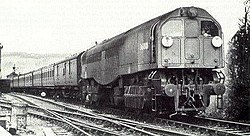
A side-and-front view of an 0-6-0+0-6-0 tank steam locomotive travelling towards the cameraman. The locomotive is a cuboid that contains boiler, fuel and cabs. The cuboid sits on two 0-6-0 bogies. It is hauling a train of around seven carriages past a signal box in the background.
Leader locomotive 36001 with test train at Oxted
Type and origin
Power typeSteam
DesignerOliver Bulleid
BuilderSR Brighton Works
Build date1946–1949
Total produced5 (only one completed)
Specifications
Configuration:
 • Whyte0-6-6-0T (de jure)
0-6-0+0-6-0T (de facto)
 • UICC'C' h6t
Gauge4 ft 8+12 in (1,435 mm) standard gauge
Driver dia.5 ft 1 in (1.549 m)
Length67 ft (20.42 m)
Loco weight150 long tons (168 short tons; 152 tonnes)
Fuel typeCoal
Fuel capacity4 long tons (4.5 short tons; 4.1 tonnes)
Water cap.4,000 imp gal (18,000 L; 4,800 US gal)
Firebox:
 • Grate area25.5 sq ft (2.37 m2)
Boiler pressure280 lbf/in2 (1.93 MPa)
CylindersSix (Three in each bogie)
Cylinder size12+14 in × 15 in (311 mm × 381 mm)
Valve gearBulleid chain driven valve gear
Performance figures
Tractive effort26,300 lbf (116.99 kN)
Career
Operators
ClassSR / BR: Leader
Power classSR / BR: Unknown
NicknamesThe Chinese Laundry
LocaleSouthern Region
Withdrawn1951
DispositionAll scrapped

The Leader was a class of experimental 0-6-0+0-6-0T steam locomotive, produced in the United Kingdom to the design of the innovative engineer Oliver Bulleid. The Leader was an attempt to extend the life of steam traction by eliminating many of the operational drawbacks associated with existing steam locomotives. It was intended as a replacement for the ageing fleet of M7 class tank engines still in operation on the Southern Railway (SR).[2] Design work began in 1946 and development continued after the nationalisation of the railways in 1948, under the auspices of British Railways (BR).

The Leader project was part of Bulleid's desire to modernise the steam locomotive based on experience gained with the Southern Railway's fleet of electric stock.[2] Bulleid considered that attitudes towards the labour-intensity of steam operation had changed during the post-war period, favouring dieselisation and electrification. In an effort to demonstrate the continued potential of steam, Bulleid pushed forward the boundaries of steam-power, hoping it could compete with diesel and electric locomotives in terms of labour-saving and ease of operation.[3]

The design incorporated many novel features, such as the use of thermic siphons, bogies and cabs at either end of the locomotive, resulting in its unique—for a steam locomotive—modern diesel-like appearance. Several of its innovations proved to be unsuccessful however, partly accounting for the project's cancellation in the early 1950s. Five Leader locomotives were started, although only one was completed. The operational locomotive was trialled on the former Southern Railway network around Brighton. Problems with the design, indifferent reports on performance and political pressure surrounding spiralling development costs, led to all locomotives of the class being scrapped by 1951.

Background

[edit]

The basis of the Leader originated from a 1944 review of the Southern Railway's steam locomotive fleet, resulting in a Southern Railway design brief which called for a high-powered locomotive requiring little maintenance to replace the ageing fleet of M7 class tank engines.[2] The brief also stipulated that the locomotive would be used on both passenger and freight trains, requiring high route availability. Bulleid proposed an initial design based on his SR Q1 class locomotive, which had proved easy to maintain in service.[3] As the proposal progressed, Bulleid saw that certain tasks required with conventional steam locomotives could be eliminated by adopting some of the features of the contemporary Southern electric locomotives.[2] However, one of the subsequent designs of a 0-4-4-0 wheel arrangement had an unacceptably high axle-loading of 20 long tons (20.3 tonnes; 22.4 short tons), which increased the risk of damaging the Southern Railway's track.[4] By developing the proposal further, Bulleid settled for a 0-6-0+0-6-0T design of bogie locomotive, which spread the weight more evenly over the rails and reduced the axle-loading.[5]

Design

[edit]
A line diagram of an 0-6-0+0-6-0 tank steam locomotive showing side and front profiles. It includes principal dimensions and weights.
Works diagram of the Leader

A series of initial ideas were presented to the Southern Railway management by Bulleid that incorporated double-ended running, giving the locomotive driver maximum visibility in either direction without a boiler or tender obscuring his view. The need for a turntable to turn the locomotive was therefore eliminated, although the initial designs were rejected by the operating department because of problems with welding technique.[6] The accepted design included two 0-6-0 steam bogies with weight-saving sleeve valves and chains to couple the driving axles. The boiler was offset to provide space for a communication corridor, allowing the driver to access both cabs without leaving the locomotive, an arrangement which led to later problems.[7] The firebox, near the centre of the locomotive, was fed by the fireman from a third cab, linked to both driving cabs by the communication corridor.[8] The entire ensemble was placed on a common frame and thus often referred to as an 0-6-6-0T, even though the actual notation is 0-6-0+0-6-0T since both engine units pivoted as on a Garratt, Double Fairlie or Meyer locomotive.[9][10][11][12]

The Leader prototype was constructed at Brighton railway works, work beginning in 1946.[6] An initial order for five locomotives was placed straight from the drawing board in 1946 and a further 31 were ordered in 1947, although, with nationalisation looming, this was merely a gesture.[13] The latter order was cancelled after the Southern Railway was taken into public ownership, to allow trials to be carried out on the prototype.[13]

Bogie and cylinder design

[edit]

Each of the two bogies had three cylinders, with the driving wheels connected by chains enclosed in an oil-bath, based upon Bulleid's chain-driven valve gear on his Pacific locomotives.[14] The valve gear used the unusual sleeve valve arrangement that was also tested on the ex-LB&SCR H1 class Hartland Point in parallel with the construction of the first Leader locomotive.[14] The Leader was the first steam locomotive to use a form of sleeve valve since Cecil Paget's locomotive of 1908 and the concurrent testing of the principle on Hartland Point hints at the rushed nature of the locomotive's conception.[15] The locomotive sat on the unusual Bulleid Firth Brown wheels, which were lighter, yet stronger, than the spoked equivalent.

The use of sleeve valves and oil baths to lubricate the moving parts of the engine units was inspired by contemporary internal combustion engine practice.[6] This included oscillating gear that gave a 25-degree axial movement to the sleeves, allowing even lubrication of the moving parts.[16] However, this resulted in an over-complicated mechanism that was difficult to maintain, perpetuating the seizures it was meant to eradicate. This feature was removed from both bogies of the prototype as the trials progressed.[17] Another innovative feature of the steam bogie assembly was the ability to interchange them when faults occurred, an easy operation for maintenance staff when compared to the complexities of overhauling a regular steam locomotive's motion.[4]

The three cylinders of each bogie were cast in mono-block format, each surrounded by two annular inlet steam chests and a single large outlet steam chest.[16] These had the added function of keeping the cylinder heated by hot steam to maintain the temperature and pressure of steam entering the cylinders. However, these castings were difficult to machine accurately.[16] The steam-sealing arrangements needed for this system were also complex, with each of the six cylinders and valve sleeves requiring 24 sealing rings.[15]

Boiler, firebox, smokebox and casing design

[edit]
A picture of a steam locomotive boiler under construction. The firebox is a cube with curved top and is in pieces ready for welding. Various components are scattered about the floor of a boilershop at a locomotive works site.
The Leader boiler and firebox, showing the offset firehole door position (dotted). Also visible are two of the four thermic siphons.

The boiler was the culmination of lessons learned with the Pacifics and was a prolific steam-raiser. All Leader boilers were constructed at Eastleigh, and proved to be the least problematic area of the entire design.[14] The boiler pressure was set at 280 psi (1,900 kPa) and each was fitted with four thermic siphons within the firebox, both to increase the rate of evaporation and improve water circulation.[18] These had been used previously to great effect on Bulleid's Merchant Navy and West Country and Battle of Britain class designs.[18]

The Leader had a "dry lining" firebox. It was not surrounded on top and sides by a "jacket" of water as in normal practice,[19] but was constructed of welded steel and used firebricks instead of water for insulation, a novel but troublesome solution.[6] Using firebricks reduced the grate area from 47 square feet (4.4 m2) to 25.5 square feet (2.37 m2) and concentrated the fire in a smaller area.[19] The firehole door was offset to the left of the boiler backhead, which created difficulties for the fireman when adding coal to the fire.[20] The firebox was not initially equipped with a firebrick arch, although one was retro-fitted during the summer of 1950.[21] The arch was problematic because it led to a tendency for flames to enter the cab at high outputs, a situation made worse by the narrowing of the firebox area.[21]

The smokebox had an inherent problem in maintaining a constant vacuum. This was a result of another Bulleid labour-saving innovation, a sliding hatch controlled from the front cab, that enabled ash to be cleaned out via a chute onto the track when the locomotive was on the move.[22] The problem lay with ash gathering around the edges of the slide, allowing air to leak into the smokebox, thereby reducing the overall efficiency of the locomotive.[19] The fierce blast from the exhaust also meant that ash and embers were ejected into the atmosphere, creating a potential lineside fire hazard.[23]

For ease of maintenance, the boiler, firebox and smokebox were encased in steel sheeting, which meant that the engine's shape resembled that of a modern diesel locomotive. That was a major departure from traditional steam locomotive design, allowing the engine to be cleaned using a carriage-washing plant.[24] The locomotive was designed to carry 4 tons (4.06 tonnes) of coal and 4,000 imperial gallons (18,000 L; 4,800 US gal) of water, and the coal bunker was covered by a tarpaulin to prevent water ingress into the fireman's cab.[1] Entry into the locomotive was by way of ladders leading up to sliding doors, although, due to the bogie design, the climb into the fireman's cab necessitated clambering over the oilbath casing.[19]

Construction

[edit]

Construction of the first five Leader locomotives began at the Southern Railway's Brighton railway works in July 1947.[25] British Railways inherited the Leader project upon nationalisation in 1948, which was far enough advanced to continue constructing the prototype, as Bulleid was still chief mechanical engineer of the newly formed Southern Region of British Railways.[26] Although work on the other four locomotives stalled, the prototype Leader emerged from Brighton as locomotive No. 36001 in June 1949.

The other four members of the initial order made by the Southern Railway, Nos. 36002–5, were at varying stages of construction by the end of the development period. No. 36002 was almost complete, No. 36003 was without its outer casing, and Nos. 36004–5 were little more than sets of frames, although most of their major components had been constructed at Eastleigh and Brighton and were stored ready for fitting.[6] With no prospect of further money being allocated by the Railway Executive for their completion, the unfinished locomotives were put into store at various depots around the former Southern Railway network pending a decision on their future.[6]

Operation

[edit]

With a calculated tractive effort of 25,350 lb, the Leader was given the power classification of 5.[27] This was considerably lower than the contemporary WC/BB pacifics which were rated as class 7, and this meant that the Leader had to be able to have an axle loading that would allow it to operate over secondary routes and on branch lines where the double-ended design would be of most benefit, something that was not likely with the weight inherent in the design.

On completion, No. 36001 was immediately put into service trials using empty passenger carriage stock in the south-east of England.[6] The official trial records kept at Brighton works reported varying degrees of success and failure on the runs undertaken.[28] However, the results of the trials as reported to British Railways headquarters at Marylebone were "conspicuous by the absence of praise" for the strengths of the Leader, namely the boiler, braking system and total adhesion provided by the two bogies.[29] Several theories have been put forward regarding this state of affairs, the most plausible being that the more conservative members of the railway workforce at Brighton and the Railway Executive felt that the Leader was too revolutionary and were keen to maintain the status quo.[30]


A picture of a locomotive under construction. The cuboid box containing cabs and boiler is being lowered onto the two bogies by a crane inside a locomotive works. Various components are scattered in the foreground.
The Leader being lifted onto its power bogies at Brighton, May 1949. The casing allowed the locomotive to be put through a carriage-washing plant.

Following trials that lasted over a year, No. 36001 was shown to have several flaws, including heavy coal and water consumption, mechanical unreliability, untenable working conditions for both fireman and driver, loss of steam through the cylinder rings and uneven weight distribution on the bogies. After renewing the cylinder assembly, it was tested around Brighton and Eastleigh using an LNER Dynamometer car, where good running was experienced at high costs in fuel and effort on the part of the fireman. For a period of two weeks the Leader was tested against the performance of a U class locomotive[27] which indicated that the brake release was too slow in service for use on tight schedules despite the brake application being noted as the best used on a Bulleid design.[31] These trials were interrupted by breakage of the crank axles, these being replaced by axles from 36002 only for these to break in turn at approximately the same mileage as the originals.[27]

Throughout No. 36001's trials, the firebrick lining provided a constant problem by continually collapsing into the fire.[8] The firebricks were then replaced with cast iron substitutes that melted in the intense heat of the firebox, which were in turn replaced by thicker 9-inch (230 mm) firebricks.[6] Some of the firemen allotted to the Leader complained about cramped conditions in the centre cab of the locomotive, a situation made worse by flames entering the cab from the firebox at high outputs.[23] It was an enclosed space that was constantly hot and the single fireman's entrance door on the side of the locomotive was left open during travel to promote ventilation.[8] The door into the fireman's cab also attracted criticism, as it would have been blocked in the event of the locomotive overturning on that side, preventing the fireman's escape, so that members of the railway trade union ASLEF threatened to stop their crews from operating the Leader.[19] Measurements in the fireman's cab showed temperatures could reach 120 °F (50 °C) earning the locomotive the nickname of The Chinese Laundry due to the heat and humidity.[27]

During work on the crank axles at Eastleigh Works the opportunity was taken to place the locomotive on the weighbridge which showed that the offset boiler and coal bunker caused the locomotive's centre of gravity to be shifted to one side.[27] Experiments had to be undertaken to balance the locomotive by filling the linking corridor with large quantities of scrap metal, replaced in a re-design by a raised floor, covering the weighted material. These modifications resulted in the engine exceeding the total weight limit of 150 tons (151 tonnes), severely limiting the design's route availability during testing.[32] A related problem was that despite being a tall locomotive, at 12 feet 11 inches (3.94 m), the cab ceilings were relatively low. The cab at the smokebox end of the locomotive suffered from the same excessive heat as did the fireman's cab. To circumvent this problem the locomotive was used in reverse, as the rear cab was next to the water tank and coal chute and therefore away from the hot gases circulating inside the smokebox.[33]

Despite its problems, the locomotive displayed outstanding steaming characteristics and total traction from the two power bogies on its trial runs.[34] When properly fired, the Leader was capable of keeping up with the schedules, even running ahead on occasions. However, operational difficulties were encountered when stopping for water - not only did the locomotive use water at a rapid rate, requiring frequent stops but the all-enclosed casing and the overall height of the locomotive meant that many of the water cranes were too low to feed directly into the water tank, thus requiring either an improvised arrangement of scoops and hoses or filling the tank from a standpipe and hose - both options greatly extended the amount of time needed to take on water. These delays tended to lose any time advantages gained when the locomotive performed well and affected the published performance figures.[35] Despite hauling test trains over the Central Section of the former Southern Railway, the Leader prototype was never used on a revenue-earning service because of the risk of failure of the valve gear and the adverse publicity this would cause for British Railways.[36]

Livery and numbering

[edit]

Southern Railway

[edit]

When the project was under the auspices of the Southern Railway, No. 36001 would have been numbered CC101.[1] Bulleid advocated a continental style of locomotive nomenclature, based upon his experiences at the French branch of Westinghouse Electric before the First World War. The Southern Railway number followed an adaptation of the UIC classification system where "C" refers to the number of driving axles – in this case three on each bogie.[37] Since the design has six driving axles, the numbering would have been CC101–CC105 for the initial batch, the final number being the locomotive identifier.

British Railways

[edit]
Leader 36001 outside Brighton works in 1949

Operational livery was photographic grey with red and black lining. The British Railways "Cycling Lion" crest was also used, though after the works photograph this was painted over without explanation.[6] Numbering was the British Railways standard system, in the 36001 series.[6] If the class had gone into full production, the locomotives would have been painted in British Railways mixed traffic/freight black livery with red, grey and cream lining. 36001 was initially painted in this livery but this preceded the official works photograph and was subsequently repainted in photographic grey.[38]

Operational assessment

[edit]

Production of the Leader demonstrated the inherent unsuitability of encasing a steam boiler in an enclosed superstructure. The environment inside was highly unsuitable, the weight was prohibitive, and necessary maintenance such as boiler washouts could only be achieved by a major dismantling of the locomotive.[27]

Despite the high expectations attached to the Leader, it was not the motive power revolution that Bulleid intended it to be. No part of the Leader design was perpetuated on the British Railways Standard class locomotives by Robert Riddles, nor did it find favour internationally, with the Garratt locomotives providing a similar function for less maintenance.[3] The whole concept was quietly dropped in 1951 after Bulleid left British Railways to become Chief Mechanical Engineer of Córas Iompair Éireann (where he produced CIÉ No. CC1, a peat-burning locomotive to a similar design) and all five were scrapped.[3] The culmination of the project was a £178,865 5s 0d (equivalent to £7,741,108 as of 2023[39]) bill for the taxpayer though, when the press reported the story as late as 1953, it was claimed that £500,000 (equivalent to £21,639,498 as of 2023) was wasted on the project.[40] R. G. Jarvis, who was placed in charge of the project after Bulleid's departure, insisted that the locomotive required an entire re-design to solve the problems of the original concept.

After the problems during the trials in 1950, in November of that year 36001 and the four other Leader locomotives then in various stages of assembly were all cut up for scrap.[27] Only the numberplates of No. 36001 and No. 36002 are known to exist.[41] The numberplate for No. 36001 is in the National Railway Museum; a locomotive builder's plate intended for the locomotive, but never fitted in service, was auctioned for £1050 in 2008.[42] The Leader was a bold attempt at pushing back the boundaries of contemporary steam locomotive design and, if successful, might have prolonged the life of steam on British Railways.[3]

References

[edit]

Further reading

[edit]
[edit]
Revisions and contributorsEdit on WikipediaRead on Wikipedia
from Grokipedia
The SR Leader class was an experimental class of 0-6-6-0T articulated steam locomotives designed by Oliver Bulleid, Chief Mechanical Engineer of the Southern Railway (SR), as a versatile mixed-traffic engine intended to compete with emerging diesel and electric traction while replacing older tank locomotives like the M7 class. Only one , numbered 36001 and named Leader, was fully completed and operational, constructed at Works between 1948 and June 1949, with five originally planned but the project ultimately limited to partial assembly of additional units before cancellation in March 1951. Bulleid's innovative emphasized efficiency and low maintenance, incorporating twin power bogies for bidirectional operation without turning facilities, all-welded construction including a modified Pacific-type operating at 350 psi, and oscillating s driven by chain gear to reduce wear and enable higher speeds up to 90 mph. The locomotive measured 67 feet in length and weighed approximately 120 tons, utilizing lightweight Bulleid Firth Brown (BFB) wheels with a 5-foot-1-inch for improved strength and reduced unsprung . During trials beginning in June 1949, Leader demonstrated promising performance in tests but encountered significant issues, including excessive weight distribution (24.5 tons per axle), overheating in the cab, unreliable operation, and poor crew conditions, compounded by the post-war shift toward and dieselization on the SR network. Despite these challenges, the class represented one of the boldest attempts to modernize British technology, influencing later discussions on locomotive but never entering production.

Development and Background

Origins and Requirements

In 1944, the Southern Railway conducted a comprehensive review of its freight locomotive maintenance challenges, prompted by the increasing obsolescence and high upkeep costs of its aging fleet, particularly the M7 class 0-4-4 tank engines that had been in service since the late 19th century. These locomotives, originally designed for suburban passenger duties, were increasingly tasked with freight operations, leading to visibility issues when running tender-first and overall inefficiency in handling heavier post-war loads. The review, held in December 1944, highlighted the need for a new generation of tank engines that could provide better adhesion, reduced maintenance, and improved operational flexibility without relying on tenders. Following , the Southern Railway faced mounting pressure to modernize its designs to accommodate heavy freight traffic on its extensively electrified network, where full electrification for freight services remained impractical due to cost and infrastructure limitations. Despite significant progress in third-rail electrification for passenger services, steam traction was still essential for freight over these lines, exacerbating maintenance demands amid material shortages and economic recovery efforts. Railway officials, including the Traffic Manager, emphasized the urgency for powerful, self-contained tank locomotives capable of replacing the M7s while operating efficiently in mixed-traffic roles, with requirements for enhanced visibility, longer ranges between refueling stops, and compatibility with electrified routes. In response, an initial proposal emerged in January 1945 for the construction of 25 experimental tank locomotives to test advanced freight traction concepts, later limited to five +T articulated units approved in 1946, marking a bold step toward innovative engineering. Oliver Bulleid, the Southern Railway's Chief Mechanical Engineer, played a pivotal role in championing this project, drawing on his experience with wartime designs like the Q1 class to advocate for features such as double-bogie arrangements for superior weight distribution and reduced wear, aimed at minimizing maintenance while boosting efficiency and power output beyond existing classes. Bulleid's vision positioned the Leader class as a versatile solution to compete with emerging diesel alternatives, aligning with the railway's pre-nationalization push for forward-thinking technology.

Design Influences

The SR Leader class represented an evolution of design principles first explored in the 0-6-0 freight , which Oliver Bulleid had developed during as an austerity engine with a rigid for high on heavy goods trains. Bulleid adapted the Q1's compact, welded steel frame and efficient power layout—originally constrained by wartime material shortages—into a configuration, initially considering 0-6-2 and 0-6-4 wheel arrangements before settling on articulated bogies with all wheels driven to enable bidirectional operation and greater route availability across the Southern Railway's network. This progression allowed the Leader to build on the Q1's proven simplicity and low axle loading while addressing limitations in speed and versatility for postwar traffic demands. Drawing from his innovations on the Pacific locomotives, Bulleid incorporated electric-like traits into the Leader, including chain-driven sleeve valves for the cylinders, which promised reduced maintenance and higher by eliminating traditional slide valves. These sleeve valves, first tested on a modified SR H1 class (No. 2039 'Hartland Point'), were oil-bathed and positioned within the bogies to minimize space and weight, reflecting Bulleid's aim to emulate the reliability of electric traction systems he had observed during his earlier career at the London, Midland and Scottish Railway. Additionally, the firebox featured four thermic siphons—welded circulatory passages inherited directly from the design—to boost evaporative capacity and steam production without increasing overall size, thereby enhancing the locomotive's for sustained high-speed running. The Leader's external casing and cab arrangement were heavily influenced by contemporary diesel-electric locomotives, adopting a streamlined, fully enclosed body to improve , reduce ingress, and provide superior crew protection from the elements—features Bulleid admired for their modernity and operational efficiency. This styling, with its smooth sheet-metal sheathing and integrated , positioned the driver at the leading end with duplicated controls at both ends, mirroring the cab-forward layout of electric units to facilitate quick reversals without runarounds, much like Bulleid's exposure to American streamlined diesels during wartime consultations. Overall, Bulleid envisioned the Leader as a pioneering "leader" for mixed-traffic duties, blending conventional steam propulsion with mechanical simplicity akin to non-steam technologies to achieve a versatile engine capable of 90 mph speeds, 80 miles on a single water fill, and coverage of 97% of Southern Railway routes without tender assistance. This hybrid approach sought to future-proof steam traction against encroaching electrification and dieselization by prioritizing welded construction, automatic lubrication, and bogie-mounted power units for easier maintenance and higher utilization.

Technical Design

Bogie and Cylinder Arrangement

The SR Leader class locomotives adopted an innovative , comprising two independent six-wheel s that together provided all twelve driving wheels for . Each functioned as a self-contained power unit, with the mounted centrally and supported by the s via pivot centers, allowing the locomotive to for enhanced maneuverability on curved tracks. This design distributed the locomotive's weight evenly across the axles while maximizing for mixed-traffic duties. Each incorporated three cylinders—two outside and one inside—driving the central through connecting rods, powered by Bulleid's chain-driven . This gear, enclosed in an for protection, transmitted motion via chains to the mechanisms, enabling precise control of admission and exhaust while reducing the need for external rods that could snag on trackside obstacles. The cylinders measured 12.25 inches in by 15 inches in stroke, optimized for the compact space. A key feature was the use of technology in the , marking the first application in a British locomotive since early 20th-century experiments. Each employed a single oscillating sleeve that rotated and slid within the bore to uncover inlet and exhaust ports, eliminating traditional piston valves and their associated glands. This arrangement shortened passages for better , reduced cylinder condensation, and improved maintenance by minimizing wearing parts and enhancing lubrication through the sleeve's surface contact. The sleeves were driven by the chain gear, providing smooth operation with lower friction compared to conventional systems. The overall configuration delivered a tractive effort of 26,300 lbf at 100% boiler pressure, sufficient for accelerating heavy freight trains to match performance. The locomotive's total weight of approximately 150 long tons was managed through careful axle loading distribution, but the prototype's actual weight resulted in axle loads exceeding 20 long tons on some s, violating Southern Railway route restrictions and highlighting balance challenges in the articulated design. The articulation mechanism relied on spherical bearings at the bogie pivots and flexible steam pipes connecting the boiler to each power unit, permitting independent swiveling of the bogies through angles up to 6 degrees. This allowed of tight curves with a minimum of 5.5 chains (approximately 402 feet), reducing flange wear and risk while maintaining stability at speed. The bogies could be detached and interchanged for , a practical feature for workshop efficiency.

Boiler, Firebox, and Smokebox

The of the SR Leader class was designed for a working pressure of 280 psi, providing a total heating surface of 2,389 sq ft (222 m²), and incorporated thermic siphons in the firebox to enhance efficiency by improving and water circulation. The firebox featured a grate area of 25.5 sq ft, equipped with a arch to direct gases effectively and a self-cleaning apparatus to manage the high consumption required for the locomotive's power output. In the , elements contributed 453 sq ft (42.1 m²) of heating surface, while specialized exhaust arrangements optimized draft efficiency to support sustained steaming performance. The locomotive's water capacity stood at 4,000 imperial gallons, complemented by a capacity of 4 long tons, enabling extended operational ranges without frequent refueling.

Casing, Cab, and Auxiliary Features

The SR Leader class locomotives were characterized by their innovative streamlined casing, designed to mimic the appearance of contemporary diesel and electric locomotives for improved and reduced operational noise. Constructed from welded steel panels, the casing formed a smooth, box-like that covered the , firebox, and much of the running gear, including an for the bogies to minimize maintenance needs. This air-smoothed profile not only aimed to lower air resistance but also provided a protective barrier against and , contributing to the locomotive's modern, unconventional aesthetic. Dual cabs were positioned at each end of the to facilitate bi-directional running, eliminating the need for turning facilities and enhancing efficiency on mixed-traffic duties. Each cab featured enclosed compartments for the driver, with duplicated controls, , and a side corridor connecting to the central fireman's position for crew coordination. Ventilation and heating systems were incorporated, but in practice, they proved inadequate, resulting in excessively hot conditions—often over 100°F (38°C) in the fireman's compartment due to proximity to the firebox and poor insulation, forcing crew to rely on open windows and doors for relief. Auxiliary systems supported the locomotive's advanced design, including electric lighting throughout the cabs and corridors for safe operation in low-visibility conditions. A was fitted to automate coal feeding into the firebox, addressing the challenges of the large firegrate in a high-output . Air compressors provided pneumatic assistance for the braking system, ensuring reliable control during bi-directional travel. The itself was fully enclosed within the streamlined casing for protection and aesthetic integration. Overall dimensions included a of 67 ft (20.42 m) and a width of 9 ft (2.74 m), making the Leader one of the longer tank locomotives of its era.

Construction

Prototype Assembly

The prototype of the SR Leader class was constructed at Brighton Works, with preparatory work beginning in 1946 and major assembly starting in 1947 following approval for the project. The construction spanned from 1946 to June 1949, during which the Southern Railway was nationalized on 1 1948, placing the ongoing build under British Railways ownership. Key milestones included the fabrication and initial testing of the power bogies in 1947, which were among the most innovative components of the design; the ordering of materials in December 1946 and its subsequent installation in 1948; and the completion of assembly leading to steaming and final testing in 1949. The total cost for the reached approximately £176,000 by early 1950, reflecting the extensive experimental features such as the articulated bogies and coal-fired . Initially allocated the Southern Railway number CC1 under Bulleid's continental-style classification for the 0-6-6-0 , the was renumbered 36001 upon entry into British Railways stock after . This single unit represented a significant in unproven technology, with assembly emphasizing welded construction and modular components to facilitate potential future production.

Planned and Uncompleted Units

The Southern Railway initially planned to construct five examples of the Leader class, numbered 36001 through 36005, to facilitate comparative testing and evaluation of the innovative articulated design under the direction of Chief Mechanical Engineer Oliver Bulleid. This modest production run was intended to assess the locomotive's potential for mixed-traffic duties while addressing operational demands on , with the first unit serving as the prototype and the subsequent four enabling direct performance comparisons. Construction progressed beyond the prototype, with frames for additional units set up at Brighton Works beginning in May 1948, alongside the fabrication of boilers, cylinders, and other components for Nos. 36002–36005. However, work on these uncompleted locomotives halted in November 1949 following the completion and initial trials of No. 36001, after which the partially assembled units were stored and subjected to partial disassembly at Brighton Works, as well as sites at New Cross Gate and Bognor. By early 1951, the entire project was abandoned, and all uncompleted frames, boilers, and components were scrapped, primarily due to the prototype's operational shortcomings, including excessive weight, ergonomic issues for the fireman, and unreliable valve gear performance during dynamometer car tests. Economic pressures further sealed the fate of the additional units, as the actual construction costs for the prototype reached £176,000—nearly double the original £100,000 estimate—amid rising material prices and a strategic pivot toward dieselization and under British Railways. These factors, combined with unfavorable trial reports issued in December 1950, prompted the decision in March 1951 to cancel the class outright, preventing any further investment in what was deemed an unviable steam design.

Operational History

Testing and Trials

The prototype SR Leader class , No. 36001, began its initial trials in June 1949 on Southern Region lines, encompassing light engine runs as well as loaded freight hauls to evaluate its mixed-traffic capabilities. These early evaluations included dynamometer car tests for comparative performance against established designs like the SR U class 2-6-0. Performance during the trials revealed significant inefficiencies, with the achieving a top speed of 90 mph in light engine configurations but demonstrating high consumption—approximately 67 percent higher—and correspondingly elevated usage—47 percent higher—than a comparable U class locomotive. Such metrics underscored the design's ambitious power output at the expense of fuel economy, particularly under load where a 480-ton was successfully hauled during later evaluation runs. Early testing from 1949 to 1950 highlighted mechanical challenges, including a failure after roughly 6,000 miles and issues with the innovative gear, such as frequent component breakage and leakage leading to overheating concerns. These problems prompted modifications, including changes to assemblies to mitigate loss through the bogies. Following initial track tests near locations like and , No. 36001 undertook shunting and hump-yard duties to assess its versatility in yard operations.

Performance Issues and Withdrawal

During its operational trials in 1950 and 1951, the SR Leader class No. 36001 suffered from recurrent mechanical failures, notably sleeve valve seizures on the leading that frequently necessitated towing to workshops for repairs, alongside excessive vibration stemming from the articulated power bogies and poor crew visibility owing to the enclosed cab design and forward-facing orientation limitations. These issues were compounded by other defects, such as a broken crank after a test run and repeated collapses of firebricks in the firebox, which further hampered reliability. Maintenance requirements proved exceptionally high, surpassing initial projections due to the locomotive's innovative yet unproven features; this included frequent boiler washouts to combat priming and contamination exacerbated by the thermic siphons, as well as intensive bogie repairs to mitigate wear on the complex suspension and motion components. The need to remove outer body panels for access to the boiler and cylinders added to the labor-intensive servicing, contributing to escalating costs and delays in evaluation. Crew feedback underscored significant ergonomic and environmental shortcomings, with reports of cramped cab spaces causing severe heat buildup from inadequate insulation near the firebox, particularly in the fireman's compartment, and the operational complexity of the sleeve valve gear and oil-bath lubrication system demanding specialized skills and constant attention. These conditions rendered the working environment untenable for prolonged shifts, prompting strong objections from enginemen during trials. In light of these persistent problems and the shifting priorities toward diesel and electric traction under British Railways, No. 36001 was withdrawn from service in early 1951 after limited mileage in testing, having completed its final revenue run on 2 November 1950 hauling a 480-ton . The was then stored at pending disposal, and along with the incomplete frames of sister units 36002–36005, it was scrapped later that year, effectively ending the Leader project.

Livery and Numbering

Southern Railway Period

The SR Leader class locomotives were intended to receive the standard Southern Railway of casing accented with panels, a scheme typical of Bulleid's post-war for the company's express passenger fleet. This vibrant color combination, featuring a mid-chrome green body with sunshine lining on the casing edges and panels, was planned to enhance the modern aesthetic of the unconventional 0-6-6-0 articulated . Although construction began under Southern Railway auspices in 1947, the class's completion occurred after in 1948, and the planned livery was never applied. Numbering for the prototype followed the Southern Railway's wheel arrangement-based system, assigning it the identity CC101 to reflect its six coupled driving axles per end (CC denoting 0-6-0+0-6-0). The number was to be displayed in large 18-inch sans-serif lettering on the cab sides, using Oliver Bulleid's distinctive chain-line font for clarity and modernity. Accompanying this were elaborate "Southern Railway" scrolls in the same style, positioned below the number plates to affirm ownership during the brief pre-nationalization planning and early assembly stages. Due to the 1948 transition to British Railways, the SR livery and numbering scheme saw no realization on the Leader class. This underscored the rapid administrative changes impacting Bulleid's experimental project.

British Railways Period

Upon nationalization in 1948, the prototype Leader class locomotive No. 36001, the only completed example, transitioned to British Railways (BR) ownership while retaining its experimental character. It was introduced into service on 21 June 1949 in a plain silvery light grey livery without any lining or insignia, marking a departure from its Southern Railway origins. The partially assembled units 36002-36005 were allocated numbers but never completed, liveried, or entered service. By 28 June 1949, during trials at , No. 36001 was repainted in matt light , commonly referred to as photographic , to better suit official and testing documentation; this scheme included red and black lining added later in at Works, consisting of three panels per end and four per side. The locomotive received BR numbering as 36001, displayed in 4-inch yellow numerals positioned on the cab sides behind the access doors, along with cast number plates at the front of each cab end. The BR lion-and-wheel emblem was applied to one side of the body on 28 June, though it was subsequently painted out during further modifications in mid-. These markings underscored its experimental status, with additional test plates affixed to the bogies to monitor performance data during trials. As service progressed through 1950 into 1951, the photographic grey livery faded under exposure to the elements, accumulating grime from intensive testing and operational use without routine cleaning. By the time of its withdrawal and scrapping in March 1951, the once-distinct grey finish appeared weathered and soiled, reflecting the short-lived and troubled career of the .

Assessment and Legacy

Technical and Operational Evaluation

The SR Leader class featured innovative sleeve-valve gear, which aimed to enhance and reduce mechanical weight compared to traditional piston valves, allowing for a more compact suitable for mixed-traffic duties. This was complemented by a high power output, with the prototype capable of sustaining speeds up to 90 mph and hauling freight loads comparable to those of the Southern Railway's Q1 class or lighter Pacific locomotives, demonstrating potential for versatile freight and operations. However, these strengths were significantly offset by the overall complexity, including chain-driven valve actuation and dual articulated bogies, which introduced maintenance challenges and increased the locomotive's operational intricacy. Key weaknesses included substantial cost overruns during construction, with the prototype's expenses rising from an estimated £100,000 in September 1948 to £176,000 by January 1950 due to experimental components and fabrication difficulties. Reliability issues were prevalent, encompassing steam leakage in the valves, inconsistent firebox performance leading to poor steaming, and rapid corrosion of motion pins, which compromised long-term durability. Additionally, the design's axle loading of 24.5 tons—exceeding estimates by 5.5 tons—rendered it incompatible with much of the existing British railway infrastructure, limiting and exacerbating wear on tracks. In comparison to contemporaries such as the , the Leader exemplified high experimental risk through its unconventional articulated tank configuration and unproven technologies, whereas the 9F achieved widespread success as a reliable heavy freight locomotive with conventional and proven components, entering service in 1954 and proving economical for bulk coal and hauls. The Leader's bold innovations, while forward-thinking, lacked the iterative refinement that made the 9F a benchmark for steam freight power. The 1951 official evaluation by British Railways concluded that the class was uneconomical, citing the need for extensive modifications to address valve gear flaws, excessive fuel and water consumption (67% and 47% higher than the U class in trials, respectively), and the impending shift toward diesel and electric traction, which diminished the viability of further investment in experimentation. car tests in December 1950 further underscored these issues, revealing suboptimal performance such as sustaining only a 480-ton at 50 mph.

Preservation and Modern Interest

The SR Leader class locomotives were not preserved in their entirety, with the sole completed prototype, No. 36001, and partially built units scrapped by 1951 following the project's cancellation after trials in 1950. The only surviving artifacts are fragmentary components, including the numberplate from No. 36001, which entered the National Railway Museum's collection in 1994 and represents the class's brief experimental legacy. A builder's plate intended for the prototype No. 36001 but never fitted was sold at private auction in 2008, further underscoring the absence of substantial physical remains. In the , scholarly and enthusiast assessments of the Leader class continue to highlight Oliver Bulleid's visionary approach to design, praising its articulated 0-6-6-0 configuration, enclosed cabs, and integrated coal and water carrying as bold innovations aimed at improving efficiency and crew conditions amid the transition to diesel. However, these analyses consistently critique the execution, noting issues such as excessive weight, mechanical complexity, and thermal inefficiencies that undermined performance during trials, leading to the class's rapid abandonment without entering revenue service. As of 2025, no significant new archival discoveries or reevaluations have emerged to alter this consensus, with interest sustained primarily through historical retrospectives rather than fresh . The class maintains a niche presence in heritage modeling, where its unconventional form inspires detailed scale reproductions for enthusiasts. Recent developments include KR Models' ready-to-run versions released in 2024 and 2025, featuring the prototype in Southern Railway grey livery and British Railways black, complete with functional details like chain-driven representations. These models, produced in limited variants, cater to collectors interested in Bulleid's experimental ethos and have been showcased at model railway exhibitions, such as the 2017 Bristol Show, where related Bulleid artifacts were displayed alongside simulations of Leader operations. Digital simulations remain limited, with basic representations appearing in older titles like , though no prominent modern video games or comprehensive train simulator add-ons feature the class as of 2025, reflecting its obscurity beyond specialist circles. Occasional exhibitions of Bulleid-related artifacts indirectly link to the Leader's legacy, such as the National Railway Museum's display of the numberplate during curator talks on experimental locomotives, which contextualizes the class within Southern Railway's innovative postwar efforts. Similarly, gauge-1 models, like the prototype recreation at the Brighton Toy and Model Museum, highlight the design's enduring curiosity among preservationists focused on Bulleid's broader contributions.
Add your contribution
Related Hubs
User Avatar
No comments yet.