Hubbry Logo
Saale glaciationSaale glaciationMain
Open search
Saale glaciation
Community hub
Saale glaciation
logo
8 pages, 0 posts
0 subscribers
Be the first to start a discussion here.
Saale glaciation
Saale glaciation
from Wikipedia
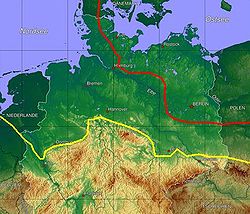
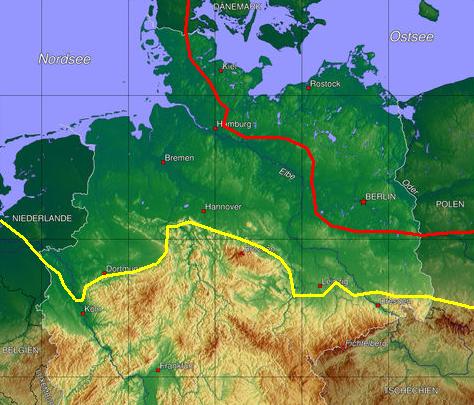
Maximum extent (Drenthe stadium) of the Saale complex (yellow line). The red line shows the greatest extent of the younger Weichselian glaciation.

The Saale glaciation or Saale Glaciation, sometimes referred to as the Saalian glaciation, Saale cold period (German: Saale-Kaltzeit), Saale complex (Saale-Komplex) or Saale glacial stage (called the Wolstonian Stage in Britain), covers the middle of the three large glaciations in Northern Europe and the northern parts of Eastern Europe, Central Europe and Western Europe by the Scandinavian Inland Ice Sheet. It follows the Holstein interglacial (Hoxnian Stage in Britain) and precedes the Eemian interglacial (globally known as the Last Interglacial and the Ipswichian in Britain), spanning from around 400,000 years ago to 130,000 years ago. The Saalian covers multiple glacial cycles punctuated by interglacial periods. In its latter part it is coeval with the global Penultimate Glacial Period.

Age and definitions

[edit]
Graph showing glacial cycles in Europe from 600-100,000 years ago, with the Saalian period labelled
Aurochs skull from the Saale complex of Ilford, UK

The Saalian succeeded the Holstein interglacial and was followed by the Eemian interglacial (which began around 130,000 years ago)[1] Though the start date of the Saalian was historically controversial, recent scholarship has suggested that the start date of the Saalian (and thus the end of the Holstein) is around 400,000 years ago.[2][3] The Saalian encompasses multiple glacial cycles separated by interglacial periods.[3] The first cold phase (Fuhne glacial) at the start of the Saale complexes is separated by a warmer period (Dömnitz interglacial) from the actual Saale "ice age". The term "Saale Ice Age" or "Saale Glacial" thus has 2 meanings in the literature – it sometimes refers to the phase in which the glacier advanced into North Germany, but can also refer to the whole Saale complex. The terms are frequently interchanged in the literature.[Footnote 1]

The Saale Glaciation occurred at around the same time as the Wolstonian Stage in the British Isles and the Illinoian Stage in North America.

In 1910, the name for "Saale glaciation" was given by German geologists Jacob Stoller and Konrad Keilhack.[4]

Extent

[edit]

The maximum advance of the ice sheet in North Germany during the Drenthe Stage is described by a line from Düsseldorf via Paderborn, Hamelin, Goslar, Eisleben, Zeitz and Meissen to Görlitz. From the eastern edge of the Harz eastwards (Poland, Brandenburg, Saxony and Saxony-Anhalt) the ice advanced to about 10 to 50 km behind the maximum extent of the Elster glaciation. On the northern edge of the Harz the two ice sheets reached the same line; and west of the Harz the ice of the Saale complex extended over 100 km further south than the ice sheet of the Elster. In front of this line, i.e. in front of the former glaciers, fluviatile and periglacial sediments are widespread. In the Drenthe Stage the present day North Sea basin, Great Britain and Ireland were also affected.

Several species were hurt by the glaciation, including the woolly mammoths, which suffered a reduction comparable to the one towards the end of the ice age.[clarification needed]

The Würm glaciation (known in north Germany as the Weichselian) in comparison with the Riss (in north Germany as the Saale). Glacial advances were interrupted by warmer interstadials. In these some ancient European co-ancestors (the Neanderthals, as successors of homo heidelbergensis) spread out from mountain zones over the intermittent permafrost to the north and northeast. Then from about 40,000 BC European early modern humans more greatly settled these regions.

Sequence and subdivisions

[edit]

The Saale complex may be divided into a lower (also Saale Early Glacial[5]) and an upper section (also Middle and Upper Saale Glacial,[5] or Younger Saale glaciation[6]), with glacial advances into Northern Germany.

The Saale Early Glacial includes the:

  • Dömnitz interglacial, which was characterised by oak mixed forest, hazel and hornbeam. Worth mentioning is the discovery of Water Fern (Azolla filiculoides).
  • Fuhne glacial. After the end of the Holstein interglacial, the forests of North Germany died and a sub-arctic vegetation formed.

The upper part of the Saale complex (obere Teil des Saale-Komplexes) is characterised in North Germany by three great glacial advances (possibly even four in Schleswig-Holstein[7]). They are usually called the:

  • Warthe Stage or Stadium (Warthe-Stadium)
  • Drenthe Stage or Stadium (Drenthe-Stadium)
    • Drenthe II Phase (Jüngere Drenthe)
    • Drenthe I Phase (Haupt-Drenthe)

There are no indisputable traces in northern Germany of clear thermomers (interstadials, intervals) between these advances. In the work by Litt et al. (2007) focussed on the southern perimeter of the North German glaciations, the upper part of the Saale complex is subdivided as follows:

  • Warthe Stage (Warthe-Stadium)
  • Seyda Interval (Seyda-Intervall)
  • Drenthe Stage (Drenthe-Stadium)
    • Leipzig Phase (Leipzig-Phase)
    • Pomßen Interval (Pomßen-Intervall)
    • Zeitz Phase (Zeitz-Phase)
  • (Delitzsch Phase (Delitzsch-Phase)[Footnote 2])

The Drenthe Stage corresponds to the maximum extent of glaciation during the Saale complex. During the last stage, the Warthe Stage, glaciers only covered northeast Lower Saxony (parts of the Lüneburg Heath), the Altmark, the Elbe valley downstream of Magdeburg and the region east of it (cf. Südlicher Landrücken), so that these areas are geomorphologically younger than the Northwest German Plain, but older and exhibiting more surface weathering than the much later Young Drift areas of the Weichselian glaciation in northeast Germany. The areas last covered by the Saale cold period, roughly the Westphalian Bight, a large part of Lower Saxony and Saxony-Anhalt, south Brandenburg, or the Leipzig Bay and Lusatia in Saxony, are called the Old Drift Landscapes (Altmoränenlandschaften). They were further shaped and changed during the later Weichselian cold period by periglacial processes such as wind-borne sand and loess. The major urstromtal associated with the Saale glacial stage is the Breslau-Magdeburg-Bremen Urstromtal, which was not subsequently covered by ice.

See also

[edit]
Historical names of the "four major" glacials in four regions.
Region Glacial 1 Glacial 2 Glacial 3 Glacial 4
Alps Günz Mindel Riss Würm
North Europe Eburonian Elsterian Saalian Weichselian
British Isles Beestonian Anglian Wolstonian Devensian
Midwest U.S. Nebraskan Kansan Illinoian Wisconsinan
Historical names of interglacials.
Region Interglacial 1 Interglacial 2 Interglacial 3
Alps Günz-Mindel Mindel-Riss Riss-Würm
North Europe Waalian Holsteinian Eemian
British Isles Cromerian Hoxnian Ipswichian
Midwest U.S. Aftonian Yarmouthian Sangamonian

References

[edit]

Footnotes

[edit]

Literature

[edit]
Revisions and contributorsEdit on WikipediaRead on Wikipedia
from Grokipedia
The Saale glaciation, also known as the Saalian glaciation, was a major cold stage of the Middle Pleistocene epoch in northern and , spanning approximately 300,000 to 130,000 years ago and corresponding primarily to (MIS) 8 through 6. It represented the third extensive following the Günz and Elsterian glaciations, separated from the latter by the relatively warm Holsteinian interglacial (MIS 11, ~424,000–374,000 years ago), and preceding the Eemian interglacial (MIS 5e). During this period, massive Fennoscandian ice sheets advanced southward from , reaching as far as , , the , , and parts of the and , with the southernmost extents documented in the Leipzig Basin and . The Saale glaciation includes multiple substages, with early advances around 250,000–200,000 years ago (MIS 8), the main Substage (~175,000–150,000 years ago, MIS 6) representing the maximum extent, a Middle Saalian interstadial, and the later Warthe Substage (~150,000–130,000 years ago, late MIS 6), each marked by varying ice advances and retreats influenced by orbital forcings and climatic oscillations. Key geological features include widespread glacial tills (such as grey deposits), push moraines, valleys, and proglacial lake systems, which provide evidence of ice-marginal dynamics and drainage patterns across the European Lowlands. of ice-marginal sediments confirms the timing of these advances, with the Substage extending to central around 160,000–140,000 years ago and the Warthe Substage representing a northward retreat without reaching as far south. This glaciation played a crucial role in shaping the paleogeography of , influencing river systems like the and through and incision, and creating barriers that affected hominin migrations during interstadials. Fossil records from Saale deposits reveal cold-adapted faunas, including mammoths and , alongside evidence of tundra-steppe environments during glacial maxima and forested interstadials. The Saale's complex climatic variability, including brief warm episodes, underscores the transitional nature of Middle Pleistocene ice ages toward the more intense that followed.

Definition and Historical Context

Naming and Discovery

The Saale glaciation, formally termed the Saalian, derives its name from the River in central , where prominent glacial deposits served as the stratigraphic reference. The name was introduced by German geologist Konrad Keilhack in 1911 during his work with the Prussian Geological Survey, appearing first on detailed 1:25,000-scale geological maps of northern . These maps distinguished the Saalian till and associated features from earlier Elsterian and later Weichselian sediments, marking a key advancement in regional Pleistocene . Recognition of glacial activity in northern Germany began in the mid-19th century, building on the broader acceptance of the ice age theory following Louis Agassiz's proposals in the 1840s. However, direct evidence in the flat northern plains was subtler than in the Alps, relying on boulder clays (tills), erratic boulders, and striations. Swedish geologist Otto Torell provided pivotal early observations in 1875, identifying glacial striations on bedrock at the Rüdersdorf quarry near Berlin, which convinced many skeptics of Scandinavian ice sheet incursions into the region. Systematic surveys by the Prussian Geological Survey from the late 19th century onward mapped extensive till sheets and moraines, gradually differentiating multiple glacial episodes based on superposition and lithology. The type localities for the Saalian are concentrated in the Saale Valley exposures around Halle and , where sequences of reddish-brown overlie Elsterian deposits, interspersed with sediments like the Holsteinian. These sites, investigated during early 20th-century field campaigns, highlighted distinct Saalian characteristics, such as thicker layers and specific erratic compositions from Scandinavian sources. In the early , significant controversies surrounded the Saalian, particularly whether it constituted a single major glaciation or multiple discrete advances separated by milder intervals. Influenced by Albrecht Penck and Eduard Brückner's Alpine model of four glaciations (1909), some researchers initially viewed the Saalian as a unified event equivalent to the Riss stage, while others, drawing from northern sediment records, argued for subdivisions—later formalized as the , Warthe, and other substages. These debates persisted until the 1920s, when broader acceptance of polyglacialism solidified the Saalian as a complex Middle Pleistocene phase.

Terminology and Regional Equivalents

The Saale glaciation, also termed the Saalian glaciation or Saale complex, encompasses a series of glacial advances and intervals within the Middle Pleistocene of , reflecting a complex climatic regime rather than a uniform cold phase. This terminology underscores the period's internal variability, including multiple ice-sheet expansions punctuated by warmer episodes that facilitated sediment deposition and landscape modification. The name derives from the River valley in , where key stratigraphic sections were first identified, but contemporary usage emphasizes its role as a stratigraphic unit in regional frameworks. In modern , the Saalian is recognized by the International Union for Quaternary Research (INQUA) as a formal stage within the Middle Pleistocene, integrated into global correlations of glacial deposits and paleoclimatic records. INQUA classifications highlight its subdivision into early, middle, and late phases, often linked to broader European terrestrial sequences, and it serves as a benchmark for mapping ice-sheet extents and chronologies across continents. The term "Saale Ice Age" (Saale-Kaltzeit) is considered outdated in this context, as it misleadingly suggests a singular, monolithic glacial event, whereas evidence from till and records demonstrates a multi-phase sequence with distinct stadials and interstadials. Regionally, the Saalian finds equivalents in other stratigraphic schemes, facilitating cross-continental comparisons. In Britain, it aligns with the Wolstonian Stage, characterized by similar ice limits extending into the Midlands and East Anglia, with comparable till compositions and erosional features. Across the Atlantic, the Illinoian Stage in North America corresponds to the later phases of the Saalian, sharing evidence of extensive Laurentide ice-sheet dynamics and loess-paleosol sequences. In the Alpine region, the Riss glaciation serves as a southern European counterpart, marked by valley glaciations and moraine belts that parallel the northern plain advances of the Saalian complex. These alignments, established through lithostratigraphic and biostratigraphic correlations, underscore the Saalian's integration into a unified Quaternary framework.

Chronology and Stratigraphy

Age Estimates and Dating Methods

The Saale glaciation, a major Middle Pleistocene in , is estimated to have spanned approximately 300,000 to 130,000 years ago, commencing after the Holsteinian and concluding prior to the onset of the Eemian . This temporal range encompasses multiple cold phases within (MIS) 8 through 6, with associated fluvial beginning around 400 ka (MIS 11/early MIS 10) and its termination marked by deglacial warming around 150–130 ka. Determining the chronology of the Saale glaciation relies primarily on luminescence and radiometric techniques applied to glacial sediments, tills, and associated organic deposits, as traditional radiocarbon dating (¹⁴C) is ineffective for this period due to its limited range of about 50,000 years and the scarcity of suitable organic material predating 300 ka. Optically stimulated luminescence (OSL), particularly post-infrared infrared stimulated luminescence (pIRIR) on feldspar grains, has been instrumental in dating quartz and feldspar-rich sediments from ice-marginal and fluvial contexts, providing minimum ages for deposition during glacial advances. For instance, infrared-radiofluorescence (IR-RF) and OSL analyses of Saalian Main Terrace sediments in central Germany have yielded ages such as 236 ± 23 ka, constraining early phases of the glaciation. Cosmogenic nuclide dating, using isotopes like ¹⁰Be in exposed boulders and erratics, complements OSL by estimating exposure ages of moraines and marginal features, though inheritance from prior glaciations can introduce scatter in pre-Weichselian contexts. Uranium-thorium (U-Th) disequilibrium dating, applied to peat horizons and authigenic carbonates interbedded with glacial deposits, offers precise bracketing for deglacial and interstadial intervals, with ages from organic successions ranging 227 +9/-8 to 177 ± 8 ka in northern Germany. Recent studies have refined the Saale glaciation's timeline, particularly its onset and maximum extent. A investigation using OSL on sediments from German type localities pushed the start of Saalian fluvial to ~400 ka (MIS 11/early MIS 10), postdating the Elsterian glaciation, while the maximum ice advance ( substage) is dated to 300–250 ka based on ages from proglacial deltas and tills. Another study on northern central European sites corroborated these findings with OSL ages of 179 ± 51 ka for glacifluvial deposits, highlighting the role of multiple advances within the overall cycle. Uncertainties persist for the earliest phases (>300 ka) owing to potential incomplete bleaching in OSL signals and open-system behavior in U-Th dating of peats, necessitating integrated multi-proxy approaches for robust chronologies.

Relation to Interglacials and Global Cycles

The Saale glaciation is positioned within the Middle Pleistocene epoch, immediately following the Holsteinian interglacial, which spanned approximately 424 to 374 thousand years ago (ka) and corresponded to Marine Isotope Stage (MIS) 11. During the Holsteinian, experienced warm climatic conditions conducive to the development of mixed oak forests, including species such as Quercus and Corylus, reflecting a temperate phase with elevated temperatures and increased precipitation compared to preceding glacial periods. This interglacial marked a significant warming after the Elsterian glaciation (MIS 12), setting the stage for the subsequent Saalian cold phase through a transition involving gradual cooling and shifts toward more open landscapes. The Saale glaciation concluded with the onset of the Eemian around 130 to 115 ka, aligned with MIS 5e, which represented the last major warm period before the . In terms of global marine records, the Saale glaciation primarily encompasses MIS 8 through 6, characterized by multiple glacial advances, notably during MIS 8 (with an early Saalian ice expansion around 300–250 ka) and the prominent late Saalian advance in MIS 6 (approximately 190–130 ka). These stages reflect a composite glacial complex influenced by varying ice sheet dynamics across , with δ¹⁸O records from deep-sea cores indicating progressively colder benthic conditions and reduced global ice volume minima during the interstadials within this interval. Internally, the Saale glaciation included warmer interstadials, such as the Dömnitz interglacial around 220 ka, correlated with MIS 7, which featured temperate flora including oaks (Quercus spp.) and water ferns (e.g., Azolla filiculoides), indicative of lacustrine environments with mild summers and sufficient moisture for aquatic and deciduous vegetation. This phase interrupted the overall glacial progression, allowing brief recolonization by thermophilous plants in refugia south of the ice margins. The multi-phase nature of the Saale is tied to Milankovitch cycles, where variations in orbital eccentricity (with ~100 ka periodicity) modulated the amplitude of precessional forcing, while obliquity changes (~41 ka cycle) influenced seasonal insolation contrasts, promoting the observed sequence of glacial maxima and interstadials through enhanced Northern Hemisphere cooling during low-obliquity alignments.

Geographical Extent and Ice Dynamics

Maximum Ice Sheet Coverage

The Saale glaciation, particularly during its older phase associated with the substage, witnessed the achieve its maximum extent across northern and central Europe. This advance originated from the Fennoscandian highlands and extended southward to the Düsseldorf-Görlitz line in , encompassing vast areas of present-day , , , and the , while overriding the basin and much of the , including significant portions of . The ice sheet's coverage during this peak phase had its southern margins defined by terminal moraines and push ridges that marked the interaction between the advancing ice and pre-existing . Key structural elements of the ice sheet included prominent lobes that facilitated its southerly progression. The Baltic lobe protruded eastward through the depression, depositing tills rich in eastern Fennoscandian clasts across northern and the eastern German lowlands. Complementing this, the lobe advanced westward into the and northwestern , shaping the Embayment and influencing sediment distribution in the southern . Further west, the Irish Sea lobe extended from coalescing British-Irish ice masses, contributing to the glaciation of eastern and western Britain by channeling ice southward along the Irish Sea basin. These lobes collectively enabled the ice sheet to reach thicknesses of up to 2-3 kilometers in the Fennoscandian core, with modeled elevations exceeding 3,000 meters above sea level in central , supporting dynamic flow toward peripheral regions. While the older Saalian phase, linked to the Drenthe substage around 170 thousand years ago (MIS 6), represented the farthest overall advance, the younger Saalian Warthe phase exhibited more restricted extents, with ice margins retreating northward of the Düsseldorf-Görlitz line and confining major advances to and the . These variations reflect fluctuating climatic forcings and ice-sheet dynamics over the Saalian complex. Research from 2018 utilizing proglacial lake modeling has reinforced evidence for this extensive coverage, demonstrating how ice-dammed lakes in northern , with volumes up to 265 cubic kilometers, were impounded behind the advancing ice margins and drained via catastrophic overspills, thereby validating the reconstructed ice-sheet boundaries through integrated stratigraphic and geomorphic data.

Proglacial Lakes and Marginal Features

During the Saale glaciation, extensive proglacial lakes formed along the southern and western margins of the Scandinavian ice sheet in northern , primarily due to ice-damming of major river valleys such as the , , and . These lakes developed during ice advances in Marine Isotope Stage (MIS) 6, with water levels rising to altitudes of 160–200 m above as the ice blocked drainage pathways and impounded . Key examples include the Weser Lake, which reached a maximum extent of approximately 1870 km² and a volume of 120 km³, and the Leine Lake, covering about 900 km² with a volume of 36 km³; both were situated in the northwestern German lowlands near the Elbe region. Further east, the Halle-Leipzig Lake in the Saale-Unstrut basin expanded to 6245 km² and held up to 224 km³ of water, while the Münsterland Lake in the west attained levels up to 350 m a.s.l. during early phases. Sedimentary evidence for these lakes includes varved clays, which record annual deposition cycles from seasonal influxes and ice-rafted , particularly in the basin and valley. In the Valley, varved sequences up to several meters thick preserve fine-grained silts and clays interbedded with dropstones, indicating fluctuating lake levels and ice-margin proximity during retreat phases around 157–171 ka. Similarly, in the Rinteln area of the basin, varved clays document rapid calving and sediment delivery from subaqueous ice margins, with couplets reflecting summer suspension settling and winter ice cover. Lake drainage often occurred catastrophically through bedrock spillways, releasing outburst floods that incised channels and deposited coarse-grained sediments downstream toward the . Marginal features such as Urstromtäler—broad valleys—emerged as primary drainage routes for proglacial systems, with the Breslau-Magdeburg-Bremen Urstromtal serving as a major east-west corridor for Saalian discharge across . This 500-km-long feature, up to 50 m deep and 2–5 km wide, facilitated the evacuation of water from lakes like the Halle-Leipzig and Saale-Unstrut, bypassing subsequent ice advances and preserving a record of dynamic retreat. Along the southern ice limits, push moraines formed through compressive deformation of unconsolidated sediments during localized readvances, creating arcuate ridges in the Embayment and Leinebergland. These features, such as those near Freden and Bornhausen, exhibit thrust-block structures up to 15 m high, with folded glacilacustrine clays indicating oscillatory ice margins around 160 ka. Eskers, sinuous ridges of glaciofluvial and , also mark subglacial conduits exposed during , particularly in 's Baltic coastal areas where late Saalian examples are preserved offshore. Recent optically stimulated (OSL) of lake sediments has refined these marginal dynamics, confirming ages of 155–175 ka for proglacial deposits in the and regions and highlighting multiple retreat-readvance cycles in . For instance, OSL analyses of varved clays from the basin indicate dynamic ice margins with rapid rates exceeding 1 m per year during peak melt phases.

Internal Subdivisions

Early Saalian Stage

The Early Saalian Stage, also referred to as the Lower Saale or Fuhne glacial, marks the onset of the Saale glaciation approximately 400,000 to 300,000 years ago, encompassing Marine Isotope Stage (MIS) 10 for its primary cold phase. This stage followed the Holsteinian (MIS 11) and featured limited ice advances compared to subsequent phases, serving as a preparatory period for more extensive glaciations. records indicate a marked cooling after the Holsteinian warmth, with renewed dominance of open-ground plant taxa reflecting periglacial environments across northern and . During the Fuhne substage, periglacial conditions prevailed, including development in and minor expansions from into and the basin. Geological evidence includes deposits, push moraines, and buried channels, such as those on the Isle of , demonstrating ice invasion of the and areas but without reaching as far south as later advances. These features correlate with the Odranian glaciation in and the Dnieper glaciation in , highlighting a relatively confined Scandinavian activity. The stage transitioned around 300,000 years ago into the embedded Dömnitz interglacial (MIS 9), a temperate period characterized by the re-establishment of forests without significant marine influence. Palynological evidence from sites in and reveals vegetation succession toward mixed oak-hazel woodlands, indicating warmer, continental climates. This , separated from the Holsteinian by Fuhne sands, underscores the Early Saalian's role as an initial, interrupted cold phase before the intensification of glacial dynamics.

Middle and Late Saalian Stages

The Middle Saalian, known as the Stage, spanned approximately 250 to 160 thousand years (ka BP) and marked the peak intensity of the Saale glaciation with extensive thick ice sheets advancing across northern . This stage featured the maximum areal coverage of the Scandinavian , reaching far into , the , and , driven by severe cold conditions during Marine Isotope Stage (MIS) 8 and early MIS 6. The Stage is subdivided into two primary advances: the earlier I advance, dated to roughly 254–214 ka BP, which involved ice flow from southern , and the subsequent II advance around 175–156 ka BP, characterized by ice sourced from central and southern . These advances were interrupted by the brief Seyda interstadial, a short warmer interval following the initial push but still within the overall glacial MIS 6 framework, allowing limited vegetation recovery before renewed icing. Pollen records from this period reveal a pronounced shift to colder and drier climates relative to the early Saalian, with assemblages dominated by cold-steppe herbs such as Artemisia and grasses, indicating open tundra-like landscapes and reduced forest cover. Faunal evidence, including mammal remains from periglacial deposits, points to adaptations among herbivores like woolly mammoth (Mammuthus primigenius) and reindeer (Rangifer tarandus), reflecting harsher, arid conditions that supported sparse, drought-resistant ecosystems across unglaciated margins. The Late Saalian, or Warthe Stage, occurred from about 155 to 130 ka and represented a diminished readvance compared to the maximum, with ice lobes primarily affecting northeast , including the and regions. This stage included multiple pulses, culminating in the Phase as the final glacial surge, which deposited tills in the Basin and adjacent lowlands around 140–130 ka , signaling the waning of Saalian ice dynamics. Throughout the Middle and Late Saalian, the sequence alternated between intense stadials of ice buildup and brief interstadials of partial retreat, with spectra showing persistent cold indicators like high Pinus and Betula percentages alongside minimal thermophilous taxa, underscoring drier, continental . The complex concluded with progressive warming trends, evidenced by increasing toward the end, paving the way for the Eemian interglacial around 130 ka .

Geological Evidence

Sedimentary Deposits

The sedimentary deposits of the Saale glaciation primarily consist of glacigenic materials formed through subglacial, , and lacustrine processes, reflecting the dynamics of the advances across northern . These include a variety of tills, sorted fluvioglacial sediments, and fine-grained proglacial lake deposits, which are preserved in the subsurface and surface exposures of the . Tills represent the dominant subglacial sediments, encompassing tills deposited by direct ice-bed interaction and deformation tills resulting from shear and incorporation of underlying substrates in lowlands. In , boulder clays—compact, unsorted mixtures of clay matrix with pebbles, cobbles, and boulders—form thick sheets, notably the Drenthe till of the Drenthe Formation, which exhibits strong subglacial fabrics and clast orientations indicating ice flow from the northeast. These s often contain indicator clasts from southern and central or eastern , with flint-poor compositions in upper units and flint-rich lower layers incorporating local pre-existing sediments. Outwash and fluvioglacial sands comprise extensive, sorted deposits of gravelly to medium sands, forming coarsening-upward sequences from systems and deltas in front of retreating ice margins. These are particularly prominent along the Saale Valley and across the , where they include planar cross-bedded units from bar migration and channel fills up to 8 m wide, derived from reworking of glacial debris. Such sediments level pre-existing terrain and are often overridden during subsequent ice advances, preserving glaciofluvial textures with , , and fragments from eroded substrates. Lacustrine varves occur as fine-grained, annually layered sediments in proglacial lakes dammed by margins, consisting of alternating silt-to-sand couplets from seasonal pulses. These varved clays, such as those in the Halle-Leipzig and Böhlen-Lochau basins, exhibit plane-bedded and ripple-laminated structures without prominent clayey laminae in some distal settings, recording in ice-dammed depressions at elevations up to 165 m a.s.l. Associated periglacial and cryoturbations include wind-blown silty deposits overlying glacial sediments, with cryoturbation features like involutions indicating freeze-thaw cycles in exposed forelands. Saalian tills are distinguished from underlying Elsterian deposits by their stratigraphic superposition, with Saalian boulder clays often displaying a redder hue in units like the Hondsrug complex due to sourcing from Scandinavian regions rich in reddish indicators, such as Åland granites, contrasting with the typically browner, more local-provenance Elsterian tills. This color and clast provenance difference aids in separating the two glaciation sequences, where Saalian deformation often incorporates deformed Elsterian substrates without preserving relict relief.

Landforms and Erosional Features

The Saalian glaciation left prominent depositional landforms across , particularly in the form of end systems that delineate the ice sheet's advances and retreats. In , the phase, corresponding to the older Saalian (Drenthe) advance around Marine Isotope Stage (MIS) 8, produced extensive arcuate end moraines in the central lowlands, such as those near , marking the southernmost extent of the ice lobe with hummocky topography and push ridges up to 50 meters high. These features reflect multiple stillstands and readvances, with the moraines composed primarily of compacted . Further north, drumlins are prevalent in the northern Polish plains and adjacent German territories, streamlined by fast-flowing ice streams during Saalian phases; although some show overprinting from later glaciations, their core sediments often include with crystalline erratics from Scandinavian sources. Erosional features from the Saalian ice sheet are evident in the crystalline basement rocks of Scandinavia and the Baltic region, where subglacial processes sculpted the landscape under thick, temperate ice. U-shaped valleys dominate the fjord systems of southern and , deepened and widened by repeated glacial advances that eroded pre-existing fluvial V-shaped profiles into broad, flat-floored troughs, such as those in the area, with depths exceeding 1,000 meters below . Roches moutonnées, asymmetric knobs with smoothed stoss sides and plucked lee faces, are widespread in the Fennoscandian shield, formed by plucking during glacial flow; examples in central show overprint from multiple Pleistocene glaciations. Overdeepenings, basin-like excavations in , occur beneath former ice streams in the floor and onshore in , where Pleistocene glacial erosion removed up to 80 meters of sediment and rock in some areas, creating depressions filled by later deposits. The Westphalian Bight in northwestern preserves relict Old Drift landscapes from multiple Saalian advances, characterized by low-relief plains and subdued s that represent heavily eroded remnants of earlier glacial episodes. These altmoränenlandschaften, shaped by the and Warthe phases, feature undulating ground sheets dissected by channels, with the bight's topography reflecting successive ice incursions from the that deposited and then planed down tills into broad lowlands. Post-glacial modifications in include ongoing isostatic rebound from Saalian ice loading, evidenced by tilted strandlines and raised marine limits in southern , where uplift rates of 1-2 mm/year continue to elevate former shorelines by up to 100 meters since MIS 6 . This rebound has exposed additional erosional features, such as wave-cut platforms now inland, underscoring the long-term geodynamic response to Saalian mass redistribution.

Paleoenvironment and Climate

Climatic Conditions and Drivers

The Saale glaciation, spanning approximately 300,000 to 130,000 years ago and corresponding primarily to (MIS) 8 through 6, was marked by severely cold climatic conditions across northern and adjacent regions. In ice-covered areas, mean annual temperatures were roughly 10–15°C below modern values, with summer temperatures over the rarely exceeding -20°C and winter temperatures dropping below -50°C at the center. Periglacial zones experienced arid conditions with reduced , often limited to less than 200 mm per year in regions, fostering widespread that extended to depths inferred from cold, dry environments, though specific depths up to 500 m are modeled for similar Pleistocene glacial maxima based on thermal gradients. These conditions resulted in a predominantly with low , exacerbated by extensive ice cover that suppressed and altered . Key drivers of the Saale glacial climate included Milankovitch orbital forcings, particularly during the late Saalian (MIS 6, ~160–140 ka), when high eccentricity (around 0.033) and aligned perihelion in early December, reducing Northern Hemisphere insolation by up to 20 W/m² during spring and summer at mid-to-high latitudes (30–70°N), thereby amplifying cooling and minimizing snowmelt to promote accumulation. Atmospheric CO₂ levels, reconstructed from cores like EPICA Dome C and Vostok, fluctuated between 180 and 200 ppm during glacial maxima, similar to the , acting as a feedback that intensified orbital-induced cooling by reducing radiative forcing. Other regional factors, such as proglacial lakes and deposition, further lowered summer temperatures by 3–5°C through effects and stabilized sheets, while colder sea surface temperatures in the North Atlantic (4–18°C below modern) limited moisture influx. Climatic variability within the Saale included stark contrasts between stadials of extreme and cold, and milder interstadials with increased (up to 50% higher in some Eurasian sectors) and temperatures rising 5–15°C locally, as seen in the middle Saalian (MIS 8–7). During glacial maxima, global sea levels dropped 100–130 m below modern, exposing land bridges in the and due to ice volume storage. Proxy records from ice cores, such as GRIP and GISP2, reveal abrupt shifts in δ¹⁸O isotopes during MIS 8 equivalents, indicating Dansgaard-Oeschger-like events with rapid warmings of 8–16°C over decades, reflecting millennial-scale oscillations driven by North Atlantic circulation changes. These proxies, corroborated by dust and gas records, underscore the Saale's dynamic climate, with stadial dominating periglacial environments.

Flora, Fauna, and Ecosystems

During the stadial phases of the Saale glaciation, vegetation in the unglaciated lowlands of northern and was dominated by a , characterized by sparse herbaceous , grasses, and scattered shrubs such as dwarf () and willow (Salix spp.), with limited tree cover including pine (Pinus) and larch (Larix) in refugial areas. records from German bogs and lake sediments indicate low arboreal percentages, reflecting cold, arid conditions that restricted expansion and favored open landscapes adapted to and periglacial processes. In contrast, interstadials like the Dömnitz phase (associated with Marine Isotope Stage 7) saw warmer, more humid intervals that allowed deciduous s to develop in southern refugia, with pollen assemblages showing increased presence of oak (Quercus), hazel (Corylus), and elm (Ulmus), indicating temporary recoveries in woodland cover. Terrestrial fauna during the Saalian included elements of the emerging Mammuthus- faunal complex, adapted to the cold steppe-tundra environments, with woolly mammoths (Mammuthus primigenius or transitional forms) grazing on grasses and sedges alongside woolly rhinoceroses (Coelodonta antiquitatis), (Rangifer tarandus), and (Equus spp.). Cave bears (Ursus spelaeus), evolving in the early Middle Pleistocene, occupied karstic refugia in , relying on a herbivorous diet supplemented by cave hibernation during harsh winters. Small mammal communities, such as voles ( and Lemmus spp.) and lemmings, dominated periglacial zones, with faunal assemblages indicating stable cold-adapted populations in unglaciated peninsulas like Iberia and the , where remained relatively consistent despite glacial advances. In the North Sea region, marine ecosystems shifted toward cold-water assemblages during glacial maxima, featuring arctic and subarctic mollusks like Portlandia arctica and Astarte spp., reflecting lowered sea levels and influxes of glacial that reduced salinity and temperature. Saalian ecosystems were predominantly periglacial steppes with extensive deposits forming fertile, wind-blown soils that supported sparse but resilient vegetation and grazing , creating a mosaic of , , and occasional habitats in ice-free corridors. reached lows during peak stadials due to and climatic extremes, with megafaunal populations like mammoths and contracting to southern refugia, but interstadials facilitated recoveries through recolonization by forest-adapted species and increased floral diversity. These dynamics set the ecological stage for post-Saalian recolonization during the Eemian , as -stabilized soils preserved nutrient cycles essential for rapid vegetation rebound. Overall, the Saalian biotic communities exemplified adaptations to oscillating cold climates, with periglacial processes driving resilience amid megafaunal dominance.

Significance and Comparisons

Correlations with Other Glaciations

The Saale glaciation in northern Europe is broadly equivalent to the Illinoian Stage in North America, spanning approximately 300 to 130 thousand years ago (ka) and corresponding to Marine Isotope Stages (MIS) 8 through 6. Both events featured extensive ice sheet maxima, with the Laurentide Ice Sheet in North America reaching similar southern limits as the Fennoscandian Ice Sheet in Europe, influencing regional sea-level lowering and periglacial landscapes. This temporal and dynamic alignment underscores a shared response to global cooling during the Middle Pleistocene, though the Illinoian included multiple advances akin to the subdivided Saalian phases. In the , the glaciation correlates with the Late Wolstonian Stage (MIS 8–6), distinct from the earlier (MIS 12) and Early Wolstonian (MIS 10). These British events shared influences from ice streams, with glacial sediments and landforms extending into eastern , mirroring the Drenthe and Warthe substages of the . The Late Wolstonian glaciation, like the , involved repeated ice incursions that reshaped lowlands, but with more pronounced interactions between Scandinavian and British ice margins due to proximity. The Alpine Riss glaciation is temporally aligned with the , both peaking during MIS 6 around 150–130 ka, though the Riss was more fragmented owing to the region's mountainous that confined to valleys. Unlike the expansive continental sheets of the , Riss advances produced localized glaciers and moraines, yet both contributed to widespread cooling across . Globally, the Saale glaciation forms part of the , centered on the MIS 6 peak, which represented one of the most severe cold phases of the Middle Pleistocene with significant ice volume. This contrasts with the subsequent Weichselian glaciation's (MIS 2), where global ice extent was comparably vast but sea-level depression was deeper due to greater contributions, highlighting evolving glacial dynamics across Pleistocene cycles.

Environmental and Human Impacts

The Saale glaciation profoundly reshaped the landscapes of northern and , particularly through the incision of major river valleys such as the , where fluvial downcutting occurred during the Saalian-Eemian transition, creating deep gorges and altering drainage patterns that persist today. Glacial and periglacial processes also contributed to the deposition of blankets across the , fostering fertile soils that support modern agriculture by enhancing soil structure and nutrient retention in the region. Environmentally, the glaciation led to significant fluctuations, with eustatic lowering of at least 100 meters during its coldest phases, exposing vast coastal plains that facilitated terrestrial migrations of and fauna across . These conditions imposed bottlenecks on European megafauna, as cold-stage assemblages dominated by species like (Mammuthus primigenius) and (Coelodonta antiquitatis) adapted to steppe-tundra environments, while warmer interstadials allowed brief recolonizations that shaped genetic diversity patterns. During milder interstadials of the Saale glaciation, particularly in (MIS) 7 and 6, expanded into central and , exploiting refugia in river valleys and forested edges with tool technologies adapted for hunting and processing . Archaeological evidence from sites like Veldwezelt-Hezerwater in indicates Neanderthal presence even in the late Saalian Zeifen Interstadial (MIS 6), where they navigated periglacial conditions without overlap from Homo sapiens populations. In contemporary contexts, sands from the Saale glaciation form key aquifers, such as the main in the region, providing vital drinking water supplies and influencing hydrological management across . Additionally, paleoclimate simulations of the Saalian extent and dynamics serve as analogs in modern modeling efforts to project future glacial responses to anthropogenic warming, informing predictions of stability and .

References

Add your contribution
Related Hubs
User Avatar
No comments yet.