


Community hub
Recent from talks
Contribute something
Nothing was collected or created yet.
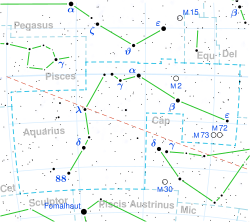
Beta Aquarii
View on Wikipedia  | |
| Observation data Epoch J2000 Equinox J2000 | |
|---|---|
| Constellation | Aquarius |
| Right ascension | 21h 31m 33.53171s[1] |
| Declination | −05° 34′ 16.2320″[1] |
| Apparent magnitude (V) | 2.87[2] |
| Characteristics | |
| Evolutionary stage | Yellow supergiant |
| Spectral type | G0 Ib[3] |
| U−B color index | +0.58[2] |
| B−V color index | +0.84[2] |
| Astrometry | |
| Radial velocity (Rv) | 6.451±0.0627[4] km/s |
| Proper motion (μ) | RA: +18.77[1] mas/yr Dec.: −8.21[1] mas/yr |
| Parallax (π) | 5.9728±0.2147 mas[5] |
| Distance | 541.8+18.4 −15.5 ly (166.12+5.64 −4.75 pc)[6] |
| Absolute magnitude (MV) | −3.04[7] |
| Details[8] | |
| Mass | 4.97±0.10[8] – 6.3[9] M☉ |
| Radius | 47.88+1.68 −1.81 R☉ |
| Luminosity | 2046±180 L☉ |
| Surface gravity (log g) | 2.05[10] cgs |
| Temperature | 5608±71 K |
| Metallicity [Fe/H] | −0.03[11] dex |
| Rotational velocity (v sin i) | 6.3±1.3[12] km/s |
| Age | 56[9] – 110±10 Myr |
| Other designations | |
| Sadalsuud, Saad el Sund, β Aqr, 22 Aqr, BD−06 5770, FK5 808, GC 30137, HD 204867, HIP 106278, HR 8232, SAO 145457, ADS 15050 A, CCDM J21316-0534A[13] | |
| Database references | |
| SIMBAD | data |
Beta Aquarii is a single[14] yellow supergiant star in the constellation of Aquarius. It has the official name Sadalsuud (/ˌsædəlˈsuːəd/)[15] and the Bayer designation β Aquarii, abbreviated Beta Aqr or β Aqr. Based upon parallax measurements obtained during the Hipparcos mission, this component is located at a distance of approximately 540 light years (165 parsecs) from the Sun.[1] It is drifting further away with a radial velocity of 6.5 km/s.[4] The star serves as an IAU radial velocity standard.[16]
Nomenclature
[edit]β Aquarii, Latinised to Beta Aquarii, is the star's Bayer designation.
It bore the traditional name Sadalsuud, from an Arabic expression سعد السعود (sa‘d al-su‘ūd), the "luck of lucks". Other spellings that were sometimes encountered were Sad es Saud, Sadalsund, and Saad el Sund. In the catalogue of stars in the Calendarium of Al Achsasi Al Mouakket, this star was designated Nir Saad al Saaoud, which was translated into Latin as Lucida Fortunæ Fortunarum (rather identic with R.H. Allen), meaning the brightest of luck of lucks.[17] The International Astronomical Union Working Group on Star Names (WGSN)[18] has approved the name Sadalsuud for the primary or 'A' component.[15]
In Chinese, 虚宿 (Xū Xiù), meaning Emptiness (asterism), refers to an asterism consisting of Beta Aquarii and Alpha Equulei.[19] Consequently, the Chinese name for Beta Aquarii itself is 虛宿一 (Xū Xiù Yī, English: the First Star of Emptiness).[20]
Sadalsuud is found in Hindu texts as Kalpeny and, in the context of the ancient Indian system of astronomy, Jyotisha Veda, is located in the 23rd Nakshatra Shravishthā, a lunar mansion which is ruled by Eight vasus - the "deities of earthly abundance" . On the Euphrates, Sadalsuud was known as Kakkab Nammax, the Star of Mighty Destiny; that may have given origin to the title of the manzil, as well as to the astrologers' name for it — Fortuna Fortunarum.[21]
Properties
[edit]β Aquarii is the brightest star in Aquarius with an apparent magnitude of 2.87[2] and a stellar classification of G0 Ib.[3] Since 1943, the spectrum of this star has served as one of the stable anchor points by which other stars are classified.[22] It has an estimated age of 56 million years;[9] old enough for a star of this mass to evolve into a supergiant. The star has about five or six[9] times the mass of the Sun, but it has expanded to 48 times the Sun's radius. It is most likely fusing helium into carbon in its core, and, with insufficient mass to explode as a supernova, will likely end up as a massive white dwarf comparable to Sirius B.[23] It is emitting roughly 2,000 times the Sun's luminosity from its enlarged photosphere at an effective temperature of 5,608 K,[8] giving it the characteristic yellow hue of G-type stars.[24]
X-ray emissions from the corona of this star have been detected using the Chandra X-ray Observatory; among the first such detections of X-rays for a G-type supergiant. A secondary X-ray source discovered near Beta Aquarii probably has an extragalactic origin.[12] This star belongs to a group of three intermediate mass stars with a space velocity that is carrying them perpendicular to the plane of the galaxy. The other members of this grouping are Alpha Aquarii and Eta Pegasi.[12]
Optical companions
[edit]| Component | Magnitude | RA | Dec |
| B | 11.0 | 21h 31m 31.9s | −05° 33′ 46″ |
| C | 11.6 | 21h 31m 33.0s | −05° 35′ 10″ |
β Aquarii appears as a solitary star to the naked eye, but when viewed with a telescope is seen to have two faint optical companions. The first has an apparent magnitude of 11.0. In 1947, the position angle was observed at 321 degrees with a separation from Beta Aquarii of 35.4 arcseconds.[25][26] The second star has a magnitude of 11.6. Its position angle is 186 degrees with a separation from Beta Aquarii of 57.2 arcseconds.[25][26] The brighter star is designated component A of this grouping, while the companions are components B and C, respectively. As of 2008, there is no definitive evidence that the three stars form a ternary star system,[14] and Gaia Data Release 2 shows the two companions to be around twice the distance of β Aquarii. All three stars have very different proper motions.[27][28]
In mythology
[edit]
In the context of older worldviews (i.e. Egyptian, Persian and Islamic mythology), Sadalsuud relates to the rising of the Sun when winter has passed (March) and the season of gentle, continuous rain has begun.[21] Hence the myth of "luck" or "good fortune" was seen as closely aligned with the essence of spring itself, the burgeoning of new life, and by extension agriculture, which in all societies is the very foundation of prosperity or "good fortune". This mythological view of "the luck of the lucks" also belongs to the 22d Manzil (Arabic Lunar Mansion), which included the two stars Xi Aquarii (Bunda) and 46 Capricorni.[21][a]
β and ξ Aquarii also constitute the Persian lunar mansion Bunda and the similar Coptic mansion Upuineuti, the meaning of which is "the Foundation".
In Chinese mythology, β Aqr alone marks the xiu (Chinese lunar mansion) Heu, Hiu, or Hü, "the Void/Emptiness", anciently Ko, the central one of seven xiu which, taken together, were known as Heung Wu, the Black Warrior, in the northern quarter of the sky.[21] As such, Sadalsuud is an expression of the feminine archetype, the Yin or "Void" (Cosmic Mother), from which, many cultures have believed, creation itself (birth) emanates.
Notes
[edit]- ^ β Aqr as Nir Saad al Saaoud or Lucida Fortunæ Fortunarum (the brightest of luck of lucks) and Xi Aquarii as Thanih Saad al Saaoud or Secunda Fortunæ Fortunarum (the second of luck of lucks). 46 Capricorni should be Thalath Fortunæ Fortunarum or Tertia Fortunæ Fortunarum (the third of luck of lucks) consistently, but Al Achsasi Al Mouakket was not designated the title for this star with uncleared consideration. Possibly according to the differences of opinion with R.H.Allen.
References
[edit]- ^ a b c d e van Leeuwen, F. (November 2007). "Validation of the new Hipparcos reduction". Astronomy and Astrophysics. 474 (2): 653–664. arXiv:0708.1752. Bibcode:2007A&A...474..653V. doi:10.1051/0004-6361:20078357. S2CID 18759600.
- ^ a b c d Johnson, H. L.; et al. (1966). "UBVRIJKL photometry of the bright stars". Communications of the Lunar and Planetary Laboratory. 4 (99): 99. Bibcode:1966CoLPL...4...99J.
- ^ a b Morgan, W. W.; Keenan, P. C. (1973). "Spectral Classification". Annual Review of Astronomy and Astrophysics. 11: 29. Bibcode:1973ARA&A..11...29M. doi:10.1146/annurev.aa.11.090173.000333.
- ^ a b Soubiran, C.; et al. (2018). "Gaia Data Release 2. The catalogue of radial velocity standard stars". Astronomy and Astrophysics. 616: 8. arXiv:1804.09370. Bibcode:2018A&A...616A...7S. doi:10.1051/0004-6361/201832795. S2CID 52952408. A7.
- ^ Brown, A. G. A.; et al. (Gaia collaboration) (2021). "Gaia Early Data Release 3: Summary of the contents and survey properties". Astronomy & Astrophysics. 649: A1. arXiv:2012.01533. Bibcode:2021A&A...649A...1G. doi:10.1051/0004-6361/202039657. S2CID 227254300. (Erratum: doi:10.1051/0004-6361/202039657e). Gaia EDR3 record for this source at VizieR.
- ^ Bailer-Jones, C. A. L.; Rybizki, J.; Fouesneau, M.; Demleitner, M.; Andrae, R. (2021). "Estimating Distances from Parallaxes. V. Geometric and Photogeometric Distances to 1.47 Billion Stars in Gaia Early Data Release 3". The Astronomical Journal. 161 (3): 147. arXiv:2012.05220. Bibcode:2021AJ....161..147B. doi:10.3847/1538-3881/abd806. S2CID 228063812. Data about this star can be seen here.
- ^ Huang, W.; et al. (2012). "A catalogue of Paschen-line profiles in standard stars". Astronomy & Astrophysics. 547: A62. arXiv:1210.7893. Bibcode:2012A&A...547A..62H. doi:10.1051/0004-6361/201219804. S2CID 119286159.
- ^ a b c Baines, Ellyn K.; et al. (2018). "Fundamental Parameters of 87 Stars from the Navy Precision Optical Interferometer". The Astronomical Journal. 155 (1). 30. arXiv:1712.08109. Bibcode:2018AJ....155...30B. doi:10.3847/1538-3881/aa9d8b.
- ^ a b c d Lyubimkov, Leonid S.; Lambert, David L.; Korotin, Sergey A.; Rachkovskaya, Tamara M.; Poklad, Dmitry B. (2015-02-01), "Carbon abundance and the N/C ratio in atmospheres of A-, F- and G-type supergiants and bright giants", Monthly Notices of the Royal Astronomical Society, 446 (4): 3447–3460, arXiv:1411.2722, Bibcode:2015MNRAS.446.3447L, doi:10.1093/mnras/stu2299, ISSN 1365-2966
- ^ Smiljanic, R.; et al. (April 2006). "CNO in evolved intermediate mass stars". Astronomy and Astrophysics. 449 (2): 655–671. arXiv:astro-ph/0511329. Bibcode:2006A&A...449..655S. doi:10.1051/0004-6361:20054377. S2CID 3711409.
- ^ Soubiran, C.; et al. (2008). "Vertical distribution of Galactic disk stars. IV. AMR and AVR from clump giants". Astronomy and Astrophysics. 480 (1): 91–101. arXiv:0712.1370. Bibcode:2008A&A...480...91S. doi:10.1051/0004-6361:20078788. S2CID 16602121.
- ^ a b c Ayres, Thomas R.; Brown, Alexander; Harper, Graham M. (July 2005). "Chandra Observations of Coronal Emission from the Early G Supergiants α and β Aquarii". The Astrophysical Journal. 627 (1): L53–L56. Bibcode:2005ApJ...627L..53A. doi:10.1086/431977. S2CID 122519436.
- ^ "bet Aqr -- Star in double system". SIMBAD. Centre de Données astronomiques de Strasbourg. Retrieved 2010-05-17.
- ^ a b Eggleton, P. P.; Tokovinin, A. A. (September 2008). "A catalogue of multiplicity among bright stellar systems". Monthly Notices of the Royal Astronomical Society. 389 (2): 869–879. arXiv:0806.2878. Bibcode:2008MNRAS.389..869E. doi:10.1111/j.1365-2966.2008.13596.x. S2CID 14878976.
- ^ a b "Naming Stars". IAU.org. Archived from the original on 10 March 2025. Retrieved 28 February 2017.
- ^ Scarfe, C. D. (1985). "The zero-point of the IAU standard velocity system". In Haynes, D. S.; et al. (eds.). Calibration of fundamental stellar quantities, IAU Symposium held at Villa Olmo, Como, Italy, May 24-29, 1984. Vol. 111. pp. 583–586. Bibcode:1985IAUS..111..583S.
- ^ Knobel, E. B. (June 1895). "Al Achsasi Al Mouakket, on a catalogue of stars in the Calendarium of Mohammad Al Achsasi Al Mouakket". Monthly Notices of the Royal Astronomical Society. 55: 429. Bibcode:1895MNRAS..55..429K. doi:10.1093/mnras/55.8.429.
- ^ "IAU Working Group on Star Names (WGSN)". International Astronomical Union. Archived from the original on 10 June 2016. Retrieved 22 May 2016.
- ^ 陳久金 (2005). 中國星座神話. 五南圖書出版股份有限公司. ISBN 978-986-7332-25-7.
- ^ "香港太空館 - 研究資源 - 亮星中英對照表]". Hong Kong Space Museum. Archived from the original on 2010-08-18. Retrieved November 23, 2010.
- ^ a b c d Allen, Richard H. (1963). "Aquarius, the Waterman". Star Names: Their Lore and Meaning. Dover Publications. Retrieved 2010-05-17.
- ^ Garrison, R. F. (December 1993). "Anchor Points for the MK System of Spectral Classification". Bulletin of the American Astronomical Society. 25: 1319. Bibcode:1993AAS...183.1710G. Archived from the original on 2019-06-25. Retrieved 2012-02-04.
- ^ "Sadalsuud". stars.astro.illinois.edu. Retrieved 2024-08-04.
- ^ "The Colour of Stars". Australia Telescope, Outreach and Education. Commonwealth Scientific and Industrial Research Organisation. December 21, 2004. Archived from the original on 2012-03-18. Retrieved 2012-01-16.
- ^ a b "CCDM (Catalog of Components of Double & Multiple stars) (Dommanget+ 2002)". VizieR. Centre de Données astronomiques de Strasbourg. Retrieved 2010-05-17.
- ^ a b "Sadalsuud". Alcyone Bright Star Catalogue. Retrieved 2010-05-17.
- ^ Brown, A. G. A.; et al. (Gaia collaboration) (August 2018). "Gaia Data Release 2: Summary of the contents and survey properties". Astronomy & Astrophysics. 616. A1. arXiv:1804.09365. Bibcode:2018A&A...616A...1G. doi:10.1051/0004-6361/201833051. Gaia DR2 record for this source at VizieR.
- ^ Brown, A. G. A.; et al. (Gaia collaboration) (August 2018). "Gaia Data Release 2: Summary of the contents and survey properties". Astronomy & Astrophysics. 616. A1. arXiv:1804.09365. Bibcode:2018A&A...616A...1G. doi:10.1051/0004-6361/201833051. Gaia DR2 record for this source at VizieR.
External links
[edit]- An Atlas of the Universe: Multiple Star Orbits
- Harvard Map Collection The Mercator Globes
- Image β Aquarii


Beta Aquarii
View on GrokipediaNomenclature
Proper Names
Beta Aquarii is traditionally known by the proper name Sadalsuud, derived from the Arabic phrase saʽd al-suʽūd, meaning "luck of lucks" or "luckiest of the lucky."[6] This name reflects its historical association with good fortune, particularly as its heliacal rising was believed to herald beneficial seasonal changes.[6] The International Astronomical Union (IAU) formally approved Sadalsuud as the proper name for the star in August 2016 as part of its effort to standardize culturally significant names. Alternative interpretations in ancient Arabic texts occasionally link the name to concepts of prosperity in domestic settings, such as "luck of the homes" or "auspice of tents," tying into the nomadic traditions where the star's appearance signaled favorable conditions for shelter and livelihood.[7] In Chinese astronomy, Beta Aquarii is designated as 虛宿一 (Xū Xiù Yī), or "First Star of Emptiness," serving as the primary star in the Xu Xiu (Emptiness) asterism, one of the 28 lunar mansions that marked celestial divisions for calendrical and seasonal purposes.[8] Hindu astronomical texts refer to the star as Kalpeny, a name associated with themes of fortune and auspiciousness within the ancient Indian sidereal system, where it falls in the 23rd nakshatra (lunar mansion), Dhanishta (Shravishthā).[6] From ancient Mesopotamian records along the Euphrates, the star was called Kakkab Nammax (or Nammaḫ), translated as "the Star of Mighty Destiny," emphasizing its role as an omen of powerful fate or prosperity.[9] These proper names collectively underscore Beta Aquarii's position in the constellation Aquarius—the water-bearer—as a celestial marker of abundance and transition, often linked to the onset of rains or fertile seasons in various cultures, symbolizing renewal and good fortune rather than mere astronomical positioning.[6]Catalog Designations
Beta Aquarii holds the Bayer designation β Aquarii, the brightest star in the constellation Aquarius as assigned by Johann Bayer in his star atlas Uranometria published in 1603.[10][11] It also receives the Flamsteed designation 22 Aquarii, from English astronomer John Flamsteed's catalog in Historia Coelestis Britannica, first compiled around 1712 and published in 1725.[12][11] In the Henry Draper Catalogue, compiled by Annie Jump Cannon and Edward Charles Pickering at Harvard College Observatory and published between 1918 and 1924, the star is entry HD 204867, providing its spectral classification G0 Ib.[11] The related Bright Star Catalogue, an extension of Harvard's efforts and last revised in 1991 by Dorrit Hoffleit and Wayne H. Warren Jr., lists it as HR 8232.[11] The Hipparcos Catalogue, produced by the European Space Agency's Hipparcos mission and released in 1997, identifies the star as HIP 106278, enabling precise astrometric measurements including parallax.[13][11] Subsequent Gaia mission data releases refined this further; the second data release (Gaia DR2) in 2018 provided an initial parallax value confirming its distance, while the third (Gaia DR3) in 2022 updated the source identifier to 2671038928727970944 with enhanced precision.[14][11] Beta Aquarii appears in the Geneva Observatory's photometric database as GEN# +1.00204867, supporting kinematic and metallicity studies, though it is not part of the Geneva-Copenhagen Survey, which focuses on nearby F and G dwarfs.[15][11] Cross-identifications are compiled in databases such as SIMBAD (main identifier * bet Aqr), which aggregates over 20 catalog entries including BD-06 5770 from the Bonner Durchmusterung, SAO 145457 from the Smithsonian Astrophysical Observatory Star Catalog, and 2MASS J21313352-0534161 from the Two Micron All Sky Survey.[11]| Catalog | Designation | Reference |
|---|---|---|
| Bayer | β Aquarii | Bayer (1603)[10] |
| Flamsteed | 22 Aquarii | Flamsteed (1725)[12] |
| Henry Draper | HD 204867 | Cannon & Pickering (1918–1924) |
| Bright Star | HR 8232 | Hoffleit & Warren (1991) |
| Hipparcos | HIP 106278 | ESA (1997)[13] |
| Gaia DR3 | 2671038928727970944 | Gaia Collaboration (2023)[14] |
| Geneva Photometry | GEN# +1.00204867 | Rufener (1988) |
Stellar Properties
Fundamental Parameters
Beta Aquarii occupies equatorial coordinates of right ascension 21ʰ 31ᵐ 33.⁵³ˢ and declination −05° 34′ 16.″2 (J2000.0 epoch). Its apparent visual magnitude is 2.89, rendering it the brightest star in the constellation Aquarius. The star's distance is estimated at 167.4 ± 6.0 parsecs (approximately 546 ± 20 light-years), derived from a parallax of 5.973 ± 0.215 milliarcseconds measured by the Gaia mission (DR3). Earlier Gaia DR2 data yielded a parallax of 6.02 ± 0.23 mas, corresponding to 541.8 ± 17 light-years.[16][17] The star displays proper motion components of +19.21 mas/yr in right ascension and −8.16 mas/yr in declination (Gaia DR3). Beta Aquarii has a radial velocity of +6.45 ± 0.001 km/s, indicating it is receding from the Solar System, and serves as an International Astronomical Union standard for radial velocity measurements. Beta Aquarii's absolute bolometric magnitude implies a luminosity of approximately 2046 L_⊙.[4] Evolutionary models estimate its mass in the range 4.97–6.3 M_⊙. Isochrone fitting suggests an age of 56–110 million years.| Parameter | Value | Source |
|---|---|---|
| Apparent visual magnitude | 2.89 | SIMBAD [2002yCat.2237....0D] |
| Parallax (Gaia DR3) | 5.973 ± 0.215 mas | Gaia Collaboration (2021) |
| Distance | 546 ± 20 ly | Gaia DR3 |
| Proper motion (RA) | +19.21 mas/yr | SIMBAD/Gaia DR3 |
| Proper motion (Dec) | −8.16 mas/yr | SIMBAD/Gaia DR3 |
| Radial velocity | +6.45 km/s | SIMBAD [2018A&A...616A...7S] |
| Luminosity | ~2046 L_⊙ | Evolutionary models |
| Mass | 4.97–6.3 M_⊙ | Ekström et al. (2012) |
| Age | 56–110 Myr | Isochrone fitting |