Hubbry Logo
TRAPPIST-1eTRAPPIST-1eMain
Open search
TRAPPIST-1e
Community hub
TRAPPIST-1e
logo
8 pages, 0 posts
0 subscribers
Be the first to start a discussion here.
TRAPPIST-1e
TRAPPIST-1e
from Wikipedia

TRAPPIST-1e
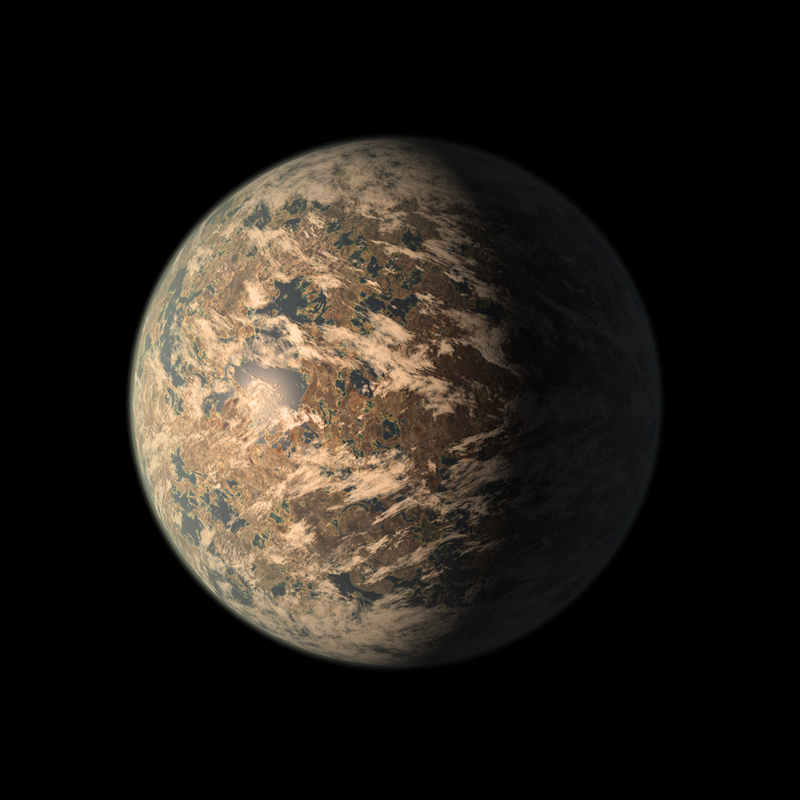
Artist's impression of TRAPPIST-1e from 2018, depicted here as a tidally locked planet with a liquid ocean. The actual appearance of the exoplanet is currently unknown, but based on its density, it is likely not entirely covered in water.
Discovery[1]
Discovered byMichaël Gillon et al.
Discovery siteSpitzer Space Telescope
Discovery date22 February 2017
Transit
Orbital characteristics[2]
0.02925±0.00025 AU
Eccentricity0.00510±0.00058[3]
6.101013±0.000035 d
Inclination89.793°±0.048°
108.37°±8.47°[3]
StarTRAPPIST-1[4]
Physical characteristics[2]
0.920+0.013
−0.012
 R🜨
Mass0.692±0.022 M🜨
Mean density
4.885+0.168
−0.182
 g/cm3
0.817±0.024 g
8.01±0.24 m/s2
TemperatureTeq: 249.7±2.4 K (−23.5 °C; −10.2 °F)[5]
Atmosphere
Composition by volumeNone or mostly N2, with trace amounts of CH4 and CO2[6]

TRAPPIST-1e is a rocky, close-to-Earth-sized exoplanet orbiting within the habitable zone around the ultracool dwarf star TRAPPIST-1, located 40.7 light-years (12.5 parsecs; 385 trillion kilometers; 239 trillion miles) away from Earth in the constellation of Aquarius. Astronomers used the transit method to find the exoplanet, a method that measures the dimming of a star when a planet crosses in front of it.

The exoplanet was one of seven discovered orbiting the star using observations from the Spitzer Space Telescope.[1][7] Three of the seven (e, f, and g) are in the habitable zone/"goldilocks" zone.[8][9] TRAPPIST-1e is similar to Earth's mass, radius, density, gravity, temperature, and stellar flux.[3][10] It is also confirmed that TRAPPIST-1e lacks a cloud-free hydrogen-dominated atmosphere, meaning that if the planet has an atmosphere it is more likely to have a compact atmosphere like the terrestrial planets in the Solar System.[11]

In November 2018, researchers determined that of the seven exoplanets in the multi-planetary system, TRAPPIST-1e has the best chance of being an Earth-like ocean planet, and the one most worthy of further study regarding habitability.[12] According to the Habitable Exoplanets Catalog, TRAPPIST-1e is among the best potentially habitable exoplanets discovered.[13] The most recent observation in 2025 was unable to conclude with confidence if there was an atmosphere or not, though it could rule out certain atmosphere scenarios.

Physical characteristics

[edit]

Mass, radius, density, composition and temperature

[edit]

TRAPPIST-1e was detected with the transit method, where the planet blocked a small percentage of its host star's light when passing between it and Earth. This allowed scientists to accurately determine the planet's radius at 0.920 R🜨, with a small uncertainty of about 83 km (52 mi). Transit-timing variations and advanced computer simulations helped constrain the planet's mass, which turned out to be 0.692 M🜨, or about 15% less massive than Venus.[2] TRAPPIST-1e has 82% the surface gravity of Earth, the third-lowest in the system. Its radius and mass are also the third-least among the TRAPPIST-1 planets.[2]

With both the radius and mass of TRAPPIST-1e determined with low error margins, scientists could accurately calculate the planet's density, surface gravity, and composition. Initial density estimates in 2018 suggested it has a density of 5.65 g/cm3, about 1.024 times Earth's density of 5.51 g/cm3. TRAPPIST-1e appeared to be unusual in its system, as it was the only planet with a density consistent with a pure rock-iron composition, and the only one with a higher density than Earth (TRAPPIST-1c also appeared to be entirely rock, but with a lower density than TRAPPIST-1e). The higher density of TRAPPIST-1e implies an Earth-like composition and a solid rocky surface. This also appeared to be unusual among the TRAPPIST-1 planets, as most were thought to have densities consistent with being completely covered in either a thick steam/hot CO2 atmosphere, a global liquid ocean, or an ice shell.[3] However, refined estimates show that all planets in the system have similar densities, consistent with rocky compositions, with TRAPPIST-1e having a somewhat lower but still Earth-like bulk density.[2]

The planet has a calculated equilibrium temperature of 246.1 K (−27.1 °C; −16.7 °F) given an albedo of 0, also known as its "blackbody" temperature.[10] For a more realistic Earth-like albedo however, this provides an unrealistic picture of the surface temperature of the planet. Earth's equilibrium temperature is 255 K;[14][better source needed] it is Earth's greenhouse gases that raise its surface temperatures to the levels we experience. If TRAPPIST-1e has a thick atmosphere, its surface could be much warmer than its equilibrium temperature.

Host star

[edit]

The planet orbits an (late M-type) ultracool dwarf star named TRAPPIST-1. The star has a mass of 0.089 M – near the boundary between a brown dwarf and low-mass star – and a radius of 0.121 R. It has a temperature of 2,516 K (2,243 °C; 4,069 °F) and is 7.6 billion years old. In comparison, the Sun is 4.6 billion years old[15] and has a temperature of 5,778 K (5,505 °C; 9,941 °F).[16] The star is metal-rich, with a metallicity ([Fe/H]) of 0.04, or 109% the solar amount. This is particularly odd as such low-mass stars near the boundary between brown dwarfs and hydrogen-fusing stars should be expected to have considerably less metal content than the Sun. Its luminosity (L) is 0.0522% of that of the Sun.

The star's apparent magnitude, or how bright it appears from Earth's perspective, is 18.8. Therefore, it is far too dim to be seen with the naked eye.

Orbit

[edit]

TRAPPIST-1e orbits its host star quite closely. One full revolution around TRAPPIST-1 takes only 6.099 Earth days (~146 hours) to complete. It orbits at a distance of 0.02928285 AU (4.4 million km; 2.7 million mi), or just under 3% the separation between Earth and the Sun. For comparison, the closest planet in the Solar System, Mercury, takes 88 days to orbit the Sun at a distance of 0.38 AU (57 million km; 35 million mi). Despite its close proximity to its host star, TRAPPIST-1e gets only about 60% the starlight that Earth gets from the Sun due to the low luminosity of its star. The star would cover an angular diameter of about 2.17 degrees from the surface of the planet, and so would appear about four times larger than the Sun does from Earth.

Atmosphere

[edit]

Transit observations with James Webb Space Telescope suggested no clear answer about the existence of an atmosphere, but it did rule out many atmosphere scenarios. See the "Habitability" studies below.

Habitability

[edit]
Artist's impression of the TRAPPIST-1 system, seen from above the surface of one of the planets in the habitable zone

The exoplanet was announced to be orbiting within the habitable zone of its parent star, the region where, with the correct conditions and atmospheric properties, liquid water may exist on the surface of the planet. TRAPPIST-1e has a radius of around 0.91 R🜨, so it is likely a rocky planet. Its host star is a red ultracool dwarf, with only about 8% of the mass of the Sun (close to the boundary between brown dwarfs and hydrogen-fusing stars). As a result, stars like TRAPPIST-1 have the potential to remain stable for up to 12 trillion years, which is over 2,000 times longer than the Sun.[17] Because of this ability to live for such a long period of time, it is likely TRAPPIST-1 will be one of the last remaining stars in the Universe, when the gas needed to form new stars will be exhausted, and the existing stars begin to die off.

2018 studies

[edit]

Despite being likely tidally locked – meaning one hemisphere permanently faces the star while the other does not – which may reduce the habitability of the planet, more detailed studies of TRAPPIST-1e and the other TRAPPIST-1 planets released in 2018 determined that the planet is in fact one of the most Earth-sized worlds found, with 91% the radius, 77% the mass, 102.4% the density (5.65 g/cm3), and 93% the surface gravity. TRAPPIST-1e is confirmed to be a terrestrial planet with a solid, rocky surface. It is cool enough for liquid water to pool on the surface, but not so cold that it would freeze like on TRAPPIST-1f, g, and h.[3]

The planet receives a stellar flux 60.4% that of Earth, about a third lower than that of Earth but significantly more than that of Mars.[10] Its equilibrium temperature ranges from 225 K (−48 °C; −55 °F)[18] to 246.1 K (−27.1 °C; −16.7 °F),[10] depending on how much light the planet reflects into space. Both of these are between those of Earth and Mars as well. In addition, its atmosphere is confirmed to not be dense or thick enough to harm the habitability potential as well, according to models by the University of Washington.[11] The atmosphere, if it is dense enough, may also help to transfer additional heat to the dark side of the planet.

2024 studies

[edit]

According to a 2024 study, based on modeling, TRAPPIST-1e could be having its atmosphere stripped by its host star, possibly as a result of its short orbital period, which would make it inhospitable to life. The same phenomenon could impact the atmospheres of the other planets in this system.[19][20]

2025 studies

[edit]

Based on four observations of TRAPPIST-1e using the James Webb Space Telescope's NIRSpec instrument, researchers were unable to find conclusive evidence for or against the presence of an atmosphere. The analysis showed two models the data could adequately explain. The first is a flat-line model, which could mean two things: TRAPPIST-1e is a bare rock; or it has an atmosphere of an unknown type completely hidden by a high, thick cloud deck. The second model is a range of nitrogen-rich atmospheres, with nitrogen as the dominant gas. Within the nitrogen scenarios, there is a "tentative preference" for trace amounts of methane (CH4) mixed in. The authors conclude that the primary limitation in studying TRAPPIST-1e is mitigating the effects of its active star. To overcome this, a new program of 15 additional JWST observations is underway. This program will observe back-to-back transits of TRAPPIST-1e and its neighboring planet, TRAPPIST-1b, which is believed to be a bare rock. By using the signal from the bare rock planet to correct for the star's activity, it may be possible to reveal whether TRAPPIST-1e has an atmosphere.[6][21]

Discovery

[edit]

A team of astronomers headed by Michaël Gillon[22] used the TRAPPIST (Transiting Planets and Planetesimals Small Telescope) telescope at the La Silla Observatory in the Atacama Desert, Chile,[23] to observe TRAPPIST-1 and search for orbiting planets. By utilising transit photometry, they discovered three Earth-sized planets orbiting the dwarf star; the innermost two are tidally locked to their host star while the outermost appears to lie either within the system's habitable zone or just outside of it.[24][25] The team made their observations from September–December 2015 and published its findings in the May 2016 issue of the journal Nature.[23][7]

Artist's impression of the TRAPPIST-1 planetary system.

The original claim and presumed size of the planet was revised when the full seven-planet system was revealed in 2017:

"We already knew that TRAPPIST-1, a small, faint star some 40 light years away, was special. In May 2016, a team led by Michaël Gillon at Belgium’s University of Liege announced it was closely orbited by three planets that are probably rocky: TRAPPIST-1b, c and d ...
"As the team kept watching shadow after shadow cross the star, three planets no longer seemed like enough to explain the pattern. "At some point we could not make sense of all these transits," Gillon said.
"Now, after using the space-based Spitzer telescope to stare at the system for almost three weeks straight, Gillon and his team have solved the problem: TRAPPIST-1 has four more planets.
"The planets closest to the star, TRAPPIST-1b and c, are unchanged. But there's a new third planet, which has taken the d moniker, and what had looked like d before turned out to be glimpses of e, f, and g. There's a planet h, too, drifting farthest out, and only spotted once."[26]
[edit]

Videos

[edit]

See also

[edit]

References

[edit]
Revisions and contributorsEdit on WikipediaRead on Wikipedia
from Grokipedia
TRAPPIST-1e is a terrestrial orbiting the ultracool star TRAPPIST-1, an M8-type star located approximately 39 light-years (12 parsecs) from in the constellation Aquarius. As the fourth planet from its host star in a compact system of seven Earth-sized worlds, TRAPPIST-1e resides within the , receiving about 62% of the stellar flux that does from the Sun, which suggests potential conditions for liquid surface water if an atmosphere is present. Discovered in 2017 using the transit method with ground-based telescopes including the (Transiting Planets and Planetesimals Small Telescope) in , it completes one orbit every 6.1 days at a semi-major axis of 0.029 AU, with a low eccentricity of approximately 0.01. The planet's physical characteristics indicate a rocky composition similar to , with a of 0.692 ± 0.024 masses, a radius of 0.910 ± 0.031 radii, and a mean of about 5.1 g/cm³ ( 0.923 times 's), consistent with a mantle and iron core lacking significant volatile envelopes. Its equilibrium temperature is estimated at around 251 (-22°C), though —due to the close orbit—would create a permanent dayside and nightside, potentially leading to extreme temperature gradients without atmospheric heat transport. The system itself is notable for its near-resonant orbital chain, where the planets' periods form ratios close to integers (e.g., 3:2 for e and d), stabilizing the configuration over billions of years despite the host star's age of 7.6 ± 2.2 billion years—roughly twice that of the Solar System. Habitability assessments for TRAPPIST-1e highlight both promise and challenges: its position in the conservative and rocky nature make it one of the most Earth-like exoplanets known, but the active host star emits frequent flares that could strip atmospheres through high levels of and radiation. Models suggest the planet could retain a thin atmosphere over geological timescales, potentially supporting liquid water on the dayside if protected by a or specific compositions like nitrogen-dominated gases. However, early studies indicated possible water loss from the outer planets, though TRAPPIST-1e, receiving moderate , fares better than inner siblings. Recent observations with the in 2025 have provided the first transmission spectra of TRAPPIST-1e, revealing no strong evidence for a thick atmosphere and weakly disfavoring CO₂-rich scenarios at pressures similar to Venus or Mars. These data, spanning 0.6–5.5 μm, show significant contamination from stellar spots but rule out hydrogen-rich atmospheres with or , while permitting bare-rock surfaces or thin, nitrogen-dominated atmospheres with trace gases. Such findings narrow the possibilities for volatile retention, emphasizing TRAPPIST-1e's likely barren or minimally atmospheric state, though future JWST transits of other system planets may refine these constraints. Additional JWST observations, including fifteen more transits of TRAPPIST-1e, are ongoing as of late 2025 to further refine these constraints.

Discovery and nomenclature

Initial detection

TRAPPIST-1e was first detected as part of the Ultra-cool Dwarf Transit Survey (TUDTS), a ground-based photometric program aimed at identifying Earth-sized exoplanets transiting nearby within their habitable zones. The survey utilized the 0.6-meter (Transiting Planets and Planetesimals Small Telescope) robotic telescope installed at the in , which monitored the star —a late M8-type star located approximately 12 parsecs from Earth—for periodic brightness dips indicative of planetary transits. Initial observations of began in late 2015, leading to the detection of three inner transiting planets (designated b, c, and d) announced in May 2016. To resolve ambiguities in the light curve and search for additional planets, follow-up observations were conducted using NASA's , which provided continuous monitoring in the infrared to minimize atmospheric interference. Starting in September 2016, Spitzer observed for nearly 500 hours over 20 days, revealing four additional shallow transit signals beyond the initial three planets. Among these, the signal for TRAPPIST-1e was identified through detailed analysis of the transit timing variations and photometric data, confirming it as an Earth-sized orbiting in the of the system. The full seven-planet configuration, including TRAPPIST-1e as the innermost of the newly detected worlds, was announced by Michaël Gillon and collaborators on February 22, 2017, in a paper published in . This detection highlighted the potential of ultracool dwarfs as hosts for compact multi-planet systems amenable to transit surveys.

Confirmation and naming

The existence of TRAPPIST-1e, along with the other planets in the system, was confirmed through the extensive Spitzer observations conducted in late 2016, supplemented by ground-based photometry from the telescope and the (VLT) at , which corroborated the initial signals and provided light curves to distinguish true planetary transits from stellar variability. The planet was formally named TRAPPIST-1e in accordance with the International Astronomical Union's nomenclature for exoplanets, where letters 'b' through 'h' denote the planets in ascending order of orbital periods around the host star , positioning 'e' as the fourth innermost world. No informal or provisional names have been adopted for TRAPPIST-1e or its siblings. Early parameter estimates derived from these transit data indicated a radius of approximately 0.92 radii (R⊕) for TRAPPIST-1e, establishing it as an Earth-sized planet, though no direct mass determination was possible at this stage due to the faint radial-velocity signal of the host star. The comprehensive confirmation of the seven Earth-sized planets orbiting , including , was detailed in a seminal paper by Gillon et al., published in in 2017, marking a milestone in the study of compact multi-planet systems around low-mass stars.

The TRAPPIST-1 system

Host star characteristics

is an star of spectral class M8V, classified as a late-type M dwarf due to its low and small size. Located in the constellation Aquarius at a distance of 40.5 light-years (12.4 parsecs) from , it hosts a compact system of seven Earth-sized planets. The star's fundamental parameters are as follows:
ParameterValueSource
0.0898 ± 0.0023 M⊙Agol et al. (2021)
0.1192 ± 0.0013 R⊙Agol et al. (2021)
2566 ± 26 KAgol et al. (2021)
Bolometric luminosity(5.5 ± 0.3) × 10^{-4} L⊙Agol et al. (2021)
Age7.6 ± 2.2 GyrBurgasser & Mamajek (2017)
These properties reflect TRAPPIST-1's status as a low-mass, fully convective with a dim glow that defines the system's close-in orbital . Despite its mature age, TRAPPIST-1 displays elevated magnetic activity, including a high flare rate—observing up to several flares per day in optical and wavelengths—and substantial and UV emissions driven by persistent processes in its convective interior. This activity level, atypical for such an old M dwarf, arises from strong magnetic fields that sustain coronal heating and flaring events.

System architecture and planets

The TRAPPIST-1 system comprises seven rocky, Earth-sized planets designated b through h, which orbit their host star in a tightly packed, near-resonant chain, enabling detailed characterization through transit observations. This compact , with all planetary orbits confined within approximately 0.06 AU of the star, facilitates the detection of transit timing variations (TTV) that have been crucial for estimating planetary masses. TRAPPIST-1e occupies the fourth position in this sequence, lying within the system's and receiving about 0.65 times the average stellar insolation that experiences from the Sun. The planets span a narrow range of sizes, with radii between roughly 0.76 and 1.13 radii, and masses estimated via TTV analyses from approximately 0.33 to 1.37 masses, positioning TRAPPIST-1e as one of the more Earth-like members in both dimensions.

Physical properties

Size, mass, and density

TRAPPIST-1e has a of 0.920 ± 0.012 radii, determined from the depth of its transits across the host star as observed by the and other facilities. This measurement reflects the planet's size relative to , placing it among the terrestrial worlds in the system. The planet's mass is 0.692 ± 0.022 masses, derived from detailed analysis of transit-timing variations (TTVs) that capture gravitational interactions among the planets, refining earlier estimates from initial discoveries. These TTVs, combined with N-body simulations, provide constraints on the orbital dynamics and bulk properties. From the mass and , the mean is calculated as 4.885 ± 0.18 g/cm³, a value consistent with a predominantly rocky composition similar to 's. The surface gravity on TRAPPIST-1e is approximately 0.817 g, or 8.01 m/s², computed using the g=GMr2g = \frac{GM}{r^2}, where MM is the and rr is the . This lower compared to Earth's arises from the planet's despite its near-Earth size.

Composition and internal structure

TRAPPIST-1e is characterized as a rocky planet, with its of approximately 4.89 g/cm³ indicating a differentiated interior dominated by materials. This high supports the presence of an iron-rich core comprising about 25–28% of the planet's total mass, overlaid by a mantle that constitutes roughly 65–70% of the mass, and potentially a thin crust. The core-mantle boundary is inferred from interior structure models that account for the planet's mass and radius constraints, suggesting a core of around 0.4–0.5 times the planet's under Earth-like compositional assumptions depleted in iron (approximately 21 wt% Fe). The planet's effectively rules out a substantial hydrogen-helium , with models limiting any gaseous layer to less than 1% of the total mass, as thicker envelopes would reduce the below observed values. Instead, the interior is consistent with a volatile-poor to moderately volatile-enriched composition, without for extended gas layers. Interior structure models further indicate the potential for a or layer, with volatile mass fractions estimated at 5–20% depending on formation scenarios and histories. These models, incorporating multi-phase layers (including supercritical, , and condensed phases), predict that such a could overlie the mantle, though confirmation awaits direct observational constraints on the planet's full mass-radius profile.

Orbital dynamics

Key orbital parameters

TRAPPIST-1e orbits its host star at a close distance, completing one revolution in approximately 6.1 days, placing it within the system's alongside planets f and g. This short results from the planet's proximity to the star, with key parameters derived from extensive transit timing variations (TTVs) and photometric observations using telescopes such as Spitzer and ground-based facilities. The orbit is nearly circular, as indicated by a low eccentricity value, and highly inclined relative to the line of sight, enabling frequent transits observable from . The following table summarizes the primary orbital parameters for TRAPPIST-1e:
ParameterValueUnitSource
Semi-major axis0.02925 ± 0.00016Agol et al. (2021)
Orbital period6.101013 ± 0.000035daysAgol et al. (2021)
Eccentricity0.00510 ± 0.00038-Agol et al. (2021)
Inclination89.75° ± 0.05°degreesDucrot et al. (2020)
These parameters reflect refinements from multi-year monitoring campaigns that combined measurements with transit data to constrain the planet's trajectory precisely. The low eccentricity contributes to a stable thermal environment, while the near-edge-on inclination (close to 90°) facilitates detailed characterization through transit spectroscopy. Assuming zero and no atmospheric , the planet's equilibrium temperature is calculated as 251 K (-22°C), based on the stellar irradiation received at its orbital distance. The insolation at is approximately 847 /, equivalent to about 0.62 times the Earth's incident solar flux, underscoring its position in the conservative of the system.

Orbital resonance and stability

TRAPPIST-1e participates in the TRAPPIST-1 system's extensive chain of mean-motion resonances, where it maintains a near 3:2 resonance with both the inner planet TRAPPIST-1d and the outer planet TRAPPIST-1f, contributing to the overall architecture that includes ratios such as 8:5 for b-c, 5:3 for c-d, 4:3 for f-g, and 3:2 for g-h. This configuration extends to three-body Laplace resonances among consecutive planetary triplets, such as those involving d, e, and f, which involve librating angles that enforce mutual gravitational interactions and prevent orbital disruptions. These resonances collectively stabilize the compact arrangement of the seven planets, with TRAPPIST-1e playing a central role in linking the inner and habitable-zone orbits. Long-term dynamical simulations indicate that the resonant chain, including TRAPPIST-1e's position, ensures orbital stability over billions of years, even given the close proximities that would otherwise lead to chaotic ejections in non-resonant systems. Recent JWST observations have refined transit timings, improving ephemeris precision and supporting assessments of resonance stability. Configurations formed through convergent disk migration, as likely occurred for TRAPPIST-1, exhibit robustness without requiring ongoing tidal dissipation, with stability timescales exceeding 50 million years and extending to the system's estimated age of about 7.6 billion years under nominal perturbations. However, the motion remains mildly chaotic, with small variations in eccentricities and inclinations that do not compromise the overall integrity. Tidal interactions between TRAPPIST-1e and the host star could induce gradual , including potential semi-major axis decay or eccentricity damping leading to further circularization over gigayear timescales. For TRAPPIST-1e, with its of approximately 6.1 days, these effects are estimated to cause eccentricity reduction on timescales of roughly 10^9 years, enhancing long-term stability by minimizing disruptive close encounters. Such tidal circularization may have already played a role in refining the current near-circular orbits observed across the system. The masses of TRAPPIST-1e and its neighbors have been refined using the transit-timing variation (TTV) method, which detects perturbations from gravitational interactions within the resonant chain. These TTV signals, arising primarily from nearby planets like d and f, allow for mass determinations to 3–5% precision, revealing TRAPPIST-1e's mass as 0.692 ± 0.022 masses (see Physical properties section) and confirming the resonance-driven dynamics. This approach underscores how the stability of the chain enables precise modeling of mutual perturbations.

Atmosphere

Potential composition and models

Theoretical models suggest that TRAPPIST-1e formed through core accretion in a dense around its host star, potentially accumulating volatiles during inward migration from beyond the H₂O . In this pebble-driven formation scenario, the planet's compact orbit and the system's resonant chain imply efficient growth of Earth-mass s with limited initial gas envelopes, though recent simulations indicate a range of outcomes from dry worlds to those with modest envelopes depending on disk conditions and migration timing. Volatile delivery via impacts or icy pebble accretion could have supplemented any primordial volatiles, but the planet's position in the inner system likely restricted substantial ice incorporation compared to outer siblings. Given its rocky interior, TRAPPIST-1e is expected to retain a thin secondary atmosphere dominated by N₂ and CO₂ if volatiles were not completely stripped, with possible H₂O vapor contributions from internal . Such compositions arise from the planet's formation in a volatile-poor inner disk region, where nitrogen and carbon compounds could persist post-accretion, potentially building up to several millibars of pressure without significant escape. , in particular, may emerge from of a silicate mantle, though limited by the planet's low internal due to and minimal radiogenic heating. Early atmospheric loss mechanisms, driven by the host star's intense stellar winds and /EUV radiation, would have preferentially stripped lighter H/He envelopes during the planet's formation phase, leaving behind heavier species like CO₂ and N₂. Hydrodynamic escape models predict that TRAPPIST-1e could have lost up to a few oceans of hydrogen-rich atmosphere in its youth, but denser gases resist such erosion, allowing for secondary replenishment. Volcanic represents a key pathway for regenerating these atmospheres, releasing CO₂ and H₂O from the rocky interior over geological timescales, potentially sustaining a thin envelope against ongoing photoevaporation. Climate models for TRAPPIST-1e incorporate these potential compositions to assess surface conditions, adjusting the blackbody equilibrium of approximately 251 for forcing. A thin CO₂ atmosphere could enhance surface temperatures by 20–50 through pressure broadening and radiative trapping, shifting the substellar region into habitable ranges while maintaining a cold nightside due to synchronous . These 3D general circulation models emphasize that even modest CO₂ partial pressures (around 0.1–1 bar) suffice to prevent atmospheric collapse and enable liquid water stability at the terminator, though haze formation from could modulate the effect.

Observational constraints

Early searches for an atmosphere on TRAPPIST-1e utilized transmission spectroscopy with the (HST) in 2018, targeting the near-infrared range with the instrument. These observations of two transits yielded no detection of prominent absorption features, such as those from in an H/He-dominated envelope, resulting in a flat transmission spectrum. Upper limits on the water absorption amplitude were placed at 11.9 scale heights for one transit and 17 scale heights for the other at 3σ confidence, effectively constraining the presence of a thick hydrogen-helium atmosphere. More recent observations in 2025 employed the (JWST) with the NIRSpec/PRISM disperser to acquire four transmission spectra spanning 0.6–5.3 μm during mid-to-late 2023 transits. The combined exhibits a flat profile from 1–5 μm with minimal absorption features, indicating no evidence for a thick atmosphere and excluding hydrogen-dominated compositions with more than 80% H₂ by volume at greater than 3σ confidence. Stellar contamination from the M dwarf host was accounted for in the analysis, which revealed scatter consistent with instrumental noise rather than planetary signals. These JWST data impose stringent constraints on secondary atmospheres, ruling out carbon dioxide-rich scenarios at surface pressures akin to Venus (~90 bar) or Mars (~0.006 bar) at 2σ confidence, as well as H₂-rich envelopes with significant CO₂ or CH₄. Permitted scenarios include a bare rock surface or a thin, nitrogen-dominated atmosphere with trace amounts of CH₄ and CO₂, potentially akin to Titan's composition. Upper limits on water vapor column densities are tight, consistent with less than one Earth ocean equivalent retained, though a subsurface ocean remains possible.

Habitability

Theoretical habitability factors

TRAPPIST-1e orbits within the of its host star, receiving approximately 0.66 times the stellar insolation incident on . This positioning suggests the potential for surface liquid water under certain conditions, such as a planetary of around 0.3 and the presence of a moderate to trap heat and maintain temperatures above freezing. The planet's of about 6.1 days contributes to this insolation level, placing it near the inner edge of the conservative as defined by stellar and planetary greenhouse models. Due to its proximity to the star, TRAPPIST-1e is expected to be tidally locked in a 1:1 spin-orbit resonance, with one hemisphere perpetually facing the star. This configuration results in pronounced temperature contrasts between the dayside and nightside, fostering strong but also risking atmospheric collapse on the cold nightside if the atmosphere is insufficiently dense to transport heat effectively. Such uneven heating could limit global unless robust heat redistribution mechanisms, like thick atmospheric layers, are present. The radiation environment around poses significant challenges to long-term , as the star emits high levels of (XUV) radiation—estimated at 100 to 200 times the flux experienced by during the planet's early . This intense irradiation drives hydrodynamic escape and photochemical processes that erode the atmosphere over billions of years, potentially stripping away lighter elements like and oxygen while leaving heavier species behind. Despite this, models indicate that TRAPPIST-1e may retain a substantial atmosphere if its initial envelope was massive enough to withstand prolonged exposure. Theoretical models of planetary formation and volatile delivery suggest that TRAPPIST-1e, having accreted interior to the ice line, likely incorporated a low mass fraction of less than 1%, though outer disk migration could allow up to ~5% in some scenarios. With such enrichment, the might host a minor subsurface beneath a thin icy crust, protected from stellar and tidal stresses, providing a stable environment for potential liquid even if surface conditions are inhospitable. These models account for post-formation volatile loss but highlight the role of the 's rocky composition in trapping internally.

Recent studies (2018–2025)

In 2018, climate modeling efforts highlighted as a potential capable of retaining liquid water across its surface, depending on its initial volatile inventory and tidal influences, building on the baseline characterization from the system's discovery. These models also positioned as having the highest among the planets, scoring approximately 0.85–0.95, indicating close matches in radius, density, and insolation to . Simulations from 2024 indicate significant challenges for atmospheric retention on TRAPPIST-1e due to stellar and , with models suggesting the planet likely loses ~1 bar of N₂/CO₂ atmosphere in ~5 million years under present-day irradiance, making substantial secondary atmospheres unlikely over geological timescales despite its position. observations in 2025 provided the first direct constraints on TRAPPIST-1e's atmosphere, ruling out thick hydrogen-dominated envelopes and favoring high-mean-molecular-weight compositions. Analysis from the JWST-TST DREAMS program indicated that - or Mars-like atmospheres are unlikely, with no detectable or signatures in transmission spectra, suggesting either a thin or absent secondary atmosphere or one obscured by aerosols. However, the data offered tentative evidence for an N₂-rich atmosphere, potentially with trace , consistent with from a rocky interior and enhancing prospects for surface if is present. Complementary modeling explored bare-rock scenarios, where the planet might lack a substantial atmosphere due to prolonged stellar erosion, yet still support transient volatiles in subsurface reservoirs. As of November 2025, additional JWST observations including 15 more transits of TRAPPIST-1e are underway, expected to refine constraints on its atmospheric composition and potential for liquid water by the end of the year.

Future observational prospects

Ongoing and planned (JWST) observations, including thermal phase curves using NIRSpec and , will build on 2025 data to measure day-night heat redistribution and atmospheric dynamics for TRAPPIST-1e. These efforts, part of general observer programs through 2027, aim to probe volatile retention and climate stability. Ground-based facilities like the (ELT) and (GMT), expected to achieve first light in the early 2030s, offer promising capabilities for high-resolution of TRAPPIST-1e. These telescopes will target reflected light in the visible and near-infrared, searching for molecular biomarkers such as , oxygen, and through Doppler-shifted absorption lines during non-transit observations. Simulations indicate that ELT and GMT could detect these signatures in a few nights of observation, providing direct evidence of surface or atmospheric composition to evaluate potential for liquid . The ESA's Atmospheric Remote-sensing Infrared Exoplanet Large-survey () mission, launching in 2029, will incorporate the system into its core survey of approximately 1,000 atmospheres. 's fine guidance system and photometric channels will enable time-series observations of the system's planets, including TRAPPIST-1e, to map chemical compositions and cloud properties across the . This comparative approach will contextualize TRAPPIST-1e's atmospheric state relative to its siblings, aiding assessments through detection of key gases like CO2 and H2O. A primary challenge in these prospective observations is the star's intense variability, including frequent flares and starspots that can contaminate planetary signals by up to several percent in flux. This stellar activity often mimics or obscures atmospheric features, necessitating multi-epoch datasets spanning months to years for robust signal isolation. Advanced modeling of the star's and activity cycles will be crucial to disentangle these effects and confirm any indicators.

References

Add your contribution
Related Hubs
User Avatar
No comments yet.