Recent from talks
Nothing was collected or created yet.
Saundersfoot
View on Wikipedia
Saundersfoot (Welsh: Llanusyllt;[1] Old Welsh: Llanussyllt[2]) is a large village and community (and former electoral ward) in Pembrokeshire, Wales. It is near Tenby, both being holiday destinations. Saundersfoot lies in the Pembrokeshire Coast National Park and on the Pembrokeshire Coast Path. The village population was recorded as 2,500 (rounded to the nearest 100) in the 2021 census.[3]
Key Information
History
[edit]
Saundersfoot was known in medieval Wales as Llanussyllt, and after the Norman conquest as St. Issels (sometimes Issells), both after the parish church dedicated to the Welsh saint Issel. It appeared as St. Tissels on a 1578 parish map of Pembrokeshire.[4] Its bishop or abbot was considered one of the seven principal clerics of Dyfed under medieval Welsh law.[5] It was a substantial parish in 1833 with 1,226 inhabitants.[6] John Marius Wilson described the village and parish as St Issells in his 1870–72 Imperial Gazetteer of England and Wales.[7] The church lies in a dell to the north of Saundersfoot and is a grade II* listed building.[8]
Harbour
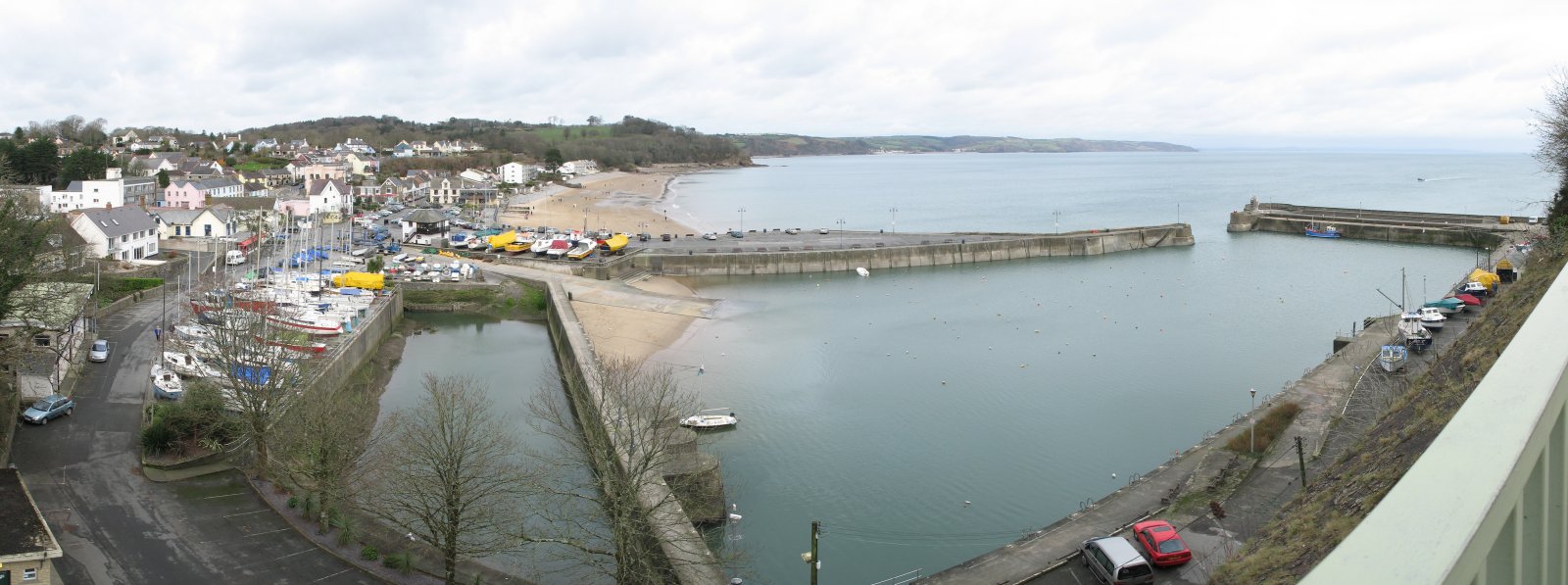
[edit]Permission to build the harbour was granted by Parliament in 1829 to the Saundersfoot Railway and Harbour Company[9] for the export of anthracite coal from the many mines in the area, although coal was exported from the beach for centuries before this.[10] The village grew up to serve the port which by 1837 had five jetties handling coal and iron ore and subsequently pig iron and firebricks from local sources. The course of the tramway from Bonville's Court mine bisects the village and ends at the jetty. The tramway from Stepaside forms the sea front. The industry finally faded away in the early years of the twentieth century, so that today, the harbour accommodates private moorings,[11] pleasure boats for seasonal tourism,[12] and small fishing charters.[13]
Demographics
[edit]In 2021, the recorded population of Saundersfoot was 2,500. Of this, 39.3% were aged 65+, above the county average of 26.3%. The largest ethnic group is White who make up 97.1% of the population, above the county average of 97.6%, with the second largest being Asian/Asian British with 1.4% of the population, below the county average of 0.9%. The largest religious group was recorded as Christian who make up 56.4% of the population, above the county average of 48.8%, with the second largest being No religion, who make up 35.5% of the population, below the county average of 43.0%.[3]
Governance
[edit]At the local level, councillors are elected to Saundersfoot Community Council to oversee local issues, such as planning applications and maintenance of the local public buildings and cemetery.[14]
Until 2022 the boundaries of the Saundersfoot community were coterminous with a Saundersfoot electoral ward, electing one county councillor to Pembrokeshire County Council. Councillor Rosemary Hayes MBE was the ward's representative on South Pembrokeshire District Council and Pembrokeshire County Council for 25 years, before losing to Phil Baker at the May 2008 elections.[15]
Following the recommendations of a boundary review by the Local Government Boundary Commission for Wales, effective from the 2022 local elections, the Saundersfoot ward was split into North and South. The north part was merged with the neighbouring community of Amroth to create a new ward of 'Amroth and Saundersfoot North'.[16] The south part became a new county ward of 'Saundersfoot South'. Both wards elect a councillor to the county council.
Notable people
[edit]- William Frost (1848–1935), a Welsh designer of an early flying machine, the Frost Airship Glider.
- Rod de'Ath (1950–2014), a Welsh musician, drummer with Irish guitarist Rory Gallagher
- Jay James Picton (born 1983), a Welsh recording artist, songwriter with The Overtones and broadcaster
Railway
[edit]Saundersfoot railway station is a mile from the village centre off the B4316 road. Trains call every two hours, westwards to Pembroke Dock and eastwards to Whitland, Carmarthen and Swansea.
Saundersfoot swim
[edit]Saundersfoot holds its New Year's Day swim every year which is sponsored by local businesses. More than 1,500 people took part in 2016.[17] Due to COVID-19, the 2021 event was cancelled[18] but was allowed to go ahead again in 2023.[19]
References
[edit]- ^ Bartrum, Peter (1993). A Welsh Classical Dictionary: People in History and Legend up to about A.D. 1000. National Library of Wales. p. 729. ISBN 0907158730.
- ^ Charles-Edwards, T. M. (November 1971). "The Seven Bishop-Houses of Dyfed" (PDF). Bulletin of the Board of Celtic Studies. XXIV(III): 247.
- ^ a b "Build a custom area profile - Census 2021, ONS". www.ons.gov.uk. Retrieved 21 March 2024.
- ^ "Penbrok comitat". British Library. Archived from the original on 11 April 2021. Retrieved 18 June 2020.
- ^ Wade-Evans, Arthur. Medieval Welsh Law, p. 263.
- ^ "GENUKI: St Issells". Retrieved 2 May 2019.
- ^ "History of St Issells in Pembrokeshire: Map and description". Retrieved 8 February 2016.
- ^ "St.Issell's Church, Saundersfoot". British Listed Buildings. Retrieved 29 December 2013.
- ^ "Ports.org.uk / Saundersfoot". www.ports.org.uk.
- ^ Price, Martin Connop (1982). Industrial Saundersfoot. Llandysul, Dyfed: Gomer Press. pp. 17–21. ISBN 0 85088 866 2.
- ^ "Harbour Facilities". Saundersfoot Harbour.
- ^ "Pembrokeshire Boat Trips | Saundersfoot Boat Trips". 13 December 2018.
- ^ Saundersfoot Sea Fishing - Accessed 12 Feb 2021
- ^ "Saundersfoot Community Council". Tenby Observer. 12 June 2015. Retrieved 2 May 2019.
- ^ "Election Shocks". Narberth & Whitland Observer. 9 May 2008. Retrieved 2 May 2019.
- ^ "Review of Community Boundaries in the County of Pembrokeshire. Final Recommendations Report" (PDF). Local Democracy and Boundary Commission for Wales. 2021. pp. 69–71. Retrieved 12 June 2022.
- ^ "1,500 take part in New Year's Day Saundersfoot swim". BBC. 1 January 2016. Retrieved 8 February 2016.
- ^ "Saundersfoot New Year's Day Swim 2021 cancelled because of Covid-19 rules". Western Telegraph. 25 August 2020. Retrieved 12 February 2020.
- ^ "Swim is back with a big splash to welcome in 2023". Western Telegraph. 6 November 2022. Retrieved 21 March 2024.
External links
[edit]
Saundersfoot travel guide from Wikivoyage
Saundersfoot
View on GrokipediaSaundersfoot is a large coastal village and community in Pembrokeshire, Wales, located on the southeastern shore within the Pembrokeshire Coast National Park.[1] With a population exceeding 3,000, it serves as a popular seaside holiday destination featuring a wide expanse of golden sand and shallow waters ideal for families, swimming, and watersports.[1][2] The village's sheltered harbor, a key historical site for coal export during the 19th century, now supports small-scale fishing, boating, and tourism while preserving its maritime heritage.[3] Positioned near the larger resort of Tenby, Saundersfoot attracts visitors for its scenic coastal paths, community events, and dog-friendly beach areas, contributing to the region's economy through seasonal tourism.[2][4]
Geography and Environment
Location and Topography
Saundersfoot is a coastal community in Pembrokeshire, Wales, positioned on the southeastern shore of Carmarthen Bay at coordinates approximately 51.71°N 4.70°W.[5] It forms part of the Pembrokeshire Coast National Park, lying between Tenby to the west and the park's eastern boundary.[6] The settlement overlooks a broad bay, with its harbor and beach directly fronting the sea.[5] The topography features low-lying coastal terrain with an average elevation of 41 meters, rising to steeper slopes inland.[7] The shoreline includes a sandy beach extending about 900 meters, backed by a pebble bank above the high tide mark and low cliffs.[5] Behind the immediate coastal zone, rolling lowlands characterize the landscape, supporting settlement and agriculture.[6] Rock platforms and shingle ridges contribute to the varied coastal profile, exposed to southeast-facing aspects.[8]Coastal Features and Erosion Risks
Saundersfoot's coastline is characterized by a broad sandy beach interspersed with rock platforms and a shingle ridge, backed by cliffs rising to steep coastal slopes composed of Carboniferous strata including mudstones, shales, siltstones, and sandstones from the Millstone Grit and basal Coal Measures groups.[8][9] These formations exhibit complex geological structures, such as chevron folds, anticlines like the Lady Cave Anticline, synforms, and faults, resulting from Variscan deformation during the late Paleozoic era.[10][11][12] The sandy beach and underlying rock exposures contribute to dynamic coastal morphology, with visible strata patterns and textures in the cliffs highlighting tectonic history and differential erosion rates between harder sandstones and softer mudstones.[13] Erosion processes are influenced by wave action exposing cliff toes, leading to ongoing retreat in undefended sections of the Tenby to Saundersfoot management unit.[14] Coastal erosion risks in Saundersfoot are elevated due to the vulnerability of sandy beaches to storm surges and rising sea levels, with shingle and pebbles providing natural barriers that, when depleted, increase threats to adjacent properties and infrastructure.[15] In September 2024, unauthorized removal of protective pebbles from the beach prompted warnings from local officials about accelerated erosion defending homes.[16] By May 2025, councillors and authorities continued addressing these concerns through monitoring and potential interventions, amid broader climate-driven intensification of risks like cliff landslides near The Norton.[17][18] Shoreline management policies emphasize sustained observation of erosion hotspots to evaluate asset losses from progressive cliff exposure.[14][19]History
Origins and Early Settlement
Evidence of prehistoric activity in the Saundersfoot area includes Bronze Age standing stones and a possible burial barrow known as Harry's Tump.[20] Iron Age occupation is attested by the hill fort at Hean Castle and placenames incorporating "rath," signifying fortified enclosures or homesteads.[20] These features point to continuous human presence from the Neolithic through the Celtic period, with the latter evolving into the indigenous Welsh population.[20] Following the Norman conquest after 1066, the region integrated into the Earldom of Pembroke, with Coedrath forest preserved as a hunting ground for the Earls.[20] Early medieval settlement consisted of a few cottages in a forest clearing within this woodland.[21] The parish church of St Issell's, constructed in the 13th century and rebuilt in stone with a surviving medieval tower, anchored the community and inspired the early names Llanussyllt in Welsh and St Issels after the Norman period.[20] [22] The modern name Saundersfoot likely originated from "Elisaunder’s Ford," recorded in a 1332 rent document, denoting a ford at the foot of a hill possibly associated with a landowner named Alexander or Saunders.[21] Nearby fortifications, such as Bonville Castle built around the early 14th century by Nicholas de Bonville, underscore the defensive character of early settlements in the vicinity.[20]Industrial Development and Coal Era
The industrial development of Saundersfoot accelerated in the early 19th century with the construction of its harbor between 1829 and 1830, specifically designed to export high-quality anthracite coal from nearby collieries in the Pembrokeshire coalfield.[23] The Saundersfoot Railway and Harbor Company received parliamentary authorization in 1829 to build infrastructure for coal transport, with the railway linking inland mines to the harbor by 1830–1834, facilitating efficient loading onto ships via multiple jetties operational by 1837.[20] This development transformed the modest coastal settlement into a bustling export port, where anthracite—prized for its low smoke and high heat value—was shipped to markets including Europe and beyond, alongside minor exports like pig iron and firebricks.[21] Central to the coal era was Bonville's Court Colliery, among the largest in Pembrokeshire, which commenced anthracite production in 1842 and underwent significant expansion from the 1860s under London solicitor Charles Vickerman, owner of local estates including Hean Castle.[24] By 1903, the colliery employed 215 workers and featured steam-powered winding and pumping engines to address flooding issues common in the faulted geology of the South Wales coalfield.[24] Peak output exceeded 15,000 tons annually in 1938, though deteriorating conditions with increased faulting hampered sustained production; the pit closed amid broader regional decline around 1930.[25] The coal industry's prosperity peaked in the mid-19th century, drawing workers to Saundersfoot and spurring ancillary infrastructure like tramways and limekilns, but output waned by the early 20th century due to geological challenges, thinner seams, and competition from larger Welsh coalfields.[26] Local anthracite, noted for superior quality, supported harbor activity until exports ceased with the collieries' exhaustion, contributing to the coalfield's overall contraction before nationalization in 1947.[23] This era's legacy includes engineered coastal features like breakwaters, which persist despite the shift to tourism post-decline.[27]Post-Industrial Transition
The decline of coal mining in Saundersfoot accelerated in the early 20th century, with major collieries such as Bonville's Court closing by 1930, though some coal processing continued briefly from nearby sites.[24] The associated Saundersfoot Railway, operational since 1834 for transporting coal to the harbor, ceased entirely in 1939, marking the effective end of the industrial coal era in the locality.[28] This closure contributed to high unemployment and economic hardship, mirroring broader patterns in Pembrokeshire's coalfield where the last nearby pit at Kilgetty shut in 1947 amid nationalization and competition from larger South Wales fields.[29] Post-mining, Saundersfoot pivoted toward tourism as its primary economic driver, leveraging its sandy beach and coastal location to attract visitors, which supplanted coal as the dominant industry by the mid-20th century.[30] The harbor, originally constructed in 1834 for anthracite exports, transitioned to leisure and small-scale maritime uses, with derelict industrial sites gradually repurposed.[31] In recent decades, targeted regeneration efforts have accelerated this shift, including a multi-million-pound harbor redevelopment program initiated by the Saundersfoot Harbour Trust. Phase 1 cleared disused industrial land, while Phase 2, completed in 2022, introduced amenities to establish the area as a year-round tourist hub, encompassing retail, dining, and event spaces.[31] Complementary projects, such as proposed ornamental coal truck installations in 2025, aim to preserve mining heritage while integrating it into tourism narratives, fostering cultural tourism without reviving extractive industry.[32] These initiatives have mitigated lingering post-industrial challenges like seasonal employment fluctuations, though the local economy remains tourism-dependent.[33]Economy and Tourism
Tourism and Beach Attractions
Saundersfoot attracts tourists primarily through its coastal appeal, with the beach serving as the central draw for families and water enthusiasts. The village's sheltered bay features a wide expanse of golden sand that extends significantly at low tide, providing ample space for activities while maintaining accessibility at high tide. Shallow waters make it suitable for swimming and paddling, contributing to its reputation as a family-friendly destination.[2][34] The beach holds Blue Flag status, an international eco-label recognizing high standards in water quality, environmental management, safety, and educational efforts, as awarded in 2025 by the Foundation for Environmental Education. This certification underscores the beach's cleanliness and facilities, including lifeguard presence during peak seasons and amenities like restrooms and parking. Water quality is rated excellent, supporting safe bathing.[35][36] Popular activities include canoeing, sailing, windsurfing, and fishing from the shore or nearby harbour, with the calm bay ideal for beginners. The adjacent harbour facilitates boat trips and supports maritime tourism, while coastal walks along the Pembrokeshire Coast Path offer views of the beach and link to sites like Wiseman's Bridge via disused railway tunnels. Dining options emphasize fresh seafood, reflecting the area's fishing heritage.[4][34][37]Harbour Operations and Maritime Economy
Saundersfoot Harbour operates as a trust port managed by the Saundersfoot Harbour Commissioners, providing facilities for a small commercial fishing fleet and leisure boating. The harbour accommodates eight commercial fishing vessels with exclusive use of the East Wall, landing catches that position it as the second-largest fishing port in Wales by tonnage.[38][39] Infrastructure includes 349 meters of quay length, 200 leisure moorings, storage for 55 boats, and a 16-tonne boat hoist, supporting berthing for up to six visiting vessels within the tidal basin and additional moorings on buoys or pontoons in the bay.[38][39] Maritime activities emphasize small-scale fishing alongside recreational pursuits such as watersports, sea angling charters, and yachting, with a flushing system via weir maintaining navigable depths in the channel.[40][41] No large-scale commercial shipping occurs, reflecting the harbour's transition from 19th-century coal exports to contemporary leisure-oriented operations.[42] Access is tidal, with a marked channel, 3-knot speed limit, and VHF contact to the harbour master for berthing instructions.[39] The maritime economy contributes to local sustainability through fishing revenues and tourism-driven activities, including events and the Wales International Coastal Centre, which promotes year-round visitation via family-oriented marine heritage exhibits and watersports training.[40] Non-marine ventures, such as retail and property developments like Ocean Square, generate profits funneled into a development fund to bolster harbour viability and facilities.[38] A £10 million-plus investment program has enhanced infrastructure, aiming to create over 90 jobs and reinvest tourism income for long-term growth in commercial development and sustainable practices.[38]
Economic Challenges and Diversification
Saundersfoot's economy remains heavily dependent on tourism, with approximately 52% of employee jobs in distribution, hotels, and restaurants as of 2007, reflecting a broader pattern in Pembrokeshire where the sector supports 23% of local employment and generates £604 million annually from over 6.3 million visitors.[43][44] This reliance exposes the community to seasonal fluctuations, including higher unemployment in winter months and vulnerability to external factors such as adverse weather, economic downturns, and policy changes like proposed second-home council tax hikes, which local stakeholders warn could damage visitor numbers.[43][45] Median hourly earnings in Saundersfoot lag behind Welsh averages, at £9.31 for men and £7.70 for women in 2008, contributing to lower gross value added per head (82% of the Wales average).[43] Additional pressures include traffic congestion, limited parking, high commercial rates deterring quality retail, and insufficient wet-weather facilities, which hinder year-round viability.[46] Diversification initiatives aim to mitigate these risks by extending economic activity beyond peak summer tourism. The Saundersfoot Harbour Trust's re-development, including a £10 million Wales International Coastal Centre completed in 2022 with EU, Welsh Government, and Coastal Communities funding, has revitalized derelict sites into modern facilities, boosting boat capacity from 200 to over 300, adding visitor moorings, and introducing retail outlets, cafes, and event spaces to support year-round operations.[31] These enhancements, alongside heritage interpretation centres and water-based activities, promote non-seasonal attractions like arts events and educational programs.[31] In 2024, the nearby Port of Milford Haven acquired St Brides Spa Hotel in Saundersfoot as part of its strategy to diversify from volatile oil and gas revenues into hospitality, partnering with The Celtic Collection for management to enhance regional tourism resilience and deliver economic, social, and cultural benefits without disrupting local jobs.[47] Local development plans further emphasize rural diversification, including business support and heritage trails, to build a more balanced economy less tethered to visitor peaks.[48]Infrastructure and Transport
Road and Public Transport
Saundersfoot is connected to the broader road network primarily via the A478 trunk road, which provides coastal access southward to Tenby (approximately 3 miles away) and northward to Amroth, facilitating vehicle entry from major routes like the A477 from the west.[49] Local roads such as the B4316 from Pentlepoir and the C3177 Fan Road offer alternative approaches, though these can experience temporary closures for events or maintenance, as seen during the annual Wales Sportive in June.[50] Traffic congestion in the village center, particularly during peak tourist seasons, has prompted Pembrokeshire County Council initiatives for active travel improvements, including traffic calming, enhanced pedestrian crossings, and proposed shared-use paths to reduce reliance on cars.[51] Public transport options include rail and bus services. Saundersfoot railway station, located about 1 mile north of the village center in Pentlepoir, is served by Transport for Wales on the Milford Haven branch line, with trains connecting to Swansea (via Carmarthen) and westward to Milford Haven; typical journey times to Tenby are under 10 minutes, though services are infrequent outside peak hours.[52] Bus connectivity relies on Pembrokeshire's coastal network, operated by local providers, featuring routes such as 350, 351, 352, 353, 333, 381, and 361, which link Saundersfoot to nearby towns like Tenby, Narberth, and Pembroke Dock.[53] The seasonal Pembrokeshire Coastal Bus service operates daily from May to September and on weekends in winter, enabling access to beaches, walks, and attractions without a car; hourly services connect key stops like Hill Park to the village arcade on weekdays.[54] Overall, while road access dominates due to the area's rural setting, public transport supports tourism but remains limited by timetables and distances from stops to core village amenities.[55]Railway Legacy and Current Access
The Saundersfoot Railway, a narrow-gauge industrial line of 4-foot gauge, was authorized by an Act of Parliament in 1829 and constructed between 1830 and 1834 to transport coal from local collieries to the harbor for export.[20][56] It linked inland mines at sites including Stepaside, Kilgetty, Reynalton, and Thomas Chapel via a network of branches and tunnels, facilitating the shipment of anthracite and culm primarily to southern England and Ireland during the peak of Pembrokeshire's coal era.[57][28] Operations relied on horse-drawn wagons initially, with steam locomotives introduced later, but the line remained independent of broader networks and emphasized freight over passenger service.[58] Declining coal demand in the interwar period, exacerbated by exhausted seams and competition from larger Welsh coalfields, led to colliery closures by the 1920s; the railway ceased operations entirely in 1939 on the eve of World War II.[28][20] Physical remnants persist as heritage features, including three short tunnels near the harbor—excavated in 1832–1834 for the main line—which now form part of pedestrian and cycling paths, preserving the route's engineering amid post-industrial reclamation.[58] Contemporary rail access relies on Saundersfoot railway station, a standard-gauge stop on the Pembroke Dock branch line opened in 1866 by the Pembroke and Tenby Railway as part of its coastal extension from Tenby.[59] Managed by Transport for Wales, the unstaffed station handles regional services with direct trains to destinations including Swansea (approximately 1 hour 30 minutes) and Pembroke Dock (about 45 minutes), operating roughly hourly on weekdays.[52][60] Situated 1 mile (1.6 km) northeast of the village center, it offers step-free platform access via ramps, though the site lacks full amenities like ticket machines.[60] Ongoing infrastructure enhancements, such as the 2024 Active Travel Link connecting the station to Valley Road, aim to improve pedestrian integration with local paths and the coastal route.[61]Governance and Demographics
Local Administration
Saundersfoot falls under the jurisdiction of Pembrokeshire County Council, the unitary authority responsible for the principal area of Pembrokeshire in Wales, handling services such as education, highways, social care, and planning.[62] The council comprises 60 elected members serving four-year terms, with the most recent election held on 5 May 2022.[63] Saundersfoot is represented at the county level by two electoral divisions: Amroth and Saundersfoot North, represented by Alec Cormack (Liberal Democrats), and Saundersfoot South, represented by Chris Williams (Independent).[64] Local administration is managed by Saundersfoot Community Council, an elected body with statutory powers to maintain community facilities including public seating, bus shelters, noticeboards, footpath lighting, and war memorials, as well as to represent residents on local issues to higher authorities.[65] [66] The council operates from The Regency Hall, Milford Street, Saundersfoot SA69 9EW, with contact via [email protected] or telephone 07562 959405.[67] Meetings are open to the public, often held monthly, and focus on matters like planning objections, community events, and infrastructure maintenance.[68] In October 2024, the community council faced significant instability when the chair and several other members resigned, prompting a call for eight new councillors to fill vacancies.[69] This followed internal disagreements, though specific causes were not publicly detailed beyond general reports of mysterious quits. Community councils in Wales, including Saundersfoot's, derive their authority from the Local Government Act 1972 and related legislation, but lack the broader powers of principal councils, relying on precept funding from local taxpayers via the county council.[65]Population Characteristics
The Saundersfoot community recorded a population of 2,355 at the 2021 census, an increase of 175 from the 2,180 residents enumerated in 2011, reflecting a modest growth rate of approximately 0.8% per year over the decade.[70] This figure encompasses the broader rural community area of 6.771 square kilometres, yielding a population density of 348 inhabitants per square kilometre.[70] The parish-level data aligns closely, reporting 2,354 usual residents on census day, 21 March 2021.[71] Demographic profiles indicate an ageing population structure, with a high concentration of older residents characteristic of rural Welsh coastal communities. Approximately 38% of the population (894 individuals) were aged 65 and over, compared to 49% (1,148) in working ages 18-64 and 12% (290) under 18.[70] More granular age distribution data reveals pronounced peaks in senior cohorts: 266 residents aged 80 and above, 444 aged 70-79, and 387 aged 60-69, underscoring a dependency ratio elevated by retirement migration and low birth rates typical of such locales.[70]| Age Group | Number of Residents |
|---|---|
| 0-17 years | 290 |
| 18-64 years | 1,148 |
| 65+ years | 894 |
Community and Culture
Notable Residents
William Frost (1848–1935), a carpenter born and raised in Saundersfoot, designed an early manned flying machine known as the Frost Airship Glider, for which he received British Patent No. 9825 in 1894.[72] Constructed in his workshop on St Bride's Hill, the glider featured a lightweight wooden frame covered in silk, with adjustable wing flaps for control and a wheeled undercarriage; local reports claim Frost achieved a powered flight of about 800 yards (730 meters) at 20–30 feet (6–9 meters) altitude from a field near Saundersfoot on September 30, 1896, powered by clockwork mechanisms driving propellers—seven years before the Wright brothers' Kitty Hawk flight—though the event relies on anecdotal eyewitness accounts without photographic or widespread documentation.[73][74] Frost's invention demonstrated practical elements of controlled flight but received limited recognition due to financial constraints and lack of publicity.[75] Betty Lloyd-Davies (1892–after 1958), an actress born in Saundersfoot, performed in stage and screen roles later in her career, including appearances as Waldo's Mother in the 1957 radio adaptation of Dylan Thomas's Under Milk Wood and in the television series Charlesworth at Large (1958).[76] Her early artistic talents were nurtured locally before she pursued acting, contributing to Welsh cultural productions.[77]Local Events and Traditions
Saundersfoot's local events emphasize its maritime heritage, with annual gatherings organized by community groups like the Saundersfoot Sailing Club and Saundersfoot Festivities Ltd, a not-for-profit entity focused on charity-driven activities.[78] The Coppet Week Regatta, hosted by the sailing club, stands as a key tradition since the 1970s, originating from visiting sailors who established it as a family sailing holiday featuring competitive races in gusty coastal conditions. Typically held in late June, the 2025 edition included multiple races and social events, attracting over 50 crews and marking its enduring appeal through boat repairs and storytelling post-racing.[79][80] Harbour-based festivities include the annual Duck Race, a charitable spectacle where rubber ducks are released into the water for a timed competition, drawing crowds in August; the 2025 event concluded the summer series on August 24 at 4 p.m.[81] Rowing competitions further highlight the area's watersports tradition, such as the Welsh Rowing Coastal Sculling Championships held on Saundersfoot Beach in June 2025 by Wisemans Bridge Rowing Club, and international events like the 2022 World Rowing Beach Sprint Finals attended by HRH The Princess Royal.[82][83] Winter traditions center on the Coastal Christmas, featuring a lights switch-on event that illuminates the village with displays including a "Welcome to Saundersfoot" sign, alongside markets, pantomimes, and community gatherings from early December through the holidays. Preparations for the 2025 season included enhanced lighting installations announced in September, transforming the seaside setting into a festive hub with local shops and performances.[84][85] New Year's Day also features a traditional swim, continuing the community's embrace of its coastal environment year-round.[86]Planning and Development Issues
Recent Housing and Infrastructure Projects
In recent years, Saundersfoot has seen several housing developments approved under the Pembrokeshire Coast National Park Authority's Local Development Plan, which allocates specific sites for residential growth to address local housing needs.[87] The Ger-y-Môr scheme, located off Sandy Hill, comprises 72 homes including a mix of one- to five-bedroom detached, semi-detached, terraced houses, and apartments, with 25 designated as affordable housing.[88] Planning permission was granted in July 2024, and site acquisition was finalized in November 2024 by Persimmon Homes West Wales, with construction underway by July 2025.[89] [90] The development incorporates zero-carbon-ready features such as solar panels, sustainable urban drainage systems with bio-retention areas and rain gardens, and energy-efficient designs aimed at reducing environmental impact.[91] Another significant project is Nant Y Dderwen, a development of 54 energy-efficient homes including houses, bungalows, and apartments, situated near Saundersfoot Bay.[92] Led by Morgan Homes in partnership with Ateb Group, it includes 19 units under construction as of September 2025, emphasizing proximity to local beaches and high-efficiency standards.[93] In May 2025, amendments were proposed to allow early occupancy of initial phases, reflecting efforts to accelerate delivery amid demand for local housing.[94] Not all proposals have advanced; for instance, the initial phase of a 36-home scheme at Penny Farm was refused planning permission in June 2025 due to concerns over access roads and pedestrian safety, despite the site's allocation for housing in the Local Development Plan and inclusion of 14 affordable units.[95] Infrastructure enhancements tied to these housing projects have primarily focused on integrated sustainable elements rather than standalone initiatives, such as improved drainage and green spaces, with broader harbor-area transformations predating 2020.[31] These developments respond to Pembrokeshire's identified need for affordable housing while navigating constraints from the National Park's environmental protections.[96]Environmental and Community Disputes
Saundersfoot has faced ongoing environmental challenges related to coastal erosion, with local authorities and residents expressing concerns about the vulnerability of the village's shoreline. In September 2024, Pembrokeshire County Councillor Chris Williams highlighted that Saundersfoot beach was being stripped of essential pebbles, which serve as a natural barrier against erosion threatening nearby homes; unauthorized removal of these materials exacerbated the risk, prompting calls for stricter enforcement.[16] Discussions among councillors and organizations continued into May 2025, focusing on proactive measures to mitigate future erosion without compromising the area's appeal as a seaside resort.[17] Earlier assessments in February 2024 placed Saundersfoot under spotlight for flooding and erosion risks, influencing broader Pembrokeshire strategies for coastal defense.[19] Water quality issues have also sparked environmental alerts, particularly affecting recreational use of the beach and sea. In July 2023, Natural Resources Wales issued warnings for swimmers and surfers to avoid the water at Saundersfoot following untreated sewage discharges into the sea, attributed to storm overflow systems overwhelmed by heavy rainfall; such incidents underscore persistent infrastructure limitations in managing wastewater during peak tourist seasons.[97] Additionally, in April 2025, local residents and officials reported frustration over up to 250 cockle pickers descending on Glen Beach, allegedly depleting shellfish stocks and disrupting the ecosystem, leading to demands for regulatory crackdowns to preserve marine biodiversity.[98] Community disputes have frequently intersected with planning decisions, notably opposition to a proposed traveller site on the village outskirts. In April 2025, nearly 300 residents signed petitions against the development for a Romany Gypsy site, citing concerns over location suitability, traffic, and integration with the existing community; Pembrokeshire Coast National Park planners rejected the application in May 2025, reflecting widespread local resistance.[99][100] Housing proposals have similarly drawn contention, as seen in June 2025 when a scheme for new dwellings was denied due to nine formal objections raising highway safety, increased traffic, inadequate access, and insufficient affordable units, highlighting tensions between growth and infrastructure capacity.[101] Broader critiques of peripheral developments argue they risk eroding Saundersfoot's rural village classification under Office for National Statistics criteria, potentially straining local services without proportional benefits.[102] These conflicts illustrate competing priorities between environmental preservation, community cohesion, and development pressures in a constrained coastal setting.References
- https://commons.wikimedia.org/wiki/File:Saundersfoot_railway_station%2C_Pembrokeshire_-_geograph.org.uk_-_3992061.jpg
