Hubbry Logo
Eggenberg Palace, GrazEggenberg Palace, GrazMain
Open search
Eggenberg Palace, Graz
Community hub
Eggenberg Palace, Graz
logo
8 pages, 0 posts
0 subscribers
Be the first to start a discussion here.
Eggenberg Palace, Graz
from Wikipedia

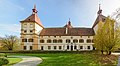
Eggenberg Palace (German: Schloss Eggenberg) in Graz, is the most significant Baroque palace complex in the Austrian state of Styria.[1] With its preserved accouterments, the extensive scenic gardens, as well as some special collections from the Universalmuseum Joanneum housed in the palace and surrounding park, Schloss Eggenberg ranks among the most valuable cultural treasures of Austria. Eggenberg Palace is situated at an elevation of 381 meters on the Western edge of the city.[2] Its architectural design and the still visible imprint of centuries of history continue to bear witness to the vicissitude and patronage of the one-time mightiest dynasty in Styria, the House of Eggenberg.

Key Information

In 2010, the significance of Schloss Eggenberg was recognised with an expansion to the listing of the Graz Historic Old Town among the UNESCO World Cultural Heritage Sites.

Surrounded by walls, with a huge portal facing West, the palace is located in the Eggenberg district of Graz and can be reached by tram. The northern corner of the palace grounds features the Planetary Garden and Lapidarium of Roman stonework as well as the entrance to the new Archeology Museum,[1] which houses the Cult Wagon of Strettweg. At ground level, the palace houses a numismatic collection (Coin Cabinet)[3] located in the former rooms of Balthasar Eggenberger, owner of the imperial minting license and operations in the Late Middle Ages. On the upper level, the Alte Galerie[4] encompasses a large array of paintings, sculptures, and other works of art from the medieval era through the early modern period, spanning five centuries of European art history.

History

[edit]
Ideal perspective of Eggenberg. Copper etching by Andreas Trost, before 1700
Copper engraving with portrait of Prince Hans Ulrich von Eggenberg, 17th century

Construction

[edit]

At first glance, Schloss Eggenberg presents itself as a uniform, new construction of the 17th century. Nevertheless, large portions of the building date back to the Late Middle Ages and construction continued throughout the early modern era.

Before 1460 Balthasar Eggenberger, financier to Frederick III, Holy Roman Emperor, bought property in the west of Graz which became a fixed noble residence in the family name. In the subsequent years the family residence was constructed and expanded. By 1470, a square Gothic chapel had been constructed in the tower. A Papal indulgence from 30 May 1470 refers to the "Capella Beate Marie Virginis Sita in Castro Eckenperg", the Chapel of the Virgin Mary in Eggenberg Castle, which became the nucleus of the new palace built by Balthasar's great-grandson, Hans Ulrich von Eggenberg.[5]

The younger cousin of General Ruprecht von Eggenberg, Hans Ulrich, as a superb diplomat and statesman, steered the foreign policy of his Emperor, Ferdinand II,[6][7] while Eggenberg's counterpart and political adversary, Cardinal Richelieu of France, guided that of King Louis XIII[8][9] during Thirty Years War. As prime minister (in contemporary political jargon)[10] and close, personal confidant of Ferdinand II, Hans Ulrich wanted a grandiose residence representing his new status and authority when he was named "Gubernator" (Governor) of Inner Austria after the emperor chose Vienna as his imperial capital.[11] In 1625 Prince Hans Ulrich von Eggenberg commissioned court architect Giovanni Pietro de Pomis with the planning of his new palace, inspired by El Escorial in Spain.[12] As an architect, painter, and medailleur (designer and minter of medals), de Pomis, originally from Lodi near Milan, became the most important artist at the Grazer court.[13] Incorporating the original medieval family residence into the new palace, de Pomis himself oversaw the construction work up to his death in 1631. Fortress master builder Laurenz van de Syppe continued the work for two years until the building was finished, in the end, by both of de Pomis' site foremen, Pietro Valnegro and Antonio Pozzo. The shell appears to have been completed by 1635 or 1636. Between 1641 and 1646 work on the ornamentation was brought to a close.

In 1666, Johann Seyfried von Eggenberg, grandson of Hans Ulrich, began to develop the palace according to the splendor and grandeur of the Baroque style and in 1673 the residence again entered the limelight as Archduchess Claudia Felicitas of Tyrol was a guest in the palace on the occasion of her wedding in Graz to Leopold I, Holy Roman Emperor.[14] Under Prince Johann Seyfried, the comprehensive cycle of ceiling coverings of approximately 600 paintings in the rooms of the piano nobile was accomplished in just 7 years. Hans Adam Weissenkircher began his service as the court painter of the princely Eggenberger court in 1678. He finished the painting cycle of the main festival hall, the famous Planetary Room, in 1684/85. With this, the first phase of accouterment work on Schloss Eggenberg was completed.

After the extinction of the male line of the Eggenberg family, the Eggenberger state rooms were left in a half-emptied and neglected state. The husband of the last Eggenberger princess, Johann Leopold Count Herberstein, ordered a comprehensive renewal of the complex.[15] Between 1754 and 1762 the building and the garden underwent their second major phase of ornamentation, this time in complete accordance with the tastes of the Rococo. Above all, the accouterment of the piano nobile was modernized. Nevertheless, the Planetary Room and the entire cycle of ceiling paintings remained almost unchanged. Thus, the works limited themselves to wall decorations, stoves and pieces of furniture. In keeping with the taste of the times, three East Asian cabinets were introduced and the state rooms received new wall coverings. The most extensive change was probably the demolition of the Eggenberger palace theater, in the place of which a baroque palace church was established. The supervisor of these works was the Grazer court architect Joseph Hueber, a student of Johann Lukas von Hildebrandt.

The third phase of the changes came during the 19th century and was limited to the living quarters on the 1st storey (2nd floor in American English) of the palace. The piano nobile remained untouched and unused for a full century. The primary focus of attention of this period was the total transformation of the Baroque formal garden into a romantic landscape garden after the English fashion.

The entire complex remained in the possession of the Herberstein family up to 1939. Shortly before the war, Schloss Eggenberg was acquired with the park by the state of Styria. The oldest museum in Austria, the Joanneum, which was established on 26 November 1811 by Archduke Johann of Austria, took over management of the palace and park. The Joanneum conducted extensive restoration work to repair the damage that occurred during World War II and the subsequent occupation by the Allies and in 1953 Schloss Eggenberg and the Eggenberg Schloss Park were finally opened again to the public.

Scheme

[edit]

With his new residence, Hans Ulrich von Eggenberg, the mental inspiration behind the complex program, realized an architectural concept deeply influenced by the humanist notions of magic as the praxis of natural philosophy and of the rational order of the world. Above all, astronomy, astrology and alchemy were major components of the education of a worldly prince. In addition to representing the prince's new rank, all these aspects flowed into the vision of the new building as a symbol of the cosmos as a well-organized, hierarchical, logico-mathematically explicable system.

Schloss Eggenberg relies on the Gregorian calendar as a basis for this constructed universe. The palace has 365 exterior windows, one for each day of the year. Of these, 52 are on the 24 rooms of the piano nobile representing the weeks of one year. The 2nd storey contains these 24 state rooms in a ring-shaped arrangement which symbolize the hours in a single day. Every floor in the building bares exactly 31 rooms counting the maximum number of days in a calendar month. The 52 windows of the piano nobile with the 8 windows of the Planetary Room make a total of 60, representing both the number of seconds in a minute and the minutes in an hour.

The palace is erected on a rectangular plan with the geometrical center being formed by the middle tower with its Gothic chapel. On each corner there is a tower-like rise. Each of these corner-towers represents one of the four seasons and the outside corner of each is aimed exactly in a cardinal direction.

Planetary Room

[edit]
Painting of Mercury in the Planetary Room

The cycle of 24 state rooms culminates in the main festival hall, the Planetary Room and serves as both the beginning and the end of the ring of state rooms. The cycle of the oil paintings in this hall was created by Hans Adam Weissenkircher and displays the four elements, the 12 signs of the Western zodiac and of course the seven classical "planets" (planetes asteres: wandering stars) known to Antiquity. The cycle of paintings by Weissenkircher melds the architectural program with the ornamentation of the palace thereby achieving an allegory of the "Golden Age" ruled over by the House of Eggenberg.

Piano nobile

[edit]
Eggenberg Palace courtyard Detail
Central courtyard

The cycle of some 600 ceiling paintings in the 24 state rooms of the piano nobile recalls the history of the world with scenes from Greek and Roman mythology, religious scenes from the Old Testament, and historical legends from Western Europe. This ceiling program with its stucco framing dates back to the first period of accouterment in the 17th century.

Under the married couple Eggenberg-Herberstein, the 24 rooms of the piano nobile were refurbished according to the tastes of the Rococo starting in the mid-18th century. In addition to new pieces of furniture, chandeliers and sconces, and high-quality faïence stoves, nearly all the rooms also received brand-new, monochrome silk damask wall coverings. Five rooms in the north tract of the piano nobile were equipped with large painted canvasses. Styrian artist Johann Anton Baptist Raunacher dedicated each room to a different subject; shepherd's games, theatrical scenes and gambling scenes are found alongside society scenes and hunting scenes in Schloss Eggenberg. It was during this phase that the Eggenberg palace theater was converted into a palace church in the Baroque style. In addition, three exquisite East Asian cabinets were integrated into the sequence of rooms. The first two are adorned with valuable Imari porcelain plates and bowls as well as Chinese silk paintings. In the wall coverings of the third cabinet, eight panels of a precious Japanese folding screen have been used. These traditional dividers portray the palace and the fortified town of Osaka before 1615, whereby it can be determined that these panels were executed shortly thereafter. From the early modern era there are very few of these screens depicting the city before its destruction, so these works are especially noteworthy. On account of the viewpoint on Osaka the Eggenberg panels represent a unique exhibit.[16]

The find of the screen created a sensation in Japan, since any visual remnants of the time of Hideyoshi were rare. During the state visit of the Austrian president in 2009 a memorandum of understanding was signed creating a partnership between Eggenberg and Osaka Castle.[17]

Gardens

[edit]
Entrance gate to the garden and palace
Water feature in the English garden

The various owners and builder-owners have always looked at the palace and at the surrounding gardens as corresponding elements. Thus, every succeeding generation has carried out significant alterations.

The largest expansion of the garden occurred after the completion of the house. In the last third of the 17th century the garden was generously extended around the building. It followed the pattern of the strictly subdivided Italian garden, with parterres, bosquet areas, fountains, aviaries and pheasant gardens.

Johann Leopold Count Herberstein allowed the whole arrangement to be reshaped into a French garden. As early as the 1770s, the Eggenberg Gardens were an attraction open to the Grazer public.

However, with the advent of the Enlightenment and the liberalization of ideas under Joseph II, Holy Roman Emperor, by the end of the 18th century, it was thought that Baroque gardens were ugly; having a pruned nature constricted by too stringent norms. Jérôme Count Herberstein, as a fanatical garden lover, partook of this perspective and in 1802 prompted the stylish transformation of the Eggenberg Schloss Park into a picturesque English garden.[18] labyrinths, fountains, straight paths and hierarchical patterns all had to give way to the call to "return to nature" in the sense of Jean-Jacques Rousseau. Apart from the straight entrance way, which was preserved, the goal was to create artificial vistas with the new, winding pathways and the illusion of being in an Arcadian landscape painting such as those of Claude Lorraine[19] whose works inspired the likes of Stourhead as well as many others. The recently restored Rose Mound formed the climax of this 19th-century landscape park.

The early 20th century saw a dwindling of interest in the palace gardens and the Eggenberg Schloss Park no longer employed a gardener. This had the unfortunate consequences of individual elements of the garden being torn-out and, over the course of decades, the rest being overgrown; the entire arrangement thus becoming more or less a simple city park.

In 1993, in cooperation with the Austrian Federal Bureau of Cultural Heritage Management (Bundesdenkmalamt), a garden grooming project was begun with the goals of preserving and reconstructing the gardens as a cultural monument to Romanticism. The still existing elements were to be made recognizable and protected and the lost elements reconstructed in so far as it was possible. The initial phases of this project that have already been completed are the reconstruction of the 1848 Breakfast Garden behind the palace and the reclamation and restoration, which occurred during the winter months of 2007/08, of the Rose Mound, one of the most important components of the romantic English landscape garden.

Additionally, the peacocks from the Graz Peacock Garden formerly located between the inner city and the city park have found a new home in the Eggenberg Schloss Park. The species are of both the white variety and the more common Indian blue peacock. During mating season, the loud cawing of the males as well as their brilliant plumage adds an exotic flair to the splendor of the park as they try to attract the larger but less colorful females.

Planetary Garden

[edit]
Planetary Garden aerial view

In the north corner of the grounds, an enclosed, separate garden went through such diverse transformations and uses over the course of the palace history that in the end it was discernible only by the spatial structure.

Due to a lack of surviving records, a new design for the flower garden was decided on in 2000 and a new garden grew out of an old idea. Landscape architect Helga Tornquist took up the theme of the Eggenberg scheme and incorporated it into a contemporary garden creation. This reclamation takes up in a playful fashion the ancient system of planetary "signatures", which is of special significance for the iconography of Schloss Eggenberg.[20] The Lapidarium has been established over the foundations of the former orangery as a point of interest and to provide an appropriate setting for the Roman Stonework Collection of the Joanneum.

Schloss Eggenberg enters the 21st century with the opening of a newly constructed subterranean showroom adjoined to the Lapidarium to house the Joanneum's Pre- and Early History archaeological Collections in autumn of 2009 to be ready for the Joanneum's bicentennial celebration in 2011.

peacocks on the bridge

Commemorative silver euro coin

[edit]

In 2002, the Austrian Mint honored the importance of Schloss Eggenberg, by using it as the main motif of one of its most popular silver euro commemorative coins: the 10 euro Eggenberg Palace commemorative coin. The reverse side shows an image of Johannes Kepler, a personal acquaintance of Eggenberg's[21] who taught at the former Protestant school in Graz. His first major work, Mysterium Cosmographicum describing the Copernican system, written while he was still in Graz, likely influenced the symbolism of the design of the palace.[21]

See also

[edit]

Notes and references

[edit]

Sources

[edit]
  • Das Joanneum – Österreichs Universalmuseum [documentary film DVD] By Günther Schilhan (director) & Helmut Gesslbauer (producer), Austria: ORF Steiermark, 2006. (available through the Joanneum)
  • Schloss Eggenberg. By Barbara Kaiser. Graz: Christian Brandstätter Verlag, 2006. ISBN 978-3-902510-80-8 (English Edition) or ISBN 978-3-902510-96-9 (German Edition) (available through the Joanneum)
  • Planet Eggenberg. By Hermann Götz. Graz: Landesmuseum Joanneum / Leykam Medien AG, 2005.
  • Ôsaka zu byôbu: Ein Stellschirm mit Ansichten der Burgstadt Ôsaka in Schloss Eggenberg. in Joannea Neu Folge, Band 1. By Franziska Ehmcke et al. Graz: Universalmuseum Joanneum, 2010. ISBN 978-3-902095-32-9 (available through the Joanneum)
  • The Thirty Years War. By Cicely Veronica Wedgwood. Garden City, NY: Anchor Books, 1961. (Re-issued by NYRB Classics, 2005. ISBN 978-1-59017-146-2)
  • Hans Ulrich Fürst von Eggenberg: Freund und erster Minister Kaiser Ferdinand II. By Hans von Zwiedineck-Südenhorst. Charleston, SC: BiblioBazaar, 2009. (new edition of digitally preserved original German text printed in Vienna in 1880, printed in Leipzig by Amazon Distribution GmbH) ISBN 978-1-113-02782-5
  • Ein Staat in Alt-Österreich: Besitzungen der Eggenberger. By Franz Kammerhofer. Graz: Franz Kammerhofer, 1998. ISBN 978-3-9500808-1-0
  • Die Fürsten und Freiherren zu Eggenberg und ihre Vorfahren. By Walther Ernest Heydendorff. Graz: Verlag Styria, 1965.
  • Alte Galerie – Masterpieces. By Ulrich Becker et al. Graz: Landesmuseum Joanneum, 2005. (English edition) ISBN 978-3-7011-7533-8
  • Der Eggenberger Altar. By Paul W. Roth et al. Vienna, Austria: Österreichische Galerie Belvedere, 2001.
  • Schloss Eggenberg: Lernbehelf für Guides. By Barbara Kaiser. Graz: Landesmuseum Joanneum, 2001.
  • Hans Adam Weissenkircher: Fürstlich Eggenbergischer Hofmaler. By Barbara Ruck. Graz: Landesmuseum Joanneum, 1985.
  • Giovanni Pietro de Pomis. By Kurt Woisetschläger et al. Graz: Verlag Styria, 1974. ISBN 978-3-222-10847-1
[edit]
Revisions and contributorsEdit on WikipediaRead on Wikipedia
from Grokipedia
Eggenberg Palace (German: Schloss Eggenberg) is a palace complex located on the western edge of , , renowned as one of the most significant princely residences in and a since 2010 as part of the "City of Graz – Historic Centre" extension. Built primarily between 1625 and 1635 on the site of a medieval castle, it was commissioned by Hans Ulrich von Eggenberg (1568–1634), a prominent statesman and Imperial Governor of , as a symbolic manifestation of cosmic order and political legitimacy amid the turmoil of the . The palace exemplifies early with influences, featuring a rigorously symmetrical layout that allegorically represents the universe through elements such as 365 windows (one for each day of the year), 52 rooms on the ground floor (weeks in a year), and 31 rooms on the piano nobile (days in a month). The Eggenberg family, originating as Graz merchants and bankers in the 15th century, rose meteorically to princely status through financial acumen and loyalty to the Habsburgs, with Hans Ulrich transforming their fortunes into the wealthiest dynasty in by the early . Designed initially by the Italian Giovanni de Pomis (1565/67–1633), the palace's construction proceeded in phases, with structural completion by 1635 under successors Valnegro and Antonio Pozzo, and interiors finalized by 1685 during the tenure of Johann Seyfried von Eggenberg (1644–1713). The male line of the family ended in 1717, leading to the estate's division among heirs and eventual acquisition by the Herberstein family in 1789; minimal alterations occurred thereafter, including a conversion of the original gardens to an English landscape style in the early . In 1939, the palace passed to the state of , which undertook extensive restorations and opened it as a museum in 1953, preserving its authenticity as rated "excellent" by the . At the heart of the palace lies the Bel Étage, comprising 24 meticulously preserved state rooms that form one of Austria's finest ensembles of 17th- and 18th-century interiors, blending and styles with original furnishings, tapestries, and over 500 ceiling paintings in frames. The crown jewel is the Planetary Room, completed in 1685 with frescoes by Hans Adam Weissenkircher depicting the solar system and zodiac, symbolizing and imperial ideology under Habsburg patronage. Today, managed by the Universalmuseum Joanneum, the palace houses three museums—the Alte Galerie (Old Gallery) with medieval to art, the Coin Cabinet, and the Archaeological Museum—while its expansive park, featuring a planetary garden and aviaries, offers a serene to the opulent interiors. This synthesis of architecture, art, and landscape underscores Eggenberg's role as a testament to the cultural and political ambitions of 17th-century European aristocracy.

Overview

Location and Description

Eggenberg Palace is situated on the western edge of , in the state of , , approximately 3 km from the city's historic center. Its geographic coordinates are 47°04′26″N 15°23′29″E, and it stands at an elevation of 381 m above . The palace occupies expansive grounds covering 90,000 m², providing a secluded setting amid the urban landscape. The structure forms a complex with a rectangular footprint measuring 65 m by 80 m and a prominent central tower rising to 50 m in height. It consists of a four-wing building enveloping a central lined with arcades on the ground floor. The layout includes a on the upper level, accessible via the arcaded wings, creating a symmetrical and enclosed architectural form typical of grand European residences. As part of the Universalmuseum Joanneum, integrates these physical elements into a cohesive complex.

Historical and Cultural Significance

Eggenberg Palace represents the most significant palace complex in the Austrian state of and exemplifies 17th-century political architecture in . Constructed to embody absolutist ideals, it stands as one of Austria's premier ensembles, highlighting the region's cultural and artistic ambitions during the Habsburg era. The palace symbolizes the rising influence of its commissioner, Hans Ulrich von Eggenberg, imperial governor of and a key political figure under Emperor Ferdinand II. As a close confidant who aided Ferdinand II's election as , von Eggenberg used the residence to project his authority and allegiance to the Habsburg dynasty. Modeled on the Spanish royal complex of , it reflects a deliberate emulation of monarchical symmetry and grandeur to underscore themes of order and legitimacy. Functioning as a political , the palace articulates von Eggenberg's vision of good governance, peace, and stability amid the turmoil of the . It served as a symbolic , reinforcing Habsburg legitimacy through its design as a "huge stage" for courtly rituals and dynastic representation. Integrated into 's historic fabric, Eggenberg Palace contributes to the city's role as a hub of central European heritage, added in 2010 as an extension to the City of Graz – Historic Centre, a since 1999. This designation underscores its enduring status as a preserved testament to aristocratic power and cultural synthesis in the region.

History

Origins and Construction

The origins of Eggenberg Palace trace back to the mid-15th century, when Balthasar Eggenberger, a prominent financier and mint master to Frederick III, acquired the property known as "Orthof" on the outskirts of in Algersdorf before 1464. He transformed the site into a fortified , consisting of a square tower and an L-shaped residential building, which served as the family seat and reflected the Eggenbergers' rising status in Styrian nobility. By 1470, Balthasar had added a Gothic dedicated to the Virgin Mary within the tower, featuring a winged that underscored the family's piety and wealth. In 1625, Hans Ulrich von Eggenberg, elevated to Prince and appointed Imperial Governor of , initiated the construction of a new grand residence on the site to symbolize his political power and Habsburg loyalty. He commissioned the Italian court architect Giovanni Pietro de Pomis to design and oversee the project, which incorporated surviving elements of the medieval manor while transitioning to an early style. De Pomis, drawing inspiration from Spanish models like , directed the integration of the old Gothic structures into the expansive new layout. Construction advanced swiftly, fueled by Hans Ulrich's substantial financial resources, and the basic structure was completed by around 1635, even amid the disruptions of the . Following de Pomis's death in 1631, Italian foremen Pietro Valnegro and Antonio Pozzo took charge, ensuring the project's continuation with skilled labor that included artisans from . This phase marked the palace's emergence as Styria's premier complex.

Ownership and Modifications

Following the death of Prince Hans Ulrich von Eggenberg in 1634, his grandson Johann Seyfried von Eggenberg inherited the palace and oversaw its continuation and enhancement in the style until his death in 1713, with works extending to around 1685. These modifications integrated elaborate designs, furniture, tapestries, and decorations into the existing structure, aligning it more closely with the grandeur of 17th-century European princely residences. The male line of the Eggenberg family ended in 1717 with the death of Johann Christian II. The estate then passed through female heirs, with Maria Eleonora von Eggenberg inheriting the palace in 1754 as part of a division with her sister following their mother's death. Maria Eleonora, who had married Johann Leopold Count von Herberstein as her third husband in 1740, saw the property fully pass to the Herberstein family upon her death in 1774. Between 1754 and 1763, the Herbersteins undertook significant refurbishments, modernizing the state rooms and adding features such as Far Eastern side rooms and a palace chapel, while the complex remained in their possession until 1939. In January 1939, shortly before the outbreak of , the State of acquired Eggenberg Palace along with its surrounding park from the Herberstein family. Incorporated into the Landesmuseum Joanneum in 1948, the palace underwent extensive post-war restorations to repair damage from the conflict and subsequent Allied occupation, enabling its public opening as the Baroque Museum in 1953. Since 1972, it has been managed by the Schloss Eggenberg Department of the Universalmuseum Joanneum, which continues to oversee preservation and access.

Architecture

Overall Design and Symbolism

Eggenberg Palace exemplifies early through its four-winged layout, which encloses three arcaded courtyards and emphasizes in the arrangement of rooms, corridors, and staircases—a novel feature in Austrian palace design at the time. The rectangular ground plan, tower-like corner façades, and central fifth tower create a sense of grandeur and , drawing inspiration from Spanish models like the Escorial, with its arrangement of four wings around courtyards, as well as Upper influences such as those of . This structure was primarily designed by court architect Giovanni Pietro de Pomis starting in 1625. The arcaded courtyards and austere, puritanical style further underscore the palace's harmonious proportions and imposing scale. The palace's design is deeply embedded with numerical symbolism derived from the , transforming the building into an allegorical representation of cosmic order and time. It features 365 exterior windows, symbolizing the days of the year, 31 rooms per storey corresponding to the longest months, and 24 state rooms representing the hours in a day. Additionally, 52 windows in these state rooms evoke the weeks of the year, while the four corner towers allude to the seasons, and elements like the seven planetary motifs and twelve zodiac references align with weekdays and months, respectively. Three rooms along the central axis adjust for months with 30, 29, and 28 days, incorporating a leap day adjustment to complete the calendrical program. Astronomical and alchemical motifs are integrated throughout the design, reflecting the intellectual interests of the Eggenberg family, particularly Prince Hans Ulrich von Eggenberg, in hermetic philosophy and celestial harmony. The overall serves as an architectural image of the , with allegorical programs expressing themes of , hierarchy, and alchemical transformation, legitimizing the princely power through a constructed cosmic ideal. This symbolic framework, combined with the palace's symmetrical footprint, underscores a humanistic vision of an ordered world.

Interiors and Key Features

The piano nobile serves as the primary ceremonial floor of Eggenberg Palace, housing 24 state rooms arranged in a circumferential layout around the building's central axis. These rooms form a preserved ensemble of and interiors, featuring original 17th- and 18th-century furnishings that highlight the palace's representational function. Across these state rooms, over 500 ceiling paintings from the are integrated into elaborate frames, depicting mythological, historical, and allegorical themes that remained untouched during later redecorations. In the mid-18th century, under the ownership of the Herberstein family, the interiors evolved from their original style to incorporate elements, with refurbishments beginning after 1754 led by Counts Leopold and Maria Eleonora von Herberstein. This transformation included the installation of monochrome damask wall coverings in colors such as red for the southern State Apartments, alongside new furniture, chandeliers, sconces, and stoves to suit contemporary tastes and the countess's preferences. Three northern rooms were specially fitted with East Asian cabinets displaying , , and screens from the princely collections, adding an exotic dimension to the scheme. The contrasts with the upper levels, primarily comprising utility and service spaces originally intended for economic purposes, such as storage and staff quarters. Arcades line the courtyards at this level, providing covered passageways that facilitate access while echoing the palace's symmetrical design. These areas have since been adapted for functions, including the Coin Cabinet in former administrative rooms.

Planetary Room

The Planetary Room, situated on the piano nobile of Eggenberg Palace, was commissioned by Prince Johann Seyfried von Eggenberg as part of the palace's interior furnishing and completed in 1685. The decoration of this space was carried out by the court painter Hans Adam Weissenkircher between 1678 and 1685, forming a comprehensive allegorical cycle that glorifies the Eggenberg dynasty. This early interior stands as one of the most impressive preserved examples in , blending architectural elements with intricate pictorial programs. The ceiling centers on seven oil paintings depicting the planets known in the 17th century—Sun, Moon, Mercury, Venus, Mars, Jupiter, and Saturn—arranged symmetrically around a dominant central Sun. Each planetary figure is portrayed as a Roman deity and linked to specific correspondences: a day of the week, an alchemical metal (such as gold for the Sun or silver for the Moon), an Eggenberg family coat of arms, and a key family member, often shown in allegorical roles like a victorious general or imperial envoy. In the ceiling's corners, symbolic representations of the four classical elements—earth, water, air, and fire—provide additional layers of cosmological meaning. These elements draw on hermetic traditions, emphasizing the harmony between celestial influences and terrestrial order. The walls feature twelve large oil paintings illustrating the zodiac signs—Capricorn, Aquarius, Pisces, Aries, Taurus, Gemini, Cancer, Leo, Virgo, Libra, Scorpio, and Sagittarius—each accompanied by mythological narratives of their origins and tied to the months of the year. Overarching the entire ensemble are alchemical and astrological concepts, including the , which posits correspondences between planetary forces, human character, and natural phenomena to evoke a timeless cosmic . The dome and surrounding frames further integrate these themes, creating an immersive environment that reflects and interests in the macrocosm-microcosm analogy. Serving as the palace's principal grand hall, the Planetary Room was designed for formal receptions and ceremonial events, functioning as the symbolic heart of Eggenberg Palace by encapsulating the family's aspiration for under their patronage. Its thematic focus on planetary and zodiacal underscores the Eggenbergs' alignment with imperial and universal ideals, positioning the room as a microcosm of the palace's broader astronomical program.

Gardens

Historical Development

The gardens of Eggenberg Palace were established in the early , contemporaneous with the of the palace complex initiated by Prince Hans Ulrich von Eggenberg between 1625 and 1635, reflecting the era's influences in landscape design. These initial layouts featured formal parterres with intricate boxwood patterns, ornate fountains, and structured pathways that harmoniously extended the palace's architectural symmetry into the surrounding grounds. High clipped hedges enclosed exotic botanical specimens, while aviaries and greenhouses housed rare birds and plants, elements symbolically aligned with the palace's planetary representing cosmic order. In 1678, under Prince Johann Seyfried von Eggenberg, the gardens underwent refinement in the Italian style, incorporating additional ornamental features such as a pheasantry, hedge theater, terrapin pools, and perimeter walls that integrated seamlessly with the palace's facades to create a unified ensemble. By the mid-18th century, specifically in 1754, the grounds were redesigned in the French formal style by owner Johann Leopold Count Herberstein, emphasizing geometric precision with renewed parterres de broderie, fountains, a , an octagonal pavilion, and expanded greenhouses and orchards. This shift maintained symbolic ties to the palace's astronomical themes through structured vistas and allegorical plantings, while the gardens were briefly opened to the in the 1770s, attracting imperial visitors including Franz Stefan I and in 1765. The late 18th and early 19th centuries marked a pivotal evolution, as the rigid formal styles gave way to more naturalistic designs influenced by Romantic ideals during the . In 1802, under the ownership of the Herberstein family, the transformation into an English landscape park began, fully realized by 1820 through the work of head gardeners Franz Matern and Friedrich Wägener, who introduced winding paths, shrubberies with exotic flora, woodland groves, open lawns, an artificial , and the Rose Mound hill topped with a wooden in 1835. Spanning approximately 90,000 m², this redesign contrasted the previous geometric formality by prioritizing vistas that framed and enhanced the palace's , evoking a "perfect " while retaining subtle ornamental echoes of earlier symbolic motifs.

Planetary Garden

The Planetary Garden occupies the northern corner of the Eggenberg Palace grounds and serves as a contemporary interpretation of the 17th-century cosmological symbolism embedded in the palace's and interiors. Inspired by planetary doctrine, it recreates motifs of the seven classical planets—Sun, , Mercury, , Mars, , and Saturn—through carefully selected plantings, colors, and structural elements that align with historical , such as red barberry hedges for Mars and borders for Venus. This design mirrors the palace's overarching astronomical themes without replicating a lost original garden layout, as no 17th-century documentation for the site survives. Following , the area had become an overgrown wasteland, previously used as a kitchen garden and later a nursery, prompting its reclamation in the late 1990s. Helga Maria Tornquist was commissioned to redesign it, transforming the 1.4-hectare space into a series of lyrical, enclosed garden rooms connected by trellis-lined paths and knot-garden parterres that evoke a sense of cosmic order and philosophical harmony. The project was fully realized by 2000, integrating the garden seamlessly with the palace's historical ensemble while emphasizing meditative, non-astronomical symbolism drawn from ancient and traditions. The layout centers on thematic enclosures for each planet, fostering a progression that symbolizes the hierarchical structure of the , with subtle nods to zodiac influences through bordering motifs that complement the palace's interior symbolism. A central anchors the composition, surrounded by radiating paths that guide visitors through the planetary sequence, enhancing the garden's role as an outdoor extension of the palace's intellectual and artistic program. Integrated into the garden is the , showcasing a collection of Roman stone artifacts from , which predates the modern redesign. In 2009, this was expanded with the opening of the , an underground 600-square-meter facility designed by BWM Architects, displaying 1,221 prehistoric, classical, and ancient Near Eastern objects in a light-filled space that connects directly to the garden's thematic landscape.

Current Use

As a Museum

In 1939, the state of acquired Eggenberg Palace along with its surrounding park, initiating its shift from private ownership to a cultural asset. After sustaining damage during and the subsequent Allied occupation, the palace underwent extensive post-war restorations led by the Universalmuseum Joanneum, which assumed management responsibilities in 1948 to safeguard its historical and artistic integrity. The site officially opened to the in 1953 as the , a branch of the Universalmuseum Joanneum focused on preserving its Baroque-era heritage through careful conservation efforts. These restorations facilitated the palace's adaptation for modern , transforming it into an accessible destination with structured visitor experiences. Guided tours, available in multiple languages including German, English, Italian, and French, provide essential access to restricted interiors and emphasize the site's symbolic and artistic value. The venue also accommodates cultural events, such as concerts and special programs, reinforcing its function as a dynamic hub for with Styrian history. In 2025, Eggenberg Palace hosted the STEIERMARK SCHAU exhibition "Ambition & Illusion" (26 April to 2 ), marking the palace's 400th anniversary through immersive presentations in the state rooms. As of 2025, the palace continues to serve as a premier cultural institution under the Universalmuseum Joanneum's stewardship, with ongoing guided tours and seasonal events.

Collections and Exhibitions

The Alte Galerie at Eggenberg Palace houses Styria's most significant collection of paintings, spanning from the Gothic period through the to the era, covering approximately 600 years of European art history. Displayed across 22 themed rooms, the collection features masterpieces that reflect evolving themes such as medieval faith and worldview in Gothic works, alongside depictions of wars, hardships, and emerging in and pieces. Notable artists represented include , , Giovanni Pietro de Pomis, and Johann Georg Platzer, with highlights like Cranach's allegorical paintings and Bruegel's detailed landscapes providing insight into the cultural transitions of the time. The Coin Cabinet, or Münzkabinett, presents a comprehensive numismatic focused on coinage and monetary circulation in from antiquity to the period, emphasizing the region's economic and political history through its coins. The collection includes historical Styrian coins such as the Panther thaler minted in , Celtic Wuschelkopf types, and "Schinderlinge" copper pennies from the monetary crisis around 1460, alongside medals of Archduke Charles II and rare ducats, thalers, florins, and produced by the Eggenberg family after 1625. Housed in two dedicated rooms named after Balthasar Eggenberger and Hans Ulrich von Eggenberg, the exhibits trace Styria's integration into broader European monetary systems, with artifacts like a from Flavia Solva reworked into jewelry illustrating cultural reuse. The , located in the basement of Eggenberg Palace, showcases over 1,200 artifacts from Styria's prehistoric to Roman periods, highlighting regional archaeological significance through unique finds that address fundamental human experiences. Key items include the prehistoric Cult Wagon of Strettweg, a ritual object from the 7th century BCE, and the Mask of Kleinklein, a ceremonial face covering, both emblematic of early Styrian cultures. The collection extends to Roman-era objects from sites like and Flavia Solva, as well as select pieces from and , providing context for Styria's position in ancient trade and cultural networks. These collections are integrated with the palace's historic rooms to enhance their presentation, particularly through the display of period furniture and in the 24 state rooms, which feature and elements alongside over 500 original ceiling paintings. This arrangement places the exhibits within restored interiors that evoke the palace's 17th- and 18th-century grandeur, creating a cohesive experience of and .

Legacy

UNESCO World Heritage Status

The Historic Centre of was inscribed on the World Heritage List in 1999 during the 23rd session of the as "City of – Historic Centre." Eggenberg Palace was added as an extension in 2010 at the 34th session in , , explicitly incorporating the estate located approximately three kilometers west of the city center. The site meets criteria (ii) and (iv) of the . Under criterion (ii), it exemplifies the exchange of artistic and architectural influences across Germanic, Balkan, and Mediterranean regions, with Eggenberg Palace serving as a key synthesis of late and styles that highlight central European cultural crosscurrents. Criterion (iv) underscores its outstanding example of harmonious urban and architectural development over centuries, where the palace represents a preserved masterpiece integrated into the broader historic landscape, illustrating exemplary principles of the era. This status has significantly bolstered conservation efforts, with the palace protected under Austria's Monument Protection Act of 1923 and subsequent amendments, supported by a comprehensive Management Plan implemented since to ensure structural integrity and mitigate urban pressures. The designation has also elevated , drawing global visitors to appreciate the site's living heritage while emphasizing sustainable preservation to maintain its architectural and cultural value for future generations.

Commemorative Coin

In 2002, the Austrian Mint issued a 10-euro silver dedicated to Eggenberg Palace as part of the "Castles in " series, which highlights significant architectural landmarks across the country. This coin, released on April 24, , celebrates the palace's status as a premier complex in . The obverse features a detailed view of the palace's facade, accompanied by the inscription "SCHLOSS EGGENBERG REPUBLIK ÖSTERREICH 10 EURO 2002," designed by engraver Andreas I. Zanaschka. The reverse portrays a half-length figure of seated with astronomical instruments, inscribed "JOHANNES KEPLER 1571-1630," and was engraved by Thomas Pesendorfer; this design nods to Kepler's influence on the palace's original owner, Hans Ulrich von Eggenberg, and the site's enduring astronomical motifs. The coin's specifications include a composition of 0.925 fine silver, a total weight of 17.3 grams (with 16 grams of pure silver), a of 32 mm, and a plain edge. Mintage figures comprise 130,000 pieces for circulation, 20,000 in brilliant uncirculated condition, and 50,000 in proof quality. Through this numismatic tribute, the coin underscores Eggenberg Palace's role in preserving and promoting Styrian .

References

Add your contribution
Related Hubs
User Avatar
No comments yet.