



Community hub
Recent from talks
Contribute something
Nothing was collected or created yet.
Digital delay line
View on Wikipedia
A digital delay line (or simply delay line, also called delay filter) is a discrete element in a digital filter, which allows a signal to be delayed by a number of samples. Delay lines are commonly used to delay audio signals feeding loudspeakers to compensate for the speed of sound in air, and to align video signals with accompanying audio, called audio-to-video synchronization. Delay lines may compensate for electronic processing latency so that multiple signals leave a device simultaneously despite having different pathways.
Digital delay lines are widely used building blocks in methods to simulate room acoustics, musical instruments and effects units. Digital waveguide synthesis shows how digital delay lines can be used as sound synthesis methods for various musical instruments such as string instruments and wind instruments.
If a delay line holds a non-integer value smaller than one, it results in a fractional delay line (also called interpolated delay line or fractional delay filter). A series of an integer delay line and a fractional delay filter is commonly used for modelling arbitrary delay filters in digital signal processing.[2] The Dattorro scheme is an industry standard implementation of digital filters using fractional delay lines.[3]
Theory
[edit]The standard delay line with integer delay is derived from the Z-transform of a discrete-time signal delayed by samples[4]:


![{\displaystyle y[n]=x[n-M]}](https://wikimedia.org/api/rest_v1/media/math/render/svg/40be9731d2f9971f62f4f5b6995068cc557545a6)
![{\displaystyle {\xrightarrow[{}]{\mathcal {Z}}}}](https://wikimedia.org/api/rest_v1/media/math/render/svg/180b260268ef119be0ea81daede2ca6c708dd0d1)
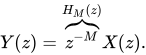
In this case, is the integer delay filter with:
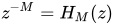
![{\displaystyle {\begin{cases}|\centerdot |=1=0dB,&{\text{zero dB gain}}\\\measuredangle =-\omega M,&{\text{linear phase with }}\omega =2\pi fT_{s}{\text{ where }}T_{s}{\text{ is the sampling period in seconds }}[s].\end{cases}}}](https://wikimedia.org/api/rest_v1/media/math/render/svg/3fbf6ae79953a07bbaada9ff38b6887211a55576)
The discrete-time domain filter for integer delay as the inverse zeta transform of is trivial, since it is an impulse shifted by [5]:

![{\displaystyle h_{m}[n]={\begin{cases}{\text{1}},&{\text{for }}n=M\\0,&{\text{for }}n\neq M.\end{cases}}}](https://wikimedia.org/api/rest_v1/media/math/render/svg/d2c4337d2e89786faf8772e961c3d018318d944f)
Working in the discrete-time domain with fractional delays is less trivial. In its most general theoretical form, a delay line with arbitrary fractional delay is defined as a standard delay line with delay , which can be modelled as the sum of an integer component and a fractional component which is smaller than one sample:


| Def. 1 |

This is the domain representation of a non-trivial digital filter design problem: the solution is an any time-domain filter that represents or approximates the inverse Z-transform of .[2]

Filter design solutions
[edit]Naive solution
[edit]The conceptually easiest solution is obtained by sampling the continuous-time domain solution, which is trivial for any delay value. Given a continuous-time signal delayed by samples, or seconds[6]:


![{\displaystyle {\xrightarrow[{}]{\mathcal {F}}}}](https://wikimedia.org/api/rest_v1/media/math/render/svg/9e48e1acd34b29b9fc0c38a6fd28da43bc747c48)

In this case, is the continuous-time domain fractional delay filter with:

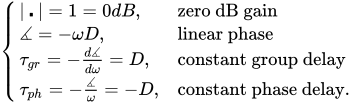
The naive solution for the sampled filter is the sampled inverse Fourier transform of , which produces a non-causal IIR filter shaped as a Cardinal Sine shifted by [6]:
![{\displaystyle h_{ideal}[n]}](https://wikimedia.org/api/rest_v1/media/math/render/svg/5a1930205fc5eb87a56219a42b47d4e8043fcc7a)


![{\displaystyle h_{ideal}[n]={\mathcal {F}}^{-1}[H_{ideal}(\omega )]={1 \over {2\pi }}\int \limits _{-\pi }^{+\pi }e^{j\omega D}e^{j\omega n}d\omega =sinc(n-D)={sin(\pi (n-D)) \over {\pi (n-D)}}}](https://wikimedia.org/api/rest_v1/media/math/render/svg/6f90373718f1ae945a4d905fc4ad70684adbf9bd)
The continuous-time domain is shifted by the fractional delay while the sampling is always aligned to the cartesian plane, therefore:

- when the delay is an integer number of samples , the sampled shifted degenerates to a shifted impulse just like in the theoretical solution.
- when the delay is a fractional number of samples , the sampled shifted produces a non-causal IIR filter, which is not implementable in practice.


Truncated causal FIR solution
[edit]The conceptually easiest implementable solution is the causal truncation of the naive solution above.[7]
![{\displaystyle h_{\tau }[n]={\begin{cases}sinc(n-D)&{\text{for }}0\leq n\leq N\\0&{\text{otherwise}}\end{cases}}\;\;\;\;\;{\text{where}}\;\;\;\;\;{N-1 \over {2}}<D<{N+1 \over {2}}\;\;\;\;\;{\text{and}}\;\;\;\;\;N\;{\text{is the order of the filter.}}}](https://wikimedia.org/api/rest_v1/media/math/render/svg/925b9b1670137a5c7046c5db0a8a7a4aefcb7c5c)
Truncating the impulse response might however cause instability, which can be mitigated in a few ways:
- Windowing the truncated impulse response, therefore smoothing it. Note that in this case we have to add a further shift in order to align the window and the and provide symmetric filtering[7][8].
- General Least Square (GLS) Method:[2] iteratively adjusts the frequency response by windowing a Least Square Integral Error design, which minimises the square integral error between ideal and truncated frequency responses of the filter, defined as:

![{\displaystyle h_{\tau }[n]={\begin{cases}w(n-D)sinc(n-D)&{\text{for }}L\leq n\leq L+N\\0&{\text{otherwise}}\end{cases}}\;\;\;\;\;{\text{where}}\;\;\;\;\;L={\begin{cases}round(D)-{N \over {2}}&{\text{for even }}N\\\lfloor D\rfloor -{N-1 \over {2}}&{\text{for odd }}N\end{cases}}}](https://wikimedia.org/api/rest_v1/media/math/render/svg/21426c2e39afd8536796e94432b2a17e0af4765e)

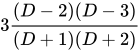
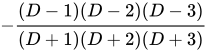
- Lagrange Interpolator (Maximally Flat Fractional Delay Filter):[9] adds "flatness" constraints to the first N derivatives of the Least Square Integral Error. This method is of particular interest because it has a closed form solution:

![{\displaystyle h_{D}[n]=\prod _{k=0,\;k\neq n}^{N}{D-k \over {n-k}}\;\;\;\;\;{\text{where}}\;\;\;\;\;0\leq n\leq N}](https://wikimedia.org/api/rest_v1/media/math/render/svg/6bf446da4e273efa8d0165ff30f4dbfb361000a5)
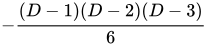
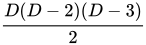
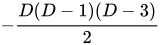
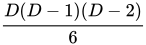
What follows is an expansion of the formula above displaying the resulting filters of order up to :

| Lagrange Interpolator Formula Expansion[7] | ||||
|---|---|---|---|---|
| N = 1 | - | - | ||
| N = 2 | - | |||
| N = 3 | ||||
![{\displaystyle h_{\tau }[0]}](https://wikimedia.org/api/rest_v1/media/math/render/svg/4bc4d76e82cde4b4dd5447b32774098e28f21b05)
![{\displaystyle h_{\tau }[1]}](https://wikimedia.org/api/rest_v1/media/math/render/svg/131a2706c413350fd0a5444f8d531153434e77e2)
![{\displaystyle h_{\tau }[2]}](https://wikimedia.org/api/rest_v1/media/math/render/svg/f38aa2571f36d7cfef3793075ca97486aead41d1)
![{\displaystyle h_{\tau }[3]}](https://wikimedia.org/api/rest_v1/media/math/render/svg/06ce2107ddfbd2394aa3ffc5404fba5e2cf7a0e3)



All-pass IIR phase-approximated solution
[edit]Another approach is designing an IIR filter of order with a Z-transform structure that forces it to be an all-pass while still approximating a delay[7]:


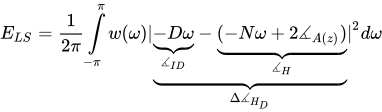
The reciprocally placed zeros and poles of respectively flatten the frequency response, while the phase is function of the phase of . Therefore, the problem becomes designing the FIR filter , that is finding its coefficients as a function of D (note that always), so that the phase approximates best the desired value .[7]


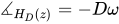
The main solutions are:
- Iterative minimization of Least Square Phase Error,[2] which is defined as:
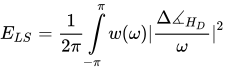
- Iterative minimization of Least Square Phase Delay Error,[2] which is defined as:
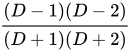
- Thiran All-Pole Low-Pass Filter with Maximally Flat Group Delay.[11] This yields a closed solution for finding the coefficients for positive delay :


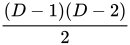
What follows is an expansion of the formula above displaying the resulting coefficients of order up to :
| Thiran All-Pole Low-Pass Filter Coefficients Formula Expansion[7] | ||||
|---|---|---|---|---|
| N = 1 | 1 | - | - | |
| N = 2 | 1 | - | ||
| N = 3 | 1 | |||



Commercial history
[edit]
Digital delay lines were first used to compensate for the speed of sound in air in 1973 to provide appropriate delay times for the distant speaker towers at the Summer Jam at Watkins Glen rock festival in New York, with 600,000 people in the audience. New York City–based company Eventide Clock Works provided digital delay devices each capable of 200 milliseconds of delay. Four speaker towers were placed 200 feet (60 m) from the stage, their signal delayed 175 ms to compensate for the speed of sound between the main stage speakers and the delay towers. Six more speaker towers were placed 400 feet from the stage, requiring 350 ms of delay, and a further six towers were placed 600 feet away from the stage, fed with 525 ms of delay. Each Eventide DDL 1745 module contained one hundred 1000-bit shift register chips and a bespoke digital-to-analog converter, and cost $3,800 (equivalent to $28,565 in 2024).[12][13]
See also
[edit]References
[edit]- ^ "The M-Sample Delay Line". ccrma.stanford.edu. Retrieved 2023-07-06.
- ^ a b c d e Laakso, Timo I.; Välimäki, Vesa; Karjalainen, Matti A.; Laine, Unto K. (January 1996), "Splitting the unit delay [FIR/all pass filters design]", IEEE Signal Processing Magazine, vol. 13, no. 1, pp. 30–60, Bibcode:1996ISPM...13...30L, doi:10.1109/79.482137
- ^ Smith, Julius O.; Lee, Nelson (June 5, 2008), "Computational Acoustic Modeling with Digital Delay", Center for Computer Research in Music and Acoustics, retrieved 2007-08-21
- ^ "Delay Lines". ccrma.stanford.edu. Retrieved 2023-07-06.
- ^ "INTRODUCTION TO DIGITAL FILTERS WITH AUDIO APPLICATIONS". ccrma.stanford.edu. Retrieved 2023-07-06.
- ^ a b "Ideal Bandlimited (Sinc) Interpolation". ccrma.stanford.edu. Retrieved 2023-07-06.
- ^ a b c d e f Välimäki, Vesa (1998). "Discrete Time Modeling of Acoustic Tubes Using Fractional Delay Filters".
- ^ Harris, F.J. (1978). "On the use of windows for harmonic analysis with the discrete Fourier transform". Proceedings of the IEEE. 66 (1): 51–83. doi:10.1109/proc.1978.10837. ISSN 0018-9219. S2CID 426548.
- ^ Hermanowicz, E. (1992). "Explicity [sic] formulas for weighting coefficients of maximally flat tunable FIR delays". Electronics Letters. 28 (20): 1936. doi:10.1049/el:19921239.
- ^ Smith, Julius (5 September 2022). "Explicit Formula for Lagrange Interpolation Coefficients". ccrma.
- ^ Thiran, J.-P. (1971). "Recursive digital filters with maximally flat group delay". IEEE Transactions on Circuit Theory. 18 (6): 659–664. doi:10.1109/TCT.1971.1083363. ISSN 0018-9324.
- ^ Nalia Sanchez (July 29, 2016), "Remembering the Watkins Glen Festival", Eventide Audio, retrieved February 20, 2020
- ^ "DDL 1745 Digital Delay". Eventide Audio. Retrieved 2023-07-22.
Further reading
[edit]- Valimaki, Vesa; Laakso, Timo; Karjalainen, Matti; Laine, Unto (1996). "Splitting the Unit Delay". IEEE Signal Processing Magazine. 13 (1): 30–60. Bibcode:1996ISPM...13...30L. doi:10.1109/79.482137 – via IEEE Explore.
- Harris, Frederic J. (January 1978). "On the use of windows for harmonic analysis with the discrete Fourier transform". Proceedings of the IEEE. 66 (1): 51–83. doi:10.1109/PROC.1978.10837. S2CID 426548.
External links
[edit]- Introduction to Digital Filters by Julius Smith
- Spectral Audio Signal Processing by Julius Smith
- Physical Audio Signal Processing by Julius Smith
- Discrete-Time Modeling of Acoustic Tubes Using Fractional Delay Filters by Valimaki Vesa
Digital delay line
View on GrokipediaFundamentals
Definition and Purpose
A digital delay line is an electronic device or circuit that introduces a precise time delay to a digital signal. In hardware implementations, it may use chains of logic gates, shift registers, or programmable components to delay binary signals by fixed or variable time intervals, typically in nanoseconds to microseconds. In digital signal processing (DSP) systems, it stores successive samples in a memory buffer and retrieves them after a specified number of clock cycles or samples.[4] This postponement allows the output signal to lag behind the input by a fixed duration, typically measured in samples at the system's sampling rate.[6] Unlike analog delay lines, which depend on physical mechanisms such as coiled transmission lines or bucket-brigade devices to achieve delay through charge transfer or wave propagation, digital delay lines leverage discrete-time processing or logic elements for greater accuracy, stability, and ease of implementation in software or hardware.[1] The primary purposes of digital delay lines encompass signal synchronization, where they align the timing of multiple signals in applications like telecommunications and radar systems to ensure coherent reception or transmission. In audio processing, they enable echo effects by recirculating delayed signals with attenuation, simulating acoustic reflections for applications in music production and sound design.[6] Additionally, they facilitate phase shifting to adjust signal phases for applications such as beamforming, and model propagation delays in simulations of wave phenomena, such as in virtual acoustics or seismic analysis. Within digital filter architectures, delay lines form the core building blocks for more sophisticated structures, including comb filters that create notched frequency responses and reverberation algorithms that generate spatial audio impressions through multiple delayed paths.[6] These uses highlight their versatility in both real-time processing and offline analysis. Digital delay lines emerged in the 1970s with the rise of digital signal processing hardware, marking a shift from analog predecessors that suffered from noise, limited delay lengths, and tuning instability.[7] Early commercial realizations, such as Eventide's H910 Harmonizer introduced in 1975, demonstrated their potential by providing clean, adjustable delays in professional audio environments.[8]Basic Signal Delay Concepts
In discrete-time systems, a digital delay line functions by shifting the input signal sequence by an integer number of samples , producing the output . This operation effectively postpones the signal by a discrete number of time steps while maintaining its amplitude and spectral characteristics intact.[9] The temporal resolution of this delay is governed by the system's sampling frequency , where the physical time delay is expressed as . Increasing refines the achievable delay increments, allowing for more precise control over timing, which is essential in scenarios like audio processing where synchronization demands sub-millisecond accuracy.[10] In DSP implementations, digital delays differ from their continuous-time counterparts, which transmit signals without temporal discretization, by necessitating analog-to-digital conversion to generate the discrete samples. This conversion process introduces quantization noise, arising from the approximation of continuous amplitudes to finite-bit representations, typically modeled as additive white noise with variance for fixed-point arithmetic of bits.[11][12] Additionally, if the input signal is not bandlimited to below the Nyquist frequency , aliasing distorts the delayed output by folding higher frequencies into the lower band, a phenomenon absent in analog delays. Anti-aliasing filters prior to sampling are thus critical to preserve signal integrity.[13]Theoretical Foundations
Integer Delay Modeling
The integer delay of samples, where is a positive integer, models an exact temporal shift in discrete-time signals, expressed as . In the z-transform domain, this delay is represented by the transfer functionwhich scales the z-transform of the input signal by to produce the delayed output .[14] The corresponding impulse response is a unit impulse shifted by samples,
indicating that the system outputs a single impulse at time in response to an input impulse at , with zero values elsewhere.[15] The frequency response, evaluated on the unit circle as , exhibits a constant magnitude of across all frequencies , confirming its behavior as an ideal all-pass filter that preserves signal amplitude without attenuation or amplification.[16] The phase response is linear, given by , which introduces a constant group delay of samples, ensuring the signal's waveform shape remains undistorted upon delay.[15] In the time domain, exact integer delays are implemented using circular buffers in software or shift registers in hardware. A circular buffer allocates an array of length at least to store recent input samples, employing modular indexing (e.g., via a write pointer incrementing modulo ) to overwrite the oldest sample each cycle; the delayed output is then read from the position steps before the write pointer, enabling efficient access without data shifting.[6] In hardware, a shift register chain of stages—each a clocked flip-flop or latch—serially advances the input through the registers on each clock edge, delivering the delayed signal at the final stage after precisely cycles.[17] The integer delay corresponds to a finite impulse response (FIR) structure, implemented in non-recursive form where each output depends solely on a finite number of past inputs without feedback, ensuring unconditional stability since all poles are at the origin (no denominator in ). This contrasts with recursive (infinite impulse response, IIR) forms used in other filters, which can introduce instability from pole locations outside the unit circle but offer lower computational complexity for certain responses; for exact integer delays, however, the non-recursive FIR approach is preferred for its guaranteed stability and simplicity, requiring only arithmetic operations (typically a single addition or assignment) and units of memory per channel, scaling linearly with delay length but remaining efficient for typical applications up to thousands of samples.