Hubbry Logo
Sedum albumSedum albumMain
Open search
Sedum album
Community hub
Sedum album
logo
8 pages, 0 posts
0 subscribers
Be the first to start a discussion here.
Sedum album
Sedum album
from Wikipedia

Sedum album
Scientific classification Edit this classification
Kingdom: Plantae
Clade: Tracheophytes
Clade: Angiosperms
Clade: Eudicots
Order: Saxifragales
Family: Crassulaceae
Genus: Sedum
Species:
S. album
Binomial name
Sedum album

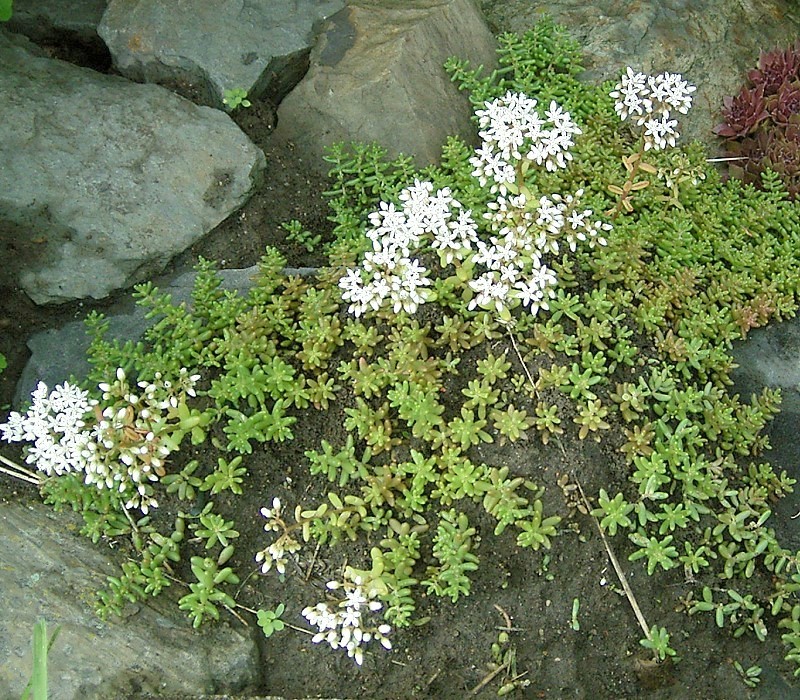
Sedum album, the white stonecrop, is a flowering plant of the genus Sedum in the family Crassulaceae. It is found in the northern temperate regions of the world, often growing in crevices or free-draining rocky soil. As a long-day plant it grows vegetatively for most of the year and flowers in summer.[1]

Taxonomy

[edit]

Three subspecies album, micranthum (Bastard ex DC.) Syme and teretifolium Syme have been described. [2][3][4] In 2015, a new subspecies rupimelitense was described in Malta.[5]

Description

[edit]

White stonecrop is a tufted perennial herb that forms mat-like stands. Much of the year the stems are short, semi prostrate and densely clad in leaves. At the flowering time in July and August, the stems lengthen and are erect, occasionally branched and often pinkish-brown. The leaves are alternate, fleshy and nearly cylindrical with a blunt, rounded tip. They are also sometimes tinged with pink, especially in drought-stressed plants. The starry flowers form a dense cyme. The calyx has five fleshy sepals fused at the base, the corolla consists of five regular white petals, there are ten stamens, a separate gynoecium and five pistils. The fruit is five united, many-seeded follicles.[6]

Habitat

[edit]

White stonecrop is a low-growing plant that cannot compete with more vigorous fast-growing species. It is specially adapted for growing on thin dry soils and can be found on walls, dry banks, seashore rocks and in rocky meadows.[6]

Physiology

[edit]

Sedum album is able to acclimate to its environment. It can switch between C3 carbon fixation and crassulacean acid metabolism (CAM) depending on the availability of water. CAM saves water as the stomata on its leaves only open to allow CO2 to diffuse into the leaves at night when the temperature (and therefore evapotranspiration) is lower.[7] Drought stressed plants are also more susceptible to photoinhibition which CAM may help to protect against.[1]

Cultivation

[edit]

Hardy in Zones 3–9.[4]

References

[edit]
Revisions and contributorsEdit on WikipediaRead on Wikipedia
from Grokipedia
Sedum album, commonly known as white stonecrop or small houseleek, is a low-growing, succulent belonging to the family . It forms dense mats through creeping, rooting stems up to 30 cm long, bearing small, fleshy, cylindrical to obovate leaves that are 4–20 mm long and typically , though sometimes tinged . In summer, it produces flat-topped clusters of tiny, star-shaped flowers, each about 5–7 mm across with five petals, attracting pollinators such as bees and flies. Native to Eurasia—from and Britain in the west to and in the east—and , including and , Sedum album thrives in dry, sunny habitats such as rocky outcrops, walls, cobbled paths, and thin soils over rock, tolerating both acidic and conditions as well as and maritime exposure. It has been introduced and naturalized in parts of , including scattered locations in the northeastern and , such as and , where it often appears in anthropogenic settings like roadcuts, ledges, and near dwellings. Hardy to USDA zones 6–8, this hermaphroditic, self-fertile species reproduces vegetatively via rhizomes and fragments, as well as by seed from its dry, dehiscent follicles. Beyond its ecological role in stabilizing rocky terrains and providing habitat for small invertebrates, Sedum album is valued in horticulture for its versatility as a ground cover, rock garden plant, and component in green roofing systems due to its drought tolerance and low maintenance needs. The leaves are edible raw, cooked, or pickled, offering a mild, succulent flavor, though they contain alkaloids like sedine and sedamine that may cause mild gastric upset if consumed in excess. Traditionally, it has been used medicinally as an anti-inflammatory poultice for skin conditions and hemorrhoids, though modern applications emphasize its ornamental and ecological benefits.

Taxonomy

Classification

Sedum album belongs to the kingdom Plantae, phylum Tracheophyta, class Magnoliopsida, order Saxifragales, family Crassulaceae, and genus Sedum L., a diverse group commonly known as stonecrops that comprises over 400 species of succulent herbs primarily adapted to rocky or arid environments. The binomial name Sedum album L. was established by Carl Linnaeus in the first edition of Species Plantarum, volume 1, page 432, published on 1 May 1753, with the protologue citing European localities such as "Habitat in Europa rupibus." The lectotype, designated by D. F. Chamberlain in 1972, is a specimen from Herb. Clifford: 177, Sedum 6 (BM-000628578) housed at the Natural History Museum, London. Several synonyms have been proposed for album, reflecting historical taxonomic revisions within the ; notable examples include Oreosedum album (L.) Grulich (1984), Leucosedum album (L.) Fourr. (), and Sedum athoum DC. (), though Sedum album remains the accepted name under the International Code of Nomenclature for algae, fungi, and plants. The species shows infraspecific diversity, with accepted subspecies including S. album subsp. album, S. album subsp. serpentini (Janch.) Barina, and S. album subsp. rupimelitense Mifsud, R. Stephenson & Thiede recognized in POWO.

Subspecies and cultivars

Sedum album exhibits taxonomic variation at the subspecies level, with several accepted forms distinguished primarily by differences in morphology, habitat, and reproductive traits. The nominotypical subspecies, S. album subsp. album, represents the typical form with obovate to linear leaves and white flowers featuring petals around 4–5 mm long. S. album subsp. serpentini (Janch.) Barina is a succulent subshrub native to Albania, characterized by specific morphological adaptations in its temperate habitat. S. album subsp. rupimelitense Mifsud, R. Stephenson & Thiede was described in 2015 as a distinct taxon endemic to Malta, with laxly caespitose growth, creeping shoots up to 25 cm long, and stems densely glandular-hairy at the base; it differs in producing inflorescences rarely, often without peduncular leaves or floral bracts, and flowers where the outer whorl of stamens is shorter than the petals. Numerous cultivars of Sedum album have been developed for ornamental use, selected for enhanced aesthetic qualities such as foliage color and growth form while maintaining the species' hardiness in USDA zones 3–9. 'Coral Carpet' is a popular low-growing cultivar with new growth emerging in salmon-orange tones that mature to bright green and shift to reddish-bronze in winter, forming dense mats ideal for ground cover. 'Athoum' represents a compact form with dark green rosettes of chunky leaves tipped in red during hot weather, producing light pink flowers and exhibiting strong for use in rock gardens or borders. These cultivars generally offer improved visual over types through more vivid seasonal color changes and tighter growth habits, though they retain the ' resilience to poor soils and .

Description

Vegetative morphology

Sedum album is an with a creeping, mat-forming growth habit, typically reaching a of 5–10 cm while spreading via semi-prostrate stems that can extend up to 30 cm in length. This laxly cespitose form allows it to form dense, low-growing mats, with much-branched stems that are fleshy and originate from the base. The stems are prostrate to short-ascending, often rooting at the nodes to facilitate vegetative spread, and are minutely puberulent with dense glandular pubescence at the base. The leaves of Sedum album are succulent, arranged alternately along the stems, and measure 4–20 mm in length by 1–2 mm in width. They are sessile, linear to ovate or obovate in , subterete (cylindrical) with a slightly flattened adaxial surface, and green, often tinged reddish, without bloom; the surfaces are glabrous or sparsely hairy, with obtuse or rounded apices and bases that are scarcely spurred. The is fibrous and shallow, consisting of a network of thin, branching that primarily spread horizontally near the surface, enabling effective anchorage in rocky or thin-soiled substrates. This structure supports the plant's adaptation to drought-prone environments by facilitating rapid water uptake from shallow moisture sources.

Flowers and reproduction

The of Sedum album consists of dense, terminal cymes, borne on erect stems 5–18 cm tall that arise from the mat-forming vegetative growth. These flat-topped to cylindrical clusters typically contain 15–50 flowers and are erect during , though they may nod or arch in bud. The flowers are small and starry in shape, with a diameter of 5–7 mm, featuring five white petals (occasionally pinkish) that are 2–4.5 mm long, five sepals that are 0.5–1.5 mm long, and ten stamens arranged in two whorls. The flowers exhibit radial with a superior lacking a hypanthium. Blooming occurs from July to August in midsummer, attracting pollinators to the nectar-rich blooms. Pollination in Sedum album is primarily entomophilous, mediated by insects such as bees and flies, though butterflies may also visit the flowers. The species is hermaphroditic and self-compatible, enabling autogamy, but outcrossing is common due to the prominence of insect vectors in natural populations. Following pollination, the ovary develops into five distinct follicles, each splitting along one side to release numerous small, yellowish-brown seeds that are oblong or ovoid and ribbed. In addition to sexual reproduction, Sedum album propagates vegetatively through stem fragments, which root readily upon contact with soil, facilitating rapid mat expansion.

Distribution and habitat

Native range

Sedum album is native to a broad expanse across temperate and Mediterranean regions, spanning from northern areas including , , , and , through encompassing , , Czechia-Slovakia, , , the , and , to southwestern and with occurrences in the Baleares, Corse, , , Sardegna, , , Sicilia, , , , Kriti, , and the northwestern Balkan Peninsula, as well as eastern in Krym and . Its range extends eastward into western , including the Transcaucasus, (including Turkey-in-), , and Lebanon-Syria, and southward into , where it is found in Algeria, Libya, Morocco, and Tunisia. The species is particularly widespread in central and southern European countries such as , , and , where it occupies diverse terrains across its distribution. Phylogeographic analyses reveal that S. album underwent post-glacial recolonization of Europe following the , originating from multiple refugia in the , Apennine Peninsula, and southeastern (including and the ), with subsequent migrations proceeding northeastward from Iberia, northward from the Apennines, and northward/westward from the to repopulate higher latitudes and longitudes. Overall, Sedum album faces no global conservation threats and is considered stable across most of its range, though local populations, such as the endemic subspecies S. album subsp. rupi-melitense in Malta, are critically endangered due to their extremely limited distribution confined to specific coastal cliffs and vulnerability to habitat disturbance.

Habitat preferences

_Sedum album thrives in thin, well-drained soils that are typically rocky, sandy, or gravelly, with low fertility and neutral to alkaline pH levels ranging from 6.0 to 7.5. These oligotrophic, non-saline substrates support its succulent nature, preventing waterlogging and promoting root establishment in nutrient-poor environments. The species prefers full sun exposure, indicated by a high Ellenberg light value of 8.6, though it tolerates light shade in hotter conditions. It is highly drought-tolerant due to its adaptations to low-moisture habitats, with an Ellenberg moisture value of 2.6, making it suited to arid or semi-arid microenvironments. Typical sites for Sedum album include rock crevices, dry banks, old walls, coastal cliffs, and gravelly meadows, often in sparsely vegetated areas such as scree slopes or cobbled paths. It occurs from sea level to lower foothill elevations in temperate regions across Europe and parts of Asia. In terms of climate, Sedum album is adapted to temperate zones with an Ellenberg temperature value of 6.3, featuring mild, dry summers and cold winters to which it shows hardiness down to -30°C (USDA Zone 4). It commonly associates with open grasslands, scrub, or rocky vegetation of the Sedo-Scleranthetea class, sharing habitats with other drought-tolerant succulents and pioneer species on limestone or similar substrates.

Ecology and physiology

Photosynthetic adaptations

Sedum album, a succulent member of the , exhibits a facultative photosynthetic that allows it to alternate between C3 photosynthesis under favorable conditions and (CAM) during periods of stress. In well-watered environments, the primarily utilizes the standard C3 pathway, where stomata open during the day to facilitate CO2 uptake for the , enabling efficient carbon fixation when is abundant. This flexibility enhances its adaptability to fluctuating environmental conditions, particularly in rocky or arid habitats where water availability varies seasonally. The transition to CAM is triggered by water stress, with induction occurring within days of drought onset, often fully established after about 14 days of withholding water. Under CAM, stomata open primarily at night to minimize water loss, capturing CO2 which is then fixed by the enzyme phosphoenolpyruvate carboxylase (PEPC) into oxaloacetate and subsequently stored as malic acid in the vacuoles. During the day, with stomata closed, malic acid is decarboxylated to release CO2 for use in the Calvin cycle by Rubisco, allowing photosynthesis to proceed without significant transpiration. This nocturnal CO2 uptake and diurnal recycling mechanism reduces water loss by approximately 80% compared to C3 mode, substantially improving water-use efficiency and enabling survival in water-limited environments. The efficiency of this dual pathway in S. album is further supported by rapid upregulation of key enzymes, such as PEPC and its activating kinase (PPCK), which can increase in expression by up to 73-fold during CAM induction, facilitating the metabolic shift. This adaptation not only conserves water but also mitigates through coordinated antioxidative responses, ensuring sustained photosynthetic under prolonged . Overall, these physiological mechanisms underscore S. album's resilience in arid ecosystems, where CAM allows it to maintain positive carbon balance when C3 photosynthesis would otherwise falter.

Biotic interactions

Sedum album's white flowers serve as an attractant for various pollinators, particularly small bees and hoverflies, which visit the blooms for nectar and pollen during the summer flowering period. These interactions support local pollinator populations, especially in urban green roof environments where S. album is commonly planted. The experiences occasional herbivory from rabbits, which may on young shoots or leaves, though its thick, waxy foliage and bitter taste often deter significant damage. herbivores, such as slugs and snails, can occasionally feed on the succulent leaves, but no major pest outbreaks are typically reported. S. album employs chemical defenses, including alkaloids like sedine and sedamine in its leaves, which contribute to its resistance against herbivores. Symbiotic relationships with arbuscular mycorrhizal fungi (AMF) are common in S. album, facilitating enhanced nutrient uptake, particularly phosphorus, in nutrient-poor, rocky soils. These associations improve plant establishment and stress tolerance in harsh habitats. Seed dispersal in S. album primarily occurs via wind, as the plant produces abundant tiny, lightweight seeds that are easily carried by air currents. Vegetative propagation contributes to spread, with prostrate stems rooting at nodes and fragments potentially transported by water flow or adhering to animal fur. In non-native regions, such as parts of , S. album can naturalize and form dense mats that suppress competing vegetation through rapid vegetative spread, leading to potential invasiveness in disturbed areas. This mat-forming habit alters local dynamics but is generally manageable due to shallow .

Cultivation and uses

Ornamental cultivation

Sedum album, commonly known as white stonecrop, is widely cultivated as an ornamental plant due to its low-growing habit and adaptability. It exhibits strong hardiness across USDA Zones 3 to 9, tolerating frost down to -40°F (-40°C) in colder regions and heat up to 100°F (38°C) in warmer climates. Additionally, it shows resilience to urban pollution, making it suitable for city environments where air quality is compromised. For optimal growth, Sedum album requires full sun exposure of at least six hours daily, though it can tolerate . It thrives in well-drained, sandy to gravelly soils with moderate to low fertility, avoiding heavy or waterlogged conditions. Once established, the plant is highly drought-tolerant, requiring minimal irrigation except during prolonged dry spells in the first year. In , Sedum album serves effectively as a ground cover, forming dense mats that spread 30-45 cm (12-18 inches) wide and suppress weeds. It is particularly valued in rock gardens, borders, and roofs, where its succulent foliage provides year-round and on slopes. The 's mat-forming growth, reaching 8-15 cm (3-6 inches) in , enhances and low-maintenance areas. Popular cultivars in the trade offer variations in foliage color for added ornamental . For instance, 'Coral Carpet' features new growth emerging in salmon-orange tones that mature to and turn reddish-bronze in winter, providing seasonal contrast. Sedum album is generally resistant to pests and diseases, contributing to its low-maintenance . Occasional issues include slugs and snails, which can foliage in moist conditions, and if planted in poorly drained soil. Proper minimizes these risks.

Propagation methods

Sedum album is readily propagated through vegetative methods, which are preferred due to their and high rates. Stem cuttings, taken from healthy, non-flowering shoots in spring or summer, can be placed directly in well-drained, moist or a damp medium, where they typically root within 2-3 weeks under indirect and temperatures around °C. Division of established mats is another effective technique, best performed in early spring by separating rooted sections and replanting them immediately in similar conditions, allowing quick establishment of new plants. These methods are reliable for home gardeners and horticulturists. Seed offers an alternative for producing larger quantities, though it is slower than vegetative approaches. should be surface-sown in spring on a sterile, well-draining mix without , as scarification is unnecessary; occurs in 10-14 days at 15-20°C with consistent and exposure. Seedlings can be transplanted once they develop true leaves, providing viable for subspecies variation, albeit with lower rates compared to cuttings. In commercial settings, tissue culture is employed for mass propagation of cultivars, utilizing Murashige and Skoog medium supplemented with 1 mg/L naphthaleneacetic acid (NAA) and 2 mg/L benzyladenine (BA) to induce adventitious buds from leaf explants, yielding multiplication rates up to 46,656 plants per explant in six months with over 70% bud induction success. This method ensures uniform, disease-free stock suitable for green roof applications and ornamental production.

References

Add your contribution
Related Hubs
User Avatar
No comments yet.