Hubbry Logo
Sedum rubrotinctumSedum rubrotinctumMain
Open search
Sedum rubrotinctum
Community hub
Sedum rubrotinctum
logo
8 pages, 0 posts
0 subscribers
Be the first to start a discussion here.
Sedum rubrotinctum
Sedum rubrotinctum
from Wikipedia

Jelly-beans
Scientific classification Edit this classification
Kingdom: Plantae
Clade: Tracheophytes
Clade: Angiosperms
Clade: Eudicots
Order: Saxifragales
Family: Crassulaceae
Genus: Sedum
Species:
S. rubrotinctum
Binomial name
Sedum rubrotinctum

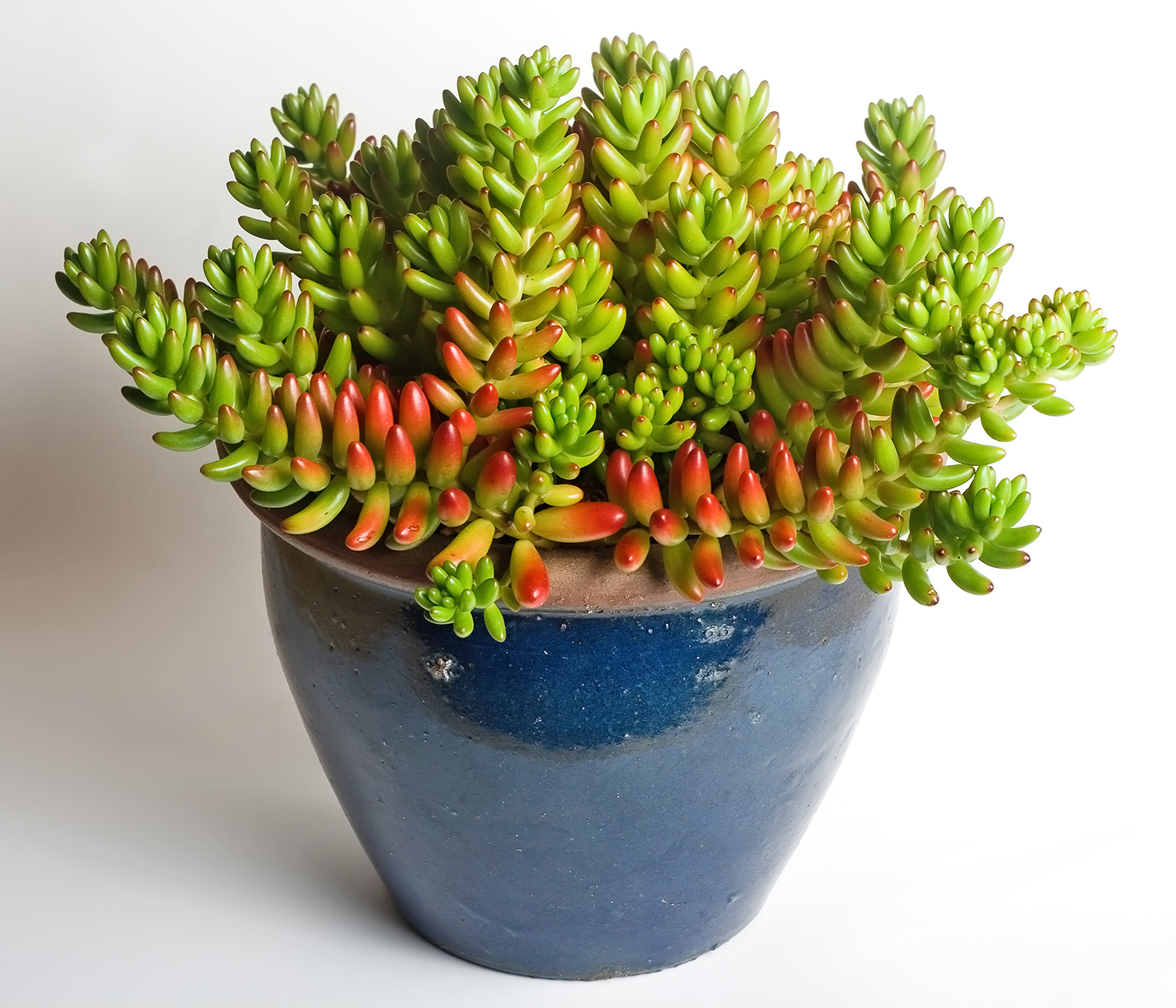
Sedum rubrotinctum or Sedum × rubrotinctum, commonly known as jelly-beans,[1] jelly bean plant, or pork and beans,[2] is a species of Sedum from the plant family Crassulaceae. It is a succulent plant originating in Mexico.[3] The common English name refers to its short leaves that resemble jelly beans, especially when taking on a protective hue.[4]

Description

[edit]
On granite cliff

The leaves of Sedum rubrotinctum change colour from green to red during the summer months as a protective adaptation.[4][5] The plant sprouts bright yellow flowers from between the leaves in mid-spring.[4]

Taxonomy

[edit]

The species was first described in 1948. It is considered to be an artificial hybrid between Sedum pachyphyllum and Sedum stahlii.[6]

Cultivation

[edit]

Sedum rubrotinctum is cultivated as an ornamental plant, for planting in gardens and as potted plants. It is grown very easily and tolerates all types of soil except for those that are poorly drained. It grows very well in summer, can take variations in climate, although it is not frost-tolerant.

New plants may be grown from leaves (or beans) that drop off or are separated from the stem and laid on soil.

This plant has won the Royal Horticultural Society's Award of Garden Merit.[7]

Sedum rubrotinctum is poisonous and may cause irritation when ingested or touched.[4]

References

[edit]
[edit]
Revisions and contributorsEdit on WikipediaRead on Wikipedia
from Grokipedia
Sedum rubrotinctum, commonly known as the jelly bean plant or , is a low-growing succulent hybrid in the family, prized for its ornamental foliage that shifts from bright green to vibrant red under stress or full sun. This plant is a nursery hybrid originating from , resulting from the cross between Sedum pachyphyllum and Sedum stahlii, whose parent species thrive on rocky slopes at elevations up to 2,400 meters. It features prostrate, branching stems forming compact clumps 10-20 cm tall and up to 60 cm wide, with short, club- or jelly bean-shaped leaves that store water, enabling . In mid-spring, it produces clusters of small, star-shaped yellow flowers, approximately 10-12 mm across, often tinged with red, adding seasonal interest. Native to arid habitats, S. rubrotinctum does not occur naturally but is widely cultivated worldwide as a groundcover, , or in rock gardens due to its adaptability and ease of growth. It prefers well-draining , bright indirect to full (which intensifies coloration), and moderate watering during the growing season, allowing to dry completely between sessions, while requiring minimal water in winter; it tolerates a range of soils but is sensitive to and poor drainage. is straightforward via stem cuttings or fallen leaves, which readily in suitable conditions, making it popular among succulent enthusiasts. Notably, all parts of the are poisonous if ingested, potentially causing or gastrointestinal upset, so it should be kept away from pets and children.

Taxonomy

Classification

Sedum rubrotinctum, commonly known as the jelly bean plant, belongs to the kingdom Plantae, phylum Tracheophyta, class Magnoliopsida, order Saxifragales, family Crassulaceae, and genus Sedum. This placement reflects its status as a vascular, flowering plant within the diverse Crassulaceae family, which comprises over 1,400 species of succulents adapted to arid environments. The is designated as Sedum × rubrotinctum to denote its hybrid origin, arising from the cross between Sedum pachyphyllum and Sedum stahlii, two Mexican species in the same . This artificial hybrid is known exclusively from cultivation and lacks a wild distribution, highlighting its horticultural development rather than natural . First described as a distinct species by Robert T. Clausen in 1948, S. rubrotinctum was later reclassified as a hybrid based on morphological and genetic analyses confirming its parentage. It has no primary synonyms in major taxonomic databases, though occasional misclassifications occur under the names of its parental due to superficial similarities.

Etymology and History

The genus name Sedum derives from the Latin verb sedeo, meaning "to sit," which alludes to the low, sprawling growth habit of many in the , often appearing as if perched on rocks or soil surfaces. The specific epithet rubrotinctum combines the Latin words rubor (red) and tinctus (dyed or tinged), a reference to the distinctive reddish hue that develops on the tips of its leaves, particularly when exposed to intense sunlight or environmental stress. Sedum rubrotinctum was formally described as a distinct in 1948 by American botanist Robert T. Clausen in the Cactus and Succulent Journal, based on specimens cultivated in during the preceding decades. The plant, known only from cultivation at the time of description, likely originated from collections in the highland regions of central , where similar species thrive, though no wild populations have been documented. Subsequent taxonomic revisions in the late confirmed S. rubrotinctum as an artificial hybrid rather than a wild , with parentage attributed to Sedum pachyphyllum and Sedum stahlii, distinguishing it from naturally occurring taxa through morphological and genetic analyses. This recognition highlighted its status as a garden-origin , emphasizing the role of horticultural selection in its development.

Description

Morphology

Sedum rubrotinctum is a low-growing, succulent that forms dense clumps or spreading mats, typically reaching heights of 10-20 cm and spreads of up to 60 cm. The plant exhibits a ground-hugging, sprawling habit with branching from the base, contributing to its mat-forming growth. The stems are thick, fleshy, and succulent, growing trailing or slightly upright to lengths of up to 30 cm, often rooting at nodes where they contact the soil. They branch profusely from the base, supporting the overall compact structure. Leaves are cylindrical and fleshy, resembling jelly beans, measuring 1-2.5 cm in length, and arranged in tight spirals around the stems. They have a base color of bright green, with tips shifting to red or pink under full sun exposure or stress conditions. Flowers are small, star-shaped with bright yellow petals, approximately 1 cm in diameter, and borne in terminal clusters on short stalks; they typically appear from late winter to spring. The sepals may exhibit reddish tinges, enhancing the floral display. Seasonal changes include leaf reddening in summer heat due to increased light intensity, while low conditions can cause , leading to elongated stems and paler foliage. In milder winter conditions, leaves revert to predominantly .

Reproduction

Sedum rubrotinctum is a succulent characterized by a life cycle of active growth in spring and summer, with reduced metabolic activity during fall and winter. Flowering typically occurs from late winter to spring, triggered by lengthening photoperiods and rising temperatures, when the produces terminal clusters of small, star-shaped yellow flowers on upright stems rising 10-15 cm above the foliage. These blooms, each about 1 cm in diameter, form dense cymes that collectively create yellow flower heads attractive to pollinators. Pollination is primarily entomophilous, facilitated by insects such as bees and butterflies that visit the open, nectar-bearing flowers during the blooming period. Successful pollination leads to seed set within small, dehiscent follicles containing numerous minute seeds, which are lightweight and primarily dispersed by wind or passively by gravity in natural habitats. Although sexual reproduction occurs, vegetative reproduction is a dominant mode in natural populations, enabling clonal spread without dependence on seeds. The plant's prostrate stems readily root at nodes upon soil contact, forming new individuals and contributing to dense mats in suitable habitats. Additionally, naturally detached leaves or stem fragments can root adventitiously in moist soil, further promoting population persistence and expansion in the wild.

Distribution and Habitat

Native Range

Sedum rubrotinctum is an artificial hybrid originating from cultivation in , with its parent species Sedum pachyphyllum and Sedum stahlii native to highland regions in states such as and . Sedum pachyphyllum is found in , , and adjacent central Mexican states at elevations of 1,400–2,600 meters, while Sedum stahlii occurs in , , and at 1,170–2,440 meters. As a hybrid first described in 1948, Sedum rubrotinctum does not occur naturally and is only known from cultivation worldwide.

Environmental Preferences

Sedum rubrotinctum is a hybrid succulent derived from Sedum pachyphyllum and Sedum stahlii, both native to , and thus lacks wild populations of its own; however, its ecological adaptations mirror those of its parents, which thrive in semi-arid highland environments characterized by rocky slopes, cliffs, and dry scrublands. These habitats typically occur at elevations between 1,170 and 2,600 meters in regions such as the Sierra Madre del Sur and the , where the plants cling to steep, exposed rock faces and outcrops amid sparse vegetation. As a drought-tolerant succulent, Sedum rubrotinctum exhibits adaptations suited to arid climates with full sun exposure, mild temperatures ranging from 10°C to 30°C, and low humidity levels prevalent in its parental species' native ranges. The thick, fleshy leaves store efficiently, enabling survival during prolonged dry periods typical of highlands, while the plant's prostrate growth form helps it avoid excessive on sun-baked slopes. In the wild habitats of its progenitors, Sedum rubrotinctum's preferred soils are well-drained, gravelly or sandy substrates derived from or conglomerate, with a neutral to slightly alkaline that prevents waterlogging and supports root anchoring on unstable terrains. These mineral-rich, low-organic soils mimic the nutrient-poor conditions of cliff faces and scrublands, promoting compact growth and resilience to . Populations of the parent species face vulnerability from habitat loss due to and in central and southern , though neither is currently classified as endangered globally. Conservation efforts focus on protecting these rocky ecosystems to preserve the underlying hybrids like Sedum rubrotinctum.

Cultivation

Growing Conditions

Sedum rubrotinctum thrives in full sun, requiring at least six hours of direct sunlight daily to develop its characteristic vibrant red leaf tips, though partial shade can prevent scorching in intensely hot climates. It is hardy in USDA zones 9 through 11, where average temperatures range from 10°C to 32°C (50°F to 90°F), but must be protected from frost and temperatures below -7°C (20°F), as prolonged cold can cause leaf damage or plant death. In cooler regions, it benefits from being grown in containers that can be moved indoors during winter. For optimal growth, this succulent requires well-draining , such as a commercial or succulent mix amended with or to ensure quick drainage and prevent . Watering should be infrequent and thorough, following a "soak and dry" method where the is allowed to dry out completely between waterings—typically every 1-2 weeks in spring and summer, reduced to once a month or less in fall and winter to mimic its arid native conditions. Overwatering leads to mushy leaves and rot, while underwatering causes wrinkling. Fertilization is minimal; a diluted, balanced succulent (such as 10-10-10 at half strength) applied monthly during the active growing season (spring through summer) supports healthy development without promoting excessive leggy growth. In maintenance, any elongated or leggy stems in early spring using clean shears to encourage a compact, bushy form and remove spent flower heads or dead leaves as needed. This plant is versatile for both indoor and outdoor cultivation, excelling in containers, rock gardens, or hanging baskets where its trailing habit can be showcased; outdoors it performs best in sunny, dry spots, while indoors it requires a bright south-facing window or grow lights to maintain color and vigor. In non-native climates, overwintering indoors near a sunny window ensures survival.

Propagation Methods

Sedum rubrotinctum, commonly known as the jelly bean plant or , is readily propagated through vegetative methods, which are preferred over seeds due to their reliability and speed in both home and nursery environments. These techniques leverage the plant's succulent nature, allowing for easy rooting of leaves, stems, or offsets in well-draining soil mixes. Leaf propagation begins by gently twisting healthy, plump leaves from the stem to ensure a clean pull, avoiding any tearing that could invite rot. The detached leaves should then callus over for 1-2 days in a shaded, dry area to seal the wound. Place the callused end on the surface of a moist, well-draining succulent mix, such as one incorporating or sand, and maintain high without direct watering until roots emerge, typically within 2-4 weeks during the . New plantlets often form multiple rosettes from a single under bright, indirect . For stem cuttings, select a healthy stem of 5-10 cm in length from the plant's tip using sterile scissors or a knife to minimize disease risk. Allow the cut end to dry and for several days out of direct , then insert it shallowly into a well-drained medium like cactus potting soil. Mist sparingly until roots develop in 2-3 weeks, after which normal care can resume; this method boasts a high success rate, often exceeding 90% under optimal conditions. Division involves separating offsets or pups from a mature parent plant, ideally in spring when growth is active. Wait until the offsets have developed substantial and stalks, then carefully cut them away with a clean tool, allowing the cut surfaces to dry for 24 hours before replanting in individual pots with succulent mix. This approach is straightforward and yields established plants quickly. Seed is rarely practiced for Sedum rubrotinctum owing to low seed viability and slow rates, but when attempted, fresh seeds should be surface-sown in a sterile, moist mix under bright light and mild temperatures around 20-24°C, with possible in 2-4 weeks.

Pests and Diseases

Sedum rubrotinctum is generally resistant to many pests but can occasionally suffer infestations from common succulent adversaries such as mealybugs, , and spider mites. These pests feed on plant sap, leading to symptoms like yellowing or distorted leaves, , and a sticky residue known as honeydew that may attract . Mealybugs appear as white, cottony masses in leaf axils, while cluster on new growth, and spider mites cause fine webbing and speckled foliage. To manage these, applications of or are effective, as they suffocate soft-bodied insects without harming the plant when used according to label instructions. Diseases affecting Sedum rubrotinctum primarily involve fungal pathogens thriving in overly moist conditions, with being the most prevalent issue caused by overwatering or poor drainage. Pathogens such as spp., spp., and spp. lead to brown, water-soaked roots that become mushy and slough off, often extending rot into the lower stem and causing or chlorotic foliage despite adequate moisture. Stem rot, similarly favored by high humidity and saturated soil, manifests as soft, blackened stems and can progress rapidly in enclosed environments. Preventive measures are crucial for maintaining healthy Sedum rubrotinctum plants, including quarantining new acquisitions to avoid introducing pests or pathogens, ensuring good air circulation to reduce around foliage, and avoiding overhead watering to keep leaves dry. For control, prioritize well-draining and pots with drainage holes, allowing to dry completely between waterings to prevent fungal proliferation. Early detection through regular inspections allows for prompt removal of affected parts, minimizing spread.

Varieties and Safety

Notable Cultivars

Sedum rubrotinctum 'Aurora', commonly known as Pink Jelly Bean, is a popular cultivated variety selected for its enhanced ornamental qualities, featuring plump, jellybean-shaped leaves that display a vibrant pink tinge, particularly under full sun exposure, contrasting with the base species' more subdued green-to-red foliage transitions. This cultivar exhibits more compact, clumping growth, typically reaching 6 inches in height and spreading 18 to 36 inches wide, making it ideal for borders, containers, and ground covers. While the standard form of Sedum rubrotinctum shows leaves that shift from green to red under stress, 'Aurora' emphasizes deeper pink and sometimes bronze variations for heightened visual appeal in landscapes. Developed through in nurseries, 'Aurora' has a garden origin, derived from the wild native to and cultivated to accentuate color intensity and form for decorative use. It shares the ' drought and low-maintenance needs, thriving in well-drained soils with minimal watering once established. Widely available in the horticultural trade under names like Pink Jelly Bean, this is prized for its evergreen habit and ability to attract pollinators with small yellow flowers in summer.

Toxicity and Precautions

Sedum rubrotinctum contains irritants in its sap and leaves that render it mildly toxic if ingested or handled without care. These compounds can provoke adverse reactions, though the plant is not considered highly dangerous. In humans, direct contact with the plant's sap may lead to skin irritation, including redness, itching, or dermatitis, particularly in sensitive individuals; wearing gloves during handling is recommended to prevent this. Ingestion of leaves or stems can result in gastrointestinal upset, such as nausea, vomiting, or diarrhea, but the plant is not edible and should be avoided. No known fatalities from Sedum rubrotinctum exposure have been reported. For pets, assessments of toxicity vary: some sources describe mild risks to cats and dogs, with symptoms of typically including , excessive , and minor digestive discomfort, while others, including the ASPCA, consider it non-toxic. It is prudent to keep Sedum rubrotinctum out of reach of household animals, as well as grazing , to avoid potential issues. General precautions involve labeling the plant in gardens or indoor settings to alert others of its irritant properties. In cases of significant ingestion or severe skin reactions, prompt medical or veterinary consultation is advised, though most incidents resolve without long-term effects.

References

Add your contribution
Related Hubs
User Avatar
No comments yet.