Hubbry Logo
Shuffling machineShuffling machineMain
Open search
Shuffling machine
Community hub
Shuffling machine
logo
8 pages, 0 posts
0 subscribers
Be the first to start a discussion here.
Shuffling machine
Shuffling machine
from Wikipedia
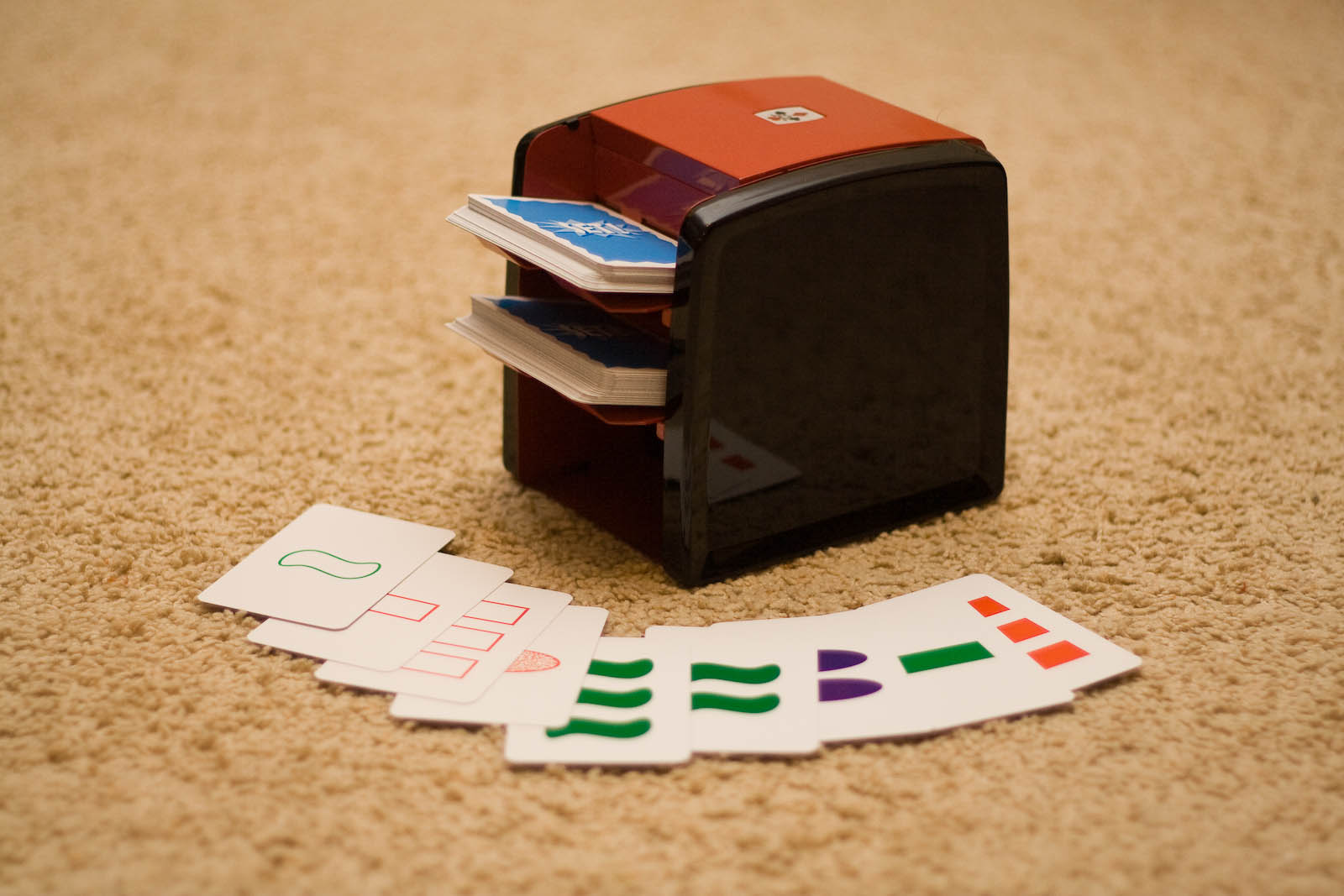
A small, modern tabletop shuffling machine, used on a deck of Set cards

A shuffling machine is a machine for randomly shuffling packs of playing cards.

Because standard shuffling techniques are seen as weak, and in order to avoid "inside jobs" where employees collaborate with gamblers by performing inadequate shuffles, many casinos employ automatic shuffling machines to shuffle the cards before dealing. These machines are also used to reduce repetitive motion stress injuries to a dealer.

Shuffling machines have to be carefully designed, as they can generate biased shuffles otherwise: the most recent shuffling machines are computer-controlled. The randomness or otherwise of cards produced from automatic shuffling machines is the subject of considerable interest to both gamblers and casinos.

Shuffling machines come in two main varieties: continuous shuffling machines (CSMs), which shuffle one or more packs continuously, and batch shufflers or automatic shuffling machines (ASMs), which shuffle an entire single pack in a single operation. Batch shufflers are more expensive, but can avoid the problems associated with some continuous shufflers, whereby the shuffling operation only slowly changes the state of the deck, and new cards may be taken before shuffling has sufficiently randomized the pack, allowing some players to "shuffle track" cards through the shuffling process.

A widely reported, but unpublished, study by Persi Diaconis and Susan Holmes in 2000 resulted in the redesign of many shuffling machines. SIAM News later published a reasonably detailed discussion of its results.[citation needed]

Early mechanical card shufflers

[edit]

Patents regarding card shuffling devices started to appear in the United States around the end of the 19th century. It is unclear whether these devices were converted to commercial products or were discarded. These machines were often complex with many mechanical parts to achieve card retrieval, shuffling and distribution with pseudo-randomness.

In 1878, Henry Ash proposed an apparatus to shuffle cards.[1] His device was a box with an open top where the operator would place the deck. The operator would then slightly shake the box to make the cards fall through a comb at the bottom of the box. About half of the cards would fall into the lower compartment while the rest were still in the upper compartment. The operator would take these upper cards, pack them together and do the same with the lower cards. The two packs would be placed upon each other to form a new deck and the operation could be repeated for better shuffling.

A modern card shuffler similar in principle to Tingley and Stetson's

In 1887, Silvanus Tingley and Charles Stetson patented their "card shuffling apparatus".[2] The device was composed of two card-holding boxes where the packs were held by springs. The device simulated a riffle shuffling by extracting the cards through a slot at the bottom of each box and placing them in a pile in the middle. The operator would turn a crank which was connected to gears and finally disks covered with rubber that were in contact with cards. This feeding mechanism ensured that the final stack was composed of cards "randomly" coming from the left or right chamber. The main difference with the next machines is that only one card would be ejected from a box during one turn.

In 1892, William H. Ranney filed a patent for a "card shuffling and dealing mechanism".[3] The apparatus was basically an inclined box which was fixed to the border of the playing table. The cards were inserted from the top of the case and were trapped inside a receptacle hold by a lever. The operator would turn a crank which would slowly lower the bottom wall of the inclined receptacle. At this point, the device relied upon the friction force between the cards to achieve some kind of randomness. One card would start to slide as a result of the steepness and would attract a few cards with it. The number of cards being released at each turn would typically vary between one and five cards. The cards fell into another receptacle and the operator would turn the whole device to distribute the cards to another player. This rotation activated a roller which would distribute the bottom card out of the box. One year later, William Ranney proposed another version of his device where the original deck was split in half and cards would fall from one or both halves at once.[4]

In 1897, two brothers, the Crooks, proposed a more complex machine which was similar to a slot machine displaying five cards.[5] This device did not distribute cards to players but was just displaying a random sequence of cards. However, it used a shuffling mechanism that relied upon a rotating triangular frame where each side contained the same device. Only one mechanical side could operate and display cards at a moment and the operator would rotate the whole drum to perform another shuffling. A shuffling box would be split into five compartments using what they called "partition fingers". A complex pins mechanism would then mix the cards between the compartments and the new result would be displayed.

John Bowen proposed in 1899 a compact "card shuffling machine" where the unshuffled pack was enclosed between two horizontal plates.[6] The principle of this apparatus was similar to Tingley and Stetson's machine. The top plate could move and was called the follower, the bottom plate was fixed. The operator would press the deck using a vertical handle which was connected to the follower, and he would turn a crank that activated two rollers which were above and under the deck. In front of the deck, a bar would block most cards except those on top of the pack as well as those at the bottom. The rollers were pressing against the cards and with their respective rotation, would throw them into a receptacle. At each step, cards could come from the top or the bottom of the deck and the number of cards which were ejected was not constant. Variable friction between the rollers and the cards themselves ensured some randomness as in Ranney's machine.

Fred C Rollings in 1899 invented a device with a rotating table where cards were spread around the center using a detent with variable pressure.[7] In 1901, Benjamin Bellows filed a patent for his device which used "gravity alone for all movements of the cards" by dividing guiding them through moving compartments.[8] Various mechanisms were proposed during the following years with different combinations of rollers, card-holding boxes, combs and pins systems. Most of these machines were manually run by turning a crank which would activate the inner gears and rollers. Randomness could be improved by increasing the number of shuffling turns performed by the operators or by increasing the number of boxes, combs or partitioning chambers in the machines. Some devices were simple boxes with combs that would simulate a manual shuffling like riffle shuffling. In 1925, Charles and William Gunzelmann filed a patent for a simple rhombus-shaped apparatus where the cards were inserted in an upper chamber.[9] Shaking the device would make the cards fall into a lower compartment; the shuffling was ensured by two small wings in the middle of the box that would distribute the cards. The operator would then turn the box upside down and repeat the operation. A glass windows permitted seeing that all cards had fallen into the compartment.

Improving randomness using mechanical tricks

[edit]

After 1930, inventors focused on the design of machines that could directly deal the cards, an idea that was already present in Ranney's machine in 1892.

In 1932, a dealing table was patented by Laurens Hammond.[10] This was one of the first machines to use electricity to power the necessary shuffling and dealing mechanism. His patent description provides interesting insights regarding the problems related to previous machines: If the cards were worn or bent, the shuffling could fail. He also criticized the randomness of previous shuffling methods and pointed out the risk of predicting the final sequence. The patent also contains mathematical explanations regarding the inner state of his machine. A motor drove a rotating frame that would distribute 13 cards to each player. The machine went through 53 cycles to distribute the 52 cards. During each cycle, a selector plate with 52 notches rotated by one step. There were four possible depths for the notches and a lug touching the notches would determine which player would receive the card. Each card was taken from the top of deck and sent to the corresponding player's receptacle using a conveyor track. The first cycle was used to rotate the plate and ensured that the distribution would start with a new sequence. One property of the machine was that the same player could be served during two or three consecutive cycles. To increase randomness, the author proposes to use a set of different selector plates or to use another deck being shuffled while people are playing. The machine was fast enough to shuffle a whole deck in a few seconds. If only one plate was used, the same dealing sequence would appear after 52 deals (there were 52 possible starting points on the plate; the starting point was not randomly chosen, as the plate always rotated by one step in the same direction during each cycle).

The problem of ensuring randomness using mechanical means was hard to resolve. In the early 1930s, Robert McKay proposed an ingenious machine containing a chamber with 52 balls of different diameters (for each player, there were 13 balls with the same size).[11] Like in a lottery machine, the balls would be shaken and randomly chosen by driving them one by one into a wheel with 52 slots. This wheel would then rotate, slot by slot, and a rod in contact with the ball would "detect" its diameter. A distribution mechanism could then use the diameter information and take the appropriate action to deal the card to the correct player.[citation needed]

Together with the lottery machines, the shuffling devices continued to evolve. In 1934, Ralph Potter invented an electromechanical machine that would read perforated cards and generates random sequences.[12] The data would be then used to power up lamps on the gaming table. These lights symbolized cards and roulette values. Players pressed on buttons to indicate their choices to the machine. To some extent, his device was one of the first attempts to make a computerized pseudo-random generator and game console.

During the rest of the 1930s, many inventions tried to address the dealing problem, mainly by using rotating frames that would distribute cards to each player around the table. Rotating parts were common in the shuffling machines; designers often used gears and plates with notches or holes whose purposes were similar to the sequence-generator plate of Hammond's machine. These shufflers shared some similarities with the machines used in cryptography such as Enigma. This German encryption device used during World War II contained rotors that stepped each time a key was typed and produced an encrypted version of the letter. Both domains must fulfill mathematical requirements regarding randomness to avoid known patterns, repeated sequences and other kind of statistical weaknesses or biases.

After World War II

[edit]

After World War II, engineers tried to generate random sequences using electrical devices. Signals from electrical noise sources (like a hot cathode gas discharge tube or a resistor) would typically be sent through filters and amplifiers to output one or several random streams. Such a device is described in a 1940 patent by Newby et al..[13] Most patented machines continued to be based on old mechanical designs that did not provide as much randomness as noise sources, but were more practical. According to the patents filed during the 1950s and 1960s, designers created simple devices where a basic shuffling operation was repeated several times (by feeding the output deck back into the machine) instead of having one complex pass implying many tricky mechanical operations ending up with a poor shuffling and lower reliability. Some of them tried to reproduce what was manually done during riffle shuffling with cards interleaving each others. Card-picking rollers in contact with the top or bottom of the deck were still heavily used at that time.

Computerized shufflers

[edit]
PlayBridgeDealer 4 machine, connected to a computer to deal random hands for the game of bridge

In 1969, Thomas Segers patented his "electronic card dealer" which was not working with real cards but simulating random selections.[14] Thanks to lights, players could see the result. According to the patent, the design contains multivibrators, AND logic gates and a tube oscillator. The inventor also indicates that transistors could have been used in the circuit. In 1974, David Erickson and Richard Kronmal proposed a shuffler based upon a logic circuit with binary gates.[15] The deck was placed in a holder and cards were extracted one by one, sent into a downward slope channel containing some flaps that would be activated or deactivated, depending upon which stack should be fed. The flap forwarded the card into the proper container and was moved by a coil controlled by the pseudo-random generator. Synchronization was important and several methods were used to ensure that the card would follow the correct path.

Until the 1980s, there were not many innovations. In 1985, Edward Sammsel proposed a machine that extracted the cards from the bottom of two deck holders and put them in a second compartment. Another extractor would eject the card that was taken by the dealer.[14] The order in which the two cards were taken from the holders was driven by a logic circuit whose main parts were a counter and a decoder. Photosensors detected how many cards were present in each compartment and if the card was taken by the dealer. In this case, another card would be processed from the initial holders.

See also

[edit]

References

[edit]
[edit]
Revisions and contributorsEdit on WikipediaRead on Wikipedia
from Grokipedia
A shuffling machine is a mechanical or electronic device designed to randomly intermix a deck of playing cards, ensuring an unbiased distribution for games such as poker, , and bridge. These machines automate the shuffling process to enhance efficiency, security, and fairness, particularly in high-stakes environments like where manual shuffling can be prone to or manipulation. The concept of shuffling machines dates back to the late 19th century, with early mechanical designs emerging to address the tedium of hand-shuffling. In 1892, inventor William H. Ranney patented a gravity- and friction-based device that used a lever to gradually separate and recombine cards from the deck's bottom and top. By the mid-20th century, more refined models appeared, such as the 1951 crank-operated shuffler by Nestor Johnson Manufacturing Company, capable of handling up to three decks with rubber rollers and chrome-trimmed steel construction. The modern era of automatic shufflers began in the late 1970s and early 1980s, driven by casino needs to counter card-counting techniques in games like blackjack. Key innovations include the continuous machine (CSM), pioneered by John G. Breeding, who patented an early electronic version in 1979 and founded Shuffle Master Inc. in 1983 to commercialize it. CSMs continuously recirculate 4–8 decks during play, preventing predictability and reducing downtime between hands, though they have sparked debate over their impact on game speed and player enjoyment. Today, machines range from battery-powered home units for casual play to sophisticated models using generators and optical sensors for precise , with ongoing patents refining ejection and sorting mechanisms for reliability. However, recent incidents as of 2025 have highlighted vulnerabilities, with machines being hacked in illegal operations, prompting enhanced security measures.

History

Early Mechanical Inventions

The origins of mechanical shuffling machines trace back to the late 19th century, with the first known patent for such a device filed by William H. Ranney in 1892. Ranney's "card shuffling and dealing mechanism," patented in 1893 as US507930A, featured a casing divided into two receptacles separated by inclined partitions, where decks were split and inserted. A lever-operated gate alternately released cards from each receptacle into a common delivery area, relying on gravity and friction to interleave them through controlled sliding motion. This gravity-based design aimed to mimic manual riffle shuffling but required precise manual input to ensure even distribution. Early 20th-century innovations built on this foundation with simpler, portable devices. In 1925, brothers Charles A. Gunzelman and William J. Gunzelman patented a compact card shuffler (US1569277A), granted in 1926, resembling an inverted triangular or rhombus-shaped . Cards were loaded into the upper chamber, and manual shaking caused them to cascade through pivotally mounted vanes spaced approximately 3/4 inch apart, which deflected and intermixed the cards as they fell to the bottom compartment. This shaking mechanism promoted interleaving without complex levers, making it suitable for home use, though its effectiveness depended heavily on the vigor and duration of the user's motion. By , mechanical designs incorporated more dynamic components for improved interleaving. Inventors Carl Ruckman and Henry R. Hawkinson received US patent 1984702A in 1934 for a card shuffling machine that used a crank-driven system. The device housed cards in a slot, where a central blade divided the pack; pairs of spring-loaded rollers on pivoting arms then engaged and ejected cards progressively from opposite sides onto an inclined collection plate, with intermeshing gears ensuring counter-rotation for mixing. Operated by hand crank, this roller-based approach accelerated the process compared to prior gravity methods. These early inventions, while pioneering, suffered from inherent limitations tied to their manual nature. Reliance on user-controlled levers, shaking, or cranks often produced inconsistent results, with cards prone to clumping or uneven distribution if not operated skillfully. Moreover, the absence of advanced elements frequently resulted in predictable patterns, as the mechanical interleaving favored partial rather than fully random mixes, limiting their reliability for high-stakes applications.

Mid-20th Century Advancements

Following , advancements in —honed during wartime for machinery and manufacturing—facilitated the development of more reliable mechanical prototypes for card handling in the late , enabling smoother operation and reduced manual intervention in shuffling devices. A notable example emerged in with the Nestor Johnson Manufacturing Company's card shuffler, designed by inventor Rudolph Notz and patented under US2706117A (filed 1950, granted 1955). This model featured improved rubber friction rollers mounted on geared shafts, allowing the device to handle up to three decks of cards simultaneously by splitting them into two horizontal stacks and intermixing them via crank operation. Aimed primarily at home and small-scale recreational use, the shuffler was constructed from with chrome trim for durability, and its compact design emphasized economical production with minimal moving parts to achieve thorough superior to hand shuffling. By the 1960s, the introduction of the first fully automatic batch shufflers marked a shift toward hands-free operation, with mechanical systems that automatically separated cards into compartments and recombined them through repeated interleaving cycles without requiring user cranking. These devices built on earlier crank models by incorporating geared motors or levers for , targeting both consumer and emerging professional settings while maintaining a focus on of standard decks. Throughout this era, designers addressed persistent challenges like card jamming and material by integrating friction-reducing features, such as tapered deflecting discs and upturned lips on card platforms to guide cards smoothly into the shuffling well and prevent misalignment or upending. Rubber rollers and components minimized on cards and the itself, while the overall emphasis on precise alignment in prototypes helped ensure consistent performance across multiple shuffling passes.

Late 20th Century Computerization

The introduction of electronic and computerized shuffling machines in the late 20th century revolutionized card handling in casinos, transitioning from purely mechanical devices to systems incorporating sensors, motors, and basic computing for greater efficiency and randomness. John Breeding, inspired by reports of card counting, invented an early electronic automatic card shuffler in 1982 (patented as US4807884 in 1989) and founded Shuffle Master, Inc. in 1983 to commercialize it, specifically aimed at thwarting advantage play by enabling rapid, unpredictable shuffles. This innovation addressed a key vulnerability in table games, where manual shuffling allowed players to track card distribution, and laid the groundwork for industry-wide adoption. In the 1980s, Shuffle Master focused on refining electronic components, culminating in the development of its first single-deck automatic shuffler in 1989. Early trials and regulatory approvals followed, with the certifying the device for use in casinos by the early 1990s; the first commercial installation occurred at Bally's in January 1992. These machines significantly improved operational speed, completing a shuffle in under 30 seconds compared to manual methods that could take over a minute, thereby reducing game downtime and enhancing casino throughput. The 1990s saw further computerization through the integration of microprocessors, allowing for programmable shuffling algorithms that ensured statistical randomness while accommodating multiple decks. Shuffle Master's early multi-deck models, such as those in the series introduced in the mid-, could process up to eight decks using microprocessor-controlled compartments and ejection mechanisms, enabling customized sequences for games like and . Advancements in continuous shufflers also emerged during this decade, with Shuffle Master's pioneering CSM released around 1992, which recycled played cards back into the mix mid-game to maintain a constant supply and eliminate predictability, further bolstering casino security against counting strategies.

Design Principles

Core Mechanical Components

The core mechanical components of shuffling machines include card feeders, interleaving mechanisms, and output trays, which work in tandem to process decks of playing cards. Card feeders typically consist of powered rollers with frictional outer surfaces that grip and advance cards from an input tray, often paired with adjustable spacing mechanisms such as eccentric shafts or levers to accommodate varying card thicknesses. In some designs, elevators—comprising linearly positioned trays—lift and align stacks for consistent feeding, ensuring smooth transfer to subsequent stages. These feeders interact with interleaving mechanisms, such as riffle-style ejector blades or shuffling wheels equipped with radial slots and plates, which divide and merge card packets; for instance, upper and lower rollers separate cards into small groups before ejecting them randomly into a delivery path, where belts and additional rollers interleave them to simulate a riffle shuffle. Output trays, often inclined at angles like 15 degrees for gravity-assisted stacking, receive the shuffled deck via final feed rollers that propel cards into a collection area, completing the physical flow from input to output. Power sources for these components have evolved from manual levers and cranks in early designs, which relied on user-applied force to drive rollers and wheels, to electric motors that provide consistent for handling standard 52-card decks, typically requiring low-torque outputs sufficient for frictional engagement without damaging cards—around 0.1 to 0.5 Nm based on belt-driven systems. Modern iterations incorporate geared motors to rotate shuffling wheels and conveyor belts. This progression allows machines to process decks without excessive manual intervention while maintaining mechanical integrity. Shuffling machines are engineered to handle multi-deck capacities ranging from 1 to 8 decks, with adjustable roller gaps and resilient elements in feeders adapting to cumulative thicknesses up to several centimeters, preventing slippage in configurations. Anti-jam features employ mechanical stops, such as floating gates or stop arms, which limit card passage to small batches (e.g., no more than three cards at a time) and halt operations if misalignment occurs, using physical barriers rather than electronic detection for basic reliability. These elements ensure operational continuity across varying load sizes common in professional settings. The basic operational cycle of a shuffling machine begins with loading, where cards are placed into the input tray and advanced by feeder rollers into the separation stage, dividing the deck into subsets via belts and stripper plates. Randomization follows through interleaving, as ejector blades or rotating wheels merge the subsets in an overlapping manner to disrupt order, mimicking manual techniques. The cycle concludes with ejection, where powered rollers and belts transport the interleaved stack to the output tray for retrieval, typically completing in under 90 seconds for multi-deck operations. Early mechanical inventions, such as crank-driven shufflers from the mid-20th century, laid the foundation for this cycle by introducing powered interleaving.

Randomness Enhancement Methods

Mechanical tricks in early shuffling machines aimed to disrupt predictable card orders through physical variability. Variable-speed interleaving involved motors that altered the pace of card release from hoppers, preventing consistent stacking patterns and introducing irregularity in the merge process. Random barriers, such as adjustable dividers or oscillating gates within the card path, further randomized trajectories by deflecting cards into alternate compartments unpredictably. The mathematical foundations for assessing randomness in shuffling draw from the Gilbert-Shannon-Reeds (GSR) model of shuffles, which approximates human shuffling by splitting the deck into two packets and interleaving them with each card dropping from either packet independently with equal probability. In this model, a single shuffle produces a with exactly one or two rising sequences—maximal ascending subsequences of consecutive card values in the output order. For a 52-card deck ordered from 1 to 52, the number of rising sequences after kk shuffles follows a , where the probability of a π\pi is given by Rk(π)=(2k+nrn)/2nkR_k(\pi) = \binom{2^k + n - r}{n} / 2^{n k}, with rr being the number of rising sequences and n=52n=52. To achieve near-, where the to the uniform distribution drops below 0.5, approximately 7 shuffles are required for a 52-card deck, as fewer iterations leave detectable clumps (e.g., after 5 shuffles, the exceeds 0.6, while 7 yields about 0.334). This metric highlights how rising sequences evolve from 1 (ordered deck) toward a with mean log2n5.7\log_2 n \approx 5.7 in a fully random deck, providing a quantifiable measure of mixing. Early electronic methods in the 1980s integrated pseudo-random number generators (PRNGs) to control motor timing and card ejection, enhancing mechanical variability with computational unpredictability. In John Breeding's 1985 card shuffler , a PRNG compared generated random numbers against position signals from a reciprocating to trigger irregular ejections, ensuring cards were released at non-deterministic intervals from the deck. This approach, foundational to Shuffle Master's devices founded in 1983, used linear feedback shift registers or similar algorithms to produce sequences that appeared random for practical purposes, directing cards into randomized compartments. The resulting shuffle , measuring uniformity, is quantified by the Shannon formula H=pilog2piH = -\sum p_i \log_2 p_i, where pip_i is the probability of a card appearing in position ii; for a perfectly random 52-card deck, H=log2(52!)225.68H = \log_2 (52!) \approx 225.68 bits, with PRNG-driven shuffles approaching this value through iterative random selections. Testing protocols for these methods employ statistical analyses to verify output uniformity, with chi-squared tests commonly applied to assess deviations in card position distributions from expected uniformity. In chi-squared validation, observed frequencies of cards in each position across multiple shuffles are compared to uniform expectations (χ2=(OiEi)2/Ei\chi^2 = \sum (O_i - E_i)^2 / E_i), where a low indicates ; for example, Gaming Laboratories International () standards require such tests, alongside overlaps and poker tests, to certify shufflers like Shuffle Master's, ensuring no position has disproportionate occupancy (e.g., validations confirm p-values >0.05 for over 10,000 trials). Shuffle Master devices underwent these protocols, demonstrating chi-squared statistics consistent with in regulatory approvals, preventing exploitable patterns in use.

Types of Shufflers

Batch Shufflers

Batch shufflers are automatic devices designed to process an entire deck or multiple decks of playing cards in a single operational cycle, loading the cards fully into compartments before and then dispensing the randomized output for immediate use. These machines typically employ mechanical mechanisms such as interleaving two halves of the deck in a riffle-like fashion or ejecting cards randomly into slots to achieve mixing, ensuring a complete shuffle before the deck is ready for dealing. Early models from the mid-20th century, such as the crank-operated Nestor Johnson shuffler using rubber rollers or battery-operated units from the , exemplified this batch process by rapidly shuffling up to three decks. The primary advantages of batch shufflers include their mechanical simplicity, which contributes to lower and costs—often under $500 for consumer-grade home units—and the provision of full in each cycle without ongoing intervention. This design allows for thorough mixing of the loaded cards, enhancing fairness by minimizing or bias in the shuffle. However, a key limitation is the downtime required between games, as the machine must be manually reloaded with a fresh deck after each use, interrupting play flow. Modern examples of batch shufflers include battery-powered models like the Games Automatic Card Shuffler, which handles 1 to 2 decks for home poker or card games and completes a shuffle in approximately 5 to 15 seconds. These portable units often feature rechargeable batteries and low-noise operation, making them suitable for recreational settings. In terms of capacity, batch shufflers efficiently manage 1 to 6 decks depending on the model, though they necessitate manual reloading after each cycle, distinguishing them from designs that enable uninterrupted operation. Randomness enhancement methods, such as precise interleaving algorithms, are integrated directly into the batch cycle to ensure uniform distribution without additional steps.

Continuous Shuffling Machines

Continuous shuffling machines (CSMs) represent a specialized category of automatic card shufflers designed to recycle cards mid-game without interrupting play, enabling seamless operation in high-volume environments. Invented in the early 1980s by John Breeding, a former inspired by card-counting techniques prevalent in Atlantic City s, these devices were commercialized through Shuffle Master, the company he founded in 1983 to develop and market automatic shufflers. The first CSM model was released in 1992, revolutionizing table game efficiency by automating the discard-to-shuffle cycle. At their core, CSMs employ or systems to handle card movement continuously. Used cards are removed from a discard receiver and transferred one at a time into a vertically movable stack of 17-19 compartments via a card-moving mechanism controlled by a for random selection. These compartments form the , which rotates or elevates to integrate the cards back into the active deck, while a separate unloading mechanism delivers shuffled cards to a dealing to maintain a buffer of approximately 20-24 cards, replenishing as needed when the shoe level drops. This design ensures immediate reintroduction of played cards, maintaining a perpetual process without pausing gameplay. Core mechanical components, like precision rollers and sensors, are adapted for this non-stop operation to minimize downtime. Operationally, CSMs typically accommodate 4 to 8 decks of cards, with an automated loop that sustains a constant total, such as 312 cards (equivalent to 6 standard decks) in blackjack setups. Discarded cards enter the receiver after each hand, are individually inserted into random compartments, and cycled back into the shoe, preserving the deck's integrity and size throughout extended play sessions. The primary benefit of CSMs lies in their ability to eliminate through constant randomization, as the recurrence rate of any specific card sequence drops to approximately 4.3%, rendering traditional tracking strategies ineffective. This enhances game and speeds up play by reducing manual shuffling time, allowing to handle more hands per hour. However, these machines require higher due to their complex mechanics, and they are susceptible to mechanical failures like card jams, which can disrupt operations and necessitate regular servicing. Additionally, as of 2025, reports of hacking vulnerabilities in shuffling machines have emerged, particularly in unregulated environments, highlighting ongoing concerns. Notable early models include Shuffle Master's King shuffler from the , a continuous device optimized for that utilized 5 decks and integrated the system for real-time recycling during gameplay. This model exemplified the transition to widespread adoption, building on Breeding's foundational s for elevator-based .

Applications and Developments

Casino and Professional Use

Shuffling machines have seen widespread adoption in casinos since the 1980s, primarily to enhance fairness, accelerate gameplay, and mitigate cheating such as card counting in games like blackjack and poker. Early electronic models, pioneered by Shuffle Master in 1979, evolved into more advanced systems during the decade, becoming standard equipment in many U.S. casinos by the late 1990s, particularly for high-volume tables. Continuous shuffling machines (CSMs), introduced in the late 1990s and early 2000s, further propelled this trend by continuously recycling cards, rendering traditional counting strategies largely ineffective and leading to their widespread use on low- to mid-stakes blackjack tables by the early 2000s. In professional settings, modern shuffling machines are increasingly integrated into table designs as hybrid units that combine with dealer assistance and verification technologies. These integrated systems, often embedded within table layouts, allow for seamless operation where the shuffler feeds verified cards directly to the dealer, reducing manual handling while maintaining integrity under regulatory oversight. Security concerns have intensified with reports of vulnerabilities in these devices, particularly in illicit operations. In October 2025, the FBI detailed a major illegal scheme involving hacked card shufflers, where organized groups exploited internal video feeds and predictable shuffling algorithms in models like the DeckMate to manipulate outcomes in high-stakes poker s. These hacks, which allowed cheaters to predict card orders via accessed camera imagery, were linked to mob-influenced rings targeting private and semi-professional venues, prompting enhanced audits across the industry. Economically, shuffling machines have transformed operations by alleviating dealer fatigue through of the labor-intensive shuffling process and boosting . CSMs, in particular, enable up to 20% more hands per hour in , accelerating revenue generation without altering core . The enforces strict standards, including hash-based code verification on restart, to ensure and prevent tampering, supporting their reliable deployment in regulated environments.

Home and Recreational Models

The development of home and recreational shuffling machines began gaining traction in the early , as affordable battery-operated batch shufflers entered the consumer market, typically priced between $20 and $100. These devices were designed for casual settings like family poker nights or board games such as UNO, offering a simple way to interleave one or two standard decks without manual handling, thus speeding up for non-professional users. Batch shuffler designs were adapted for home use by incorporating compact, portable mechanisms with rubber rollers and basic electric motors powered by AA batteries, enabling quick operation in seconds per shuffle. By 2025, innovations have led to 2-in-1 shuffler-dealer hybrids featuring 360° rotation for equitable card distribution and wireless remote controls for hands-free activation, capable of processing 1-2 decks in under 10 seconds. Representative examples include Amazon-listed models like the 2025 Smart 2-in-1 Automatic Card Shuffler and Dealer, which supports up to 12 players with programmable settings and multiple remotes. User-oriented features emphasize accessibility, such as compatibility with sleeved cards in select models to protect collectible decks during shuffling, and super-quiet operation to avoid disrupting social gatherings. However, these consumer-grade machines generally offer lower durability and randomness than casino counterparts, often leading to mechanical wear after repeated use. User reviews commonly highlight occasional jams from misaligned cards or debris, underscoring the trade-offs for cost and convenience in recreational environments.

References

  1. https://wizardofvegas.com/forum/gambling/[blackjack](/page/Blackjack)/39292-blackjack-odds-with-auto-shuffler/
Add your contribution
Related Hubs
User Avatar
No comments yet.