Hubbry Logo
search
logo
1758963

Signed distance function

logo
Community Hub0 Subscribers
Read side by side
from Wikipedia
The graph (bottom, in red) of the signed distance between the points on the xy plane (in blue) and a fixed disk (also represented on top, in gray)
A more complicated set (top) and the graph of its signed distance function (bottom, in red).

In mathematics and its applications, the signed distance function or signed distance field (SDF) is the orthogonal distance of a given point x to the boundary of a set Ω in a metric space (such as the surface of a geometric shape), with the sign determined by whether or not x is in the interior of Ω. The function has positive values at points x inside Ω, it decreases in value as x approaches the boundary of Ω where the signed distance function is zero, and it takes negative values outside of Ω.[1] However, the alternative convention is also sometimes taken instead (i.e., negative inside Ω and positive outside).[2] The concept also sometimes goes by the name oriented distance function/field.

Definition

[edit]

Let Ω be a subset of a metric space X with metric d, and be its boundary. The distance between a point x of X and the subset of X is defined as usual as


where denotes the infimum.

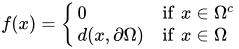
The signed distance function from a point x of X to is defined by


Properties in Euclidean space

[edit]

If Ω is a subset of the Euclidean space Rn with piecewise smooth boundary, then the signed distance function is differentiable almost everywhere, and its gradient satisfies the eikonal equation

If the boundary of Ω is Ck for k ≥ 2 (see Differentiability classes) then d is Ck on points sufficiently close to the boundary of Ω.[3] In particular, on the boundary f satisfies

where N is the inward normal vector field. The signed distance function is thus a differentiable extension of the normal vector field. In particular, the Hessian of the signed distance function on the boundary of Ω gives the Weingarten map.

If, further, Γ is a region sufficiently close to the boundary of Ω that f is twice continuously differentiable on it, then there is an explicit formula involving the Weingarten map Wx for the Jacobian of changing variables in terms of the signed distance function and nearest boundary point. Specifically, if T(Ω, μ) is the set of points within distance μ of the boundary of Ω (i.e. the tubular neighbourhood of radius μ), and g is an absolutely integrable function on Γ, then

where det denotes the determinant and dSu indicates that we are taking the surface integral.[4]

Algorithms

[edit]

Algorithms for calculating the signed distance function include the efficient fast marching method, fast sweeping method[5] and the more general level-set method.

For voxel rendering, a fast algorithm for calculating the SDF in taxicab geometry uses summed-area tables.[6]

Applications

[edit]
Signed distance fields stored as raster images can be used to represent shapes.

Signed distance functions are applied, for example, in real-time rendering,[7] for instance the method of SDF ray marching, and computer vision.[8][9]

SDF has been used to describe object geometry in real-time rendering, usually in a raymarching context, starting in the mid 2000s. By 2007, Valve is using SDFs to render large pixel-size (or high DPI) smooth fonts with GPU acceleration in its games.[10][non-primary source needed] Valve's method is not perfect as it runs in raster space in order to avoid the computational complexity of solving the problem in the (continuous) vector space. The rendered text often loses sharp corners. In 2014, an improved method was presented by Behdad Esfahbod. Behdad's GLyphy approximates the font's Bézier curves with arc splines, accelerated by grid-based discretization techniques (which culls too-far-away points) to run in real time.[11][non-primary source needed]

A modified version of SDF was introduced as a loss function to minimise the error in interpenetration of pixels while rendering multiple objects.[12] In particular, for any pixel that does not belong to an object, if it lies outside the object in rendition, no penalty is imposed; if it does, a positive value proportional to its distance inside the object is imposed.
In 2020, the FOSS game engine Godot 4.0 received SDF-based real-time global illumination (SDFGI), that became a compromise between more realistic voxel-based GI and baked GI. Its core advantage is that it can be applied to infinite space, which allows developers to use it for open-world games.[13][non-primary source needed]

In 2023, the authors of the Zed text editor announced a GPUI framework that draws all UI elements using the GPU at 120 fps. The work makes use of Inigo Quilez's list of geometric primitives in SDF, Figma co-founder Evan Wallace's Gaussian blur in SDF, and a new rounded rectangle SDF.[14][non-primary source needed]

See also

[edit]

Notes

[edit]

References

[edit]
Revisions and contributorsEdit on WikipediaRead on Wikipedia
from Grokipedia
The signed distance function (SDF), also known as the signed distance field, is a mathematical function that, for a given point in Euclidean space, computes the shortest (orthogonal) distance to the boundary of a domain or shape, with the distance value signed to indicate whether the point lies outside (positive), inside (negative), or on the boundary (zero) of the domain.[1][2] For a domain Ω\Omega with boundary Ω\partial \Omega, the SDF ϕ:RnR\phi: \mathbb{R}^n \to \mathbb{R} is formally defined such that ϕ(x)=dist(x,Ω)sign(x)\phi(\mathbf{x}) = \mathrm{dist}(\mathbf{x}, \partial \Omega) \cdot \mathrm{sign}(\mathbf{x}), where dist(x,Ω)=infyΩxy\mathrm{dist}(\mathbf{x}, \partial \Omega) = \inf_{\mathbf{y} \in \partial \Omega} \|\mathbf{x} - \mathbf{y}\| is the Euclidean distance to the boundary, and the sign is determined by the position relative to Ω\Omega.[3] A canonical example in 2D is the SDF to a unit circle centered at the origin, given by ϕ(x,y)=x2+y21\phi(x, y) = \sqrt{x^2 + y^2} - 1, which equals zero on the circle, negative inside, and positive outside.[3] Key properties of the SDF include its Lipschitz continuity with constant 1, ensuring that ϕ(x)ϕ(y)xy|\phi(\mathbf{x}) - \phi(\mathbf{y})| \leq \|\mathbf{x} - \mathbf{y}\| for all points x,y\mathbf{x}, \mathbf{y}, and the eikonal equation ϕ(x)=1|\nabla \phi(\mathbf{x})| = 1 almost everywhere, which guarantees that the gradient points in the direction of the nearest boundary point and has unit length.[1][4] This gradient property also encodes the surface normal at the boundary, as n(x)=ϕ(x)\mathbf{n}(\mathbf{x}) = \nabla \phi(\mathbf{x}) for xΩ\mathbf{x} \in \partial \Omega, making SDFs particularly useful for representing shapes implicitly without explicit boundary parametrization.[5] Additionally, SDFs support Boolean operations for combining shapes: the union of two domains corresponds to min(ϕ1,ϕ2)\min(\phi_1, \phi_2), intersection to max(ϕ1,ϕ2)\max(\phi_1, \phi_2), and difference to max(ϕ1,ϕ2)\max(\phi_1, -\phi_2), preserving the signed distance property under certain conditions.[3][6] SDFs have broad applications across fields such as computer graphics, where they enable efficient ray marching for rendering complex scenes and procedural modeling of organic shapes; level set methods in partial differential equations (PDEs) for simulating evolving interfaces like flame fronts or fluid boundaries; and shape optimization in engineering, including topology optimization and medial axis computation.[2][7] In recent advances, neural networks have been trained to approximate SDFs for generalizable 3D shape reconstruction from images or point clouds, leveraging differentiable rendering techniques to infer geometry and poses.[8][9] These representations are also integral to computational geometry tasks, such as surface reconstruction from scanned data and motion planning in robotics, due to their ability to handle topological changes smoothly.[5][10]

Definition and Basic Properties

Formal Definition

The distance from a point $ x \in \mathbb{R}^n $ to the boundary $ \partial \Omega $ of a domain $ \Omega \subset \mathbb{R}^n $ is defined by the unsigned distance function $ d(x, \partial \Omega) = \inf_{y \in \partial \Omega} | x - y | $, where $ | \cdot | $ denotes the Euclidean norm.[11] The signed distance function (SDF) $ f: \mathbb{R}^n \to \mathbb{R} $ incorporates a sign to indicate position relative to the domain and is defined piecewise as $$ f(x) = \begin{cases}
  • d(x, \partial \Omega) & \text{if } x \in \Omega, \ 0 & \text{if } x \in \partial \Omega, \ d(x, \partial \Omega) & \text{if } x \notin \bar{\Omega}. \end{cases} $$
[1] This convention assigns negative values inside $ \Omega $ and positive values outside. An alternative convention reverses the signs, yielding positive values inside $ \Omega $ and negative values outside, which appears in some mathematical contexts.[11] The zero level set of the SDF coincides exactly with the boundary, $ { x \mid f(x) = 0 } = \partial \Omega $, thereby representing the domain implicitly through level sets of the function.[1] The signed distance function originated in the development of level-set methods for tracking moving interfaces, as introduced by Osher and Sethian in 1988.[12]

Geometric Interpretation

The signed distance function (SDF) to the boundary Ω\partial \Omega of a domain Ω\Omega in Euclidean space provides a measure of the shortest perpendicular distance from any point xx to Ω\partial \Omega, with the sign indicating the spatial relationship to the domain: positive values for points outside Ω\Omega and negative values for points inside Ω\Omega, while the value zero corresponds exactly to the boundary itself.[13][14] This signed convention allows the SDF to partition space into interior and exterior regions, facilitating intuitive geometric analysis without explicit boundary parametrization.[13] Geometrically, the level sets of the SDF, defined as {xf(x)=c}\{x \mid f(x) = c\} for constant c0c \neq 0, represent parallel offsets to the boundary Ω\partial \Omega at a distance c|c|, forming tubular neighborhoods or "tubes" around Ω\partial \Omega that expand outward for positive cc and inward for negative cc.[13] These level sets visualize the SDF's role in capturing the topology and morphology of Ω\Omega, as they evolve smoothly away from the boundary, preserving the perpendicularity of the distance measurement along the normal direction.[13] A simple example in two dimensions is the unit disk Ω={xR2x1}\Omega = \{x \in \mathbb{R}^2 \mid \|x\| \leq 1\}, where the SDF is given by f(x)=x1f(x) = \|x\| - 1; here, points inside the disk yield negative values (e.g., f(0)=1f(0) = -1), points on the boundary yield zero, and points outside yield positive values, illustrating the radial symmetry and concentric level sets as circles of varying radii.[15] This example highlights how the SDF encodes the geometry through signed radial distances, with level sets f(x)=cf(x) = c forming parallel circles offset by c|c| from the unit boundary.[15] Inside the domain Ω\Omega, the SDF exhibits local minima at points along the medial axis (or skeleton), which consists of the set of points equidistant from at least two boundary points and represents the "ridges" or centers of maximal inscribed balls within Ω\Omega.[14] These minima occur where the closest boundary point is not unique, marking the structural skeleton of the shape and providing insight into its overall form without singularities in the distance measure itself.[14]

Advanced Mathematical Properties

Differentiability and Eikonal Equation

The signed distance function ff to the boundary Ω\partial \Omega of a domain ΩRn\Omega \subset \mathbb{R}^n is 1-Lipschitz continuous, satisfying f(x)f(y)xy|f(x) - f(y)| \leq \|x - y\| for all x,yRnx, y \in \mathbb{R}^n, a direct consequence of its definition as the infimum of distances to boundary points.[16] As a Lipschitz continuous function, ff is differentiable almost everywhere in Rn\mathbb{R}^n by Rademacher's theorem.[16] Where differentiable and away from the boundary, i.e., for xΩx \notin \partial \Omega, the signed distance function satisfies the eikonal equation f(x)=1|\nabla f(x)| = 1.[16] This partial differential equation arises from the geometric minimization inherent in the distance definition: the gradient f(x)\nabla f(x) equals the unit outward normal vector at the unique closest boundary point, ensuring the magnitude is exactly 1, which reflects the uniform rate of change perpendicular to level sets.[16] The signed distance function is non-differentiable precisely along the skeleton of Ω\partial \Omega, also known as the medial axis or cut locus, which consists of points having multiple closest boundary points.[16] At these loci, the competing influences from equidistant boundary segments prevent a well-defined gradient direction. Despite points of non-differentiability, the signed distance function serves as a viscosity solution to the eikonal equation f(x)=1|\nabla f(x)| = 1 in the weak sense over RnΩ\mathbb{R}^n \setminus \partial \Omega, with f=0f = 0 on Ω\partial \Omega.[16] This framework, introduced for Hamilton-Jacobi equations including the eikonal type, ensures uniqueness and stability for such first-order nonlinear PDEs without requiring classical differentiability.

Boundary Behavior and Normals

On the boundary Ω\partial \Omega of a domain Ω\Omega, the gradient of the signed distance function ff satisfies f(x)=N(x)\nabla f(x) = N(x), where N(x)N(x) is the unit outward normal vector to Ω\partial \Omega.[17] This property extends the normal vector field differentiably off the boundary, providing a smooth representation of the surface orientation. For boundaries Ω\partial \Omega that are CkC^k-smooth with k2k \geq 2, the signed distance function ff is CkC^k-smooth within a tubular neighborhood of Ω\partial \Omega.[18] This neighborhood, denoted T(Ω,μ)T(\partial \Omega, \mu) for sufficiently small μ>0\mu > 0, consists of points within distance μ\mu from Ω\partial \Omega, excluding regions near focal points where the distance function may lose smoothness. The tubular neighborhood theorem parameterizes this region locally using the boundary point uΩu \in \partial \Omega and a signed offset λ\lambda along the normal N(u)N(u), yielding coordinates x=u+λN(u)x = u + \lambda N(u). The volume element in these coordinates leads to the change-of-variables formula for integrals:
T(Ω,μ)g(x)dx=Ωμμg(u+λN(u))det(IλWu)dλdSu, \int_{T(\partial \Omega, \mu)} g(x) \, dx = \int_{\partial \Omega} \int_{-\mu}^{\mu} g(u + \lambda N(u)) \det(I - \lambda W_u) \, d\lambda \, dS_u,
where WuW_u is the Weingarten map (shape operator) at uu, and dSudS_u is the surface measure on Ω\partial \Omega.[19] The eigenvalues of WuW_u correspond to the principal curvatures κi(u)\kappa_i(u) of Ω\partial \Omega at uu, which influence the determinant and thus the geometry of the tubular neighborhood.[18]

Computational Methods

Numerical Algorithms

Numerical algorithms for computing signed distance functions (SDFs) primarily involve solving the eikonal equation $ |\nabla f| = 1 $ with boundary conditions $ f = 0 $ on the interface, where $ f $ represents the SDF. These methods discretize the domain, typically on regular grids, and propagate distance information from the boundary outward, ensuring the gradient magnitude condition is approximated. The eikonal equation underpins many approaches, enabling efficient computation for applications requiring accurate distance fields.[20] The fast marching method (FMM) is a Dijkstra-like algorithm designed for monotone front propagation, solving the eikonal equation by advancing a narrow band of accepted points in order of increasing distance. It uses upwind finite differences to update tentative distances at neighboring grid points, maintaining a priority queue to select the next point for acceptance, thus ensuring causality and stability. This method is particularly effective for static geometries where the front expands unidirectionally without reversal. The computational complexity is $ O(N \log N) $ for $ N $ voxels on a uniform grid.[20] The fast sweeping method provides an iterative alternative, employing Gauss-Seidel updates over the entire grid in multiple sweeping directions to approximate the eikonal equation $ |\nabla f| = 1 $. It initializes distances near the boundary and iteratively relaxes values using upwind schemes, alternating sweeps (e.g., in 3D across all eight octants) until convergence, leveraging the causality of characteristics for efficient propagation. This approach achieves linear complexity $ O(N) $ in practice for uniform grids and is simpler to parallelize than FMM, though it may require more iterations for high accuracy.[21] Level-set methods evolve implicit surfaces defined by the zero level set of a function $ \phi $, often initialized as an SDF, using Hamilton-Jacobi partial differential equations to track interface motion under various speeds. During evolution, $ \phi $ deviates from being a true SDF, necessitating periodic reinitialization to restore the signed distance property while preserving the interface location. Reinitialization solves a modified eikonal equation via PDE-based iterations or fast solvers like FMM, ensuring $ |\nabla \phi| = 1 $ away from the zero level set through constrained updates that avoid shifting the front. These methods are versatile for dynamic interfaces but introduce overhead from reinitialization steps.[22] Voxel-based approximations discretize the SDF on uniform grids, computing distances via sequential distance transforms tailored to specific metrics. For L1 (Manhattan) or $ L_\infty $ (Chebyshev) metrics, efficient algorithms perform forward and backward passes to propagate minimum distances from boundary voxels, achieving exact results in linear time $ O(N) $. Chamfer distance transforms approximate the Euclidean metric using local masks during two-pass scans, offering a balance of speed and accuracy with errors bounded by about 2% of the grid resolution; these are particularly useful for initial coarse estimates before refinement.[23] Post-2010 advancements have leveraged GPU accelerations for these algorithms, enabling real-time computation of SDFs on large voxel grids through parallel propagation and hierarchical structures. For instance, GPU implementations of FMM and sweeping methods achieve speedups of 10-100x over CPU versions for million-voxel domains, facilitating interactive applications in 3D modeling and simulation.[24] Recent work as of 2025 has further accelerated SDF evaluation by up to three orders of magnitude using optimized numerical techniques, enhancing real-time ray-surface intersections.[25]

Representations and Data Structures

Signed distance functions (SDFs) can be represented implicitly as continuous mathematical expressions, enabling compact storage and exact queries without discretization. In this approach, an SDF is defined analytically or via procedural methods, such as constructive solid geometry (CSG) operations on primitive shapes. For instance, the union of two shapes with SDFs f1f_1 and f2f_2 is given by min(f1,f2)\min(f_1, f_2), while the intersection uses max(f1,f2)\max(f_1, f_2); these operations preserve the signed distance property and allow hierarchical composition of complex geometries. Modern variants employ neural networks to parameterize continuous SDFs, where a decoder network maps latent codes to distance values, supporting shape interpolation and generalization across classes with minimal storage (e.g., 7.4 MB for thousands of shapes).[26] Recent neural hybrids, such as ViiNeuS (2025), combine volumetric density and SDFs for improved 3D reconstruction.[27] Discrete representations approximate SDFs by sampling values on a grid, facilitating efficient numerical computations and hardware acceleration. A common method stores SDFs in voxel grids, where each voxel holds a signed distance to the nearest surface, enabling trilinear interpolation for off-grid queries: for a point pp, the value is interpolated from the eight surrounding voxels.[28] To handle sparsity and reduce memory, octree structures organize voxels hierarchically, aggregating values in larger nodes away from surfaces and refining near boundaries; this supports truncated SDFs (TSDFs) for volumetric mapping, achieving up to 98% memory savings over dense grids while maintaining real-time fusion at 10-40 Hz.[29] Adaptive data structures enhance efficiency by focusing storage and computation on regions of geometric interest, particularly near boundaries. Adaptively sampled distance fields (ADFs) use spatial hierarchies like octrees to sample SDFs at varying resolutions, subdividing cells only where field variation exceeds a tolerance (e.g., high detail at sharp features, coarse elsewhere), resulting in significant memory reduction—such as 1713 cells versus 23,573 for equivalent quadtrees in 2D analogs.[30] Narrow-band storage further optimizes by limiting representation to a thin shell around the surface (e.g., ± a user-defined thickness), discarding distant values while using GPU-accelerated scan conversion for updates, which is ideal for dynamic simulations. These can integrate with meshes or point clouds in hybrid forms, storing SDFs only for boundary-adjacent elements to support localized queries in reconstruction tasks.[31] Approximation techniques leverage hierarchies to balance accuracy and storage for large-scale SDFs. Multi-resolution hierarchies, such as hierarchical hphp-adaptive SDFs, employ polynomial bases within octree cells, adapting both element size (hh) and order (pp) to capture smooth variations coarsely and details finely, enabling narrow-band extensions for additional memory savings in rendering and editing.[32] For smooth SDFs, Fourier-based methods decompose the field into frequency components, allowing band-limited approximations that prioritize low-frequency global structure while compressing high-frequency details, though primarily explored in neural contexts for level-of-detail reconstruction.

Applications

In Computer Graphics

In computer graphics, signed distance functions (SDFs) are widely employed for rendering implicit surfaces through ray marching techniques, particularly sphere tracing, which efficiently computes ray-object intersections by leveraging the distance information provided by the SDF. Sphere tracing advances the ray position iteratively, stepping forward by a distance bounded by the SDF value to guarantee no intersections are missed, with a typical step size of $ \max(\epsilon, |f(\mathbf{x})|) $, where $ \epsilon $ is a small positive constant to mitigate floating-point precision issues. This method, originally proposed for antialiased rendering of implicit surfaces, enables high-quality visualization of complex geometries without explicit mesh representations, making it suitable for procedural modeling and volumetric effects in real-time applications.[33][34] Complex objects and scenes are efficiently constructed in procedural modeling by combining basic geometric primitives—such as spheres, boxes, cylinders, and cones—using operations including union (implemented as the minimum of distances), subtraction, smooth blending (via smooth minimum), repetition, and deformations (such as twisting or bending). This approach enables the procedural generation of everyday items like furniture, lamps, bottles, and architectural elements, as well as more intricate shapes including human figures, animals, temples, snails, and mushrooms. Resources by Inigo Quilez provide extensive catalogs of SDF primitives and raymarching techniques, while Shadertoy hosts numerous demonstrations showcasing practical constructions of such complex models from simple SDF components.[35][36][37] SDFs have also revolutionized scalable text and user interface rendering on GPUs, as demonstrated by Valve's 2007 technique for generating signed distance field textures from vector outlines. These textures store the distance to glyph edges in an alpha channel, allowing bilinear filtering and alpha testing to produce smooth, anti-aliased results at arbitrary scales without aliasing artifacts or performance loss from mipmapping. This approach, implemented in games like Team Fortress 2, supports efficient rendering of fonts and icons in dynamic UIs, influencing subsequent adoptions in engines and libraries for vector graphics magnification.[38] For global illumination, SDFs facilitate real-time approximations of soft shadows and ambient occlusion by propagating light through distance-based occlusion queries. A prominent example is Godot 4.0's Signed Distance Field Global Illumination (SDFGI), introduced in 2020, which uses cascaded voxel grids of SDFs to trace secondary rays for indirect diffuse lighting, achieving scalable performance on mid-range hardware with low overhead compared to traditional probe-based methods. This technique enhances scene realism in open-world rendering by capturing bounced light in dynamic environments, supporting up to 60 FPS in complex scenes.[39][40] In dynamic scenes involving deformable objects, real-time SDF updates enable responsive rendering of animations and simulations, such as in UI frameworks where shapes morph fluidly. For instance, Zed's GPUI library, released in 2023, employs SDFs for GPU-accelerated vector drawing of rectangles and paths, updating distance fields incrementally during layout changes to maintain 120 FPS rendering of interactive elements like code editors. This addresses challenges in traditional mesh-based UIs by avoiding costly triangulation.[41]

In Computer Vision and Robotics

In computer vision, signed distance functions (SDFs) play a pivotal role in 3D reconstruction by enabling the fusion of depth data into coherent volumetric representations. A seminal example is KinectFusion, introduced in 2011, which utilizes truncated SDF volumes to perform real-time scanning and integration of depth measurements from a moving RGB-D sensor like the Microsoft Kinect. In this approach, incoming depth frames are aligned to a global coordinate system and fused into a voxel grid where each voxel stores an SDF value approximating the distance to the nearest surface, with truncation to bound computational costs and focus on nearby geometry. This method achieves dense, high-fidelity reconstructions at interactive frame rates, facilitating applications such as augmented reality and object scanning by iteratively updating the SDF to minimize alignment errors via point-to-plane ICP optimization.[42] SDFs also enhance motion segmentation in video processing by representing evolving interfaces in level-set frameworks, allowing the separation of moving objects from static backgrounds. In level-set evolution, the SDF serves as the embedding function whose zero level set defines the object boundary, evolving under a speed term derived from motion cues like optical flow or frame differences to capture dynamic regions. For instance, truncated SDF-based volumetric reconstructions from RGB-D sequences can detect motion by comparing temporal changes in the SDF field against a static model, isolating moving elements through thresholding or further evolution. This technique proves effective in low-texture environments, as demonstrated in volumetric video segmentation pipelines that achieve robust object isolation by leveraging SDF gradients for boundary refinement.[43] In robotics, SDFs underpin path planning and collision avoidance by providing gradient information for safe navigation around obstacles. Represented as distance fields in configuration space, SDFs enable potential field methods where repulsive forces are computed from the negative gradient of the SDF, guiding robots away from collisions while attracting them toward goals. This gradient-based avoidance is particularly efficient for real-time operation, as seen in composite SDFs that predict future states for dynamic environments, significantly reducing SDF prediction times by 81–97% compared to exact methods, enabling faster real-time planning in cluttered dynamic environments. Such fields are integrated into motion planners for manipulators and mobile robots, ensuring collision-free trajectories with sub-millimeter precision in high-dimensional spaces.[44][45] Recent advancements post-2020 incorporate neural SDFs into simultaneous localization and mapping (SLAM) systems, enhancing gap filling and robustness in sparse or noisy sensor data. Neural networks regress continuous SDFs from partial observations, allowing implicit surface reconstruction that fills occlusions through learned priors, outperforming voxel-based methods in accuracy on benchmark datasets. In robotic SLAM, frameworks like iSDF optimize lightweight networks in real-time to infer SDFs for pose estimation and mapping, enabling dense reconstruction in unstructured environments with reduced memory footprint. These approaches extend traditional SDF volumes by generalizing to unseen scenes via meta-learning, supporting applications in autonomous navigation and manipulation.[46]

In Scientific Computing and Optimization

In scientific computing, signed distance functions (SDFs) play a crucial role in physics simulations, particularly for enforcing boundary conditions in fluid dynamics through level-set methods. These methods represent interfaces as the zero level set of an SDF, enabling accurate tracking of moving boundaries without explicit mesh deformation. For instance, a modified level set advection equation can preserve the local signed distance property at the interface by incorporating a source term proportional to the interfacial area generation rate, allowing simulations of two-phase flows with moving contact lines while avoiding costly reinitialization steps.[47] In finite element methods (FEM), SDFs facilitate contact modeling by defining the gap function between deforming bodies, such as in metal forming processes, where the metric properties of the SDF ensure robust enforcement of contact conditions and adaptive meshing from Lagrangian to Eulerian frameworks.[48] Shape optimization leverages SDFs to parameterize evolving domains via gradient flows on level sets, minimizing energy functionals subject to geometric constraints. By representing shapes implicitly, SDFs allow computation of shape derivatives for functionals involving distances to boundaries, such as thickness constraints, through variational formulations that solve for adjoint states without ray-tracing integrations.[49] This approach integrates with discrete gradient flows, providing a framework for topology-aware optimization where perturbations along normal directions update the SDF to reduce compliance or volume while maintaining manufacturability.[50] In machine learning, SDFs serve as implicit representations for shapes, enabling generative modeling through neural networks trained on continuous distance fields. The DeepSDF model learns a latent-code conditioned SDF to represent classes of 3D shapes, achieving high-fidelity reconstruction, interpolation, and completion from partial inputs by optimizing a data term alongside geometric priors.[51] Training incorporates eikonal regularization to enforce the unit gradient norm property of SDFs, stabilizing optimization of neural fields directly from point clouds and improving surface accuracy without explicit supervision.[52] Extensions of SDFs to non-Euclidean spaces, such as hyperbolic geometries, enhance machine learning tasks like classification in hierarchical data by defining signed distances to prototypes in the Poincaré ball model, preserving tree-like structures with low distortion.[53] In higher dimensions, algebraic SDFs generalize to tensor fields for scientific simulations, approximating multi-scale distances in performance-critical contexts like computational design, where higher-order expansions capture complex interactions beyond Euclidean norms.[54]

References

User Avatar
No comments yet.