Hubbry Logo
search
logo
2118159

Simrishamn

logo
Community Hub0 Subscribers
Read side by side
from Wikipedia

Simrishamn is a locality and the seat of Simrishamn Municipality, Skåne County, Sweden with 6,527 inhabitants in 2010.[1] Despite its small population, Simrishamn is, for historical reasons, usually still referred to as a city.

Key Information

Simrishamn is a picturesque coastal town, built around the main street (Storgatan) that passes the market square, itself being the centre of the town. The climate of Simrishamn is mild, because it is warmed by the Gulf Stream and the Baltic Sea, and the hardiness zone of Simrishamn is 8a, comparable to Paris, France.

History

[edit]

Simrishamn is first mentioned (as Symbrishafn) in 1161 and as a town in 1361. Simris has been interpreted as "at the mouth of the slow-flowing (river)" and hamn as "port or harbour",[2] meaning present-day Tommarpsån. It has been speculated that the name has something to do with the Cimbri, a Germanic tribe, as the name also has been "Cimbrishavn". In 1658, when Scania under the Treaty of Roskilde was permanently transferred from Denmark to Sweden, the town had a population of about 200 people. The growth was relatively small until about 1810 when it reached 700 inhabitants, growing to 1,365 in 1850 and 1,966 in 1890.[3] The local government reform of 1971 made Simrishamn the seat of Simrishamn Municipality with about 20,000 inhabitants.

Simrishamn received its railway station with the opening of the Simrishamn-Tomelilla Line in 1892. This line connected Simrishamn to the Ystad-Eslöv Line at Tomelilla. In 1997, the Skåne Commuter Rail was extended to Simrishamn, further integrating the town into the regional rail network

Climate

[edit]

The nearest station to Simrishamn is in Skillinge 10 kilometres (6.2 mi) further down the coastline, also on the open sea. Skillinge has a maritime climate with a moderated coastline and a slightly warmer interior during summers. Österlen has a drier climate than elsewhere in Southern Sweden, although it has no active weather station measuring sunshine. Even so, the cool temperatures of the Baltic Sea keeps the immediate coastline on average a couple of degrees cooler during July days than in places further north in the country or the western part of Skåne. This is due to the dominance of water in the surroundings, whereas the Mälar valley around Stockholm is surrounded by more land.

Especially during summer, seasonal lag is strong on the local coastline. This means that August averages the warmest summer nights and that September is a lot warmer than May as the sea water gradually warms. During winter, this maritime proximity of Österlen reverses the climate patterns and leads to average highs above 3 °C (37 °F) on the coastline and frosts usually being weak even while frequent. Records for Skillinge began in 1995 and as such do not contain likely historical extremes. Simrishamn had an active weather station from 1951 that closed in 1996.[4]

Climate data for Skillinge; 10 kilometres (6.2 mi) south of Simrishamn (2002–2021 averages, extremes since 1995)
Month Jan Feb Mar Apr May Jun Jul Aug Sep Oct Nov Dec Year
Record high °C (°F) 11.2
(52.2)
13.4
(56.1)
19.5
(67.1)
21.9
(71.4)
25.6
(78.1)
31.1
(88.0)
30.5
(86.9)
32.0
(89.6)
26.9
(80.4)
20.9
(69.6)
16.8
(62.2)
12.0
(53.6)
32.0
(89.6)
Mean maximum °C (°F) 7.7
(45.9)
8.0
(46.4)
12.3
(54.1)
16.7
(62.1)
21.4
(70.5)
25.7
(78.3)
26.4
(79.5)
25.8
(78.4)
22.6
(72.7)
16.9
(62.4)
12.4
(54.3)
9.0
(48.2)
28.3
(82.9)
Mean daily maximum °C (°F) 3.3
(37.9)
3.3
(37.9)
5.8
(42.4)
9.7
(49.5)
14.3
(57.7)
19.1
(66.4)
21.5
(70.7)
21.0
(69.8)
17.6
(63.7)
12.4
(54.3)
8.3
(46.9)
5.1
(41.2)
11.8
(53.2)
Daily mean °C (°F) 1.3
(34.3)
1.2
(34.2)
3.1
(37.6)
6.4
(43.5)
10.6
(51.1)
15.0
(59.0)
17.5
(63.5)
17.5
(63.5)
14.4
(57.9)
9.9
(49.8)
6.3
(43.3)
3.1
(37.6)
8.9
(47.9)
Mean daily minimum °C (°F) −0.8
(30.6)
−0.9
(30.4)
0.3
(32.5)
3.0
(37.4)
6.9
(44.4)
10.9
(51.6)
13.5
(56.3)
14.0
(57.2)
11.1
(52.0)
7.3
(45.1)
4.2
(39.6)
1.0
(33.8)
5.9
(42.6)
Mean minimum °C (°F) −9.6
(14.7)
−7.1
(19.2)
−5.7
(21.7)
−2.0
(28.4)
0.9
(33.6)
5.7
(42.3)
9.0
(48.2)
8.5
(47.3)
5.4
(41.7)
0.3
(32.5)
−3.0
(26.6)
−6.3
(20.7)
−11.1
(12.0)
Record low °C (°F) −16.8
(1.8)
−14.6
(5.7)
−16.1
(3.0)
−4.8
(23.4)
−1.5
(29.3)
2.1
(35.8)
7.0
(44.6)
6.0
(42.8)
2.9
(37.2)
−5.9
(21.4)
−7.1
(19.2)
−17.7
(0.1)
−17.7
(0.1)
Average precipitation mm (inches) 52.4
(2.06)
33.5
(1.32)
31.2
(1.23)
22.8
(0.90)
36.0
(1.42)
43.8
(1.72)
57.1
(2.25)
61.0
(2.40)
42.3
(1.67)
67.1
(2.64)
59.3
(2.33)
52.9
(2.08)
559.4
(22.02)
Source 1: SMHI Open Data for Skillinge A, precipitation[5]
Source 2: SMHI Open Data for Skillinge A, temperature[6]
[edit]

See also

[edit]

References

[edit]
[edit]
Revisions and contributorsEdit on WikipediaRead on Wikipedia
from Grokipedia
Simrishamn is a locality and the administrative seat of Simrishamn Municipality in Skåne County, southern Sweden, situated on the Baltic Sea coast in the Österlen region.[1][2] With a town population of about 6,863 as of 2023 and a municipal population of approximately 18,890 in 2024, it serves as a charming coastal hub blending maritime heritage with modern tourism.[1][3] Historically, Simrishamn has evidence of Stone Age settlements and was first documented in 1123, receiving town privileges in the 13th century as a key fishing port driven by herring abundance.[2] Its growth, fueled by trade connections including those of the Hanseatic League, until the 17th century, when Swedish military actions disrupted prosperity; by the 19th century, it boasted Sweden's largest sailing fleet, reflecting a shift toward merchant shipping.[2] Today, the town's economy builds on traditional agriculture and fishing while emphasizing tourism, cultural events, and small-scale industries, with the harbor remaining a vital feature for boating and seafood.[4] Notable landmarks include the 12th-century St. Nicolai Church, built from local limestone and featuring sculptures by Carl Milles, alongside attractions like the Österlen Museum, which showcases regional history, and the Autoseum, a vintage car collection.[2] Simrishamn's pastel-hued wooden houses, cobblestone streets, and hidden gardens exemplify Österlen's artistic vibe, drawing visitors for its beaches, wineries, and cycling paths through surrounding villages.[2][4] As the "capital" of Österlen, it acts as a gateway to the area's apple orchards, galleries, and natural reserves, fostering a community that balances preservation with seasonal influxes of tourists.[2]

Geography

Location and Administrative Status

Simrishamn is situated in southeastern Sweden within Skåne County, serving as the administrative seat of Simrishamn Municipality.[5] The locality lies along the Baltic Sea coast at coordinates 55°33′N 14°21′E, positioning it as a key coastal hub in the Österlen region.[6] This placement in Skåne County, Sweden's southernmost county, underscores its integration into the national administrative framework, where municipalities handle local governance under the oversight of county councils and national authorities. The land area of the Simrishamn locality measures 4.91 km² as of 2020, reflecting its compact urban form amid a broader municipal territory of 391 km².[1] Historically, the area transitioned to Swedish control via the Treaty of Roskilde in 1658, when Denmark ceded Skåne and adjacent provinces to Sweden following military defeats in the Northern Wars.[7] This treaty marked a pivotal shift, incorporating Simrishamn into the Swedish realm and establishing the foundations for its enduring administrative ties to the mainland.[8] In the modern era, Simrishamn's administrative role solidified through Sweden's nationwide municipal reforms of the late 20th century. The 1971 reform abolished distinctions between urban and rural municipalities, creating unified entities with equal responsibilities for services like education, social welfare, and infrastructure.[9] For Simrishamn, this involved a 1969 merger of the city with nearby rural parishes, forming the current municipality that now encompasses diverse coastal and inland areas under centralized local governance.[10] This structure enhances Simrishamn's capacity to manage regional development while aligning with national policies.

Physical Features and Coastline

Simrishamn occupies a coastal position on the southeastern shore of Sweden, along the Baltic Sea, where the landscape transitions between expansive sandy beaches and rugged rocky shores typical of the Österlen peninsula.[11] The coastline features long stretches of fine white sand, such as at Knäbäckshusens Strand, interspersed with coarser reddish sands at sites like Tobisvik, creating diverse habitats for coastal activities and natural observation.[11] These features contribute to Österlen's dramatic scenery, including steep cliffs and bright sandy expanses that define the region's appeal.[12] The broader topography around Simrishamn encompasses the varied terrain of the Österlen region, with flat, agriculture-dominated plains in the southern areas giving way to rolling fields, hilly elevations, and occasional steep slopes in the north.[11] Partly forested hills, influenced by the Linderödsåsen tectonic fault line, rise to the area's highest point at Stenshuvud, reaching 97 meters within Stenshuvuds National Park.[11] This proximity to Österlen's undulating landscapes of heather moors and rocky outcrops integrates seamlessly with the town's setting, providing a backdrop of open fields and elevated coastal views.[13] Within this natural framework, Simrishamn's urban core serves as key anchors, with Storgatan—the main cobblestone street—extending from the harbor uphill to the central market square, Stortorget, blending human development with the surrounding coastal environment.[14] This layout positions the town as a focal point amid the seaside terrain, facilitating access to both maritime and inland features. The region's mild climate places Simrishamn in USDA hardiness zone 8a, enabling vegetation that mirrors southern European mildness, such as resilient forests, extensive orchards—a major center of apple production in nearby Kivik, with Skåne accounting for about 80% of Sweden's total—and emerging vineyards.[15][11][16]

History

Early Settlement and Medieval Period

The area of Simrishamn was first recorded in 1123 as Svimrar-Os in the Norse sagas, likely referring to a settlement at the mouth of a slow-flowing river near the Baltic Sea coast.[17] Symbrishafn, the name for the harbor, appears in historical documents in 1161. This coastal position, with its natural harbor, enabled early human activity centered on maritime pursuits, though organized settlement likely predated the written record.[18] Simrishamn received town privileges sometime in the 13th century, with this status first documented in Danish royal privileges from 1361 that supported its administrative and economic functions.[17] During the medieval period, the town emerged as a key fishing and trading harbor along the Skåne coast, driven by abundant herring stocks that attracted fishermen and merchants from across northern Europe.[18] The construction of Sankt Nicolai Church in the early 13th century, dedicated to the patron saint of sailors and fishermen, underscores the centrality of maritime trade and seasonal fisheries to the community's identity.[18] In the later Middle Ages, Simrishamn flourished as Österlen's primary urban center, surpassing nearby inland settlements like Östra Tommarp through expanded commerce in salted herring, grain, and other goods transported via its harbor. As a member of the Hanseatic League, Simrishamn's trade expanded significantly during this period.[2] The town's medieval layout, with narrow streets and clustered buildings around the waterfront, preserved its role as a regional hub until stagnation set in during the 17th century. By 1658, on the eve of its permanent transfer from Danish to Swedish control under the Treaty of Roskilde, the population stood at approximately 200 residents, reflecting a modest but stable community reliant on harbor-based livelihoods.[17]

Modern Development and Infrastructure

Simrishamn experienced gradual population growth during the early 19th century, reaching 700 inhabitants by 1810, which nearly doubled to 1,365 by 1850 amid increasing trade and fishing activities. By 1890, the population had further expanded to 1,966, reflecting the town's emerging role as a regional hub built upon its medieval foundations as a chartered town. This steady increase laid the groundwork for infrastructural advancements that supported further modernization.[19] A pivotal development occurred with the opening of the Simrishamn–Tomelilla railway line on December 16, 1882, which spanned 27 kilometers and linked Simrishamn directly to the YstadEslöv line at Tomelilla, enhancing connectivity for goods and passengers across Skåne. The railway, initially operated as the Cimbrishamn–Tomelilla Jernväg before being renamed, stimulated local commerce, particularly in agriculture and fisheries, and marked a shift toward industrialized transport in the region. Passenger services on this line continued to operate until later integrations, underscoring its long-term impact on Simrishamn's accessibility.[20] The local government reform of 1971 transformed Simrishamn into the administrative seat of the newly consolidated Simrishamn Municipality, merging the former city with surrounding rural parishes and enabling coordinated urban planning and expansion. This restructuring, part of Sweden's nationwide shift to unitary municipalities, promoted residential and commercial development in the town center and outskirts, including new housing districts that accommodated growing administrative needs. By integrating diverse localities, the municipality fostered balanced growth while preserving the coastal town's character.[21] Further integration into regional networks came in 1997 with the extension of the Skåne Commuter Rail (Pågatågen) from Ystad to Simrishamn along the Österlen Line, electrifying and modernizing the route to improve daily commuting and tourism flows. This upgrade, following the merger of Malmöhus and Kristianstad counties into Skåne County, reduced travel times to Malmö and bolstered Simrishamn's position within the county's transport system, supporting sustainable urban development without extensive new construction.[22]

Government and Demographics

Local Government

Simrishamn has served as the administrative center of Simrishamn Municipality since the nationwide municipal reforms of 1971, when the modern municipality was established through the merger of the former city of Simrishamn with adjacent rural parishes, creating a unified local government entity with a population of approximately 20,000 at the time. The municipal administration is headquartered in the town, with the primary offices located at Stortorget 6, where key services including civil registry, building permits, and public administration are managed. This central role facilitates the delivery of essential local services such as education, social welfare, waste management, and environmental protection, all coordinated from Simrishamn.[23] As a municipality within Skåne County, Simrishamn operates under the oversight of Region Skåne, the regional authority responsible for broader services like healthcare, regional development, and public transportation, ensuring coordination between local and county-level governance. The local political structure follows Sweden's standard municipal framework, featuring a unicameral municipal council (kommunfullmäktige) of 41 elected members serving four-year terms, which holds ultimate authority over municipal policies and budgets. The council appoints a municipal executive board (kommunstyrelse) to implement decisions and oversee operations, supported by five specialized committees: child and education, building, culture and leisure, community planning, and social services.[24] These bodies meet regularly in Simrishamn, with council sessions held at Skeppet venue on Varvsgatan 2.[23] In the 2022 municipal elections, voter turnout was 83.51%, with the Moderate Party (M) emerging as the largest party at 26.94% of the vote, securing 11 seats; the Social Democrats (S) followed with 23.41% and 10 seats; and the Sweden Democrats (SD) obtained 18.87% for 8 seats. Smaller representations included the Centre Party (C) with 6.81% and 3 seats, the Left Party (V) and Greens (MP) each with 2 seats, the Liberals (L) with 2 seats, the Christian Democrats (KD) with 1 seat, and local parties Österlenpartiet and Klimatinitiativ Simrishamn each with 1 seat.[25] For national representation, Simrishamn falls within the Skåne County Northern and Eastern constituency for Riksdag elections, which elects 11 members to Sweden's parliament. In the 2022 general election, the Sweden Democrats led locally with 27.64%, followed by the Social Democrats at 25.53% and the Moderates at 18.43%, reflecting a right-leaning shift in the area. The municipality is divided into several electoral sub-districts, including Simrishamn North and Simrishamn South, to facilitate voting logistics.[26]

Population Statistics

Simrishamn, as a locality (tätort), recorded a population of 6,527 residents as of December 31, 2010, according to official Statistics Sweden data. This figure reflects the most detailed historical census for the urban core area. The corresponding population density was 1,453 inhabitants per square kilometer, calculated over an area of approximately 4.49 square kilometers.[1] By 2023, the estimated population of the Simrishamn locality had grown modestly to 6,863, with a density of 1,398 inhabitants per square kilometer across 4.910 square kilometers. In contrast, the broader Simrishamn Municipality, which includes rural surroundings and smaller settlements, had 19,074 residents in 2022. The municipal population declined slightly to 18,890 by December 31, 2024, marking a net change of -72 for that year, amid an average annual variation of -0.27% from 2018 to 2022; preliminary data indicate 18,974 residents as of June 30, 2025.[1][27][28][29][30] Demographic trends in Simrishamn highlight a pattern of urban-to-rural migration, particularly among artists and creatives relocating from larger cities like Stockholm and Malmö. This movement is driven by factors such as lower living costs, access to natural landscapes, and cultural opportunities like the annual Konstrundan art event, contributing to Österlen's reputation as a hub for artists. Despite this inflow, the overall municipal population has shown mild contraction, influenced by aging demographics and net out-migration in non-creative sectors.[31]

Economy

Port and Maritime Activities

The name Simrishamn incorporates the Swedish word "hamn," meaning "harbor" or "port," which underscores the town's foundational maritime character, evolving from its earlier designation as Svimraros—a term denoting "the mouth of the river that overflows," in reference to the nearby Tommarp River. This etymological emphasis on the harbor reflects Simrishamn's origins as a coastal settlement centered on seafaring activities.[2] Since medieval times, Simrishamn has served as a vital port on the Baltic Sea, first documented in 1123 when Norwegian King Sigurd Jorsalfare anchored his fleet there during a crusade. The town emerged as a significant hub for trade and fishing, particularly driven by the lucrative herring industry, which fueled economic growth and attracted merchant houses during the Age of Liberty in the 18th century. By the late 19th century, the region boasted Sweden's largest fleet of sailing ships, with local families like the Björkengrens owning up to 70 vessels, facilitating commerce across the Baltic, including routes to Bornholm. Although the port's prominence waned after the decline of the Hanseatic League and mid-17th-century conflicts, it retained its role as a key maritime gateway for regional exchange.[2][32][33] Today, Simrishamn's port supports a range of activities centered on fishing fleets, small-scale cargo handling, and recreational yachting. The fishing operations predominantly involve small-scale boats under 15 meters, targeting species like cod and herring, with a focus on sustainable practices such as quota distribution and value-chain integration for processing byproducts into food, supplements, and cosmetics. An ongoing project, "Framtidens fiskehamn," promotes sustainable Baltic Sea fisheries by developing new products from herring, sprat, and byproducts, aiming to enhance jobs and innovation.[34][35][36][37] Maritime trade and fishing contribute substantially to Simrishamn's local economy, ranking as the third-largest employer with approximately 155 full-time equivalents in 2006, including 70 in catching and 57 in processing. The sector generated about SEK 79 million in value added that year, bolstered by municipal revenues of SEK 1 million from port fees and fuel, while supporting innovation in sustainable fisheries to create jobs and enhance food security. Despite a decline in landings from 18,000 tons in 2006 to 5,000 tons in 2021, these activities remain integral to the community's economic resilience and coastal identity.[35][38]

Tourism and Local Industries

Simrishamn has emerged as a prominent tourist destination within the Österlen region of Skåne, drawing visitors primarily for its scenic beaches and rich cultural heritage. The area's coastline features diverse beaches such as Knäbäckshusens Strand and Prästens badkar, which offer sandy shores and rocky inlets ideal for swimming, hiking, and relaxation, attracting both domestic and international travelers during the summer months.[39] The town's historical landmarks contribute to Österlen's reputation for blending natural beauty with cultural exploration.[12] In 2022, Simrishamn recorded 1,090,992 guest nights, with holiday homes accounting for 74% (811,776 nights). However, tourism experienced a decline in 2023, with reductions in restaurant turnover (25-30%) and camping occupancy (-21.6% for Swedish tourists).[40] Local industries in Simrishamn complement tourism through agriculture, retail, and seasonal services, fostering economic stability in this rural coastal municipality. Agriculture remains a foundational sector, with approximately 600 individuals engaged in farming, particularly fruit cultivation in the surrounding fertile fields of Österlen, which supply local markets and support food-related businesses.[41] Retail and small-scale enterprises thrive on tourist influx, while seasonal services such as accommodations, restaurants, and guided tours expand during peak periods, employing many in hospitality roles. The economy, historically rooted in agriculture, fishing, and small enterprises, has diversified post-industrial era, with tourism now serving as the primary driver; as of 2022, it generated an annual turnover of SEK 493.37 million and accounted for one-third of all trade turnover in the municipality.[4][40] Events and markets play a crucial role in bolstering the local economy by extending tourist stays and stimulating spending. Seasonal flea markets, such as the one at Suckarnas gång held on Saturdays and select Sundays during high season, draw crowds for antiques and local crafts, directly benefiting retailers and artisans. Cultural events and art fairs in Österlen, including the annual Konstrundan art round, promote longer visits and increase revenue for accommodations and eateries, supporting job creation and business viability year-round.[42][43] This event-driven tourism has led to noticeable economic growth, including in-migration of taxpayers and sustained operations for small businesses in trade, construction, and services.[40]

Culture and Landmarks

Cultural Heritage

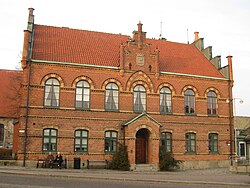
Simrishamn's cultural heritage is deeply rooted in its historical ties to Denmark, as the town and surrounding Skåne region remained under Danish rule until the Treaty of Roskilde in 1658 transferred it to Sweden.[44] This Danish influence is evident in the town's early development, including its medieval town status granted in the 13th century, which fostered a blend of Scandinavian architectural and communal traditions that persisted post-integration.[11] Following the transition, Swedish governance integrated local customs while preserving Danish linguistic and cultural elements, contributing to Simrishamn's unique hybrid identity within Österlen.[44] The town center features well-preserved 19th-century architecture, including brick buildings like the Old Town Hall constructed in 1867, which exemplifies the period's sturdy, functional design with original facades and details. Cobblestone streets, half-timbered houses, and ornate doors known as "Simrishamn doors"—rooted in 18th-century styles, with original models from the 1700s—maintain the historic charm of the old town, with preservation efforts emphasizing authentic materials and techniques to protect these structures as key elements of municipal identity.[45][46] These buildings not only reflect industrial-era growth tied to the port but also serve as tangible links to the town's evolution from a Danish outpost to a Swedish coastal hub.[11] Local traditions in Simrishamn are closely linked to its fishing communities, which have thrived for centuries, earning the town the nickname "herring town" due to its historical reliance on herring fisheries and coastal processing.[47] These communities uphold practices such as seasonal netting and direct seafood handling, passed down through generations and integral to communal life. Annual markets, like the prominent Kiviks Marknad held each July in the municipality, celebrate these traditions by showcasing local seafood, crafts, and folklore, drawing on fishing heritage to foster social bonds and cultural continuity.[48] Simrishamn plays a central role in Österlen's vibrant artistic and literary scene, recognized as a hub with one of northern Europe's highest densities of working artists, where the region's natural landscapes inspire painters, sculptors, and writers.[49] Institutions like Österlens Museum host exhibitions that highlight local creativity, blending historical motifs from fishing and architecture with contemporary expression, while literary events draw on the area's poetic heritage to promote storytelling rooted in coastal life.[50] This artistic milieu underscores Simrishamn's evolution as a cultural crossroads, sustaining traditions amid modern influences.[43]

Notable Attractions and Events

Simrishamn's Storgatan serves as the town's vibrant main thoroughfare, lined with colorful half-timbered houses and boutique shops that attract visitors for leisurely strolls and local shopping experiences.[14] During summer months, the street transforms into a pedestrian zone filled with market stalls and outdoor art displays, enhancing its appeal as a central hub for casual exploration.[14] Adjacent to Storgatan lies Stortorget, the historic market square and heart of community life, featuring the Old Town Hall and often hosting seasonal gatherings that showcase local vendors and sculptures like Hanns Karlewski's "The Source of Life" from 1986.[51] Nearby beaches provide serene natural escapes, with Tobisvik standing out as a prime example just north of the town center; this approximately two-kilometer-long sandy stretch offers clean, wide shores ideal for swimming and relaxation, complemented by nearby camping facilities.[52] For those interested in regional history, Glimmingehus Castle, located about 12 kilometers southwest of Simrishamn, draws crowds as Scandinavia's best-preserved medieval stronghold, built between 1499 and 1506 as a fortified manor.[53][54] The town hosts several annual events that celebrate its cultural vibrancy, including summer markets such as the quality flea market at Suckarnas Gång, held on Saturdays and select Sundays during the high season to highlight local crafts and antiques.[42] Cultural festivals like the Österlen Food Festival emphasize regional cuisine through outdoor culinary events, while Midsummer celebrations feature traditional dancing, folk music, and picnics at various sites around Simrishamn.[55][56] Art exhibitions abound, particularly during the spring Konstrundan, one of the world's largest open-studio events where local artists in Österlen, including those in Simrishamn, invite visitors to galleries and ateliers.[43] Modern cultural venues enrich the visitor experience, with Österlen Museum offering year-round exhibits on local history and traditions through artifacts and programs like the museum magazine Garvaren.[57] The Autoseum - Nisse Nilsson Collection displays an extensive private assortment of vintage automobiles, appealing to enthusiasts of industrial heritage. Additional spots include the Tannery Museum in a 17th- or 18th-century building that explores Simrishamn's leatherworking past, and the Gösta Werner och Havet Art Museum, which focuses on sea-inspired contemporary works.[58][59] Tjörnedala Konsthall provides rotating exhibitions of modern art in a scenic rural setting nearby.[60]

Climate and Environment

Climate Patterns

Simrishamn experiences a maritime climate, moderated by the warming influence of the Gulf Stream and the adjacent Baltic Sea, which contributes to relatively mild winters and cool summers compared to inland areas of Sweden. This coastal location results in smaller temperature fluctuations and higher humidity levels year-round.[61] Average temperatures in the region, based on data from the nearby Skillinge meteorological station (approximately 10 km south of Simrishamn) for the period 2002–2021, show winter highs typically exceeding 3°C, with the coldest months of January and February averaging around 3°C during the day and 0°C at night. Summers are comfortable, with the warmest month being August, where daily highs reach about 20°C and lows around 13°C. Overall, the annual mean temperature hovers near 9°C, reflecting the temperate conditions suitable for agriculture and outdoor activities.[62][63] Temperature extremes recorded at Skillinge since 1995 underscore the mild climate, with the lowest temperatures rarely dropping below -7°C and the highest seldom exceeding 25°C, avoiding the severe cold snaps common farther north in Sweden. Winters remain mild, with infrequent deep freezes, while summers provide pleasant warmth without oppressive heat, enhanced by sea breezes.[62][63] Precipitation in Simrishamn is relatively evenly distributed throughout the year, totaling around 500–600 mm annually along the coast, with the highest monthly averages occurring in July (about 53 mm) and November (around 57 mm). Rain is more frequent in autumn and winter, often accompanied by overcast skies, though heavy downpours are uncommon except during occasional storms. Snowfall is light and short-lived, accumulating to only 3–4 cm on average in February.[61][62] Wind patterns are influenced by the open coastal landscape, with prevailing westerly and southwesterly winds averaging 30–35 km/h in winter months like January, decreasing to about 20–25 km/h in calmer periods such as May. Gusts can reach 50–60 km/h during storms, particularly in autumn, contributing to the dynamic maritime weather but rarely causing prolonged disruptions.[61][62]

Environmental Features

Simrishamn's coastal areas, part of the Österlen region along the Baltic Sea, support diverse biodiversity, particularly in habitats influenced by the sea's brackish waters. The region's sandy beaches, rocky shores, and adjacent meadows host a variety of bird species, including wintering waterbirds such as the pochard (Aythya ferina), smew (Mergellus albellus), and tufted duck (Aythya fuligula), which congregate in Hanö Bay in numbers that represent significant portions of Sweden's national populations. Marine habitats in Hanö Bay feature underwater ecosystems with varying salinity levels due to currents and winds, fostering biodiversity in benthic communities and supporting migratory fish species, though these are threatened by eutrophication and overfishing. Terrestrial biodiversity complements this, with coastal dunes and heaths providing niches for insects like rare butterflies and ground beetles, as well as reptiles such as the sand lizard (Lacerta agilis). Environmental initiatives in Skåne County emphasize coastal protection through nature-based solutions to enhance resilience against climate impacts. The LIFE Coast Adapt project, implemented across multiple Skåne municipalities, tested ecosystem-based measures like beach nourishment and vegetation restoration to mitigate erosion while boosting habitat quality for local flora and fauna, demonstrating synergies between conservation and adaptation. These efforts align with broader county strategies to preserve marine and coastal ecosystems, including monitoring programs by the County Administrative Board to protect sensitive bird breeding sites and reduce nutrient runoff into the Baltic Sea. Simrishamn faces notable environmental challenges from Baltic Sea-driven erosion, exacerbated by storm surges and rising sea levels, which have led to beach closures and habitat loss in areas like Knäbäckshusen. As of 2025, the beach at Knäbäckshusen remains closed due to accelerated erosion following Storm Babet in 2023, with municipal plans for restoration underway.[64] In the Österlen region, climate adaptation focuses on integrating soft engineering techniques, such as dune reinforcement with native plants, to counter shoreline retreat rates that have accelerated since the 1990s along Skåne's coasts. These challenges influence local ecology, with milder winters potentially shifting bird migration patterns and increasing vulnerability to invasive species in altered marine habitats. Nearby protected areas underscore Simrishamn's commitment to conservation, with Stenshuvud National Park serving as a key reserve encompassing 400 hectares of coastal hills, forests, and beaches that safeguard over 500 insect species, including butterflies and moths, alongside birds like the Eurasian golden oriole (Oriolus oriolus) and tawny pipit (Anthus spinoletta). Other reserves, such as Drakamöllan and Haväng & Vitemölla Strandbackars, protect dune systems and strand meadows, preserving rare orchids and ground-nesting bird populations while restricting development to maintain ecological integrity.

References

User Avatar
No comments yet.