Hubbry Logo
SkorpiosSkorpiosMain
Open search
Skorpios
Community hub
Skorpios
logo
8 pages, 0 posts
0 subscribers
Be the first to start a discussion here.
Skorpios
Skorpios
from Wikipedia
View of the island in July 2007

Key Information

Skorpios or Scorpios (Greek: Σκορπιός, pronounced [skorˈpços]) is a private island in the Ionian Sea off the western coast of Greece and just to the east of the island of Lefkada. The 2011 census reported a population of five inhabitants. Administratively it is part of the municipality of Meganisi in Lefkada regional unit.

Geography

[edit]

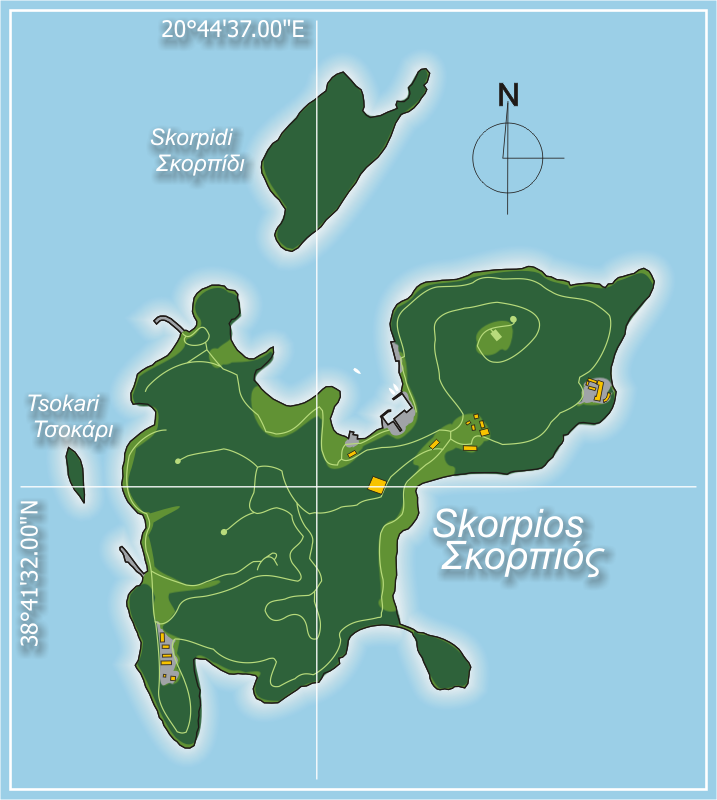
The island, spanning 83.2 hectares (roughly 205 acres), is irregularly shaped, with main axes about 1,500 m (4,900 ft) and 1,000 m (3,300 ft). It is heavily forested from south to north and features over 200 varieties of trees imported to the once nearly barren island by Aristotle Onassis. There are some sandy beaches, most notably East Beach, which was created by Onassis, who brought sand from Salamis Island for this purpose. It is home to three residences, a helicopter landing pad and a boat quay. Onassis also built harbor facilities in the bay on the north side for his Christina O yacht.[1]

History

[edit]

Skorpios is primarily known as the private island of the late Greek shipping billionaire Aristotle Onassis. It was bought in 1963 and believed to have cost him the equivalent of about €11,000 of today's money (2015).[1] Numerous high profile parties were hosted during the time of Aristotle Onassis. Skorpios was also the site of his wedding to former United States First Lady Jacqueline Kennedy on October 20, 1968. In 1971, Jacqueline Kennedy Onassis was photographed nude by an Italian paparazzo on a Skorpios beach.[2] Upon Onassis's death the island was passed to his daughter Christina, and then in turn to her daughter Athina Onassis, the only surviving heir. Onassis, his son Alexander, and his daughter Christina are all buried on the island.[3]

Rybolovlev long term lease

[edit]

In April 2013, Ekaterina Rybolovleva, the 24-year-old daughter of Russian oligarch Dmitry Rybolovlev, bought a group of companies from Athina Onassis for $153 million from her trust. [4][5][6] The assets included a long term lease to Skorpios and its smaller islet, Sparti.[7] Beginning in October 2018 and with a completion date of 2020, Rybolovleva began developing a 10,000 square metres (110,000 sq ft) luxury resort on Skorpios for a total investment estimated at €184 million.[8] The island is a Natura 2000 protected area with no more than 5% of its area to be developed.[8] The Greek government is yet to confirm the legality of the purchase. An investigation is underway, as Giannis Mihelakis (a New Democracy MP) raised the question in the Greek parliament.[9] Specifically, Onassis stated in his will that the island would remain in the family as long as they could afford to cover its maintenance expenses. According to the will, if his descendants could not cover the expenses, the island would be donated either to the now defunct Olympic Airlines or to the state.[10]

References

[edit]
[edit]
Revisions and contributorsEdit on WikipediaRead on Wikipedia
from Grokipedia
Skorpios (Greek: Σκορπιός) is a small in the , situated approximately 2 kilometers northwest of in , covering an area of about 2.17 square kilometers. Acquired by magnate in 1963 for roughly £10,000, the uninhabited island was transformed into a luxurious personal retreat featuring a , , and landscaped grounds where Onassis hosted international celebrities, royalty, and politicians. It gained global notoriety as the site of Onassis's 1968 wedding to former U.S. Jacqueline Kennedy, attended by a select few amid intense media scrutiny, and later as the location of high-profile gatherings including the infamous nude photographs of Kennedy Onassis in 1971. Following Onassis's death in 1975, the island passed to his daughter Christina and eventually to granddaughter Athina Onassis de Miranda, who in 2013 sold it to Swiss-based Russian billionaire Ekaterina Rybolovleva—daughter of Dmitry Rybolovlev—for over $100 million, granting a 99-year lease for development rights. Under Rybolovlev family stewardship, Skorpios, designated as a Natura 2000 protected area, is undergoing transformation into an ultra-exclusive eco-luxury resort limited to 5% land development, emphasizing sustainable technology, art installations, and privacy for ultra-high-net-worth individuals, with projects advancing as of 2024 despite environmental and heritage preservation constraints. This evolution marks a shift from its mid-20th-century glamour as an Onassis family sanctuary to a modern billionaire enclave, sparking debates over commercialization of cultural icons while prioritizing empirical ecological limits over unchecked expansion.

Geography

Location and physical characteristics


Skorpios is a private island situated in the Ionian Sea, off the western coast of mainland Greece, approximately 3 kilometers east of Lefkada. Its central coordinates are 38°41′ N, 20°44′ E.
The island encompasses 83.2 hectares (205 acres) and possesses an irregular shape, with main axes extending roughly 1,500 meters and 1,000 meters. Originally barren rock, its terrain now supports dense forestation comprising over 200 imported tree species, primarily from south to north. The landscape features hilly elevations reaching up to 81 meters.

Climate and ecology

Skorpios exhibits a (Köppen classification Csa), featuring hot, dry summers and mild, rainy winters typical of the . Average annual temperatures hover around 23°C, with daytime highs in summer months often exceeding 30°C and nighttime lows in winter dipping to approximately 7°C. Precipitation is concentrated between October and March, averaging 800–1,000 mm annually, while summers remain arid with minimal rainfall. These conditions support lush vegetation during the but impose seasonal water constraints, influencing ecological patterns such as flowering cycles and animal migrations. The island's reflects a blend of native Mediterranean habitats and extensive human modification through . Originally a rocky, nearly barren outcrop, Skorpios was transformed in the mid-20th century by the planting of over 200 tree species imported by , creating a dense that dominates the 2.2 km² from to north. This introduced flora, including pines, olives, and , enhances but overshadows remnant native maquis shrublands and phryganic vegetation characteristic of the Echinades . Faunal diversity aligns with broader Ionian Island patterns, particularly as part of the Echinades complex, which harbors a rich herpetofauna including species like the Balkan green lizard (Lacerta viridis) and loggerhead sea turtles (Caretta caretta) nesting on nearby beaches. The island supports breeding raptors such as the (Accipiter nisus) and (Falco eleonorae), drawn to its coastal and forested habitats, though limited public access restricts comprehensive surveys. Ongoing resort development under current ownership incorporates sustainability measures, such as controlled landscaping to preserve this engineered ecosystem amid climate pressures like rising temperatures and erosion risks.

History

Ancient and pre-modern era

Skorpios, a small (approximately 2 km²) off the eastern of in the , lacks documented evidence of ancient settlements or significant human activity. No archaeological excavations or artifacts from prehistoric, Classical Greek, Hellenistic, Roman, or Byzantine periods have been reported on the island, consistent with its arid terrain, absence of natural freshwater sources, and sparse vegetation, which deterred sustained habitation. In the medieval and early modern eras, Skorpios formed part of the , which evaded Ottoman domination and instead experienced successive Western European administrations, including prolonged Venetian control from the mid-14th century until , followed by French, Russo-Turkish condominium, and rule until 1864. Despite this regional context, the island itself remained undeveloped and effectively uninhabited, with any potential use limited to intermittent pastoral activities such as goat grazing from nearby , though specific records are scarce. Its isolation and inhospitable conditions preserved it as a barren outcrop until the mid-20th century.

Acquisition and transformation under Aristotle Onassis

In 1963, Greek shipping magnate Aristotle Onassis acquired the uninhabited island of Skorpios, located in the Ionian Sea off the western coast of Greece, for 3.5 million drachmas, equivalent to approximately $12,500 at the time. The purchase transformed the 74-acre barren rock, previously used only for grazing by local shepherds, into a private family estate. Onassis undertook extensive development to create a luxurious retreat, importing sand from Salamis to form artificial beaches and planting thousands of trees across more than 200 varieties to establish dense forests covering the island from south to north. He also piped in utilities such as electricity and water, constructed roads, and developed infrastructure including a helipad, a small marina, and harbor facilities capable of accommodating his yacht Christina O. Key structures built under Onassis included a family compound with three residences, among them the distinctive "Pink House" villa, and a private chapel that later hosted significant family events. These enhancements turned Skorpios into a verdant paradise symbolizing Onassis's vision of opulent seclusion, far removed from its prior desolate state.

Onassis family stewardship

Following Aristotle Onassis's death on March 15, 1975, Skorpios passed to his daughter , who inherited the island as part of the family estate and maintained it as a private retreat. The island served primarily as a secluded family site, including as the burial place for Aristotle Onassis and his son , who had died in a plane crash in 1973. , known for her peripatetic lifestyle and multiple marriages, used Skorpios sporadically for personal escapes but did not undertake significant developments or public alterations, preserving its status as an off-limits private domain. Christina Onassis died on November 19, 1984, at age 37, reportedly from a linked to her struggles with weight and health; she was buried alongside her father and brother on the island. Ownership then transferred to her newborn daughter, Roussel (born January 3, 1985), the sole surviving heir, though Athina was a minor and the estate was managed by trustees, including her father . In 1999, a Swiss court reassigned oversight of Athina's inheritance, including Skorpios, to the auditing firm Fides in to ensure professional administration amid family disputes. Under Athina's stewardship, which gained full control upon her reaching adulthood in , the island received minimal active intervention, with management focused on basic upkeep of family graves and structures rather than restoration or expansion. Aristotle Onassis's will had conditioned family retention on covering maintenance expenses, failing which the island would revert to the Greek state—a provision that underscored the escalating costs, estimated at millions in taxes and repairs by the early 2010s. Athina reportedly paid approximately €35 million in inheritance taxes and ongoing maintenance since assuming responsibility, amid reports of the island's vegetation overgrowing former manicured areas and limited family visits. Local accounts from nearby indicated sparse activity, with the island largely reverting to a natural state, reflecting a shift from Aristotle's era of intensive transformation to passive preservation amid financial pressures.

Ownership and development

Sale to the Rybolovlev family

In April 2013, , the granddaughter and sole surviving heir of , sold Skorpios and the adjacent islet of Sparti to , daughter of Russian fertilizer magnate , for a reported $153 million. The transaction was confirmed by Rybolovlev's investment office and Greek media outlets, amid reports of Athina divesting family assets during Greece's ongoing economic crisis, which had escalated maintenance costs for the 74-acre (30-hectare) private island. The deal marked the end of Onassis family ownership of the island, which Aristotle had acquired in 1963 for under $20,000 and transformed into a symbol of opulence, including the site of his 1968 wedding to Jacqueline Kennedy. Ekaterina Rybolovleva, then 24, was reported to intend using the property for both personal enjoyment and commercial development, though initial plans emphasized preservation of its exclusivity. Some accounts described the acquisition as structured through a long-term lease rather than outright freehold transfer, potentially to navigate Greek regulations on foreign ownership of culturally significant sites, with a 99-year term valued at around $150 million. Dmitry Rybolovlev, whose fortune derived from stakes in potash mining and banking, facilitated the purchase via family entities, reflecting a pattern of high-profile real estate investments by Russian oligarchs in Mediterranean properties prior to subsequent geopolitical sanctions. The sale price exceeded early Greek media estimates of over $100 million, underscoring the island's enduring prestige despite its remote location in the Ionian Sea.

Infrastructure and resort transformation

Following the acquisition by the Rybolovlev family in , Skorpios underwent significant infrastructural enhancements aimed at converting the into an ultra-luxury resort complex. In 2021, Greek authorities approved a €165 million plan by Mykinai SA, the owner's company, encompassing upgrades to existing Onassis-era structures such as villas and a , alongside new constructions totaling 21,500 square meters. This included a two-level main building with seven luxury suites, a 5-star hotel and complex accommodating up to 84 beds initially, and 12 new villas ranging from 500 to 1,200 square meters each, designed to integrate with the terrain. Key infrastructural additions focused on accessibility and amenities for high-net-worth visitors, including an expanded capable of berthing superyachts, a for , and sports facilities such as tennis courts and an amphitheater. A fiber optic network was installed to establish Skorpios as a "smart" island, supporting advanced digital services for guests. By April 2023, the project scope doubled in scale with regulatory approval for an additional 10,000 square meters of development, elevating total investment estimates to €400 million while capping guest capacity at 50 to maintain exclusivity. Construction progressed through 2023 and into 2024, with initial phases targeting completion by summer 2024, though full operational rollout extended into 2025 amid ongoing enhancements like vineyards and wellness infrastructure. Existing buildings were renovated for modern standards, preserving historical elements while adding energy-efficient systems, with the project expected to generate 152 permanent jobs upon completion. The transformation shifted Skorpios from a secluded family retreat to a rentable VIP destination, with weekly rates projected to exceed €1 million for elite clientele.

Economic implications and sustainability measures

The transformation of Skorpios into a luxury resort under the Rybolovlev family's ownership involves a substantial investment estimated at €165 million, approved by Greek authorities in January 2021 for infrastructure including a main hospitality complex, villas, a multi-sports center, helipad, and port expansions. This capital infusion supports high-end tourism facilities designed to accommodate up to 84 overnight guests and 250 day visitors, with the entire island available for weekly rentals starting at over €1 million, targeting ultra-wealthy clientele. The project is projected to generate at least 130 permanent jobs for staff operations, contributing to employment in the Ionian region's tourism sector, which has seen Greece's visitor numbers nearly double since 2012 to around 30 million annually. Economically, the initiative aligns with Greece's emphasis on in , positioning Skorpios as a premium destination that could indirectly stimulate ancillary services on nearby through supply chains and visitor spillovers, though its exclusivity limits mass benefits. Some estimates suggest total development costs may exceed €240 million, reflecting expanded scope amid regulatory approvals. Sustainability measures incorporated into the project include environmental conditions approved by Greece's Ministry of Environment, ensuring compliance with ecological standards for construction and operations on the ecologically sensitive island. Architectural design by firm Snøhetta emphasizes integration with the natural to minimize visual intrusion and preserve scenic integrity, alongside like fiber optic cabling for efficient, low-impact operations. These elements address potential habitat disruptions in the Ionian , though detailed metrics on carbon reduction or offsets remain unspecified in public approvals.

Cultural significance

Iconic events and figures

, the Greek-Argentine shipping magnate who built one of the world's largest merchant fleets, acquired Skorpios in 1963 for roughly 3.5 million drachmas (equivalent to about $10,000 at the time) and invested heavily in its transformation from a barren into a landscaped private estate featuring olive groves, a , and luxury villas. used the island as a secluded retreat for high-profile guests and family, embodying his vision of opulent exclusivity amid the . The island's most renowned event occurred on October 20, 1968, when Onassis married , the widow of U.S. President , in a private ceremony at the island's chapel amid cypress trees. The union, attended by roughly 100 guests including members and celebrities, drew global media attention despite Onassis's efforts at secrecy, symbolizing a blend of American political legacy and Greek tycoon extravagance; the event unfolded on the yacht nearby before moving ashore. , a central figure in the island's lore, spent significant time there during her marriage, which lasted until Onassis's death in 1975, though the couple's relationship faced scrutiny for its dynamics and her reported unease with the island's isolation. Onassis's daughter, , inherited stewardship of Skorpios after her father's passing and maintained it as a family holding until financial pressures amid Greece's economic woes prompted its 2013 sale by her daughter to Ekaterina Rybolovlev for €153 million. The island also served as the burial site for and his son , who perished in a 1973 plane crash, underscoring its role as a familial . These associations cemented Skorpios's status as a of 20th-century elite seclusion, though later Rybolovlev-hosted events, such as Ekaterina's 2014 birthday celebration with displays and Greek festivities, evoked echoes of Onassis-era extravagance without matching its historical resonance.

Representation in media and legacy

Skorpios achieved enduring prominence in global media through its role as the site of Aristotle Onassis's 1968 marriage to Jacqueline Kennedy on October 20, which attracted widespread press coverage, including journalists stationed in boats offshore to document the ceremony and festivities. Iconic images from the era, such as those depicting the couple aboard vessels near the island on August 25, 1970, have been archived and reproduced in photo collections, underscoring Skorpios as a backdrop for high-society glamour. The island's media portrayal extends to biographical accounts of Onassis, where it represents his ascent from modest origins to commanding a private domain; for example, the 1988 television film Onassis: The Richest Man in the World, starring Raul Julia, dramatizes elements of his life intertwined with Skorpios ownership. Documentaries and video features further amplify this representation, often framing Skorpios as the transformed "barren rock" Onassis acquired in for approximately 3.5 million drachmas (equivalent to about $12,500 in contemporary terms), which he developed into a verdant retreat hosting gatherings. Coverage of personal tragedies, including the 1973 burial of Onassis's son and Onassis's own interment on March 19, 1975, on the hillside wedding site, has cemented its image as a place of both triumph and loss in news reports. The legacy of Skorpios endures as an emblem of Onassis's self-made empire and the exclusivity of billionaire privacy, symbolizing a refuge amid the that hosted figures emblematic of 20th-century power and wealth. It continues to evoke the jet-set of the Onassis , influencing perceptions of private islands as ultimate sanctuaries, even as subsequent ownership shifts toward commercial development preserve its aura of unattainable luxury. This historical imprint persists in cultural narratives, distinguishing Skorpios from mere real estate as a marker of personal legacy over transient possession.

Controversies and debates

In April 2013, , the sole surviving heir of , sold Skorpios to , daughter of Russian billionaire , for a reported sum exceeding €100 million according to Greek media estimates. The transaction immediately faced legal challenges from Greek authorities, who questioned its compliance with national laws designed to safeguard the island's preservation as a private retreat, in line with 's expressed intentions to maintain it as an undeveloped family paradise rather than allow commercialization or unrestricted foreign control. The Greek Culture Ministry and government sought advisory opinions from the , Greece's highest administrative court, to determine if the sale violated heritage protections or property transfer regulations applicable to culturally significant sites like Skorpios, which had been acquired by Onassis in and symbolized national prestige. Critics, including local officials and media, argued that the deal risked undermining statutory safeguards enacted to honor Onassis's legacy and prevent the island from falling into non-Greek hands without oversight, potentially requiring state approval for such transfers. Reports indicated that the structure of the deal involved transferring the remaining term of a long-term rather than outright freehold ownership, as Greek law limits perpetual private titles on certain lands and mandates public registry updates that were initially delayed. These disputes highlighted tensions between rights and state interests in cultural patrimony, though the transfer ultimately facilitated Rybolovlev control, paving the way for later approvals in 2020.

Environmental and regulatory scrutiny

The acquisition of Skorpios by Ekaterina Rybolovleva in April 2013 prompted immediate regulatory scrutiny from Greek authorities, who questioned whether the transaction complied with the terms under which Aristotle Onassis had originally obtained rights to the island through a perpetual lease from the Greek state in 1963. The Greek Finance Ministry referred the matter to the Legal Council of the State in May 2013 to assess potential violations of donation or lease conditions that restricted commercial exploitation and required state approval for transfers. Despite these concerns, the sale proceeded after legal examination, with no formal blockage imposed, allowing development plans to advance under subsequent regulatory oversight. Development proposals to convert Skorpios into a luxury resort, including up to 22 villas, a 5-star with 12 buildings, a , amphitheater, for superyachts, and , faced rigorous environmental and regulatory review starting in 2017. Greece's Ministry of Economy and Development granted initial permits in December 2017 for infrastructure upgrades, contingent on adherence to laws protecting the island's forested and coastal ecosystems. By January 2021, the €165 million project received formal approval following a positive (EIA) from the Regional Council, which imposed conditions such as limits on built area to 3% of the island's 210 hectares and mandates for bioclimatic design to minimize ecological disruption. A revised technical environmental study was approved in February 2022, incorporating measures like plants, units powered by , and preservation of 97% of the land as green space to address potential impacts on local and . While approvals emphasized sustainability, critics noted the challenges of enforcing regulations on a remote , given Greece's of lenient in similar high-profile developments amid protected zones nearby. No major environmental violations have been documented post-approval, though ongoing monitoring by the Ministry of Environment and Energy requires annual compliance reports on habitat preservation and .

Public and political viewpoints

The Greek government, under the New Democracy administration, approved the Rybolovlev family's €165 million investment plan for Skorpios in January 2021, framing it as a boost to and local amid post-crisis recovery efforts. This endorsement came despite the island's status as a protected area, where regulations cap development at 5% of the land to preserve . officials emphasized compliance with environmental assessments, though the approval during the drew implicit criticism for prioritizing elite over broader public access. Parliamentary debate has centered on the 2013 sale's alignment with Aristotle Onassis' will, which stipulated perpetual Greek ownership and use as a family retreat or public park if sold domestically. In 2013, the Finance Ministry sought legal counsel from the State Legal Council to verify the transfer's validity to foreign buyers, reflecting early political caution over privatizing a cultural landmark. New Democracy MP Giannis Mihelakis later questioned the transaction in parliament, prompting an ongoing probe into potential testamentary breaches, though no formal revocation has occurred. Public sentiment, as covered in international and Greek media, blends economic pragmatism with cultural unease. Supporters highlight job creation—potentially hundreds in construction and operations—and revenue from high-end tourism, estimated at over €1 million weekly once operational. Critics, including heritage advocates, decry the shift from Onassis-era exclusivity to a "Bond-style" resort with helipads, marinas for superyachts, and sniper-patrolled perimeters, arguing it commodifies a symbol of Greek glamour tied to figures like Jacqueline Kennedy. Environmental scrutiny persists, with reports of habitat disruption risks despite limits, fueling calls for stricter oversight amid Greece's overtourism debates. No widespread protests have materialized, but online discourse and press evoke nostalgia for the island's uncommercialized past.

References

Add your contribution
Related Hubs
User Avatar
No comments yet.