Recent from talks
Nothing was collected or created yet.
Amish
View on Wikipedia
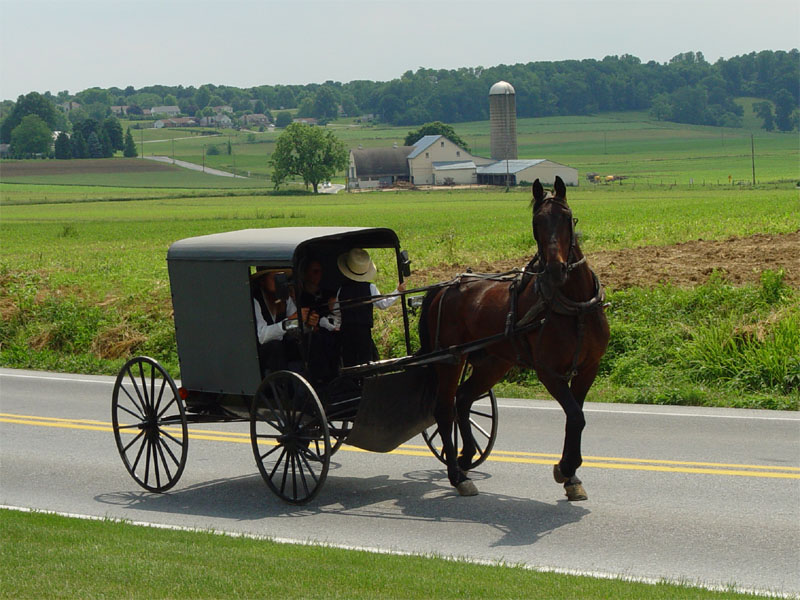
An Amish family riding in a traditional Amish buggy in Lancaster County, Pennsylvania | |
| Total population | |
|---|---|
(2025, Old Order Amish)[1] | |
| Founder | |
| Jakob Ammann | |
| Regions with significant populations | |
| United States (large populations in Indiana, Ohio, Pennsylvania; notable populations in Maryland, Kentucky, Missouri, Michigan, New York, and Wisconsin; small populations in various other states) Canada (mainly in Ontario) | |
| Religions | |
| Anabaptist | |
| Scriptures | |
| The Bible | |
| Languages | |
| English Pennsylvania Dutch Swiss German |
The Amish (/ˈɑːmɪʃ/ ⓘ, also /ˈæmɪʃ/ or /ˈeɪmɪʃ/; Pennsylvania German: Amisch), formally the Old Order Amish, are a group of traditionalist Anabaptist Christian church fellowships with Swiss and Alsatian origins.[2] Because they maintain a degree of separation from surrounding populations, and hold their faith in common, the Amish have been described by certain scholars as an ethnoreligious group, combining features of an ethnicity and a Christian denomination.[3][4] The Amish are closely related to Old Order Mennonites and Conservative Mennonites, denominations that are also a part of Anabaptist Christianity.[5] The Amish are known for simple living, plain dress, Christian pacifism, and slowness to adopt many conveniences of modern technology, with a view neither to interrupt family time, nor replace face-to-face conversations whenever possible, and a view to maintain self-sufficiency. The Amish value rural life, manual labor, humility and Gelassenheit (submission to God's will).
The Amish church began with a schism in Switzerland within a group of Swiss and Alsatian Mennonite Anabaptists in 1693 led by Jakob Ammann.[6] Those who followed Ammann became known as Amish.[7] In the second half of the 19th century, the Amish divided into Old Order Amish and Amish Mennonites; the latter do not abstain from using motor cars, whereas the Old Order Amish retained much of their traditional culture. When people refer to the Amish today, they normally refer to the Old Order Amish, though there are other subgroups of Amish.[8] The Amish fall into three main subgroups—the Old Order Amish, the New Order Amish, and the Beachy Amish—all of whom wear plain dress and live their life according to the Bible as codified in their church's Ordnung.[9][10][11] The Old Order Amish and New Order Amish conduct their worship in German, speak Pennsylvania Dutch, and use buggies for transportation, in contrast to the Beachy Amish who use modern technology (inclusive of motor cars) and conduct worship in the local language of the area in which they reside.[10] Both the New Order Amish and the Beachy Amish emphasize the New Birth, evangelize to seek converts, and have Sunday schools.[12][9]
In the early 18th century, many Amish and Mennonites emigrated to Pennsylvania for a variety of reasons. Most Old Order Amish, New Order Amish and the Old Beachy Amish speak Pennsylvania Dutch, but Indiana's Swiss Amish also speak Alemannic dialects.[13] As of 2024[update], the Amish population surpassed the 400,000 milestone,[14] with about 405,000 Old Order Amish living in the United States, and over 6,000 in Canada:[1] a population that is rapidly growing.[15] Amish church groups seek to maintain a degree of separation from the non-Amish world. Non-Amish people are generally referred to as "English" by the Amish, and outside influences are often described as "worldly".
Amish church membership begins with adult baptism, usually between the ages of 16 and 23. Church districts have between 20 and 40 families, and Old Order Amish and New Order Amish worship services are held every other Sunday in a member's home or barn, while the Beachy Amish worship every Sunday in churches.[16] The rules of the church, the Ordnung, which differs to some extent between different districts, are reviewed twice a year by all members of the church. The Ordnung must be observed by every member and covers many aspects of Old Order Amish day-to-day living, including prohibitions or limitations on the use of power-line electricity, telephones, and automobiles, as well as regulations on clothing. Generally, a heavy emphasis is placed on church and family relationships. The Old Order Amish typically operate their own one-room schools and discontinue formal education after grade eight (age 13–14). Most Amish do not buy commercial insurance or participate in Social Security. As present-day Anabaptists, Amish church members practice nonresistance and will not perform any type of military service.[17]
History
[edit]Beginnings of Anabaptist Christianity
[edit]

The Anabaptist movement, from which the Amish later emerged, started in circles around Huldrych Zwingli (1484–1531) who led the early Reformation in Switzerland. In Zürich on January 21, 1525, Conrad Grebel and George Blaurock practiced believer's baptism to each other and then to others.[18] This Swiss movement, part of the Radical Reformation, later became known as Swiss Brethren.[19]
Emergence of the Amish
[edit]The term Amish was first used as a Schandename (a term of disgrace) in 1710 by opponents of Jakob Amman, an Anabaptist leader. The first informal division between Swiss Brethren was recorded in the 17th century between Oberländers (those living in the Bernese Oberland) and Emmentalers (those living in the Emmental). The Oberländers were a more extreme congregation; their zeal pushed them into more remote areas.[citation needed]
Swiss Anabaptism developed, from this point, in two parallel streams, most clearly marked by disagreement over the preferred treatment of "fallen" believers. The Emmentalers (sometimes referred to as Reistians, after bishop Hans Reist, a leader among the Emmentalers) argued that fallen believers should only be withheld from communion, and not regular meals. The Amish argued that those who had been banned should be avoided even in common meals. The Reistian side eventually formed the basis of the Swiss Mennonite Conference. Because of this common heritage, Amish and conservative Mennonites from southern Germany and Switzerland retain many similarities. Those who leave the Amish fold tend to join various congregations of Conservative Mennonites.[20][21]
Migration to North America
[edit]Amish began migrating to Pennsylvania, then-regarded favorably due to the lack of religious persecution and attractive land offers, in the early 18th century as part of a larger migration from the Palatinate and neighboring areas. Between 1717 and 1750, approximately 500 Amish migrated to North America, mainly to the region that became Berks County, Pennsylvania, but later moved, motivated by land issues and by security concerns tied to the French and Indian War. Many eventually settled in Lancaster County. A second wave of around 1,500 arrived around the mid-19th century and settled mostly in Ohio, Illinois, Iowa and southern Ontario. Most of these late immigrants eventually did not join the Old Order Amish but more liberal groups.[22]
1850–1878: Division into Old Orders and Amish Mennonites
[edit]Most Amish communities that were established in North America did not ultimately retain their Amish identity. The major division that resulted in the loss of identity of many Amish congregations occurred in the third quarter of the 19th century. The forming of factions worked its way out at different times at different places. The process was rather a "sorting out" than a split. Amish people are free to join another Amish congregation at another place that fits them best.[citation needed]
In the years after 1850, tensions rose within individual Amish congregations and between different Amish congregations. Between 1862 and 1878, yearly Dienerversammlungen (ministerial conferences) were held at different places, concerning how the Amish should deal with the tensions caused by the pressures of modern society.[23] The meetings themselves were a progressive idea; for bishops to assemble to discuss uniformity was an unprecedented notion in the Amish church.[citation needed] By the first several meetings, the more traditionally minded bishops agreed to boycott the conferences.[citation needed]
The more progressive members, comprising roughly two-thirds of the group, became known by the name Amish Mennonite, and eventually united with the Mennonite Church, and other Mennonite denominations, mostly in the early 20th century. The more traditionally minded groups became known as the Old Order Amish.[24] The Egli Amish had already started to withdraw from the Amish church in 1858. They soon drifted away from the old ways and changed their name to "Defenseless Mennonite" in 1908.[25] Congregations who took no side in the division after 1862 formed the Conservative Amish Mennonite Conference in 1910, but dropped the word "Amish" from their name in 1957; in the year 2000 many congregations left to organize the Biblical Mennonite Alliance in order to continue the practice of traditional Anabaptist ordinances, such as headcovering.[26][27]
Because no division occurred in Europe, the Amish congregations remaining there took the same way as the change-minded Amish Mennonites in North America and slowly merged with the Mennonites. The last Amish congregation in Germany to merge was the Ixheim Amish congregation, which merged with the neighboring Mennonite Church in 1937. Some Mennonite congregations, including most in Alsace, are descended directly from former Amish congregations.[28][29]
20th century
[edit]
Although splits happened among the Old Order in the 19th century in Mifflin County, Pennsylvania, a major split occurred in World War I. At that time, two very conservative affiliations emerged – the Swartzentruber Amish in Holmes County, Ohio, and the Buchanan Amish in Iowa. The Buchanan Amish soon were joined by like-minded congregations all over the country.[30]
With Germany's aggression toward the US in World War I came the suppression of the German language in the US that eventually led to language shift of most Pennsylvania German speakers, leaving the Amish and other Old Orders as almost the only speakers by the end of the 20th century. This created a language barrier around the Amish that did not exist before in that form.[31]
In the late 1920s, the more change-minded faction of the Old Order Amish, that wanted to adopt the car, broke away from the mainstream and organized under the name Beachy Amish.[32]
During the Second World War, the old question of military service for the Amish came up again. Because Amish young men in general refused military service, they ended up in the Civilian Public Service (CPS), where they worked mainly in forestry and hospitals. The fact that many young men worked in hospitals, where they had a lot of contact with more progressive Mennonites and the outside world, had the result that many of these men never joined the Amish church.[33]
In the 1950s, the Beachy Amish laid heavy emphasis on the New Birth, personal holiness and Sunday School education.[34][35] The ones who wanted to preserve the old way of the Beachy became the Old Beachy Amish.[32]
In 1966, the New Order Amish were formed after certain congregations left the Old Order Amish due to issues regarding salvation and "the use of modern agricultural methods".[36] The Old Order Amish believe that they have a "hope for salvation", believing that "joining with other church members to live according to the Ordnung and the Bible will give them the strength to lives worthy of salvation".[37] The New Order Amish, on the other hand, affirm that a believer can have assurance—"that one can know the state of his soul while on earth".[37][38]
Until about 1950, almost all Amish children attended small, rural, non-Amish schools, but then school consolidation and mandatory schooling beyond eighth grade caused Amish opposition. Amish communities opened their own Amish schools. In 1972, the United States Supreme Court exempted Amish pupils from compulsory education past eighth grade. By the end of the 20th century, almost all Amish children attended Amish schools.[39]
In the last quarter of the 20th century, a growing number of Amish men left farm work and started small businesses because of increasing pressure on small-scale farming. Though a wide variety of small businesses exists among the Amish, construction work and woodworking are quite widespread.[40] In many Amish settlements, especially the larger ones, farmers are now a minority.[41] Approximately 12,000 of the 40,000 dairy farms in the United States are Amish-owned as of 2018.[42][43]
Until the early 20th century, Old Order Amish identity was not linked to the limited use of technologies, as the Old Order Amish and their rural neighbors used the same farm and household technologies. Questions about the use of technologies also did not play a role in the Old Order division of the second half of the 19th century. Telephones were the first important technology that was rejected, soon followed by the rejection of cars, tractors, radios, and many other technological inventions of the 20th century.[44]
Old Order Mennonites, Old Colony Mennonites and the Amish are often grouped together in North America's popular press. This is incorrect, according to a 2017 report by Canadian Mennonite magazine:[45]
The customs of Old Order Mennonites, the Amish communities and Old Colony Mennonites have a number of similarities, but the cultural differences are significant enough so that members of one group would not feel comfortable moving to another group. The Old Order Mennonites and Amish have the same European roots and the language spoken in their homes is the same German dialect. Old Colony Mennonites use Low German, a different German dialect.
Religious practices
[edit]
Two key concepts for understanding Amish practices are their rejection of Hochmut (pride, arrogance, haughtiness) and the high value they place on Demut (humility) and Gelassenheit (calmness, composure, placidity), often translated as "submission" or "letting be". Gelassenheit is perhaps better understood as a reluctance to be forward, to be self-promoting, or to assert oneself. The Amish's willingness to submit to the "Will of Jesus", expressed through group norms, is at odds with the individualism so central to the wider American culture. The Amish anti-individualist orientation is the motive for rejecting labor-saving technologies that might make one less dependent on the community. Modern innovations such as electricity might spark a competition for status goods, or photographs might cultivate personal vanity. Electric power lines would be going against the Bible, which says that you shall not be "conformed to the world" (Romans 12:2).[citation needed]
Amish church membership begins with baptism, usually between the ages of 16 and 23. It is a requirement for marriage within the Amish church. Once a person is baptized within the church, he or she may marry only within the faith. Church districts have between 20 and 40 families and worship services are held every other Sunday in a member's home or barn. The district is led by a bishop and several ministers and deacons who are chosen by a combination of election and cleromancy (lot).[46]
The rules of the church, the so-called Ordnung, which differs to some extent between different districts, is reviewed twice a year by all members of the church. Only if all members give their consent to it, Lord's supper is held. The Ordnung must be observed by every member and covers many aspects of day-to-day living, including prohibitions or limitations on the use of power-line electricity, telephones, and automobiles, as well as regulations on clothing. As present-day Anabaptists, Amish church members practice nonresistance and will not perform any type of military service. The Amish value rural life, manual labor, humility, and Gelassenheit, all under the auspices of living what they interpret to be God's word.[citation needed]
Members who do not conform to these community expectations and who cannot be convinced to repent face excommunication and shunning. The modes of shunning vary between different communities.[47] On average, about 85 percent of Amish youth choose to be baptized and join the church.[48] During an adolescent period of rumspringa (lit. 'running around',[49] from Pennsylvania German rumschpringe 'to run around; to gad; to be wild';[50] compare Standard German herum-, rumspringen 'to jump around') in some communities, nonconforming behavior that would result in the shunning of an adult who had made the permanent commitment of baptism, may be met with a degree of forbearance.[51][failed verification]
Way of life
[edit]
Amish lifestyle is regulated by the Ordnung ("rules"),[52] which differs slightly from community to community and from district to district within a community. There is no central Amish governing authority. Each Amish community makes its own decisions, and what is acceptable in one community may be unacceptable in another.[53] The Ordnung is agreed upon – or changed – within the whole community of baptized members prior to Communion which takes place two times a year. The meeting where the Ordnung is discussed is called Ordnungsgemeine in Standard German and Ordningsgmee in Pennsylvania Dutch. The Ordnung includes such matters as dress, permissible uses of technology, religious duties, and rules regarding interaction with outsiders. In these meetings, women also vote in questions concerning the Ordnung.[54]
Bearing children, raising them, and socializing with neighbors and relatives are the greatest functions of the Amish family. Amish typically believe that large families are a blessing from God. Farm families tend to be larger, because sons are needed to perform farm labor.[55] Community is central to the Amish way of life.
Working hard is considered godly, and some technological advancements have been considered undesirable because they reduce the need for hard work. Amish also avoid using technologies they believe will disrupt their traditional lives. Machines, such as automatic floor cleaners in barns, have historically been rejected as this provides young farmhands with too much free time.[56]
Transportation
[edit]Amish communities are known for traveling by horse and buggy because they feel horse-drawn vehicles promote a slow pace of life. Many Amish communities do also allow riding in motor vehicles, such as buses and cars.[57] They also are allowed to travel by train.[58][59] In recent years many Amish people have taken to using electric bicycles as they are faster than either walking or harnessing up a horse and buggy.[53]
Clothing
[edit]
The Amish are known for their plain attire. Men wear solid colored shirts, broad-brimmed hats, and suits that signify similarity amongst one another. Amish men grow beards to symbolize manhood and marital status, as well as to promote humility. They are forbidden from growing mustaches because mustaches are seen by the Amish as being affiliated with the military, to which they are strongly opposed, due to their pacifist beliefs. Women have similar guidelines on how to dress, which are also expressed in the Ordnung, the Amish version of legislation. They are to wear calf-length dresses, muted colors along with bonnets and aprons. Prayer kapps and bonnets are worn by the women because they are a visual representation of their religious beliefs and promote unity through the tradition of every woman wearing one. The color of the bonnet signifies whether a woman is single or married. Single women wear black bonnets and married women wear white. The color coding of bonnets is important because women are not allowed to wear jewelry, such as wedding rings, as it is seen as drawing attention to the body which can induce pride in the individual.[60][page needed]
All clothing is sewn by hand, but the way to fasten the garment widely depends on whether the Amish person is a part of the New Order or Old Order Amish.[61][page needed] The Old Order Amish seldom, if ever, use buttons because they are seen as too flashy; instead, they use the hook and eye approach to fashion clothing or metal snaps. The New Order Amish are slightly more progressive and allow the usage of buttons to help attire clothing.[citation needed]
Cuisine
[edit]
Amish cuisine is noted for its simplicity and traditional qualities. Food plays an important part in Amish social life and is served at potlucks, weddings, fundraisers, farewells, and other events.[62][63][64][65] Many Amish foods are sold at markets, including pies, preserves, bread mixes, pickled produce, desserts, and canned goods. Many Amish communities have also established restaurants for visitors. Amish meat consumption is similar to the American average though they tend to eat more preserved meat.[66]
Amish cuisine is often mistaken for the similar cuisine of the Pennsylvania Dutch with some ethnographic and regional variances,[67] as well as differences in what cookbook writers and food historians emphasize about the traditional foodways and intertwined religious culture and celebrations of Amish communities. While myths about the diffusion of shoofly pie are common subject matter for studies of American cuisine, food anthropologists point out that the culinary practices of Pennsylvania Dutch and Amish are innovative and dynamic, evolving across time and geographic spaces, and that not all the Pennsylvania Dutch are Amish, and not all Amish live in Pennsylvania. Distinguishing local myths from culinary fact is accomplished by dedicated anthropological field studies in combination with studies of literary sources, usually newspaper archives, diaries, and household records.[68]
Economic activities
[edit]Historically, Amish communities were primarily agrarian, with most families engaged in farming. However, rapid population growth and the resulting social and economic pressures have led to significant diversification in Amish employment patterns since the mid-20th century.[69]
In the Greater Holmes County settlement area of Ohio—the largest Amish community—approximately 75% of married males were full-time farmers in 1965. By contrast, only about 40% remained so by 1996, indicating a marked shift toward non-farming occupations. The ratio of farmers to non-farmers in the region declined from 2.41 to 0.61 during this period.[69]
More recent analyses of the Holmes County Amish Directory show that this move away from farming continues. In a 2015 census-level study, only 16% of male family heads who listed an occupation were farmers, while the remainder worked in other sectors.[70]
Common non-farming occupations include roofing, carpentry, construction, metalworking, and small-scale manufacturing.[70]
Despite the shift away from farming in recent decades, Amish communities still regard farming as a key occupation that strengthens household and community ties. Small farms provide a social foundation for family structures and the socialization of children. Through these shared agricultural experiences, farming families build a collective identity, reinforcing social, ethnic, and religious bonds.[71]
Dog breeding
[edit]Amish and Mennonite communities across many states have turned to dog breeding as a lucrative source of income. According to the USDA list of licensees, over 98% of Ohio's puppy mills are run by the Amish, as are 97% of Indiana's, and 63% of Pennsylvania's.[72][failed verification] In Lancaster County, Pennsylvania, there are roughly 300 licensed breeders, and an estimated further 600 unlicensed breeding facilities.[73]
Subgroups
[edit]The Amish fall into three main subgroups—the Old Order Amish, the New Order Amish, and the Beachy Amish—all of whom wear plain dress and live their life according to the Bible as codified in their church's Ordnung.[9][8] The Old Order Amish and New Order Amish conduct their worship in German, speak Pennsylvania German, and use buggies for transportation, in contrast to the Beachy Amish who use modern technology (inclusive of motor cars) and conduct worship in the local language of the area in which they reside (with exception of the Old Beachy Amish who continue to use Pennsylvania German).[10] Both the New Order Amish and the Beachy Amish emphasize the New Birth, evangelize to seek converts, and have Sunday schools.[12][9]
Over the years, the Amish churches have divided many times mostly over questions concerning the Ordnung, but also over doctrinal disputes, mainly about shunning. The largest group, the "Old Order" Amish, a conservative faction that separated from other Amish in the 1860s, are those who have most emphasized traditional practices and beliefs. The New Order Amish are a group of Amish whom some scholars see best described as a subgroup of Old Order Amish, despite the name.[citation needed]
Amish groups
[edit]

- Amish Mennonites
- Para-Amish groups
- Lobelville Believers in Christ
- Le Roy Plain Community, Manton Plain Community
- Ghent Plain Community
- Christian Communities
- Vernon Community
- Caneyville Christian Community
Affiliations
[edit]
As of 2011, about 40 different Old Order Amish affiliations were known to exist. The eight major affiliations of the Old Order Amish are listed below, with Lancaster as the largest one in number of districts and population:[74]
| Affiliation | Date established | Origin | States | Settlements | Church districts |
|---|---|---|---|---|---|
| Lancaster | 1760 | Pennsylvania | 8 | 37 | 291 |
| Elkhart-LaGrange | 1841 | Indiana | 3 | 9 | 176 |
| Holmes Old Order | 1808 | Ohio | 1 | 2 | 147 |
| Buchanan/Medford | 1914 | Indiana | 19 | 67 | 140 |
| Geauga I | 1886 | Ohio | 6 | 11 | 113 |
| Swartzentruber | 1913 | Ohio | 15 | 43 | 119 |
| Geauga II | 1962 | Ohio | 4 | 27 | 99 |
| Swiss (Adams) | 1850 | Indiana | 5 | 15 | 86 |
Use of technology by different affiliations
[edit]The table below indicates the use of certain technologies by different Amish affiliations. The use of cars is not allowed by any Old and New Order Amish, nor are radio, television, or in most cases the use of the Internet. Three affiliations—"Lancaster", "Holmes Old Order" and "Elkhart-LaGrange"—are not only the three largest affiliations but also represent the mainstream among the Old Order Amish. The most conservative affiliations are at the top, the most modern ones at the bottom. Technologies used by very few are on the left; the ones used by most are on the right. The percentage of all Amish who use a technology is also indicated approximately.[timeframe?] The Old Order Amish culture involves lower greenhouse gas emissions in all sectors and activities with the exception of diet, and their per-person emissions has been estimated to be less than one quarter that of the wider society.[75]
| Affiliation[76] | Tractor for fieldwork | Roto-tiller | Power lawn mower | Propane gas | Bulk milk tank | Mechanical milker | Mechanical refrigerator | Pickup balers | Inside flush toilet | Running water bath tub | Tractor for belt power | Pneumatic tools | Chain saw | Pressurized lamps | Motorized washing machines |
|---|---|---|---|---|---|---|---|---|---|---|---|---|---|---|---|
| Swartzentruber | No | No | No | No | No | No | No | No | No | No | No | Some | No | No | Yes |
| Nebraska | No | No | No | No | No | No | No | Some | No | No | No | No | Some | No | Yes |
| Swiss (Adams) | No | No | Some | No | No | No | No | No | Some | No | No | Some | Some | Some | Some |
| Buchanan/Medford | No | No | No | No | No | No | No | No | No | No | No | Some | No | Yes | Yes |
| Danner | No | No | No | Some | No | No | Some | No | Yes | Yes | Yes | No | No | Yes | No |
| Geauga I | No | No | No | No | No | No | No | Some | Yes | Yes | Yes | Yes | Yes | Yes | Yes |
| Holmes | No | Some | Some | No | No | No | Some | Yes | Yes | Yes | Yes | Yes | Yes | Yes | Yes |
| Elkhart-LaGrange | No | Some | Some | Some | Some | Some | Some | Some | Yes | Yes | Yes | Yes | Yes | Yes | Yes |
| Lancaster | No | No | Some | Yes | No | Yes | Yes | Yes | Yes | Yes | Yes | Yes | Yes | Yes | Yes |
| Nappanee | No | Yes | Yes | Yes | Yes | Yes | Yes | Yes | Yes | Yes | Yes | Yes | Yes | Yes | Yes |
| Kalona | Yes | Yes | Yes | Yes | Yes | Yes | Yes | Yes | Yes | Yes | Yes | Yes | Yes | Yes | Yes |
| Percentage of use by all Amish | 6 | 20 | 25 | 30 | 35 | 35 | 40 | 50 | 70 | 70 | 70 | 70 | 75 | 90 | 97 |
Language
[edit]Most Old Order Amish, New Order Amish and the Old Beachy Amish speak Pennsylvania Dutch, and refer to non-Amish people as "English", regardless of ethnicity.[77][78] Two Amish subgroups – called Swiss Amish – whose ancestors migrated to the United States in the 1850s speak a form of Bernese German (Adams County, Indiana, and daughter settlements) or a Low Alemannic Alsatian dialect (Allen County, IN and daughter settlements).[79]
Contrary to popular belief, the word "Dutch" in "Pennsylvania Dutch" is not a mistranslation, but rather a corruption of the Pennsylvania German endonym Deitsch, which means "Pennsylvania Dutch / German" or "German".[80][81][82][83] Ultimately, the terms Deitsch, Dutch, Diets and Deutsch are all cognates and descend from the Proto-Germanic word *þiudiskaz meaning "popular" or "of the people".[84] The continued use of "Pennsylvania Dutch" was strengthened by the Pennsylvania Dutch in the 19th century as a way of distinguishing themselves from later (post 1830) waves of German immigrants to the United States, with the Pennsylvania Dutch referring to themselves as Deitsche and to Germans as Deitschlenner (literally "Germany-ers", compare Deutschländ-er) whom they saw as a related but distinct group.[85]
According to one scholar, "today, almost all Amish are functionally bilingual in Pennsylvania Dutch and English; however, domains of usage are sharply separated. Pennsylvania Dutch dominates in most in-group settings, such as the dinner table and preaching in church services. In contrast, English is used for most reading and writing. English is also the medium of instruction in schools and is used in business transactions and often, out of politeness, in situations involving interactions with non-Amish. Finally, the Amish read prayers and sing in Standard German (which, in Pennsylvania Dutch, is called Hochdeitsch[a]) at church services. The distinctive use of three different languages serves as a powerful conveyor of Amish identity.[86] "Although 'the English language is being used in more and more situations,' Pennsylvania Dutch is 'one of a handful of minority languages in the United States that is neither endangered nor supported by continual arrivals of immigrants.'"[87]

Ethnicity
[edit]The Amish largely share a German or Swiss-German ancestry.[88] They generally use the term "Amish" only for members of their faith community and not as an ethnic designation. However some Amish descendants recognize their cultural background knowing that their genetic and cultural traits are uniquely different from other ethnicities.[89][90] Those who choose to affiliate with the church, or young children raised in Amish homes, but too young to yet be church members, are considered to be Amish. Certain Mennonite churches have a high number of people who were formerly from Amish congregations. Although more Amish immigrated to North America in the 19th century than during the 18th century, most of today's Amish descend from 18th-century immigrants. The latter tended to emphasize tradition to a greater extent, and were perhaps more likely to maintain a separate Amish identity.[91] There are a number of Amish Mennonite church groups that had never in their history been associated with the Old Order Amish because they split from the Amish mainstream in the time when the Old Orders formed in the 1860s and 1870s. The former Western Ontario Mennonite Conference (WOMC) was made up almost entirely of former Amish Mennonites who reunited with the Mennonite Church in Canada.[92] Orland Gingerich's book The Amish of Canada devotes the vast majority of its pages not to the Beachy or Old Order Amish, but to congregations in the former WOMC.[citation needed]
Para-Amish groups
[edit]Several other groups, called "para-Amish" by G. C. Waldrep and others, share many characteristics with the Amish, such as horse-and-buggy transportation, plain dress, and the preservation of the German language. The members of these groups are largely of Amish origin, but they are not in fellowship with other Amish groups because they adhere to theological doctrines (e.g., assurance of salvation) or practices (community of goods) that are normally not accepted among mainstream Amish. The Bergholz Community is a different case; it is not seen as Amish anymore because the community has shifted away from many core Amish principles.[citation needed]
Population and distribution
[edit]
| Year | Pop. | ±% p.a. |
|---|---|---|
| 1920 | 5,000 | — |
| 1928 | 7,000 | +4.30% |
| 1936 | 9,000 | +3.19% |
| 1944 | 13,000 | +4.70% |
| 1952 | 19,000 | +4.86% |
| 1960 | 28,000 | +4.97% |
| 1968 | 39,000 | +4.23% |
| 1976 | 57,000 | +4.86% |
| 1984 | 84,000 | +4.97% |
| 1992 | 128,150 | +5.42% |
| 2000 | 166,000 | +3.29% |
| 2010 | 249,500 | +4.16% |
| 2020 | 350,665 | +3.46% |
| 2025 | 411,060 | +3.23% |
| Source: 1992,[93] 2000,[94] 2010,[95] 2020,[96][97] 2025[1] | ||
Because the Amish are usually baptized no earlier than 18 and children are not counted in local congregation numbers, estimating their numbers is difficult. Rough estimates from various studies placed their numbers at 125,000 in 1992, 166,000 in 2000, and 221,000 in 2008.[94] Thus, from 1992 to 2008, population growth among the Amish in North America was 84 percent (3.6 percent per year). During that time, they established 184 new settlements and moved into six new states.[98] In 2000, about 165,620 Old Order Amish resided in the United States, of whom 73,609 were church members.[99][page needed] The Amish are among the fastest-growing populations in the world, with an average of seven children per family in the 1970s[100] and a total fertility rate of 5.3 in the 2010s.[101] Due to this, their population doubles in size roughly every 20 years.[102]
In 2010, a few religious bodies, including the Amish, changed the way their adherents were reported to better match the standards of the Association of Statisticians of American Religious Bodies. When looking at all Amish adherents and not solely Old Order Amish, about 241,000 Amish adherents were in 28 U.S. states in 2010.[103]
The Amish added 100,000 more adherents in just 9 years, reaching 411,000 in 2025 in comparison with the 308,000 figure from 2016,[104] at the same time the total number of settlements grew from 509 to 684 (+34%), and the number of districts went from 2,259 to 3,114 (+38%).[1]
Distribution by country
[edit]United States
[edit]| State | 1992 | 2000 | 2010 | 2020 | 2025 |
|---|---|---|---|---|---|
| Pennsylvania | 32,710 | 44,620 | 59,350 | 81,500 | 95,410 |
| Ohio | 34,830 | 48,545 | 58,590 | 78,280 | 86,325 |
| Indiana | 23,400 | 32,840 | 43,710 | 59,305 | 67,310 |
| Wisconsin | 6,785 | 9,390 | 15,360 | 22,235 | 27,535 |
| New York | 4,050 | 4,505 | 12,015 | 21,230 | 25,220 |
| Michigan | 5,150 | 8,495 | 11,350 | 16,525 | 20,090 |
| Missouri | 3,745 | 5,480 | 9,475 | 14,520 | 18,465 |
| Kentucky | 2,625 | 4,850 | 7,750 | 13,595 | 16,720 |
| Iowa | 3,525 | 4,445 | 7,190 | 9,780 | 10,965 |
The United States is the home to the overwhelming majority (over 98 percent) of Amish people. In 2025, Old Order communities were present in 32 U.S. states. The total Amish population in the United States as of June 2025[update] has stood at 404,575[1] up 9,855 or 2.5 percent, compared to the previous year. Pennsylvania has the largest population (95.4 thousand), followed by Ohio (86.3 thousand) and Indiana (67.3 thousand), as of June 2025[update].[1] The largest Amish settlements are in Lancaster County in southeastern Pennsylvania (44.7 thousand), Holmes County and adjacent counties in northeastern Ohio (39.0 thousand), and Elkhart and LaGrange counties in northeastern Indiana (29.9 thousand), as of June 2025[update].[1] The highest concentration of Amish in the world is in the Holmes County community; nearly 50 percent of the entire population of Holmes County is Amish as of 2010.[105]

The largest concentration of Amish west of the Mississippi River is in Missouri, with other settlements in eastern Iowa and southeast Minnesota.[106] The largest Amish settlements in Iowa are located near Kalona and Bloomfield.[107] The largest settlement in Wisconsin is near Cashton with 13 congregations, i.e. about 2,000 people in 2009.[108]
Because of the rapid population growth of the Amish communities, new settlements in the United States are being established each year, thus: 18 new settlements were established in 2016, 22 in 2017, 17 in 2018, 26 in 2019, 26 in 2020, 18 in 2021, 19 in 2022, 39 in 2023 and 19 in 2024.[109][96][110][111][112] The main reason for the continuous expansion is to obtain enough affordable farmland, other reasons for new settlements include locating in isolated areas that support their lifestyle, moving to areas with cultures conducive to their way of life, maintaining proximity to family or other Amish groups, and sometimes to resolve church or leadership conflicts.[98]
The adjacent table shows the eight states with the largest Amish population in the years 1992, 2000, 2010, 2020 and 2025.[113][56][114][115][96][1]
Canada
[edit]The Amish of Canada settled in southwestern Ontario, having come from the United States in 1815 and directly from Europe in 1822. They numbered about 1,000 people in 1991.[116] Today, the Canadian Amish population exceeds 6,000 people, living in 20 different communities.[117]
Rising land prices are causing some Amish families to leave Ontario.[118] Since 2015, some Amish families have settled in provinces other than Ontario, including Manitoba, New Brunswick, and Prince Edward Island, primarily due to farmland prices, the geography of existing Amish settlements in both Canada and the United States, and the political hospitality of certain provinces.[119][120] Since 2017, some Amish families originally from Ontario have settled in Manitoba's Rural Municipality of Stuartburn.[121]
The Old Order Amish in Canada trace their origins to two distinct waves of Amish Mennonite migration. The first wave occurred in the 1880s, when a group of Amish Mennonites from Europe settled in Ontario. The second wave of Old Order Amish migration occurred in the 1950s, when Amish communities from states such as Ohio, Pennsylvania, and Iowa established settlements in Ontario.[122]
| Canada | 1992 | 2010 | 2020 | 2024 |
|---|---|---|---|---|
| All of Canada | 2,295 | 4,725 | 5,995 | 6,190 |
| Ontario | 2,295 | 4,725 | 5,605 | 5,785 |
| Prince Edward Isl. | 0 | 0 | 250 | 280 |
| New Brunswick | 0 | 0 | 70 | 125 |
The majority of Old Order settlements are located in the province of Ontario, namely Oxford (Norwich Township) and Norfolk Counties. A small community is also established in Bruce County (Huron-Kinloss Township) near Lucknow.[citation needed]
In 2016, several dozen Old Order Amish families founded two new settlements in Kings County in the province of Prince Edward Island. Increasing land prices in Ontario had reportedly limited the ability of members in those communities to purchase new farms.[123] At about the same time a new settlement was founded near Perth-Andover in New Brunswick, only about 12 km (7.5 mi) from Amish settlements in Maine. In 2017, an Amish settlement was founded in Manitoba near Stuartburn.[124] In 2024 this colony ceased to exist, as the Amish have sold their properties and moved to Minnesota.[125]
Latin America
[edit]There is only one colony left in Latin America, in Bolivia. The Argentina colony ceased to exist as of 2024.[112] The first attempt by Old Order Amish to settle in Latin America was in Paradise Valley, near Galeana, Nuevo León, Mexico, but the settlement lasted from only 1923 to 1929.[28] An Amish settlement was tried in Honduras from about 1968 to 1978, but this settlement failed too.[126] In 2015, new settlements of New Order Amish were founded east of Catamarca, Argentina, and Colonia Naranjita, Bolivia, about 75 miles (121 km) southwest of Santa Cruz.[127] Most of the members of these new communities come from Old Colony Mennonite background and have been living in the area for several decades.[128]
Europe
[edit]In Europe, no split occurred between Old Order Amish and Amish Mennonites; like the Amish Mennonites in North America, the European Amish assimilated into the Mennonite mainstream during the second half of the 19th century through the first decades of the 20th century. Eventually, they dropped the word "Amish" from the names of their congregations and lost their Amish identity and culture. The last European Amish congregation joined the Mennonites in 1937 in Ixheim, today part of Zweibrücken in the Palatinate region.[129]
Seekers and joiners
[edit]Only a few hundred outsiders, so-called seekers, have ever joined the Old Order Amish.[130] Since 1950, only some 75 non-Anabaptist people have joined and remained lifelong members of the Amish.[131] Since 1990, some twenty people of Russian Mennonite background have joined the Amish in Aylmer, Ontario.[132]
Two whole Christian communities have joined the Amish: the church at Smyrna, Maine, one of the five Christian Communities of Elmo Stoll after Stoll's death[133][134] and the church at Manton, Michigan, which belonged to a community that was founded by Harry Wanner (1935–2012), a minister of Stauffer Old Order Mennonite background.[135] The "Michigan Amish Churches", with which Smyrna and Manton affiliated, are said to be more open to seekers and converts than other Amish churches. Most of the members of these two para-Amish communities originally came from plain churches, i.e. Old Order Amish, Old Order Mennonite, or Old German Baptist Brethren.[citation needed]
More people have tested Old Order Amish life for weeks, months, or even years, but in the end decided not to join. Others remain close to the Amish, but never think of joining.[131]
On the other hand, the Beachy Amish, many of whom conduct their services in English and allow for a limited range of modern conveniences, regularly receive seekers into their churches as visitors, and eventually, as members.[136][137]
Stephen Scott, himself a convert to the Old Order River Brethren, distinguishes four types of seekers:
- Checklist seekers are looking for a few certain specifications.
- Cultural seekers are more enchanted with the lifestyle of the Amish than with their religion.
- Spiritual utopian seekers are looking for true New Testament Christianity.
- Stability seekers come with emotional issues, often from dysfunctional families.[132]
Various congregations belonging to Old Order Anabaptism and Conservative Anabaptism lend support to Christian Aid Ministries, a missionary arm of these movements, along with Iron Curtain and Freiheit Messengers Prison Ministry.[138]
Health
[edit]

Amish populations have higher incidences of particular conditions, including dwarfism,[139] Angelman syndrome,[140] and various metabolic disorders,[141] as well as an unusual distribution of blood types.[142][further explanation needed] The Amish represent a collection of different demes or genetically closed communities.[143] Although the Amish do not have higher incidence of genetic disorders than the general population,[3] since almost all Amish descend from a few hundred 18th-century founders, some recessive conditions are more prevalent (an example of the founder effect).[144][145][146] Some of these disorders are rare or unique, and are serious enough to increase the mortality rate among Amish children. The Amish are aware of the advantages of exogamy, but for religious reasons, marry only within their communities.[147] The majority of Amish accept these as Gottes Wille (God's will); they reject the use of preventive genetic tests prior to marriage and genetic testing of unborn children to discover genetic disorders. When children are born with a disorder, they are accepted into the community and tasked with chores within their ability.[148] However, Amish are willing to participate in studies of genetic diseases.[146] Their extensive family histories are useful to researchers investigating diseases such as Alzheimer's, Parkinson's, and macular degeneration.[citation needed]
While the Amish are at an increased risk for some genetic disorders, researchers have found their tendency for clean living can lead to better health. Overall cancer rates in the Amish are reduced and tobacco-related cancers in Amish adults are 37 percent and non-tobacco-related cancers are 72 percent of the rate for Ohio adults. Skin cancer rates are lower for Amish, even though many Amish make their living working outdoors where they are exposed to sunlight. They are typically covered and dressed by wearing wide-brimmed hats and long sleeves which protect their skin.[149]
Treating genetic problems is the mission of Clinic for Special Children in Strasburg, Pennsylvania, which has developed effective treatments for such problems as maple syrup urine disease, which once was fatal. The clinic is embraced by most Amish, ending the need for parents to leave the community to receive proper care for their children, an action that might result in shunning. Another clinic is DDC Clinic for Special Needs Children, located in Middlefield, Ohio, for special-needs children with inherited or metabolic disorders.[150] The DDC Clinic provides treatment, research, and educational services to Amish and non-Amish children and their families.[citation needed]
People's Helpers is an Amish-organized network of mental health caregivers who help families dealing with mental illness and recommend professional counselors.[151] Suicide rates for the Amish are about half that of the general population.[b]
The Old Order Amish do not typically carry private commercial health insurance.[153][154] A handful of American hospitals, starting in the mid-1990s, created special outreach programs to assist the Amish. In some Amish communities, the church will collect money from its members to help pay for medical bills of other members.[148] Although the Amish are often perceived by outsiders as rejecting all modern technologies, this is not the case and modern medicine is employed by Amish communities, including hospital births and other advanced treatments. As they go without health insurance and pay up front for services, Amish individuals will often travel to Mexico for non-urgent care and surgery to reduce costs.[155][156]
Amish typically have a large number of children, not because of any lack of birth control but because of their beliefs and because large families are useful in agrarian communities.[15]: 156 Comparing the number of children per family across multiple communities, it is clear that some Amish seem to practice some form of family planning, a subject that generally is not discussed among the Amish, because the size of families increases in correlation with the conservatism of a congregation—the more conservative, the more children.[15]: 157–158 Some communities openly allow access to birth control to women whose health would be compromised by childbirth.[148] The Amish are against abortion and also find "artificial insemination, genetics, eugenics, and stem cell research" to be "inconsistent with Amish values and beliefs".[157]
Life in the modern world
[edit]

As time has passed, the Amish have felt pressures from the modern world. Issues such as taxation, education, law and its enforcement, and occasional discrimination and hostility are areas of difficulty.[citation needed][158]
The modern way of life in general has increasingly diverged from that of Amish society. On occasion, this has resulted in sporadic discrimination and hostility from their neighbors, such as throwing of stones or other objects at Amish horse-drawn carriages on the roads.[159][160][161]
The Amish do not usually educate their children past the eighth grade, believing that the basic knowledge offered up to that point is sufficient to prepare one for the Amish lifestyle. Almost no Amish go to high school and college. In many communities, the Amish operate their own schools, which are typically one-room schoolhouses with teachers (usually young, unmarried women) from the Amish community. On May 19, 1972, Jonas Yoder and Wallace Miller of the Old Order Amish, and Adin Yutzy of the Conservative Amish Mennonite Church were each fined $5 for refusing to send their children, aged 14 and 15, to high school. In Wisconsin v. Yoder (1972), the Wisconsin Supreme Court overturned the conviction,[162] and the U.S. Supreme Court affirmed this, finding the benefits of universal education were not sufficient justification to overcome scrutiny under the Free Exercise Clause of the First Amendment.[163]
The Amish are subject to sales and property taxes. As they seldom own motor vehicles, they rarely have occasion to pay motor vehicle registration fees or spend money on the purchase of fuel for vehicles.[164] Under their beliefs and traditions, generally the Amish do not agree with the idea of Social Security benefits and have a religious objection to insurance.[165][166] On this basis, the United States Internal Revenue Service agreed in 1961 that they did not need to pay Social Security-related taxes. In 1965, this policy was codified into law.[167] Self-employed individuals in certain sects do not pay into or receive benefits from the United States Social Security system. This exemption applies to a religious group that is conscientiously opposed to accepting benefits of any private or public insurance, provides a reasonable level of living for its dependent members, and has existed continuously since December 31, 1950.[168] The U.S. Supreme Court clarified in 1982 that Amish employers are not exempt, but only those Amish individuals who are self-employed.[169]
Publishing
[edit]In 1964, Pathway Publishers was founded by two Amish farmers to print more material about the Amish and Anabaptists in general. It is located in LaGrange, Indiana, and Aylmer, Ontario. Pathway has become the major publisher of Amish school textbooks, general-reading books, and periodicals. Also, a number of private enterprises publish everything from general reading to reprints of older literature that has been considered of great value to Amish families.[170] Some Amish read the Pennsylvania German newspaper Hiwwe wie Driwwe, and some of them even contribute dialect texts.[171]
Similar groups
[edit]Anabaptist groups that sprang from the same late 19th-century Old Order Movement as the Amish share their Pennsylvania German heritage and often still retain similar features in dress. These Old Order groups include different subgroups of Old Order Mennonites, traditional Schwarzenau Brethren and Old Order River Brethren. The Noah Hoover Old Order Mennonites are so similar in outward aspects to the Old Order Amish, including dress, beards, horse and buggy, extreme restrictions on modern technology, Pennsylvania German language, that they are often perceived as Amish and even called Amish.[172][173]
Conservative "Russian" Mennonites and Hutterites who also dress plain and speak German dialects emigrated from other European regions at different times with different German dialects, separate cultures, and related but different religious traditions.[174] Particularly, the Hutterites live communally[175] and are generally accepting of modern technology.[176]
In Ukraine there is a nameless movement of Baptists that has been compared to the Amish, due to their similar beliefs of plain living and pacifism.[177][178]
The few remaining Plain Quakers are similar in manner and lifestyle, including their attitudes toward war, but are unrelated to the Amish.[179] Early Quakers were influenced, to some degree, by the Anabaptists, and in turn influenced the Amish in colonial Pennsylvania. Almost all modern Quakers have since abandoned their traditional dress.[180]
Relations with Native Americans
[edit]The Northkill Amish Settlement, established in 1740 in Berks County, Pennsylvania, was the first identifiable Amish community in the New World. During the French and Indian War, the Hochstetler Massacre occurred: Local tribes attacked the Jacob Hochstetler homestead in the Northkill settlement on September 19, 1757. The sons of the family took their weapons but father Jacob did not allow them to shoot due to the Anabaptist doctrine of nonresistance.[17] Jacob Sr.'s wife, Anna (Lorentz) Hochstetler, a daughter (name unknown) and Jacob Jr. were killed by the Native Americans. Jacob Sr. and sons Joseph and Christian were taken captive. Jacob escaped after about eight months, but the boys were held for several years.[181] When freed, both of these sons joined the church and one of them became a minister.[17]
As early as 1809 Amish were farming side by side with Native American farmers in Pennsylvania.[182] According to Cones Kupwah Snowflower, a Shawnee genealogist, the Amish and Quakers were known to incorporate Native Americans into their families to protect them from ill-treatment, especially after the Removal Act of 1832.[clarification needed][183][better source needed]
The Amish, as pacifists, did not engage in warfare with Native Americans, nor displace them directly, but were among the European immigrants whose arrival resulted in their displacement.[184]
In 2012, the Lancaster Mennonite Historical Society collaborated with the Native American community to construct a replica Iroquois Longhouse.[185] The following years saw continuous efforts to meet with local Indigenous in a series of reconciliation meetings, a process started by Lancaster Mennonites more than a decade prior.[186]
See also
[edit]Notes
[edit]References
[edit]- ^ a b c d e f g h "Amish Population Profile, 2025". Elizabethtown College, the Young Center for Anabaptist and Pietist Studies. July 2, 2025. Retrieved July 3, 2025.
- ^ Harry, Karen; Herr, Sarah A. (April 2, 2018). Life beyond the Boundaries: Constructing Identity in Edge Regions of the North American Southwest. University Press of Colorado. ISBN 978-1-60732-696-0.
The Amish were one of many Anabaptist groups that grew from the Radical Reformation in sixteenth-century Europe (Hostetler 1993).
- ^ a b Nolt, Steven M. (2016). The Amish: A Concise Introduction. Baltimore: Johns Hopkins University Press. pp. 1–21, 106. ISBN 978-1421419565.
- ^ Anderson, Cory; Kenda, Loren (December 22, 2015). "What Kinds of Places Attract and Sustain Amish Populations?". Rural Sociology. 80 (4): 483–511. doi:10.1111/ruso.12083. ISSN 0036-0112.
- ^ "Anabaptists". Young Center for Anabaptist and Pietist Studies at Elizabethtown College. Retrieved May 11, 2022.
The Amish are one of many Anabaptist groups that trace their roots to the Anabaptist movement in sixteenth-century Europe at the time of the Protestant Reformation. Other groups include Mennonites, Hutterites, the Brethren in Christ, and Brethren groups that began in Schwarzenau, Germany, in 1708.
- ^ Kraybill 2001, pp. 7–8.
- ^ Kraybill 2001, p. 8.
- ^ a b Misiroglu, Gina (March 26, 2015). American Countercultures: An Encyclopedia of Nonconformists, Alternative Lifestyles, and Radical Ideas in U.S. History: An Encyclopedia of Nonconformists, Alternative Lifestyles, and Radical Ideas in U.S. History. Routledge. ISBN 978-1-317-47728-0.
There are various sects of Amish. Old Order Amish maintain the practices best known in mainstream society. These practices include rigorous restrictions on the use of modern conveniences such as electricity automobiles, and telephones. Other groups, such as the Beachy Amish and New Order Amish, use electricity and automobiles, among other modern conveniences, but they still consider themselves Amish.
- ^ a b c d Meyers, Thomas J.; Nolt, Steven M. (2005). An Amish Patchwork: Indiana's Old Orders in the Modern World. Indiana University Press. p. 22. ISBN 978-0-253-34538-7.
Groups that today identify themselves as Amish include not only the Old Orders but also the so-called New Order Amish and the Beachy Amish ... The New Order Amish share much with their Old Order Amish religious kin, including horse-and-buggy culture and identifiably traditional dress patterns, but the New Orders employ a more explicit language of personal salvation and are also somewhat less wary of technology—for example, permitting telephones in homes. The Beachy Amish ... are plain in their appearance but clearly less traditional than Old Orders in lifestyle. Beachy Amish members drive cars, use English in worship, and place emphasis on evangelism and missions.
- ^ a b c Johnson-Weiner, Karen M. (May 2, 2017). New York Amish: Life in the Plain Communities of the Empire State. Cornell University Press. ISBN 978-1-5017-0813-8.
- ^ Kraybill, Donald B. (May 1, 2003). The Riddle of Amish Culture. JHU Press. ISBN 978-0-8018-7631-8.
...the Old Order Amish, New Order Amish, and Beachy Amish represent three different affiliations.
- ^ a b Gerlach, Horst (June 1, 2013). My Kingdom Is Not of This World: 300 Years of the Amish, 1683-1983. Masthof Press & Bookstore. p. 376. ISBN 978-1-60126-387-2.
- ^ Zook, Noah; Yoder, Samuel L (1998). "Berne, Indiana, Old Order Amish Settlement". Global Anabaptist Mennonite Encyclopedia Online. Archived from the original on May 13, 2013. Retrieved April 3, 2009.
- ^ "2024: Amish Population Passes 400,000 (Five Interesting Facts)". Amish America. August 19, 2024. Retrieved August 20, 2024.
- ^ a b c Kraybill, Donald B.; Johnson-Weiner, Karen M.; Nolt, Steven M. (2013). The Amish. Baltimore: Johns Hopkins University Press. pp. 156–158. ISBN 9781421409146.
- ^ Kroeker, Marvin E. "Amish". Oklahoma Historical Society. The Encyclopedia of Oklahoma History and Culture. Retrieved April 25, 2024.
The Clarita and Chouteau Amish are identified by the typical Old Order markers of buggies, beards, and bonnets. They speak Pennsylvania German, are schooled through the eighth grade, wear plain attire, worship in homes, and do not use electricity. ... By comparison, the Beachy Amish are less conservative than the Old Order. They install electricity, drive cars, own computers and cell phones, use church buildings, allow secondary schooling, and have less stringent dress codes. They engage in evangelistic outreach. More than any other European ethnic group in Oklahoma, the Amish have retained a distinct cultural identity by consciously drawing symbolic boundaries between themselves and the society around them.
- ^ a b c Long, Steve. "The Doctrine of Nonresistance". Pilgrim Mennonite Conference. Archived from the original on May 18, 2022. Retrieved May 20, 2022.
- ^ Anthony L. Chute, Nathan A. Finn, Michael A. G. Haykin. The Baptist Story, Nashville, 2015, p. 12.
- ^ C. Arnold Snyder. Anabaptist History and Theology: An Introduction. Kitchener, Ontario, 1995, p. 62.
- ^ Smith & Krahn 1981, pp. 212–214.
- ^ Kraybill 2000, pp. 63–64.
- ^ Crowley, William K. (1978). "Old Order Amish Settlement: Diffusion and Growth". Annals of the Association of American Geographers. 68 (2): 250–251. doi:10.1111/j.1467-8306.1978.tb01194.x. ISSN 0004-5608. JSTOR 2562217.
- ^ Nolt 1992, p. 159.
- ^ Nolt 1992, pp. 157–178.
- ^ "Our History". Fecministries.org. Archived from the original on April 28, 2021. Retrieved December 28, 2017.
- ^ Stephen Scott. An Introduction to Old Order and Conservative Mennonite Groups. Intercourse, Penn.: 1996, pp. 122–123.
- ^ Kraybill, Donald B. (2010). Concise Encyclopedia of Amish, Brethren, Hutterites, and Mennonites. JHU Press. p. 240. ISBN 978-0-8018-9911-9.
- ^ a b Nolt 1992.
- ^ Nolt 1992, p. 227.
- ^ Nolt 1992, pp. 264–266.
- ^ Donald B. Kraybill, Karen M. Johnson-Weiner, Steven M. Nolt. The Amish. Baltimore: Johns Hopkins University Press, 2013, p. 122.
- ^ a b Nolt 1992, pp. 278–281.
- ^ Nolt 1992, pp. 287–290.
- ^ Gerlach, Horst (2013). My Kingdom Is Not of This World: 300 Years of the Amish, 1683–1983. Masthof Press & Bookstore. p. 376. ISBN 978-1-60126-387-2.
- ^ Camden, Laura L. (2006). Mennonites in Texas: The Quiet in the Land. Texas A&M University Press. p. 68. ISBN 978-1-60344-538-2.
- ^ Elise Schebler Roberts; Helen Kelley; Sandra Dallas; Jennifer Chiaverini; Jean Ray Laury (2010). The Quilt. Voyageur Press. p. 104. ISBN 978-1-61060-536-6.
- ^ a b Johnson-Weiner, Karen M. (September 15, 2020). The Lives of Amish Women. JHU Press. p. 24. ISBN 978-1-4214-3870-2.
- ^ "What's the difference between New Order and Old Order Amish?". Amish America. 2010. Retrieved May 22, 2021.
- ^ Donald B. Kraybill, Karen M. Johnson-Weiner, and Steven M. Nolt, (2013) The Amish. Baltimore: Johns Hopkins University Press, pp. 250–255.
- ^ Donald B. Kraybill, Karen M. Johnson-Weiner, Steven M. Nolt. The Amish, Baltimore: 2013, p. 294.
- ^ Donald B. Kraybill, Karen M. Johnson-Weiner, and Steven M. Nolt, The Amish Baltimore: Johns Hopkins University Press 2013, pp. 281–282.
- ^ "Licensed Dairy Farm Numbers Drop to Just Over 40,000". Milk Business. February 21, 2018.
- ^ "Amish dairy farmers at risk of losing their living and way of life as their buyer drops their milk". Milwaukee Journal Sentinel. Archived from the original on April 28, 2021. Retrieved December 21, 2018.
- ^ Kraybill, Donald B.; Johnson-Weiner, Karen M.; Nolt, Steven M. (2013). The Amish. JHU Press. p. 313. ISBN 978-1-4214-0914-6.
- ^ "10 things to know about Mennonites in Canada". Canadian Mennonite Magazine. Canadian Mennonite. January 12, 2017. Archived from the original on April 28, 2021. Retrieved December 6, 2020.
it is in many ways, an option of last resort and it's something we only do when we think we have a critical threat to the community's safety and we need immediate action
- ^ Kraybill 1994, p. 3.
- ^ "Church Discipline - Amish Studies". Young Center for Anabaptist and Pietist Studies, Elizabethtown College.
- ^ "Frequently Asked Questions - Amish Studies".
- ^ Stevick, Richard A. (2014). Growing up Amish: the Rumspringa years (Second ed.). Baltimore: Johns Hopkins University Press. p. 5. ISBN 978-1-4214-1372-3. Retrieved March 19, 2024.
- ^ Lambert, Marcus Bachman (1924). A Dictionary of the Non-English Words of the Pennsylvania-German Dialect. Pennsylvania-German Society.
- ^ "Amisch Teenagers Experience the World". National Geographic Television. Archived from the original on November 10, 2008.
- ^ "Pennsylvania Amish Lifestyle". Discover Lancaster. Retrieved May 24, 2023.
- ^ a b Jeremiah Budin (April 23, 2023). "Amish communities are using a surprising new kind of vehicle to travel long distances: 'It's a lot quicker'". The Cool Down.
- ^ Johnson-Weiner, Karen (2001). "The role of women in old order Amish, beachy Amish and fellowship churches". Mennonite Quarterly Review. 75: 231–257.
- ^ Ericksen, Julia; Klein, Gary (1981). "Women's Roles and Family Production among the Old Order Amish". Rural Sociology. 46: 282–296.
- ^ a b Kraybill 2001.
- ^ "The Amish Buggy". Amish America. September 2, 2011. Retrieved April 23, 2023.
- ^ "Why Are There So Many Amish People in Union Station?". Chicago Magazine. Retrieved September 4, 2024.
- ^ "Pennsylvania Amish Lifestyle". Discover Lancaster. Retrieved September 4, 2024.
- ^ Nolt, Steven M.; Meyers, Thomas J. (2007). Plain Diversity: Amish Cultures and Identities (Young Center Books in Anabaptist and Pietist Studies). Johns Hopkins University Press. ISBN 978-0801886058.
- ^ Klein, H. M. J. (1946). History and customs of the Amish people. York, Pennsylvania: Maple Press Company. ASIN B004UOJ17K.
- ^ Sherry Gore Zondervan. Simply Delicious Amish Cooking.Zondervan, 2013.
- ^ Eicher, Lovina; Williams, Kevin (2010). The Amish Cook's Anniversary Book: 20 Years of Food, Family, and Faith. Andrews McMeel. ISBN 978-0740797651.
- ^ Lovina Eicher. The Amish Cook at Home: Simple Pleasures of Food, Family, and Faith. 2008.
- ^ Vincent, Bill (2012). Traditional Amish Recipes. Bloomington, Indiana: Independently published.
- ^ Gebra Cuyun Carter. Food Intake, Dietary Practices...Among the Amish [1] 2008.
- ^ Chrzan, Janet; Brett, John, eds. (2017). Food Culture: Anthropology, Linguistics and Food Studies. Berghahn Books. p. 224.
- ^ Chrzan, Janet; Brett, John, eds. (2017). Research Methods for Anthropological Studies of Food and Nutrition: Volumes I–III, Volumes 1–3. Berghahn Books. p. 221.
- ^ a b Donnermeyer, Joseph; Wasao, Samson W. (1996). "An Analysis of Factors Related to Parity among the Amish in Northeast Ohio". Population Studies. 50 (2). Retrieved October 24, 2025.
- ^ a b Wasao, Samson; Anderson, Cory; Mpody, Christian (November 2021). "The persistently high fertility of a North American population: A 25-year restudy of parity among the Ohio Amish". Population Studies. 75 (3): 477–486. doi:10.1080/00324728.2021.1883725. ISSN 1477-4747. PMC 8417155. PMID 33657966.
- ^ Anderson, Cory; Kenda, Loren (December 2015). "What Kinds of Places Attract and Sustain Amish Populations?". Rural Sociology. 80 (4): 483–511. doi:10.1111/ruso.12083.
- ^ "APHIS Public Search Tool". aphis-efile.force.com. Retrieved March 17, 2022.
- ^ "Puppies 'Viewed as Livestock' in Amish Community, Says Rescue Advocate". ABC News. Retrieved March 17, 2022.
- ^ Kraybill, Donald B., Karen M. Johnson-Weiner, and Steven M. Nolt (eds.). The Amish. Baltimore: Johns Hopkins University Press, 2013, p. 139.
- ^ Subak, Susan (2018). The Five-Ton Life. University of Nebraska Press. p. 59. ISBN 978-0803296886.
- ^ Wesner, Erik (April 19, 2007). "Amish Technology Use in Different Groups". Amish America.
- ^ ""Behalt": Amish settlers in the 18th century American colonies". The Community News. Retrieved April 25, 2024.
These days, the "Old Beachy Amish," the "New Order Amish," and the Old Order Amish still speak Pennsylvania German
- ^ "The Amish Community". LLCER Anglais | Site d'aide à la phonologie anglaise, grammaire, linguistique et civilisations anglophones (in Canadian French). Retrieved December 6, 2022.
- ^ Chad Thompson: The Languages of the Amish of Allen County, Indiana: Multilingualism and Convergence, in Anthropological Linguistics, Vol. 36, No. 1 (Spring, 1994), pp. 69–91
- ^ Hughes Oliphant Old: The Reading and Preaching of the Scriptures in the Worship of the Christian Church, Volume 6: The Modern Age. Eerdmans Publishing, 2007, p. 606.
- ^ Mark L. Louden: Pennsylvania Dutch: The Story of an American Language. JHU Press, 2006, p. 2
- ^ Hostetler, John A. (1993), Amish Society, The Johns Hopkins University Press, Baltimore, p. 241
- ^ Irwin Richman: The Pennsylvania Dutch Country. Arcadia Publishing, 2004, p. 16.
- ^ W. Haubrichs, "Theodiscus, Deutsch und Germanisch – drei Ethnonyme, drei Forschungsbegriffe. Zur Frage der Instrumentalisierung und Wertbesetzung deutscher Sprach- und Volksbezeichnungen." In: H. Beck et al., Zur Geschichte der Gleichung "germanisch-deutsch" (2004), 199–228
- ^ Mark L. Louden: Pennsylvania Dutch: The Story of an American Language. JHU Press, 2006, pp. 3–4 ISBN 1421418282
- ^ Hurst, Charles E.; McConnell, David L. (2010). An Amish Paradox: Diversity and Change in the World's Largest Amish Community. The Johns Hopkins University Press. pp. 15–16. ISBN 978-0801893988.
- ^ Hurst, Charles E.; McConnell, David L. (2010). An Amish Paradox: Diversity and Change in the World's Largest Amish Community. The Johns Hopkins University Press. p. 15. ISBN 978-0801893988.
- ^ Hugh F. Gingerich and Rachel W. Kreider. Revised Amish and Amish Mennonite Genealogies. Morgantown, Penn.: 2007. This comprehensive volume gives names, dates, and places of births and deaths, and relationships of most of the known people of this unique sect from the early 1700s until about 1860 or so. The authors also include a five-page "History of the First Amish Communities in America".
- ^ "Genetic Disorders Hit Amish Hard". CBS News. June 8, 2005. Archived from the original on February 22, 2017. Retrieved January 31, 2017.
- ^ Hammond, Phillip E. (2000). The Dynamics of Religious Organizations: The Extravasation of the Sacred and Other Essays. Oxford University Press. p. 59. ISBN 978-0198297628.
1. Religion is the major foundation of ethnicity, examples include the Amish, Hutterites, Jews, and Mormons. Ethnicity in this pattern, so to speak, equals religion, and if the religious identity is denied, so is the ethnic identity. [Footnote: In actuality, of course, there can be exceptions, as the labels "jack Mormon," "banned Amish," or "cultural Jew" suggest.] Let us call this pattern "ethnic fusion."
2. Religion may be one of several foundations of ethnicity, the others commonly being language and territorial origin; examples are the Greek or Russian Orthodox and the Dutch Reformed. Ethnicity in this pattern extends beyond religion in the sense that ethnic identification can be claimed without claiming the religious identification, but the reverse is rare. Let us call this pattern "ethnic religion."
3. An ethnic group may be linked to a religious tradition, but other ethnic groups will be linked to it, too. Examples include Irish, Italian, and Polish Catholics; Danish, Norwegian, and Swedish Lutherans. Religion in this pattern extends beyond ethnicity, reversing the previous pattern, and religious identification can be claimed without claiming the ethnic identification. Let us call this pattern "religious ethnicity" - ^ Nolt 1992, p. 104.
- ^ Gingerich, Orland (1990). "Western Ontario Mennonite Conference". Global Anabaptist Mennonite Encyclopedia Online. Archived from the original on January 6, 2012. Retrieved July 5, 2008.
- ^ "Amish Population Trends 1992–2013". Young Center for Anabaptist and Pietist Studies, Elizabethtown College. Archived from the original on June 14, 2013. Retrieved June 12, 2013.
- ^ a b "Amish Population Change Summary 1992–2008" (PDF). Young Center for Anabaptist and Pietist Studies, Elizabethtown College. Archived (PDF) from the original on January 19, 2012. Retrieved July 8, 2009.
- ^ "Amish Population Change, 2010–2015 (Alphabetical Order)" (PDF). Groups.etown.edu. Archived (PDF) from the original on August 15, 2018. Retrieved December 28, 2017.
- ^ a b c "Amish Population Profile, 2020". Elizabethtown College, the Young Center for Anabaptist and Pietist Studies. August 18, 2019. Archived from the original on January 11, 2021. Retrieved August 18, 2020.
- ^ "The Amish Population in 2021". Elizabethtown College, the Young Center for Anabaptist and Pietist Studies. August 12, 2021. Archived from the original on August 12, 2021. Retrieved August 22, 2021.
- ^ a b "Population Trends 1992–2008". Young Center for Anabaptist and Pietist Studies, Elizabethtown College. Archived from the original on June 6, 2009. Retrieved July 8, 2009.
- ^ Kraybill 2000.
- ^ Ericksen, Julia A.; Ericksen, Eugene P.; Hostetler, John A.; Huntington, Gertrude E. (July 1979). "Fertility Patterns and Trends among the Old Order Amish". Population Studies. 33 (2): 255–276. doi:10.2307/2173531. ISSN 0032-4728. JSTOR 2173531. OCLC 39648293. PMID 11630609.
- ^ "Eric Kaufmann on Immigration, Identity, and the Limits of Individualism (Ep. 70)". July 3, 2019. Retrieved November 26, 2019.
- ^ "Amish Population Profile, 2024". Young Center for Anabaptist and Pietist Studies, Elizabethtown College. Retrieved July 19, 2025.
- ^ Manns, Molly. "Indiana's Amish Population". InContext. Indiana Business Research Center. Archived from the original on December 28, 2012. Retrieved January 14, 2013.
- ^ "Amish Population Profile 2016". Retrieved July 7, 2025.
- ^ Hurst, Charles E. (2010). An Amish paradox : diversity & change in the world's largest Amish community. McConnell, David L. Baltimore: Johns Hopkins University Press. ISBN 978-0801893995. OCLC 647908343.
- ^ "Amish Population by State". Young Center for Anabaptist and Pietist Studies, Elizabethtown College. 2009. Archived from the original on January 19, 2012. Retrieved February 4, 2012.
- ^ "Iowa Amish". amishamerica.com. October 12, 2010. Archived from the original on October 13, 2010. Retrieved September 18, 2015.
- ^ "Wisconsin Amish: Cashton" Archived April 28, 2021, at the Wayback Machine at amishamerica.com.
- ^ Amish Population in the United States and Canada by State and County, September 18, 2021 by Edsel Burdge, Jr., Young Center for Anabaptist and Pietist Studies, Elizabethtown College.
- ^ "Amish Population 2022: Amish Call New Mexico Home". Elizabethtown College, the Young Center for Anabaptist and Pietist Studies. July 29, 2022. Retrieved August 2, 2022.
- ^ "Amish Population Profile, 2023". Elizabethtown College, the Young Center for Anabaptist and Pietist Studies. September 2, 2023. Retrieved September 2, 2023.
- ^ a b "Amish Population Profile, 2024". Elizabethtown College, the Young Center for Anabaptist and Pietist Studies. August 19, 2024. Retrieved August 20, 2024.
- ^ "Amish Population Change 1992–2013 (Alphabetical Order)" (PDF). Population Trends 1992–2013. 21-Year Highlights. Archived from the original on March 6, 2016. Retrieved September 5, 2018.
- ^ 2010 U.S. Religion Census Archived August 22, 2014, at the Wayback Machine, official website.
- ^ "Amish Population Change, 2000-2021" (PDF). Elizabethtown College, the Young Center for Anabaptist and Pietist Studies. August 12, 2021. Retrieved March 19, 2022.
- ^ "Amish". www.thecanadianencyclopedia.ca. Retrieved December 16, 2024.
- ^ "The Amish in Canada: 2024 Guide – Amish America". November 18, 2011. Retrieved December 16, 2024.
- ^ "Amish communities checking out province". The Guardian (Charlottetown). Retrieved December 17, 2024.
- ^ MacLean, Cameron (December 9, 2018). "1st Amish settlement west of Ontario prepares for Prairie winter in quiet Manitoba town". CBC. Retrieved July 24, 2025.
- ^ Arsenault, Gabriel (2021). "Understanding Amish Migrations to New Brunswick, Prince Edward Island, and Manitoba". The Journal of Plain Anabaptist Communities. 1 (2): 22–41. doi:10.18061/jpac.v1i2.7944. Retrieved December 16, 2024.
- ^ "Amish putting down new roots". Winnipeg Free Press. November 6, 2017. Retrieved December 17, 2024.
- ^ "Old Order Amish | Mennonite Archives of Ontario". uwaterloo.ca. Retrieved December 17, 2024.
- ^ "Amish scout new community in P.E.I." Canadian Broadcasting Corporation. Archived from the original on September 12, 2016. Retrieved January 31, 2017.
- ^ Wesner, Erik (November 7, 2017). "Amish Moving To Fourth Canadian Province". Amish America - Exploring Amish Culture and Communities. Archived from the original on October 6, 2018. Retrieved July 24, 2025. at amishamerica.com.
- ^ "Amish Studies". Retrieved January 13, 2025.
- ^ Anderson, Cory; Anderson, Jennifer (2016). "The Amish Settlement in Honduras, 1968–1978". Journal of Amish and Plain Anabaptist Studies. 4 (1): 1–50. doi:10.18061/1811/78020. hdl:1811/78020. ISSN 2471-6383.
- ^ "2016 Amish Population: Two New Settlements In South America". Amishamerica.com. June 27, 2016. Retrieved December 28, 2017.
- ^ Amish Population Profile, 2018 Archived February 5, 2019, at the Wayback Machine at Amish Studies – The Young Center.
- ^ "Ixheim (Rheinland-Pfalz, Germany)". Gameo.org. Global Anabaptist Mennonite Encyclopedia Online. Archived from the original on August 2, 2017. Retrieved December 28, 2017.
- ^ Anderson, Cory (March 1, 2016). "Religious Seekers' Attraction to the Plain Mennonites and Amish". Review of Religious Research. 58 (1): 125–147. doi:10.1007/s13644-015-0222-5. ISSN 2211-4866. S2CID 142046764. Archived from the original on April 28, 2021. Retrieved February 17, 2021.
- ^ a b Donald B. Kraybill, Karen M. Johnson-Weiner, Steven M. Nolt. The Amish. Baltimore: 2013, p. 159.
- ^ a b Donald B. Kraybill, Karen M. Johnson-Weiner, Steven M. Nolt. The Amish. Baltimore: 2013, pp. 160f.
- ^ Waldrep, G. C. (2008). "The New Order Amish And Para-Amish Groups: Spiritual Renewal Within Tradition". Mennonite Quarterly Review. 3: 420.
- ^ Hoover, Peter. "Radical Anabaptists Today – Part 4". Scrollpublishing.com. Archived from the original on December 28, 2017. Retrieved December 28, 2017.
- ^ Waldrep, G. C. (2008). "The New Order Amish And Para-Amish Groups: Spiritual Renewal Within Tradition". Mennonite Quarterly Review. 3: 416.
- ^ Huber, Tim (September 30, 2019). "Far-flung outposts translate Plain life". Anabaptist World. Retrieved May 22, 2021.
- ^ "Frequently Asked Questions". BeachyAM. Retrieved May 22, 2021.
- ^ Hurst, Charles E.; McConnell, David L. (April 5, 2010). An Amish Paradox: Diversity and Change in the World's Largest Amish Community. JHU Press. ISBN 978-0-8018-9790-0.
- ^ McKusick, Victor A (2000). "Ellis-van Creveld syndrome and the Amish". Nature Genetics. 24 (3): 203–204. doi:10.1038/73389. PMID 10700162. S2CID 1418080.
- ^ Harlalka, GV (2013). "Mutation of HERC2 causes developmental delay with Angelman-like features". Journal of Medical Genetics. 50 (2): 65–73. doi:10.1136/jmedgenet-2012-101367. PMID 23243086. S2CID 206997462. Archived from the original on November 3, 2014. Retrieved November 3, 2014.
- ^ Morton, D. Holmes; Morton, Caroline S.; Strauss, Kevin A.; Robinson, Donna L.; Puffenberger, Erik G; Hendrickson, Christine; Kelley, Richard I. (June 27, 2003). "Pediatric medicine and the genetic disorders of the Amish and Mennonite people of Pennsylvania". American Journal of Medical Genetics. 121C (1): 5–17. doi:10.1002/ajmg.c.20002. PMID 12888982. S2CID 25532297. Archived from the original on January 5, 2013. Retrieved July 2, 2008.
Regional hospitals and midwives routinely send whole-blood filter-paper neonatal screens for tandem mass spectrometry and other modern analytical methods to detect 14 of the metabolic disorders found in these populations...
- ^ Hostetler 1993, p. 330.
- ^ Hostetler 1993, p. 328.
- ^ Crowley, William K. (1978). "Old Order Amish Settlement: Diffusion and Growth". Annals of the Association of American Geographers. 68 (2): 251. doi:10.1111/j.1467-8306.1978.tb01194.x. ISSN 0004-5608. JSTOR 2562217.
- ^ Landing, James E. (July 1969). "Geographic Models of Older Order Amish Settlements". The Professional Geographer. 21 (4): 238. doi:10.1111/j.0033-0124.1969.00238.x. ISSN 0033-0124.
- ^ a b Francomano, Clair A.; McKusick, Victor A.; Biesecker, Leslie G. (August 15, 2003). "Medical genetic studies in the Amish: Historical perspective". American Journal of Medical Genetics. 121C (1): 1–4. doi:10.1002/ajmg.c.20001. ISSN 0148-7299. PMID 12888981. S2CID 7688595.
- ^ Ruder, Katherine 'Kate' (July 23, 2004). "Genomics in Amish Country". Genome News Network. Archived from the original on January 10, 2012. Retrieved July 2, 2009.
- ^ a b c Showalter, Anita (2000). "Birthing among the Amish". International Journal of Childbirth Education. 15: 10.
- ^ "Amish Have Lower Rates of Cancer, Ohio State Study Shows". Columbus, OH: Ohio State University Medical Center. January 1, 2010. Archived from the original on June 16, 2010. Retrieved January 6, 2010.
- ^ "DDC Clinic for Special Needs Children". October 7, 2011. Retrieved November 25, 2011.
- ^ Kraybill 2001, p. 105.
- ^ Kraybill (Autumn 1986), "Suicide Patterns in a Religious Subculture: The Old Order Amish", International Journal of Moral and Social Studies, vol. 1, et al
- ^ Rubinkam, Michael (October 5, 2006). "Amish Reluctantly Accept Donations". The Washington Post. Archived from the original on September 27, 2018. Retrieved March 25, 2008.
- ^ "Amish Studies – Beliefs". Young Center for Anabaptist & Pietist Studies, Elizabethtown College. Archived from the original on February 12, 2013. Retrieved February 2, 2013.
- ^ Millman, Joel (February 21, 2006). "How the Amish Drive Down Medical Costs". The Wall Street Journal. ISSN 0099-9660. Archived from the original on February 16, 2021. Retrieved April 28, 2021.
- ^ Robinson, Ryan (February 7, 2007). "Amish facing passport dilemma". LancasterOnline. Archived from the original on July 30, 2017. Retrieved April 28, 2021.
- ^ Andrews, Margaret M.; Boyle, Joyceen S. (2002). "Transcultural concepts in nursing care". Journal of Transcultural Nursing. 13 (3). Lippincott: 178–180. doi:10.1177/10459602013003002. ISBN 978-0781736800. PMID 12113145. S2CID 201377433. Archived from the original on April 28, 2021. Retrieved January 19, 2008.
- ^ Kraybill 1994, p. 21, 22.
- ^ Iseman, David (May 18, 1988). "Trumbull probes attack on woman, Amish buggy". The Vindicator. p. 1. Archived from the original on March 8, 2021. Retrieved July 12, 2011.
- ^ "Stone Amish". Painesville Telegraph. September 12, 1949. p. 2. Archived from the original on November 7, 2020. Retrieved July 12, 2011.
- ^ "State Police Arrest 25 Boys in Rural Areas". The Vindicator. October 25, 1958. Archived from the original on March 8, 2021. Retrieved July 12, 2011.
- ^ Wisconsin v. Yoder, 182 N.W.2d 539 (Wis. 1971).
- ^ Wisconsin v. Yoder, 406 U.S. 205, 32 L.Ed.2d 15, 92 S.Ct. 1526 (1972).
- ^ "Rumble strips removed after the Amish say they're dangerous". WWMT television news. August 20, 2009. Archived from the original on September 28, 2011. Retrieved November 24, 2011.
Dobberteen is one of a growing number of people in St. Joseph County who believes that the Amish shouldn't have a say in what happens with a state road. 'Some people are saying, "Well jeeze, you know the Amish people don't pay taxes for that, why are we filling them in" what do you think about that? We pay our taxes,' said Dobberteen. Roads are paid for largely with gas tax and vehicle registration fees, which the Amish have no reason to pay.
- ^ Kraybill, Donald. "Top Ten FAQ (about the Amish)". PBS/The American Experience. Archived from the original on April 19, 2013. Retrieved February 2, 2013.
- ^ Kelley, Daniel (October 6, 2013). "As U.S. struggles with health reform, the Amish go their own way". NBC News. Archived from the original on February 14, 2020. Retrieved February 14, 2020.
- ^ "U.S. Code collection". Cornell Law School. Archived from the original on April 28, 2021. Retrieved September 20, 2012.
- ^ "Application for Exemption From Social Security and Medicare Taxes and Waiver of Benefits" (PDF). Internal Revenue Service. 2006. Archived (PDF) from the original on June 30, 2012. Retrieved July 2, 2008.
- ^ "U.S. v. Lee, 102 S. Ct. 1051 (1982)". August 20, 2009. Retrieved November 24, 2011.
On appeal, the Supreme Court noted that the exemption provided by 26 U.S.C. 1402(g) is available only to self-employed individuals and does not apply to employers or employees. As to the constitutional claim, the court held that since accommodating the Amish beliefs under the circumstances would unduly interfere with the fulfillment of the overriding governmental interest in assuring mandatory and continuous participation in and contribution to the Social Security system, the limitation on religious liberty involved here was justified. Consequently, in reversing the district court, the Supreme Court held that, unless Congress provides otherwise, the tax imposed on employers to support the Social Security system must be uniformly applicable to all.
- ^ "Pathway Publishers". Gameo.org. Global Anabaptist Mennonite Encyclopedia Online. Archived from the original on November 12, 2017. Retrieved December 28, 2017.
- ^ Werner, Michael (2021): Hiwwe wie Driwwe - Der Pennsylvania ReiseVERführer. Neustadt an der Weinstraße: 163.
- ^ "7 News Belize". 7newsbelize.com. Archived from the original on October 15, 2014. Retrieved December 13, 2014.
- ^ "Stauffer Mennonite Church". Gameo.org. Global Anabaptist Mennonite Encyclopedia Online. Archived from the original on May 13, 2013. Retrieved December 28, 2017.
- ^ "Elizabethtown College". Etown – Young Center. Archived from the original on January 17, 2012. Retrieved November 25, 2011.
- ^ "Hutterites". Encyclopædia Britannica. Archived from the original on December 11, 2011. Retrieved November 9, 2008.
- ^ Laverdure, Paul (2006). "Hutterites". Encyclopedia of Saskatchewan. Canadian Plains Research Center. Archived from the original on October 13, 2008. Retrieved November 9, 2008.
- ^ Romanyshyn, Yuliana (November 1, 2015). "They live like Amish, but they are not". KyivPost. Retrieved December 7, 2021.
- ^ Mash, Dave (December 7, 2021). "Living the Amish faith half way across the world…". The Bargain Hunter. Retrieved December 7, 2021.
- ^ Hamm 2003, p. 101.
- ^ Hamm 2003, pp. 103–105.
- ^ Nolt, Steven M. (May 2016). The Amish. JHU Press. p. 84. ISBN 978-1-4214-1956-5.
- ^ "WGBH American Experience. The Amish". PBS. Archived from the original on December 7, 2016. Retrieved January 31, 2017.
- ^ Cones Kupwah Snowflower in NAAH No. July 14, 1996 "Let's Get Physical"
- ^ "Gathering at the Hearth: Stories Mennonites Tell". Archived from the original on December 19, 2010. Retrieved November 22, 2016.
- ^ "Attempting to Repair the Past: An American Indian Longhouse Exhibit Coming to Amish Country". Indiancountrymedianetwork.com. April 29, 2012. Archived from the original on September 8, 2017. Retrieved January 31, 2017.
- ^ "THE SCRIBBLER: Amish ask for forgiveness from Native Americans". August 2016.
Bibliography
[edit]- Hamm, Thomas D. (2003). The Quakers in America. Columbia University Press. ISBN 978-0-231-50893-3. Retrieved February 20, 2021.
- Hostetler, John (1993), Amish Society (4th ed.), Baltimore, Maryland; London: Johns Hopkins University Press, ISBN 978-0-8018-4442-3.
- Kraybill, Donald B (1994), Olshan, Marc A (ed.), The Amish Struggle with Modernity, Hanover, NH: University Press of New England, p. 304, ISBN 0-87451-684-6.
- Kraybill, Donald B, The Anabaptist Escalator.
- ——— (2001) [2000], Anabaptist World USA, Herald Press, ISBN 978-0-8361-9163-9.
- ——— (2001), The Riddle of Amish Culture (revised ed.), JHU Press, ISBN 978-0-8018-6772-9.
- Nolt, Steven M. (1992), A History of the Amish, Intercourse: Good Books.
- "Swiss Amish", Amish America, Type pad, archived from the original on March 2, 2009, retrieved March 26, 2009.
Further reading
[edit]- Die Botschaft – Lancaster, PA – Newspaper for Old Order Amish and Old Order Mennonites; only Amish may place advertisements.
- The Diary – Gordonville, PA – Monthly newsmagazine by and for Old Order Amish.
- Beachy, Leroy (2011). Unser Leit ... The Story of the Amish. Millersburg, OH: Goodly Heritage Books. ISBN 0-9832397-0-3
- DeWalt, Mark W. (2006). Amish Education in the United States and Canada. Rowman and Littlefield Education.
- Garret, Ottie A and Ruth Irene Garret (1998). True Stories of the X-Amish: Banned, Excommunicated and Shunned, Horse Cave, KY: Neu Leben.
- Garret, Ruth Irene (1998). Crossing Over: One Woman's Escape from Amish Life, Thomas More.[ISBN missing]
- Gehman Richard. "Plainest of Pennsylvania's Plain People Amish Folk". National Geographic, August 1965, pp. 226–53.
- Good, Merle and Phyllis (1979). 20 Most Asked Questions about the Amish and Mennonites. Intercourse, PA: Good Books.
- Hostetler, John A. ed. (1989). Amish Roots: A Treasury of History, Wisdom, and Lore. Baltimore: Johns Hopkins University Press.[ISBN missing]
- Igou, Brad (1999). The Amish in Their Own Words: Amish Writings from 25 Years of Family Life, Scottdale, PA: Herald Press.[ISBN missing]
- Johnson-Weiner, Karen M. (2006). Train Up a Child: Old Order Amish and Mennonite Schools. Baltimore: Johns Hopkins University Press.[ISBN missing]
- Johnson-Weiner, Karen M. (2017) New York Amish : Life in the Plain Communities of the Empire State (Cornell UP, 2017).
- Keim, Albert (1976). Compulsory Education and the Amish: The Right Not to be Modern. Beacon Press.
- Kraybill, Donald B., Karen M. Johnson-Weiner, and Steven M. Nolt, The Amish (Johns Hopkins University Press, 2013), 500 pp.
- Kraybill, Donald B. "Amish." in Gale Encyclopedia of Multicultural America, edited by Thomas Riggs, (3rd ed., vol. 1, Gale, 2014), pp. 97–112. online Archived April 28, 2021, at the Wayback Machine
- Kraybill, Donald B. (2008). The Amish of Lancaster County. Mechanicsburg, PA: Stackpole Books.* Kraybill, Donald B. ed. (2003). The Amish and the State. Foreword by Martin E. Marty. 2nd ed.: Baltimore: Johns Hopkins University Press.[ISBN missing]
- Kraybill, Donald B. (2014). Renegade Amish: Beard Cutting, Hate Crimes, and the Trial of the Bergholz Barbers. Baltimore: Johns Hopkins University Press.[ISBN missing]
- Kraybill, Donald B. & Carl D. Bowman (2002). On the Backroad to Heaven: Old Order Hutterites, Mennonites, Amish, and Brethren. Baltimore: Johns Hopkins University Press.[ISBN missing]
- Kraybill, Donald B. & Steven M. Nolt (2004). Amish Enterprise: From Plows to Profits. 2nd ed. Baltimore: Johns Hopkins University Press.[ISBN missing]
- Kraybill, Donald B., Steven M. Nolt & David L. Weaver-Zercher (2006). Amish Grace: How Forgiveness Transcended Tragedy. New York: Jossey-Bass.[ISBN missing]
- Kraybill, Donald B., Steven M. Nolt & David L. Weaver-Zercher (2010). The Amish Way: Patient Faith in a Perilous World. New York: Jossey-Bass.[ISBN missing]
- Luthy, David (1991). Amish Settlements That Failed, 1840–1960. LaGrange, IN: Pathway Publishers.[ISBN missing]
- Mackall, Joe: Plain Secrets: An Outsider among the Amish, Boston, Mass. 2007.
- Nolt, Steven M. and Thomas J. Myers (2007). Plain Diversity: Amish Cultures and Identities. Baltimore: Johns Hopkins University Press.[ISBN missing]
- Schachtman, Tom (2006). Rumspringa: To be or not to be Amish. New York: North Point Press.[ISBN missing]
- Schlabach, Theron F. (1988). Peace, Faith, Nation: Mennonites and Amish in Nineteenth-Century America. Scottdale, PA: Herald Press.[ISBN missing]
- Schmidt, Kimberly D., Diane Zimmerman Umble, & Steven D. Reschly, eds. (2002) Strangers at Home: Amish and Mennonite Women in History. Baltimore: Johns Hopkins University Press.[ISBN missing]
- Scott, Stephen (1988). The Amish Wedding and Other Special Occasions of the Old Order Communities. Intercourse, PA: Good Books.[ISBN missing]
- Smith, C Henry; Krahn, Cornelius (1981), Smith's Story of the Mennonites (revised & expanded ed.), Newton, Kansas: Faith and Life Press, pp. 249–356, ISBN 978-0-87303-069-4.
- Smith, Jeff (2016). Becoming Amish. Cedar, MI: Dance Hall Press[ISBN missing]
- Stevick, Richard A. (2007). Growing Up Amish: the Teenage Years. Baltimore: Johns Hopkins University Press.[ISBN missing]
- Umble, Diane Zimmerman (2000). Holding the Line: the Telephone in Old Order Mennonite and Amish Life. Johns Hopkins University Press.
- Umble, Diane Zimmerman & David L. Weaver-Zercher, eds. (2008). The Amish and the Media. Johns Hopkins University Press
- Weaver-Zercher, David L. (2001). The Amish in the American Imagination. Baltimore: Johns Hopkins University Press.
- Yoder, Harvey (2007). The Happening: Nickel Mines School Tragedy. Berlin, OH: TGS International.
External links
[edit]- The Journal of Amish and Plain Anabaptist Studies
- "Amish" in the Global Anabaptist Mennonite Encyclopedia Online
- Select Affiliations in the Seven Plain Anabaptist Religious Traditions - Beachy AM
- "Amish America", a website dedicated to news and information about the Amish
- "Amish Studies" at Young Center for Anabaptist & Pietist Studies at Elizabethtown College
- Mennonite Historical Library at Goshen College
- "FAQs About the Amish", by resident experts at the Mennonite Information Center.
- "The Amish in Missouri" Archived November 14, 2020, at the Wayback Machine from the Missouri Folklore Society
- Quebec Bans Mennonite Kerchiefs, The Unger Review
Amish
View on GrokipediaOrigins and History
Roots in Anabaptist Movement
The Anabaptist movement, from which the Amish trace their religious ancestry, emerged in 1525 in Zurich, Switzerland, as a radical faction of the Protestant Reformation opposing both Catholic and emerging Protestant practices.[9][10] Conrad Grebel, initially a follower of reformer Huldrych Zwingli, led a group that rejected infant baptism, viewing it as lacking biblical warrant and emphasizing instead voluntary adult baptism as a public confession of faith.[11][12] On January 21, 1525, Grebel performed the first recorded adult rebaptism of the Reformation era by baptizing George Blaurock in Zollikon, near Zurich, an act that formalized the break and sparked rapid spread among disillusioned reformers seeking a return to New Testament church models.[11][12] Central Anabaptist convictions included Gelassenheit (yieldedness to God's will), communal discipline, pacifism rooted in the Sermon on the Mount, and separation of believers from state churches to form voluntary congregations free of coercion.[9] These Swiss Brethren, as the Zurich group became known, faced immediate persecution—executions by drowning symbolized rejection of their baptismal views—driving underground networks and migrations that preserved teachings through confessions like the 1527 Schleitheim document, which codified nonresistance, excommunication, and bans on oaths or magistracy.[9][13] The movement's emphasis on scripture-alone authority and ethical living over sacramental rituals distinguished it from magisterial Reformers, fostering a countercultural ethos of simplicity and mutual aid that directly informed later Amish practices.[10][13] Amish forebears remained integrated within broader Anabaptist fellowships, particularly the Swiss Brethren tradition, until the late 17th century, sharing migrations to escape European intolerance and adapting communal structures amid ongoing doctrinal refinements by leaders like Menno Simons, whose writings bridged Swiss and Dutch strains.[9][13] This heritage prioritized empirical fidelity to apostolic patterns—evident in early Anabaptist rejection of state alliances as causally linked to corruption—over institutional power, a causal realism that sustained small, disciplined communities against assimilation pressures.[9] By the 1690s, these roots culminated in the Amish schism, but the foundational Anabaptist impulse for believer-led purity and worldly detachment endured as core to Amish identity.[1][13]Jakob Ammann and the Schism
Jakob Ammann, born around 1644 in Switzerland, converted to Anabaptism sometime between 1671 and 1680 and rose to become an elder in the Swiss Brethren church, a Mennonite group emphasizing adult baptism and separation from state churches.[14] [15] By the late 17th century, Ammann grew concerned over what he perceived as lax discipline among Swiss and Alsatian Anabaptists, including infrequent communion (held only annually), avoidance of footwashing during ordinances, and inconsistent application of shunning (Meidung) for errant members.[16] [1] In late summer 1693, Ammann, commissioned by Alsatian churches, traveled to the Emmental region to address these issues, clashing with leaders like Hans Reist, who advocated a more lenient approach to excommunication and reintegration.[17] [18] Ammann pushed for reforms rooted in his interpretation of New Testament practices, including biannual communion services, mandatory footwashing as part of the ordinance, summary excommunication for lying or other moral failings, and stricter shunning that barred social and economic interactions with the unrepentant to enforce repentance.[1] [15] He also opposed cultural accommodations like men wearing long hair, shaving beards, or donning flashy clothing, viewing them as worldly influences eroding separation from society.[15] The tensions escalated into a formal schism by November 1693, when Ammann issued a letter on November 22 accusing Reist and his followers of abandoning apostolic doctrines through their permissive stance on discipline.[19] Ammann proceeded to excommunicate Reist and other opponents, forming separate congregations with those aligning to his stricter standards; these groups became known as Amish, derived from the German pronunciation of his name.[20] [18] The divide persisted despite Ammann's later regrets and multiple reconciliation attempts in the following years, as reconciliation efforts failed due to entrenched differences over authority and practice.[21] This 1693 split marked the Amish emergence as a distinct conservative faction within Anabaptism, prioritizing visible humility and communal accountability over the Mennonites' relatively flexible interpretations.[22]Persecution in Europe and Early Migration
The Amish trace their roots to the Anabaptist movement that emerged during the Protestant Reformation in 1525, when Swiss Brethren began practicing adult baptism, rejecting infant baptism, and advocating separation of church and state, positions that provoked severe persecution from both Catholic and Reformed authorities across Europe.[9] Anabaptists endured executions by drowning, burning, and sword, with estimates of thousands martyred; in Switzerland alone, government edicts from 1526 onward mandated death for rebaptism, driving many underground or into exile.[9] This hostility stemmed from views of Anabaptist pacifism and communalism as threats to state religion and social order, resulting in confiscation of property, imprisonment, and forced labor for survivors.[23] The Amish specifically arose from a 1693 schism within Swiss and Alsatian Mennonite Anabaptist communities, led by Jakob Ammann, who demanded stricter enforcement of shunning (Meidung), footwashing in communion, and plain dress to preserve separation from the world amid diluting influences.[1] Ammann's excommunication by Mennonite leaders escalated internal divisions, while external persecution intensified; Swiss cantons like Bern issued warrants for Ammann's arrest in December 1693, and Amish faced bans, fines, and expulsion for nonconformity.[24] Small Amish congregations persisted precariously in the Jura Mountains and Palatinate, but recurrent edicts—such as Bern's 1711 mandate for Anabaptist emigration or conversion—compelled many to flee, with some relocating temporarily to Catholic Alsace or Protestant German states offering limited toleration.[23] Persistent intolerance prompted early Amish migration to North America, where William Penn's 1681 charter promised religious liberty to attract settlers.[25] The first documented Amish arrivals occurred around 1727 in Philadelphia, but the pivotal voyage was in 1737, when 21 Amish and Mennonite families aboard the Charming Nancy disembarked in Philadelphia, establishing settlements in Berks County, Pennsylvania, drawn by affordable land and freedom from European mandates.[23] [10] These migrants, primarily from the Palatinate and Switzerland, numbered in the hundreds by mid-century, forming self-sustaining farming communities while maintaining Anabaptist distinctives; further influxes through the 1740s solidified Pennsylvania as the Amish cradle in the New World, escaping the cycles of persecution that had defined their European existence.[26]Settlement and Expansion in North America
The first Amish immigrants arrived in North America during the early 18th century, fleeing religious persecution in Europe, particularly from Swiss and German regions. Approximately 500 Amish migrated between 1717 and 1750, primarily settling in eastern Pennsylvania, drawn by William Penn's policies of religious tolerance and available farmland.[23][10] Initial settlements formed in Berks County, Pennsylvania, with families such as the Detweilers and Siebers establishing communities along Northkill and Irish Creeks as early as 1736. The ship Charming Nancy brought 21 Amish and Mennonite families to Philadelphia in 1737, marking one of the earliest documented group arrivals. By the 1740s, Bishop Jacob Hertzler led the Northkill settlement, the first prominent Amish bishopric in the continent. Lancaster County emerged as the oldest continuously inhabited Amish community around 1760, growing from these early footholds due to communal clustering for mutual support.[26][23][10] Population expansion remained modest through the 18th and 19th centuries, constrained by high mortality, assimilation, and limited immigration after 1860. Internal growth through large families—averaging seven children—drove gradual increases, with new districts forming when congregations exceeded 20-40 households to maintain social cohesion. By the 20th century, land scarcity and rising costs in Pennsylvania prompted migrations to Ohio, Indiana, and Illinois starting in the 1800s, followed by further westward and southward expansions into over 30 U.S. states and Ontario, Canada.[2][10][27] As of 2025, the North American Amish population exceeds 410,000, having grown from about 178,000 in 2000 at an annual rate of roughly 3-4%, fueled by retention rates above 80% and high fertility rather than conversion or immigration. Pennsylvania hosts the largest concentration, with over 90,000 Amish, followed by Ohio and Indiana; Canada maintains smaller settlements totaling over 6,000. This dispersal reflects pragmatic responses to economic pressures, with new communities founded annually—averaging 40-50 since 2000—to secure affordable farmland while preserving traditional agrarian lifestyles.[2][28][29]19th-Century Divisions and Old Order Formation
In the early to mid-19th century, Amish communities in North America, primarily in Pennsylvania, Ohio, and Indiana, experienced growing internal divisions driven by differing views on church discipline, cultural assimilation, and technological adoption. Conservative members sought to maintain strict separation from the surrounding society through adherence to traditional practices, including home-based worship, plain dress without buttons, and avoidance of innovations like topped buggies or lightning rods, while progressive factions, influenced by broader Mennonite trends and American revivalism, advocated for reforms such as meetinghouses, milder shunning, and limited acceptance of modern conveniences.[26] These tensions were exacerbated by debates over baptism methods, photography, and the role of evangelism, reflecting causal pressures from population growth, westward migration, and exposure to non-Amish influences that threatened communal cohesion.[26] Efforts to unify the church through ministers' conferences highlighted these rifts. The first pan-Amish ministers' conference, held in 1862 in Wayne County, Ohio, aimed to standardize practices but instead deepened divisions, as unresolved issues like dress reforms and technology use left conservative leaders feeling marginalized and prompting accusations of progressive overreach.[26] By 1865, conservative groups, dissatisfied with the conferences' direction toward liberalization—including Sunday schools, English-language preaching, and relaxed discipline—formally withdrew and coalesced as the Old Order Amish, recommitting to the unaltered Ordnung (church rules) emphasizing Gelassenheit (yielded humility) and separation from the world.[26][10] The Old Order formation was not a singular event but part of a series of schisms spanning 1850–1878, during which progressive congregations evolved into Amish Mennonite churches, adopting practices like formal evangelism and technological accommodations, while the Old Order remnant prioritized strict excommunication (Meidung) and rejection of worldly progress to preserve spiritual purity. Notable offshoots included the Egly Amish in 1865–1866 under Henry Egly in Indiana, which emphasized personal conversion experiences, and the Stuckey Amish in 1871–1878 under Joseph Stuckey in Illinois, which permitted reintegration of excommunicated members and doctrinal shifts toward universalism.[26] These divisions reduced the overall Amish population but solidified the Old Order as a distinct conservative body, numbering around 5,000 by 1900, focused on agrarian self-sufficiency and resistance to state-mandated changes like compulsory education.[30] The resulting structure allowed the Old Order to endure by enforcing conformity through social and ecclesiastical mechanisms, countering the dilution observed in progressive splinter groups.[10]20th- and 21st-Century Developments
The Amish population in North America experienced exponential growth throughout the 20th and 21st centuries, driven primarily by high fertility rates averaging five to seven children per family and retention rates of approximately 85 percent among youth. In 1901, the Old Order Amish numbered around 5,000; by 1950, this had risen to about 19,000, reflecting a near quadrupling in five decades. The growth accelerated further, with the population reaching approximately 177,910 in 2000 and expanding to an estimated 410,955 by June 2025, more than doubling in the intervening 25 years and increasing over 130 percent since the turn of the millennium.[2][28] This demographic surge, occurring at an annual rate of 3-4 percent, far outpaced the U.S. population growth of 23 percent from 1992 to 2017, enabling the establishment of new settlements.[31] Settlement expansion accompanied this population boom, with Amish communities proliferating beyond traditional strongholds in Pennsylvania, Ohio, and Indiana to 32 states by 2025, including northern extensions into Maine and southern and western reaches. Early 20th-century migrations were spurred by land scarcity and internal divisions, but post-World War II growth led to over 600 settlements by the late 20th century, with ongoing diversification into less traditional areas to accommodate family sizes exceeding viable farm inheritance. Economically, the Amish underwent a significant shift from agriculture-dominated livelihoods to non-farm occupations, as farmland prices rose and plots became insufficient for growing families; by the late 20th century, only about 10-20 percent of Amish men engaged in full-time farming, with many turning to woodworking, construction, small manufacturing, and market vending in a "mini-industrial revolution."[32][33][34] This adaptation preserved community cohesion while leveraging manual skills, though it introduced tensions over technology use, such as pneumatic tools or shared telephones, with conservative groups like the Swartzentruber Amish rejecting even rubber tires on buggies to limit speed and worldly integration.[6] Legal confrontations marked key 20th-century developments, particularly over education. Amish resistance to compulsory high school attendance, viewing it as promoting secular values incompatible with their faith, led to arrests and fines in the 1920s and 1950s; this culminated in the 1972 U.S. Supreme Court case Wisconsin v. Yoder, where the Court ruled 7-0 that states could not enforce education beyond the eighth grade for Amish children, as it substantially burdened their free exercise of religion without sufficient state interest. In the 21st century, tragic events like the October 2, 2006, West Nickel Mines School shooting—where gunman Charles Carl Roberts IV killed five Amish girls and injured five others—highlighted communal resilience, as families promptly forgave the perpetrator, attended his funeral, and directed aid to his widow and children, aligning with Anabaptist teachings on non-resistance and forgiveness.[35][36] Ongoing schisms into over 40 affiliations, such as the more progressive New Order Amish permitting tractors, reflect debates over Ordnung interpretations amid modernization pressures, yet core practices of separation from the world persist.[37]Theological Foundations and Practices
Core Doctrines and Biblical Interpretations
The Amish adhere to the eighteen articles of the Dordrecht Confession of Faith, adopted in 1632 by Dutch Mennonites and serving as their primary doctrinal statement since the 18th century.[3] This confession affirms orthodox Christian beliefs in the Trinity—one God in three persons: Father, Son, and Holy Spirit—and salvation through Jesus Christ's atoning death and resurrection, with the Holy Spirit enabling conviction of sin and empowerment for holy living.[38] Biblical authority is central, with the Amish viewing the Bible, particularly the New Testament, as the infallible guide for faith and practice, interpreted literally in matters of ethics and conduct such as pacifism derived from Matthew 5:38-48 and non-conformity to worldly patterns from Romans 12:1-2.[39][40] Key doctrines emphasize adult believer's baptism by pouring, symbolizing repentance and commitment to Christ, as practiced in Acts 2:38 and Matthew 28:19, rejecting infant baptism as unbiblical.[3] The Lord's Supper and footwashing, observed biannually, commemorate Christ's humility and servanthood per John 13:1-17 and 1 Corinthians 11, underscoring communal equality and mutual aid rooted in Galatians 6:2 and Acts 2:44-45.[41] Pacifism, or non-resistance, mandates rejection of violence, oaths, and military service, based on Christ's teachings in the Sermon on the Mount and the apostolic pattern of suffering for faith rather than retaliation.[42] Separation from the world constitutes a core interpretive principle, drawn from 2 Corinthians 6:14-18 and James 1:27, manifesting in voluntary withdrawal from societal norms to preserve purity and obedience, with the church as a visible body of disciples rather than an invisible spiritual entity.[43] This ecclesiology prioritizes visible fruits of faith—evident in lifestyle—over professed belief alone, aligning with James 2:14-26, though salvation remains by grace through faith in Christ, not works.[44] Interpretations occur collectively via bishops' consensus, avoiding individualistic exegesis, and are codified in the Ordnung, which applies scriptural mandates to contemporary contexts like technology use.[3] Discipline, including shunning for unrepentant sin per 1 Corinthians 5:11 and Matthew 18:15-17, aims at restoration, reflecting a covenantal view of church membership.[45]The Ordnung: Rules for Separation from the World
The Ordnung comprises the unwritten rules and guidelines that govern Amish daily conduct, emphasizing separation from modern society to preserve faith and community cohesion. Derived from New Testament teachings, particularly the imperative to remain "unspotted from the world" as stated in James 1:27, the Ordnung applies biblical principles of nonconformity to contemporary issues.[46] This separation aims to shield members from worldly temptations such as pride, materialism, and individualism, fostering humility and mutual accountability within the church district.[5] Each Amish church district maintains its own version of the Ordnung, orally transmitted and periodically reviewed during semiannual council meetings, allowing for adaptations while upholding core tenets of isolation from external cultural influences.[47] Central to the Ordnung's separation mandate are regulations on dress and appearance, which mandate plain, uniform clothing in subdued colors without patterns or jewelry to symbolize equality and reject fashion-driven vanity. Men wear broad-brimmed hats, suspenders, and beards after marriage, while women don long dresses with capes and head coverings, all designed to distinguish Amish from "English" society and discourage personal ostentation.[21] Transportation rules prohibit automobile ownership, enforcing horse-drawn buggies equipped with modern safety features like lights and reflectors for visibility amid motorized traffic, thereby limiting mobility and discouraging assimilation into faster-paced lifestyles.[48] Technology restrictions form another pillar, barring public electricity, telephones in homes, and internet access to prevent dependency on external systems and exposure to media that could erode traditional values. Some communities permit battery-powered devices or shared phone shanties, but prohibitions on television, radios, and computers underscore the commitment to interpersonal communication over digital isolation.[5] Leisure activities are curtailed to avoid worldly entertainments; for instance, organized sports, commercial amusements, and higher education beyond eighth grade are typically forbidden, as they promote competition and secular knowledge over scriptural simplicity.[49] Variations in the Ordnung reflect affiliations and local contexts, with conservative Old Order groups imposing stricter bans—such as on indoor plumbing or rubber tires on buggies—compared to more progressive settlements that might allow tractors for farm work confined to the fields. These differences arise from communal consensus rather than centralized authority, ensuring the rules evolve to address emerging challenges like urbanization while prioritizing separation; for example, Swartzentruber Amish enforce the most rigorous standards, rejecting even slow-moving vehicle triangles on buggies.[50] Adherence is voluntary upon baptism, typically around age 17-20, with violations addressed through confession and potential excommunication to maintain the boundary against worldly encroachment.[51]Worship, Baptism, and Sacraments
Amish worship services occur every other Sunday and are conducted in members' homes or barns, reflecting a commitment to simplicity and community integration rather than dedicated church buildings.[52][53] These gatherings typically last three hours and emphasize unadorned humility, with no decorations, instruments, or paid clergy.[52][54] The service begins with a cappella hymn singing from the Ausbund, the Amish hymnal containing Anabaptist martyr writings, sung slowly in High German without instrumental accompaniment.[55] This is followed by silent prayer, scripture readings in Pennsylvania Dutch, a short introductory sermon, and a longer main sermon delivered extemporaneously by an unpaid minister selected by lot from among ordained male members.[52][53] A second hymn and communal prayer conclude the formal worship, after which a shared meal reinforces social bonds.[54] Baptism represents a public vow of adult commitment to the church and its Ordnung (disciplinary code), administered only to those who have reached maturity, typically between ages 16 and 21 following the exploratory period known as Rumspringa.[56][57] Candidates undergo preparatory instruction in nine sessions over 18 weeks, covering doctrine, church rules, and expectations of obedience, often initiated by parental notification to the bishop.[57][58] The rite itself involves kneeling before the congregation, confessing faith in Christ and submission to the church, followed by pouring of water on the head by an ordained minister; immersion is not practiced.[56] This ordinance binds the individual to lifelong accountability, including potential excommunication for violations, and approximately 80-90% of Amish youth ultimately choose baptism, forgoing broader societal integration.[57] The Amish observe two primary ordinances—baptism and communion—eschewing the seven sacraments of Catholic tradition in favor of symbolic acts tied to New Testament literalism.[59] Communion, held twice annually in spring and fall, requires prior baptism and confession of faults to ensure communal purity, lasting an additional full day after preparatory services.[60] Participants receive unleavened bread and grape juice or wine, symbolizing Christ's body and blood, while the accompanying foot-washing ritual, performed in same-sex pairs, enacts Jesus' example of servant humility from John 13, with towels and basins provided for mutual service.[59][61] This practice underscores reconciliation and equality, as no other formal rituals like marriage or ordination are deemed sacramental.[60]Discipline, Confession, and Shunning
Amish church discipline enforces compliance with the Ordnung, the unwritten code of conduct, through a stepwise process emphasizing repentance and communal accountability rather than punitive isolation. Baptized adult members, who have publicly committed to church vows during adolescence or early adulthood, face initial private counseling from elders or ministers for violations such as technology use, marital infidelity, or doctrinal dissent.[62] Persistent defiance escalates to public admonition during worship services, followed by a probationary period excluding participation in communion.[62] This graduated approach prioritizes restoration over expulsion, reflecting the Amish interpretation of New Testament teachings on correcting sin within the body of believers to avoid leavening the community with unrepentance.[63] Confession forms the core of disciplinary resolution, conducted publicly to affirm humility and communal solidarity. Offenders kneel before the congregation—often at the front of the meetinghouse during bimonthly services—and verbally acknowledge their transgression, seeking forgiveness from God and members.[64] This occurs especially in preparatory meetings (Ordnungs Gmay) held before biannual communion, where closed doors ensure privacy for members only, as confessions detail personal failings audible to all.[65] Women, like men, participate in this open admission, forgoing private absolution in favor of collective witness to deter recidivism and model accountability.[64] Successful confession, evidenced by visible contrition and restitution where applicable, restores full standing; refusal prolongs exclusion from sacraments.[62] Shunning (Meidung), imposed post-excommunication for unyielding members, entails structured social avoidance to enforce the baptismal covenant and safeguard ecclesiastical purity. Community members refrain from shared meals, unnecessary business dealings, or intimate fellowship with the shunned individual, though immediate family ties and emergency aid persist to avoid total abandonment.[66] All baptized Amish bear responsibility for upholding the ban, as non-compliance risks their own discipline, underscoring the practice's role in collective covenant fidelity rooted in passages like 1 Corinthians 5:11.[63] Intended as "tough love" to awaken conscience and prompt return—many eventually repent and rejoin—shunning varies by affiliation, with Old Order groups enforcing stricter separation than New Order counterparts, who may permit moderated contact.[63] Critics, including some ex-members and external observers, contend it can exacerbate isolation, yet Amish sources maintain its necessity for moral cohesion in a non-coercive, voluntary faith.[67]Social Organization and Subgroups
Family, Marriage, and Gender Roles
Amish families emphasize extended kinship networks that offer mutual support across generations, with elderly parents often residing in attached apartments or separate structures on family farms known as Grossdawdy Häuser.[68] These arrangements facilitate the transmission of practical skills and cultural values from grandparents to grandchildren.[68] Amish women become pregnant naturally through sexual intercourse with their husbands. Family sizes remain notably large, with total fertility rates averaging 6-8 children per woman, driven by the rejection of most forms of birth control, artificial contraception, and modern reproductive technologies such as artificial insemination and IVF, which are inconsistent with Amish values, and a cultural valuation of progeny as blessings from God.[69] Marriage constitutes a lifelong covenant within the church community, with couples typically wedding between ages 20 and 22 for women and 21 and 23 for men following courtship initiated around age 16 during unstructured youth gatherings.[70] Courtship practices involve discreet buggy rides and private visits, often arranged through church districts' singing events, emphasizing compatibility in faith and lifestyle over romantic individualism; public displays of affection are minimized to preserve modesty.[70] Weddings occur post-harvest in November, hosted in homes or barns with communal feasts featuring traditional dishes like chicken roast and creamed celery, attended by 200 to 500 guests who assist in preparations and cleanup.[71] Divorce is forbidden under Amish doctrine, interpreted from biblical passages such as Matthew 19:6, resulting in virtual absence of dissolutions except in cases of spousal abandonment tied to church defection, which invites excommunication.[72] Gender roles adhere to complementarian principles derived from scriptural interpretations, wherein men assume primary financial provision, spiritual headship in the household, church leadership positions, and community decision-making.[68] Women focus on bearing and nurturing children, household management, hospitality, and domestic production, though flexibility emerges in dual-income scenarios like farm-based enterprises where wives may handle livestock or men assist with gardening.[68] While husbands hold ultimate authority, many couples engage in joint decision-making and shared child discipline, with variations in relational dynamics influenced by individual temperaments rather than rigid uniformity.[68] Single or post-childrearing women increasingly operate home-based ventures such as quilt shops or produce stands, supplementing family income without challenging core role distinctions.[68] This structure, often characterized as patriarchal yet tempered by mutual respect and communal accountability, sustains family stability amid high fertility and economic pressures.[68]Community Governance and Affiliations
Amish communities are organized into autonomous church districts, each comprising 20 to 40 households within a defined geographic area, typically spanning several square miles to facilitate horse-and-buggy travel to worship services held biweekly in members' homes.[73][74] These districts function as the primary unit of governance, with no overarching national or denominational hierarchy; decisions on doctrine, discipline, and daily conduct are made locally through consensus among ordained leaders and the congregation.[75][76] Leadership within a district consists of unpaid male elders selected for life: a bishop, who oversees baptisms, marriages, funerals, and excommunications while serving as the spiritual authority; two or three ministers, responsible for preaching and counseling; and a deacon, who handles administrative duties such as almsgiving and community aid.[74][75] Candidates for these roles are nominated by the congregation from married men in good standing, with the final selection determined by drawing lots from Bibles containing aspirant names, a process viewed as divinely guided and conducted roughly every decade as needs arise.[77][78] Enforcement of the Ordnung—the unwritten code of conduct—relies on these leaders' interpretation and communal agreement, with disputes resolved through private admonition, public confession, or, in severe cases, shunning (Meidung) to preserve group cohesion.[74][75] Affiliations represent informal networks of districts sharing similar interpretations of the Ordnung, practices, and levels of technology adoption, fostering occasional cooperation on issues like ministerial training or settlement expansion without binding authority; over 40 such affiliations exist, varying from conservative groups like the Swartzentruber to more progressive ones.[73][79] The largest include the Lancaster affiliation, with districts emphasizing progressive farming adaptations while maintaining horse-drawn transport; the Holmes Old Order in Ohio, known for stringent rules on electricity; and the Elkhart-LaGrange group in Indiana, balancing tradition with selective mechanization.[80][79] These affiliations enable districts separated by geography to align on core values, such as separation from worldly influences, but permit local adaptations, ensuring governance remains decentralized and responsive to immediate community needs.[73][79]Variations Among Old Order, New Order, and Progressive Groups
The Old Order Amish represent the largest and most traditional subgroup, adhering strictly to the Ordnung that prohibits automobile ownership, public electricity, and most modern machinery to preserve community cohesion and separation from worldly influences. These groups, comprising over 90% of Amish church districts as of 2020, emphasize uncertain assurance of salvation through faithful obedience rather than explicit grace-alone doctrine, viewing works as integral to perseverance. Horse-and-buggy transportation remains universal, with telephones restricted to communal shanties rather than homes.[81][82][83] New Order Amish emerged from schisms in the 1960s, such as the 1966 division in Lancaster County, Pennsylvania, driven by concerns over youth spiritual apathy and a desire for evangelistic revival influenced by figures like George Brunk II. Unlike Old Order groups, New Order communities explicitly teach salvation by grace through faith alone, promoting assurance of salvation and incorporating structured Bible studies or Sunday schools—practices often absent in traditional settings. They enforce stricter bans on tobacco and alcohol use, interpreting the body as the Lord's temple, and reject bundling or bed courtship customs. Technology allowances include in-home telephones but retain bans on cars and grid electricity, positioning them as moderately more permissive in communication while conservative in personal conduct. As of recent estimates, New Order districts number around 30-40 nationwide, concentrated in Ohio and Pennsylvania.[84][82][83][85] Progressive Amish groups, often termed "high" or liberal affiliations on the Amish spectrum, permit greater technology integration to adapt to economic pressures while maintaining core Anabaptist separation principles, including cell phones, smartphones for business, air travel, and occasionally brighter buggy designs for visibility. These communities prioritize mission outreach and evangelical engagement, diverging from Old Order insularity by fostering external evangelism and sometimes allowing tractors on public roads or limited power tools. Theological emphases align closer to New Order grace-focused soteriology but extend to more flexible Ordnung interpretations, such as selective electricity in shops. Such groups remain a minority, with examples in Ohio settlements showing higher rates of youth retention through adaptive practices, though they risk further fragmentation from conservative critiques of worldliness.[86][87]| Aspect | Old Order | New Order | Progressive |
|---|---|---|---|
| Salvation Assurance | Uncertain; works and obedience key | By grace through faith; explicit assurance | Grace-focused; flexible interpretation |
| Tobacco/Alcohol | Permitted in moderation | Strictly prohibited | Varies; often restricted |
| Telephones | Communal shanties only | In-home allowed | Cell/smartphones common |
| Transportation | Horse-and-buggy only | Horse-and-buggy; no cars | Buggies plus air travel possible |
| Outreach/Bible Study | Minimal; internal focus | Evangelical; Sunday schools promoted | Mission-oriented; external engagement |
Ethnicity, Language, and Para-Amish Groups
The Amish trace their ethnic origins to the Anabaptist movement of the 16th century in Europe, particularly among Swiss, South German, and Alsatian communities in regions like the Palatinate and Zurich.[1] Their ancestors, followers of Jakob Ammann who formalized Amish distinctives around 1693, emigrated primarily to North America between 1727 and 1770, settling in Pennsylvania and other Mid-Atlantic colonies.[1] This population, numbering about 500 upon arrival, has grown through high birth rates and endogamy, resulting in a genetically insular group with ancestry overwhelmingly from German-speaking European Protestant reformers, showing minimal non-European admixture in DNA analyses of descendants.[88] Amish ethnicity is thus not defined by race alone but by religious separation, though biological descent remains tied to these historical Swiss-German roots, with rare conversions from outside adding negligible diversity.[89] The primary language of the Amish is Pennsylvania German (also called Pennsylvania Dutch), a dialect cluster derived from Palatine German spoken by 17th- and 18th-century immigrants, with influences from Swiss German and English loanwords.[90] This High German variety serves for daily home and community interactions, church services, and informal settings, preserving oral traditions and hymns from the Ausbund, their oldest hymnbook dating to 1564.[90] Most Amish are bilingual, acquiring English through one-room parochial schools ending at eighth grade and for commerce or legal dealings with non-Amish ("English") society, though proficiency varies by settlement and age.[91] A small subset known as the Swiss Amish, concentrated in Indiana and Ohio with roots in 19th-century migrations from Europe, speak a dialect akin to Bernese Swiss German rather than Pennsylvania German, reflecting their distinct ancestral migration patterns.[90] Para-Amish groups encompass affiliated Anabaptist communities that share Amish theological emphases on adult baptism, plain living, and separation from modernity but diverge in practices like vehicle use, dress strictness, or church polity, often emerging from 19th- or 20th-century schisms.[81] Prominent examples include Old Order Mennonites, who maintain horse-and-buggy transportation and similar Ordnung (church rules) but permit more centralized conferences and sometimes tractors for field work, with populations exceeding 20,000 in North America as of 2020.[92] Beachy Amish-Mennonites, originating from a 1927 Ohio split, represent a progressive para-Amish variant allowing automobiles and evangelical outreach while retaining plain clothing; their congregations, numbering around 7,000 members by 2015, blend Amish separatism with Mennonite missions.[81] Other para-Amish entities, such as Conservative Mennonite fellowships or New Order Amish (formed in 1966 in Ohio over issues like communion wine), exhibit varying technology adoption—e.g., limited electricity—and occasional intermarriage with core Amish districts, fostering blurred boundaries in multi-group areas like Pennsylvania's Big Valley.[93] These groups collectively embody "plain people" traditions but prioritize scriptural interpretations that permit adaptations Amish elders deem worldly compromises.[81]Daily Life and Cultural Norms
Education and Youth Rumspringa
Amish children typically begin formal schooling at age six and complete it after the eighth grade, around age 14 or 15, in one- or two-room parochial schools constructed and operated by their communities.[94] These schools, numbering over 1,100 across 22 states by the late 1990s, enroll an average of 20 to 30 students each, often within walking distance of homes, emphasizing separation from public education systems to preserve religious values.[95] Teachers are generally unmarried Amish women who themselves possess only an eighth-grade education, selected by school committees and tasked with instilling discipline alongside academics.[96][97] The curriculum prioritizes foundational skills—reading, writing, arithmetic, spelling, grammar, penmanship, history, and geography—supplemented by Bible study and instruction in Pennsylvania Dutch, with limited or absent coverage of science and sex education to align with communal norms against worldly influences.[98] Practical vocational preparation follows formal schooling, as youth apprentice in farming, crafts, homemaking, or trades, reflecting the Amish view that extended academic pursuits foster individualism over community utility and humility.[99] This approach, upheld legally since the 1972 U.S. Supreme Court decision in Wisconsin v. Yoder, prioritizes religious formation over higher secular learning, enabling self-sufficiency within agrarian lifestyles.[98] Upon reaching adolescence, typically around age 16, Amish youth enter a transitional phase known as Rumspringa, derived from Pennsylvania Dutch for "running around," during which parental oversight relaxes, particularly on weekends, allowing exploration of the external world prior to formal church commitment.[7] This period, varying in duration from a few years to the early twenties, involves social gatherings, singing events, and limited exposure to modern amusements like cars or parties, though participation remains moderated by ongoing family and peer expectations rather than unrestrained rebellion.[100] Contrary to sensationalized media depictions emphasizing deviance, most youth maintain proximity to community norms, attending church and avoiding permanent estrangement, as Rumspringa serves primarily as a rite of informed choice before baptism into the church.[101] Baptism, occurring by pouring or affusion around ages 17 to 22 for those electing membership, formalizes adult accountability to the Ordnung; non-participants or defectors face potential shunning if baptized elsewhere or rejecting core tenets.[102] Retention rates remain high, with approximately 85 to 90 percent of raised Amish youth ultimately joining the church, contributing to population doubling every 20 years alongside average family sizes of five or more children.[103][104] This fidelity underscores the efficacy of insular socialization, where defection often correlates with prior marginalization or unmet familial obligations rather than widespread disillusionment.[29]Clothing, Appearance, and Symbolism
Amish clothing adheres to the principles of modesty, uniformity, and separation from worldly fashion, as prescribed by each community's Ordnung, the unwritten set of rules governing daily life. This attire, often handmade from plain fabrics, avoids ostentation and emphasizes humility, with solid colors such as black, navy, gray, or muted greens and blues dominating wardrobes; brighter hues or patterns are prohibited in conservative groups to prevent individualism.[105] [106] Fastenings typically employ straight pins, hooks and eyes, or snaps rather than buttons or zippers, which are viewed as modern vanities in stricter affiliations.[5] [107] Men's dress consists of broadfall trousers held by suspenders (banning belts to avoid prideful displays), plain long-sleeved shirts without collars in some groups or with simple collars in others, and straight-cut suit coats worn for church or formal occasions. Married men grow full beards without mustaches—reflecting a Biblical distinction from military styles—and wear broad-brimmed felt hats in black or dark colors during winter, switching to straw hats in summer; these hats symbolize authority and protection from the elements while reinforcing group identity.[108] [109] Footwear is sturdy black shoes, and vests or knitted sweaters provide layering, all in subdued tones to promote equality among wearers.[5] Women's attire features full-length dresses with long sleeves and high necklines, overlaid with capes and aprons; unmarried women wear white heart-shaped prayer caps, while married women don black ones, both secured over long hair parted in the middle and pinned into buns to signify submission and marital status. Dresses are not form-fitting, with skirts extending below the knee and stockings opaque black cotton, prohibiting jewelry—including wedding rings—as symbols of vanity; this ensemble underscores roles of nurture and restraint from adornment.[109] [106] Children mimic adult styles from young ages, with boys donning miniature versions of men's suits and girls wearing scaled-down dresses, instilling conformity early without allowances for trendy variations.[107] The symbolism of this plain dress derives from Anabaptist interpretations of New Testament exhortations to modesty and nonconformity to the world, as in Romans 12:2, serving as a visible marker of separation from English (non-Amish) society and a rejection of consumerism-driven fashion cycles that foster pride and inequality. Uniformity within a church district fosters communal bonds and deters envy, while the absence of logos or prints reinforces focus on inner faith over external display; deviations, such as brighter colors in progressive groups, signal subtle shifts toward assimilation but retain core elements of humility.[110] [111] [105] Affiliations exhibit variations: Old Order Amish favor the plainest styles with darker palettes and stricter prohibitions on synthetic fabrics or elastic, whereas New Order or progressive subgroups may permit lighter colors, short sleeves in private, or even denim for work, reflecting looser Ordnung interpretations while preserving overall modesty. Swartzentruber Amish, among the most conservative, mandate nearly all-black attire and smaller hats, heightening visual distinction from outsiders.[112] [113] These differences arise from church votes on Ordnung updates, balancing tradition with practical needs like climate adaptation in diverse settlements.[114]Transportation, Technology Selectivity, and Home Life
The Amish primarily rely on horse-drawn buggies for personal transportation, limiting travel to a radius of approximately 20 miles at speeds of 5 to 8 miles per hour.[115] These buggies, often gray in color for Old Order groups, incorporate safety modifications such as battery-powered headlights, reflective orange triangles, turn signals, and slow-moving vehicle emblems to comply with state traffic laws.[115] [116] Ownership of automobiles is prohibited under the Ordnung, the unwritten church guidelines emphasizing separation from worldly influences, though Amish may hire non-Amish drivers or use vans, buses, and trains for longer distances.[117] [118] Bicycles and scooters are permitted in some communities, but tractors are generally restricted to farm fields with steel wheels to deter road use.[117] Amish selectivity toward technology stems from the Ordnung's aim to safeguard community cohesion, family bonds, and humility by evaluating innovations against biblical principles of non-conformity to the world.[118] Televisions, radios, and personal computers are outright rejected as they foster individualism and external cultural immersion.[6] Permitted technologies are often modified; for instance, batteries power buggy lights, flashlights, fans, and calculators, while pneumatic or hydraulic systems operate tools in workshops to avoid direct grid electricity.[6] Community discussions precede adoption, with decisions varying by affiliation—New Order Amish allow more flexibility, such as home telephones, compared to stricter Old Order prohibitions.[37] This discernment prioritizes technologies that do not undermine face-to-face interactions or economic interdependence, rooted in historical reactions to industrialization's disruptions post-19th century.[118] In home life, Amish forgo public utility electricity to prevent dependency and worldly attachments, instead employing propane, diesel generators, or batteries for essential appliances like refrigerators, freezers, and stoves.[119] [120] Daily routines emphasize manual labor and communal support: families rise before dawn for chores, share prayer and meals, with women managing laundry via gas or diesel-powered wringers, gardening, and baking, while men handle fieldwork or trades.[121] [122] Homes feature wood stoves for heating and cooking, kerosene lamps for lighting, and natural cleaning methods using vinegar or lye-based soaps, fostering self-reliance and seasonal rhythms tied to agrarian cycles.[122] Large families—averaging six to eight children—navigate these constraints through mutual aid, such as barn-raisings, reinforcing social ties without modern conveniences that could isolate members.[123]Cuisine, Diet, and Seasonal Rhythms
Amish cuisine emphasizes self-sufficiency, drawing primarily from farm-raised livestock, home gardens, and orchards, resulting in meals rich in carbohydrates, fats, and locally sourced proteins.[124] Typical staples include breads, potatoes, noodles, meats such as beef, pork, and chicken, along with dairy products like cheese and milk, often prepared in casseroles, stews, or roasts.[125] [126] Desserts feature prominently, with pies (e.g., shoofly pie), cakes, and cookies made from simple ingredients like molasses, sugar, and farm butter, reflecting a cultural preference for hearty, comforting fare over processed or exotic foods.[127] [128] Food preparation relies on manual methods without electricity, involving wood-fired ovens for baking and large-scale cooking for families averaging seven children.[129] Common dishes include chicken corn soup, friendship bread, and meatloaf, seasoned modestly to prioritize nourishment over variety.[127] Preservation techniques, such as canning vegetables (e.g., corn, beans, pickles) and fruits into jams or sauces, ensure year-round access to summer harvests, with families processing hundreds of quarts annually during peak seasons.[130] [131] Dietary patterns follow agricultural cycles, with spring meals incorporating fresh asparagus and salads from early garden yields, while summer and fall focus on harvesting and immediate consumption of produce like tomatoes and berries.[132] Winter diets shift to preserved soups, stews, root vegetables stored in cellars, and smoked or cured meats, minimizing reliance on external supplies and aligning caloric intake with labor-intensive farming demands.[124] This rhythmic adaptation sustains communities through variable weather, as evidenced by traditions of communal canning bees where groups process produce collectively to build reserves before frost.[133] Overall, these practices promote health through unprocessed, seasonal eating, though high-fat components contribute to elevated obesity rates in some settlements.[129][124]Economy and Labor
Traditional Farming and Crafts
The Amish traditionally rely on horse-drawn plows, cultivators, and other draft animal-powered equipment for field preparation and planting, eschewing gasoline tractors to maintain community norms against centralized power sources.[134] They practice crop rotation, alternating fields with grains like wheat and corn, legumes such as soybeans, and cover crops like rye grass that is plowed under to restore soil nutrients.[134][135] Principal field crops include corn for feed and silage, hay for livestock, tobacco in Pennsylvania settlements, barley, and wheat, with vegetable gardening for household use emphasizing self-sufficiency.[136] Fertilization derives primarily from livestock manure, composted barn bedding, and occasional lime applications to sustain soil fertility without synthetic chemicals or commercial fertilizers in most traditional operations.[135][137] Dairy production forms a core of traditional Amish agriculture, with small herds of Holstein cows milked by hand or basic machines and sold locally or processed into cheese and butter, often without bulk tanks due to off-grid preferences.[134] Livestock such as horses, mules, and cattle are integral, providing draft power, meat, and manure, with breeding selected for work endurance over high yields.[134] These methods prioritize soil conservation and family labor over mechanized efficiency, yielding lower per-acre outputs but fostering long-term land stewardship, as evidenced by sustained fertility in Amish fields compared to neighboring industrial farms.[138] Historically, up to 90% of Amish households engaged in full-time farming as late as the mid-20th century, though this has declined to around 10% today due to land scarcity and rising costs, preserving traditional practices mainly in rural settlements like Lancaster County, Pennsylvania.[139][29] Amish crafts emphasize handmade goods produced with basic tools, reflecting Ordnung guidelines that limit electricity and favor manual skills for economic independence. Woodworking predominates, with craftsmen using hand planes, chisels, and dovetail joinery to create durable oak or cherry furniture like cabinets, tables, and benches, often customized without nails or synthetic finishes.[140] Quilting, primarily a women's craft, involves hand-stitching or treadle-sewn layers of wool or cotton batting into geometric patterns such as Lone Star or Sunshine and Shadow, originally for warmth but now marketed for their precision and bold solids.[141][142] Blacksmithing supplies farm implements, horseshoes, and hardware, forging iron with coal fires and hammers to repair plows or craft gates, sustaining self-reliant repair traditions.[143] These crafts generate supplementary income through roadside stands or markets, with products valued for authenticity and longevity, though commercialization has grown alongside farming's decline.[140][134]Modern Businesses and Economic Adaptation
The Amish have increasingly diversified into non-agricultural enterprises due to rapid population growth, which has doubled approximately every 20 years since 2000, reaching over 350,000 individuals by 2020, and resulting land shortages that limit traditional farming opportunities.[144] [29] In response, a majority of Amish households now derive income from small businesses rather than farming, with about two-thirds of entrepreneurs operating non-farm ventures such as woodworking, metal fabrication, construction, and retail operations.[145] These businesses often emphasize skilled trades aligned with Amish values, including furniture and cabinetry production, quilt-making, harness shops, and food processing like bakeries and bulk food stores, which leverage manual craftsmanship and community networks for market access.[146] [147] Amish enterprises demonstrate exceptional longevity, with studies indicating a 95% survival rate after five years, compared to roughly 50% for general U.S. small businesses, attributed to low debt levels, family labor, frugality, and mutual aid among competitors, such as sharing techniques or resources.[148] [149] These practices distinguish Amish economic adaptation from that of Mennonites, who generally integrate more fully into the modern economy with diverse occupations spanning larger-scale farming using tractors, manufacturing, professional services like teaching and healthcare, and mainstream banking and insurance participation. Amish prioritize self-sufficiency through small-scale, community-oriented businesses with low debt, relying on mutual aid—such as interest-free loans and community fundraising—over commercial insurance or government assistance, for which they seek exemptions like IRS Form 4029 for Social Security. They strictly limit technology, avoiding grid electricity and motorized vehicles, while Mennonites embrace such tools and exhibit greater flexibility, though conservative Mennonite subgroups share some similarities.[150][151][152] Technological adaptations in these operations balance Ordnung restrictions against grid electricity with practical needs; for instance, pneumatic and hydraulic tools powered by diesel compressors enable efficient manufacturing, while non-Amish employees or drivers handle prohibited tasks like computer use or long-distance transport.[153] In regions like Holmes County, Ohio, Amish involvement has driven manufacturing employment to 27.5% of the local workforce, with a 36.7% job growth in the sector from 2010 to 2021, reflecting broader economic integration without full assimilation.[154] This shift has introduced income disparities, with a bimodal distribution where larger enterprises yield higher revenues, yet community norms discourage ostentation and promote wealth redistribution through church aid.[155]Interactions with Non-Amish Economy
The Amish participate in the non-Amish economy primarily through the sale of agricultural products, handmade crafts, and services such as construction and carpentry to outsiders, often at farmers' markets, roadside stands, and tourist-oriented shops.[156][157] In regions like Lancaster County, Pennsylvania, and Holmes County, Ohio, these transactions form a key revenue stream, with Amish vendors offering items like furniture, quilts, baked goods, and produce directly to non-Amish consumers.[158] This commerce supports Amish self-sufficiency while integrating them into broader market dynamics, though church districts regulate participation to preserve community values.[157] A significant portion of Amish labor now occurs outside traditional farming, with many men employed in non-Amish-owned factories, particularly in rural areas of settlements like northern Indiana, where woodworking, metal fabrication, and assembly roles predominate.[159] Nationally, only about 10-15% of Amish families rely primarily on agriculture, reflecting a shift to non-farm occupations driven by land scarcity and economic pressures, which necessitates interactions with external employers and supply chains.[150][34] Amish workers in these settings often commute via hired drivers or vans, maintaining separation from full immersion in modern workplaces.[160] Tourism amplifies economic ties, generating substantial indirect benefits in Amish-heavy areas; for instance, in Holmes County, Ohio, visitor spending contributes $300-500 million annually to the local economy as of 2024, boosting sales at Amish markets and businesses catering to tourists.[161] While this influx supports Amish enterprises through increased demand for authentic goods, it also elevates land prices and traffic congestion, prompting some families to relocate to less touristed regions.[162] Amish-owned businesses, which exhibit a 95% five-year survival rate compared to the national average of around 50%, frequently partner with non-Amish retailers to expand market reach.[148] Amish communities purchase essential goods, machinery parts, and raw materials from non-Amish suppliers, using cash or checks while avoiding credit and insurance systems.[157] They remit state and federal income taxes, sales taxes, real estate taxes, and public school taxes, but qualify for exemptions from Social Security contributions due to their communal welfare practices.[163] These interactions underscore a pragmatic balance: leveraging external markets for prosperity without adopting individualistic financial norms.[164]Health, Genetics, and Welfare
Traditional Healing and Community Support
Amish communities integrate traditional healing practices with faith-based approaches for minor ailments, prioritizing natural remedies and spiritual intervention over immediate recourse to modern medicine. These methods include herbal treatments, such as using vinegar for digestive issues, aloe vera for burns, and comfrey root for wounds, drawn from Pennsylvania Dutch folk traditions.[165] Powwowing, or Braucherei, persists among some Amish as a form of ritual faith healing, involving prayers, charms, and physical manipulations recited from old German texts to invoke divine power for conditions like fevers or injuries, though its use varies by settlement and is not universally endorsed.[166] This practice emphasizes humility before God and views illness as potentially stemming from spiritual causes, aligning with Amish theology that attributes healing ultimately to divine will rather than human expertise alone.[167] For routine health maintenance, Amish families rely on home-based care, including dietary adjustments and preventive measures like communal prayer during outbreaks, reflecting a cultural preference for self-sufficiency and community resilience over pharmaceutical dependence. Midwives assist in most births at home, employing time-honored techniques unless complications necessitate hospital transfer, with maternal and infant mortality rates comparable to or lower than national averages in some studies due to robust familial support structures.[168] While these traditions persist, Amish selectively incorporate modern diagnostics for serious conditions, but initial treatments often favor empirical folk cures tested across generations.[169] Community support forms the backbone of Amish healthcare financing, eschewing commercial insurance—which many view as akin to gambling or lacking in communal accountability—in favor of mutual aid networks. Informal church district funds and ad-hoc fundraisers cover extraordinary expenses like surgeries or hospitalizations, with members voluntarily contributing labor, goods, or cash to assist afflicted families, ensuring no one faces ruinous debt.[170] In larger settlements, formalized plans such as Amish Hospital Aid pool resources to reimburse major medical costs, operating since the mid-20th century and covering claims exceeding routine care thresholds through subscription-like assessments on participants.[171] This system, documented in ethnographic studies, leverages dense social ties to distribute risk collectively, with negotiation aides interfacing with hospitals to reduce bills via cash payments or bulk discounts, achieving cost efficiencies not replicable in individualistic insurance models.[172] Such arrangements underscore Amish commitment to biblical principles of bearing one another's burdens, though they strain under rising medical costs and aging populations, prompting occasional exemptions or hybrid adaptations.[173]Prevalence of Genetic Disorders
The prevalence of certain genetic disorders is markedly elevated in Amish communities compared to the general population, attributable to the founder effect arising from descent from a limited pool of approximately 200 Swiss and German Anabaptist immigrants in the 18th century, compounded by endogamy and genetic drift that concentrate rare recessive alleles.[174] This results in reduced genetic diversity and higher rates of homozygosity for pathogenic variants, particularly autosomal recessive conditions, with over 39 heritable disorders documented in Amish populations as of 2002.[175] Consanguinity, though not universal, further exacerbates risks in insular settlements, though out-migration (10-20% per generation) introduces some external alleles, mitigating but not eliminating the founder bottlenecks.[174] Prominent examples include Ellis–van Creveld syndrome, a skeletal dysplasia featuring short stature, polydactyly, and cardiac anomalies, with a birth prevalence of about 1 in 5,000 live births among the Old Order Amish of Lancaster County, Pennsylvania—orders of magnitude higher than the global rate of roughly 1 in 1,000,000.[176][177] Glutaric acidemia type I (GA1), a metabolic disorder leading to encephalopathic crises and striatal degeneration if untreated, occurs at an incidence of approximately 1 in 500 births in certain Pennsylvania Amish groups, driven by a founder variant with carrier frequencies up to 1 in 10, far exceeding the worldwide rate of 1 in 100,000.[178][179] In the Ontario Old Order Amish, nephropathic cystinosis—a lysosomal storage disease causing renal failure—exhibits a carrier frequency of 1 in 6 for a specific CTNS gene mutation (G339R), yielding a disease incidence of 1 in 144, versus 1 in 100,000 generally.[174] Similarly, disorders like maple syrup urine disease show carrier rates around 1 in 10 in affiliated Old Order Mennonite communities, reflecting shared Anabaptist ancestry.[180] Comprehensive newborn and carrier screening for up to nine common variants in some Amish groups reveals that 68% of screened adults carry at least one, with 18% carrying two, underscoring the cumulative burden.[181] These patterns highlight the interplay of isolation and high fertility in perpetuating founder variants, though community-led genetic counseling and testing have reduced some incidences since the 1980s.[182]| Disorder | Key Features | Amish Carrier Frequency | Disease Incidence in Amish | General Population Incidence |
|---|---|---|---|---|
| Ellis–van Creveld syndrome | Short limbs, polydactyly, congenital heart defects | Not specified | ~1 in 5,000 births (Lancaster Amish) | ~1 in 1,000,000 births[176][177] |
| Glutaric acidemia type I | Metabolic crises, basal ganglia damage | Up to 1 in 10 (PA Amish) | ~1 in 500 births | ~1 in 100,000 births[178][179] |
| Nephropathic cystinosis | Renal failure, corneal crystals | 1 in 6 (Ontario Amish) | 1 in 144 | ~1 in 100,000 births[174] |
Vaccination, Modern Medicine, and Public Health Conflicts
The Amish approach to healthcare emphasizes self-reliance, community mutual aid, and traditional remedies, with selective use of modern medicine for severe conditions such as surgeries or infections requiring antibiotics.[168] They largely forgo commercial health insurance, instead relying on informal networks like church aid societies or community collection funds to cover major expenses, which fosters financial thrift but can limit access to preventive care.[169] Empirical data indicate that while Amish adults use complementary and alternative medicine (CAM) at higher rates, their utilization of conventional medical services for serious illnesses aligns comparably with non-Amish populations in studied areas like Holmes County, Ohio.[167] Vaccination rates among the Amish remain persistently low, often below 20% for routine childhood immunizations in communities like those in northeast Ohio, driven by religious exemptions, philosophical hesitancy rooted in faith in divine providence, concerns over vaccine safety and necessity, and a cultural preference for natural immunity through exposure.[183] [184] Contrary to claims of total rejection, surveys show variable uptake, with some families vaccinating partially or for specific diseases, though overall hesitancy has declined slightly post-outbreaks but persists due to distrust of rapid vaccine development, as seen with COVID-19 where acceptance hovered around 10-20% in surveyed Pennsylvania and Ohio groups.[185] [186] This selectivity stems from practical reasoning—viewing vaccines as unnecessary interventions when community health historically relied on isolation and hygiene—rather than outright opposition, though it results in higher hospitalization risks for vaccine-preventable diseases (VPDs).[187] Public health conflicts have arisen primarily from VPD outbreaks in underimmunized Amish settlements, exemplified by the 2014 measles epidemic in Ohio's Holmes and Knox Counties, where 383 confirmed cases emerged over 121 days, originating from unvaccinated travelers returning from the Philippines and spreading rapidly due to low herd immunity.[188] [189] Local health departments responded with containment measures including contact tracing, quarantine, and vaccination drives, which increased Amish uptake temporarily—some clinics reported vaccinating over 100 individuals post-outbreak—but faced resistance over perceived government overreach and fears of side effects.[190] Similar tensions surfaced during the COVID-19 pandemic, with Amish areas experiencing elevated infection and mortality rates despite natural immunity from prior exposure, yet vaccine mandates for schools or events prompted legal exemptions and community pushback, highlighting causal links between low preventive uptake and heightened outbreak vulnerability.[186] These episodes underscore empirical trade-offs: Amish communal resilience mitigates some costs through volunteer care and lower chronic disease burdens from active lifestyles, but data confirm elevated acute risks from infectious diseases absent modern interventions.[187]Demographics and Geography
Population Growth and Fertility Rates
The North American Amish population reached an estimated 400,910 individuals (including adults and children) as of June 2024, reflecting an annual increase of 16,620 people or approximately 4.3% growth from 2023 levels. [104] This expansion continues a pattern of exponential increase, with the total rising from about 177,910 in 2000 to over 410,000 by mid-2025, a gain of more than 233,000 individuals driven almost entirely by natural reproduction rather than external migration or conversions. [28] The population doubles roughly every 20 to 22 years, outpacing broader U.S. demographic trends where fertility has declined amid urbanization and economic pressures. [191] Amish total fertility rates (TFR) consistently exceed six children per woman, far surpassing the U.S. average of 1.6, with completed family sizes typically ranging from six to eight live births. [192] [69] Age-specific fertility peaks sharply between 20 and 29 years, when most Amish women marry and begin childbearing, while non-marital births remain negligible due to cultural norms enforcing premarital chastity. [192] In regions like Lancaster County, Pennsylvania—the largest Amish settlement—about 10% of families include ten or more children, underscoring the prevalence of large households. [29] These elevated rates stem from doctrinal commitments rooted in Anabaptist theology, which view procreation as a divine mandate and reject artificial contraception or abortion as interference with God's will. [29] Early and universal marriage, often by the early 20s, combined with rural agrarian economies that benefit from family labor, further incentivize high parity without the fertility-suppressing factors of dense urbanization or career-oriented delays common in modern societies. [193] Sustained growth also reflects low attrition during adolescence, as the vast majority adhere to community expectations post-ritual exploration periods, preserving the demographic base across generations. [194]Distribution Across North America
The Amish population in North America totals 410,955 individuals as of June 2025, distributed across 32 U.S. states and three Canadian provinces: Ontario, New Brunswick, and Prince Edward Island.[2] This includes 3,114 church districts, each typically comprising 20-40 households averaging around 150 members, organized into 683 settlements.[195] While present in diverse regions from New York to Montana and Ontario to Prince Edward Island, the communities remain concentrated in the Northeast and Midwest, driven by historical migrations seeking affordable farmland and cultural compatibility.[2] Pennsylvania, Ohio, and Indiana host the largest shares, accounting for 61% of the total population, with Pennsylvania's Lancaster County settlement being the oldest and most populous single community, encompassing over 200 districts.[195] The following table summarizes the estimated populations in the top ten U.S. states:| State | Settlements | Districts | Population |
|---|---|---|---|
| Pennsylvania | 63 | 636 | 95,410 |
| Ohio | 74 | 696 | 86,325 |
| Indiana | 28 | 492 | 67,310 |
| Wisconsin | 68 | 209 | 27,535 |
| New York | 60 | 188 | 25,220 |
| Michigan | 53 | 158 | 20,090 |
| Missouri | 64 | 143 | 18,465 |
| Kentucky | 55 | 136 | 16,720 |
| Iowa | 25 | 79 | 10,965 |
| Illinois | 20 | 63 | 9,280 |
