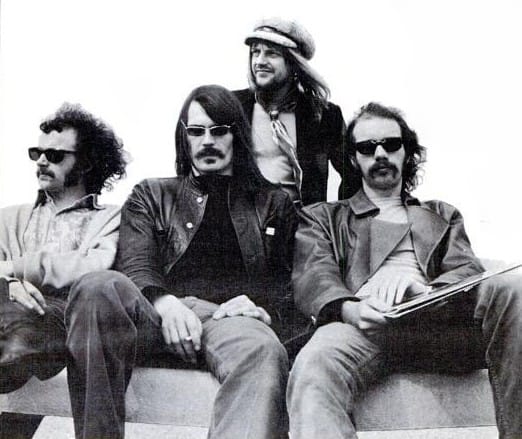

Soft Machine
View on Wikipedia
Soft Machine are an English rock band from Canterbury, Kent. The band were formed in 1966 by Mike Ratledge, Robert Wyatt, Kevin Ayers, Daevid Allen and Larry Nowlin. Soft Machine were central in the Canterbury scene; they became one of the first British psychedelic acts, and later helped pioneer progressive[1][2] and jazz rock. Soft Machine's lineup has undergone many changes, and has included Andy Summers, Hugh Hopper, Elton Dean,[3] John Marshall, Karl Jenkins, Roy Babbington and Allan Holdsworth. As of 2025[update], the current lineup consists of John Etheridge, Theo Travis, Fred Thelonious Baker and Asaf Sirkis. The band's name originates from William S. Burroughs's novel The Soft Machine.
Key Information


The band originated with its predecessor, The Wilde Flowers. After forming, Soft Machine originally dabbled with psychedelic pop, releasing their debut studio album, The Soft Machine, in 1968, alongside the single "Joy of a Toy". The band's progressive roots stemmed from their second studio album, Volume Two (1969). The band fully established their signature sound with the album's Third (1970) and Fourth (1971). By 1971, Soft Machine became a purely instrumental band.[4] This transition was followed by the 1972 album Fifth, and the 1973 albums Six and Seven. In 1975, the band released their eight studio album, Bundles, followed by their then-final studio album, Softs (1976). In 1978, the group broke up.
In 1980, the band briefly reunited and released their tenth studio album, Land of Cockayne, in 1981. After breaking up again, and briefly reuniting in 1984, the group Soft Machine Legacy was formed in 2004, and released three studio albums, including their self-titled debut (2006), Steam (2007), and Burden of Proof (2013). The "Legacy" suffix was dropped in 2015, and they released two studio albums, Hidden Details (2018) and Other Doors (2023). Though they have achieved little commercial success, critics consider Soft Machine to have been influential in rock music.[5][6][7] Dave Lynch at AllMusic called them "one of the most influential underground bands of their era".[8]
History
[edit]Original run (1966–78)
[edit]Early releases and The Soft Machine (1966–1968)
[edit]In mid-1966, Mike Ratledge (keyboards), Robert Wyatt (drums, vocals), Kevin Ayers (bass, vocals), Daevid Allen (guitar) and Larry Nowlin (guitar) formed Soft Machine, who were billed as The Soft Machine up to 1969 or 1970.[9] Allen and Wyatt first played together in 1963 as part of the Daevid Allen Trio, and were occasionally accompanied by Ratledge. In 1964, Wyatt and Ayers were founder members of The Wilde Flowers; by 1966, they had both left that band and rejoined Allen to form the short-lived band Mister Head, which also included Nowlin.[10] The four members soon joined with Ratledge to form the Soft Machine.[11] Ayers suggested the band's name, which comes from William S. Burroughs's novel The Soft Machine (1961).[12] The band became a quartet when Nowlin departed in September 1966.[13]
During late 1966 and early 1967, the Soft Machine became involved in the early UK underground scene. Along with Pink Floyd, they became one of the major resident bands at the UFO Club, and played other London clubs like the Speakeasy and Middle Earth. According to Wyatt, the Soft Machine received negative reactions when playing at venues other than these underground clubs; this led to their penchant for long tracks and segued tunes because continuously playing deprived their audiences chances to boo them.[14] In February 1967, the band released their first single "Love Makes Sweet Music" on Polydor Records.[14]
In April 1967, the Soft Machine recorded nine demo songs with producer Giorgio Gomelsky in De Lane Lea Studios; due to a dispute over studio costs, these tracks were unreleased for several years.[15] Polydor later released these demos in 1972 as Jet Propelled Photographs.[16] Later in 1967, the band began touring in mainland Europe, becoming especially popular in France.[17] When returning from a tour of France in August, Allen, an Australian, was denied re-entry to the UK,[14] so the group continued as a trio while Allen returned to Paris to form Gong.[18]
The Soft Machine, who shared the same management as the Jimi Hendrix Experience, supported them on two North American tours during 1968.[19] The band signed to Probe Records and recorded their eponymous first album in New York City in April at the end of the first tour, though it was not released until December. In London, guitarist Andy Summers, later of the Police, joined the Soft Machine. The band's new line-up began a US tour with some headlining shows before supporting Hendrix in August and September 1968. By the time the Hendrix tour began, Summers had been fired at Ayers' insistence.[20] Ayers himself departed amicably after the final tour date at the Hollywood Bowl in September, and the Soft Machine disbanded. Wyatt stayed in the US to record solo demos while Ratledge returned to London and began composing.[21]
Transition into jazz; Volume Two, Third, and Fourth (1969–1971)
[edit]In December 1968, to fulfil contractual obligations, Wyatt and Ratledge re-formed the Soft Machine with their former road manager Hugh Hopper replacing Ayers on bass. Hopper, like Ayers and Wyatt, was a founding member of The Wilde Flowers. In 1969, the Soft Machine recorded their second album Volume Two, which started a change to jazz fusion. The album fulfilled the band's contract with Probe and they signed with CBS Records by the beginning of 1970. In May 1969, the Soft Machine played as the uncredited backing band on two tracks of The Madcap Laughs, the debut solo album of Pink Floyd's Syd Barrett. Shortly after the Barrett recording, Hopper's brother Brian Hopper, another Wilde Flowers co-founder, joined the Soft Machine on saxophone. Around this time, the band recorded the soundtrack for a multimedia show called Spaced, which ran in London for five days in mid 1969. The soundtrack was commercially released in 1996 by Cuneiform Records. In October 1969, following Brian Hopper's departure, the Soft Machine expanded to a septet; Wyatt, Ratledge and Hugh Hopper added a four-piece horn section composed of the saxophonists Elton Dean and Lyn Dobson, cornet player Mark Charig and trombonist Nick Evans. After two months, Charig and Evans departed the band.[22]
The quintet continued until March 1970, when Dobson departed. The remaining quartet recorded the double album Third (1970) and its single-album follow-up Fourth (1971). Third was mostly instrumental save for Wyatt's song "Moon in June", the last Soft Machine song to have lyrics. Third is unusual for its time in having each of the four sides feature one suite.[3] Third has since become Soft Machine's biggest-selling album. From Fourth onwards, the band became completely instrumental on record, and then on stage following Wyatt's departure soon after the album's release. During this period, the band received unprecedented acclaim across Europe, and they became the first rock band to be invited to play in August 1970 at London's Proms concert, and the show was broadcast live on UK national television.[23]
Fifth to Softs and breakup (1972–1978)
[edit]
After differences over the group's musical direction, Wyatt was fired[24] in August 1971 and formed Matching Mole (a pun on "machine molle", French for "soft machine"; also said at the time to have been taken from stage lighting equipment "Matching Mole").[3] He was briefly replaced by Australian drummer Phil Howard. This line-up toured extensively in Europe during late 1971 and began the recording of their next album Fifth, but further musical disagreements led to Howard's dismissal at the beginning of 1972, with the album being completed with his replacement, John Marshall. Fifth was released in 1972, with side one comprising tracks recorded with Howard and side two comprising tracks recorded with Marshall. Later that year, Dean left the band[3] and was replaced by Karl Jenkins, who also played keyboards in addition to saxophone. Both Marshall and Jenkins were former members of Ian Carr's Nucleus. The band's next album was a half-live half-studio double album Six, released in early 1973.
After the release of Six, Hopper left the band[3] and was replaced by Roy Babbington, another former Nucleus member. During this period, Jenkins began to take over as bandleader and main composer. After they released Seven in late 1973, Soft Machine again switched record labels from CBS to Harvest Records, a sub-label of EMI Records. At the end of 1973, another former Nucleus member Allan Holdsworth was added to the band, becoming their first guitarist since Andy Summers' brief tenure in 1968. Holdsworth played on the next album Bundles (1975) before leaving in early 1975. Holdsworth's replacement was John Etheridge, and the saxophonist Alan Wakeman, a cousin of Yes keyboardist Rick Wakeman, also joined at the beginning of 1976.[3] The next album, Softs (1976), was the first without Ratledge, the last-remaining original member of the band, who left in March 1976. Other members of Soft Machine during the late 1970s were the saxophonist Ray Warleigh, the violinist Ric Sanders, and the bassists Percy Jones of Brand X and Steve Cook.[25] During 1977, Soft Machine recorded the live album Alive & Well: Recorded in Paris, which was released early the following year. In 1978, Soft Machine gave only one live performance, which was at the Sound & Musik Festival in Dortmund, West Germany, on 8 December, with a line-up of Marshall, Jenkins, Cook and Holdsworth.[26][27] After this show, Soft Machine disbanded.
Occasional reunions (1980–81; 1984)
[edit]The name Soft Machine was resurrected for the 1981 album Land of Cockayne. Soft Machine also briefly reformed for a series of concerts at London's Ronnie Scott's Jazz Club in mid 1984[f] that featured John Marshall, Karl Jenkins, Ray Warleigh, John Etheridge, bassist Paul Carmichael and pianist Dave MacRae.
Alternative bands (1978–2015)
[edit]Soft Heap / Soft Head (1978–88)
[edit]Soft Heap was formed in January 1978 by Hugh Hopper and Elton Dean from Soft Machine, and Alan Gowen and Pip Pyle from National Health. Heap is an acronym that is composed of the initials of the members' first names. The band toured in the early-to-mid 1978 as Soft Head because Dave Sheen replaced Pip Pyle due to Pyle's commitments to National Health.[28] The live album Rogue Element was recorded on that tour and was released in 1978.
The original Soft Heap line-up reformed in October 1978 to record their eponymous studio album, which was released in 1979.[citation needed] After two line-up changes from 1979 to 1981, the new line-up intermittently toured throughout the 1980s; they performed four tours during the decade in 25 European concerts, culminating on 11 May 1988 at the festival "Jazz sous les pommiers" in Coutances, France.[28]
Soft Ware (1999), Soft Works (2002–04), Soft Mountain (2003) and Soft Bounds (2004)
[edit]Soft Ware (sometimes SoftWhere), which was formed in September 1999, was composed of Elton Dean, Hugh Hopper, John Marshall on drums and Marshall's long-time friend Keith Tippett. This short-lived line-up played one performance at (Augustusburg Hunting Lodge, Germany, on 4 September 1999. In 2002, with Tippett unavailable, another former Soft Machine member Allan Holdsworth (on guitar) joined the other three members of Soft Ware, who in June 2002 renamed themselves Soft Works[26] to avoid confusion with Peter Mergener's band Software. Soft Works made their live debut on 17 August 2002 at the Progman Cometh Festival at Moore Theater in Seattle, Washington; and a live album of the performance was released on 29 July 2003.[29] Their only studio album Abracadabra, consisting of new material and recorded at Eastcote Studios, London, on 5–7 June 2002. The album was toured in Japan in August 2003, Italy in January and February 2004, and Mexico in March 2004.[26]
During a Japanese Soft Works tour in August 2003, Elton Dean on saxophone and Hugh Hopper on bass formed the band Soft Mountain along with Japanese musicians Hoppy Kamiyama on keyboards, whom Hopper had met two years earlier, and Yoshida Tatsuya from the band Ruins on drums. Soft Mountain named themselves after Hoppy Kamiyama, whose name translates as "God Mountain".[30] Looking for a break from relatively fixed set lists and song forms, Hugh Hopper had contacted Kamiyama with the idea of using a studio for one day to see what might happen. Kamiyama brought in Tatsuya, and, with no discussion, the quartet played two 45-minute improvisations. In 2007, a year after Elton Dean died aged 60, Soft Mountain released the eponymous album they had recorded on 10 August 2003 in Tokyo, Japan.[30] The two-part "Soft Mountain Suite" extracts the best thirty minutes from each improvisation.[31]
In June 2004, Elton Dean and Hugh Hopper formed the band Soft Bounds with Sophia Domancich on keyboards and Simon Goubert on drums); they played at the Festival "Les Tritonales" in Les Lilas, Paris, France.[28] This concert was partially released in 2005 as the Soft Bounds' album Live at Le Triton.
Soft Machine Legacy (2004–15)
[edit]In October 2004, the members of Soft Works, with John Etheridge permanently replacing Holdsworth, took the name "Soft Machine Legacy" and performed two festival shows; one on 9 October in Turkey and the other on 15 October in the Czech Republic. Liam Genockey temporarily replaced John Marshall who had ligament problems. The new band's line-up was Elton Dean, John Etheridge, Hugh Hopper and Liam Genockey.[26] Soft Machine Legacy released three albums: Live in Zaandam (2005),[32] the studio album Soft Machine Legacy (2006),[32] which was recorded in September 2005 and features fresh material, and Live at the New Morning (2006).[33] After Elton Dean died in February 2006, the band continued with the British saxophonist and flautist Theo Travis, formerly of Gong and The Tangent.
In December 2006, the new Legacy line-up recorded the album Steam[34][35][36] in Jon Hiseman's studio. Steam was released in August 2007 by Moonjune Records before a European tour. Hopper left the band in 2008 because he was suffering from leukaemia, so for live performances Fred Thelonious Baker deputising for Hopper. Following Hopper's death in 2009, the band announced they would continue with Roy Babbington again replacing Hopper on bass.[37]
Soft Machine Legacy released their fifth album in October 2010; the 58-minute record Live Adventures was recorded live in October 2009 in Austria and Germany during a European tour.[38] Founding Soft Machine bassist Kevin Ayers died in February 2013 at aged 68,[39][40] and 77-year-old Daevid Allen died in March 2015 following a short battle with cancer.[41][42] On 18 March 2013, the Legacy band released a new studio album titled Burden of Proof.[43] Travis stated: "legally we could actually be called Soft Machine but for various reasons it was decided to be one step removed".[44]
A return to the name "Soft Machine" (2015–present)
[edit]Reformation and Hidden Details (2015–2018)
[edit]In September and October 2015, it was announced Soft Machine Legacy, which was composed of drummer John Marshall, guitarist John Etheridge, bassist Roy Babbington, and sax, flute and keyboard player Theo Travis, would be performing under the name Soft Machine in late 2015 and early 2016: they would perform two shows in the Netherlands and Belgium in early December 2015,[45][g] and seven UK shows in March and April 2016.[45][47][h] In December 2015, it was confirmed the band were dropping the word "Legacy" from their name, becoming known as Soft Machine for the first time since 1984.[47]
The former Soft Machine member Allan Holdsworth, aged 70, died from heart failure on 15 April 2017 at his home in Vista, California.[50][51][52] On 7 September 2018, Soft Machine released Hidden Details on Dyad Records in the UK and Tonefloat Records in the US, their first new studio album since Land of Cockayne (1981). In late 2018 and until February 2019, they toured the world to mark their 50th anniversary and to support the new album.[i]
Further tours and Other Doors (2019–present)
[edit]On 20 March 2020, Soft Machine released Live at The Baked Potato, their first original live album since Alive & Well (1978). It was recorded live on 1 February 2019 at The Baked Potato, Los Angeles, and was initially only available as a twelve-track limited-edition double vinyl LP of 200 copies but it has since been released on Compact Disc (CD). The album documents their extensive 2018–2019 world tour.[55][56] On 7 December 2021, Soft Machine announced Babbington was retiring from the band and would be replaced by Fred Thelonious Baker.[57]
In June 2023, Soft Machine released the new studio album Other Doors, which was recorded with John Marshall before he retired from music. Marshall died on 16 September 2023.[58] As of January 2023[update], the line-up of Soft Machine was Etheridge, Travis, Baker and drummer Asaf Sirkis.[59][60] They embarked on a seven-date UK tour beginning on 3 February 2023 at the New Cross Inn in London and ending on 26 May 2023 at City Varieties in Leeds.[j] The band began touring again in November 2023 with dates booked until November 2024.[61]
Co-founding member Mike Ratledge died on 5 February 2025. On 4 March 2025 in Manchester (at Band On The Wall), the band embarked on an 8-date UK Spring tour which concluded on 4 April in London (at The Vortex Jazz Club), celebrating on that occasion John Etheridge's 50 years with the band (since 12 April 1975).[61] Soft Machine toured Europe from 9 May in London (at Signature Brew) to 25 May 2025 in Zoetermeer, The Netherlands (at De Boerderij): the 10-date Spring tour also included Sweden (four dates), Norway (one date), Finland (two dates) and Germany (one date). Ater a special show dedicated to Mike Ratledge on 1 September 2025 in London (at the Pizza Express jazz club), Soft Machine are due to embark on 2 November 2025 in Cardiff (at Acapela Studio) on an 8-date UK Fall tour which should conclude on 30 November 2025 in Southampton (at 1865) (with Colosseum), also visiting Market Harborough, Barnard Castle, Hull, Bristol and London again (2 dates at Sound Lounge and at Cadogan Hall (again with Colosseum)). A show on 9 April 2026 in Kinross (at Backstage at the Green) is already scheduled too.[62]
Musical style
[edit]Soft Machine's music encompasses progressive rock,[63][64][65] experimental rock,[66][67] jazz rock,[68][69] jazz,[8][70] proto-prog,[71] psychedelic rock[40] and art rock.[72] The band are part of the Canterbury scene of progressive rock.[8][65] According to Hugh Hopper: "We weren't consciously playing jazz rock, it was more a case of not wanting to sound like other bands; we certainly didn't want a guitarist".[73]
Members
[edit]Current
[edit]- John Etheridge – guitar (1975–1978, 1984, 2015–present)
- Theo Travis – saxophones, flutes, keyboards, piano (2015–present)
- Fred Thelonious Baker – bass (2020–present)
- Asaf Sirkis – drums (2022–present)[59][60]
Former
[edit]- Mike Ratledge – keyboards, piano, organ, synthesizers, flute (1966–1976; died 2025)
- Robert Wyatt – drums, percussion, keyboards, lead and backing vocals (1966–1971)
- Kevin Ayers – bass, guitar, backing and lead vocals (1966–1968; died 2013)
- Daevid Allen – guitar, bass, backing vocals (1966–1967; died 2015)
- Larry Nowlin – guitar, backing vocals (1966)
- Andy Summers – guitar (1968)
- Hugh Hopper – bass, guitar, alto saxophone (1968–1973; died 2009)
- Brian Hopper – tenor and soprano saxophones (1969)
- Elton Dean – alto saxophone, saxello, flute, keyboards (1969–1972; died 2006)
- Lyn Dobson – tenor and soprano saxophones, flute, backing vocals (1969–1970)
- Mark Charig – cornet, trumpet (1969)
- Nick Evans – trombone (1969)
- Phil Howard – drums (1971–1972)
- John Marshall – drums, percussion (1972–1978, 1980–1981, 1984, 2015–2022; died 2023)[59][60]
- Karl Jenkins – baritone and soprano saxophones, recorder, flute, oboe, keyboards, piano, synthesizers (1972–1978, 1980–1981, 1984)
- Roy Babbington – bass (1973–1976, 2015–2020)
- Allan Holdsworth – guitars, violin, voices (1973–1975, 1978, 1980–1981; substitute for Etheridge at one show in 1977; died 2017)[74][75]
- Alan Wakeman – tenor and soprano saxophones (1976)
- Ray Warleigh – alto saxophone, flute (1976, 1980–1981, 1984; died 2015)
- Ric Sanders – violin, keyboards[76] (1976–1978)
- Percy Jones – bass (1976)
- Steve Cook – bass (1976–1978)
- Jack Bruce – bass (1980–1981; died 2014)
- Stu Calver – vocals (1980–1981; died 2000)
- Dick Morrissey – tenor saxophone (1980–1981; died 2000)
- John Perry – vocals (1980–1981)
- Tony Rivers – vocals (1980–1981)
- Alan Parker – guitar (1980–1981)
- John Taylor – piano (1980–1981; died 2015)
- Paul Carmichael – bass (1984)
- Dave MacRae – keyboards, piano (1984)
Discography
[edit]Studio albums
[edit]- The Soft Machine (1968)
- Volume Two (1969)
- Third (1970)
- Fourth (1971)
- Fifth (1972)
- Six (1973)
- Seven (1973)
- Bundles (1975)
- Softs (1976)
- Land of Cockayne (1981)
- Hidden Details (2018)[77][78][79]
- Other Doors (2023)
Soft Machine Legacy studio albums
[edit]- Soft Machine Legacy (2006)
- Steam (2007)
- Burden of Proof (2013)
Soft Works studio albums
[edit]- Abracadabra (2003)
Filmography
[edit]- Soft Machine Legacy: New Morning – The Paris Concert, available in DVD format (2006)
- Alive in Paris 1970, available in DVD format (2008)
- Romantic Warriors III: Canterbury Tales, available in DVD format (2015)
Notes
[edit]- ^ 1999–2002
- ^ 2002–2004
- ^ 2003
- ^ 2004
- ^ 2004–2015
- ^ A week of gigs from 30 July to 4 August 1984.[26]
- ^ On 2 December 2015 at Cultuurpodium Boerderij in Zoetermeer, Netherlands[46] and on 4 December 2015 at N9 Villa in Eeklo, Belgium.[45]
- ^ On 18 March 2016[48] as part of the HRH Prog 4 Festival (scheduled from 17 to 20 March) at Camp HRH (Hafan y Môr Holiday Park), Pwllheli, North Wales, UK,[49] on 19 March at the Brewery Arts Centre, Kendal, UK, on 20 March at the Bristol Jazz Festival, Bristol, UK (once scheduled then cancelled and rescheduled for 16 November 2016 at The Robin 2, Wolverhampton, UK), on 24 March 2016 at the Talking Heads in Southampton, UK, on 26 March 2016 at Trading Boundaries, Sheffield Green, East Sussex, UK, on 30 March at the Assembly Rooms, Leamington Spa, UK, on 31 March 2016 at the Band on the Wall in Manchester, UK, on 1 April 2016 at Nell's Jazz & Blues Club in London, UK.[45]
- ^ Soft Machine embarked on 6 September 2018 in Oslo, Norway on a world tour starting with a 10-date Europe leg (ended on 19 September 2018 in Jena, Germany); followed on 6 October in Baltimore by a 12-date North American leg – their first North American tour since 1974 (ended on 23 October in Saint Paul, Minnesota); followed on 3 November in Canterbury by an 11-date second European leg (ended on 16 December 2018 in Bonn, Germany); and embarked on 21 January 2019 on a 14-date second North American leg (ended by a 5-date residency from 4 to 8 February 2019 at Key West, Florida through Cozumel, Mexico at the Cruise to the Edge festival).[53][54]
- ^ On 3 February 2023 at the New Cross Inn (a pub in New Cross) in London; 8 February at the Tivoli Theatre, Wimborne; 9 February at The Pavilion, Falmouth; 15 February at Band on the Wall in Manchester; 16 February at Backstage at The Green Hotel in Kinross; 17 February at Zeffirellis in Ambleside; 26 May 2023 at City Varieties Music Hall in Leeds
References
[edit]- ^ Breznikar, Klemen (20 March 2019). "Soft Machine interview". It's Psychedelic Baby Magazine. Retrieved 1 August 2025.
- ^ Zimmerman, Lee (24 December 2018). "The Soft Machine Turns On". Rock and Roll Globe. Retrieved 1 August 2025.
- ^ a b c d e f Sutcliffe, Phil (5 March 1991). "Where are they Now? Soft Machine". Q Magazine. 55: 33.
- ^ Lynch, Dave. "Soft Machine". AllMusic. Retrieved 26 August 2018.
- ^ Jones, Mikey IQ (24 March 2015). "A beginner's guide to Daevid Allen". FACT. Retrieved 26 August 2018.
- ^ Keepnews, Peter (16 March 2015). "Daevid Allen, Guitarist and Singer in Progressive Rock, Dies at 77". The New York Times. Retrieved 26 August 2018.
- ^ Lynch, Joe (13 March 2015). "Soft Machine & Gong Co-Founder Daevid Allen Dead at 77". Billboard. Retrieved 26 August 2018.
- ^ a b c Lynch, Dave. "Soft Machine". AllMusic. Retrieved 26 August 2018.
- ^ "Prom 26, Thursday 13 August at 10". BBC Proms Prospectus. 1970.
- ^ Bennett, Graham (2014). Soft Machine: Out-Bloody-Rageous. Syzygy. pp. 62–63. ISBN 9-7-8-90-822792-0-7.
- ^ Bennett, Graham (2014). Soft Machine: Out-Bloody-Rageous. Syzygy. p. 70. ISBN 9-7-8-90-822792-0-7.
- ^ Bennett, Graham (2014). Soft Machine: Out-Bloody-Rageous. Syzygy. p. 70. ISBN 9-7-8-90-822792-0-7.
- ^ Bennett, Graham (2014). Soft Machine: Out-Bloody-Rageous. Syzygy. p. 80. ISBN 9-7-8-90-822792-0-7.
- ^ a b c Stump, Paul (1997). The Music's All that Matters: A History of Progressive Rock. Quartet Books Limited. pp. 27–28. ISBN 0-7043-8036-6.
- ^ Jet Propelled Photographs liner notes
- ^ Hoffmann, Frank (12 November 2004). "Soft Machine". Encyclopedia of Recorded Sound. Routledge. ISBN 978-1-135-94949-5.
- ^ "Soft Machine-Chronology (1)". Calyx-canterbury.fr.
- ^ Allen, Daevid. Gong Dreaming 1. SAF Publishing, 2007, p.76.
- ^ "Soft Machine-Chronology". Canterbury Music website. Retrieved 12 August 2013.
- ^ Andy Summers (2006). One Train Later. Thomas Dunne Books. ISBN 0-312-35914-4.
- ^ "The Soft Machine years with Robert Wyatt singing & drumming (1967–1969)". Hulloder, The Netherlands. Archived from the original on 24 September 2015. Retrieved 20 March 2016.
- ^ "NDR Jazz workshop – Hamburg, Germany 1973 CD + DVD" (PDF). Archived from the original (PDF) on 19 September 2010.
- ^ "Cosmik Debris Magazine Presents: The 21st Century Be-Bop Of Soft Works; an interview of Hugh Hopper – May 2003". Cosmik.com. Archived from the original on 4 May 2013. Retrieved 12 August 2013.
- ^ Unterberger, Richie: 1996 Robert Wyatt interview Archived 29 April 2006 at the Wayback Machine at Perfect Sound Forever Archived 23 July 2008 at the Wayback Machine (online music magazine)
- ^ "Steve Cook". The Canterbury Music website. 4 August 1948. Retrieved 12 August 2013.
- ^ a b c d e "Chronology 1973–". Canterbury Music website. Retrieved 20 March 2016.
- ^ Bennett, Graham (2014). Soft Machine: Out-Bloody-Rageous. Syzygy. p. 344. ISBN 9-7-8-90-822792-0-7.
- ^ a b c "Elton Dean chronology (Soft Head / Soft Heap concerts)". calyx-canterbury.fr. Retrieved 26 March 2020.
- ^ "Soft Works – Abracadabra (review by Glenn Astarita)". AllMusic. Retrieved 15 August 2015.
- ^ a b "cdsales84". Huxrecords.com. 26 March 2020. Retrieved 26 March 2020.
- ^ "Soft Mountain: Soft Mountain (by John Kelman – February 6, 2007)". Allaboutjazz.com. 26 March 2020. Retrieved 26 March 2020.
- ^ a b "Live in Zaandam – Soft Machine Legacy | Songs, Reviews, Credits, Awards". AllMusic. 10 May 2005. Retrieved 12 August 2013.
- ^ "Live at the New Morning". AllMusic. 1 July 2006. Retrieved 12 August 2013.
- ^ Lynch, Dave. "Steam – Soft Machine Legacy | Songs, Reviews, Credits, Awards". AllMusic. Retrieved 12 August 2013.
- ^ "Soft Machine Legacy: Steam". AllAboutJazz.com. 12 August 2007. Retrieved 12 August 2013.
- ^ "Soft Machine Legacy: Steam". AllAboutJazz.com. 19 August 2007. Retrieved 12 August 2013.
- ^ "Soft Machine Legacy". John Etheridge. Archived from the original on 15 April 2009. Retrieved 12 August 2013.
- ^ "Soft Machine Legacy – Live Adventures (AllMusic Review by Alex Henderson)". All Music. Retrieved 30 October 2015.
- ^ "Kevin Ayers Has Died | News | Clash Magazine". Clashmusic.com. 20 February 2013. Retrieved 12 August 2013.
- ^ a b "R.I.P. Daevid Allen, founder of Gong and Soft Machine, has died" by Ben Kaye, Consequence of Sound, 13 March 2015
- ^ "Gong founder Daevid Allen has died, aged 77", The Guardian, 13 March 2015
- ^ "R.I.P. Daevid Allen Of Soft Machine and Gong 1938–2015" by Paul Cashmere, Noise 11, 13 March 2015
- ^ "New Soft Machine Legacy album out now". Weirdomusic.com. 27 February 2013. Retrieved 20 March 2016.
- ^ "Soft Machine Legacy" in Cherry Red Records My Favourite Flavour magazine; issue #28; June 2013; p. 11
- ^ a b c d "Soft Machine – 2015–2016 tour dates: 4 concerts". songkick. 2015. Retrieved 6 October 2015.
- ^ "Soft Machine – Tour Dates 2015–2016". bandsintown.com. 2015. Retrieved 6 October 2015.
- ^ a b "Soft Machine line up 8 UK dates for 2016 – Tour takes in HRH Prog 4 plus 7 shows in England (by Stef Lach)". teamrock.com. 1 December 2015. Retrieved 28 March 2016.
- ^ "HRH Prog 4 Festival 2016 2016 (Line-up: Friday Line-Up". hrhprog.com. 2015. Archived from the original on 6 September 2015. Retrieved 7 September 2015.
- ^ "HRH Prog 4 Festival 2016 2016 (Line-up: Soft Machine, Caravan, The Crazy World of Arthur Brown, Curved Air...)". songkick.com. 2015. Retrieved 5 September 2015.
- ^ Varga, George (16 April 2017). "Allan Holdsworth, internationally celebrated guitar innovator, dead at 70". The San Diego Union-Tribune. Tronc. Retrieved 13 May 2017.
- ^ Molenda, Michael (29 June 2017). "The Magnificent Architect of Improvisation: A Tribute to Allan Holdworth". Guitar Player. Retrieved 11 July 2017.
- ^ "Virtuosos: Allan Holdsworth". Aminoapps.com.
- ^ "Theo Travis / Soft Machine Gigs / Upcoming Events". theotravis.com. October 2018. Archived from the original on 10 January 2019. Retrieved 14 January 2019.
- ^ "John Etheridge / Events". john-etheridge.com. October 2018. Retrieved 14 January 2019.
- ^ "Soft Machine Live at The Baked Potato 2LP". tonefloat.com. 3 February 2020. Retrieved 7 April 2020.
- ^ "Soft Machine release "Live at The Baked Potato"". Theotravis.com. 13 February 2020. Archived from the original on 7 April 2020. Retrieved 7 April 2020.
- ^ "Roy Babbington retires from Soft Machine". London Jazz News. 7 December 2021. Retrieved 8 December 2021.
- ^ Travis, Theo (17 September 2023). "John Marshall (1941–2023). A tribute by Theo Travis". London Jazz News. Retrieved 17 September 2023.
- ^ a b c "Prog legends Soft Machine announce short run of February UK dates where they will introduce new drummer @asafsirkis, who replaces the now-retired John Marshall..." Mobile.twitter.com. 8 January 2023. Retrieved 10 January 2023.
- ^ a b c "Soft Machine to introduce new drummer on UK live dates". Jazzmusicarchives.com. 9 January 2023. Retrieved 10 January 2023.
- ^ a b "Past Gigs". softmachine.org. 2 May 2025. Retrieved 2 May 2025.
- ^ "Upcoming Events". Softmachine.org. 22 August 2025. Retrieved 22 August 2025.
- ^ Macan, Edward. Rocking the Classics: English Progressive Rock and the Counterculture; Oxford University Press; 1 edition 9 January 1997; ISBN 978-0195098884
- ^ Holm-Hudson, Kevin (editor).Progressive Rock Reconsidered ; Routledge; 21 October 2001; ISBN 978-0815337157
- ^ a b "A guide to the best (and a bit of the worst) of prog rock" by Jason Heller, The A.V. Club, 7 June 2012
- ^ Hegarty, Paul. Beyond and Before: Progressive Rock since the 1960s; Bloomsbury Academic; 23 June 2011; ISBN 978-0826423320; p.105
- ^ Blake, Andrew. The Land Without Music: Music, culture and society in twentieth-century Britain; Manchester University Press, 15 February 1998; ISBN 978-0719042997; p.151
- ^ "Jazz » Fusion » Jazz-Rock", AllMusic
- ^ Rupprecht, Philip. British Musical Modernism: The Manchester Group and their Contemporaries; Cambridge University Press; 18 August 2015; ISBN 978-0521844482; p.425
- ^ "Gong, Soft Machine Founder Daevid Allen Dead at 77" byDaniel Kreps, Rolling Stone, 13 March 2015
- ^ Greene, Doyle (2016). Rock, Counterculture and the Avant-Garde, 1966–1970: How the Beatles, Frank Zappa and the Velvet Underground Defined an Era. McFarland. p. 182. ISBN 978-1-4766-2403-7.
- ^ Dougan, John. "Robert Wyatt | Biography & History". AllMusic. Retrieved 6 January 2020.
- ^ Irvin, Jim. The MOJO Collection: The Ultimate Music Companion; Canongate Books Ltd; 4th edition: 1 November 2007; ISBN 978-1841959733; p.208
- ^ "Soft Machine-Chronology (2)". Calyx-canterbury.fr.
- ^ "John Etheridge Interview". YouTube. 20 August 2023.
- ^ "Soft Machine- Newcastle England 1976". YouTube. 21 November 2015.
- ^ Joe Banks (September 2018). "Soft Machine – Hidden Details (review)". Shindig!.
- ^ Brian Morton (October 2018). "Soft Machine – Hidden Details (review)". The Wire.
- ^ "Soft Machine – Hidden Details (info and reviews)". Prog Archives. Retrieved 16 December 2018.
Further reading
[edit]- Bennett, Graham. Soft Machine: Out-Bloody-Rageous; London: SAF Publishing; 2005; ISBN 0-946719-84-5; Revised and updated edition: 2014; ISBN 978-90-822792-0-7
External links
[edit]- Official Website
- Soft Machine section at the Canterbury Music website
- Une discographie de Robert Wyatt (in French)
- Soft Machine discography (archived 2007)
- Soft Machine at IMDb
- Soft Machine discography at Discogs
| International | |
|---|---|
| National | |
| Artists | |
| Other | |

Soft Machine
View on GrokipediaHistory
Formation and psychedelic origins (1966–1969)
The Soft Machine were formed in mid-1966 in Canterbury, United Kingdom, by drummer and vocalist Robert Wyatt, bassist and vocalist Kevin Ayers, guitarist Daevid Allen, and keyboardist Mike Ratledge.[8][9] The band took their name from William S. Burroughs' 1961 novel The Soft Machine, part of his Nova Trilogy that extends themes from Naked Lunch.[10] Emerging from the local music scene connected to the Wilde Flowers, the group quickly immersed themselves in the burgeoning UK underground, performing initial gigs in London—such as supporting Pink Floyd at All Saints Hall in October 1966—and later in Paris during a European tour in 1967.[11][12] Their debut single, "Love Makes Sweet Music" backed with "Feelin' Reelin' Squealin'," was released in February 1967 on Polydor Records, capturing a playful psychedelic pop sound with R&B undertones reflective of their early influences.[13] This was followed by their self-titled debut album in December 1968 on Probe Records, recorded in New York earlier that year during a US tour supporting Jimi Hendrix; the LP featured short, experimental tracks blending psychedelic rock, pop structures, and improvisational elements, establishing their reputation in the Canterbury scene.[14][12] Key disruptions occurred during 1967 when, after a European tour including French dates, Australian-born Allen faced visa complications upon attempting re-entry to the UK, leading to his temporary departure from the band and relocation to Paris.[15] Ayers also left in late 1968 following the demanding American tours, prompting Hugh Hopper—previously the band's road manager and a Canterbury scene associate—to join as bassist, stabilizing the trio of Wyatt, Ratledge, and Hopper.[16][17] This lineup recorded Volume Two in February and March 1969 at Olympic Studios in London, released in July on Probe Records; the album marked a shift toward more avant-garde experimentation while retaining psychedelic roots, incorporating jazz-inflected improvisation, Dadaist humor, and abstract compositions across its concise tracks.[18][19]Transition to jazz fusion (1970–1971)
In June 1970, Soft Machine released Third, a double album that represented a pivotal shift from their psychedelic origins toward extended jazz-rock compositions, blending studio recordings with live performances captured in Croydon and Birmingham.[20] The album featured the core quartet of drummer and vocalist Robert Wyatt, keyboardist Mike Ratledge, bassist Hugh Hopper, and saxophonist Elton Dean, who had joined as a full member earlier that year after initial collaborations in the band's short-lived septet phase; trombonist Nick Evans also contributed to select tracks, enhancing the horn sections.[8][20] Wyatt's influence remained prominent on Third, particularly in the track "Moon in June," where he handled vocals, composition, and much of the instrumentation in a sprawling, personal suite that highlighted his scat singing and songwriting amid the band's increasingly instrumental focus—this would mark one of the final vocal-led pieces in Soft Machine's catalog.[20] However, internal tensions escalated as Wyatt's preference for song-oriented material clashed with Ratledge and Dean's push toward complex, free-form jazz structures.[8][21] The transition solidified with the release of Fourth in February 1971, Soft Machine's first entirely instrumental album, which delved deeply into jazz fusion through intricate arrangements, improvisational solos—especially from Dean's alto saxophone—and Ratledge's swirling organ work, all anchored by Wyatt's dynamic drumming.[20][21] Wyatt's frustration with the band's direction culminated in his departure in August 1971, reportedly following disagreements during and after a US tour, paving the way for his solo career and the formation of Matching Mole.[8][21] To fill the drumming role, the band recruited Australian expatriate Phil Howard, whose free-jazz style suited their evolving sound and appeared on early post-Wyatt recordings.[8] Guitarist Andy Summers, fresh from Dantalian's Chariot and later a key member of The Police, briefly joined during this lineup flux in mid-1971, contributing to rehearsals and a second US tour before departing.[8] By this time, Soft Machine had garnered increasing critical praise in jazz and progressive circles for their innovative blend of rock energy and improvisational depth, positioning them as pioneers of the emerging fusion genre.[22][23]Core fusion era and lineup shifts (1972–1978)
In 1972, Soft Machine released Five, their fifth studio album, which solidified their instrumental jazz fusion direction with a core lineup of Mike Ratledge on keyboards, Hugh Hopper on bass, Elton Dean on saxello and alto saxophone, and John Marshall on drums, though Phil Howard played drums on the first half before Marshall's arrival.[24] The album featured complex, riff-based compositions blending electric keyboards, reeds, and rhythmic interplay, marking a departure from earlier Canterbury scene psychedelia toward more structured fusion.[25] Following Five, the band expanded to a quintet for Six in 1973, incorporating Karl Jenkins on oboe, baritone and soprano saxophones, and piano, who contributed to the album's live and studio tracks emphasizing improvisational energy and layered textures.[26] Roy Babbington joined on electric bass for portions of Six, providing a more groove-oriented foundation that foreshadowed his full-time role, while Marshall's drumming added propulsion to the ensemble's evolving sound.[27] After Six, significant lineup shifts occurred: Elton Dean departed in mid-1973, replaced by Jenkins as the primary wind player, and Hopper left shortly thereafter, with Babbington assuming full bass duties for the remainder of the classic era.[8] This reconfiguration centered Seven (1973), a studio album of intricate fusion pieces composed largely by Jenkins and Ratledge, highlighting the quartet's—Ratledge, Jenkins, Babbington, and Marshall—tight integration without additional personnel, though subtle brass elements emerged in arrangements like "Nettle Bed."[28] Jenkins increasingly dominated as composer, infusing Nucleus-influenced structures with Soft Machine's improvisational flair, which propelled the band's international touring schedule across Europe and select U.S. dates in 1973–1974.[20] By 1975, the addition of guitarist Allan Holdsworth marked a pivotal evolution for Bundles, Soft Machine's eighth album, introducing electric guitar as a frontline element for the first time and elevating their fusion to a commercial peak, with the record charting in jazz categories in the UK.[29] The expanded sextet—Ratledge, Jenkins, Babbington, Marshall, Holdsworth, and guest brass from Nucleus alumni like Chris Ackman on trumpet—delivered complex, riff-driven tracks such as "Hazard Profile" and "Bundles," blending rock energy with sophisticated orchestration during extensive European tours that year.[30] Holdsworth's fluid, legato style contrasted Jenkins' thematic leadership, though internal tensions over direction began surfacing, exacerbated by Ratledge's growing disillusionment.[31] Lineup instability continued into 1976 with Softs, the ninth album, where Holdsworth was replaced by John Etheridge on guitars, Ratledge departed entirely after the recording—citing creative fatigue and the band's shift toward accessibility—and Alan Wakeman joined on soprano and tenor saxophones, allowing Jenkins to focus exclusively on keyboards and composition.[32] The quintet of Jenkins, Etheridge, Wakeman, Babbington, and Marshall produced brass-augmented fusion with tracks like "Softrak," reflecting peak complexity in arrangements while touring Europe amid Hopper's brief guest appearances on bass for select dates.[33] These changes underscored Jenkins' dominance, as his compositional techniques drove the band's sound toward polished, ensemble-driven jazz-rock.[8] The era culminated in 1978's Alive & Well: Recorded in Paris, a live double album capturing performances from July 1977 at Théâtre Le Palace, featuring the sextet of Jenkins, Etheridge, Wakeman, Babbington, Marshall, and violinist Ric Sanders, with complex brass sections amplifying fusion peaks in extended pieces like "White Pouffe."[34] Despite the recording's vitality, mounting internal conflicts—stemming from frequent personnel turnover, creative divergences, and management pressures—led to the band's disbandment later that year, ending their original run after over a decade of evolution.[8]Disbandment and early reunions (1978–1984)
Following the release of the live album Alive & Well: Recorded in Paris in 1978, Soft Machine disbanded amid financial difficulties stemming from the declining prog rock market and creative differences over the band's direction after years of lineup changes and touring exhaustion.[35] Keyboardist Mike Ratledge, who had already stepped back from performing in 1976, focused on film and television composition, while multi-instrumentalist Karl Jenkins pursued solo and collaborative projects, including classical works.[35] No new studio material was produced during the immediate aftermath, though archival recordings from earlier BBC sessions were later compiled and released as The Peel Sessions in 1990.[36] In 1980, the band briefly revived under Jenkins' leadership for BBC radio sessions, but without the original members. The group did not embark on a formal tour, marking a nod to their legacy amid individual careers. The band reformed in 1981 under Jenkins' leadership, with drummer John Marshall and guest musicians including Allan Holdsworth (guitar) and various session players like Jack Bruce (bass) and Dick Morrissey (saxophone), for the release of the studio album Land of Cockayne and a short European tour.[37] This project blended fusion elements with more commercial jazz arrangements but failed to reignite sustained activity, leading to another hiatus. No verified one-off reunion of original members occurred in 1984, though individual pursuits continued without further band commitments.Spin-off ensembles (1978–2015)
Following the disbandment of Soft Machine in 1978, former members pursued various spin-off projects that echoed the group's jazz fusion and Canterbury scene aesthetics through improvisational structures and ensemble interplay. These ensembles, often featuring overlapping personnel from Soft Machine's classic lineups, maintained the band's experimental spirit without using the original name, evolving the sound through live performances and recordings until the mid-2010s. Key figures like bassist Hugh Hopper and saxophonist Elton Dean were central to many of these groups, bridging the gap between Soft Machine's 1970s peak and later revivals. Soft Heap emerged in 1978 as a quartet comprising saxophonist Elton Dean, bassist Hugh Hopper, keyboardist Alan Gowen, and drummer Pip Pyle, all with ties to Soft Machine and the broader Canterbury scene. The group debuted with the album Soft Heap in 1979 on Charly Records, featuring tracks like "A.W.O.L." that blended jazz-rock improvisation with rhythmic complexity characteristic of Soft Machine's fusion era. A later recording from 1982–1983 sessions was released as A Veritable Centaur in 1995 on Impetus Records, showcasing the band's continued exploration of free-form jazz elements during sporadic activity through the 1980s. The ensemble occasionally varied its lineup, incorporating guitarist Mark Hewins from 1981 onward, and emphasized live collaboration over studio output.[38][39] In the same year, Soft Head served as a short-lived variant of Soft Heap for a summer tour, with Dave Sheen replacing Pyle on drums alongside Dean, Hopper, and Gowen. This configuration captured live performances in France during May 1978, later compiled on the album Rogue Element, released in 1996, which highlighted avant-garde jazz tendencies with extended improvisations such as "Seven Drones." Though presented as Hopper's solo project with Soft Machine influences, it functioned as an ad hoc extension of Soft Heap's personnel and style.[40] Soft Ware formed in 1999, reuniting Dean and Hopper with pianist Keith Tippett and drummer John Marshall, all former Soft Machine affiliates, to revive the group's improvisational jazz-rock approach. The quartet's sole documented output, Scaly Brute Miscellany, emerged in 2002, reflecting conceptual continuity in ensemble dynamics despite limited commercial release. This project transitioned directly into Soft Works in 2002 upon guitarist Allan Holdsworth's addition, replacing Tippett, and the new lineup recorded the live-in-studio album Abracadabra in 2003 on Tone Center, featuring intricate fusion pieces like "Abracadabra Suite" that evoked Soft Machine's 1970s complexity. Soft Works disbanded after a 2004 tour following Dean's health issues.[41][42] Parallel short-lived ensembles included Soft Mountain in 2003, a Dean-Hopper collaboration with French jazz musicians emphasizing atmospheric improvisation, captured on the self-titled album released in 2006 on Hux Records, which drew on Soft Machine's textural bass and reed explorations. Similarly, Soft Bounds in 2004 paired Dean and Hopper with pianist Sophia Domancich and drummer Simon Goubert for a French-UK fusion, documented on the live recording Live at Le Triton 2004 from Musea Records, incorporating material from Soft Machine's Softs era in a contemporary jazz context. These variants underscored the enduring Canterbury connections through transient lineups.[43][44][45] Soft Machine Legacy, established in 2004 from the Soft Works foundation, featured guitarist John Etheridge replacing Holdsworth, alongside Dean, Hopper, and Marshall. Their debut, the live album Live in Zaandam (2005, MoonJune Records), recorded at De Kade in the Netherlands, included reinterpreted Soft Machine staples like "Kings & Queens" amid original compositions. After Dean's death in 2006, saxophonist Theo Travis joined, leading to the studio album Steam (2007, MoonJune Records), which balanced fusion energy with melodic structures on tracks such as "The Nodder." Hopper's passing in 2009 prompted bassist Roy Babbington's return, and the group released Something Special (2010, MoonJune Records), a live set blending archival influences with modern improvisation until adopting the original Soft Machine moniker in 2015. Throughout, Legacy preserved the spin-off tradition of evolving jazz-rock innovation.[46][47]Reformation and modern era (2015–present)
In 2015, Soft Machine officially reformed under the band's original name, dropping the "Legacy" moniker previously used for post-1980s iterations, with a core lineup consisting of guitarist John Etheridge, saxophonist and flautist Theo Travis, bassist Roy Babbington, and drummer John Marshall.[48] This reunion marked a return to the band's jazz fusion roots, emphasizing improvisational structures and complex compositions drawn from their canonical repertoire.[8] The reformed ensemble released their first studio album in nearly four decades, Hidden Details, in 2018, featuring original material that blended Canterbury scene influences with contemporary jazz elements, recorded by the initial quartet. This was followed by Other Doors in 2023, which further explored self-referential themes through intricate ensemble interplay and Etheridge's signature guitar work.[49][50] Live performances during this period highlighted the band's commitment to spontaneous improvisation, often extending classic pieces like "Facelift" into extended fusions of rock, jazz, and avant-garde elements. In 2021, longtime bassist Roy Babbington announced his retirement after over 50 years of involvement with Soft Machine and related projects, citing health reasons while designating jazz veteran Fred Thelonious Baker as his successor; Baker, known for his work with artists like Eric Clapton and his own fusion groups, joined the lineup seamlessly for subsequent tours.[51][52] Drummer John Marshall died on September 16, 2023, at age 82, and was replaced by Asaf Sirkis. The band continued active recording and touring with Etheridge, Travis, Baker, and Sirkis, culminating in the 2025 release of Floating World Live, a remastered archival recording from their 1975 Bremen performance that captured the transitional energy of the era, now enhanced for modern audiences.[53] The year 2025 brought further milestones, including a remastered edition of the 1971 album Drop issued in May, which preserved the raw intensity of the band's early fusion experiments with Mike Ratledge, Elton Dean, Hugh Hopper, and Phil Howard.[54] Soft Machine embarked on an extensive UK and European tour, commencing with a March performance at Manchester's Band on the Wall, followed by dates in Hull, Bristol, and beyond into November, showcasing their evolving improvisational style to enthusiastic audiences.[55] Additionally, the band received a nomination for Best British Prog Band at the HRH Prog Awards in November 2025, recognizing their enduring impact alongside contemporaries like Caravan and Gong.[56] The death of founding keyboardist Mike Ratledge on February 5, 2025, at age 81, prompted widespread tributes from the progressive and jazz communities, honoring his pivotal role in shaping Soft Machine's innovative sound during its formative years.[57] In response, the band dedicated portions of their spring tour performances to Ratledge, integrating his compositional legacy into sets that balanced reverence with forward momentum.[58] Despite these changes, Soft Machine remains a vital force in improvisational jazz fusion, with ongoing European engagements underscoring their adaptability and creative vitality into late 2025.[59]Artistry
Musical style and evolution
Soft Machine's early work in the late 1960s established them as pioneers of the Canterbury scene, blending psychedelic rock with pop structures and close vocal harmonies inspired by the surrealist literary techniques of William S. Burroughs, after whom the band was named with the author's permission. Their debut album, The Soft Machine (1968), featured whimsical, narrative-driven songs like "Hope for Happiness" that incorporated layered instrumentation and dreamlike lyrics evoking Burroughs' cut-up method, creating a sense of disjointed yet melodic psychedelia.[60][3] By 1970, the band underwent a profound evolution toward jazz fusion, marked by extended improvisations, complex odd meters such as 7/8 and 5/4, and intricate ensemble interplay that emphasized rhythmic displacement and collective exploration over song forms. This shift was evident on Volume Two (1969) and especially Third (1970), where Mike Ratledge's innovative keyboard work—utilizing a Lowrey organ processed through a fuzz box for a distorted, ethereal tone—layered with Elton Dean's alto saxophone to produce dense, textural soundscapes influenced by free jazz pioneers like Ornette Coleman and Albert Ayler.[3][61][62][63] Karl Jenkins, joining as a multi-instrumentalist, further advanced these keyboard innovations with Mellotron swells and electric piano voicings that bridged rock energy and jazz harmony, as heard in the sprawling suites of Third.[3] The band's core fusion era reflected the Canterbury scene's signature whimsical yet technically rigorous approach, combining playful melodic motifs with avant-garde structures in rock-jazz hybrids; for instance, Bundles (1975) integrated Allan Holdsworth's electric guitar for more propulsive, riff-based grooves while retaining improvisational freedom. Later spin-off projects, such as Soft Machine Legacy, incorporated subtle electronic elements like synthesized textures and processing effects to modernize the sound, while the 2015 reformation maintained a balance of composed sections and spontaneous improvisation in live performances, as showcased on albums like Hidden Details (2018) and Other Doors (2023), with their upcoming album Thirteen (2026) continuing this approach.[64][48][65][66]Influences and legacy
Soft Machine's early sound drew heavily from the psychedelic rock movement, particularly the innovative experimentation of The Beatles during their mid-1960s phase, which inspired the band's incorporation of surreal lyrics, tape loops, and Eastern musical elements in their debut album.[67] As they transitioned to jazz fusion in the late 1960s and early 1970s, influences from Miles Davis's electric period and free jazz pioneers like Ornette Coleman shaped their shift toward improvisational structures and avant-garde improvisation, evident in albums like Third (1970), which paralleled Davis's Bitches Brew in blending rock energy with jazz complexity.[20] Within the Canterbury Scene, Soft Machine shared mutual inspirations with contemporaries such as Caravan and later ensembles like Hatfield and the North, fostering a regional sound rooted in whimsical prog-jazz interplay and chamber-like arrangements.[68] As pioneers of jazz-rock fusion, Soft Machine's integration of psychedelic rock with free jazz laid foundational groundwork for the Canterbury Scene, influencing offshoots like Robert Wyatt's Matching Mole, which extended their experimental vocal-jazz hybrid, and National Health, whose lineup drew directly from Soft Machine alumni to explore intricate, ensemble-driven compositions.[69] Their legacy extends broadly to progressive jazz acts, including Weather Report and Return to Forever, where Soft Machine's early fusion innovations—such as extended improvisations and genre-blending—helped define the 1970s jazz-rock landscape alongside American counterparts.[70] Archival reissues, including the 2025 remaster of Drop and ongoing releases of live recordings, along with recent studio albums such as Other Doors (2023) and the upcoming Thirteen (2026), have sustained interest in their catalog, highlighting unreleased material from pivotal lineups and introducing their work to new generations.[71][66] Soft Machine's nomination for Best British Prog Band at the 2025 HRH Prog Awards underscores their enduring relevance in progressive music circles, amid a resurgence of interest in 1970s fusion.[72] The band's cultural footprint ties deeply to 1960s counterculture through their psychedelic origins and associations with figures like William S. Burroughs, evolving into 1970s avant-garde experimentation that challenged rock conventions.[73] Mike Ratledge's passing on February 5, 2025, at age 81, prompted widespread reflections on his foundational role as the band's sole constant member and architect of their jazz fusion direction.[74][1]Personnel
Current members
The current lineup of Soft Machine, as of 2025, consists of John Etheridge on guitar, Theo Travis on saxophone, flute, bass flute, and keyboards, Fred Thelonious Baker on bass, and Asaf Sirkis on drums.[75] John Etheridge serves as the band's guitarist, having first joined Soft Machine in 1975 during the recording of the album Softs and returning for the band's reformation in 2015 after stints in spin-off projects like Soft Works (2002) and Soft Machine Legacy (from 2004).[8][76] His distinctive jazz phrasing and improvisational style have been central to the band's modern sound, including leading compositions on the 2018 album Hidden Details, where his guitar work drives tracks like "The Man Who Waved at Trains."[77] Etheridge's long association provides continuity, blending fusion-era roots with contemporary progressive jazz elements in live performances.[78] Theo Travis handles saxophone, flute, bass flute, and keyboards, joining the precursor Soft Machine Legacy in 2006 to replace Elton Dean and becoming a full member upon the band's reformation in 2015.[8][79] His multi-reed approach echoes Dean's improvisational legacy while incorporating broader progressive influences from his time in Gong, contributing melodic and textural depth to albums like Hidden Details and the 2023 release Other Doors.[80] Travis's flute and saxophone lines often provide ethereal counterpoints to Etheridge's guitar, enhancing the band's atmospheric fusion sound in recent tours.[73] Fred Thelonious Baker plays bass, joining Soft Machine in January 2022 as the replacement for Roy Babbington after previously substituting for the band since 2008.[75][81] A veteran of the Canterbury scene through groups like In Cahoots, Baker employs both upright and electric bass to deliver a solid rhythmic foundation, supporting the ensemble's complex jazz-rock structures in live settings and contributing to the 2023 album Other Doors.[80] His precise, melodic bass lines have been integral to the band's 2025 tour activities, maintaining the fusion tradition amid lineup changes.[82] Asaf Sirkis provides drums and percussion, having joined in January 2023 as the successor to John Marshall.[75] Known for his work with the Asaf Sirkis Trio and other international jazz projects, Sirkis brings dynamic, propulsive rhythms that blend jazz precision with rock energy, enhancing the band's live improvisations during their 2025 worldwide tours.[83] His addition has injected fresh vitality into Soft Machine's performances, allowing for expanded rhythmic explorations in recent shows.[84]Former members
Soft Machine's founding lineup in 1966 consisted of drummer and vocalist Robert Wyatt, bassist and vocalist Kevin Ayers, guitarist Daevid Allen, and keyboardist Mike Ratledge.[8] Wyatt, born in 1945, provided the band's early psychedelic vocals on their debut album and contributed to the whimsical, improvisational style that defined their initial phase, departing in 1971; he later suffered a serious accident in 1973 that ended his drumming career and achieved solo success with albums like Rock Bottom (1974) and formed Matching Mole. Ayers, also a key vocalist, handled bass duties from 1966 to 1968, infusing the group's sound with psychedelic elements heard on tracks like "We Did It Again" from their first album, after which he left to pursue a solo career in psychedelia, releasing influential works such as Whatevershebringswesing (1971) with his band the Whole World. Allen, the original guitarist, performed from 1966 to 1967, contributing to live performances and early recordings before being deported from the US due to visa issues during a tour supporting Jimi Hendrix; he subsequently founded the space rock band Gong, which became a cornerstone of the Canterbury scene. Ratledge, the longest-serving founding member, played keyboards from 1966 to 1976, serving as the core composer whose intricate arrangements shaped the band's evolution from psychedelia to jazz fusion on albums like Third (1970) and Fifth (1972); he withdrew during the recording of Softs (1976) to focus on solo projects and collaborations, passing away on February 5, 2025, at age 81 after a short illness.[1] As the band transitioned to jazz fusion, Hugh Hopper joined on bass in 1968, replacing Ayers, and provided the distinctive, fuzz-toned bass lines that anchored extended improvisations on Third, remaining until 1973 and briefly returning from 1975 to 1976 for albums like Spaced (1976); he later pursued a prolific solo career and collaborations within the Canterbury scene until his death in 2009.[85] Saxophonist Elton Dean became a member in 1969, delivering free jazz solos that added textural depth to live performances and recordings like Fourth (1971), staying until 1975 when creative differences led to his exit; he continued leading groups such as Elton Dean's Just Us and Ninesense, influencing European jazz until his death in 2006.[86] Karl Jenkins entered in 1970 initially on reeds before shifting to keyboards, co-leading the band from 1972 to 1978 with compositions and arrangements that defined the fusion era on Bundles (1975) and Softs; post-departure, he achieved classical crossover success with projects like Adiemus.[8] Other notable former members included drummer John Marshall, who joined in 1972 replacing Phil Howard and served multiple stints (1972–1974, 1975–1976, and 2004–2023), providing versatile jazz-rock drumming on albums like Six (1973) and contributing to the band's longevity through reunion projects until his death on September 16, 2023.[87] Bassist Roy Babbington, who first joined in 1971 as a session player on Fourth before becoming a full member from 1973 to 1975, providing solid rhythmic foundation during lineup shifts, and returning intermittently from 2004 to 2021 for reunion efforts and albums like Hidden Details (2018); he retired in 2021 citing health reasons.[27][51] Australian drummer Phil Howard replaced Wyatt in late 1971, contributing a freer jazz approach to Fifth and the live album BBC Radio 1 Live in Concert (1972) before leaving in 1972 amid personal challenges; he later worked in jazz circles but largely withdrew from the public eye.[88] Trombonist Nick Evans had a brief stint in 1970 during the band's experimental septet phase, adding brass layers to live sets and appearing on Third in sparse contributions; he went on to play with Keith Tippett's groups and Centipede.[89] Guitarist Andy Summers filled in briefly in 1968 after Allen's departure, participating in US tour dates and early rehearsals that influenced the band's rock edge, before pursuing a career that led to his fame with the Police.[90] Saxophonist Alan Wakeman joined for a short period in 1976, providing soprano and tenor sax on Softs and enhancing the album's melodic fusion textures; he subsequently toured with prog acts and recorded with Curved Air.[91]Discography
Studio albums
The Soft Machine's studio albums mark the band's evolution from psychedelic rock to jazz fusion and beyond, with recordings spanning five decades. The early albums captured their experimental, beat-influenced sound, while later works reflected lineup changes and a shift to instrumental complexity. Post-reformation releases revived the band's legacy with contemporary production. Below is a catalog of their primary studio albums, excluding live recordings and compilations.| Album | Year | Label | Production Notes |
|---|---|---|---|
| The Soft Machine | 1968 | Probe | Debut album recorded in April 1968 at Record Plant Studios in New York City, produced by Chas Chandler; features the original lineup of Robert Wyatt, Mike Ratledge, Kevin Ayers, and Daevid Allen, blending psychedelic rock with R&B influences.[92] |
| Volume Two | 1969 | Probe | Second album recorded in 1969, showcasing a more improvisational style with extended tracks; lineup includes Wyatt, Ratledge, Ayers, and Hugh Hopper after Allen's departure. |
| Third | 1970 | Columbia | Double album marking a transition to jazz fusion, featuring side-long suites and guest musicians like Rab Spall; produced by Nick Mason, with Wyatt on drums for the final time on a studio album. |
| Fourth | 1971 | Columbia | First fully instrumental album and Wyatt's last with the band; lineup of Mike Ratledge, Elton Dean, Roy Babbington, and Robert Wyatt, emphasizing keyboard and wind instrument interplay.[93] |
| Five | 1972 | Columbia | Short-form album (also known as 5), recorded with Ratledge, Dean, Babbington, and Phil Howard (with Hugh Hopper on bass for select tracks); focuses on concise jazz-rock compositions amid lineup instability.[94] |
| Six | 1973 | Columbia | Recorded in 1973 with Ratledge, Hugh Hopper, Karl Jenkins, and John Marshall; highlights shifting rhythms and ensemble dynamics.[95] |
| Seven | 1973 | Columbia | Final Columbia release, featuring Ratledge, Jenkins, Babbington, and Marshall; produced with a focus on atmospheric textures and free improvisation elements.[96] |
| Bundles | 1975 | Harvest | EMI release introducing guitarist Allan Holdsworth alongside Ratledge, Jenkins, Babbington, and Marshall; recorded at Command Studios, emphasizing fusion grooves and guitar solos.[97] |
| Softs | 1976 | Harvest | Final album with Ratledge, featuring Holdsworth, Jenkins, Babbington, and Marshall; produced by John Wood, noted for its polished jazz-rock arrangements.[98] |
| Alive & Well | 1978 | Harvest | Last original studio album of the classic era (hybrid live/studio recording), with Jenkins, Etheridge, Babbington, and Marshall (with guests including Ric Sanders on violin); captures energy following Holdsworth's departure.[99] |
| Land of Cockayne | 1981 | EMI | Reformation-era album led by Karl Jenkins, featuring John Marshall, Allan Holdsworth, and others including Dave MacRae and Alan Wakeman; continues fusion style with added electronic elements.[100] |
| Hidden Details | 2018 | Moonjune | First studio album in 40 years, reuniting three-quarters of the Softs-era lineup (Jenkins, Babbington, Marshall) with Theo Travis; recorded at Jon Hiseman's Temple Music Studios, blending legacy sounds with modern production.[101][102] |
| Self-Reference | 2021 | Moonjune | Post-reformation release continuing the band's instrumental jazz fusion direction; features the core lineup of Travis, Babbington, and Marshall under Jenkins' direction, emphasizing thematic continuity.[103] |
| Other Doors | 2023 | Moonjune | Contemporary studio album with John Etheridge, Theo Travis, Roy Babbington, and John Marshall; explores improvisational jazz fusion, recorded prior to Marshall's retirement.[50] |
Live albums and compilations
The Soft Machine's live albums and compilations capture the band's evolving performances across decades, often drawing from radio sessions, concerts, and archival material to showcase their improvisational prowess and fusion explorations. Early efforts include Spaced, originally recorded in 1969 as manipulated tapes for a London "happening" by the classic trio of Robert Wyatt, Mike Ratledge, and Hugh Hopper, which circulated as a bootleg before its official release in 1996 on Cuneiform Records; the album features looped and experimental pieces blending psychedelia with jazz elements.[104][105] Another key early compilation is BBC Radio 1967–1971, a 2003 double-CD set on Hux Records compiling live BBC sessions from the band's psychedelic rock phase through its jazz transition, highlighting tracks like "Hope for Happiness" and "Moon in June" performed by lineups including Wyatt, Ratledge, and Elton Dean.[106][107] In the mid-1970s fusion era, Alive & Well: Recorded in Paris (1978, Harvest/EMI) documents a mostly live performance by the Ratledge-led quintet at Théâtre Le Palace, blending studio overdubs with on-stage energy from tracks such as "Soft Space" and "K's Riff," reflecting the band's shift toward intricate jazz-rock arrangements amid lineup changes including Karl Jenkins and John Marshall.[99][108] The 1971 live recording Drop, captured during European tours with Wyatt's departure looming, was first officially released in 2008 on MoonJune Records but remastered in 2025, preserving extended improvisations like the title track and "Slightly All the Time" that exemplify the band's peak creative flux.[54][109] Spin-off ensembles extended the legacy through live documentation, such as Soft Machine Legacy's Live in Zaandam (2005, MoonJune), a concert recording from De Kade in the Netherlands featuring John Etheridge, Roy Babbington, Tony Levin (on one track), and Marshall, reviving classics like "Ash" and "Facelift" with renewed vigor.[47][110] Similarly, the short-lived Soft Works—comprising Elton Dean, Allan Holdsworth, Hopper, and Marshall—issued Abracadabra in Osaka (2003, MoonJune), a live album from their August 11 concert in Japan, capturing fiery fusion renditions of Soft Machine staples and originals like "Abracadabra."[111] The Peel Sessions (1990, Strange Fruit), compiling BBC radio performances from 1969–1970, serves as an archival compilation of the Wyatt-era band's raw energy, including extended takes on "Moon in June" and "Facelift."[112] In the modern reformation period, Floating World Live (originally recorded 1975, remastered 2025 on MoonJune) revives a Jenkins-Marshall-Holdsworth-Babbington lineup's concert from Queen Mary College, London, with enhanced audio revealing the band's dynamic interplay on suite-like pieces such as "Floating World" and "Bundles."[53][113]| Title | Year (Original/ Release) | Label | Key Notes |
|---|---|---|---|
| Spaced | 1969/1996 | Cuneiform | Experimental tapes for happening, bootleg origins |
| BBC Radio 1967–1971 | 1967–1971/2003 | Hux | Double-CD BBC sessions, psychedelic to jazz shift |
| Drop | 1971/2008 (2025 remaster) | MoonJune | European tour live, Wyatt-era improvisations |
| Alive & Well: Recorded in Paris | 1978/1978 | Harvest/EMI | Hybrid live/studio, fusion quintet performance |
| Abracadabra in Osaka (Soft Works) | 2003/2003 | MoonJune | Spin-off live in Japan, Holdsworth-Dean lineup |
| Live in Zaandam (Soft Machine Legacy) | 2005/2005 | MoonJune | Reformation concert, Etheridge-Marshall focus |
| Floating World Live | 1975/2025 remaster | MoonJune | 1970s concert revival, enhanced audio suite |