


Community hub
Recent from talks
Contribute something
Nothing was collected or created yet.
Sour (cocktail)
View on Wikipedia | This article needs additional citations for verification. (October 2020) |
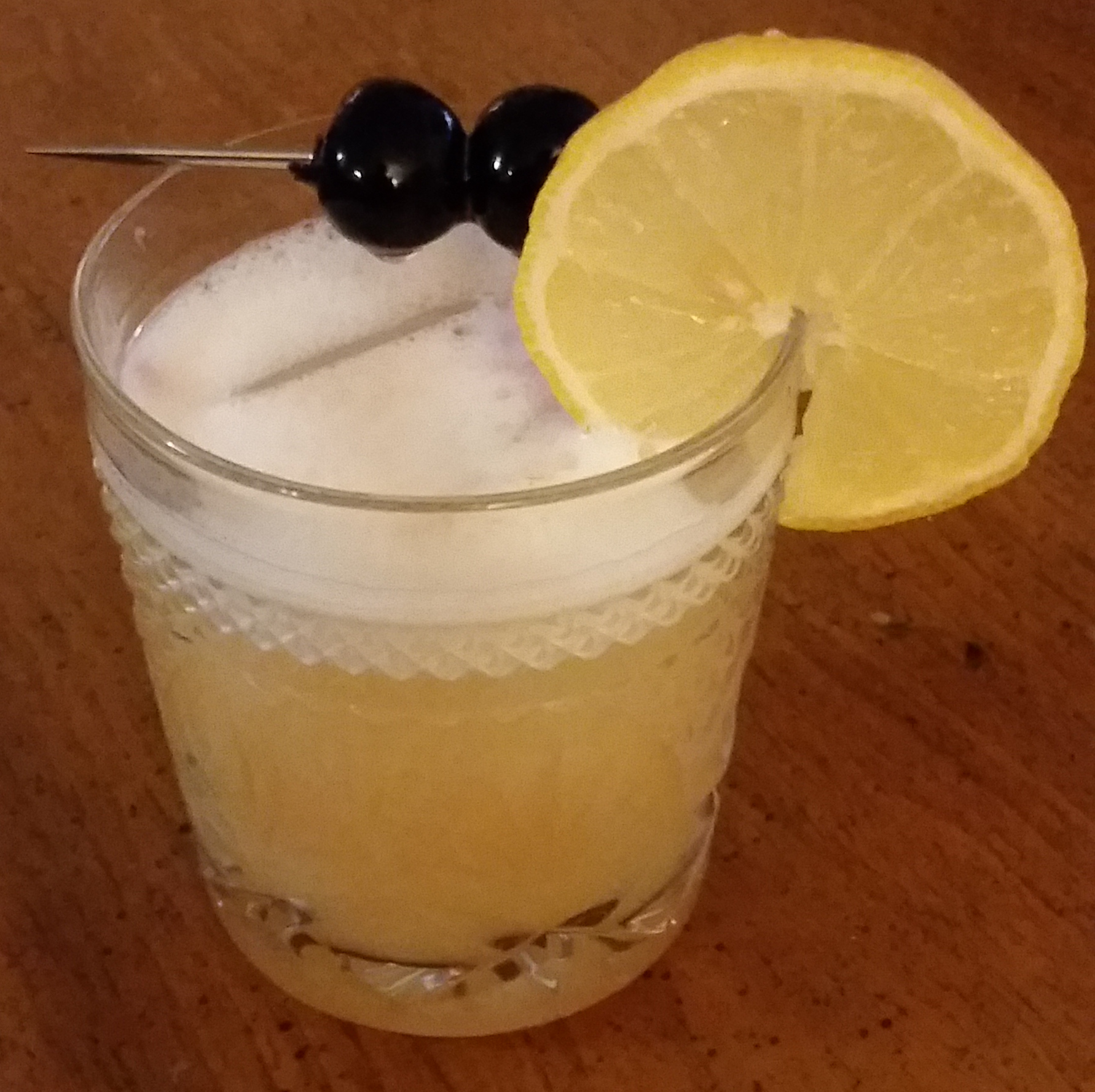
 A whiskey sour garnished with a wheel of lemon and maraschino cherries. | |
| Type | Cocktail family |
|---|---|
| Base spirit | Gin, Bourbon whiskey, Brandy, Pisco, Rum, Amaretto |
A sour is a traditional family of mixed drinks. Sours belong to one of the old families of original cocktails and are described by Jerry Thomas in his 1862 book How to Mix Drinks.[1]
Sours are mixed drinks containing a base liquor, lemon or lime juice, and a sweetener (simple syrup or orgeat syrup).[2] Egg whites are also included in some sours.
Types of sours
[edit]Gin sour
[edit]The gin sour is a traditional mixed cocktail that predates Prohibition in the United States. It is a simple combination of gin, lemon juice, and sugar. Adding carbonated water to this turns it into a gin fizz.
It was popular during the 1940s, and Kevin Starr includes it in "an array of drinks (the gin sour, the whiskey sour, the gin Rickey, the Tom Collins, the pink lady, the old fashioned) that now seem period pieces, evocative of another era".[1]
Pisco sour
[edit]The classic pisco sour recipe contains pisco brandy (usually an un-aged grape brandy from Perú), fresh lime juice, fresh lemon juice, simple syrup, egg white, and bitters.[3] It is shaken, strained, and served straight in a cocktail glass then garnished with the bitters (cinnamon can be used). The addition of egg white creates a foamy head when shaken before serving. While pisco sour is flavoured with key lime by default, pisco is combined with other fruit to create mango sour, maracuya (passion fruit) sour, lucuma sour and so forth.[4] Peru has a National Pisco Sour Day (which lasts a weekend) in mid-February,[5] and Chile has Pisco Day in mid-May.
Rum sour
[edit]The basic Daiquiri, sometimes called a Daiquiri sour, is made with rum, lime juice and simple syrup.[6] One account of the drink's origin is that the general manager of the Spanish-American Iron Core Company, which operated the "Daiquiri" mine, ran out of gin one night when making gin sour for his guests, and switched to rum. This rum sour became known as the Daiquiri. However, earlier printed recipes for rum sour exist such as one from Jerry Thomas from 1887.[7]
Whiskey sour
[edit]The whiskey sour is a mixed drink containing bourbon whiskey or rye whiskey, lemon juice, sugar, and optionally a dash of egg white to make it a Boston Sour. It is shaken and served either straight or over ice. The traditional garnish is half an orange slice and a maraschino cherry. If floated with claret red wine it's called a New York sour.[8]
A notable variant of the whiskey sour is the Ward 8, which often is based with either bourbon or rye whiskey, both lemon and orange juices, and grenadine syrup as the sweetener. The egg white sometimes employed in other whiskey sours is generally not included in this variation.
Other sours
[edit]- Amaretto sour: Amaretto liqueur, lemon juice and sometimes egg white, bitters or sugar syrup.[9]
- Brandy sour or brandy daisy (Jerry Thomas, 1887): brandy, clear or orange curaçao, sugar, lemon juice, shaken and strained into a wine glass.
- Caipirinha: Cachaça, sugar, lime, ice in an old fashioned glass.
- Cypriot brandy sour: Cyprus brandy, lemon cordial and bitters, stirred in a tall glass, and topped with soda or lemonade.
- Midori sour: Honeydew melon liquor, grenadine, lemon juice. Poured properly, it resembles a green tequila sunrise with visible layers.
- Santa Cruz sour (Jerry Thomas, 1887): Santa Cruz rum, sugar, lemon juice, shaken and strained into a wine glass.
- Tequila sour: Tequila, lemon juice, lime juice, agave nectar, Bittercube Corazon bitters, egg white.[10]
See also
[edit]
- List of cocktails
- List of lemon dishes and beverages
- Daisy (cocktail), a class of cocktails similar to a sour but sweetened with a liqueur rather than syrup or sugar
Notes
[edit]- ^ Jacques Barzun, 2001 (reprint), Mr. Dooley in Peace and in War, University of Illinois, ISBN 0-252-07029-1. Originally published by Small, Maynard and Co., 1898. Collected from newspaper columns. Online sources cite 1897 as the year of this particular quotation.
- ^ Kevin Starr, 2002, "Embattled Dreams: California in War and Peace, 1940–1950 (Americans and the California Dream)", Oxford University Press, ISBN 0-19-512437-5, A9 page image
- ^ Tom Bullock, 1917, The Ideal Bartender. Project Gutenberg eBook. The directions "½ Lime Juice" and "½ Orange Juice" are as given in the source and presumably refer to the juice of half a lime and half an orange, respectively.
References
[edit]- ^ Paul Clarke. Make Yourself Comfortable. September 25, 2005. The Cocktail Chronicles. Retrieved on January 1, 2007.
- ^ Regan, Gary (2003). The Joy of Mixology, The Consummate Guide to the Bartender's Craft. Clarkson Potter. pp. 158–159. ISBN 0609608843.
- ^ Navarro, V. Classic Pisco Sour LA Speakeasy
- ^ Peru.com, Redacción (December 6, 2013). "Maracuya sour: Qué necesitas y cómo se prepara este exquisito trago". Perú.com.
- ^ "Todas las noticias de Día del Pisco Sour". El Comercio.
- ^ "Daiquiri cocktail". Difford's.
- ^ Broom, Dave (2016). Rum The Manual. Octopus Books. ISBN 9781784720667.
- ^ Difford, Simon. "New York Sour". Diffords Guide. Retrieved September 29, 2022.
- ^ "Amaretto Sour". Difford's Guide. Retrieved 21 March 2018.
- ^ "Tequila Sour". Awesome Drinks.
External links
[edit]

Sour (cocktail)
View on GrokipediaDefinition and Characteristics
Core Components
The core components of a sour cocktail consist of a base spirit, citrus juice, and a sweetener, which together form the foundational structure of this classic drink family. The base spirit, typically measured at 2 ounces, serves as the primary alcoholic element and can include options such as whiskey, gin, rum, brandy, or vodka, providing the drink's strength and character.[9][10] Citrus juice, usually fresh lemon or lime at approximately 1 ounce, introduces the essential acidity and tartness that defines the sour profile.[11][12] Common sweeteners include simple syrup, gum syrup, or grenadine, added in amounts ranging from 0.5 to 1 ounce to counterbalance the citrus's sharpness.[13][14] A standard ratio for these elements is often 2:1:0.5 (spirit:citrus:sweetener), though variations like 2:0.75:0.75 also appear in balanced recipes.[11][10] An optional addition is 0.5 to 1 ounce of egg white, which creates a velvety foam and enhances texture without altering the core flavor balance.[13][15] Ice, either cubed or crushed, is used as a mixing medium to chill and dilute the cocktail appropriately.[16] These components collectively achieve a harmonious interplay of strength, acidity, and sweetness in the final drink.[9]Flavor Profile
The flavor profile of a Sour cocktail is characterized by a prominent tart acidity derived from fresh citrus juices such as lemon or lime, which delivers a sharp, refreshing bite on the initial sip that evokes a sense of crisp freshness.[17][18] This acidity cuts through the drink's richness, providing brightness and complexity while preventing any cloying heaviness.[17] Counterbalancing this tartness is a measured sweetness from ingredients like simple syrup or sugar, which softens the edges of the sourness to create a harmonious sweet-tart equilibrium that lingers pleasantly on the palate.[17][18] The classic balance often adheres to a ratio such as 2:1:1 (spirit:sweet:sour), ensuring equilibrium where the spirit matches the combined volume of sweet and sour elements.[18] As the drink progresses, the base spirit's subtle flavors emerge mid-palate, such as the botanical herbal notes in a gin-based Sour or the warm, oaky undertones in a whiskey variant, adding depth without overpowering the citrus core.[18] In versions incorporating egg white, a creamy foam develops atop the drink, contributing a silky viscosity and smoother mouthfeel that enhances the sensory experience and tempers the tartness further.[19][18] This frothy texture not only provides visual appeal but also introduces a velvety quality to the swallow. The finish is refreshingly diluted from ice integration, yielding a clean, not overly boozy conclusion that invites another sip.[18] Aromatically, the cocktail releases vibrant citrus zest notes alongside the volatile essences of the spirit, with any subtle egg white undertones masked by the dominant fresh, zesty bouquet.[19][17]History
Origins in the 18th Century
Building on 17th-century punch traditions, the origins of the sour cocktail trace back to the mid-18th century, emerging from practical necessities in maritime and colonial settings where spirits were mixed with citrus and sugar to make potent alcohol more palatable and combat health issues like scurvy. A key precursor was grog, introduced in the British Royal Navy in 1740 by Admiral Edward Vernon on his ships, who ordered rum diluted with water to curb excessive drinking among sailors. Sailors often added sugar and citrus juice for palatability, which unknowingly helped combat scurvy on long voyages.[20][21][22] This mixture of rum, citrus, and sweetener laid foundational principles for the sour's core balance of acid, spirit, and sweet, serving both medicinal and recreational purposes aboard ships. The availability of citrus fruits in these early mixtures was enabled by expanding 18th-century trade routes connecting Europe, the Americas, and the Caribbean. Limes and lemons, sourced primarily from the West Indies and Mediterranean regions, were imported via British colonial networks to supply naval provisions and civilian markets, making them accessible for mixing with local spirits.[23] In colonial America, where whiskey distillation proliferated from the 1720s onward using abundant grain crops, mixed drinks evolved from punch traditions, combining local spirits with citrus and sugar in taverns and homes.[24] Early printed references to citrus-spirit-sugar combinations appeared in 18th-century guides discussing punches, which influenced sour development as communal, improvised beverages rather than standardized drinks. These punches, often documented in British and colonial texts from the 1730s onward, featured spirits like brandy or rum balanced with lemon juice and sugar, served in taverns without fixed proportions.[25] Lacking formal bartending manuals until later, sours in this era were ad hoc creations in American and British taverns, adapted from naval grog and punch traditions using whatever spirits and citrus were on hand, reflecting the era's resource-driven improvisation.[2] These 18th-century foundations provided the conceptual blueprint for the sour's refinement in the following century.Popularization in the 19th and 20th Centuries
The Whiskey Sour gained widespread recognition in the mid-19th century through Jerry Thomas's seminal 1862 publication, The Bartender's Guide: How to Mix All Kinds of Plain and Fancy Drinks, which codified it as a benchmark recipe featuring whiskey, lemon juice, and sugar, establishing the sour as a standardized American cocktail template.[2] This inclusion helped elevate sours from informal bar drinks to a fixture in professional mixology, influencing subsequent recipes and popularizing the balance of spirit, citrus, and sweetener across variations. By the late 19th century, the sour family's evolution was further evidenced in 1895 with George J. Kappeler's Modern American Drinks, which documented the Ramos Gin Fizz—a frothy, egg-white-enhanced gin sour topped with soda—linking fizzes directly to the sour structure through shared acidic and effervescent elements. During the Prohibition era from 1920 to 1933, sours adapted to the challenges of illicit alcohol production, with bartenders using citrus and sugar to mask the harsh flavors of smuggled or bootleg spirits, thereby sustaining the category's popularity in underground speakeasies. The Whiskey Sour, in particular, thrived as a versatile mixer that disguised subpar liquor, fostering creative adaptations while maintaining its core appeal amid the era's resource constraints.[26] This period of innovation reinforced sours as resilient staples, even as enforcement drove experimentation in hidden venues. Post-World War II, in the 1940s and 1950s, the tiki movement in Polynesian-style bars introduced rum sours, blending the sour template with tropical rums and exotic garnishes to capitalize on returning soldiers' wartime memories of island libations.[27] Venues like Trader Vic's and Don the Beachcomber popularized these rum-forward sours, expanding the category's cultural footprint beyond whiskey bases and integrating them into the escapist tiki aesthetic that dominated American nightlife.[28] By the 1960s, sours experienced a decline as vodka's odorless profile and marketing surge overshadowed flavor-forward whiskey drinks, leading to a broader shift toward simpler, neutral-spirit cocktails.[29] This trend persisted into the 1970s, with artificial sour mixes further diluting the originals' craft appeal. However, the 1980s craft revival, spearheaded by bartenders like Dale DeGroff at New York's Rainbow Room, breathed new life into sours by emphasizing fresh ingredients and pre-Prohibition techniques, restoring Whiskey Sours and similar variants to prominence in upscale bars.[30]Preparation Methods
Classic Recipe
The classic sour cocktail recipe adheres to a foundational template of 2 parts base spirit, 1 part fresh citrus juice, and 0.75 parts sweetener, creating a harmonious balance of bold alcohol, tart acidity, and subtle sweetness that defines the category. While lemon juice is traditional, other citrus like lime may be used depending on the variation.[15][31]Ingredients (for one serving)
- 2 oz base spirit (such as bourbon, gin, or rum)
- 1 oz fresh lemon juice (or other citrus)
- 0.75 oz simple syrup
- 1 egg white (about 1 oz, optional, for added texture and foam)
Preparation Steps
- Add all ingredients to a cocktail shaker without ice. If using egg white, perform a dry shake for about 10 seconds to emulsify and aerate the mixture.[15]
- Fill the shaker with ice and shake vigorously for 7-10 seconds to chill, dilute, and integrate the flavors.[15]
- Double-strain the mixture into a chilled coupe glass or over fresh ice in a rocks glass, using a Hawthorne strainer and a fine-mesh strainer to remove any ice shards or foam bits.[15]
- Garnish with a lemon twist or a maraschino cherry.[15]