


Community hub
Recent from talks
Contribute something
Nothing was collected or created yet.
Moscow mule
View on Wikipedia
 | |
| Type | Mixed drink |
|---|---|
| Ingredients |
|
| Base spirit | Vodka |
| Website | iba-world |
| Standard drinkware | copper mug |
| Standard garnish | Lime Slice |
| Served | On the rocks: poured over ice |
| Preparation | In a Mule Cup or rocks glass, combine the vodka and ginger beer. Add lime juice and gently stir to involve all ingredients. |
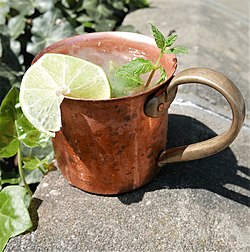
A Moscow mule is a cocktail made with vodka, ginger beer, and lime juice; garnished with a slice or wedge of lime, and a sprig of mint. The drink, being a type of buck, is sometimes called vodka buck. It is popularly served in a copper mug, which takes on the cold temperature of the liquid.
Some public health advisories recommend copper mugs with a protective coating (such as stainless steel) on the inside and the lip, to reduce the risk of copper toxicity.[1]
Variations
[edit]Due to the popularity of the Moscow mule, other buck cocktails with different liquors or other ingredients have been labeled with the "mule" name in recent years. Variations with the name changed accordingly:[2]
- Aussie mule: Pear vodka, lime juice, pineapple juice.
- Aussie mule: Bundaberg Rum.
- Berner mule: Ingwerer.
- Bohemian mule: Absinthe.
- Budapest mule: Unicum.
- Canary mule: Honey rum
- Congo mule: Tonic water
- Dead man's mule: Absinthe and cinnamon schnapps.
- French mule: Cognac and angostura bitters.
- Gin-gin mule, London mule, Munich mule, Foghorn: Gin.[3]
- Glasgow mule: Blended Scotch whisky and St-Germain liqueur.
- Irish mule: Irish whiskey.
- Jallu-muuli: Jaloviina.
- Jamaican mule: Spiced rum.
- Kentucky mule, Horsefeather: Bourbon.
- Manila mule: Lambanog and calamansi instead of lime.
- Merican Mule: Canned Moscow Mule brand.
- Mexican mule: Tequila.
- Mezcal mule: Mezcal.
- Mistletoe mule: Garnished with rosemary and cranberries.
- Mumbai mule: Moscow mule, coriander, cumin.
- New Orleans mule: Bourbon and coffee liqueur.
- Oslo mule: Akvavit.
- Prickly pear mule: Pear liqueur and Poire Williams.
- Southern mule: Southern Comfort liqueur.
- Tennessee mule: Tennessee whiskey.
- Tuscan mule: Tuaca liqueur.
- Berlin mule: Jägermeister
- Mississippi mule: Cathead Honeysuckle vodka.
- Westphalian mule: Korn, Apple juice instead of lime and cucumber
Another variation uses ginger syrup instead of ginger beer.[4]
Other ingredients, such as carrot juice and angostura bitters, can also be added.[5]
A variant which uses Mountain Dew soda in place of the ginger beer is known as a Moscow Mole.[6]
History
[edit]George Sinclair's 2007 article on the origin of the drink quotes the New York Herald Tribune from 1948:
The mule was born in Manhattan but "stalled" on the West Coast for the duration. The birthplace of "Little Moscow" was in New York's Chatham Hotel. That was back in 1941 when the first carload of Jack Morgan's Cock 'n' Bull ginger beer was railing over the plains to give New Yorkers a happy surprise…The Violette Family helped. Three friends were in the Chatham bar, one John A. Morgan, known as Jack, president of Cock 'n' Bull Products and owner of the Hollywood Cock 'n' Bull Restaurant; one was John G. Martin, president of G.F. Heublein Brothers Inc. of Hartford, Conn., and the third was Rudolph Kunett, president of the Pierre Smirnoff, Heublein's vodka division. As Jack Morgan tells it, "We three were quaffing a slug, nibbling an hors d'oeuvre and shoving toward inventive genius". Martin and Kunett had their minds on their vodka and wondered what would happen if a two-ounce shot joined with Morgan's ginger beer and the squeeze of a lemon. Ice was ordered, lemons procured, mugs ushered in and the concoction put together. Cups were raised, the men counted five and down went the first taste. It was good. It lifted the spirit to adventure. Four or five days later the mixture was christened the Moscow mule...[7]
Mayo Methot's husband, Percy T. Morgan,[8] an oil tycoon, was a co-owner of the Cock n' Bull restaurant.[9]
This story was well known for years, however in 2007, a new version of the invention of the Moscow mule cocktail was published. In this story the cocktail's inventor was Wes Price, getting the idea from Hudes Potache, Morgan's head bartender and the drink was born out of a need to clear the bar's cellar, packed with unsold inventory, including vodka and ginger beer.
Eric Felten quotes Wes Price in an article that was published in 2007 in The Wall Street Journal
"I just wanted to clean out the basement," Price would say of creating the Moscow mule. "I was trying to get rid of a lot of dead stock." The first one he mixed he served to the actor Broderick Crawford. "It caught on like wildfire," Price bragged."[10]
The Moscow mule is often served in a copper mug. The popularity of this drinking vessel is attributable to Martin, who went around the United States to sell Smirnoff vodka and popularize the Moscow mule. Martin asked bartenders to pose with a specialty copper mug and a bottle of Smirnoff vodka, and took Polaroid photographs of them. He took two photos, leaving one with the bartender for display. The other photo was put into a collection and used as proof to the next bar Martin visited of the popularity of the Moscow mule.[11] The copper mug remains, to this day, a popular serving vessel for the Moscow mule.
According to a 1942 Insider Hollywood article, the Moscow mule was most popular in Los Angeles, where it originated.[12] The Nevada State Journal (October 12, 1943) reinforced the mule's popularity in reporting: "Already the mule is climbing up into the exclusive handful of most-popular mixed drinks". It became known as a favorite drink of Reno casino owner William F. Harrah. In his book Beat the Dealer (1964), Edward O. Thorp did not name the Tahoe casino where he thought he had been poorly treated as a card counter. Instead, he wrote, "Immediately I had a Moscow mule", subtly hinting that the location was Harrah's Lake Tahoe, due to Harrah's then well-known proclivity for the drink.[13]
Following the Russian invasion of Ukraine in February 2022, some American and Canadian bars began to refer to the drink as a "Kyiv mule" – referring to the Ukrainian capital of Kyiv – in protest of the invasion.[14][15][16]
Health concerns
[edit]There are some health concerns related to the tradition of serving a Moscow Mule in a copper vessel. The ingredients in a Moscow mule cocktail are acidic, and the resulting beverage has a pH well below 6.0. This creates a problem when using traditional copper mugs without coating, as copper can start dissolving into acidic solutions. Copper in solution is considered toxic at concentrations above 1 mg/L. On July 28, 2017, the Iowa Alcoholic Beverages Division issued a statement that pure copper vessels should not be used to serve acidic drinks, but that "copper mugs lined on the interior with another metal, such as nickel or stainless steel, are allowed to be used and are widely available".[17] The U.S. Food and Drug Administration (FDA) 2013 Food Code states that copper and copper alloys such as brass "may not be used in contact with a food that has a pH below 6 such as vinegar, fruit juice, or wine or for a fitting or tubing installed between a backflow prevention device and a carbonator."[18][19]
The FDA's Model Food Code specifically prohibits copper from "coming into direct contact with foods that have a pH below 6.0". The advisory relates only to solid copper mugs. Copper mugs that are lined with stainless steel or other food-safe materials are exempt from the advisory.[1]
The risk of copper poisoning has however been questioned by Trisha Andrew, who teaches chemistry at University of Massachusetts Amherst, saying that the short duration of a usual serving would not cause the copper levels to rise high enough to pose a risk.[20]
See also
[edit]References
[edit]- ^ a b Wang, Amy (August 8, 2017). "Heads up, Moscow mule lovers: That copper mug could be poisoning you". Washington Post. Retrieved August 9, 2017.
- ^ Difford, Simon. "Moscow Mule". Difford's Guide.
- ^ Graham, Colleen (June 3, 2019). "Foghorn Recipe: Where Gin and Ginger Beer Meet". The Spruce. Retrieved December 22, 2019.
- ^ Graham, Colleen (May 24, 2019). "Stoli Alibi: A Soda Drink Where Vodka and Ginger Meet". The Spruce Eats.
- ^ "Carrot Moscow Mule Cocktail". April 13, 2017.
- ^ Hines, recipe: Nick. "The Mountain Dew Moscow Mole". VinePair.
- ^ Sinclair, George (January 2007). "Moscow Mule". Thinking Bartender. Archived from the original on March 14, 2007. Retrieved October 25, 2014.
- ^ Duchovnay, Gerald (1999). Humphrey Bogart: A Bio-Bibliography. Westport, Connecticut: Greenwood Press. p. 15. ISBN 978-0-313-22338-9.
- ^ Parsons, Louella O. (August 12, 1947). "Hepburn's Screen Career Unaffected By Frankness". St. Petersburg Times. St. Petersburg, Florida. p. 8.
- ^ Felten, Eric (June 9, 2007). "A Cock(tail) 'n' Bull Story". The Wall Street Journal. Archived from the original on February 21, 2015. Retrieved October 29, 2016.
- ^ "What's the Story Behind the Moscow Mule and that Copper Mug?". Paykoc Imports. Retrieved April 25, 2015.
- ^ Gwynn, Eith (December 27, 1942). "Insider Hollywood".
There is a new drink that is a craze in the movie colony now. It is called 'Moscow Mule'.
- ^ Edward O. Thorp. Beat The Dealer: A Winning Strategy For The Game Of Twenty One (New York: Vintage Books, 1966), 68.
- ^ Wiener-Bronner, Danielle (March 4, 2022). "Bar owners are swapping out Moscow Mules for Kyiv Mules | CNN Business". CNN. Retrieved March 8, 2022.
- ^ Tayeb, Zahra. "American bar owners are taking Moscow Mules off the menu and replacing them with Kyiv Mules in a small act of solidarity with Ukraine". Business Insider. Retrieved March 8, 2022.
- ^ "Toronto restaurants to stop serving Moscow mules". www.blogto.com. Retrieved March 8, 2022.
- ^ State of Iowa Alcoholic Beverages Division (July 28, 2017). "Use of Copper Mugs in the Serving of Alcoholic Beverages" (PDF).
- ^ Food and Drug Administration (2013). "Food Code" (PDF). Food and Drug Administration. Archived from the original (PDF) on March 9, 2014.
- ^ Oliver, David (August 8, 2017). "Health Buzz: Why You Should Stop Drinking Moscow Mules Out of Copper Mugs". US News. Retrieved August 9, 2017.
- ^ Thomson, Julie R. (August 11, 2017). "Chemist Debunks That Nasty Rumor About Moscow Mule Mugs Being Poisonous". HuffPost.
External links
[edit]
- Grimes, William (2001). Straight Up or On the Rocks: The Story of the American Cocktail. New York: North Point Press. ISBN 978-0-86547-601-1.|https://kyiv-mule.com
Moscow mule
View on GrokipediaComposition and Preparation
Ingredients
The classic Moscow Mule requires three primary ingredients: vodka, ginger beer, and fresh lime juice, with a lime wedge as garnish. Standard proportions, as codified in mid-20th-century recipes and modern authoritative cocktail guides, consist of 2 ounces vodka, ½ ounce fresh lime juice, and 3 to 6 ounces chilled ginger beer, yielding a balanced ratio that emphasizes the ginger beer's effervescence over the vodka's neutrality.[1][12] Vodka functions as a neutral spirit base, selected for its lack of strong flavor to highlight the other components; its inclusion stemmed from post-Prohibition surpluses in the 1940s, with Smirnoff specifically used in the cocktail's original promotional campaigns to boost domestic sales of imported Russian vodka rebranded for American markets.[13][14] Ginger beer contributes the drink's signature spicy bite and carbonation, traditionally a non-alcoholic, fermented brew with robust ginger root extract for heat and complexity, differing markedly from milder, sweeter modern ginger ales or sodas that lack fermentation's depth and can dilute authenticity.[15][16] Freshly squeezed lime juice provides tart acidity to cut the sweetness and unify the profile, with historical recipes and experts rejecting sweetened lime cordials, which introduce artificial sugar and diminish the citrus's bright, natural counterpoint to the ginger.[17][18]Mixing and Serving Technique
The Moscow Mule is assembled directly in a chilled copper mug filled with ice to ensure rapid cooling and minimal dilution during preparation. Typically, 2 ounces of vodka are poured first, followed by 0.5 to 1 ounce of fresh lime juice, then topped with 4 to 6 ounces of ginger beer.[18][12] This order allows the spirits and citrus to integrate before the carbonated ginger beer is added, preserving effervescence by limiting agitation.[18] A gentle stir with a spoon once or twice after adding the ginger beer suffices to blend the components without dissipating the carbonation, which is essential for the drink's signature fizz and flavor balance.[18] The use of fresh lime juice, rather than bottled alternatives, provides superior acidity and aromatic oils that enhance the cocktail's tartness and complement the ginger beer's spice, contributing to optimal taste integration.[19] Serving immediately over abundant ice maintains the beverage's chill, preventing excessive warming or dilution while delivering refreshment.[12] This method yields a standard alcohol by volume (ABV) of approximately 10% to 15%, depending on precise proportions, with the ice and mug aiding in keeping the drink at a cold serving temperature conducive to its crisp profile.[20]Role of the Copper Mug
The copper mug's primary functional role stems from copper's exceptionally high thermal conductivity, which is nearly 400 times greater than that of glass.[21] This property enables the mug to rapidly absorb cold from ice or a pre-chilled state, facilitating quick temperature equilibration and the formation of external frost, which visually signals a chilled beverage.[10] The hammered texture of traditional mugs may further contribute by creating microscopic air pockets that provide minor insulation against ambient heat after initial cooling.[22] However, this same conductivity means the mug transfers external heat—such as from a holder's hand—more efficiently than insulating materials, potentially allowing the drink to warm faster than in glass once ice melts.[23][24] Empirical tests confirm that while the mug feels intensely cold initially, it does not maintain lower temperatures longer term compared to alternatives, challenging claims of superior insulation.[23] Historically, the mug's adoption originated in 1941 from a marketing collaboration involving Sophie Berezinski, who immigrated from Russia with a surplus of approximately 2,000 copper mugs produced at her father's factory.[25] Partnering with vodka distributor John A. Morgan Jr. (of Heublein, promoting Smirnoff) and bar owner Wes Price, the trio specified the copper vessel to offload the inventory while boosting vodka sales amid post-Prohibition surpluses.[26] Promotional efforts, including demonstration films and ads, highlighted the dramatic frost formation on the copper surface to emphasize refreshment and premium appeal.[27] Though not essential to the recipe—modern servings often use highball glasses or other metals—the copper mug has become iconic, conveying luxury and tradition without altering the drink's flavor profile.[10] This aesthetic and branding role persists, as the mug's metallic sheen and heft elevate the cocktail's perceived quality in bars and homes.[28]History
Origins in the 1940s
The Moscow Mule emerged in 1941 amid efforts to offload surplus liquor stocks in the post-Prohibition United States, where the 21st Amendment's repeal in 1933 had flooded markets but left vodka largely unpopular among American consumers accustomed to whiskey and gin.[29] John G. Martin, who acquired U.S. distribution rights to Smirnoff vodka for Heublein Inc. in the late 1930s, faced persistent sales challenges as vodka lacked a domestic foothold despite its neutral profile suiting mixed drinks.[30] Concurrently, Jack Morgan, owner of the Cock 'n' Bull pub on Sunset Boulevard in Los Angeles and producer of ginger beer, grappled with excess inventory of his spicy, non-alcoholic brew that outpaced demand.[14] At the Cock 'n' Bull, Martin and Morgan collaborated with head bartender Wes Price to devise a simple cocktail combining two ounces of Smirnoff vodka, four to six ounces of Morgan's ginger beer, and a squeeze of lime juice over ice, yielding a fizzy, effervescent highball with a sharp ginger bite tempered by citrus acidity.[14] This formulation addressed their respective surpluses by creating demand synergy: the vodka's mildness complemented the ginger beer's pungency, while lime provided balance without overpowering flavors.[31] The drink's name evoked Moscow for its vodka base, despite no Russian origins in the recipe, and "mule" for its potent kick akin to a stubborn animal.[30] The copper mug serving vessel, integral to the drink's identity, traces to Sophie Berezinski, a Russian émigré who arrived in Los Angeles with approximately 2,000 mugs produced by her family's pre-revolutionary copperworks; she pitched them to Morgan at the Cock 'n' Bull, where their insulating properties—keeping the chilled mixture frosty longer—aligned with the cocktail's needs.[5] However, claims crediting Berezinski as the primary inventor lack corroboration from contemporary records, and logistical doubts persist regarding exporting such quantities from Soviet-controlled industries in the early 1940s.[14] Alternative accounts posit origins at New York's Chatham Hotel bar, but these rely on anecdotal bartender recollections without documented evidence predating the Los Angeles narrative.[30] Martin's promotional push included an early demonstration film targeting bartenders, wherein he mixed and served the drink in the signature mug to showcase its simplicity and appeal, laying groundwork for broader adoption through trade show previews and proof-of-presence Polaroid campaigns verifying bar compliance.[32] These efforts, rooted in pragmatic inventory clearance rather than culinary innovation, established the Moscow Mule as a wartime-era staple by late 1941, though its name persisted despite geopolitical tensions with the Soviet Union.[33]Popularization and Mid-Century Boom
The Moscow Mule's popularization accelerated in the mid-1940s through targeted marketing by John G. Martin, the Heublein executive who imported Smirnoff vodka. Martin traveled to bars nationwide with copper mugs, ginger beer, and limes, mixing the cocktail on-site to demonstrate its appeal. Using an early Polaroid camera, he photographed bartenders holding the served drink—one copy left with the bar as a memento and proof of adoption, the other retained to show distributors and state liquor boards evidence of growing demand. This grassroots campaign, akin to modern social proof tactics, rapidly disseminated the recipe and encouraged bars to stock the ingredients.[32][34][29] This promotion coincided with explosive growth in vodka sales, transforming Smirnoff from obscurity to prominence. In the late 1930s, annual Smirnoff sales languished at approximately 6,000 cases amid consumer preference for established spirits like whiskey and gin. By the early 1950s, overall U.S. vodka sales had escalated from 40,000 cases in 1950 to over 4 million by 1955, with the Moscow Mule credited as a catalyst in elevating vodka from less than 1% of spirits consumption to a leading category.[35][36][14] Post-World War II cultural shifts amplified the drink's traction as an American staple. The cocktail's straightforward preparation and crisp, effervescent taste offered a refreshing contrast to heavier wartime-era libations, aligning with economic optimism and the rise of casual dining. Advertisements featuring the Moscow Mule in copper mugs reinforced its image, solidifying vodka's shift toward mainstream mixer status over traditional brown spirits rationed or disrupted by war production constraints.[30][37]Decline and 21st-Century Revival
Following its mid-century peak, the Moscow Mule experienced a significant decline in popularity during the Cold War era, largely due to anti-communist sentiments in the United States that associated the drink's name with the Soviet Union, exacerbated by McCarthyism.[34] By the late 1950s, the cocktail had largely faded from prominence, overshadowed by shifting consumer preferences toward sweeter mixed drinks and a general fatigue with vodka-based recipes amid broader changes in American bar culture.[38] The drink remained obscure through the late 20th century, with minimal presence in mainstream bars until the early 2000s, when it began reemerging in hipster-oriented establishments drawn to its retro aesthetic and simple preparation.[39] This laid the groundwork for a broader revival in the 2010s, fueled by the craft cocktail movement's emphasis on pre-Prohibition and mid-century classics, alongside the visual appeal of copper mugs that lent itself to social media sharing on platforms like Instagram.[6] By the 2020s, the Moscow Mule had solidified its resurgence, ranking among the top three best-selling cocktails in U.S. on-premise venues according to CGA by NielsenIQ data, contending closely with the Martini for second place behind the Margarita in 2023.[40][41] Its appeal extended globally, with adaptations gaining traction in markets like Brazil, where local twists incorporated elements such as ginger foam, and in U.S. cities including Dallas, where search trends highlighted regional variations.[42][43] The cocktail's at-home popularity also surged, contributing to premium mixer sales growth as consumers recreated the drink amid rising interest in nostalgic, easy-to-assemble recipes.[44]Variations
Spirit Substitutions
The Moscow Mule's core structure—vodka, lime juice, and ginger beer—lends itself to spirit substitutions that preserve the effervescent, spicy profile while introducing distinct flavor profiles from alternative bases. These derivatives emerged primarily in the mid-20th century alongside the original cocktail's popularity, adapting to regional preferences and available spirits.[45][46] The Kentucky Mule replaces vodka with bourbon, imparting caramel, vanilla, and oak notes that complement the ginger beer's spice and lime's acidity. This variation traces its roots to the 1940s in Los Angeles, contemporaneous with the Moscow Mule's invention, and gained traction in the American South where bourbon's prevalence encouraged the swap.[46][47][48] The Mexican Mule substitutes tequila for vodka, with a standard recipe consisting of 2 oz (60 ml) tequila (blanco for a clean taste or reposado for added depth), ½ oz (15 ml) fresh lime juice, and 4–6 oz (120–180 ml) chilled ginger beer, built over ice in a copper mug and garnished with a lime wedge (optionally with fresh mint or jalapeño slices). For a bolder spicy variation, muddle 2–3 fresh jalapeño slices in the glass before adding ice, or add a splash of ancho chile liqueur; this complements the heat from the ginger beer and tequila.[49][50][51] This emphasizes agave-derived earthiness, herbal undertones, and subtle smoke that enhance the drink's tart backbone. Tequila's versatility across blanco, reposado, or añejo expressions allows for nuanced adaptations, with reposado often favored for its balanced oak aging. This riff proliferated in the late 20th century amid tequila's rising U.S. popularity but lacks a singular documented origin, functioning as a straightforward regional twist.[52][53][54] A gin-based version, known as the Gin Gin Mule or Gin Buck, incorporates gin's botanical juniper, citrus peel, and herbal complexities, yielding a drier, more aromatic mule that dates to pre-Moscow Mule buck-style drinks from the early 20th century.[45][55] The Dark 'n' Stormy employs dark rum in place of vodka, adding molasses sweetness and spice that deepen the ginger-lime interplay; this predates the Moscow Mule, with recipes appearing in the 1910s, though its modern mule association solidified post-1940s. Gosling Brothers holds a trademark on the name since 1980, enforceable only when using their Black Seal rum, leading to legal actions against unauthorized uses, such as suits against competing rum producers and bars in the 2010s.[45][56][57][58]Flavored and Seasonal Adaptations
Flavored adaptations of the Moscow Mule incorporate fruit infusions to enhance its tart and spicy profile without altering the base spirit. Blackberry versions often use fresh blackberries or blackberry jam muddled with lime juice and ginger beer, yielding a sweet-tart variation that balances the cocktail's inherent bitterness.[59][60] Blood orange infusions substitute or supplement lime with freshly squeezed blood orange juice, sometimes paired with simple syrup for added citrus depth and vibrant color, appealing to preferences for brighter, seasonal fruit notes.[61][62] Seasonal adaptations leverage autumn ingredients for thematic appeal, particularly in fall iterations featuring pumpkin puree or butter combined with pumpkin pie spice, cinnamon syrup, and ginger beer to evoke spiced warmth.[63][64] These modifications, documented in recipes from 2016 onward, align with broader trends in spiced cocktail offerings during cooler months.[65] Non-alcoholic mocktail versions replace vodka with simple syrup or omit spirits entirely, relying on ginger beer's spice, fresh lime juice, and mint for refreshment, catering to low- or zero-alcohol preferences in social settings.[66][67] Such adaptations maintain the mule's effervescence and bite while reducing caloric and intoxicating effects.[68] Regional twists include Brazil's ginger foam-topped mule, where a frothy blend of ginger juice, lime, simple syrup, egg white, and citrus soda caps the standard mix for a creamy texture unique to local bar practices.[69] In Texas, spicy variants incorporate serrano hot sauce or muddled jalapeños with lime and ginger beer, amplifying heat to suit regional tastes for bold flavors.[70][43]Cultural and Commercial Significance
Marketing and Economic Impact
The Moscow Mule's promotion represented a pioneering example of entrepreneurial marketing in the spirits industry, driven by private incentives to clear excess inventory. John G. Martin of Heublein, holding rights to Smirnoff vodka—which had languished as a niche import—partnered with Cock 'n' Bull owner Jack Morgan, whose house ginger beer faced weak sales, and Sophie Berezinski of the Copper Unit Manufacturing Company, saddled with unsold mugs. Their strategy involved outfitting bartenders with mugs and Smirnoff, then photographing them with Polaroid cameras to "prove" the drink's availability, distributing these images to boost bartender buy-in without relying on traditional advertising budgets. This grassroots tactic catalyzed vodka's ascent, with U.S. vodka case sales exploding from 40,000 in 1950 to over 4 million by 1955; Smirnoff specifically grew from $15 million in revenue in 1954 to over $100 million in 1956, capturing early dominance in a category previously under 1% of spirits consumption.[36][71][72] The campaign's emphasis on the copper mug extended economic benefits to ancillary industries, converting wartime-era surplus copper products into a branded essential. Berezinski's mugs, initially difficult to move, gained traction as the drink's signature vessel, fostering demand that revived specialized manufacturing; by the 2010s, companies like Moscow Copper Co. capitalized on this legacy, marketing sets of solid copper mugs priced around $120 to capitalize on renewed interest. For bars, the Moscow Mule offered high profit margins due to inexpensive ingredients—primarily vodka, ginger beer, and lime—relative to its premium pricing, making it a reliable revenue driver amid post-war consumer shifts toward mixed drinks.[73][11] Long-term, the cocktail spurred growth in ginger beer production, as its role as a key mixer elevated the ingredient from obscurity to a market staple. Ginger beer demand, amplified by Moscow Mule popularity, contributed to the global category's expansion, valued at $4.42 billion in 2021 and projected to grow at a 7.3% compound annual rate through 2030, with cocktail applications cited as a primary driver. In 2023, the Moscow Mule ranked as the third-best-selling cocktail in the U.S. by on-premise velocity, trailing only the margarita and martini, demonstrating sustained economic resilience despite evolving trends in craft spirits and low-alcohol alternatives.[74][40][75]Presence in Media and Society
The Moscow Mule has featured in American television programming, including a 2016 episode of the FX series Atlanta, where it appeared on a bar's drink menu alongside other cocktails.[76] Promotional media has also highlighted the drink, such as a 2017 video collaboration between Smirnoff and cast members of Vanderpump Rules demonstrating its preparation.[77] These appearances underscore its role as a recognizable element in portrayals of casual bar culture and celebrity-endorsed mixology. In social contexts, the Moscow Mule established itself as a bar staple in the United States following its 1941 invention at the Cock 'n' Bull tavern in Los Angeles, valued for its straightforward assembly using vodka, ginger beer, and lime juice served in a copper mug.[14] This accessibility contributed to its integration into everyday drinking venues, particularly as vodka gained traction among American consumers previously unfamiliar with the spirit.[78] The drink's unpretentious profile allowed it to appeal across demographics in post-World War II social gatherings, distinct from more elaborate cocktails of the era. By the 2010s, the Moscow Mule reemerged in media and online discourse as a hipster favorite, celebrated in blogs and social platforms for its retro charm and photogenic presentation in copperware.[39] Internationally, it has permeated bar scenes beyond the U.S., with variations incorporating local ingredients while retaining core elements, reflecting its adaptability in diverse cultural settings.[79]Modern Popularity and Trends
In the United States, the Moscow Mule ranked third among the most popular cocktails in 2023, according to NielsenIQ data, trailing only the Margarita and Martini.[40] This positioning reflects its consistent appeal, with the drink frequently vying for second place in on-premise bar orders, as tracked by CGA by NielsenIQ in quarterly reports through mid-2023.[80] Bars such as The Standard Pour in Dallas have capitalized on this demand, claiming to produce more Moscow Mules than any other venue globally, underscoring regional hotspots for high-volume service.[81] Contemporary adaptations include non-alcoholic mocktail variants, driven by Gen Z's sobriety movement, where 75% of adults aged 21-24 expressed likelihood to join Dry January initiatives in 2024.[82] Commercial products like Mingle's Sparkling Moscow Mule Mocktail, featuring cranberry, lime, and orange juices without spirits, illustrate this shift toward zero-proof options that mimic the original's profile.[83] Premium ingredients, particularly craft ginger beers such as Q Mixers—engineered specifically for balanced spice in Mules—have elevated home and bar preparations, aligning with broader trends in artisanal mixers.[16] Post-2020, at-home cocktail kits bundling vodka, ginger beer, and accessories surged in popularity during pandemic restrictions, enabling virtual happy hours and sustained consumer interest in DIY versions.[84] Looking ahead, low-ABV iterations, including spiced or reduced-spirit Mules, align with health-conscious preferences, yet the traditional highball formula persists as a staple in 2025 cocktail forecasts, where classics maintain dominance over fleeting innovations.[85][86] This enduring strength is bolstered by the drink's role in driving ginger beer sales, projected to grow through demand for premium cocktail components.[87]Health and Safety Aspects
Nutritional Profile and Alcohol Effects
A standard Moscow Mule, prepared with 1.5 ounces of vodka, 4-6 ounces of ginger beer, and 0.5 ounces of lime juice, contains approximately 180-216 calories per serving.[88][89][90] The majority of these calories derive from carbohydrates in the ginger beer, which contributes 20-21 grams of sugar, while the vodka adds nearly 100 empty calories from alcohol and the lime juice provides negligible amounts.[88][89] Lime juice supplies a modest amount of vitamin C, approximately 5-10 milligrams per half ounce, supporting minor antioxidant intake but not significantly altering the drink's overall profile dominated by sugars and ethanol.[91]| Nutrient | Approximate Amount per Serving |
|---|---|
| Calories | 180-216 kcal[89][90] |
| Total Carbohydrates | 20-21 g[88] |
| Sugars | 20 g[88] |
| Protein | 0 g[88] |
| Fat | 0 g[88] |
| Vitamin C (from lime) | 5-10 mg[91] |