Hubbry Logo
SphaerodactylidaeSphaerodactylidaeMain
Open search
Sphaerodactylidae
Community hub
Sphaerodactylidae
logo
8 pages, 0 posts
0 subscribers
Be the first to start a discussion here.
Sphaerodactylidae
Sphaerodactylidae
from Wikipedia

Sphaerodactylidae
Temporal range: Eocene - Present[1]
~47–0 Ma
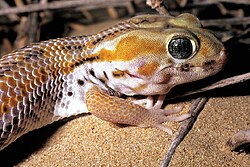
Persian wonder gecko
(Teratoscincus keyserlingii )
Scientific classification Edit this classification
Kingdom: Animalia
Phylum: Chordata
Class: Reptilia
Order: Squamata
Suborder: Gekkota
Superfamily: Gekkonoidea
Family: Sphaerodactylidae
Underwood, 1954
Genera

12, see text.

The Sphaerodactylidae are a family of geckos (Gekkota) distributed in North America, Central America, South America, and the Caribbean, as well as in Southern Europe, North Africa, the Middle East, and into Central Asia. The family contains 12 living genera and over 200 living species.[2][3][4] The family name comes from the ball shape of their finger joints.

Genera

[edit]

The following genera are recognized as valid:[5]

List of genera
Genus Image Type species Taxon author Common name Species
Aristelliger
A. georgeensis
A. lar Cope, 1862 Cope, 1862 Croaking geckos and Caribbean geckos 9
Chatogekko
C. amazonicus
C. amazonicus (Andersson, 1918) Gamble, Daza, Colli, Vitt & Bauer, 2011 Brazilian pygmy gecko 1
Coleodactylus
C. natalensis
C. meridionalis (Boulenger, 1888) Parker, 1926 5
Euleptes
E. europaea
E. europaea (Gené, 1839) Fitzinger, 1843 European leaf-toed gecko 1
Geiseleptes[6] G.delfinoi Villa, Wings & Rabi, 2022 Villa, Wings & Rabi, 2022 1
Gonatodes
G. ceciliae
G. albogularis (Duméril & Bibron, 1836) Fitzinger, 1843 Dwarf geckos 34
Lepidoblepharis
L. xanthostigma
L. festae Peracca, 1897 Peracca, 1897 Scaly-eyed geckos 21
Pristurus
P. rupestris
P. flavipunctatus Rüppell, 1835 Rüppell, 1835 Rock geckos 26
Pseudogonatodes
P. guianensis
P. furvus Ruthven, 1915 Ruthven, 1915 South American clawed geckos 7
Quedenfeldtia
Q. trachyblepharus
Q. trachyblepharus (Boettger, 1873) Boettger, 1883 Atlas day geckos 2
Saurodactylus
S. brosseti
S. mauritanicus (Duméril & Bibron, 1836) Fitzinger, 1843 Lizard-fingered geckos 7
Sphaerodactylus
S. fantasticus
S. sputator (Sparrman, 1784) Wagler, 1830 Sphaeros and least geckos 108
Teratoscincus
T. bedriagai
T. keyserlingii Strauch, 1863 Strauch, 1863 Wonder geckos 9

References

[edit]

Further reading

[edit]
Revisions and contributorsEdit on WikipediaRead on Wikipedia
from Grokipedia
Sphaerodactylidae is a family of s within the suborder Gekkota of the order , characterized by spherical phalangeal joints in their digits and the absence of subdigital adhesive scansors, distinguishing them from many other geckos. This diverse group encompasses approximately 12 genera and 239 species, representing a significant portion of global gecko diversity. The family's taxonomy has evolved through molecular and morphological studies, with Underwood establishing it as distinct from in based on key osteological and squamation features. Current genera include Aristelliger (croaking geckos), Euleptes (European leaf-toed geckos), Gonatodes (clinging geckos), Lepidoblepharis, Pristurus ( geckos), Pseudogonatodes, Sphaerodactylus (dwarf geckos), Teratoscincus (wonder geckos), Quedenfeldtia, Saurodactylus, and others, reflecting a mix of miniaturized and larger forms. Phylogenetic analyses using nuclear genes have revealed rapid and in some lineages, such as parts of Coleodactylus, underscoring ongoing taxonomic revisions. Morphologically, sphaerodactylids exhibit remarkable variation: many species, particularly in Sphaerodactylus, are among the smallest , with snout-vent lengths averaging 16–35 mm, while others like Aristelliger reach up to 150 mm. Their digits feature ball-and-socket joints enabling agile movement without setae for adhesion, and they often have , convex snouts, and specialized hemibacula in males for reproductive displays in certain genera. Ecologically, they occupy diverse habitats including tropical rainforests, arid deserts, and rocky outcrops, with activity patterns ranging from nocturnal to diurnal; for instance, Gonatodes species are often diurnal foragers on . Distributionally, the family is predominantly Neotropical, spanning (e.g., southern U.S. and ), Central and , and the islands, where they thrive in leaf litter, bark, and environments. representatives extend their range to , the , southern (e.g., Euleptes in and ), and (e.g., Teratoscincus in deserts), highlighting ancient biogeographic connections. Many species face conservation threats from habitat loss, with some, like certain Sphaerodactylus, listed as vulnerable due to their restricted island distributions.

Taxonomy

Etymology

The name Sphaerodactylidae derives from the words sphaîra (σφαῖρα), meaning "ball" or "sphere," and dáktylos (δάκτυλος), meaning "finger" or "toe," alluding to the rounded, ball-like form of the dilated digital tips characteristic of species in this family. This morphological reference highlights the distinctive spherical shape of the digits, which sets sphaerodactylids apart within gecko diversity. The family name was formally established by herpetologist Garth Underwood in 1954, in his influential paper "On the classification and evolution of geckos," where he proposed Sphaerodactylidae as a new to encompass procoelous geckos with a , emphasizing their unique phalangeal structure as a diagnostic trait distinguishing them from other gekkotans. Underwood's underscored the evolutionary significance of this digit morphology in grouping genera such as Sphaerodactylus, Gonatodes, and others. In the mid-20th century, taxonomy relied heavily on amid limited molecular tools, with Underwood's 1954 marking a pivotal shift toward integrating detailed osteological and soft-tissue characters—like phalangeal articulation and ocular features—to resolve longstanding uncertainties in familial boundaries. This approach reflected broader trends in herpetological , prioritizing morphological synapomorphies for natural groupings over earlier, more superficial delineations.

Classification

Sphaerodactylidae belongs to the taxonomic hierarchy Kingdom: Animalia, Phylum: Chordata, Class: Reptilia, Order: Squamata, Suborder: Gekkota, Superfamily: Gekkonoidea, and Family: Sphaerodactylidae. The family was established in 1954 by Garth Underwood in his seminal work on gecko classification, where he proposed Sphaerodactylidae as a new family to encompass procoelous geckos with a spectacle, distinguishing them from other gekkonoid groups like the Eublepharidae (with movable eyelids) and Gekkonidae (amphicoelous with spectacle). Underwood initially included four genera—Coleodactylus, Gonatodes, Lepidoblepharis, and Pseudogonatodes—emphasizing their strictly New World distribution centered on the Caribbean and morphological traits such as ball-like digital joints. Subsequent morphological and molecular studies have refined the family's boundaries while affirming its monophyly within Gekkota. Early revisions, such as Kluge's 1967 recognition of Sphaerodactylidae as a subfamily within Gekkonidae, temporarily subordinated it, but later works reinstated its familial status based on osteological and soft-tissue evidence. Molecular phylogenetic analyses, particularly Gamble et al.'s 2011 study using multi-locus data, confirmed the family's distinctiveness and revealed a Gondwanan vicariant origin for the core clade Sphaerodactylini (dating to 82–114 million years ago), while identifying polyphyly in genera like Coleodactylus and necessitating taxonomic adjustments to exclude or reassign divergent lineages. These studies excluded certain taxa previously associated with sphaerodactyls, such as some Aristelliger species, which were realigned based on phylogenetic evidence showing closer affinities within expanded Sphaerodactylinae-like groupings, though formal subfamily divisions remain unrecognized in current taxonomy. Today, Sphaerodactylidae is widely recognized as a distinct comprising 12 living genera and approximately 245 as of November 2025, reflecting ongoing discoveries and revisions driven by integrated morphological and genetic approaches. This classification underscores its evolutionary independence from other gekkonoid , with influences from broader Diplodactylinae-like traits in some peripheral genera but maintaining clear boundaries through shared synapomorphies like reduced subdigital scansors.

Genera

The Sphaerodactylidae family includes 12 recognized living genera, totaling over 200 , with ongoing taxonomic revisions driven by molecular studies revealing cryptic diversity and leading to new species descriptions since 2020. These genera exhibit varied morphological adaptations, such as and specialized toe structures, reflecting the family's diversification across tropical and subtropical regions. The genera are as follows:
GenusSpecies CountKey Distinguishing Traits
Aristelliger9Larger-bodied geckos with croaking vocalizations and scansorial habits, primarily in the Caribbean.
Chatogekko1Miniaturized, pug-nosed form from southern South America, characterized by unique cranial morphology.
Coleodactylus5Small, ground-dwelling geckos with reduced limbs, adapted to leaf litter in South American forests.
Euleptes1Mediterranean endemic with smooth scales and nocturnal habits, the only European sphaerodactylid.
Gonatodes34Diurnal, colorful geckos with vivid sexual dichromatism, widespread in northern South America.
Lepidoblepharis24Species with movable eyelids, a rare trait in geckos, found in Central and South America.
Pristurus30Arid-adapted Old World geckos with spiny scales, occupying rocky habitats in Africa and Arabia.
Pseudogonatodes9Dwarf, diurnal geckos with telescoped skulls in some species, from Andean regions.
Quedenfeldtia2North African endemics with robust bodies and diurnal activity in semi-arid zones.
Saurodactylus7Middle Eastern and North African geckos with elongated snouts and sand-dwelling behaviors.
Sphaerodactylus108The most speciose genus, featuring dwarf species with ball-like toe joints, dominant in the Caribbean and Americas.
Teratoscincus9Wonder geckos with fringed toes for sand burrowing, distributed in Central Asia.
One extinct genus, Geiseleptes, is known from a single species, G. delfinoi, preserved in Eocene deposits of , representing an early divergence within the family. Recent molecular analyses have contributed to species additions, such as new Pristurus taxa in 2025, Pseudogonatodes in 2024, and a revision of Lepidoblepharis with three new species in in 2025, underscoring the family's dynamic taxonomy.

Description

Physical characteristics

Sphaerodactylidae are small geckos, with most species exhibiting snout-vent lengths (SVL) ranging from 16 to 65 mm, though extremes reach up to 14 cm in larger forms. Dwarf species within the genus Sphaerodactylus are notably diminutive, often under 40 mm SVL, including one of the smallest known vertebrates, S. parthenopion, at approximately 18 mm SVL. The family is defined by distinctive digit morphology known as the sphaerodactyl condition, featuring ball-and-socket-like articulations between phalanges for enhanced flexibility, and the lack of expanded subdigital adhesive pads (lamellae) typical of other gekkotans; digits instead terminate in sharp claws, with most taxa lacking adhesive setae, though some, such as certain Gonatodes, possess subdigital scales bearing setae or fringe-like structures for frictional or limited adhesive traction on varied substrates. Dorsal scalation is characteristically granular and homogeneous, contributing to a compact, rounded body profile, while the eyes feature vertical pupils suited to low-light conditions. The eyelids form a fused () in many genera, such as Euleptes, providing protection but limiting mobility compared to species with separate lids. Sexual dimorphism is evident in many species, with males typically displaying enlarged preanal pores and prominent hemipenal bulbs at the tail base, aiding in mate attraction and identification. Morphological variations occur across genera and subfamilies; for instance, Teratoscincus species possess an elongated, fringed tail specialized for burrowing in arid sands, enhancing propulsion and stability during subterranean movement.

Reproduction

Members of the Sphaerodactylidae family are predominantly oviparous, with females typically producing clutches consisting of one or two rigid-shelled eggs per reproductive bout. This reproductive strategy is consistent across genera, including Pristurus species inhabiting high-altitude rocky environments, where females lay eggs in concealed locations such as crevices or under vegetation. Eggs are often deposited in humid, protected sites to minimize predation and risks, with females capable of multiple clutches annually under favorable conditions. Mating behaviors in Sphaerodactylidae are relatively simple, particularly in dwarf species like those in the Sphaerodactylus, where elaborate rituals are absent and copulation may occur opportunistically following encounters. In contrast, males of Gonatodes species perform tail-waving displays during interactions with females, involving lateral undulations of the tail to signal readiness or establish dominance, often preceding mounting. These displays can also serve antipredator functions but play a role in reproductive contexts by facilitating pair formation. Following fertilization, eggs undergo incubation in moist microhabitats, with hatching times varying by temperature and ; for example, Sphaerodactylus eggs typically hatch in 50–90 days at 26–28°C, though periods up to 125 days have been recorded in cooler conditions. Hatchlings emerge fully formed and independent, measuring 25–37 mm in total length depending on the . Sexual maturity is generally reached within 6–12 months in most sphaerodactylids, though some Sphaerodactylus populations require up to 18–20 months under captive conditions. In captivity, individuals often live 5–10 years, reflecting their small size and metabolic constraints, while wild lifespans may be shorter due to predation and environmental stressors. is typically absent, with no prolonged guarding or provisioning observed in most genera. However, in Gonatodes, females engage in communal egg-laying, depositing eggs in shared sites such as tree cavities, which collectively enhances protection against predators and stabilizes for development.

Distribution and habitat

Geographic range

The family Sphaerodactylidae exhibits a predominantly Neotropical distribution, with the majority of its approximately 200 species occurring in Central and South America, as well as throughout the Caribbean islands. Genera such as Sphaerodactylus, which comprises over 100 species, are particularly diverse in this region, with notable concentrations in Cuba and the Bahamas, where they occupy various island habitats. Other Neotropical genera emphasize this core range: Aristelliger spans from Mexico through Central America and the Caribbean, while Lepidoblepharis extends from Mexico southward to northern Argentina. In contrast, a smaller subset of sphaerodactylid genera extends into the , reflecting a disjunct biogeographic pattern. Euleptes is restricted to , primarily (including and other islands) and adjacent coastal , with marginal presence in . Pristurus occurs in (e.g., ) and the (e.g., and the ), while Teratoscincus is found in , including , , and surrounding arid regions. These distributions account for approximately 40 species overall. Introduced populations of certain Sphaerodactylus species have established outside their native ranges due to human-mediated dispersal, often via the pet trade or shipping. For instance, Sphaerodactylus elegans, native to the , has become established in , where it competes with native congeners. Similarly, Sphaerodactylus argus has been introduced to , where it forms established populations and competes with native congeners. These introductions highlight recent anthropogenic expansions beyond the family's natural boundaries. Biogeographic analyses suggest that Sphaerodactylidae originated in a Gondwanan context, with vicariance events following the breakup of the leading to the divergence between and lineages around 80-100 million years ago; the ancestral area is inferred to be and adjacent regions. Fossil evidence supports an ancient broader distribution, including Eocene (ca. 47 million years ago) records in , such as Geiseleptes delfinoi from , indicating a former Holarctic presence before modern disjunctions.

Habitat preferences

Sphaerodactylidae species occupy a wide array of habitats, reflecting their family's ecological versatility across arid and humid environments. Many inhabit arid deserts, where genera like Pristurus favor rocky wadis and open ground substrates, often climbing rocks or navigating sandy plains for shelter and foraging. In contrast, species such as Gonatodes thrive in tropical forests, utilizing leaf litter and tree trunks in undisturbed rainforest understories to maintain crypsis and access prey. Coastal dunes also support populations of Sphaerodactylus, which seek refuge under rocks and in sparse vegetation along beach margins, adapting to saline and wind-exposed conditions. Microhabitat preferences within these ecosystems vary, with most species exhibiting terrestrial or semi-arboreal lifestyles. Teratoscincus species are specialized burrowers, excavating shallow tunnels in loose sand or clay-gravel mixtures near shrubs in desert landscapes to escape diurnal heat. Caribbean Sphaerodactylus often exploit leaf litter in shaded, moist areas or dead plant debris like agave stalks, prioritizing high-humidity refuges for thermoregulation. Coleodactylus, similarly, confines itself to forest leaf litter, where its small size and brown coloration enhance concealment among decaying vegetation. Altitudinal distribution spans from sea level to approximately 680 meters, as seen in Coleodactylus populations in Amazonian lowlands. Activity patterns and physiological adaptations align closely with climatic demands, enabling persistence in diverse thermal regimes. In hot, arid climates, species like Teratoscincus and certain Sphaerodactylus adopt nocturnal habits to avoid extreme daytime temperatures, emerging at when conditions cool. Diurnal activity predominates in cooler, humid habitats for Gonatodes and Coleodactylus, allowing active during stable daylight hours. Leaf litter-dwelling taxa exhibit notable humidity tolerance, selecting microhabitats with near-saturated moisture levels (around 98%) to prevent , while preferring ambient temperatures of 20–35°C for optimal physiological function.

Behavior and ecology

Diet and foraging

Members of the Sphaerodactylidae are primarily insectivorous, consuming a diet dominated by small arthropods. Stomach content analyses of like Sphaerodactylus vincenti reveal that arachnids such as spiders and mites constitute a significant portion of the diet, alongside flies (Diptera) at 12.8% and moths and (Lepidoptera) at 16.5% based on combined metrics of number, volume, and frequency. Similarly, in Coleodactylus natalensis, isopods, spiders (Araneae), and crickets () represent the most important prey categories by number, volume, and frequency of occurrence. Smaller within the , such as certain dwarf geckos, incorporate mites and into their diet, reflecting adaptations to microhabitats rich in these . No instances of herbivory have been documented across the . Foraging strategies in Sphaerodactylidae predominantly involve sit-and-wait tactics, where individuals perch motionless to detect passing prey. In genera like Sphaerodactylus, this mode is evident in leaf litter or under bark, with low movement rates facilitating energy conservation in small-bodied . Gonatodes , such as G. vittatus, G. humeralis, and G. ocellatus, exhibit similar , spending 68–76% of their time perched with heads oriented downward for optimal prey detection, and displaying percent time moving values of only 1.6–3.55%. However, Gonatodes shows occasional flexibility, with short active pursuits during forays of a few centimeters to capture prey. Prey capture relies on limited tongue projection, instead emphasizing rapid jaw snapping due to the family's gekkotan morphology. Prey selection is constrained by gecko size, with items typically small relative to head width—often ≤1 mm³ in volume for species like S. vincenti—though larger individuals may consume prey up to several millimeters. In semiarid habitats, G. humeralis populations display greater dietary diversity compared to rainforest counterparts, potentially reflecting adaptations to seasonal prey availability, with increased foraging activity during wet periods and reduced intake during dry seasons for desert-adapted species.

Social behavior and reproduction

Members of the Sphaerodactylidae family typically exhibit a solitary , with individuals interacting primarily during or territorial disputes. Territorial males often employ visual displays such as head-bobbing, push-ups, gular extension, and undulations to defend resources and attract mates, as observed in species like Gonatodes humeralis. In Aristelliger praesignis, males produce distinctive croaking vocalizations to establish territories and signal during , a rare auditory communication among geckos. These displays can escalate to aggressive interactions, including chasing, biting, and antiparallel positioning, particularly in male-male encounters within Sphaerodactylus vincenti vincenti. Defense mechanisms in Sphaerodactylidae emphasize evasion and distraction over confrontation. Caudal autotomy, the voluntary shedding of a fragile tail, is a common antipredator strategy, allowing individuals like Gonatodes albogularis to escape predation while the wriggling tail distracts the threat; however, tailless exhibit altered escape behaviors, such as fleeing earlier from approaching predators. through immobility and is prevalent, with relying on their small size and leaf-like patterns to blend into leaf litter. In Pristurus species, individuals inflate and laterally compress their bodies and throats during threat displays, combining visual signaling with potential intimidation. Tail-waving and curling further serve as defensive signals, more frequently performed by males in Gonatodes humeralis. Reproductive social behaviors center on male-female interactions, often following a sequence of distant signaling, approach, and contact. Many species display polygynous mating systems, where territorial males court multiple females using displays like lick-sniffing and tail-waving inducement, as seen in Sphaerodactylus vincenti vincenti, where females may respond with tail-waving to solicit mounting or withdraw aggressively. Female choice appears influenced by male size and display vigor, with visual cues playing a key role in sex recognition among dichromatic dwarf geckos like Sphaerodactylus. Group living is rare, but loose aggregations occur in some species for communal egg-laying, such as in Gonatodes albogularis, where females deposit eggs in shared tree cavities, potentially enhancing offspring survival without direct . Predation avoidance integrates with social patterns through activity that varies from nocturnal to diurnal across the , with diurnal species like Gonatodes humeralis peaking at to minimize encounters, supplemented by rapid burrowing into or leaf litter for evasion. These behaviors align with seasonal reproductive cycles, where increased male displays coincide with female receptivity.

Evolution

Fossil record

The fossil record of Sphaerodactylidae is sparse and primarily confined to the era, with the earliest known specimens dating to the Eocene epoch. The oldest definitive sphaerodactylid is Geiseleptes delfinoi, represented by an articulated near-complete skull from the middle Eocene (~47 million years ago) of the Geiseltal locality in . This specimen, one of the most complete skulls from the , exhibits features characteristic of crown-group Sphaerodactylidae, including traits aligned with the Euleptinae , such as a pug-nosed morphology and dental characteristics indicative of the family's autapomorphies. Although primarily a cranial , its assignment to Sphaerodactylidae implies the presence of the family's diagnostic ball-and-socket joints in the digits, a key adaptation for scansorial locomotion seen in extant members. Subsequent Paleogene fossils remain limited, with disarticulated remains from Eocene sites in (e.g., Laonogekko lefevrei, Rhodanogekko viretti, and Cadurogekko species) and possible Oligocene material in showing affinities to Sphaerodactylidae, though identifications are tentative due to fragmentary preservation. No pre-Eocene records have been identified, underscoring a post-Cretaceous diversification within Gekkota. The temporal range of the family thus spans from the Eocene to the present, with European fossils indicating early presence and long-term persistence of Old World lineages in Laurasia. Molecular data suggest an overall Gondwanan origin for the family via vicariance around 100 million years ago, with no evidence required for Cenozoic dispersal to explain the New World radiation. Preservation is notably varied, with European fossils often occurring as compression specimens in lacustrine deposits, such as those at Geiseltal and Messel, which provide exceptional detail despite compression. In contrast, records are dominated by inclusions, including Miocene Sphaerodactylus species from (), which preserve soft tissues and confirm the presence of miniaturized forms in the Neotropics by ~20 million years ago. These fossils highlight the family's diversification in insular environments. Significant gaps persist in the record, particularly in , where the family's high extant diversity contrasts with the scarcity of pre-Quaternary fossils; the only early mention is undetermined material from , likely reflecting taphonomic biases in tropical continental deposits rather than absence. This paucity limits direct evidence for early Neotropical radiations, though amber records from the bridge some temporal and geographic discontinuities.

Phylogenetic relationships

Molecular phylogenetic analyses place Sphaerodactylidae within Gekkota, with relationships among families including , Sphaerodactylidae, Phyllodactylidae, and supported by comprehensive datasets including both mitochondrial and nuclear loci across hundreds of squamate species. Recent mitogenomic studies confirm the of Sphaerodactylidae and its distinction from other gekkotan families, with strong posterior probabilities exceeding 0.95 in Bayesian analyses. Earlier morphological hypotheses linking Sphaerodactylidae more closely to or have been refuted by these molecular data, highlighting the importance of multilocus approaches in resolving deep gekkotan divergences. Within Sphaerodactylidae, a major bipartition separates lineages (e.g., Sphaerodactylus and Gonatodes, primarily in the and ) from Old World lineages (e.g., Pristurus in and Teratoscincus in ), with divergence estimates ranging from 82 to 114 million years ago based on nuclear gene sequences calibrated against constraints. This split aligns with Gondwanan vicariance post-supercontinent breakup, though subsequent dispersals have shaped current distributions. Key studies utilizing mtDNA (e.g., 12S and 16S rRNA) alongside nuclear markers (e.g., , RAG2, c-mos) demonstrate rapid radiation in Sphaerodactylus, where island isolation drove bursts around 20–40 million years ago, resulting in over 100 . Hybridization evidence, particularly in Puerto Rican Sphaerodactylus (e.g., between S. nicholsi and S. townsendi), indicates occasional across boundaries in sympatric zones, maintained by ecological mosaics. Evolutionary innovations within the family include the independent loss of vocalization in several lineages, correlated with reductions in structures, and convergent burrowing adaptations such as elongated snouts and reduced limbs in genera like Coleodactylus and Teratoscincus, facilitating survival in arid or leaf-litter habitats. Despite these advances, unresolved issues persist, notably the precise placement of Chatogekko within clades, where low support in nuclear phylogenies suggests or rapid diversification; expanded genomic sampling is needed to clarify these relationships and integrate calibrations more robustly.

Conservation

Threats

Sphaerodactylidae populations face primarily anthropogenic threats that exacerbate their vulnerability due to small body sizes, specialized habitats, and limited dispersal abilities. Habitat loss and degradation, driven by , , and , represent the most pervasive risks across their Neotropical and ranges. Invasive species introduce predation and pressures, particularly in island ecosystems. Climate change alters environmental conditions through and sea-level rise, while overcollection for the pet trade targets visually striking species. , especially from pesticides, indirectly affects these insectivorous geckos by diminishing prey availability. Habitat loss is a dominant threat, particularly through in the Neotropics, where species like Gonatodes humeralis were historically reported to experience reduced abundances in fragmented Amazonian forests compared to continuous habitats based on earlier studies. However, long-term monitoring as of 2025 indicates resilience in G. humeralis populations to fragmentation, with no significant differences in density across fragment sizes (e.g., as small as 3.6 hectares, isolated for over 150 years) or distances from intact forest edges. In the , fragments coastal habitats for Sphaerodactylus , such as S. notatus in , where only 53.6 km² of suitable low-elevation habitat remains amid dense human development (427 people/km²). and further degrade leaf litter and microhabitats essential for these dwarf geckos. Invasive species pose severe risks via predation and competition, especially on Caribbean islands where Sphaerodactylus taxa are endemic. Introduced rats (Rattus spp.) historically preyed on S. micropithecus on Monito Island, Puerto Rico, nearly driving local extirpation until eradication efforts in the 1990s. Mongooses (Herpestes auropunctatus) and other non-native mammals similarly threaten small geckos across the region by preying on juveniles and eggs. Competition from invasive geckos, such as the ashy gecko (Sphaerodactylus elegans), outcompetes native S. notatus for resources in Florida coastal areas. In Cuba, introduced congeners like S. argus and Gonatodes albogularis overlap with native Sphaerodactylus in protected areas, potentially displacing them through resource competition. Climate change intensifies threats by altering thermal regimes and in both New and distributions. Sea-level rise endangers lowland Sphaerodactylus species, with a projected 2.2 m increase inundating 85% of S. notatus in the , where mean elevation is just 5.4 m. from ongoing desert expansion impacts taxa like Pristurus in the and , where historical climatic shifts toward dryness have already constrained ranges, and future warming may further reduce suitable xeric s. These changes compound , limiting adaptive potential in isolated populations. Overcollection for the international trade targets colorful , such as Teratoscincus wonder geckos in the . In the UAE, T. keyserlingii faces population declines of 80–90% from illegal harvesting alongside , with its restricted range (<5,000 km²) amplifying risks. Similar pressures affect North African Pristurus through unregulated harvesting, though data remain sparse. , particularly pesticides in agricultural landscapes, reduces prey for Sphaerodactylidae, which are arthropodivores. Insecticides diminish arthropod abundance by 10–35% in treated areas, leading to indirect population declines in geckos via food scarcity and in prey. Runoff and drift in farmlands further fragment habitats and expose like Sphaerodactylus during , with juveniles most affected.

Conservation efforts

Most species in the Sphaerodactylidae family are assessed as Least Concern on the , though a significant portion face threats, with 16.3% classified as Endangered, 5.4% as Critically Endangered, and 3.3% as Vulnerable across the family's approximately 240 species. Endemic species in , such as the Atlas day gecko (Quedenfeldtia trachyblepharus), are listed as Near Threatened due to and a restricted extent of occurrence less than 20,000 km². In the and , certain dwarf geckos like the reef gecko (Sphaerodactylus notatus notatus) are of conservation concern, with the subspecies designated as a Candidate Species for state threatened listing in as of 2025 owing to vulnerability to sea-level rise and low-lying coastal habitat dependence. Several sphaerodactylid populations benefit from inclusion in protected areas. In , species such as those in the genus Pristurus occur within national parks like Souss-Massa National Park, established to conserve coastal and continental reptile diversity amid habitat pressures. In the United States, introduced populations of Sphaerodactylus notatus are monitored within as part of broader herpetofaunal conservation efforts in south Florida's wetland ecosystems. A notable success is the Monito gecko (S. micropithecus), where black rats were eradicated from Monito Island by 1999, leading to population recovery and delisting from the U.S. Endangered Species Act in 2019. Ongoing research emphasizes genetic analyses to address threats like hybridization and inform for conservation. Phylogenetic studies of Puerto Rican Bank dwarf geckos (Sphaerodactylus) have clarified species boundaries, aiding targeted protection amid island . platforms, including and GeckoWatch, contribute monitoring data for Caribbean dwarf geckos and nonnative populations in the continental U.S., with observations extending known ranges for species like Sphaerodactylus samanensis. In February 2025, the IUCN Species Survival Commission established the Gekkota Lizard Specialist Group to coordinate global conservation efforts for geckos, including Sphaerodactylidae, focusing on threats like habitat loss and . While no Sphaerodactylidae species are currently listed under , conservation action plans for genera like Teratoscincus include recommendations for habitat restoration and population monitoring in arid regions. Zoo-based initiatives support ex situ efforts for threatened geckos, with global collections holding representatives of about 80% of assessed species to bolster programs. Conservation gaps persist, particularly in where genera like Teratoscincus remain understudied, with limited data on distribution and threats hindering effective assessments. Updated evaluations post-2020 are needed for many species to reflect recent biodiversity modeling and climate impacts.

References

Add your contribution
Related Hubs
User Avatar
No comments yet.