Hubbry Logo
LepidotesLepidotesMain
Open search
Lepidotes
Community hub
Lepidotes
logo
8 pages, 0 posts
0 subscribers
Be the first to start a discussion here.
Lepidotes
Lepidotes
from Wikipedia

Lepidotes
Temporal range: Early Jurassic
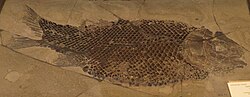
Fossil specimen of L. gigas
Scientific classification Edit this classification
Kingdom: Animalia
Phylum: Chordata
Class: Actinopterygii
Clade: Ginglymodi
Order: Lepisosteiformes
Family: Lepidotidae
Genus: Lepidotes
Agassiz, 1832[1]
Type species
Lepidotes gigas
Agassiz, 1832
Species[3]
  • L. elvensis (Blainville, 1818) (orig. Cyprinus)
  • L. gigas (type) Agassiz, 1832
  • L. semiserratus Agassiz, 1836
  • L. buelowianus Jaekel, 1929[2]
Synonyms[4]
Genus synonymy
  • Lepidosaurus Meyer, 1833
  • Serobodus Münster, 1812
  • Sphaerodus Agassiz, 1833
  • Plesiodus Wagner, 1863
  • Prolepidotus Zeitschr, 1983
Species synonymy
  • L. elvensis
  • Cyprinus elvensis de Blainville, 1818
  • Lepidotes gigas Agassiz, 1832
  • Lepidotus gigas (Agassiz, 1832) Agassiz, 1833
  • Lepidotus elcensis Quenstedt, 1847 (lapsus calami)
  • L. semiserratus
  • Lepidotus latissimus Agassiz, 1833
  • Lepidotus umbonatus Agassiz, 1833
  • L. gallineki
  • Prolepidotus gallineki (Michael, 1863) Michael, 1893
  • L. tuberculatus
  • Lepidotus unguiculatus Agassiz, 1837
  • Shaerodus minor Agassiz, 1844
  • Pycnodus rudis Phillips, 1871

Lepidotes (from Greek: λεπιδωτός lepidōtós, 'covered with scales') (previously known as Lepidotus)[5] is an extinct genus of Mesozoic ray-finned fish. It has long been considered a wastebasket taxon, characterised by "general features, such as thick rhomboid scales and, for most of the species, by semi-tritorial or strongly tritorial dentition".[clarify][6] with dozens of species assigned to it.[4] Fossils attributed to Lepidotes have been found in Jurassic and Cretaceous rocks worldwide.[7][8][9][10] It has been argued that Lepidotes should be restricted to species closely related to the type species L. gigas, which are only known from the Early Jurassic of Western and Central Europe, with most other species being not closely related, with other species transferred to new genera such as Scheenstia.[7] Lepidotes belongs to Ginglymodi, a clade of fish whose only living representatives are the gars (Lepisosteidae). The type species L. gigas and close relatives are thought to be members of the family Lepidotidae, part of the order Lepisosteiformes within Ginglymodi, with other species occupying various other positions within Ginglymodi.[7]

Description

[edit]
Fossil of L. elvensis

Inhabiting both freshwater lakes and shallow seas, Lepidotes was typically about 30 centimetres (12 in) long. The body was covered with thick, enamelled scales.[11]

Lepidotes was one of the earliest fish in which the upper jawbones were no longer attached to the jugal bone. This allowed the jaws to be stretched into a 'tube' so that the fish could suck in prey from a greater distance than in previous species.[11] This system is still seen in some modern fish, such as carp.

Lepidotes scales are ovular in shape, and are 18.5 millimetres (0.73 in) long and 3 millimetres (0.12 in) thick at the thickest point.[12] The scales are smooth and shiny on the external surface, with only a few small depressions scattered toward the centre that are shaped like punctures.[12]

Stomach contents of Lepidotes from the Early Jurassic of Germany have found remains of crustacean cuticles, and it is suggested that they fed on relatively soft-bodied prey, which was grasped with the slender marginal teeth, before being crushed by the rounded palatal teeth.[13]

Distinguishing characteristics

[edit]

Many characteristics were identified by Woodward in 1895, and they are listed below:[4]

  • a fusiform trunk only moderately compressed;
  • the fact that the marginal teeth are compressed;
  • the presence of stouter inner teeth that are smooth;
  • ossified ribs;
  • very large fin-fulera on all fins;
  • that all paired fins are small;
  • short and deep dorsal and anal fins;
  • very robust, smooth or feebly oriented scales;
  • flank scales that are not much deeper than wide;
  • scales ventrally nearly as deep as broad;
  • and the presence of inconspicuous dorsal and ventral ridge-scales.

Taxonomy

[edit]

Currently valid species after.[7]

L. gigas

[edit]

The type species of the genus, it is known from the Early Jurassic (Toarcian) of Germany.[7]

L. elvensis

[edit]

L. elvensis was described by Ducrotay de Blainville in 1818. It is known from an almost complete specimen housed in the Paris Museum of Natural History. The specimen measures up to 75 centimetres (2.46 ft) long. The specimen is from the Upper Lias, in Bavaria. The specimens P. 7406, P. 7407, P. 7408, P. 2014, P. 2054, P. 3529a, P. 3529b, 18992, 18993/94 19662, 32421, and 32422 have all been assigned to this species. The external bones of this species are smooth, but some have sparsely placed coarse tuberculations (protuberances). The frontal bone is more than twice the length of the parietal in the specimens. It also has a comparatively narrow marginal symphysis (articulation).[4] Other specimens are known from France.[7]

L. semiserratus

[edit]

This species was named by Agassiz in 1837 and is known from some incomplete remains. It has been classified as closely related to L. elvensis. It is more elongate than L. elvensis, being four times as long as tall. It also has more sharply angulated sutures between its parietals, and the parietals are also proportionally longer. It is known from the specimens P. 1127, P. 7409, P. 2012, P. 2012a, P. 3527, P. 3528, P. 3528a, P. 5213, P. 5228, P. 6394, P. 7410, and 35556, all from the Upper Lias of Yorkshire, England[4]

L. buelowianus

[edit]

Known from the Early Jurassic of (Toarcian) Germany.[7]

Reassigned species

[edit]

"Lepidotes" latifrons from the Middle-Late Jurassic of England has been reassigned to the genus Isanichthys.[14] Many other European species from the Late Jurassic-Early Cretaceous have been reassigned to Scheenstia.[7]

References

[edit]
Revisions and contributorsEdit on WikipediaRead on Wikipedia
from Grokipedia
Lepidotes is an extinct of semionotid neopterygian ray-finned belonging to the family Semionotidae within the order Semionotiformes. The genus encompasses a diverse array of that inhabited freshwater and shallow marine environments across the globe during the era, spanning from the (c. 205–201 million years ago) to the Early (c. 100–94 million years ago). First described by in 1832 based on the Lepidotes elvensis from the Lower of , , the genus has long served as a in , with over 150 nominal assigned to it over time, many of which are fragmentary, dubious, or now reassigned to other genera due to ongoing taxonomic revisions. Fossils of Lepidotes have been discovered worldwide, including notable localities in (such as and ), (), ( and ), and (), reflecting their broad paleobiogeographic distribution. Physically, Lepidotes species exhibited considerable variation but were generally characterized by robust bodies covered in lepisosteoid-type ganoid scales, often ornamented with ganoine in forms but smoother in later ones; body sizes ranged from small individuals around 30 cm in length to larger exceeding 1.5 m. These fishes possessed specialized anatomical features, including a disconnected upper for feeding, densely packed peg-like or tritoral teeth adapted for crushing hard-shelled prey, and in some , a hump-backed profile with tuberculate dermal bones on the . As carnivores, Lepidotes primarily consumed shelled mollusks like aquatic snails and hard-bodied such as larvae, using their crushing to process tough prey items. Certain , such as those co-occurring with the spinosaurid dinosaur walkeri in , are evidenced as prey for larger predators, with partially digested remains recovered from Baryonyx stomach contents.

Description

Morphology

Lepidotes represents a genus of extinct ray-finned fishes () within the clade , exhibiting a typical of many semionotiforms, with a streamlined trunk suited to aquatic environments. The body is armored by thick, enamelled, ovular (rhomboid) scales covered in a multi-layered ganoine tissue that overlays the bony base, providing robust protection against abrasion and predation. The features detached upper and lower jaws from the jugal , conferring enhanced mobility for prey capture via feeding, as evidenced by the anterior position of the jaw joint relative to the . comprises slender, peg-like marginal teeth along the jaws for grasping and rounded, bulbous palatal teeth on the and dermopalatines suited to crushing hard-shelled prey such as mollusks and exoskeletons; these palatal teeth display a tritoral arrangement, with robust, squat crowns featuring three-pointed (semi- or fully tritoral) occlusal surfaces. Skeletal elements include ossified supporting the body wall and large, robust fin-fulcra at the leading edges of fins, reinforcing the overall structural integrity of the form.

Size variation

species exhibit a notable range in body size across the genus, with many taxa attaining typical lengths of approximately 30 cm standard length, as observed in specimens from the to of where ontogenetic changes in scale ornamentation stabilize at this size. This variation is influenced by , during which juveniles display proportionally larger heads relative to body length compared to adults, a pattern documented in growth series of semionotiform fishes including Lepidotes. Certain species achieve greater dimensions; for instance, L. elvensis from the Lower Jurassic Posidonia Shale of is represented by complete specimens reaching up to 76 cm in total length. Some species, such as L. pankowskii from the , reached lengths up to 1.6 m based on skull measurements and proportional reconstructions. L. gigas, known primarily from the of , is estimated to have grown to 50-60 cm based on proportional reconstructions from preserved scale patterns and body outlines in fragmentary material. Similarly, L. gloriae from the Oxfordian of has an estimated body length of 55-60 cm derived from the holotype's preserved and scale counts. In cases of fragmentary fossils, total body size is often estimated by comparing individual scale dimensions to known body-scale ratios in complete specimens, such as those of L. mantelli, where scales maintain consistent proportions relative to overall length throughout . This method accounts for interspecific differences in scale ganoine thickness and overlap, enabling reliable reconstructions even from isolated elements.

Taxonomy and classification

Phylogenetic position

Lepidotes is classified within the kingdom Animalia, phylum Chordata, class , clade , order , and family Lepidotidae. This placement reflects its position as an extinct neopterygian within the holostean lineage, where forms one of the two primary clades of Holostei alongside Halecomorphi. The genus Lepidotes was established by in 1832, based on fossils from the of Europe, with L. gigas designated as the . Cladistic analyses confirm the monophyly of Lepidotidae, supported by synapomorphies such as reduced peg-and-socket articulation on ganoid scales and a grooved middle pit line on the roof, with Lepidotes forming a stable restricted to species from . Lepidotes shares a close phylogenetic relationship with modern gars of the family Lepisosteidae, both belonging to Lepisosteiformes, but is distinguished by its thick, rhomboidal ganoid scales featuring ganoine layers and ornamentation patterns, as well as a specialized dentition adapted for crushing, including tritoral teeth on the jaws and palate. As a basal lepisosteiform within Ginglymodi, Lepidotes plays a key role in elucidating early holostean evolution, illustrating transitional morphologies between the herbivorous or durophagous feeding strategies of basal neopterygians and the predatory adaptations seen in derived ginglymodians like gars.

Valid species

The genus Lepidotes is currently restricted to three valid species from Early Jurassic (Toarcian) deposits of central Europe, based on a cladistic analysis that emphasizes monophyly supported by synapomorphies such as the first anterior infraorbital being deeper than the posterior ones, reduced peg-and-socket articulation on scales, and specific arrangements of the middle pit line on the dermopteroticum and parietal bones. These criteria prioritize scale ornamentation, including thick ganoid scales with strong longitudinal articulation via dorsal and ventral processes, and non-tritoral tooth morphology adapted for crushing, distinguishing Lepidotes from later ginglymodians like Scheenstia. Lepidotes bülowianus Jaekel, 1929, previously included, is considered a nomen dubium due to the loss of its holotype; material from the Grimmen Formation has been reassigned to the new genus and species Mengius acutidens. The , Lepidotes gigas Agassiz, 1832, is diagnosed by its large body size, robust dentition with conical crushing teeth, and prominent scale ganoine ornamentation forming a smooth, enamelled surface; the (BSPG 1940 I 8) originates from the Formation at Holzmaden, . Lepidotes elvensis (Blainville, 1818) reaches up to 75 cm in length, featuring an elongated body, finer marginal teeth suited for grasping, and scales with subtle striations; its type locality is also the of Holzmaden, . Lepidotes semiserratus Agassiz, 1836, is characterized by serrated posterior edges on its flank scales, a moderately deep body profile, and with slightly recurved tips; the type material comes from marine deposits near and , .

Reassigned and synonymized taxa

_Lepidotes has long been recognized as a , with over 50 originally assigned to the genus based primarily on shared features like thick rhomboid scales and tritoral , leading to a polyphyletic assemblage spanning the and periods worldwide. Since the early , cladistic analyses have refined its diagnosis, resulting in the reassignment of numerous to other genera to resolve and highlight distinct morphological traits beyond scale morphology. These reassignments emphasize differences in skull structure, fin positioning, and scale articulation patterns, which vary significantly across and geography, rendering broad diagnoses unreliable. Recent work (as of 2024) has further clarified this by erecting Mengius acutidens for material from the Grimmen Formation previously referred to L. bülowianus. A prominent example involves several large European species from the to , such as Lepidotes mantelli, L. maximus, and L. laevis, which were transferred to the genus Scheenstia following phylogenetic studies that identified shared synapomorphies including a specific arrangement of suborbital bones, ventral placement, and enhanced tritoral for durophagy. Similarly, Lepidotes minor was reassigned to the newly erected Callipurbeckia based on its closer affinity to taxa like Semionotus, evidenced by differences in dorsal ridge scales and extrascapular bone count. Other species, including L. latifrons, have been moved to genera such as Isanichthys due to unique jaw and morphologies not aligning with core Lepidotes traits. Within retained species, synonymies have also been addressed; for instance, Arthur Smith Woodward in 1895 subsumed several junior synonyms under Lepidotes gigas, such as forms previously identified as L. elvensis, based on overlapping osteological features from Lower deposits, though subsequent revisions have partially reinstated distinctions using refined cladistic criteria. These efforts underscore how overlapping generic diagnoses historically contributed to taxonomic inflation, with cladistic methods now providing a more robust framework for delineating monophyletic groups. Despite these advances, reassignments remain incomplete, as many nominal species await detailed phylogenetic scrutiny, and new fossil discoveries continue to reveal morphological variability that may necessitate further taxonomic revisions.

Paleobiology

Diet and feeding mechanisms

Lepidotes employed a feeding mechanism facilitated by the detachment of the upper jawbones from the jugal bone, enabling the jaws to extend into a tubular shape for rapid intake of prey in aquatic settings. This mobility, characteristic of early lepisosteiforms, allowed for effective capture of small, evasive by generating inflow currents toward the . The robust body form and positioning further supported pursuit of moderately mobile prey, combining ram motion with suction to close the distance quickly. Direct evidence from stomach contents in specimens from reveals a diet dominated by small crustaceans, particularly shrimp-like taxa with soft exoskeletons, alongside fragments of soft-bodied . In one specimen from the Posidonienschiefer Formation (Dotternhausen), gastric remains include crushed box-like, lens-shaped, and tubular fragments up to several millimeters in size, indicating post-ingestion processing. A second specimen from the Ciechocinek Formation (Dobbertin) preserves similar elongated fragments up to 4 mm, suggesting opportunistic predation on abundant, free-living arthropods in marginal marine environments. The of Lepidotes reflects a clutching-crushing , with marginal styliform (peg-like) teeth on the jaws for grasping elusive prey and broader palatal teeth in the oral cavity for pulverizing exoskeletons. This arrangement enabled feeding on hard-bodied such as crustaceans, and possibly shelled mollusks, without the extreme specialization seen in later pycnodonts, as the teeth were robust yet not highly domed or tritoral.

Habitat preferences

Lepidotes species from the are known from a range of depositional environments, including freshwater lakes and shallow marine to brackish seas across and beyond. Fossils indicate that the genus inhabited epicontinental shelf seas, such as those represented by the in , where it co-occurred with diverse marine biota during the stage. This versatility suggests an ability to exploit varied aquatic settings, from inland freshwater bodies to coastal margins. The genus is frequently associated with lagoonal and deltaic environments, where fluctuating conditions prevailed, including periods of reduced and influx from nearby landmasses. Tolerance to low-oxygen conditions is inferred from its abundance in anoxic to dysoxic basins, such as the bituminous shales of the , which formed in stagnant, oxygen-depleted bottom waters of a shallow marine setting. The robust ganoid scales covering its body likely provided protection against predation, facilitating survival in these stratified waters. In paleoecological reconstructions, Lepidotes occupied the role of a mid-level predator within fish-dominated assemblages, preying on small crustaceans and other invertebrates as evidenced by gastric contents in well-preserved specimens. The exceptional fossil preservation in anoxic contexts like the Posidonia Shale highlights its prevalence in these ecosystems, where rapid burial in oxygen-poor sediments minimized post-mortem decay. Adaptations such as durable scales and a streamlined body shape further support its inferred euryhaline nature, enabling persistence across salinity gradients in Early Jurassic aquatic habitats.

Fossil record

Temporal distribution

Lepidotes first appeared during the , with the earliest confirmed fossils dating to approximately 199 million years ago in deposits of , such as those in the Lower Lias of , Dorset, , and equivalent strata in and . These records mark the initial radiation of the genus within semionotiform fishes, aligning with the broader post-Triassic recovery of neopterygian diversity following the end-Triassic extinction. The genus reached its peak diversity during the stage of the , around 183–174 million years ago, particularly in central European lagerstätten like the of Holzmaden, , where multiple species such as Lepidotes gigas and L. elvensis are documented. This interval coincides with the early (T-OAE), a period of global ocean anoxia and elevated temperatures that enhanced fossil preservation in organic-rich black shales but may have influenced marine and brackish-water faunal turnover, potentially limiting diversity in coastal ecosystems. The T-OAE's environmental perturbations, including widespread hypoxia, are thought to have affected the distribution and preservation of semionotiforms like Lepidotes, with exceptional soft-tissue preservation in anoxic bottom waters contributing to the abundance of articulated specimens from this time. Following the , Lepidotes underwent a marked decline by the , with the last confirmed occurrences of valid species around 170 million years ago in the early Aalenian or Bajocian stages. Although some post-Jurassic fossils have historically been assigned to Lepidotes, extending the apparent range into the (e.g., records from Las Hoyas, ), recent phylogenetic revisions restrict the genus to taxa, reassigning later forms to related genera such as Scheenstia or Lophionotus. No post-Cretaceous records exist, consistent with the broader decline of semionotiform fishes after their radiation, as ginglymodian lineages diversified toward modern lepisosteiforms and teleosts.

Geographic occurrences

Lepidotes fossils are primarily known from Western and , where they occur in several well-preserved formations. In , specimens have been recovered from the Stonesfield Slate of , a lagoonal deposit yielding articulated remains alongside terrestrial vertebrates. In , the Lower (also known as Holzmaden Shale) of , particularly at sites like Holzmaden and Ohmden, has provided exceptional preservation of complete skeletons due to anoxic bottom conditions in epicontinental seas; these localities highlight Lepidotes as a common element in marine assemblages. French sites, including the Upper limestones of the Boulonnais region, contain dental and scale fragments, while the Lusitanian Basin in (often linked to broader Western European contexts) yields scales and teeth from Kimmeridgian-Tithonian strata. In , fossils formerly assigned to Lepidotes have been reported from Jurassic and deposits in , though recent revisions may reassign many to other semionotiform genera. In , notable occurrences include Early material from the Santana Formation in (e.g., Lepidotes wenzae) and fragmentary remains from , also subject to taxonomic reassignment under modern phylogenetic frameworks. Secondary occurrences extend to other continents, reflecting wider dispersal. In , rare records include indeterminate Lepidotes sp. from western formations such as the Sundance Formation. material from the Paluxy Formation of , previously identified as Lepidotes, is now considered indeterminate or reassigned following taxonomic revisions. In , Early finds are documented from India's Kota Formation in the Deccan region. Late records include the Phu Kradung Formation in northeastern and the Qijiang locality near , (formerly including Lepidotes chungkingensis from Middle-Upper deposits, now potentially reassigned). The global distribution of Lepidotes underscores its adaptation to both marine and freshwater environments during the , facilitated by the connectivity of the Tethys Sea and the ongoing breakup of , which allowed faunal exchange across and margins. Biostratigraphic correlations, such as ammonite zonations linking the () to European and Asian sequences, confirm the temporal alignment of these sites and support interpretations of transcontinental migration pathways.

History of research

Initial discovery

The genus Lepidotes was first described by the Swiss naturalist in 1832, based primarily on distinctive rhomboidal ganoid scales recovered from deposits in and . These scales, characterized by their thick, enamelled structure, were initially collected in the early 19th century from formations such as the near Holzmaden, , and the along the English coast. Agassiz recognized their significance in distinguishing ancient actinopterygian fishes from contemporary forms, establishing Lepidotes as a key in his emerging classification of . The type species, L. gigas, was named by Agassiz for exceptionally large specimens, including partial skeletons up to 60 cm in standard length, from the Toarcian-stage Posidonia Shale of Holzmaden. These fossils highlighted the genus's robust build and scale armor, features that Agassiz contrasted with the thinner ctenoid or cycloid scales of most living teleosts. Prior to his work, such fossil scales were frequently misidentified as belonging to modern fish or dismissed as aberrant, leading to taxonomic confusion; Agassiz's detailed morphological analysis in his systematic studies clarified their distinct ganoid nature and evolutionary implications. Early contributions to the recognition of Lepidotes came from fossil collectors in , notably of , who gathered fish remains—including scales and bones—from the cliffs during the 1820s. Her discoveries, such as an exceptional specimen of the related semionotiform Dapedium politum in 1828, enriched collections that Agassiz later examined and incorporated into his descriptions. Agassiz formalized the genus in his monumental Recherches sur les Poissons Fossiles (1833–1844), where he provided comprehensive illustrations and diagnoses based on these early specimens, solidifying Lepidotes as a cornerstone of fish paleontology.

Taxonomic revisions

In the late 19th and early 20th centuries, Arthur Smith Woodward's comprehensive cataloging efforts significantly shaped the understanding of Lepidotes, as he assigned numerous species to the genus based on shared characteristics like thick rhomboid scales, thereby consolidating its scope but reinforcing its status as a wastebasket taxon for Mesozoic semionotiform-like fishes. A pivotal advancement occurred in 2012 with Andrea López-Arbarello's cladistic analysis of ginglymodian interrelationships, which redefined Lepidotes as a monophyletic genus restricted to four Early Jurassic species from central Europe—L. gigas, L. elvensis, L. semiserratus, and L. bülowianus—supported by synapomorphies such as reduced peg-and-socket articulation on scales and specific cranial features. This revision reclassified polyphyletic elements, reassigning strongly tritoral species (e.g., L. mantelli, L. maximus) to the genus Scheenstia and others like L. minor to the new genus Callipurbeckia, thereby resolving long-standing taxonomic ambiguity and placing Lepidotes within Lepisosteiformes rather than Semionotiformes. Subsequent research, such as the 2019 study (published 2021) by Detlev Thies and colleagues, examined stomach contents in Lepidotes specimens from , revealing preserved remains that not only illuminated durophagous feeding but also aided taxonomic differentiation by confirming morphological consistency within valid like L. gigas. Despite these progresses, taxonomic challenges persist, with approximately 20 still incompletely reassigned from the historical wastebasket, necessitating further cladistic studies, new discoveries since 2012, or integrative approaches like molecular clocks to refine evolutionary relationships and validate the reduced monophyletic core of 4–5 .

References

Add your contribution
Related Hubs
User Avatar
No comments yet.