


Community hub
Recent from talks
Contribute something
Nothing was collected or created yet.
Cyprinus
View on Wikipedia
| Typical carps Temporal range: Miocene–recent
| |
|---|---|

| |
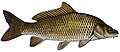
| Wild-type common carp (C. carpio) | |
Scientific classification 
| |
| Kingdom: | Animalia |
| Phylum: | Chordata |
| Class: | Actinopterygii |
| Order: | Cypriniformes |
| Family: | Cyprinidae |
| Subfamily: | Cyprininae |
| Genus: | Cyprinus Linnaeus, 1758 |
| Type species | |
| Cyprinus carpio | |
| Species | |
| Synonyms | |
| |
Cyprinus /sɪˈpraɪnəs/ is the genus of typical carps in family Cyprinidae. Most species in the genus are of East Asia origin with only the common carp (C. carpio) in Western Asia and Europe; this invasive species has also been introduced to many other regions around the world.[1] Cyprinus are closely related to some more barb-like genera, such as Cyclocheilichthys and Barbonymus (tinfoils). The crucian carps (Carassius) of western Eurasia, which include the goldfish (C. auratus), are apparently not as closely related.[2]
This genus's most widespread and well-known member is the common carp (C. carpio) species complex. Although traditionally considered a single species, recent authorities have split the European and West Asian populations from the East Asian, with the latter named C. rubrofuscus (syn. C. carpio haematopterus).[3][4] Members of the species complex are famed as a food fish and have been widely traded and introduced since antiquity, but in certain areas has multiplied inordinately and become a pest. In its long use it has been domesticated, and a number of breeds have been developed for food and other purposes. The koi (from Japanese nishikigoi, 錦鯉) are well-known carp breeds, selectively bred for being enjoyed by spectators from above. Strictly speaking, koi is simply the Japanese name of the East Asian carp.
The other species of typical carp are generally found in more restricted areas of eastern Asia, centered on the Yunnan region. In some cases, they are endemic to a single lake, most notably Lake Erhai, as well as Lake Dian, Fuxian Lake, Lake Jilu, Lake Qilihu, Lake Xingyun and Lake Yi-Lung, which are all in Yunnan proper. Several of these species are seriously threatened and five are possibly already extinct: C. yilongensis (Lake Yi-Lung), C. yunnanensis (Lake Qilihu), C. daliensis (Lake Erhai), C. megalophthalmus (Lake Erhai) and C. fuxianensis (Fuxian Lake).[5][6][7]
Species
[edit]
The following species are currently recognized in the genus.[8]
- Cyprinus acutidorsalis H. L. Chen & H. Q. Huang, 1977
- Cyprinus barbatus H. L. Chen & H. Q. Huang, 1977
- Cyprinus carpio Linnaeus, 1758
- Cyprinus chilia H. W. Wu, G. R. Yang, P. Q. Yue & H. J. Huang, 1963
- Cyprinus dai (V. H. Nguyễn & L. H. Doan, 1969)
- Cyprinus daliensis H. L. Chen & H. Q. Huang, 1977
- Cyprinus exophthalmus Đ. Y. Mai, 1978
- Cyprinus fuxianensis Yang et al., 1977
- Cyprinus hieni T. T. Nguyen & A. T. Ho, 2003
- Cyprinus hyperdorsalis V. H. Nguyễn, 1991
- Cyprinus ilishaestomus H. L. Chen & H. Q. Huang, 1977
- Cyprinus intha Annandale, 1918
- Cyprinus longipectoralis H. L. Chen & H. Q. Huang, 1977
- Cyprinus longzhouensis Y. J. Yang & H. Q. Huang, 1977
- Cyprinus megalophthalmus H. W. Wu et al., 1963
- Cyprinus melanes (Đ. Y. Mai, 1978)
- Cyprinus micristius Regan, 1906
- Cyprinus multitaeniatus Pellegrin & Chevey, 1936
- Cyprinus pellegrini T. L. Tchang, 1933
- Cyprinus qionghaiensis C. H. Liu, 1981
- Cyprinus quidatensis T. T. Nguyen, V. T. Le, T. B. Le & X. K. Nguyễn, 1999
- Cyprinus rubrofuscus Lacépède, 1803

- †Cyprinus yilongensis Yang et al., 1977
- Cyprinus yunnanensis T. L. Tchang, 1933
.jpg)

Fossil species
[edit]- †Cyprinus priscus von Meyer (fossil species from Miocene Germany)
Footnotes
[edit]- ^ "Cyprinus carpio". ISSG. 4 October 2010. Retrieved 26 February 2017.
- ^ de Graaf et al. (2007)
- ^ Huckstorf, V. (2012). "Cyprinus rubrofuscus". IUCN Red List of Threatened Species. 2012 e.T166052A1108337. doi:10.2305/IUCN.UK.2012-1.RLTS.T166052A1108337.en. Retrieved 12 November 2021.
- ^ Froese, Rainer; Pauly, Daniel (eds.). "Cyprinus rubrofuscus". FishBase. February 2017 version.
- ^ Zhou, W. (2011). "Cyprinus yilongensis". IUCN Red List of Threatened Species. 2011 e.T6179A12546193. doi:10.2305/IUCN.UK.2011-2.RLTS.T6179A12546193.en. Retrieved 12 November 2021.
- ^ Cui, K. (2011). "Cyprinus yunnanensis". IUCN Red List of Threatened Species. 2011 e.T166169A6186294. doi:10.2305/IUCN.UK.2011-2.RLTS.T166169A6186294.en. Retrieved 12 November 2021.
- ^ Wang, Wang, Li, Du, Yang, Lassoie, and Hassan (2013). Six decades of changes in vascular hydrophyte and fish species in three plateau lakes in Yunnan, China. Biodivers. Conserv. 22: 3197–3221. doi: 10.1007/s10531-013-0579-0
- ^ Froese, Rainer; Pauly, Daniel (eds.). "Species in genus Cyprinus". FishBase. February 2017 version.
References
[edit]

- de Graaf, Martin; Megens, Hendrik-Jan; Samallo, Johannis & Sibbing, Ferdinand A. (2007): Evolutionary origin of Lake Tana's (Ethiopia) small Barbus species: indications of rapid ecological divergence and speciation. Anim. Biol. 57(1): 39–48. doi:10.1163/157075607780002069 (HTML abstract)
| National | |
|---|---|
| Other | |

Cyprinus
View on GrokipediaTaxonomy
Etymology and History
The genus name Cyprinus derives from the Latin cyprinus, which itself originates from the ancient Greek kyprinos (κυπρίνος), referring to a carp-like fish noted for its bronze or henna-like coloration. This term appears in classical texts, such as Pliny the Elder's Naturalis Historia (Book 9, sections 29 and 58), where cyprinus is described as a freshwater fish occasionally found in brackish or marine environments like the Black Sea, often mentioned alongside the silurus (catfish) and characterized by its vulnerability to lightning strikes.[11] The name's etymology may also allude to the fecundity of the fish, indirectly linking to the Greek kúpris (κύπρις), a epithet for Aphrodite, goddess associated with Cyprus and fertility, though the primary association remains with the fish's appearance in ancient Mediterranean ichthyological observations.[12] The genus Cyprinus was formally established in the 10th edition of Carl Linnaeus's Systema Naturae in 1758, where it was introduced as a taxonomic category within the class Pisces. Linnaeus designated Cyprinus carpio—the common carp—as the type species by monotypy, providing a binomial nomenclature that encompassed the carp's distinctive features, such as its robust body and barbels, based on European specimens.[13] This classification marked a pivotal moment in systematic ichthyology, integrating observations from earlier naturalists into a hierarchical framework that emphasized morphological traits for genus-level distinction.[14] Subsequent taxonomic revisions refined the genus's scope, particularly for Asian species. In 1936, Paul W. Fang proposed the subgenus Mesocyprinus in the journal Sinensia to accommodate certain East Asian forms, such as Cyprinus micristius, distinguished by fewer branched dorsal-fin rays and other meristic differences from the nominate subgenus.[15] Earlier, in 1803, Bernard-Germain-Étienne de La Ville-sur-Illon (Lacepède) contributed to the genus's diversification in his Histoire naturelle des poissons (Volume 5), where he described Cyprinus rubrofuscus—a reddish-brown variant from Chinese waters—as a distinct species based on coloration and habitat notes, illustrated on plate 16, figure 1, laying groundwork for recognizing intraspecific variation within Cyprinus.[16] These developments highlighted the genus's morphological plasticity and geographic breadth within the Cyprinidae family.[17]Classification
The genus Cyprinus is classified within the kingdom Animalia, phylum Chordata, class Actinopterygii, order Cypriniformes, family Cyprinidae, and subfamily Cyprininae.[18][19] Phylogenetic analyses using molecular data, including mitochondrial DNA (mtDNA) such as cytochrome b and control regions, as well as nuclear genes like recombination activating gene 2 (RAG2), have confirmed that Cyprinus forms a monophyletic group with origins in East Asia during the mid-Eocene.[4][20] Within the genus, subgeneric divisions have been proposed, such as the subgenus Mesocyprinus Fang, 1936, which includes species like C. yilongensis based on cladistic analyses of morphological traits including fin ray counts and body proportions.[21][17] Ongoing taxonomic debates center on the common carp (C. carpio), particularly whether to recognize multiple subspecies such as C. c. carpio (European), C. c. haematopterus (East Asian), and others, as molecular phylogenies using mtDNA and nuclear markers reveal varying levels of genetic divergence that challenge traditional morphological distinctions.[22][4] As of 2025, approximately 24 species are recognized in the genus Cyprinus, with 19 extant and 5 possibly extinct according to FishBase and IUCN assessments, including critically endangered taxa like C. fuxianensis and the confirmed extinct C. yilongensis.[18]Physical Description
Morphology
The genus Cyprinus is characterized by fish possessing an elongated, robust body form that is deep and laterally compressed, providing a fusiform profile adapted for freshwater environments. Scales are large, thick, and cycloid, covering the body in a regular pattern with typically 32-39 along the lateral line. This morphology contributes to their streamlined yet sturdy build, with body height ranging from 1:3.2 to 4.8 times the standard length in wild forms.[23][9] The head features a terminal, protrusible mouth equipped with thick lips suitable for bottom-feeding, often accompanied by two pairs of barbels (rostral and maxillary) that aid in sensory detection. Pharyngeal teeth are arranged in three rows on robust, molar-like bones, typically in the formula 1,1,3-3,1,1, which is a defining trait of the Cyprinidae family. Eyes are relatively small, positioned laterally for vigilance in turbid waters.[23][9] Fins include a dorsal fin with 3-4 spines and 17-23 soft rays, the last unbranched ray often strong and weakly serrated; the anal fin has 2-3 spines and 5-7 soft rays, with the last simple ray bony and serrated. The caudal fin is deeply forked, comprising 3 spines and 17-19 rays, while paired fins are pectoral and pelvic, with the latter positioned abdominal. Size varies across the genus, with C. carpio reaching up to 120 cm in total length and 40 kg, whereas smaller species average 20-40 cm.[23][9][24] Coloration in wild Cyprinus species is typically olive-green to golden-brown on the dorsal surface, transitioning to silvery or yellowish sides and a white ventral area, often with irregular dark spots. Domesticated variants, such as koi derived from C. rubrofuscus, exhibit striking multicolored patterns including reds, whites, and blacks. Species-specific variations in fin ray counts and overall proportions occur but maintain the core cyprinid structure.[23][9][24]Variations Among Species
Cyprinus species exhibit notable morphological variations, particularly in sensory structures like barbels, which are present in most taxa but absent in specialized forms such as C. pellegrini, a barbless carp endemic to lakes in Yunnan Province, China, where the lack of barbels reflects adaptations to planktonic feeding in open water.[25] In contrast, C. carpio, the common carp, possesses four prominent barbels—two rostral and two maxillary— aiding in bottom foraging across diverse substrates.[26] Scale patterns show significant diversity within the genus, most prominently in domesticated lineages of C. carpio. Wild-type individuals feature large, regularly arranged scales covering the body, providing robust protection. However, selective breeding has produced mirror carp variants with reduced and irregularly distributed scales, often forming linear or scattered patterns along the lateral line and flanks, which can comprise as few as 20-40% of the typical scale count. Leather carp, another variant, display even fewer scales—sometimes only a few scattered along the dorsal and lateral lines—resulting in a nearly naked appearance due to a recessive genetic trait affecting scale development. Body proportions vary among species adapted to specific lacustrine environments. High-altitude species like C. dai from northern Vietnam's Black River basin show more elongated body forms suited to flowing, oxygenated streams.[27] Coloration extremes highlight adaptive and ornamental divergences. C. rubrofuscus, the wild progenitor of koi carp, displays silvery body hues with reddish pigmentation in the pelvic, anal, and lower caudal fins, a pattern intensified through selective breeding to produce vibrant red, orange, and white variants in ornamental strains.[24] Size disparities underscore the genus's ecological breadth, ranging from giant forms like C. carpio, which can attain lengths of 120 cm and weights exceeding 40 kg in optimal conditions, to dwarf species such as C. chilia from Yunnan's plateau lakes, where maximum total length is limited to 16.8 cm, reflecting constraints of isolated, nutrient-poor habitats.[23][28]Habitat and Distribution
Native Habitats
The genus Cyprinus is native primarily to East Asia, with the majority of its species endemic to freshwater systems in China, particularly the plateau lakes of Yunnan Province, as well as regions in Vietnam and Myanmar. These habitats include isolated tectonic lakes such as Dian Chi, Fuxian Lake, Erhai Lake, Qilu Lake, and Xingyun Lake in Yunnan, where species like C. micristius, C. fuxianensis, C. longipectoralis, C. yunnanensis, and C. pellegrini are restricted. In Myanmar, C. intha is confined to Inle Lake in the upper Irrawaddy basin on the Shan Plateau, while in Vietnam, species such as C. rubrofuscus occur in drainages like the Red River.[29][30][31][32][33] Cyprinus species inhabit freshwater rivers, lakes, and wetlands characterized by slow-moving or still waters, often preferring vegetated shallows and muddy or soft-bottom substrates that support their foraging behaviors. For instance, C. micristius in Dian Chi thrives in calm waters abundant with aquatic vegetation, while C. yunnanensis in Qilu Lake occupies shallow areas with plants in the middle and lower water layers. These environments provide cover and food resources, including invertebrates and plant matter, in systems with minimal current.[30][34] Altitudinal variation is notable across the genus, with C. carpio favoring lowland rivers and basins below 500 m in eastern Asia, whereas Yunnan-endemic species occupy high-elevation plateau lakes ranging from approximately 1,700 to 2,700 m above sea level, such as Fuxian Lake at 1,721 m and Erhai Lake at 1,972 m. These elevated habitats feature cooler temperatures and oligotrophic to eutrophic conditions suited to the adaptive physiology of local Cyprinus taxa.[34][35] Cyprinus species exhibit tolerance to variable water quality, including low dissolved oxygen levels as low as 0.3–0.5 mg/L and high turbidity, enabling persistence in seasonally fluctuating or degraded native systems. This resilience is evident in Yunnan lakes, where eutrophication has altered conditions but endemic species like C. chilia continue to inhabit profundal zones with soft sediments. High endemism underscores vulnerability, as many species, such as C. intha in [Inle Lake](/page/Inle Lake), are restricted to single water bodies prone to isolation and localized threats.[23][36][37][31]Global Introduction and Invasiveness
The common carp (Cyprinus carpio), native to freshwater systems across Eurasia from the Black Sea basin to East Asia, has been extensively translocated by humans beyond its indigenous range, primarily for aquaculture and food production. Historical records indicate that the Romans facilitated its initial widespread dissemination in Europe during the 1st century AD, transporting stocks from the Danube River to establish pond cultures across the empire. Subsequent medieval monastic practices in Europe further expanded its cultivation, while global trade and colonization propelled introductions to distant continents: to Australia via ornamental and aquaculture imports in the 1850s–1870s, and to the Americas starting in the mid-19th century, with successful establishments in the United States by the 1870s through federal fish stocking programs. These anthropogenic dispersals have resulted in C. carpio becoming one of the most widely introduced fish species, absent only from polar regions like Antarctica due to unsuitable cold-water conditions.[38][39][40][41] Today, non-native populations of C. carpio are established in over 90 countries across temperate and tropical zones, including extensive distributions in North America—such as the Great Lakes and Mississippi River basin—Australia's Murray-Darling Basin, and various African river systems like the Nile and Zambezi. In these regions, the species thrives in eutrophic, lowland rivers, lakes, and reservoirs, often reaching high densities that alter local hydrology and biota. While other Cyprinus species, such as East Asian endemics like C. rubrofuscus (commonly associated with koi varieties), have seen limited experimental introductions for ornamental or aquaculture purposes, most have failed to establish self-sustaining wild populations outside their native Asian habitats.[42][6][43] C. carpio is classified as invasive in more than 100 countries, where its foraging behaviors—rooting in sediments with its pharyngeal teeth and carp-like mouth—uproot aquatic vegetation, resuspend nutrients, and elevate water turbidity, thereby reducing light penetration and primary productivity essential for native flora and invertebrates. These actions cascade through food webs, intensifying algal blooms, diminishing habitat for sight-feeding fish and waterfowl, and enabling competitive dominance over endemic species for resources like plankton and benthic organisms, which can lead to biodiversity declines of up to 50% in heavily invaded shallow lakes. In North American wetlands, for instance, carp invasions have been linked to reduced populations of native cyprinids and amphibians by altering spawning substrates and oxygen levels.[38][42][44][6][45] Efforts to mitigate C. carpio invasiveness include targeted control programs, such as Australia's National Carp Control Plan (NCCP), initiated in 2018 and ongoing as of 2025, which integrates physical removal, habitat restoration, and biological agents like the Cyprinid herpesvirus 3 to potentially reduce populations by 40–80% in priority waterways. The NCCP's virus release trials, planned for late 2025 pending environmental approvals, aim to address the species' dominance in over 80% of the Murray-Darling Basin's biomass without broadly impacting non-target natives. Similar strategies in North America, including commercial harvesting and barriers in the Great Lakes, underscore global recognition of the need for multifaceted interventions to curb ecological disruptions.[46][47][48]Species Diversity
Extant Species
The genus Cyprinus encompasses 24 recognized species of carp, all native to freshwater systems across Asia, particularly in China, Myanmar, and Vietnam, with one species (C. carpio) widely introduced worldwide for aquaculture and ornamental purposes.[18] Of these, 19 are confirmed extant based on recent records, while 5 are classified by the IUCN as Extinct or Critically Endangered (possibly extinct), including C. yilongensis (Extinct, last sighted in Lake Yilong, China, during the 1980s), C. micristius (Critically Endangered, possibly extinct, Dianchi Lake endemic), C. qionghaiensis (Critically Endangered, possibly extinct, Qionghai Lake), C. yunnanensis (Critically Endangered, possibly extinct, Dianchi Lake), and C. quidatensis (Data Deficient, northern Vietnam). Many extant species are endemic to specific lakes or river basins and face threats from habitat loss and hybridization, leading to numerous IUCN listings as critically endangered or endangered (as of IUCN Red List version 2025-1).[49] The following table summarizes the 19 confirmed extant species, highlighting key characteristics such as maximum reported length, native distribution, and IUCN Red List status (where assessed; unassessed species lack formal evaluation but are presumed extant from distributional records, as of IUCN Red List version 2025-1). Lengths are approximate maxima from verified specimens.[18][49]| Scientific Name | Common Name (if applicable) | Max Length (cm) | Native Distribution | IUCN Status |
|---|---|---|---|---|
| C. acutidorsalis | - | 27 (SL) | Upper Yangtze River basin, China | Data Deficient |
| C. barbatus | Erhai carp | 35 (OT) | Erhai Lake, Yunnan, China | Critically Endangered (possibly extinct) |
| C. carpio | Common carp | 120 (TL) | Central Asia to East Asia; globally introduced | Least Concern |
| C. chilia | - | 16.8 (TL) | Dian Lake, Yunnan, China | Endangered |
| C. dai | - | - | Lancang River basin, China | Data Deficient |
| C. daliensis | - | 24.5 (SL) | Dali region lakes, Yunnan, China | Vulnerable |
| C. exophthalmus | - | - | Upper Yangtze, China | Data Deficient |
| C. fuxianensis | Fuxian carp | 22.2 (SL) | Fuxian Lake, Yunnan, China | Critically Endangered (possibly extinct) |
| C. hieni | - | - | Red River basin, Vietnam | Data Deficient |
| C. hyperdorsalis | - | - | Upper Yangtze, China | Data Deficient |
| C. ilishaestomus | Topmouth carp | 30 (NG) | Upper Yangtze, China | Critically Endangered |
| C. intha | Inle carp | 30 (NG) | Inle Lake, Myanmar | Endangered |
| C. longipectoralis | - | 35 (OT) | Upper Yangtze, China | Critically Endangered |
| C. longzhouensis | - | 17.7 (SL) | Longzhou region, China | Data Deficient |
| C. megalophthalmus | - | 24.2 (SL) | Upper Yangtze, China | Critically Endangered |
| C. melanes | - | - | Mekong River basin, Vietnam | Data Deficient |
| C. multitaeniatus | - | 42 (TL) | Irrawaddy River, Myanmar | Endangered |
| C. pellegrini | Barbel-less carp | 30 (TL) | Yangtze River basin, China | Critically Endangered |
| C. rubrofuscus | Koi carp | 28 (SL) | East Asia (Japan, China); ornamental | Not Evaluated |