Hubbry Logo
SphexSphexMain
Open search
Sphex
Community hub
Sphex
logo
8 pages, 0 posts
0 subscribers
Be the first to start a discussion here.
Sphex
Sphex
from Wikipedia

Sphex
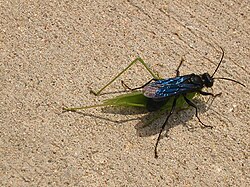
Sphex pensylvanicus on a katydid
Scientific classification Edit this classification
Kingdom: Animalia
Phylum: Arthropoda
Class: Insecta
Order: Hymenoptera
Superfamily: Apoidea
Family: Sphecidae
Subfamily: Sphecinae
Tribe: Sphecini
Genus: Sphex
Linnaeus, 1758
Type species
Sphex flavipennis
Fabricius, 1793
Species

More than 130; see text

Sphex is a genus of cosmopolitan wasp that sting and paralyze prey insects. Sphex is one of many genera in the old digger wasp family Sphecidae (sensu lato), though most apart from the Sphecinae have now been moved to the family Crabronidae.[1] There are over 130 known Sphex species.

Behavior

[edit]

In preparation for egg laying, they construct a protected "nest" (some species dig nests in the ground, while others use pre-existing holes) and then stock it with captured insects. Typically, the prey are left alive, but paralyzed by wasp toxins. The wasps lay their eggs in the provisioned nest and the wasp larvae feed on the paralyzed insects as they develop.

The great golden digger wasp (Sphex ichneumoneus) is found in North America. The developing wasps spend the winter in their nest. When the new generation of adults emerge, they contain the genetically programmed behaviors required to carry out another season of nest building. During the summer, a female might build as many as six nests, each with several compartments for her eggs. The building and provisioning of the nests takes place in a stereotypical, step-by-step fashion.

The Sphex Wasp Experiment

[edit]

Sphex has been shown, as in some Jean-Henri Fabre studies,[2] not to count how many crickets it collects for its nest. Although the wasp instinctively searches for four crickets, it cannot take into account a lost cricket, whether the cricket has been lost to ants or flies or simply been misplaced. Sphex drags its cricket prey towards its burrow by the antennae; if the antennae of the cricket are cut off, the wasp would not think to continue to pull its prey by a leg.

The navigation abilities of Sphex were studied by the ethologist Niko Tinbergen.[3] Richard Dawkins and Jane Brockmann later studied female rivalry over nesting holes in Sphex ichneumoneus.[4]

Use in philosophy

[edit]

Some writers in the philosophy of mind, most notably Daniel Dennett, have cited the results of the Sphex Wasp Experiment for their arguments about human and animal free will.[5]

Some Sphex wasps drop a paralyzed insect near the opening of the nest. Before taking provisions into the nest, the Sphex first inspects the nest, leaving the prey outside. During the inspection, an experimenter can move the prey a few inches away from the opening. When the Sphex emerges from the nest ready to drag in the prey, it finds the prey missing. The Sphex quickly locates the moved prey, but now its behavioral "program" has been reset. After dragging the prey back to the opening of the nest, once again the Sphex is compelled to inspect the nest, so the prey is again dropped and left outside during another stereotypical inspection of the nest. This iteration can be repeated several times without the Sphex changing its sequence; by some accounts, endlessly. Dennett's argument quotes an account of Sphex behavior from Dean Wooldridge's Machinery of the Brain (1963).[6] Douglas Hofstadter[7] and Daniel Dennett[5] have used this mechanistic behavior as an example of how seemingly thoughtful behavior can actually be quite mindless, the opposite of free will (or, as Dennett described it, sphexishness).

Philosopher Fred Keijzer challenges this use of Sphex, citing experiments in which behavioral adaptations are observed after many iterations. Keijzer sees the persistence of the Sphex example in cognitive theory as an indication of its rhetorical usefulness, not its factual accuracy.[8] Keijzer also noted that repeated inspection of a disturbed nest may very well be an adaptive behavior, thus diminishing the aptness of Hofstadter's metaphor.[8]

Species

[edit]
Sphex argentatus
Sphex funerarius with prey
Great golden digger wasp on narrow leaf milkweed. Part is shown at one tenth speed.

The genus Sphex contains 132 extant species:[9]

Fossil Species

[edit]

References

[edit]
[edit]
Revisions and contributorsEdit on WikipediaRead on Wikipedia
from Grokipedia
Sphex is a of cosmopolitan, solitary digger wasps in the subfamily Sphecinae of the family (Hymenoptera), characterized by their predatory behavior on orthopteran such as katydids, grasshoppers, and , which females paralyze and provision in underground nests for their larvae. The genus Sphex was established by in 1758, with Sphex flavipennis Fabricius, 1793, designated as the by the in 1946. It currently encompasses approximately 132 to 148 valid species, though taxonomic revisions continue to refine this number through synonymies and transfers to related genera like Isodontia and Prionyx. The highest species diversity occurs in the Afrotropical and Australasian regions, with notable in and . Morphologically, Sphex species are moderate to large wasps, typically measuring 15–35 mm in length, with a slender, thread-waisted body, long legs adapted for digging, and often striking golden or metallic coloration on the and . Diagnostic features include a hind tibial spur that is finely pectinate and wing venation where the basal veinlet of the second submarginal cell is shorter than the anterior veinlet, along with a petiole shorter than the combined lengths of hind tarsomeres II–IV. Biologically, Sphex wasps are univoltine or bivoltine depending on , with females constructing ground burrows—often in sandy or loose —that consist of a main leading to 3–10 individual cells. Each cell is stocked with 5–20 paralyzed orthopterans, to which a single is attached, typically on the prey's second abdominal segment; the resulting consumes the provisioned insects before pupating in a cocoon. While most species are solitary, some exhibit gregarious nesting in aggregations or even joint nest construction, and adults nectar-feed on flowers, contributing to . Nesting involves precise depth regulation, with females adjusting burrow length based on conditions to reach optimal depths of 10–30 cm. Notable species include the great golden digger wasp (S. ichneumoneus) of , known for its bright golden pubescence and stereotyped provisioning routines studied in , and S. pensylvanicus in , which preys on similar orthopterans in open habitats. These wasps are generally non-aggressive toward humans and play a key role in controlling pest orthopteran populations.

Taxonomy

Etymology and history

The genus Sphex derives its name from the word σφήξ (sphēx), meaning "wasp," reflecting its association with predatory wasp species. This etymological root was adopted by , who formally established the genus in the 10th edition of Systema Naturae in 1758, classifying it under the order within the class Insecta. In Linnaeus's initial framework, Sphex encompassed a diverse array of Hymenoptera species exhibiting wasp-like characteristics, including forms now recognized in distinct genera such as Ammophila and Pompilus. This broad inclusion stemmed from the limited morphological distinctions available at the time, with Linnaeus listing several species based primarily on limited specimens and descriptions from European collections. The , Sphex flavipennis, was described by in 1793 in his Entomologia Systematica Emendata et Aucta, adding to the genus's scope with a Mediterranean representative. However, due to ambiguities in Linnaeus's original species assignments, the officially designated S. flavipennis as the in Opinion 180 (1946), stabilizing the genus's nomenclatural foundation and resolving earlier uncertainties. During the 19th century, entomological advancements significantly refined Sphex, narrowing its boundaries through systematic revisions and regional catalogs. Pioneering works by (e.g., 1809 classifications of ) and Maximilian Spinola (1807–1843 studies on Hymenopteran genera) provided morphological criteria to separate Sphex from related groups, emphasizing traits like body structure and wing venation. Further contributions from Frederick Smith, in his 1858 Catalogue of Hymenopterous Insects in the Collection of the , detailed British and exotic species, facilitating the exclusion of misassigned taxa and solidifying Sphex as a core element of the digger wasp subfamily Sphecinae.

Classification and subgenera

The genus Sphex Linnaeus, 1758, is classified within the family Latreille, 1802, which in modern is restricted to the subfamily Sphecinae Latreille, 1802, following the revision of the former Sphecidae sensu lato into separate families and based on phylogenetic analyses. Historically, Sphex was placed in the broader Sphecidae sensu lato, but contemporary classifications, including Pulawski's ongoing catalog, maintain Sphecinae as a distinct family encompassing thread-waisted wasps like Sphex. Within Sphecinae, Sphex belongs to the tribe Sphecini Ashmead, 1903, which is distinguished from other tribes by specific morphological traits, including the presence of pronotal lobes that are acute and project forward, as well as characteristic wing venation patterns such as the reduced second submarginal cell. These features help differentiate Sphecini genera from related groups like Larrini, emphasizing the tribe's monophyletic status supported by both morphological and molecular data. The genus Sphex is subdivided into several subgenera, with approximately 148 extant recognized worldwide as of recent catalogs (as of 2025). The nominotypical subgenus Sphex s.str. includes many and cosmopolitan , characterized by traits such as a densely punctate propodeum and specific setal arrangements on the . Key subgenera include Fernaldina Bohart & Menke, 1963, primarily for like S. lucae Cockerell, 1907, diagnosed by features such as reduced wing venation and unique tibial spines; and Menkeella Dörfel & Ohl, 2022, established for Afrotropical and Australian taxa like S. paulinierei Bingham, 1896, separated by distinct propodeal setae orientation and male genitalic structures. These subgenera are delineated based on combinations of morphological characters, including variations in pronotal morphology and forewing venation, as detailed in regional revisions. Phylogenetically, Sphex is closely related to genera such as Prionyx Vanden Linden, 1827, and Isodontia Patton, 1879, within Sphecini, with shared synapomorphies in wing venation and body setation supported by both morphological and molecular phylogenies of . For instance, analyses indicate that Sphecinae, including these genera, form a paraphyletic assemblage relative to other apoid wasps, with Sphex nesting near Prionyx in trees derived from combined and data. Reclassifications of between Sphex, Prionyx, and Isodontia underscore these affinities, as seen in synonymies like S. aegyptius Linnaeus, 1761, now under Prionyx crudelis (Vanden Linden, 1827).

Description

Morphology

Sphex wasps are moderate to large solitary wasps, with body lengths typically ranging from 15 to 35 mm, though the genus encompasses species varying from 11 to 47 mm overall. The body features a distinctive thread-waisted or petiolate structure, where the is attached to the by a slender petiole that is usually shorter than the combined lengths of hindtarsomeres II–IV. This petiolate contributes to the genus's characteristic , with the metasoma often finely pubescent and segmented. The head is broad and equipped with large compound eyes that slightly converge dorsally toward the ocelli, providing wide visual coverage. Mandibles are robust and typically bidentate at the apex, suited for excavating . The is robust and densely setose, with strong forelegs armed with spines on the tibiae and femora for digging; hind femora are particularly thickened and robust. The wings are membranous, ranging from to fuscous, with forewings exhibiting a characteristic venation pattern including three submarginal cells. The abdomen terminates in a longer , modified as a for paralyzing prey, while males lack this extension. Sensory structures include filiform antennae with 12 segments in females and 13 in males, the apical segments often thickened for chemosensory functions, and dense setae covering the head, , and to detect environmental cues during activities like excavation.

Coloration and variation

Species of the genus Sphex display diverse coloration, predominantly featuring metallic golden, silvery, or black hues, often accented by red, yellow, or ferruginous markings on the legs, , or wings. For instance, S. ichneumoneus is notable for its overlaid with golden pubescence on the head and , reddish-orange legs, and a bicolored with the first segment reddish-orange. Similarly, S. sericeus exhibits metallic golden and silvery patterns that contribute to its distinctive appearance. Pubescence density varies across species, enhancing metallic sheens and aiding in visual differentiation. Sexual dimorphism in coloration is present in the genus, with males typically more extensively black and possessing paler wings than females, alongside denser pubescence on the mesosoma and metasomal that can impart a more iridescent quality. Females, in contrast, often appear duller with less extensive black pigmentation and flatter scutellar structures. However, the degree of dimorphism varies by species; for example, S. ichneumoneus shows no significant color differences between sexes. Intraspecific variation is common, influenced by geographic and climatic factors, such as increased ferruginous (reddish) coloration on the in arid regions compared to humid areas. In S. procerus, red pigmentation is minimal near humid coastal zones but maximal in arid inland areas like and , with intermediate forms in semi-arid regions varying seasonally with humidity. Similarly, S. sericeus displays regional color variants, including like S. sericeus fabricii, where pubescence density and hue differ across populations. Such variations in color and pubescence affect overall appearance and are key for identification in taxonomic keys.

Distribution and habitat

Global distribution

The genus Sphex exhibits a , occurring on all continents except , with approximately 132 recognized species worldwide. This broad range reflects the genus's adaptability to diverse environments, though species diversity is highest in tropical regions, particularly the Afrotropical and Australasian realms, where numerous endemics and widespread taxa contribute to elevated richness. In the Nearctic region, Sphex species are well-represented across , with S. pensylvanicus distributed from through the to , exemplifying the genus's extension into temperate zones. occurs in restricted areas, such as S. ashmeadi, which is largely confined to the , including , and adjacent parts of . The Palearctic region hosts around 19 species, spanning , , and , with taxa like S. maxillosus showing broad continental coverage. The Australasian realm includes native species in Australia, as detailed in a 2015 taxonomic revision that recognizes multiple endemic forms such as S. argentatissimus in northern Australia. Overall, the genus displays a pantropical core with Holarctic extensions, facilitated by natural dispersal mechanisms like wind currents.

Habitat preferences

Sphex species exhibit a strong preference for sandy or loose soils that allow for efficient nest excavation, typically selecting substrates with optimal compactness to balance stability and diggability, while avoiding heavily compacted clay that hinders burrowing. Well-drained sandy s are commonly favored, as seen in species like , which excavate nests in such soils to ensure proper drainage and warmth for larval development. These preferences extend across the , with also utilizing bare or sparsely vegetated loose in full sun for nesting. In terms of vegetation associations, Sphex wasps thrive in open, sunny habitats such as fields, meadows, and grasslands, where thermophilic conditions and sparse plant cover facilitate foraging and nesting. These environments often feature nectar-rich like milkweeds (Asclepias spp.), goldenrods (Solidago spp.), and mountain mints (Pycnanthemum spp.), providing essential resources without dense overgrowth that could obstruct ground-level activities. The favors disturbed microhabitats, including lawns, paths, and urban edges, where nest aggregations—ranging from a few to hundreds of individuals—commonly form in bare patches. Climate plays a key role in Sphex habitat suitability, with the genus distributed across temperate to tropical zones, preferring moderate temperatures and at low altitudes. In cooler regions within their ranges, species enter to overwinter, as observed in Sphex harrisi, allowing persistence in seasonal climates. Activity periods vary latitudinally, extending from April to November in southern areas and shortening to June through September in northern ones, underscoring their adaptation to warmer exposures.

Biology

Life cycle

Sphex wasps exhibit a solitary life cycle characterized by complete , progressing through , larval, pupal, and stages, typically univoltine with one per year in temperate regions, though bivoltine in warmer climates. Females lay singly, attaching a single to the ventral surface of a paralyzed orthopteran prey within an individual nest cell; the incubates for 2–3 days before hatching. The newly hatched is legless and feeds externally on the still-living but immobilized host, beginning with non-vital areas such as the to prolong the prey's viability and prevent , completing development over 1–2 weeks. Following the larval stage, the wasp spins a silken cocoon within the nest cell and overwinters as a mature in through the colder months. Pupation occurs in spring and lasts 2–4 weeks, during which the body reorganizes into the adult form. Adults emerge in summer, chewing through the to the surface; 1–2 months overall, though females typically survive longer to complete nest provisioning.

Nesting and reproductive behavior

Sphex females are solitary nesters that construct individual burrows in well-drained, compacted , often in open grasslands, prairies, or meadows. Site selection involves females inspecting potential areas by digging shallow trial burrows to assess and drainage, with aggregations forming when multiple females choose nearby suitable locations due to patchy availability. Once a site is approved, the female excavates the nest using her mandibles to loosen and forelegs to rake it away, often employing a vibratory motion of the thoracic muscles to dislodge compacted . Nest architecture typically consists of a main vertical or inclined , 7-30 cm deep depending on and conditions, branching into 3-10 side tunnels that end in oval brood cells measuring 2-3 cm in length. For example, in , the main shaft is 7-20 cm long at a 75° incline, with short 2-4 cm laterals leading to cells, while burrows can reach about 30 cm deep. Females often build multiple nests per season, up to six, reusing abandoned when possible to save energy. Although generally solitary, rare joint nesting occurs in like S. ichneumoneus, where two females may temporarily share a burrow but only one lays an per cell. Mating occurs shortly after females emerge, with males patrolling nesting aggregations or flowering plants to locate receptive females. In Sphex ingens, males aggressively pursue and mount females at nesting sites, often during digging or provisioning, leading to brief copulations lasting seconds to minutes that may involve coercive elements and multiple attempts per pair. Copulation is polygamous, with no subsequent paternal involvement in nest construction or care. Reproduction centers on progressive provisioning, where the female captures and paralyzes orthopteran prey such as katydids or , transporting 1–7 individuals per cell based on and prey size, typically 2–6 in like S. ichneumoneus and S. pensylvanicus. Typically, 2-6 prey are added per cell in like S. ichneumoneus and S. pensylvanicus, with the female laying a single on the first prey item before sealing the cell with soil and continuing to the next. The hatches to feed on the provisioned prey, and cells are not reopened after sealing, ensuring solitary development without further maternal intervention.

Foraging and predation

Hunting strategies

Females of the genus Sphex employ aerial surveillance to detect prey, hovering or patrolling low over vegetation and ground in open habitats to visually spot orthopterans such as and locusts. Upon sighting a suitable target, the wasp executes a rapid dive to intercept the fleeing , often engaging in a brief aerial or ground pursuit before subduing it. This visual detection and pursuit strategy allows efficient targeting of active, orthopteran prey in sunny, sparse environments. Once captured, the wasp delivers multiple precise stings to paralyze the prey without , typically targeting the and thoracic ganglia to disrupt motor functions. For instance, species like Sphex flavipennis administer three stings: one under the , another behind the , and a third toward the , inducing temporary that immobilizes the orthopteran while preserving its tissues for larval consumption. The , delivered via a specialized modified as a , induces that keeps the prey fresh and nutritionally viable over days. Strong mandibles assist in gripping and maneuvering the prey during stinging, preventing escape attempts by larger orthopterans comparable in size to the wasp's body length. After , females transport the prey to the nest site by dragging it terrestrially, grasping the antennae, legs, or of the to pull it along uneven . For shorter distances or obstacles, they may carry the prey in short flights, though the weight—often matching the wasp's own—limits this to brief hops. Upon reaching the entrance, the wasp performs an instinctual inspection routine, depositing the prey and entering alone to verify the nest's safety, a that demonstrates high efficiency in solitary provisioning but reveals minimal flexibility. This routine underscores the wasps' reliance on innate behaviors with limited learning, as illustrated in classic studies. Jean-Henri Fabre observed that if the prey is displaced during the inspection, some Sphex individuals repeat the deposit-and-check sequence up to 40 times without adaptation, highlighting the stereotyped nature of the process. Similarly, Niko Tinbergen's ethological experiments on digger wasps, including Sphex, confirmed this rigidity, where manipulated prey relocation triggers redundant actions, emphasizing over environmental feedback in hunting efficiency. Such adaptations ensure reliable prey delivery despite the energetic demands of handling orthopterans up to the wasp's body size.

Prey selection

Sphex wasps exhibit a strong preference for orthopteran prey, primarily from the suborders Ensifera (katydids and ) and (grasshoppers), selected to match the size and nutritional requirements of their developing larvae. These insects provide a soft-bodied, high-protein source suitable for larval consumption, with prey typically ranging from nymphs to adults based on availability and body mass compatibility. Species-specific preferences are evident within the genus; for instance, targets larger katydids such as (greater angle-wing katydid) and Scudderia species (bush katydids), while focuses on a broader array including Neoconocephalus ensiger (sword-bearing conehead katydid) and Scudderia spp. These choices reflect specialization on undefended, orthopteran prey, avoiding more heavily armored or chemically defended insects such as beetles, which are not recorded in their diet. Prey selection is influenced by local abundance in the and ease of capture, with females in open areas where orthopterans are prevalent and actively calling or moving, facilitating detection and pursuit. No significant dietary flexibility is observed, as Sphex species remain restricted to orthopterans despite variations in prey availability, underscoring a fixed predatory strategy adapted to their nesting . Typically, females provision each brood cell with 1–5 paralyzed orthopterans, depending on prey size, to ensure sufficient sustenance for a single ; over the course of constructing multiple cells (1–7 per nest) and potentially several nests (up to 11 per female per season), total prey captured can range from 20 to 100 individuals.

Ecological role

Impact on prey populations

Sphex wasps, as solitary predators, exert considerable pressure on local populations of , including katydids and grasshoppers, particularly in and open habitats where these prey species are abundant. A single female can provision multiple brood cells in her nest, with each cell typically containing 2–6 paralyzed individuals, leading to dozens of prey captured per nesting female over the season. In aggregations, this activity can help suppress potential outbreaks of herbivorous that might otherwise damage vegetation. Sphex species prey directly on orthopterans and occupy a high trophic position among solitary hymenopterans, though they are targeted by predators such as birds in many habitats. This role contributes to maintaining by preventing herbivore dominance, as reduced numbers limit on grasses and forbs. By curbing and katydid herbivory, Sphex predation indirectly benefits plant communities, promoting healthier grasslands. Studies of nesting aggregations indicate localized reductions in prey density near nests, though such effects are scale-dependent and most pronounced in high-density wasp sites.

Pollination and interactions

Adult Sphex wasps, such as S. ichneumoneus and S. pensylvanicus, primarily feed on nectar from flowers with shallow corollas, including those in the Asteraceae (composites) and Lamiaceae (mints) families, during foraging activities in open habitats. This nectar-seeking behavior positions them as incidental pollinators, where pollen grains adhere to their bodies and are transferred between flowers, contributing to cross-pollination in grassland and meadow ecosystems. Although not as efficient as bees due to their smooth exoskeletons and lack of specialized pollen-collecting structures, Sphex species enhance plant reproductive success in habitats where they are abundant. Sphex nests are vulnerable to kleptoparasites, particularly satellite flies of the Sarcophagidae (e.g., Metopia campestris), which lay eggs near burrow entrances and whose larvae consume the paralyzed prey provisions intended for wasp offspring. These flies detect host activity through visual and chemical cues from disturbed soil and prey, often resulting in significant nest failure rates in dense aggregations. occurs among Sphex and other digger wasps (Sphecidae) for suitable nesting sites in sandy or loamy soils, leading to aggressive interactions and spatial segregation to minimize resource overlap. While Sphex wasps lack primary mutualistic relationships with plants, their predation on herbivorous insects indirectly benefits vegetation by reducing pest populations and limiting damage to foliage in shared habitats.

Diversity

Extant species

The genus Sphex comprises approximately 132 to 148 extant species worldwide, representing a significant portion of the diversity within the subfamily Sphecinae of the family Sphecidae. This cosmopolitan genus exhibits its highest species richness in the Afrotropical region, with over 50 species documented, and the Australasian region, which hosts around 35 species adapted to diverse tropical and subtropical habitats. These distributions reflect the genus's evolutionary success in warm climates, where species often occupy open grasslands, savannas, and forest edges. Recent additions include two new species from the described in 2025. Taxonomic classifications within Sphex include several subgenera, with Fernaldia being prominent in the , encompassing more than 20 primarily distributed across North, Central, and . Other subgenera, such as the nominotypical Sphex, include from the . The most comprehensive catalog of these taxa is provided by Pulawski (2021, updated 2025), which details synonymies, type localities, and distributional records for all recognized , serving as the primary reference for ongoing revisions. Prominent examples include Sphex ichneumoneus, a striking golden-colored species widespread in North America, where it is commonly observed in sandy or loamy soils from southern Canada to Mexico. In contrast, Sphex pensylvanicus, a predominantly black wasp, occurs across the Holarctic region, with records spanning North America and parts of Eurasia, often in disturbed habitats like roadsides and fields. Another notable taxon is Sphex argentatus, widespread in the Oriental, Australian, and Afrotropical regions, featuring silvery pubescence that aids in thermoregulation in arid environments. These species exemplify the genus's morphological variation, from metallic sheen to robust body forms, adapted to their respective biogeographic realms. Regarding conservation, Sphex species are generally considered secure, with no taxa currently listed as threatened, vulnerable, or endangered on the as of 2025. Their abundance in natural and anthropogenic landscapes, coupled with a lack of identified major threats like loss or pesticides specific to the genus, supports this status, though localized declines may occur in heavily urbanized areas.

Fossil record

The fossil record of the genus Sphex is notably sparse, with confirmed limited to the era and no pre- representatives identified to date. Known fossils include Sphex obscurus Statz from the of (Rheinland-Pfalz, ), represented by a forewing specimen, Sphex bischoffi Zeuner from the of (Baden-Württemberg, Münsingen), known from a female , and Sphex giganteus Heer from the of (Radoboj), preserved as a wingless body. These specimens, documented in comprehensive taxonomic treatments, highlight the challenges in preserving delicate n structures outside of . While direct Sphex fossils are absent from Mesozoic deposits, related early sphecid genera provide context for the family's origins, such as Burmasphex from amber (~99 Ma), including species like B. sulcatus Melo & Rosa, which exhibit slender body forms akin to modern thread-waisted wasps. The broader family has a fossil record extending to the , but the Sphex lineage likely diversified in the post- period, with ancestral forms appearing in Eocene and amber and compressions that display similar morphological traits, including elongated petioles and wing venation patterns. Preservation in amber has been crucial for revealing these details, as inclusions often retain fine structures like setae and abdominal sculpturing that align with extant Sphex morphology, though compression fossils like those of S. bischoffi and S. giganteus provide less resolution. Current literature through 2025 indicates significant gaps, with no additional Sphex species described beyond these, underscoring the incomplete nature of the hymenopteran record and the need for further paleontological exploration in lagerstätten.

Scientific and cultural significance

Behavioral studies

Early observations of Sphex behavior were pioneered by French naturalist Jean-Henri Fabre in the late , who meticulously documented the provisioning routines of species such as Sphex flavipennis. Fabre described how females hunt crickets, paralyze them with precise stings, and transport them to burrows in a repetitive, methodical sequence, often inspecting the nest entrance before depositing prey. These accounts highlighted the wasps' instinct-driven efficiency but also raised questions about the rigidity of their actions. In the mid-20th century, ethologist Niko Tinbergen extended such studies to digger wasps, including those in the Sphex genus, demonstrating fixed action patterns in behaviors like nest location. Tinbergen's experiments showed that wasps orient to the nest using surrounding landmarks in a stereotyped manner, hovering and circling in fixed sequences triggered by visual cues, underscoring the innate, species-typical nature of these responses. Key experimental work in the 1970s and 1980s by H. Jane Brockmann focused on , examining nest-site selection and prey transport efficiency through field-based manipulations. Brockmann found that females select sandy sites with specific textures and slopes for burrowing, adjusting depth based on soil conditions to optimize protection and accessibility, with nests typically 10-20 cm deep. In studies of prey transport, she observed that wasps carry katydids weighing up to their own body mass (around 1-2 g), making multiple trips to provision nests with an average of 3 (range 1-5) paralyzed prey items per , balancing energy costs against larval needs. These experiments revealed how environmental factors influence provisioning success, with females showing slight adjustments in load size based on distance but adhering to innate sequences. Modern research has explored the tension between instinct and behavioral flexibility in Sphex, often through evolutionary models. , collaborating with Brockmann, analyzed joint nesting in S. ichneumoneus as an , where females occasionally share burrows, suggesting limited flexibility in social decisions that deviates from solitary instincts while maintaining core provisioning patterns. Quantitative assessments of capacity indicate that females achieve high efficiency, transporting prey loads equivalent to 50-100% of their body mass per trip, with total energy budgets for a nest provisioning estimated at 20-30 times the wasp's daily metabolic rate. Recent work, such as Coelho and Ladage's 1999 analysis updated in subsequent models, emphasizes how these budgets constrain flexibility, as deviations from fixed routines increase energy expenditure without proportional benefits. Long-term field observations on S. pensylvanicus from 2003 to 2017, published in 2022, documented adult life spans up to 32 days and detailed nesting aggregation behaviors, further illustrating species-specific variations in longevity and social tendencies. Ethological methodologies for studying Sphex have relied heavily on non-invasive field and controlled manipulations. Researchers like Fabre and Tinbergen used prolonged watching of natural behaviors, marking nests and tracking individuals to quantify routines without disturbance. Brockmann employed manipulations such as relocating prey near entrances or altering nest landmarks to test responses, revealing how wasps react to disruptions in their sequences—often repeating checks rigidly rather than adapting immediately. These approaches, combining direct with minimal intervention, have provided robust on instinctual patterns while minimizing artifacts in wild populations.

Use in philosophy

The Sphex wasp has become a prominent example in through the "Sphex experiment," an observation of the insect's provisioning behavior where a female wasp drags paralyzed prey to its burrow, inspects it by entering briefly, then pulls it inside; however, if the prey is subtly displaced during this routine, the wasp restarts the inspection process from the beginning, repeating this cycle up to 40 times without apparent deviation. This anecdote, originally documented by entomologist Jean-Henri Fabre in 1879, was popularized in philosophical discussions by in his 1982 column and subsequent works, where he coined the term "sphexishness" to describe such rigidly programmed, seemingly intelligent actions that lack true awareness or flexibility. Philosopher further elaborated on it in books like Brainstorms (1978) and Elbow Room (1984), using the wasp's repetitive routine to illustrate how complex behavior can emerge from mechanistic processes without necessitating or . Philosophically, the Sphex example underscores debates on , , and the nature of mind in , portraying the wasp's actions as instinct-driven automatism that mimics but reveals a lack of adaptive reasoning when interrupted, thereby challenging notions of . It has been invoked to argue against reductionist views that equate all to simple machinery, suggesting instead that even apparent in non-human organisms may be illusory and devoid of subjective . In broader contexts, the wasp contrasts instinctual rigidity with human-like , serving as a for how can produce sophisticated outcomes without higher . Dennett, in particular, extends this to discussions, warning against "sphexish" AI systems that follow rule-based scripts without genuine understanding, as seen in analyses of early computational models. Criticisms of the Sphex story highlight its oversimplification, with philosopher Fred Keijzer arguing in 2012 that empirical studies reveal adaptive variability in Sphex behavior—such as learning from disturbances after a few trials—challenging the strict deterministic interpretation and suggesting the perpetuates a questionable narrative in . These adaptive elements indicate that the wasp's routine, while ritualistic, incorporates flexibility that blurs the line between mechanism and rudimentary decision-making, prompting reevaluations of how such examples inform debates on agency.

References

Add your contribution
Related Hubs
User Avatar
No comments yet.