Hubbry Logo
Steyr TractorSteyr TractorMain
Open search
Steyr Tractor
Community hub
Steyr Tractor
logo
8 pages, 0 posts
0 subscribers
Be the first to start a discussion here.
Steyr Tractor
Steyr Tractor
from Wikipedia
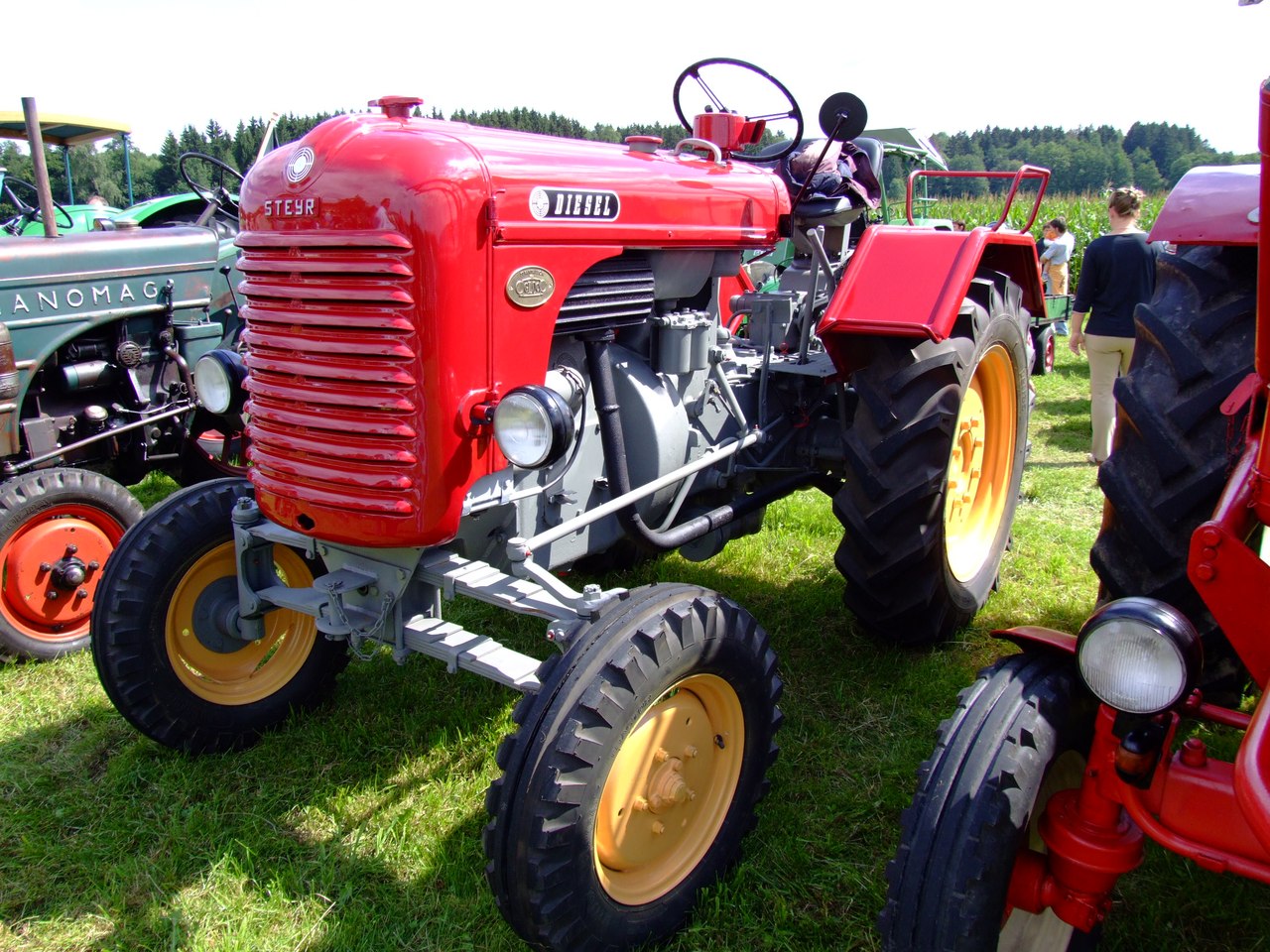
1956 Steyr 36PS

Key Information

Steyr Tractor (properly called Steyr Landmaschinentechnik AG) is an Austrian agricultural machinery manufacturer. The company was founded in 1864 in St. Valentin, Austria, and manufactures tractors. It was part of the Steyr-Daimler-Puch conglomerate from 1934 until 1990 and was purchased by Case Corporation in 1996. Case IH and New Holland merged in 1999 to form CNH Global, which in turn merged with Fiat Industrial in 2012 to form CNH Industrial.

In 2020, the factory in St. Valentin had 600 employees, and produced around 10,000 tractors per year, both Case IH and Steyr. The tractors between 75 and 220 KW have engines from Fiat Powertrain Technologies.[1][2]

See also

[edit]

References

[edit]
[edit]
Revisions and contributorsEdit on WikipediaRead on Wikipedia
from Grokipedia
Steyr Tractors is a prominent brand of agricultural tractors manufactured by Steyr Traktoren , an Austrian company based in St. Valentin that was acquired by in 1996 and has been a brand of N.V. since the company's formation in 1999. Tracing its roots to the original Steyr works established in 1864 for firearms production, the company diversified into bicycles, automobiles, and machinery before focusing on tractors after . Tractor production commenced in 1947 with the Type 180 model, marking the beginning of Steyr's legacy in robust, innovative farming equipment designed for superior quality, comfort, and efficiency. Key milestones in Steyr's development include the introduction of the first four-wheel-drive tractor in the 1960s, based on the Type 190 platform, which enhanced traction for demanding field conditions. In , the company launched the 760 series featuring a clutchless powershift transmission, improving operator control and productivity. Further innovations followed, such as the 8160A model in 1976 with an exhaust-driven for better power output, and the 8300 series in 1980, which pioneered a reversible position for versatile tasks like loader work. By 1999, Steyr introduced (CVT) technology in its models, reaching a production milestone of 500,000 tractors by 2005. As of 2025, Steyr tractors, including the Terrus CVT range offering up to 340 horsepower and the CVT range up to 435 horsepower, are celebrated for their Austrian and are sold in over 20 European countries through a network of more than 800 employees at the St. Valentin headquarters (as of 2022). The brand continues to innovate with concepts like hybrid and electric drivetrains, as demonstrated by the Hybrid Drivetrain Konzept in 2022 and the Hybrid CVT prototype in 2023, with the Plus model earning Tractor of the Year 2025 in the category, positioning Steyr as a forward-thinking leader in .

History

Origins and pre-tractor era

The Steyr company traces its origins to April 16, 1864, when Josef Werndl founded Josef und Franz Werndl & Comp. Waffenfabrik und Sägemühle in , , as a firearms manufacturing enterprise building on his father's earlier rifle works. Specializing in breech-loading rifles like the innovative Werndl-Holub model adopted by the Austrian Army in 1867, the firm rapidly expanded to become one of Europe's premier arms producers by the late , employing advanced techniques that would later support diversification. By 1894, Steyr leveraged its precision engineering to enter production, shifting some arms facilities toward two-wheeled transport amid growing demand for personal mobility in . This marked the beginning of its evolution from weaponry to civilian vehicles. In the , the company established an automotive division as a of the Österreichische Waffenfabriksgesellschaft, initiating limited-scale motorized production; its first automobile, the six-cylinder Type II "12/40", debuted in 1920, followed by motorcycles and further car models like the sporty Type 50 in the and . These early vehicles emphasized robust construction and innovative designs, establishing Steyr's reputation in the burgeoning automotive sector. The pivotal 1934 merger of Steyr-Werke AG with Austro-Daimler-Puchwerke AG formed AG, consolidating expertise in engines, bicycles, and cars into a diversified industrial powerhouse based in . During , under Nazi control following the 1938 , the conglomerate redirected its capacities toward military output, producing engines, half-tracks like the Sd.Kfz. 251, and specialized vehicles such as the Steyr 1500A command car and RSO from facilities including the expanded plant in St. Valentin. This era solidified Steyr-Daimler-Puch's role in heavy vehicle manufacturing, setting the stage for industrial recovery.

Post-war tractor development

Following , entered the market with the launch of its first model, the Type 180, on September 29, 1947, which featured a 2-cylinder producing 26 horsepower and initiated the company's tradition of producing in a distinctive color. This model drew on Steyr's pre-war expertise in vehicle manufacturing to establish a robust foundation for , emphasizing durability for post-war European farming needs. In 1949, Steyr introduced the smaller Type 80, equipped with a single-cylinder delivering 14 horsepower, targeted at smaller farms and marking an early diversification in power outputs. By 1952, the company advanced to larger-scale production with the Type 280, powered by a 4-cylinder generating 59 horsepower at 1650 rpm, designed for more demanding field operations. Steyr pioneered hydraulic hitch systems in 1950, integrating them into its tractors to enable efficient attachment and control of farm implements, with retrofit options available for earlier models to enhance versatility in plowing and cultivation tasks. This development facilitated initial integrations with basic implements like plows and seeders, improving overall farm productivity during the . Throughout the , faced challenges in adapting to growing demands for higher power and efficiency, prompting a shift from single- and two-cylinder to more powerful four-cylinder configurations to meet evolving agricultural requirements. These adaptations addressed issues such as reliability under heavy loads and , solidifying 's position in the post-war market.

Expansion and technological advancements

During the 1960s, Steyr pioneered advancements in tractor drivetrain technology by developing its first model, derived from the established Type 190 platform, which improved traction and productivity particularly in challenging terrains such as mountainous regions. This innovation was subsequently integrated into later models, marking a shift toward more versatile and robust machinery that built upon the foundational post-war designs from the 1940s and 1950s. In 1966, Steyr introduced its iconic red-and-white , which became a hallmark of the brand and enhanced its visual identity in the agricultural market. That same year, the company launched the Plus series, encompassing models such as the Steyr 30 (30 hp), Steyr 40 (38 hp), and Steyr 50 (50 hp), followed by the higher-powered Steyr 70 (70 hp) and Steyr 90 (90 hp) in 1968; these tractors, produced through 1971, emphasized increased horsepower and durable construction for demanding field operations. The momentum continued into the with the introduction of the 540 in , a 40 hp model produced until 1977 that further exemplified the company's focus on reliability and power efficiency through refined three-cylinder diesel engines. Complementing its core lineup, Steyr diversified into specialized agricultural during this era, including front-end loaders introduced in and the innovative forage loader wagon, which broadened the brand's offerings for varied farming needs.

Modern ownership and globalization

In 1990, restructuring within the Steyr-Daimler-Puch conglomerate led to the agricultural divisions being regrouped as the independent Steyr Landmaschinentechnik GmbH (SLT), based in St. Valentin, Austria, marking a shift from the broader conglomerate structure. This entity focused solely on tractor and agricultural machinery production, setting the stage for its integration into larger international operations. In 1996, Case Corporation acquired SLT, renaming it Case-Steyr Landmaschinentechnik and incorporating its specialized tractor designs into the Case IH portfolio. Four years later, in 1999, the merger of Case Corporation and New Holland N.V. formed CNH Global N.V. (later CNH Industrial N.V. in 2013), bringing Steyr under a multinational umbrella that enhanced its production capabilities and market access while preserving the brand's European focus. Under , has experienced sustained growth, exemplified by the celebration of 75 years of tractor production in 2022, commemorating the first Type 180 model built in 1947. This milestone highlighted the brand's enduring legacy, with events such as the STEYR@HOME open days at the St. Valentin plant attracting over visitors to showcase historical models alongside modern innovations. Production at the facility reached a decade-high of tractors in 2022, reflecting operational resilience amid global supply challenges and underscoring CNH's investment in the site as a key European manufacturing hub. Steyr's globalization has been facilitated through CNH Industrial's worldwide network, with the brand primarily targeting European markets including , , , , and several Eastern European countries such as and . Exports have expanded to additional regions like , , and , leveraging CNH's logistics and distribution channels to support diverse agricultural needs. Post-2000, strategic priorities have emphasized and , with Steyr tractors incorporating engines that meet EU Stage V emissions standards introduced in 2019, promoting reduced fuel consumption and lower environmental impact. These efforts align with CNH Industrial's broader goals, including initiatives for reduction and practices outlined in annual reports, ensuring adaptation to evolving EU agricultural policies on emissions and . In 2024-2025, introduced the Impuls CVT and CVT tractor lines at Agritechnica 2025, with power outputs up to 435 hp, and the Plus series won the Tractor of the Year 2025 award in the 70-150 hp utility category, reinforcing its leadership in sustainable and efficient .

Tractor Models

Early production models

Steyr's early production models, introduced in the immediate post-World War II period, marked the company's entry into the tractor market with a focus on reliable, affordable machinery suited to Europe's recovering agricultural sector. The lineup began with the Type 180 in , followed by smaller and larger variants through the , emphasizing diesel power and simple mechanical designs derived from the firm's pre-war automotive and truck engineering expertise. These tractors were primarily two-wheel-drive units with open operator stations, manual steering, mechanical drum brakes, and rear PTO capabilities operating at 540 rpm, catering to row-crop and general farming tasks in and neighboring countries. The Type 180, produced from 1947 to 1953, featured a 2.7-liter two-cylinder liquid-cooled diesel engine delivering 25.6 horsepower at the drawbar and 21.7 horsepower at the PTO, with a fuel capacity of 11.6 gallons. It utilized a basic manual transmission, weighed 3,968 pounds, and was equipped with 5.00-16 front tires and 9.00-24 rear tires on a 65.4-inch wheelbase, making it versatile for medium-duty fieldwork. Its modern design for the era contributed to Steyr's rapid establishment as a tractor producer, with the model laying the foundation for subsequent developments. Complementing the Type 180, the smaller Type 80 entered production in and continued until , powered by a 1.3-liter single-cylinder liquid-cooled rated at 14.8 horsepower. Available in standard, row-crop (80a), and narrow (80s) configurations, it had a 4-speed manual transmission, weighed 2,646 pounds, and used 4.00-15 front tires and 8-24 rear tires. Over 45,068 units were built, reflecting strong demand among small farms in post-war where compact, low-cost tractors were essential for rebuilding operations. For larger operations, the Type 280 arrived in and ran through , boasting a 5.3-liter four-cylinder liquid-cooled with 59.2 horsepower at the drawbar and 49.3 horsepower at the PTO, supported by a 26.4-gallon . It incorporated a ZF 5-forward/1-reverse , weighed 6,834 pounds, and featured 7.50-20 front tires and 14-34 rear tires on an 87.4-inch , enabling heavier and transport duties. Approximately 826 units were produced, gaining traction in Austria's expanding mechanized . An evolution of the original, the Type 180a was manufactured from 1954 to 1959 with a refined 2.7-liter two-cylinder liquid-cooled producing 29.6 horsepower at the drawbar and 26.1 horsepower at the PTO, and a 12.7-gallon . It employed a 5-speed , weighed 4,189 pounds, and came with 5.50-16 front tires and 10-28 rear tires on a 72.1-inch , improving on the Type 180's performance for row-crop applications. Production reached 14,420 units, underscoring its popularity in mid-sized European farms. The Type 185, built from to , filled a gap with a 4.0-liter three-cylinder liquid-cooled outputting 44.4 horsepower at the drawbar and 42.4 horsepower at the PTO. Equipped with a 6-speed , it weighed 5,952 pounds and used 6.50-20 front tires and 13-30 rear tires on an 81.1-inch , suitable for pulling large implements. This model, priced competitively in its market, helped achieve broader adoption as tractor ownership in surged from 79,000 units in 1957 to 147,000 by 1962, driven by post-war economic recovery and export growth.

Mid-century series

The mid-century era of tractors, spanning the to , represented a pivotal advancement in power output and operational versatility, building on the foundational designs of earlier models by incorporating higher horsepower engines and refined mechanical systems. This period saw Steyr expand its lineup to meet diverse agricultural demands, emphasizing durability and adaptability for various farming tasks across . The Type 190, produced from 1964 to 1967, featured a three-cylinder rated at 36 horsepower and served as the platform for Steyr's first four-wheel-drive in the mid-1960s, enhancing traction in challenging conditions. A narrow-track variant, the 190s, followed in 1965. The Plus series, introduced in 1966, formed the cornerstone of this evolution with models ranging from the Steyr 30 (30 hp, produced 1966–1970) to the Steyr 90 (90 hp, produced 1968–1974), covering a broad 30–90 hp spectrum to suit small to medium-scale operations. These tractors featured enhanced hydraulic capabilities, such as the Steyr 70's rear lift capacity of 6,394 lbs (2,900 kg) and total flow of 8.5 gpm (32.2 lpm), which improved implement handling compared to prior generations. Optional four-wheel-drive (4WD) variants on higher models like the Steyr 70 addressed varied terrains, including uneven fields, while utility configurations supported general-purpose use. In the , continued this progression with the 500 series, exemplified by the Steyr 540 (40 hp, produced 1974–1977) and extending to models up to 70 hp in related variants like the Steyr 670, offering hydraulic flows around 5.8 gpm (22.0 lpm) for efficient loader and tillage work. Synchronized transmissions began appearing in select configurations, enabling smoother gear shifts without clutching, which enhanced operator control during prolonged field use. Compact utility variants catered to specialized applications, such as vineyard cultivation on sloped or narrow plots. By the and , the 8000 and 9000 series introduced turbocharged engines for superior performance, with the Steyr 8090 (80 hp, produced 1983–1992) featuring a 16-speed synchronized transmission and hydraulic system delivering 10.3 gpm (39.0 lpm) at 2,538 psi (175 bar), supporting up to three valves for multi-implement setups. Higher-end models in the 9000 series, such as the 8180 (165 hp, produced 1987–1993), utilized turbocharged six-cylinder diesel engines for demanding tasks, while 4WD and narrow-track variants optimized traction for row-crop and environments. These innovations solidified Steyr's reputation for robust, versatile machinery in an increasingly mechanized agricultural landscape.

Contemporary model lines

Steyr's contemporary tractor lineup, as of November 2025, emphasizes versatility, efficiency, and compliance with modern environmental standards, featuring engines across all models. These engines, primarily four-cylinder configurations for mid-range series, deliver reliable performance while meeting Stage V emissions requirements through advanced aftertreatment systems like Hi-eSCR2. Recent updates include a redesigned operator environment and enhanced for the Impuls series, and new Plus models debuted at Agritechnica 2025. The Kompakt Series targets compact applications such as farmyard, , and tasks, offering models in the 80–120 hp range with a maximum output of 117 hp. Equipped with FPT four-cylinder engines and transmission options including synchroshift or two-speed powershift (12x12 or 24x24 configurations) reaching 40 km/h, these tractors prioritize maneuverability, low weight, and superior visibility. They support standard attachments like front loaders and PTO-driven implements, with Stage V compliance integrated via efficient exhaust aftertreatment. In the mid-range, the provides versatile options from 116 to 150 hp nominal (up to 158 hp maximum unboosted), suitable for field, industrial, and work. Featuring FPT four- or six-cylinder and transmissions such as 8-speed powershift, 4-speed powershuttle, or S-Control CVT, it includes sub-variants like Profi CVT for enhanced hydraulic flow (up to 110 l/min) and Profi Classic for mechanical controls. Models like the 6115 Profi, 6125 Profi, and 6140 Profi exemplify this range at 115–140 hp. Compatibility extends to loaders (e.g., 4145 Classic) and heavy-duty hitches (Category II/III), with Stage V emissions achieved through ecological engine designs introduced in the early 2020s. The Expert CVT series, rated at 110–140 hp, focuses on versatile mid-sized operations with FPT four-cylinder 4.5-liter NEF engines and S-Control CVT transmissions featuring S-TRONIC controls. Key features include cab suspension, ISOBUS III compatibility, and lifting capacities up to 5,600 kg at the rear hitch and 2,300 kg at the front, enabling use with front loaders (STEYR S series) and equipment. Stage V compliance is standard via patented aftertreatment, rolled out in the for reduced emissions. For higher power needs, the Impuls CVT delivers 165–225 hp using FPT 6.7-liter six-cylinder engines with class-leading (243 g/kWh consumption per DLG testing) and S-Control CVT transmissions. Models such as 6170, 6180, and 6200 emphasize ergonomic cabs, precision farming tools, and broad implement compatibility for transport and heavy fieldwork. As of November 2025, the series features updates including a revised operator environment and improved front . Stage V emissions are met through integrated and SCR systems, with updates enhancing drivability in the . The Terrus series specializes in heavy-duty tasks at 288–340 hp, powered by FPT six-cylinder engines and advanced S-Control CVT with S-TRONIC enhancements. It includes semi-active cab suspension, GUIDE automated steering, and high-capacity hitches for large-scale attachments, ensuring optimal visibility and control. Stage V compliance was implemented starting in 2019, supporting ecological operation across demanding applications.

Innovations and Technology

Engine and power systems

Steyr's early tractor engines in the post-World War II era featured simple, robust designs suited to agricultural demands, beginning with single-cylinder water-cooled diesel units in models like the Type 80, which produced 13 hp at 1500 rpm (later increased to 15 hp at 1575 rpm). These water-cooled configurations provided reliability in varied climates with minimal maintenance, though power output was limited for basic farming tasks. By the early 1950s, Steyr transitioned to multi-cylinder water-cooled diesels, as seen in the Type 180 with its 2.7L two-cylinder engine delivering approximately 26 hp. A significant advancement came in 1952 with the introduction of the Type 280, powered by the proprietary Series 13 four-cylinder water-cooled diesel engine, which generated 60 hp at 1650 rpm from a 5.3L displacement. This engine, adapted from truck applications, emphasized durability and torque for heavier fieldwork, marking Steyr's commitment to four-cylinder architectures that balanced power delivery with mechanical simplicity. Subsequent mid-century models, such as the Plus series, refined this approach with four-cylinder diesels offering improved compression and fuel atomization for enhanced performance under load. Following Case Corporation's acquisition in 1996 (later part of ), Steyr adopted FPT (Fiat Powertrain Technologies) engines, integrating advanced features like turbocharging, intercooling, and common-rail to meet modern emissions standards. The Plus series utilizes FPT F5 3.6L four-cylinder engines producing 80-117 hp, while the series features FPT 4.5L four-cylinder engines (116-150 hp) or 6.7L six-cylinder engines (up to 175 hp with boost), with turbochargers boosting airflow for efficient and common-rail systems enabling precise injection at up to 2000 bar. Modern engines comply with EU Stage V emissions standards. These engines deliver full power from low rpm (around 1300-1900), optimizing torque for versatile operations. The Terrus CVT series, as of 2023, includes the 6340 model with a 6.7L FPT six-cylinder engine delivering up to 340 hp. Steyr's adherence to a four-cylinder prioritizes compact and efficiency, yielding superior power-to-weight ratios—such as approximately 34 kg/hp in utility models—which enhance maneuverability and reduce compared to larger six-cylinder alternatives. is a hallmark, with representative DLG PowerMix tests showing consumption as low as 258 g/kWh in the 4145 (145 hp), achieved through HI-eSCR after-treatment and optimized displacement for high specific output. This approach integrates seamlessly with drive systems to maintain overall tractor performance without excessive weight.

Drive systems and transmissions

Steyr pioneered technology in during the , introducing the first 4WD model based on the Type 190, which was produced from 1964 to 1967 and featured a three-cylinder delivering 36 horsepower. This innovation enhanced traction in challenging terrains, marking a significant advancement over the configurations predominant in earlier models. By the , with the launch of the Plus series, selectable 4WD became more widely integrated, and in subsequent decades, full-time 4WD capability evolved into a standard feature across Steyr's higher-power lines, such as the modern and Terrus series, where it supports outputs up to 340 horsepower for optimal power distribution. Transmission development at Steyr progressed from simple mechanical systems in the post-war era to advanced automated options. In the , models like the Type 80 and Type 280 employed basic four-speed manual transmissions with a single reverse gear, providing reliable but limited gearing for everyday farming tasks. These evolved into more versatile powershift and synchronized manuals in the 1970s and 1980s, as seen in the Plus and 8000 series, offering up to 16 forward speeds for improved efficiency. By the late 2010s, Steyr introduced continuously variable transmissions (CVT) in its and Impuls series, utilizing the S-Control CVT system that automatically regulates engine speed and transmission ratios for seamless operation without discrete gear shifts. The S-Control CVT in the Expert CVT (4100 to 4130 models, 100-130 horsepower) and Impuls CVT (up to 200 horsepower) series incorporates multifunction joysticks via the Multicontroller armrest, allowing intuitive control of speed, direction, and loader functions in a single interface for enhanced operator precision during varied fieldwork. These transmissions emphasize durability through hydro-mechanical designs that minimize wear and support high-torque applications. To bolster traction, tractors incorporate aids such as electro-hydraulically engaged differential locks on both front and rear axles, which automatically activate under slippage to ensure even power delivery to all wheels. These locks, standard in models like the series, integrate with 4WD systems for superior grip in muddy or uneven conditions without manual intervention. Additionally, creep speed options—providing ultra-low ratios down to 0.3 km/h—are available in transmissions like the 32x32 powershift units, enabling precise maneuvering for specialized tasks such as harvesting or nursery work.

Operator features and safety

Steyr tractors initially featured open operator stations in the post-war era, as exemplified by the Type 180 model introduced in 1947, which prioritized basic functionality for agricultural tasks in . By the late , the Plus series marked a shift toward enhanced protection, incorporating approved driver protection structures for the first time on models like the Steyr 30, 40, and 50. This evolution continued into the 1970s with the adoption of enclosed cabs across mid-century series, providing better shielding from environmental elements and improving overall operator endurance during extended fieldwork. Safety advancements became prominent in the , with ensuring compliance with roll-over protective structures (ROPS) standards on all models, significantly reducing the risk of injury in overturn scenarios common to rugged terrains. Modern tractors, particularly the series, integrate ISOBUS compatibility per ISO 11783 protocols, enabling seamless communication between the tractor and precision farming implements to minimize operator errors and optimize task execution. Additionally, operator aids such as the Easy-Tronic II management system automate sequences like hitch adjustments and PTO engagement during field turns, based on time, , or events, thereby enhancing by reducing manual interventions in dynamic conditions. In terms of comfort, the series employs suspended cabs with pneumatic systems standard on Excellence variants, delivering superior and stability across varied ground conditions. These cabs offer panoramic visibility through tinted windows and a high roof option, combined with automatic air-conditioning and rear sun roller blinds for a controlled working environment. Ergonomic elements include adjustable seats and a Multicontroller that integrates transmission controls, while noise levels are maintained below 80 dB at 69 dB(A) to support prolonged operations without fatigue.

Production and Operations

Manufacturing facilities

The primary manufacturing facility for Steyr tractors is situated in St. Valentin, , where assembly operations commenced in 1947 shortly after , initially focusing on agricultural tractors and expanding to include implements the following year. Over the decades, the plant has undergone multiple expansions to accommodate increased production lines and advanced assembly processes, solidifying its role as the global headquarters for Steyr tractor manufacturing. Following historical shifts in ownership, including integration into in 2013, the facility has benefited from enhanced operational synergies within the broader corporate network. As part of , the St. Valentin plant integrates closely with other group facilities, particularly for component sourcing, including engines produced at plants in and other locations in , which supply the high-performance diesel power units for Steyr models. This collaboration ensures standardized quality and efficiency across the , with chassis and cabs assembled in using approximately 14,500 parts from over 420 global suppliers. In the 2020s, the St. Valentin facility has maintained an annual production capacity supporting outputs between 5,000 and 10,000 units as of 2022, achieving a milestone of 10,000 tractors in 2022—the first time in a —despite challenges. Employing 831 workers as of 2022, the plant focuses on tractors ranging from 100 to 300 horsepower, incorporating both and models in its assembly lines. In 2025, the plant began production of new models including the CVT series and the award-winning Plus range. is upheld through rigorous processes certified under World Class Manufacturing standards, earning the facility a Silver designation in 2015 for excellence in production efficiency, safety, and defect prevention. These measures include automated assembly techniques and comprehensive testing protocols to ensure and in agricultural applications.

Global distribution and licensing

Steyr Traktoren began expanding its export activities from in the post-World War II era, with initial shipments focusing on neighboring markets during the as production ramped up at its St. Valentin facility. By the , exports had grown to include , exemplified by the establishment of the Steyr Hellas project in 1973, which facilitated distribution of Steyr tractors and related products to via Saloniki. This period marked the transition from primarily domestic and regional sales to broader international outreach, supported by the company's integration into larger conglomerates like , which enabled logistical scaling for overseas markets. To further penetrate emerging economies, Steyr pursued licensing agreements for local production in the late 20th century. In Turkey, a key partnership was formed in 1978 with Donatim in , leading to the manufacture of Steyr-designed under license; this collaboration produced approximately 60,000 units between 1978 and 1995, primarily through the Basak licensee, which continued building Steyr models until 1996 before shifting to its own variants. In , Brahma-Steyr Tractors Ltd. was established in 1993 in , , specifically to assemble licensed Steyr , importing much of the necessary plant and machinery to support localized production for the domestic agricultural sector. These deals allowed Steyr to adapt its technology to regional needs while minimizing import barriers and fostering in developing markets during the 1970s through 1990s. Following its acquisition by in 1996, Steyr's global distribution evolved into a more integrated worldwide network, with tractors exported from the St. Valentin plant to customers across , , the , Asia, and the Pacific region. The brand maintains a strong presence in the , where it leads the Austrian market and supports growing demand in countries like and through dedicated dealer expansions. In emerging markets, such as , Steyr has established official partnerships for sales and service, enhancing accessibility in . Today, Steyr's dealer network operates primarily through Industrial's subsidiaries, providing comprehensive after-sales support including parts availability and maintenance services tailored to local conditions. This infrastructure ensures rapid response times, with free support (00800-78397000) and professional servicing available via a network of authorized dealers concentrated in but extending to select international locations. 's overarching global reach, spanning over 170 countries with more than 11,500 dealers, bolsters Steyr's distribution without diluting its European focus, enabling efficient supply of components and technical expertise to end-users worldwide.

References

Add your contribution
Related Hubs
User Avatar
No comments yet.