Hubbry Logo
Sticky bunSticky bunMain
Open search
Sticky bun
Community hub
Sticky bun
logo
8 pages, 0 posts
0 subscribers
Be the first to start a discussion here.
Sticky bun
Sticky bun
from Wikipedia
Sticky bun
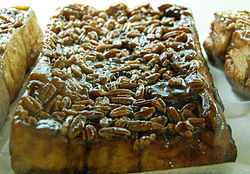
A traditional sticky bun loaf
TypeSweet roll
Main ingredientsDough, brown sugar, honey
A caramel roll

Sticky buns are a type of dessert or breakfast sweet roll that generally consist of rolled pieces of leavened dough — sometimes containing brown sugar or cinnamon — compressed together to form a kind of flat loaf corresponding to the size of the pan in which they are to be baked. Before the dough is placed in the baking-pan, the latter is lined with the "sticky" ingredients, such as brown sugar or honey (or both), as well as nuts and raisins and perhaps more sugar and sometimes butter. After the buns are baked, they are inverted so that the pan lining then becomes a topping. Commercially produced sticky buns, however, are usually just baked in an aluminum loaf tin, which allows the topping to suffuse the buns, making them sticky throughout. The way the buns were baked allows them to more or less be pulled off as individual servings, although it is often a futile effort.

Swedish cinnamon bun

Sticky buns have been consumed since the Middle Ages, at which time cinnamon became more prominent.[1]

Sticky buns also have a Germanic origin and were originally known as "Schnecken".[1] The Pennsylvania Dutch introduced Schnecken in the United States.[1] Wherever 18th-century German settlers (such as the Pennsylvania Dutch) went, sticky buns have remained long after many other cultural traits have disappeared.[citation needed]

In Venezuela, there is a very similar local version of them called golfeado. The main difference between them is the ground fresh cheese on top that gives the bun a very particular sweet-salty taste.[citation needed]

See also

[edit]

References

[edit]
Revisions and contributorsEdit on WikipediaRead on Wikipedia
from Grokipedia
A sticky bun is a type of sweet made from a yeast-leavened that is rolled out, spread with a filling of , , and , then rolled into a spiral, sliced, and baked in a pan lined with a gooey sauce typically made from , , and often pecans or other nuts, resulting in a sticky, upside-down topping when inverted after baking. This distinguishes it from a plain , as the caramel-nut glaze provides a rich, chewy contrast to the soft, spiced interior. Originating from the German pastry known as Schnecken—meaning "snails" due to its coiled shape—sticky buns trace their roots to 17th- and 18th-century , where similar honey- or sugar-sweetened rolls with nuts were popular. German settlers, particularly the , introduced the treat to the in the 18th century, adapting it with local ingredients like and pecans to create the iconic American version. By the , it had become a Philadelphia specialty, with bakeries like Beiler's at popularizing it as a or staple. Today, sticky buns remain a beloved across , often varied with additions like , fruits, or different nuts, and are celebrated annually on National Sticky Bun Day, . Associated with baking traditions, their preparation involves proofing the dough for fluffiness, creating the signature sticky glaze, and baking to achieve a balance of tender crumb and caramelized crunch, making them a highlight of American baking traditions.

History

European Origins

The term "Schnecken," the traditional German name for what would later evolve into sticky buns, derives from the word meaning "" in , alluding to the pastry's distinctive spiral shape formed by rolling the around a filling. Schnecken emerged in the baking traditions of 18th-century as enriched yeasted sweet rolls, prepared in various communities including Jewish bakeries and households across the region. These early versions drew from longstanding European practices of using for coiled pastries, reflecting a fusion of Germanic fermentation techniques with sweeter, spiced elements introduced through trade and regional exchanges. The itself was typically rich, incorporating eggs, , and sometimes for tenderness, before being rolled out, filled, and sliced into individual spirals. Early European recipes for Schnecken emphasized simple, aromatic fillings centered on and other spices, combined with inclusions like raisins, walnuts, or other nuts, and often featured a glaze applied before open-side up, differing from the thick, inverted topping of later American adaptations. These modest yet flavorful combinations highlighted the pastry's role as a comforting or accompaniment, prioritizing natural sweetness from fruits and spices. This approach underscored the resourcefulness of German bakers in utilizing accessible ingredients to create indulgent treats. The development of Schnecken was further shaped by influences from neighboring European pastry traditions, particularly coiled bun variants in and , where similar spiral-shaped yeasted rolls incorporated nuts or dried fruits within spiced doughs. These cross-regional exchanges during the contributed to the pastry's versatility, allowing for subtle variations in filling ratios while maintaining the core spiral form and yeasted base. By the late , Schnecken had become a staple in German baking, later carried across the Atlantic by Pennsylvania Dutch settlers seeking to preserve their culinary heritage.

Introduction to the United States

The sticky bun, derived from the Germanic "Schnecken," arrived in the through 18th-century Pennsylvania Dutch settlers of German origin who established communities in the area, adapting the spiral-shaped into a regional American specialty. These immigrants, fleeing in , brought traditions that blended with local ingredients and techniques, transforming the simple roll into a richer treat suited to the colonial landscape. By the 19th century, sticky buns appeared in bakeries, where bakers documented and refined the by incorporating caramelized toppings made from or early forms of , creating the signature gooey glaze that distinguishes the American version from its European precursor. The first printed for Schnecken in the United States appeared in the Settlement Cook Book in 1901. This adaptation reflected the availability of sweeteners like , a byproduct of the burgeoning sugar trade, which enhanced the pastry's indulgent appeal and solidified its place in . Amish and Mennonite communities, integral to the heritage, played a key role in preserving and refining sticky bun recipes throughout the 1800s, passing down oral traditions and family methods that emphasized simple, high-quality ingredients and slow for optimal texture. These groups maintained the craft amid industrialization, ensuring the buns remained a homemade staple in rural bakeries and households. In the early , sticky buns underwent commercialization in , with urban demand growing for convenient, ready-to-eat versions of the treat. Bakeries like those in the city's began producing them on a larger scale, incorporating pecans or raisins while retaining the core profile, which helped propel the beyond immigrant enclaves into broader American markets.

Description

Key Ingredients

The core of a classic sticky bun begins with an enriched , which incorporates all-purpose or for and development, or a milk-based liquid like for moisture and tenderness, unsalted for richness and flakiness, eggs for added and a soft crumb, granulated for subtle and to feed the , salt for flavor and fermentation control, and instant or active dry for leavening and rise. Typical proportions in this base include approximately 3 to 4 cups of , ¾ to 1 cup of or other liquid, ¼ to ½ cup of softened unsalted , 1 large egg, ¼ cup of , 1 teaspoon salt, and 2 teaspoons of , creating a soft, pliable that proofs to yield light, airy rolls. The use of unsalted is essential to prevent oversalting, as the salt in salted varieties could disrupt flavor balance in the enriched . The filling provides the signature spiced sweetness, typically comprising ground for warm flavor, granulated or for and chewiness, and softened unsalted to bind and distribute the mixture evenly across the . Optional additions like chopped pecans, walnuts, or raisins enhance texture and nuttiness without altering the core profile. Common ratios feature about ¾ to 1 cup of combined with 1 to 3 tablespoons of and ½ cup of , ensuring a gooey, aromatic layer that melts during . The sticky topping, often called the "goo," forms the indulgent caramelized base and is made from for deep molasses-like notes, unsalted for creaminess, and or to promote liquidity and prevent during . This mixture caramelizes in the to create the glossy, adherent glaze characteristic of sticky buns. Standard proportions include 1 cup of to ½ cup of and ½ cup of or , heated together to form a pourable that coats the pan bottom before assembly.

Physical Characteristics

The sticky bun features a distinctive spiral formed by rolling yeast-leavened around a cinnamon-sugar filling, resulting in layered swirls that are typically 3 to 4 inches in diameter when in a standard 9-by-13-inch pan, yielding 9 to 12 buns. Upon completion, the exterior displays a deep golden-brown hue with caramelized edges, achieved through at moderate temperatures that promote even browning without excessive darkening. After inversion from the baking pan, the bun reveals a glossy, caramel-colored topping that oozes slightly, often embedded with whole or chopped pecans or walnuts that add visual contrast and a rustic texture to the surface. In terms of texture, the interior of a sticky bun is soft and fluffy due to the yeast-risen , enriched with and for tenderness, while the spiral layers provide a subtle chewiness from the integrated filling. The signature sticky glaze, created from a caramelized mixture of , , and , clings tackily to the bun, pulling into strings when separated and contributing a gooey, that distinguishes it from drier pastries. This contrast between the pillowy core and the viscous exterior enhances the overall sensory experience, with the nuts offering a slight crunch amid the softness. The flavor profile of a sticky bun is dominated by the intense sweetness of the topping, balanced by the warm, spicy notes of infused throughout the dough swirls. Nuttiness from pecans or walnuts introduces an earthy depth, complementing the subtle tang of the dough, while the overall richness evokes a buttery, toasty complexity without overwhelming bitterness. These attributes are most pronounced when served warm, either individually or as a pan of interconnected buns, allowing the flavors to meld harmoniously.

Preparation

Dough Preparation

The dough for sticky buns is an enriched yeast dough, with butter and eggs providing tenderness and a soft crumb. The initial step involves activating the active dry to ensure robust . The is dissolved in warm at around 110°F (43°C), along with a small amount of to nourish it and kickstart activity, while avoiding temperatures above 115°F that could kill the . This mixture rests for 5 to 10 minutes until it foams and bubbles, verifying the yeast's viability. Once activated, the yeast mixture is combined with , additional , salt, melted , and eggs to form a shaggy . follows to develop the network, which gives the buns their structure and chew without excessive density. By hand, this takes 8 to 10 minutes on a lightly floured surface until the is smooth, elastic, and passes the windowpane test—stretching thin without tearing. Using a stand mixer with a dough hook, knead on medium speed for 5 to 7 minutes until similar smoothness is achieved. Over-kneading risks creating a tough texture by overdeveloping the in this fat-enriched . The kneaded is then placed in a lightly greased and covered with or a damp cloth to retain and prevent a from forming. It proofs in a warm, draft-free area (ideally 75°F to 80°F) for 1 to 2 hours until it doubles in volume, often tested by a gentle poke that leaves a slow-recovering indent. Under-proofing results in dense, heavy buns due to inadequate gas production and structure relaxation.

Assembly and Baking

Once the dough has been proofed and is ready for shaping, it is gently patted or rolled into a rectangle approximately 12 to 16 inches by 10 to 12 inches on a lightly floured or greased surface to prevent sticking. A mixture of softened butter, brown sugar, and cinnamon is then spread evenly over the dough, typically leaving a 1-inch border along one long edge to facilitate sealing. The dough is rolled tightly from the filled long edge into a log, starting from the sugar-covered side, and the seam is pinched closed. The log is sliced crosswise into pieces about 1 to 1.5 inches thick using a sharp serrated knife, dental floss, or twine for clean cuts, yielding 12 to 16 buns depending on the dough size. For pan preparation, a dish—often a 9-inch round pan, 9-by-13-inch rectangular pan, or —is generously greased with to ensure easy release. A sticky topping is created by combining melted , , corn syrup or , and sometimes or , which is poured or spread into the bottom of the pan; chopped pecans or other nuts may be sprinkled over this layer for added texture. To transform cinnamon rolls into sticky buns, scatter chopped toasted pecans in the pan bottom with homemade caramel sauce made from brown sugar, butter, and a touch of cream; place the rolls on top, bake, and then invert the pan for the pull-apart effect. The sliced pieces are then arranged cut-side down in the pan, spaced evenly to allow for rising, and covered loosely to proof again until puffy and touching, typically for 45 to 90 minutes at . Baking occurs in a preheated at 350°F (175°C), a standard for achieving even without overcooking the interior. The buns are baked for 25 to 30 minutes, or until the tops are and the internal reaches about 190°F, tenting with foil midway if too quickly to prevent drying. Immediately after removal from the , the pan is inverted onto a serving platter or wire rack while still hot, allowing the molten glaze to cascade over the buns and coat the sides as it cools; any residual topping in the pan is scraped onto the buns to maximize the sticky effect. Following inversion, the buns rest briefly for 5 to 10 minutes to let the glaze set slightly without hardening, ensuring a gooey consistency ideal for serving warm. Prolonged cooling in the pan is avoided, as it can cause the to crystallize and adhere stubbornly, complicating release and diminishing the signature sticky texture.

Variations

Traditional Additions

Traditional sticky buns often incorporate chopped pecans or walnuts into the topping, adding a satisfying crunch that complements the soft dough and gooey glaze. This practice stems from the settlers' access to abundant local nuts, such as walnuts native to the region and pecans available through trade, which were commonly used in baking to enhance texture and flavor in 18th- and 19th-century recipes. Raisins or dried currants are classic fruit elements added to the core filling, providing bursts of chewiness and subtle sweetness that date back to 19th-century American adaptations of German Schnecken by bakers. These fruits were typically plumped by soaking in warm liquids like or water to improve their tenderness before incorporation, a method reflected in early 20th-century recipes that preserved earlier traditions. Other traditional additions include apple pieces or orange zest for added moisture and notes, common in variations. Spice variations, such as or used alongside the primary in the filling, introduce subtle depth and warmth, echoing the Germanic influences brought by 18th-century immigrants to . , in particular, appears in doughs for aromatic enhancement, while nods to broader Northern European baking heritage adapted locally. To maintain balance without overpowering the , bakers typically use ½ to 1 cup of chopped nuts per batch of 12 to 16 buns, distributed evenly in the topping pan before adding the rolls.

Regional and Modern Twists

Philadelphia-style sticky buns emphasize an extra-sticky glaze made with abundant , , and sometimes , resulting in a particularly gooey topping that distinguishes them from other regional versions. This style traces its prominence to baking traditions in the , with establishments like Beiler's Bakery at serving as longstanding icons since the late 20th century and contributing to their status as a city staple. In the , sticky buns evolve into pecan-heavy variations known as pecan sticky buns, featuring a rich glaze often infused with bourbon for a boozy depth that complements the nuts' crunch. This adaptation draws from Southern caramel traditions, where and bases are common in desserts like pralines, amplifying the sticky, indulgent quality. Recipes from Southern bakers highlight toasted s layered in the pan before , creating a caramelized crust that soaks into the soft . Contemporary innovations have expanded sticky buns to accommodate dietary needs and creative flavors. Vegan versions replace with plant-based alternatives like or and use —the brine from chickpeas—as an egg substitute to achieve fluffy, tender dough without animal products. Gluten-free adaptations commonly incorporate flour blended with other grain-free flours to replicate the enriched dough's structure, maintaining the classic swirl and sticky topping. Savory twists introduce cheese-infused dough, such as cheddar or mixed into the base, paired with a reduced-sugar glaze for a breakfast-oriented, umami-forward take. Global influences introduce unique substitutions and fusions in sticky bun recipes. In , maple syrup often replaces or enhances the traditional brown sugar glaze, infusing the buns with a nuanced, earthy sweetness reflective of the country's syrup production. Post-2010s urban bakeries in cities like and New York have popularized Asian-inspired variations, such as matcha-cinnamon rolls, where green tea powder is incorporated into the filling alongside cinnamon for a bittersweet, earthy profile that appeals to diverse palates. These modern riffs, seen in spots like Bad Ash Bakes, blend Eastern flavors with the Western pastry form.

Cultural Significance

Role in American Baking Traditions

Sticky buns hold a prominent place in American baking traditions as a specialty, emerging from the fusion of German immigrant baking practices with the sweeter palates of early American settlers. Introduced by communities in the , these pastries adapted the traditional German schnecken—a simple yeasted roll—by incorporating abundant , , and glazes that reflected the availability of refined sugars in the , creating a richer, more indulgent treat symbolic of cultural blending in the region's culinary heritage. In everyday American life, particularly within Pennsylvania's and Mennonite communities, sticky buns have been a staple homemade since the , often found at diners, farm stands, and roadside markets in areas like Lancaster County. These settings highlight their role as accessible, warm indulgences that evoke and community, with bakeries producing them using time-honored recipes passed down through generations. Distinguished from similar American pastries like cinnamon rolls by their signature upside-down baking technique—where a gooey caramel-nut topping is placed at the pan's bottom before inverting post-bake—sticky buns have influenced broader breakfast baking but retain their unique sticky allure. This method sets them apart, emphasizing a decadent, shareable quality central to family and communal meals. Economically, sticky buns bolster local bakeries and contribute to in regions like Lancaster County, where Amish-themed attractions draw over 10 million visitors annually, generating $2.7 billion in spending in 2024, with baked goods serving as key draws for farm stands and markets.

Holidays and Commercial Popularity

National Sticky Bun Day is observed annually on February 21 to honor the pastry's origins as a specialty with deep roots, tracing back to German settlers known as "Schnecken." The observance highlights the treat's cultural heritage, encouraging celebrations such as special promotions and tastings at local bakeries in 's South Philly neighborhood, including establishments like Baker Brothers Bakery and Isgro Pastries. The commercialization of sticky buns expanded in the through by chains and retail products, adapting the traditional for broader appeal. , launched in 1985, popularized a similar gooey variant in mall kiosks worldwide, using premium and frozen dough sheets for consistent output. Simultaneously, supermarket frozen dough options, such as those from Rhodes Bake-N-Serv—available since the late but gaining widespread retail traction amid price competitions—enabled home bakers to assemble sticky buns easily with pre-made bases. Sticky buns' commercial popularity has grown significantly, fueled by culture and a surge in online sales following , with millions of Americans consuming rolls and similar pastries annually as treats. Cinnabon's systemwide sales alone reached nearly $500 million globally in recent years, underscoring the scale of demand for these indulgent items in the U.S. market. Media coverage has further boosted visibility, with features in early 20th-century collections, such as 1928 recipes for Royal Cinnamon Buns, and modern TV segments on 's FYI Philly showcasing local shops like Barry's Buns to emphasize regional pride.

References

Add your contribution
Related Hubs
User Avatar
No comments yet.