Hubbry Logo
StiperstonesStiperstonesMain
Open search
Stiperstones
Community hub
Stiperstones
logo
8 pages, 0 posts
0 subscribers
Be the first to start a discussion here.
Stiperstones
Stiperstones
from Wikipedia

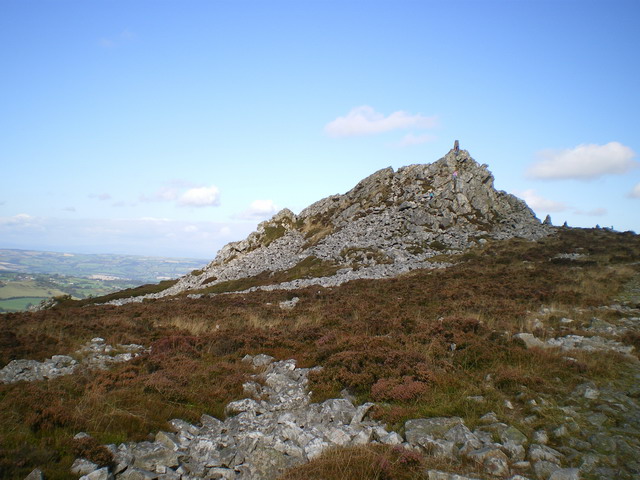
Shattered Cambrian quartzite at the Devil's Chair, Stiperstones

Key Information

The Stiperstones (Welsh: Carneddau Teon)[1] is a distinctive hill in Shropshire, England. The quartzite rock of the ridge formed some 480 million years ago. During the last Ice Age Stiperstones lay on the eastern margin of the Welsh ice sheet. The hill itself was not glaciated though glaciers occupied surrounding valleys and it was subject to intense freezing and thawing which shattered the quartzite into a mass of jumbled scree surrounding several residual rocky tors.[2] At 536 metres (1,759 ft) above sea level it is the second-highest hill in the county, surpassed only by Brown Clee Hill (540 metres (1,772 ft)). Stiperstones' 8-kilometre (5 mi) summit ridge is crowned by several jagged outcrops of rock, which may be seen silhouetted against the sky.

Geography

[edit]

The Stiperstones is noted for its tors of quartzite.[3] The principal ones are named as follows, from north-east to south-west:

Manstone Rock is the highest of these at 536 metres (1,759 ft), and is topped with a trig point. The Devil's Chair is the largest and best known.

The Stiperstones ridge is a good place to view the upland landscape of the Shropshire Hills, particularly the Long Mynd to the east, and also gives extensive views towards the North Shropshire plain and the hills of Mid Wales.

Geology

[edit]

The tors are formed from heavily faulted Ordovician age, grey-white quartzose sandstones known as the Stiperstones Quartzite Formation. This Arenigian age rock unit which dips steeply to the WNW is between 120 and 325m thick. The western slopes of the hill dropping to Stiperstones village are formed in the overlying Mytton Flag Formation, whereas the eastern slopes are formed in the underlying, and hence older, mudstones of the Shineton Shale Formation. Faulting narrows the outcrop of the Mytton Flags along the southern part of the Stiperstones ridge and the mudstones of the Hope Shale Formation with their interbedded volcaniclastics form much of the afforested ground to the west. The outcrop of the Stipertones Quartzite continues south-southwest to Black Rhadley Hill and peters out just beyond Heath Mynd. To the north-northeast, it continues as far as Pontesbury.

Much of the ground around the tors is covered by head, a gravelly and bouldery deposit arising during the present Quaternary period and deriving from the rocks immediately beneath it. There are also some isolated peat deposits in places. Of particular note is the patterned ground surrounding the tors; some of the best examples of the periglacial features known as stone stripes and polygons in England.[4][5][6]

Wildlife and conservation

[edit]

The Stiperstones is a National Nature Reserve and Site of Special Scientific Interest (SSSI).[7] and is within the Shropshire Hills Area of Outstanding Natural Beauty. It is a haven for wildlife, with birds that are normally associated with upland areas present, including red grouse, Eurasian curlew, peregrine falcon and the rare ring ouzel.

Recently, a project called Back to Purple has commenced, to clear some of the hill of remaining plantations of coniferous and wooded areas, restoring the land to heather-based heath, with seasonal purple-flowering heather covering the summits around the tors and enhancing the views of the Stiperstones from the surrounding peaks and valleys.[8] Back to Purple is managed by a partnership of Natural England, Forest Enterprise and the Shropshire Wildlife Trust. Their work has so far seen removal of thousands of pine trees and other conifers, including the whole Gatten Plantation (still shown on OS maps) and the previously covered Nipstone Rock has emerged from hiding. Thousands of heather seedlings have been successfully planted to supplement natural regeneration. To balance this out and complement it further work below summit level has also aimed at restoring grasslands, rich in herbs, hay meadows, wet flushes which produce bog cotton, Heath Bedstraw and the rarer Mountain Pansy and natural woodlands.

Cultural references

[edit]

Bog Mine and Visitor Centre

[edit]

Until the early 20th century lead was mined at The Bog, just west of Stiperstones. The mine at The Bog and the adjacent Stiperstones outcrop were only viable because of a geological movement; over time the movement of the tectonic plates landed at this site, combined with the movement of the earth it crumpled the layers and the softest layers were then eroded away.[clarification needed] After mining stopped, the undisturbed remnants provided a range of wildlife habitats: birds nest in the old buildings, bats roost in the old mine tunnels, and reservoirs and ponds are ideal for aquatic life.[11]

The Bog Visitor Centre is the main facility for visitors to the Stiperstones. It is housed in the former village school and retains its old interior design.[11] It provides historical information about the past workers, mining, and present-day work to restore the landscape. Facilities at the centre include toilets and car parking (with facilities for the disabled including reserved parking, toilets and ramps).[12] Activities include walking, with two main circular walks called Mucklewick Walk and Flenny Bank Walk and a variety of riding routes.[12]

2012 fire

[edit]

On 25 July 2012 part of the reserve was devastated by fire, said to have been a result of the sudden upturn in dry, hot weather coupled with the large amount of dry heather on the hills. More than 70 firemen battled the fire between 15.00 and 22.00 BST; smoke could be seen up to 10 miles away in the county town of Shrewsbury. Firefighters remained on site throughout the night because of the severity of the fire and the extent of the affected areas.[13][14]

[edit]

References

[edit]
Revisions and contributorsEdit on WikipediaRead on Wikipedia
from Grokipedia
The Stiperstones is a distinctive ridge in the , situated in western , , close to the border with . This approximately 8-kilometre-long upland feature is renowned for its dramatic, jagged tors—such as the prominent Devil's Chair—and its wild, atmospheric landscape shaped by glacial and periglacial processes during the last . As a National Nature Reserve (NNR), it encompasses 1,562 hectares of diverse habitats including heathland, , bogs, and acidic grasslands, safeguarding rare species like the bilberry bumblebee and supporting broader environmental goals such as carbon capture and flood management. Geologically, the Stiperstones is composed primarily of the Stiperstones Quartzite Formation, a hard, pale grey orthoquartzite of early age, dating to approximately 478–470 million years ago. These rocks were deposited in a shallow marine environment, possibly as sands or through slumps, and their resistance to relative to surrounding softer shales and flags has created the prominent north-northeast to south-southwest trending ridge with exposed crags and stone runs formed by solifluction during the Pleistocene. Notable geological sites include the tors at the summit, which exhibit steeply dipping beds and orthogonal jointing, as well as the nearby Snailbeach Mine, a (SSSI) highlighting mineral deposits. Ecologically, the reserve hosts a variety of upland species adapted to its harsh conditions, including , skylarks, , stonechats, common lizards, and butterflies, alongside important invertebrate populations like hairy wood ants and emperor moths. The 2025 expansion of the NNR, tripling its size through partnerships involving , Shropshire Wildlife Trust, and others, has enhanced protections for these habitats as part of the King's Series of reserves, contributing to England's target of protecting 30% of land by 2030. Public access is encouraged via trails such as the 8 km Stiperstones Stomp and a 650 m all-ability path, promoting , , and nature recovery in this remote, high setting. Historically, the Stiperstones area has been shaped by human activity, particularly lead mining from the Roman period through the 19th century, with remnants like the Snailbeach Mine attesting to its industrial past and yielding minerals such as galena and cerussite. The ridge's rugged terrain and folklore associations, including legends tied to the Devil's Chair, have long inspired literature and cultural narratives, while its inclusion in the Shropshire Hills underscores its role in regional conservation efforts.

Physical Geography

Location and Extent

The Stiperstones is a prominent hill range situated in western Shropshire, England, within the Shropshire Hills Area of Outstanding Natural Beauty (AONB). It lies approximately 16 km (10 miles) northwest of Shrewsbury, the county town, and forms part of the upland landscape on the English side of the Welsh border. The range borders Wales to the west, adjacent to villages such as Shelve and Snailbeach, and occupies a strategic position on the upland plateau between the River Severn valley to the east and the Long Mynd massif to the southeast. The Stiperstones extends roughly 8 km (5 miles) in a north-northeast to south-southwest orientation, from near Black Rhadley Hill in the south to areas around Pontesbury in the north. Its total area, encompassing the core ridge and surrounding uplands, covers approximately 1,562 hectares as part of the expanded Stiperstones Landscape National Nature Reserve declared in 2025. This designation integrates diverse habitats across partner-managed lands, marking a significant expansion from the original reserve to enhance cross-border conservation. Elevations across the Stiperstones range from around 300 m (980 ft) on the lower slopes to a maximum of 536 m (1,759 ft) at the summit of Manstone Rock, commonly known as . This -capped peak provides a striking visual landmark amid the rolling countryside.

Topography and Landscape Features

The Stiperstones forms a prominent north-northeast to south-southwest ridge in western , , extending roughly 8 kilometers and characterized by jagged tors and rocky outcrops that create a stark, barren visible from surrounding lowlands. This rugged topography contrasts sharply with the gentler surrounding hills, offering a dramatic visual profile often described as one of the most distinctive upland features in the Welsh borders region. The hard resists , preserving these elevated landforms while softer adjacent rocks erode more readily. Key summits define the ridge's profile, with Nipstone Rock marking a prominent southern tor, transitioning into the main axis where Manstone Rock stands as the at 536 , topped by a trig point. Other notable peaks along the ridge include Cranberry Rock, contributing to the series of elevated tors that punctuate the horizon. Flanking these heights are incised valleys, such as those drained by the River Onny and its tributaries like the East Onny and West Onny, which flow eastward and westward from the ridge base, shaping the broader lowland transitions. Periglacial processes from the last Ice Age have profoundly influenced the landscape, as the ridge remained above the surrounding ice sheets, subjecting it to intense freeze-thaw cycles that shattered the into slopes and block fields at the tors' bases. These conditions also fostered boggy plateaus and wet flushes on the higher ground, where peat accumulation supports distinctive mire habitats amid the rocky terrain. patterns have further sculpted isolated rock pillars through ongoing frost action and differential , most iconically exemplified by , a towering 20-meter-high tor resembling a natural throne and serving as a landmark for the ridge's wild character.

Geology

Geological Formation

The Stiperstones ridge originated during the Early period (ca. 478–470 million years ago), when marine sediments accumulated in an ancient ocean basin along the margin of the Avalonian terrane. These sediments, primarily sands derived from nearby landmasses, were deposited in a shallow marine environment, forming the basal Arenig Series known as the Stiperstones Formation. Fossils such as trilobites and traces of boring organisms within these layers indicate a dynamic coastal setting influenced by tidal and wave action. Subsequent tectonic activity during the , spanning the Late Silurian to periods around 420–390 million years ago, uplifted and deformed these strata through collisions between the Laurentian and Avalonian plates. This caused intense folding and faulting, tilting the quartzite layers steeply westward and elevating the region above , marking the transition from marine to terrestrial conditions. The Fault, a major NNE-SSW trending structure within the Welsh Borderland Fault System, played a key role in this process by accommodating significant downthrow to the northwest and influencing the linear alignment of the ridge. Over the ensuing hundreds of millions of years, prolonged erosion stripped away softer overlying sediments, exposing the more resistant quartzite layers that now form the ridge's core. During the Pleistocene , which concluded around 10,000 years ago, periglacial conditions dominated the area despite the ridge itself escaping direct glaciation. Intense freeze-thaw cycles shattered the quartzite through frost wedging, sharpening the prominent tors and creating boulder-strewn slopes characteristic of the landscape.

Rock Composition and Structures

The Stiperstones ridge is predominantly composed of the Stiperstones Quartzite Formation, a hard quartz arenite consisting primarily of grains cemented by secondary silica overgrowths, forming an orthoquartzite. This orthoquartzite exhibits very high purity, with silica (SiO₂) content exceeding 95%, which contributes to its characteristic white to light-colored appearance and sparkling texture due to the interlocking crystals. The rock's extreme hardness, rated at 7 on the , results from the dominance of and its resistance to chemical and physical , allowing it to form prominent ridges amid softer surrounding strata. Associated hydrothermal veins occur within the quartzite, introduced during late-stage tectonic events linked to regional igneous activity, and contain accessory minerals such as (PbS), (Fe₂O₃), barite (BaSO₄), and (ZnS). These veins, often quartz-filled, reflect fluid migration and are evident in localized outcrops and historical sites along the ridge. The quartzite also includes conglomeratic layers with sub-rounded pebbles up to 1 cm in diameter and clasts derived from nearby purple Longmyndian sandstones, adding textural variability from coarse to fine-grained fabrics. Structurally, the Stiperstones features planes that dip steeply to the west-northwest at angles of approximately 70 degrees, a result of Caledonian folding. These planes are intersected by two prominent sets of joints: one oriented perpendicular to the and the other at 90 degrees to the first set, facilitating preferential and the development of veins that cross-cut the formation. The iconic tors along the ridge, such as Manstone Rock and , formed through differential along these joints and planes, exacerbated by periglacial processes like frost shattering during the Pleistocene Ice Age, which produced blocky outcrops and associated stone runs via solifluction. The formation holds significant geological value as the type locality for the Stiperstones Formation within the Arenig Series of the System, serving as a reference for similar shallow-marine quartz arenites in the Welsh Borderland. It has been a focus of study since the 19th century, notably by geologist Charles Lapworth, who mapped and subdivided the strata in the Shelve-Stiperstones area, contributing to the establishment of the Period as a distinct chronostratigraphic unit. Ongoing research examines its depositional environment, interpreted as shallow-water sands with possible slump structures, underscoring its role in understanding early sedimentation in Britain.

Ecology and Conservation

Flora and Fauna

The Stiperstones supports a diverse array of upland heathland and adapted to its acidic, quartzite-derived soils and harsh climatic conditions. Dominant species in the dry heath include heather (Calluna vulgaris), which forms extensive carpets on slopes and contributes to soil stabilization through its deep root systems, () on north-facing aspects where it thrives in shaded, moist microhabitats, and () on higher, exposed ground, exhibiting adaptations like leathery leaves to withstand wind and drought. Bell heather () and western gorse ( gallii) are prevalent on south-facing slopes, providing nectar sources for pollinators while tolerating the nutrient-poor, free-draining conditions. In areas and wet flushes, peat-forming species such as common cottongrass (), bog asphodel (Narthecium ossifragum), and mosses dominate, with the latter species aiding carbon storage by accumulating in waterlogged anaerobic environments. These bog communities represent hotspots, fostering specialized resilient to periodic flooding and low pH levels. Acid grasslands interspersed among the heaths feature tussock-forming mat grass (Nardus stricta) and sheep's-fescue (), which are drought-resistant perennials suited to the rocky screes and grazed uplands, alongside tormentil () and heath bedstraw (Galium saxatile) that enhance soil binding on steep terrain. Rare plants such as mountain pansy (Viola lutea), heath spotted-orchid (Dactylorhiza maculata), and petty whin () occur in localized patches, highlighting the transitional nature of the habitats between lowland and upland types. Greater butterfly-orchid (Platanthera chlorantha) has shown population increases in meadow fringes, with a 2014 survey recording 976 individuals, underscoring the area's capacity for orchid diversity in semi-improved grasslands. The fauna of the Stiperstones is characterized by species adapted to open moorland and boggy terrains, with (Lagopus lagopus scoticus) forming the southernmost natural population in , relying on heather for food and camouflage against predators. Breeding birds include (Falco columbarius), a small falcon that hunts over the moors, (Alauda arvensis) whose song echoes across grasslands, and (Saxicola rubetra), which nests in tussocky vegetation for protection from harsh weather. (Lepus europaeus) inhabits the higher slopes. Invertebrates thrive in the bogs and heaths, with emperor moth (Saturnia pavonia) caterpillars feeding on heather and bilberry, and bilberry bumblebee (Bombus muscorum), a rare pollinator specialized for acidic habitats, recently recorded in expanding populations. Bog hoverflies, such as species in the Sympetrum genus, are associated with wet flushes, where larvae develop in pools. Recent evidence confirms pine marten (Martes martes) presence on the reserve's edges, following natural recolonization from nearby woodlands, with individuals utilizing mine shafts and scrub for shelter. These species assemblages create interconnected food webs, with screes and bogs serving as refugia for rare invertebrates like the northern rustic moth (Standfussiana lucernea) and heather shieldbug (Heteracantha bruniiventris).

Protected Areas and Management

The Stiperstones area is designated as a (SSSI), notified in 1953 under the National Parks and Access to the Countryside Act 1949, for its exceptional geological formations and diverse biological communities, including upland heath and . The SSSI, known as The Stiperstones and The Hollies, spans 588 hectares and underpins a (SAC) of 602 hectares recognized for its dry heath habitats. It was established as a National (NNR) in 1982 by the Nature Conservancy Council, initially covering around 448 hectares of the ridge's core upland features. In August 2025, the reserve was expanded and renamed the Stiperstones Landscape NNR under the , increasing its extent to 1,562 hectares to encompass a broader mosaic of habitats along the England-Wales border. This expansion integrates over 1,100 additional hectares managed by partners, tripling the and forming part of the King's Series of National Nature Reserves dedicated to . The entire region falls within the (AONB), designated in 1958 to safeguard its dramatic upland scenery and ecological integrity. Management of the Stiperstones Landscape NNR is coordinated by in partnership with the Shropshire Wildlife Trust, Forestry England, , the Linley Estate, and the Middle Marches , emphasizing collaborative stewardship to restore and maintain rare upland ecosystems. Key initiatives include restoration efforts to enhance carbon storage and water regulation in habitats, alongside targeted control of like to prevent encroachment on native vegetation. Controlled burning is applied selectively for heathland regeneration, aligning with evidence-based practices to support while minimizing impacts on peatlands. Ongoing challenges encompass effects, such as drying and degradation of systems, and mounting visitor pressure on fragile soils and paths, which are mitigated through habitat connectivity projects and infrastructure like the Bog Visitor Centre. Monitoring programs track recovery, including for key birds like the , to inform and ensure long-term .

Human History and Activities

Prehistoric and Early Historic Use

The Stiperstones ridge preserves evidence of Bronze Age human activity primarily in the form of cairns, which served as burial mounds and potential ritual sites. A comprehensive archaeological survey conducted in 2003-2004 identified 22 prehistoric and possibly prehistoric cairns along the ridge, many of which are stone-built burial or ceremonial monuments dating to the Early Bronze Age (c. 2500-1500 BCE). These features, often located on prominent hilltops for visibility, reflect ritual practices associated with funerary and ceremonial landscapes in the Shropshire Hills. In 2023, the "Lost Cairns" community project, organized by the Foundation for Common Land, surveyed common land on the Stiperstones to map additional potential Bronze Age cairns; volunteers recorded 12 existing cairns from the Shropshire Historic Environment Record and identified a new ring cairn (8.5 meters in diameter) near existing sites, suggesting further ritual or ceremonial activity. Five of the recorded cairns are scheduled ancient monuments, underscoring their national significance. Iron Age occupation is evidenced by the Castle Ring , a (1012869) on the northern end of the Stiperstones ridge, featuring earthen ramparts indicative of defensive settlement around 700 BCE to 43 CE. The broader area likely supported practices by prehistoric communities, with the upland ridge used for seasonal grazing of , as suggested by dispersed driftway farmsteads on edges that facilitated movement to summer pastures. This pastoral economy, evident from the Iron Age onward, contributed to early landscape management through clearance and grazing. The place-name "Stiperstones" originates from Old English elements, possibly "stīpere-stān" or similar, referring to prominent or post-like stones, highlighting the ridge's distinctive quartzite tors visible across the landscape. Roman-period references include potential trackways crossing the hills, likely supporting lead extraction activities, though pre-industrial use focused on movement rather than exploitation. In the medieval period, the Stiperstones served as with boundary markers such as banks, ditches, and stones delineating parish divisions, as identified in the 2003-2004 survey. This early historic role as shared grazing for sheep and cattle, rooted in over 4,000 years of since the , has shaped the open, heather-dominated through sustained livestock management.

Mining and Industrial Heritage

The lead mining industry in the Stiperstones area experienced a significant boom beginning in the late 17th century, with systematic operations expanding around 1690 through leases granted to miners who excavated shallow workings for a royalty share of the or smelted lead. This activity intensified in the , particularly at key sites such as Snailbeach and Roman Gravels, where was primarily extracted from steep veins within the quartzites. By the , the region reached its peak, supporting over 20 mines across the hillside, with Snailbeach emerging as the largest and most productive in , yielding thousands of tons of lead annually and contributing more than 10% of Britain's output during the 1870s. Mining techniques evolved from initial surface scratches and shallow shafts to deeper underground methods, including adits for horizontal access and vertical shafts reaching up to 342 yards, as seen at Snailbeach's Chapel Shaft. Waterwheels were initially used for drainage and powering pumps, later replaced by steam engines from the mid-19th century, such as the Boulton and Watt engine installed at Snailbeach in 1797, which facilitated operations to greater depths. The workforce numbered in the hundreds, peaking at around 500 men at Snailbeach alone during the 1850s, many of whom lived in associated villages like The Bog, a mining community that supported daily operations with schools, pubs, and institutes. Ore was hauled via tramways and processed on-site dressing floors before transport, often by the Snailbeach District Railway built in 1877. The industry declined sharply by the early due to exhausted ore veins, flooding after pumping ceased, and competition from cheaper imports, leading to the closure of major operations like Snailbeach in 1911 and The Bog's lead extraction in 1883, with only small-scale barytes continuing until 1955. Remnants of this heritage include derelict engine houses, such as those at Snailbeach and Tankerville, expansive spoil heaps, and contaminated streams like Minsterley Brook and Hogstow Brook, where including lead, , and persist from mine discharges, affecting over 40 km of waterways. These features are preserved as , documented in 19th-century maps that illustrate the extensive network of workings and contribute to the site's historical significance.

Recreation and Public Access

The Stiperstones ridge is a popular destination for hillwalking, offering rugged terrain and panoramic views that attract walkers throughout the year. Key routes include the 8 km Stiperstones Stomp, a waymarked path that traverses the national nature reserve and highlights its geological features, as well as sections of the long-distance Shropshire Way, which climbs the nearby Cefns ridge before linking to the Stiperstones. The National Trail also crosses the area, providing access to the borderlands for longer-distance hikers. These paths are maintained to ensure public enjoyment while preserving the landscape. A variety of recreational activities are available, including birdwatching along trails such as the Stiperstones Ridge Circular, where species like red grouse and meadow pipits can be observed in the upland heath habitat. Rock climbing is permitted but restricted to specific tors, notably Cranberry Rock, with no permanent aids allowed to protect the site's special scientific interest status. Mountain biking is supported on designated off-road trails, including the 22.5-mile Stiperstones Loop, while annual events such as guided geology walks during the Shropshire Hills Walking Weekender provide educational opportunities for visitors. Public access to the Stiperstones is facilitated by minor roads from nearby , with free parking available at the Bog Visitor Centre (accommodating over 20 vehicles) and additional spots at Snailbach for those approaching from the north. Public transport options are limited, primarily consisting of seasonal shuttle buses from that serve the reserve on weekends during peak months. A comprehensive network of public rights of way covers most of the national nature reserve, ensuring broad accessibility for pedestrians. Tourism is promoted by the (formerly AONB) through initiatives emphasizing sustainable recreation, with the Bog Visitor Centre attracting over 20,000 visitors annually and contributing to local economic benefits. To balance growing visitor numbers with , measures such as path repairs and encourage low-impact practices, including adherence to conservation guidelines that minimize erosion on sensitive slopes.

Cultural Significance

Literature and Folklore

The folklore of the Stiperstones is deeply intertwined with the prominent tor known as , or Manstone Rock, which local legends depict as a seat where the Devil rested while carrying a load of stones from in his apron. According to tradition, the Devil dropped the stones upon reaching the ridge, sat upon the largest to survey his domain, and cursed the land to remain barren as punishment for its resistance to his influence. This eerie landmark also features in tales of supernatural gatherings, where on midsummer's eve or the longest night of the year, the summons witches, , imps, and other malevolent spirits to the Chair for judgment or revelry, selecting an earthly ruler among them for the coming year. Additional local stories evoke the area's mystical aura through encounters with fairies, such as the of a wicked witch who stole a cow near the Stiperstones, leading to supernatural retribution that heightened the ridge's reputation for otherworldly events. The proximity of the Stiperstones to the Welsh border further enriches this , blending English tales with Celtic influences like wild hunts and spectral figures that echo broader borderland myths. Early literary depictions reinforced the Stiperstones' wild and haunting character, portraying it as a desolate, timeless expanse in 19th-century travel accounts and guidebooks that described the ridge's jagged tors as evoking isolation and ancient mystery. In , A. E. Housman's 1896 collection captures the brooding solitude and eternal melancholy of the uplands. Mary Webb's novels further immortalized the Stiperstones as a mystical setting for rural narratives, prominently featuring the ridge—renamed Wilderhope and Diafol in her works—as a dramatic, enchanted backdrop infused with and human drama. In The Golden Arrow (), the barren hills and undertones of the area underscore themes of love, betrayal, and redemption among its hardy inhabitants.

Modern Cultural References

The Stiperstones have served as a dramatic filming location in mid-20th-century British cinema, notably in Michael Powell and Emeric Pressburger's 1950 film Gone to Earth, where the hill's rugged quartzite outcrops and misty moors provided the eerie backdrop for scenes of supernatural folklore and rural isolation in Shropshire. The production utilized the landscape's stark tors, including areas near the Devil's Chair, to evoke a sense of ancient, foreboding wilderness that mirrored the film's themes of human-animal bonds and pagan mysticism. In television, the Stiperstones featured prominently in the 1989 BBC adaptation of Mary Webb's novel Precious Bane, directed by Christopher Menaul, with its windswept ridges standing in for the novel's setting of hardship and superstition during the . The two-part drama, starring and , captured the area's desolate beauty to underscore themes of deformity, community prejudice, and resilience, drawing on the hill's historical association with local while highlighting its visual starkness for modern audiences. Musical engagements with the Stiperstones in the late 20th and 21st centuries often evoke its remote, atmospheric quality through indie and jazz genres. The Wirral-based band Half Man Half Biscuit referenced the hill in their 2011 track "Descent of the Stiperstones" from the album 90 Bisodol (Crimond), using witty lyrics to depict a surreal hike amid the tors, blending humor with nods to the landscape's eerie reputation. Similarly, British jazz drummer Clark Tracey's 1987 album Stiperstones by his quintet, released on the Steam label, drew its title from the hill's rugged profile, incorporating improvisational tracks inspired by Shropshire's upland terrains during recording sessions influenced by the region's natural isolation. More recently, local musician Ian Darby's 2022 song "The Stiperstones" from the album The Shropshire Hills pays acoustic homage to the ridge's geological drama and walking trails, promoting its appeal as a site of quiet reflection in contemporary folk traditions. The hill's stark, otherworldly beauty has inspired 21st-century , particularly exhibitions that emphasize its conservation value and climatic vulnerability. Photographer Sam Davis's works, featured in exhibitions at Fine Arts, capture the Stiperstones' formations under dramatic lighting, showcasing the interplay of light and shadow on the tors to highlight ecological fragility amid changing patterns. Andrew Fusek Peters's 2021 sunset series, depicting the ridge from distant viewpoints like Snailbeach, has been exhibited locally to underscore the area's role in broader environmental narratives, with images evoking the moors' resilience against and habitat loss. Environmental literature in the has tied the Stiperstones to themes of adaptation and preservation. Sarah Gibson and Mark Sisson's 2012 book Wild devotes sections to the hill's upland heathlands and ancient woodlands, using fieldwork observations to discuss how rising temperatures threaten species like and heather, while advocating for community-led conservation to sustain its bogs as carbon sinks. This publication, informed by surveys from the Shropshire Wildlife Trust, positions the Stiperstones as a microcosm of regional challenges, blending scientific with evocative descriptions to engage readers in eco-stewardship. The Stiperstones' online presence has grown significantly since the , fueled by geotagged photography and virtual tours that promote eco-tourism. Platforms like and host user-generated images of the ridge's trails and , often linking to guided virtual hikes via apps like to encourage low-impact visits and support for the National Nature Reserve's management. This digital engagement has fostered awareness of trail erosion and protection.

Notable Sites and Events

Bog Mine and Visitor Centre

The Bog Mine, located at the heart of the Stiperstones in , , was a prominent lead mining complex active primarily during the 18th and 19th centuries. Commercial lead extraction began in the 1730s, with operations peaking in the 1870s when the Stiperstones area supplied a significant portion of Britain's lead for uses such as roofing, , and paints. Mining activities ceased in the 1880s due to declining ore yields but briefly resumed in the early 1900s for barytes extraction until 1922, leaving behind a landscape of shafts, levels, and associated structures that reflect early industrial practices like water management via drainage tunnels. Today, the site is designated as a , preserving its archaeological integrity as one of the oldest operations in the Stiperstones region. Conservation efforts, including the Stiperstones and Corndon Landscape Partnership Scheme, have focused on habitat preservation such as scrub removal to support invertebrate species. The Bog Visitor Centre, opened in 1996, served as the primary interpretive hub for the site and the surrounding upland area within the . Housed in a Victorian-era former schoolhouse (built 1839)—one of the few surviving buildings from the once-thriving village of over 200 structures demolished in —the centre featured exhibits on local history, the of the Stiperstones quartzite ridges, and the area's diverse , including rare upland species. Static panels, books, and historical records such as local census data from 1841–1901 and school registers supported education and genealogical research. The site benefits from the 2025 expansion of the Stiperstones National Nature Reserve, which has tripled its size to over 1,500 hectares, enhancing protections for habitats and rare . On-site facilities included well-maintained walking trails that led to the mine features, designated areas with seating, and a small café offering refreshments alongside locally crafted goods for sale. As of 2025, the centre is closed for the season and scheduled to reopen in spring 2026. Seasonal events, such as a Christmas fair, were held to engage visitors. These initiatives, supported by partnerships with conservation groups, underscored the site's role in promoting and heritage preservation in the region.

2012 Wildfire

On 24 July 2012, a significant broke out on the in south , , during a period of hot and dry weather that exacerbated the risk of ignition in the area's flammable heathland and gorse vegetation. The blaze, which was not considered suspicious, started around 15:00 BST on the northeast face of the hill and rapidly spread across dry and heath, fueled by strong winds. The response effort was substantial, involving over 70 firefighters and officers from Fire and Rescue Service, along with six fire engines, two specialist off-road vehicles, and two support vehicles deployed from stations across the county. The fire, which affected a large area of heathland, was contained after seven hours of intensive operations, with crews using beaters and hose reels to suppress the flames. Monitoring continued overnight and into the following day to prevent re-ignition from hotspots. The immediate impacts included the destruction of key upland heath and bog vegetation, which forms critical for such as and various moorland birds, leading to temporary displacement of local and increased risk of on the exposed slopes. Thick plumes of smoke affected air quality in nearby villages like Snailbeach and Stiperstones, prompting temporary closures of local paths for public safety. Although no human injuries were reported, the event underscored the vulnerability of the reserve's peat-based ecosystems to such disturbances. Following containment, Shropshire Fire and Rescue Service conducted re-inspections to ensure the site was secure, allowing natural regeneration processes to begin in the resilient heathland areas. Conservation monitoring by focused on assessing long-term habitat recovery, with the incident contributing to broader regional efforts to enhance wildfire preparedness in protected upland sites.

References

Add your contribution
Related Hubs
User Avatar
No comments yet.