


Community hub
Recent from talks
Contribute something
Nothing was collected or created yet.
Stoke Poges
View on Wikipedia
Stoke Poges (/ˈstoʊkˈpoʊdʒɪz/) is a village and civil parish in south-east Buckinghamshire, England. It is centred 3 miles (5 km) north-north-east of Slough, its post town, and is 2 miles (3 km) southeast of Farnham Common. In 2021, it had a population of 5,067.
Key Information


Geography
[edit]Hamlets within Stoke Poges parish include:
- Hollybush Hill
- Stoke Green
- West End
- Wexham Street
Etymology
[edit]In the name Stoke Poges, stoke means "stockaded (place)" that is staked with more than just boundary-marking stakes. In the Domesday Book of 1086, the village was recorded as Stoche. William Fitz-Ansculf, who held the manor in 1086 (in the grounds of which the Norman parish church was built), later became known as William Stoches or William of Stoke. Two hundred years later Amicia of Stoke, heiress to the manor, married Robert Pogeys, Knight of the Shire, and the village eventually became known as Stoke Poges. Robert Poges was the son of Savoyard Imbert Pugeys, valet to King Henry III and later steward of the royal household. Poges and Pocheys being an English attempt at Pugeys which ironically meant "worthless thing".[1] The spelling appearing as "Stoke Pocheys", if applicable to this village, may suggest the pronunciation of the second part had a slightly more open "o" sound than the word "Stoke".[2]
Stoke Poges Manor House
[edit]A manor house at Stoke Poges was built before the Norman Conquest and was mentioned in the 1086 Domesday Book. In 1555 the owner, Francis Hastings, 2nd Earl of Huntingdon, pulled down much of the existing fortified house. He replaced it with a large Tudor brick-built house, with numerous chimneys and gables.[3] In 1599, it was acquired by Sir Edward Coke, who is said to have entertained Queen Elizabeth I there in 1601.[4]
A few decades later, the married lady of the manor, Frances Coke, Viscountess Purbeck, the daughter of Sir Edward Coke, had a love affair with Robert Howard, a member of parliament. The affair's discovery was received as a scandal upon the three people involved, and in 1635 Lady Frances was imprisoned for adultery. She later escaped from prison to France, and eventually returned and lived at Stoke Poges Manor for a time. She died at Oxford in 1645 at the court of King Charles I.[5]
In August 1647, Charles I spent a night or two there, as a prisoner, on his removal from Moor Park, Rickmansworth on the way to his execution.[6][7]

Later the manor came into the possession of Thomas Penn, a son of William Penn who founded Pennsylvania and was its first proprietor. Thomas Penn held three-fourths of the proprietorship. The manor property remained in his family for at least two generations, as his son John Penn "of Stoke" also lived there. Thomas Gray's 1750 poem "A Long Story" describes the house and its occupants.[8] Sir Edwin Henry Landseer was a frequent visitor to the house and rented it as a studio for some time. His most famous painting, The Monarch of the Glen (1851), is said to have been created at Stoke Poges, with the deer in the park used as models.[9]
In 2012, the property was sold by South Bucks District Council for a sum of £300,000. It was bought by a property developer and was subsequently advertised for sale at £13.5 million.[10]
Education
[edit]Stoke Poges has a primary school called The Stoke Poges School.[11] It was rated 'Good' by Ofsted in 2022.[12] On 6 May 1985, four pupils drowned at Land's End during a school trip. Their bereaved parents were angered by Buckinghamshire County Council's offer of £3,500 compensation per child.[13]
A Sikh faith secondary school called Pioneer Secondary Academy opened in 2022.[14][15][16] On the site had been Khalsa Secondary Academy which had been rated 'Inadequate ' by Ofsted in 2019 and subsequently closed.[17][18][19]
Larchmoor School in Gerrards Cross Road was a major school in England for deaf children which was opened in 1967 by Elizabeth II and ran by the Royal National Institute for Deaf People. It closed in the late 20th century.[20][21][22]
Halidon House School was founded 1865, based in Slough and then in 1948 moved to Framewood Manor, Framewood Road. It was a girls school which closed in 1983.[23][24][25]
St James Roman Catholic School moved from Richmond in 1830 to Baylis House. The school closed in 1907. Rafael Merry del Val, Cardinal Secretary of State under Pope Pius X was educated at the school.[26][27]
Stoke House School in Stoke Green was a preparatory school from 1841 to 1913.[28][29] In 1913, Ted Parry the headmaster relocated the school to Seaford and later it was renamed Stoke Brunswick School.[30]
Long Dene School, moved from Jordans, Buckinghamshire to the Manor House in 1940. In 1945, the school relocated to Chiddingstone Castle, Kent.[31][32]
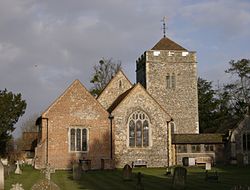
St Giles' Church
[edit]Thomas Gray's "Elegy Written in a Country Churchyard" is believed to have been written in the churchyard of Saint Giles. The church is a Grade I listed building.[33][34][35] Other churches have claimed the honour, including St Laurence's Church, Upton-cum-Chalvey and St Mary's in Everdon, Northamptonshire.

Gray is buried in a tomb with his mother and aunt in the churchyard.[36] John Penn commissioned James Wyatt to design a monument which is a Grade II* listed building. It bears lines from the Elegy.[37] The monument stands adjacent to St Giles' church and owned by the National Trust.[38]
A lychgate which is now located in the middle of the churchyard was designed by John Oldrid Scott and completed in 1887.[39] In 2022, it became a national heritage asset being listed Grade II.[40]
A gothic style rectory having a battlemented parapet was built by James Wyatt, 1802–1804 for John Penn of Stoke Park. It is now a private residence called Elegy House.[41]
Sport
[edit]There are two public recreation grounds: Bells Hill and Plough Lane.[42] In the late 20th century, large private sports facilities operated for the main benefit of Glaxo Laboratories staff at Sefton Park[43][44] and for Imperial Chemical Industries (ICI) Paints Division[45] at Duffield House, Stoke Green.[46]
Badminton: Stoke Poges Badminton Club has for many decades run in the Village Centre.[47][48]
Bowls: Stoke Poges Bowls Club was founded in 1978 and closed in 2020. The bowling green was situated in the grounds of the Polish Association in Church Lane. The bowling green had opened in 1949 by St. Helens Cable and Wire Company.[49]
Cricket: Stoke Green Cricket Club in Stoke Green has been playing there since 1879 with support of the then landowner, Howard-Vyse of Stoke Place.[50] Stoke Poges Golf Club at Stoke Park used to run a cricket club in the early 20th century, playing home matches in Farnham Royal.[51]
Darts: In 2023 darts teams from the Village Centre and the Rose and Crown public house in Stoke Poges, compete in the Chalfont and District Darts League.[52][53]
Football: Stoke Poges Football Club plays on the Bells Hill recreation ground.[54][55]
Golf: Stoke Park golf course was designed by Harry Colt for Nicholas Lane Jackson who founded it in 1908 as part of England's first golf and country club. It was known as Stoke Poges Golf Club.[56][57] The South Buckinghamshire Golf Academy consisted of a 9 holes golf course and a golf driving range. It was opened in 1994 and owned by Buckinghamshire County Council. It closed down after the granting of a planning application in 2018 to turn it into a public Country Park.[56][58] The South Buckinghamshire Golf Course, formerly known as Farnham Park Golf Course, is an 18-hole pay and play course, set in 130 acres of mature wooded parkland owned by Buckinghamshire Council.[59][56] In 2023 there were two golf clubs using the course: South Buckinghamshire Golf Club[60] and Farnham Park Golf Club. The latter was established at the course in 1977.[61] Wexham Park Golf Centre in Wexham Street, straddles Stoke Poges and Wexham Parishes. It has a variety of golf facilities with a nine hole course being located in Stoke Poges Parish.[62][56]
Padel: In 2023, Buckinghamshire Council submitted plans to build two padel tennis courts at the South Buckinghamshire Golf Course.[63]
Table Tennis: Stoke Poges Table Tennis Club was founded in 1950. Play used to take place in the pavilion at Sefton Park. In the 21st century it plays at St Andrew's Church Centre in Rogers Lane.[64]
Tennis: Stoke Poges Lawn Tennis Club operates on Bells Hill recreation ground and commenced there in 1949.[65][66]
In media
[edit]- In 1931, Aldous Huxley wrote his book Brave New World which mentions Stoke Poges in it. He frequently visited Stoke Poges golf course.[67]
- In 1957, British Pathé filmed The Vital Vaccine at Sefton Park where Glaxo Laboratories created and manufactured the 'Polyvirin', Britain's Polio vaccine. The Chairman of Glaxo, Sir Harry Jephcott is filmed. It is announced at the start of the film, that it is the former home of the music hall star, Vesta Tilley[68]
- In 1963, the film I Could Go On Singing with Judy Garland's character visits St Giles' parish church with her son.[69]
- In 1964, the golf course at Stoke Park was the setting of a golf match in the James Bond film Goldfinger, played between the principal characters.[70] The map on the dial in Bond's car that tracks Goldfinger's shows Stoke Poges.
- In 1969, Pinewood film studios hired a chemistry laboratory at Fulmer Research Institute for use as a film set for the film The Chairman (also known as The Most Dangerous Man in the World), starring Gregory Peck.[71]
- In 1981, the James Bond film For Your Eyes Only filmed its opening sequence, when Bond visits his wife's grave, in the graveyard at St Giles' Church.[72]
- In 1990, 'Inspector Lynley' crime novel Well-Schooled in Murder by Elizabeth George, and its television adaptation, are set in Stoke Poges.
- In 1996, Nick Hancock's Football Nightmares Nick Hancock is trying to hitchhike to the Victoria Ground in Stoke-on-Trent, but keeps getting dropped off in, or just outside, Stoke Poges.[73]
- In 1997, in the James Bond film Tomorrow Never Dies, Stoke Park hotel doubles as the interior of the Hamburg hotel, where Bond (Pierce Brosnan) drinks his vodka, renews his past relationship with Carver's wife Paris (Teri Hatcher) and struggles with Dr. Kaufman (Götz Otto).[74]
- In 1998, the novel Sharpe's Triumph by Bernard Cornwell was published. In the novel, Arthur Wellesley, 1st Duke of Wellington's dragoon orderly Daniel Fletcher mentions that he is from Stoke Poges: Sharpe replies: "Never heard of it."[75]
- In 2001 and 2004, Stoke Park is featured in the films Bridget Jones's Diary (2001), Layer Cake (2004), Wimbledon (2004), and Bride and Prejudice (2004).[76]
- In 2007, part of the television series Jekyll was filmed on the boardwalk and surrounding area.
- In 2010, the BBC drama series Vexed (series 1, episode 2 – with Toby Stephens and Lucy Punch) was largely filmed in the grounds and inside Stoke Court – which had earlier been Bayer Group UK's conference centre.
- In 2017, the British media caused a furore after the National Galleries of Scotland had bought The Monarch of the Glen painting by Sir Edwin Landseer for £4 million and the view by some that it may have been painted at Stoke Park.[77][78]
- In 2021, the lease of Stoke Park was bought by Reliance Industries (RIL) for £57 million from the International Group. Later in the year Stoke Park closed for refurbishment.[79][80][81][82]
- In 2021, Stoke Poges Memorial Gardens featured in the BBC programme Great British Railway Journeys presented by Michael Portillo.[83][84][85]
- In 2021, in his keynote speech at the Conservative Party Conference, Prime Minister Boris Johnson referred to Thomas Gray and Stoke Poges, about a levelling up vision in terms of an imbalanced society.[86][87]
Notable natives and residents
[edit]- Augustus Henry Eden Allhusen (1867–1925), English politician, resident at Stoke Court, Rogers Lane (1867–1925)[88]
- Christian Allhusen (1806–1890), Danish-English chemical manufacturer, resident at Stoke Court, Rogers Lane.[89]
- John Charles Bell (1844–1924), 1st Baronet, Lord Mayor of London and businessman, resident at Framewood Manor, Framewood Road (1905–1924).[90][91]
- John Beresford (1866–1944), 5th Baron Decies, Army officer, civil servant and baron, resident at Sefton Park (1905–1917)[92]
- Robert Brooke-Popham (1878–1953), Air Chief Marshal in the Royal Air Force and Governor of Kenya, resident at The Woodlands, Hollybush Hill.[93]
- Wilberforce Bryant (1837–1906), English businessman, owner of Bryant & May match manufacturer and Quaker, resident at Stoke Park (1887-1906).[94] : 70–77 [95]
- Edward Coke (1552–1634), Lord Chief Justice of England and politician, resident at the Manor House (1598-1634).[94]: 25–28
- Abraham Darby IV (1804–1878), English ironmaster, resident at Stoke Court, Rogers Lane (1851–1872).[96]
- Walter de Frece (1870–1935), British theatre impresario and politician, resident at Sefton Park with his wife, Vesta Tilley in the 1920s.[97]
- Wallace Charles Devereux (1893–1952), English businessman and engineer, founder of Fulmer Research Institute in Stoke Poges and resident at The Meads, Park Road.[98]
- John Thomas Duckworth (1748–1817), Admiral in the Royal Navy and baronet spent his childhood at the Vicarage, Park Road, where his father lived, being the Vicar of Stoke Poges (1754–1748).[99][100]
- Henry Godolphin (1648–1733) Dr., Provost of Eton College and Dean of St Paul's Cathedral, resident at Baylis House in 18th century.[101][102]
- Alfred Frank Hardiman (1891-1949), sculptor, resident at Farthing Green house.[103][104]
- Francis Hastings, 2nd Earl of Huntingdon (1514–1561), 2nd Earl of Huntingdon, politician, 1555 completed building of the Manor house.[105]
- Elizabeth Hatton (1578–1646), 2nd wife of Edward Coke, resident at the Manor House.[106]
- George Howard (1718–1796), Field Marshal in British Army and politician, resident at Stoke Place, Stoke Green (c.1764–1796).[107][108]
- Richard Howard-Vyse (1883–1962), Major General and Honorary Colonel of the Royal Horse Guards, resident at Stoke Place, Stoke Green (1883–1962)[109]
- Richard William Howard Howard Vyse (1784–1853), Major General and Egyptologist, born in Stoke Poges and resident at Stoke Place, Stoke Greens.[110]
- Alfred Webster 'Morgan' Kingston (1875–1936), tenor, opera singer, resident in Templewood Lane.[111][112]
- Henry Labouchere (1798–1869), 1st Baron Taunton, British Whig politician, resident at Stoke Park (1848–1863).[94]: 62–66
- Henry Martin (Marten) (c.1562–1641), King's Advocate for James I and Judge of Admiralty Court is reported to have been born at Stoke Poges.[113]
- Noel Mobbs (1878–1959), businessman, founder of Slough Estates, resident at Stoke Park (1928–1959).[114][94]: 188–213
- William Moleyns (1378–1425), politician, administrator, knight to Henry V, resident at the Manor House.[115][116][117]
- Bernard Oppenheimer (1866–1921), diamond merchant and philanthropist, resident at Sefton Park, Bells Hill (1917-1921).[118]
- Sydney Godolphin Osborne (1808–1889), Lord, cleric, writer, philanthropist, vicar of Stoke Poges (1832–1841).[119]
- Granville Penn (1761–1844), author, scriptural geologist and civil servant, resident at Stoke Park (1761–1844).[120][94]: 61
- John Penn (1760–1834), Chief Proprietor of Province of Pennsylvania, politician and writer, resident at Stoke Park (1760–1834).[121]
- Thomas Penn (1702–1775), son of William Penn and proprietor of Province of Pennsylvania, with three-fourths holding, resident at the Manor House, Stoke Park (1760–1775).[122]
- Borradaile Savory (1855–1906), English clergyman and baronet, resident at The Woodlands, Hollybush Hill (1855–1906).[123]
- William Scovell Savory (1826–1895), British Surgeon and baronet, resident at The Woodlands, Hollybush Hill (1884–1895).[124]
- Philip Stanhope (1694–1773), 4th Earl of Chesterfield, British statesman and diplomat, resident at Baylis house in 18th century.[125][126]
- Vesta Tilley (Matilda Alice Powles) (1864–1952), music hall performer, resident at Sefton Park in the 1920s with her husband Walter de Frece.[127]
- Alexander Wedderburn (1733–1805), 1st Earl of Rosslyn, Lord High Chancellor, resident at Baylis House, late 18th century and early 19th century.[128]
Sports
[edit]- Ruth Durlacher (1876–1946), Irish tennis player and golfer, resident at the White House and Pinegrove, Stoke Green, in early 20th century.[129][130]
- Walter Evelyn Gilliat (1869-1963), England footballer and Minister in the Church of England, resident at Duffield House where his father, Algernon, lived, Stoke Green[131][132]
- Nick 'Pa' Lane Jackson (1849–1937), founder of Stoke Park, sports administrator and author, resident Stoke Park (1908–1928).[133][94]: 100–186
- Jacques Laffite (born 1943) the French Formula One racing driver who won six Grands Prix for Ligier during the late 1970s and early 1980s, lived in Stoke Poges during some of his racing career.[citation needed]
- William Molyneux, 2nd Earl of Sefton (1772–1838), sportsman and gambler, resident at Stoke Farm, now known as Sefton Park (1795–1838).[134]
- Edward Hagarty Parry (1855–1931), International footballer & school headmaster, resident at Stoke House School, Stoke Green, (1855-1913).[135]
Notable organisations
[edit]- Comer Group, is a real estate company which c.2010 became the owner of Stoke Court for part of its residential portfolio.[136][137]
- Hitachi Data Systems, is a subsidiary of Hitachi. It provides technology and services relating to digital data. UK Headquarters at Sefton Park, Bells Hill, Stoke Poges.[138]
- International Group operates a group of companies in the leisure, sales, marketing, management, healthcare services and property development and ownership. Registered at Stoke Park until 2021, when the lease was sold to Reliance Industries[139][140]
- Reliance Industries Limited (RIL), an Indian multinational conglomerate, on the Global 500 list, bought the lease of Stoke Park in 2021[141]
- Servier Laboratories Ltd, is part of a French centric international pharmaceutical group. UK Headquarters at Sefton Park, Bells Hill, Stoke Poges.[142]
- Urenco Ltd, a nuclear fuel company, operating internationally running uranium enrichment plants. Headquarters at Sefton Park, Bells Hill, Stoke Poges.[143]
- Fulmer Research Institute, a pioneer contract research and development organisation. Its Headquarters was in Hollybush Hill, Stoke Poges from 1946 to 1990.[144]
- Glaxo Laboratories Ltd, now part of GSK, a fermentation and vaccine research laboratory at Sefton Park, Bells Hill, Stoke Poges from 1948 to 1982: (NB: see 'In Media' section above - 1957, British Pathé filmed The Vital Vaccine at Sefton Park) [145]
- Miles Laboratories, a US pharmaceutical and life sciences company. UK headquarters in Stoke Court, Rogers Lane, Stoke Poges from 1959 to 1978 when Bayer acquired it.[146][147]
Demography
[edit]| Census year | Population | Households |
|---|---|---|
| 2001 [148] | 4,414 | 1,764 |
| 2011 [149] | 4,752 | 1,832 |
| 2021 [150] | 5,067 | 1,887 |
| Measure | Stoke Poges ward | South Bucks borough | England |
|---|---|---|---|
| Population | 4,839 | 61,945 | 49,138,831 |
| Foreign born | 11.9% | 12.2% | 9.2% |
| White | 93.3% | 93.4% | 90.9% |
| Asian | 4.8% | 4.5% | 4.6% |
| Black | 0.3% | 0.4% | 2.3% |
| Christian | 76.5% | 75.6% | 71.7% |
| Muslim | 1.1% | 1.1% | 3.1% |
| Hindu | 0.7% | 1.2% | 1.1% |
| No religion | 10.6% | 12.5% | 14.6% |
| Unemployed | 1.8% | 1.9% | 3.3% |
| Retired | 16.8% | 14.8% | 13.5% |
At the 2001 UK census, the Stoke Poges electoral ward had a population of 4,839. The ethnicity was 93.3% white, 1.3% mixed race, 4.8% Asian, 0.3% black and 0.3% other. The place of birth of residents was 88.1% United Kingdom, 1.6% Republic of Ireland, 2.5% other Western European countries, and 7.8% elsewhere. Religion was recorded as 76.5% Christian, 0.2% Buddhist, 0.7% Hindu, 2.7% Sikh, 0.5% Jewish, and 1.1% Muslim. 10.6% were recorded as having no religion, 0.2% had an alternative religion and 7.6% did not state their religion.[151]
The economic activity of residents aged 16–74 was 40.8% in full-time employment, 11.6% in part-time employment, 12.6% self-employed, 1.8% unemployed, 1.5% students with jobs, 3.1% students without jobs, 16.8% retired, 6.7% looking after home or family, 2.5% permanently sick or disabled and 2.5% economically inactive for other reasons. The industry of employment of residents was 15.4% retail, 13.4% manufacturing, 6.9% construction, 21.1% real estate, 9.2% health and social work, 7.3% education, 8.8% transport and communications, 3.5% public administration, 3.4% hotels and restaurants, 2.8% finance, 0.8% agriculture and 7.4% other. Compared with national figures, the ward had a relatively high proportion of workers in real estate, transport and communications. According to Office for National Statistics estimates, during the period of April 2001 to March 2002 the average gross weekly income of households was £870, compared with an average of £660 in South East England. Of the ward's residents aged 16–74, 28.4% had a higher education qualification or the equivalent, compared with 19.9% nationwide.[151]
In 2011, The Daily Telegraph deemed Stoke Poges as Britain's eighth richest village and the third richest village in Buckinghamshire.[152]
| Output area | Homes owned outright | Owned with a loan | Socially rented | Privately rented | Other | km2 roads | km2 water | km2 domestic gardens | km2 domestic buildings | km2 non-domestic buildings | Usual residents | km2 |
|---|---|---|---|---|---|---|---|---|---|---|---|---|
| Civil parish | 727 | 717 | 183 | 159 | 28 | 0.397 | 0.076 | 1.422 | 0.176 | 0.057 | 4,752 | 10.09 |
References
[edit]- ^ David Carpenter. 2020. Henry III : The Rise to Power and Personal Rule 1207 – 1258. New Haven: Yale University Press. 360.
- ^ Plea Rolls of the Court of Common Pleas; National Archives; CP40/647; http://aalt.law.uh.edu/AALT1/H6/CP40no647/aCP40no647fronts/IMG_0029.htm; second entry, with "London" in the margin, & with defendants Thomas Clerk, William Adam, John Lambard & John Spykernell of Stoke Pocheys.
- ^ "Manor House, Stoke Poges - 1165194 | Historic England". historicengland.org.uk. Retrieved 31 May 2022.
- ^ Norsworthy, Laura (1935). The Lady of Bleeding Heart Lane. London: John Murray. p. 16.
- ^ Norsworthy, Laura (1935). The Lady of Bleeding Heart Lane. London: John Murray. p. 292.
- ^ Anon. "Stoke Poges Parish Council". Stoke Poges Parish Council. Retrieved 12 December 2024.
- ^ "Parishes: Stoke Poges". British History Online. Retrieved 27 May 2025.
- ^ "A Long Story". Thomas Gray Archive. December 2012. Retrieved 1 March 2013.
- ^ "Hotel claims Monarch of the Glen stag was English". BBC News. 26 October 2017. Retrieved 31 May 2022.
- ^ Dunhill, Lawrence (11 May 2012). "'Why was historic Stoke Poges Manor House sold for so little?'". Bucks Free Press. Retrieved 27 May 2025.
- ^ "The Stoke Poges School - GOV.UK". get-information-schools.service.gov.uk. Retrieved 31 May 2022.
- ^ "Ofsted – Short inspection on The Stoke Poges School". Gov.uk. 19 December 2020. Retrieved 21 January 2021.
- ^ Leeming, Jan (presenter) (8 September 1985). "10 O'Clock News". BBC News. Event occurs at 6:00. BBC One.
- ^ "Pioneer Secondary Academy". Pioneer Secondary Academy. Retrieved 31 May 2022.
- ^ Singh, Tarvinder. "Home". Sikh Academies Trust. Retrieved 31 May 2022.
- ^ "Pioneer Secondary Academy - GOV.UK". get-information-schools.service.gov.uk. Retrieved 31 May 2022.
- ^ "Inspection Report on Khalsa Secondary Academy". Gov.uk. Retrieved 20 January 2021.
- ^ "High Court reveals Khalsa Academies Trust's safeguarding failures". schoolsweek.co.uk. 8 October 2021. Retrieved 31 May 2022.
- ^ "Termination notice to Khalsa Secondary Academy". GOV.UK. 22 July 2014. Retrieved 31 May 2022.
- ^ "Larchmoor School, Stoke Poges | UCL UCL Ear Institute & Action on Hearing Loss Libraries". University College London. Retrieved 21 January 2021.
- ^ Booth, L.G. (1997). "The design and construction of timber hyperbolic paraboloid shell roofs in Britain: 1957–1975". Construction History. 13: 78. ISSN 0267-7768. JSTOR 41613779.
- ^ "Larchmoor School for the Deaf". The Royal National Institute for the Deaf. 22: 99–103. April 1967.
- ^ Fraser, Maxwell (1980). "9". The History of Slough. Slough: Slough Corporation. p. 94. OCLC 58814912.
- ^ "Frame Wood Manor (Halidon House School), Stoke Poges - 1124349 | Historic England". historicengland.org.uk. Retrieved 21 January 2021.
- ^ Archives, The National. "The Discovery Service". discovery.nationalarchives.gov.uk. Retrieved 21 January 2021.
- ^ Harris, L.H. (7 March 2023). "Baylis House".
- ^ "Buckinghamshire Gardens Trust - Baylis House" (PDF). 7 March 2023.
- ^ "Stoke House, Stoke Poges – 1317440 | Historic England". historicengland.org.uk. Retrieved 21 January 2021.
- ^ "Items relating to Stoke House and other schools records". Buckcc.gov.uk. 1879–1940. D-X 801/18. Retrieved 21 January 2020.
- ^ "Stoke Brunswick School". The Keep, East Sussex. 1886–1959. Retrieved 21 January 2021.
- ^ "The Long Dene Community". The Long Dene Community. Retrieved 22 February 2023.
- ^ Smithson, Sue (1999). Community adventure : the story of Long Dene School. London: New European Publications. ISBN 1-872410-13-8. OCLC 44915980.
- ^ Hoyle, Joshua Fielding (1920). The Country Churchyard – Stoke Poges Church. Oxford, UK: Church Army Press.
- ^ "Stoke Poges Church". stokepogeschurch.org. Retrieved 30 October 2021.
- ^ Historic England. "Church of St Giles, Stoke Poges (Grade I) (1164966)". National Heritage List for England. Retrieved 24 September 2022.
- ^ Historic England. "Tomb of Thomas Gray, his mother Dorothy Gray and his aunt Mary Antrobus in churchyard of St Giles Church, Stoke Poges (Grade II) (1124345)". National Heritage List for England. Retrieved 24 September 2022.
- ^ Historic England. "Gray's Monument, Stoke Poges (Grade II*) (1124346)". National Heritage List for England. Retrieved 24 September 2022.
- ^ "Gray's Monument and Gray's Field Stoke Poges, Buckinghamshire". National Trust. Retrieved 30 October 2021.
- ^ Blake, Rev. Vernon (22 November 1887). "Stoke Poges Church". The Times newspaper. Retrieved 12 February 2021.
- ^ Historic England. "Lych gate and attached stone and flint wall, Church of St Giles, Stoke Poges (Grade II) (1475583)". National Heritage List for England. Retrieved 24 September 2022.
- ^ Historic England. "St Giles' Vicarage (Grade II) (1332767)". National Heritage List for England. Retrieved 24 September 2022.
- ^ "Recreation Grounds | Stoke Poges Parish Council". Retrieved 5 March 2023.
- ^ "Hitachi Data Systems: Sefton Park - A history - Promotional Item - Computing History". computinghistory.org.uk. Retrieved 5 March 2023.
- ^ "Sefton Park | Stoke Poges Parish Council". Retrieved 5 March 2023.
- ^ Johnson, Alan Woodworth (1977). "John Donald Rose, 2 January 1911 - 14 October 1976". Biographical Memoirs of Fellows of the Royal Society. 23: 449–463. doi:10.1098/rsbm.1977.0017. S2CID 70495969.
- ^ "Duffiled House Conference Brochure by Joshua Keys - Issuu". issuu.com. Retrieved 5 March 2023.
- ^ "Stoke Poges Badminton Club | Stoke Poges Parish Council". Retrieved 5 March 2023.
- ^ "Badminton Club at Stoke Poges Village Centre". stoke-poges-centre.org.uk. Retrieved 5 March 2023.
- ^ "Stoke Poges Bowls Club | Stoke Poges Parish Council". Retrieved 5 March 2023.
- ^ "Stoke Green Cricket Club".
- ^ "Cricket 1911". archive.acscricket.com. Retrieved 5 March 2023.
- ^ "The Chalfont & District Darts League - Home". cddl.leaguerepublic.com. Retrieved 5 March 2023.
- ^ "Stoke Poges Village Centre Social Club". stoke-poges-centre.org.uk. Retrieved 5 March 2023.
- ^ "Stoke Green Rovers FC | Stoke Poges Parish Council". Retrieved 5 March 2023.
- ^ "Stoke Poges Saints First | East Berkshire Football League". fulltime.thefa.com. Retrieved 5 March 2023.
- ^ a b c d "Golf | Stoke Poges Parish Council". Retrieved 5 March 2023.
- ^ "History of Stoke Park -". Retrieved 5 March 2023.
- ^ "Buckinghamshire Council - Planning Application".
- ^ "Home". The South Buckinghamshire. Retrieved 5 March 2023.
- ^ "Noticeboard". sbgc-live. Retrieved 5 March 2023.
- ^ "Home - Farnham Park Golf Club". farnhampark.co.uk. Retrieved 5 March 2023.
- ^ "Wexham Park Golf Centre". wexhamparkgolfcentre.co.uk. Retrieved 5 March 2023.
- ^ "Buckinghamshire Council - Planning Application".
- ^ "Stoke Poges Table Tennis Club | Stoke Poges Parish Council". Retrieved 5 March 2023.
- ^ "Stoke Poges Lawn Tennis Club – Play tennis in the heart of the village". Retrieved 5 March 2023.
- ^ "Stoke Poges Tennis Club | Stoke Poges Parish Council". Retrieved 5 March 2023.
- ^ Huxley, Aldous (1998). Brave New World (First Perennial Classics ed.). New York: HarperCollins Publishers. ISBN 0-06-092987-1.
- ^ "The Vital Vaccine". British Pathé. Retrieved 6 March 2023.
- ^ Neame, Ronald (14 August 1963), I Could Go on Singing (Drama, Music), Barbican Films, retrieved 6 March 2023
- ^ "Goldfinger film locations (1964)".
- ^ J. Lee Thompson (Director), Gregory Peck (Actor) (1969). "The Chairman" (also known as "The Most Dangerous Man in the World") (Film). Pinewood Studios, Buckinghamshire, England: Twentieth Century Fox.
- ^ "For Your Eyes Only film locations". Archived from the original on 26 November 2010. Retrieved 7 August 2014.
- ^ Nick Hancock's Football Nightmares (1996), 21 October 1996, retrieved 6 March 2023
- ^ "Over 25 Years of 007 Filming Locations in England". Filming in England. 9 September 2021. Retrieved 6 March 2023.
- ^ "Sharpe's Triumph | Bernard Cornwell". bernardcornwell.net. Retrieved 7 March 2023.
- ^ "History of Stoke Park -". Retrieved 6 March 2023.
- ^ "Hotel claims Monarch of the Glen stag was English". BBC News. 26 October 2017. Retrieved 26 January 2021.
- ^ "Sir Edwin Landseer". nationalgalleries.org. Retrieved 26 January 2021.
- ^ "Luxury golf club and hotel to shut for two years after Indian billionaire buys it for £57 million". Bucks Free Press. 10 June 2021. Retrieved 30 October 2021.
- ^ "Luxury Hotel, Spa, Golf & Country Club in Buckinghamshire | Stoke Park". stokepark.com. Retrieved 30 October 2021.
- ^ Barman, Arijit. "Reliance all set to buy iconic British Country Club Stoke Park for 60 mn pounds". The Economic Times. Retrieved 30 October 2021.
- ^ Cradock, Matt (30 May 2021). "Stoke Park Country Club To Shut For Two Years After Takeover". Golf Monthly Magazine. Retrieved 30 October 2021.
- ^ "BBC Two – Great British Railway Journeys, Series 12, West Ruislip to Windsor". BBC. Retrieved 30 October 2021.
- ^ "BBC's Great British Railway Journey's next stop is Stoke Poges Memorial Gardens". Buckinghamshire Council. Retrieved 30 October 2021.
- ^ "Bucks memorial gardens set to feature on popular BBC TV show". Bucks Free Press. 23 April 2021. Retrieved 30 October 2021.
- ^ "Affluent Stoke Poges welcomes plan to 'take pressure off' by levelling up". The Guardian. 6 October 2021. Retrieved 30 October 2021.
- ^ "Levelling up is Johnson's answer to chill penury". churchtimes.co.uk. Retrieved 30 October 2021.
- ^ Debrett's House of Commons and the Judicial Bench 1901. London: Dean & Son. 1901. p. 2. Retrieved 20 January 2021
- ^ Chemist and Druggist, Volume 36. Benn Brothers. 1890. p. 61. Retrieved 20 January 2021.
- ^ South Bucks District Council (19 July 2011). "Framewood Road Character Appraisal". southbucks.gov.uk. p. 22. Retrieved 26 January 2021.
- ^ Slough Windsor Eton Observer (26 January 2021). "Death of Slough Magistrate". sloughhistoryonline.org.uk.
- ^ : 67 Rigby, Lionel (2000). Stoke Poges – A Buckinghamshire village through 1000 years. Phillimore. ISBN 9781860771316.
- ^ Kelly's directory of Berkshire, Buckinghamshire and Oxfordshire. 1935. Kelly's Directories Ltd. 1935. pp. Stoke Poges. OCLC 1114860090.
- ^ a b c d e f Pugh, Peter (2008). Stoke Park the first 1000 years. Icon Books. ISBN 978-184-046-946-2.
- ^ Corley, T. A. B. (2004). "Bryant, Wilberforce (1837–1906), match manufacturer". Oxford Dictionary of National Biography (online ed.). Oxford University Press. doi:10.1093/ref:odnb/46787. Retrieved 26 January 2021. (Subscription, Wikipedia Library access or UK public library membership required.)
- ^ "No. 21409". The London Gazette. 8 February 1853. p. 329.
- ^ "Recollections of Vesta Tilley | WorldCat.org". worldcat.org. Retrieved 6 March 2023.
- ^ "Fulmer Research Institute, timeline". 23 January 2021.
- ^ "Duckworth, Sir John Thomas (1748–1817). | History of Parliament Online". historyofparliamentonline.org. Retrieved 21 January 2021.
- ^ "Stoke Poges Heritage Walk – Map". Buckinghamshire.gov.uk. Item B. Buckinghamshire Council. 2020. Retrieved 21 January 2021.
{{cite web}}: CS1 maint: others (link) - ^ "Godolphin, Henry (1648–1733), college head and dean of St Paul's". Oxford Dictionary of National Biography (online ed.). Oxford University Press. 2004. doi:10.1093/ref:odnb/10878. Retrieved 6 March 2023. (Subscription, Wikipedia Library access or UK public library membership required.)
- ^ "Buckinghamshire Sites – Parks – Buckinghamshire Gardens Trust". Retrieved 6 March 2023.
- ^ "Alfred Frank Hardiman". London Remembers. Retrieved 31 May 2022.
- ^ "Alfred Frank Hardiman RA, RS, FRBS - Mapping the Practice and Profession of Sculpture in Britain and Ireland 1851-1951". sculpture.gla.ac.uk. Retrieved 31 May 2022.
- ^ "MANOR HOUSE, Stoke Poges – 1165194 | Historic England". historicengland.org.uk. Retrieved 31 January 2021.
- ^ Aughterson, Kate (2004). "Hatton, Elizabeth, Lady Hatton [née Lady Elizabeth Cecil; other married name Elizabeth Coke, Lady Coke] (1578–1646), courtier". Oxford Dictionary of National Biography (online ed.). Oxford University Press. doi:10.1093/ref:odnb/68059. Retrieved 14 February 2023. (Subscription, Wikipedia Library access or UK public library membership required.)
- ^ "Sir George Howard". Oxford Dictionary of National Biography (online ed.). Oxford University Press. 2004. doi:10.1093/ref:odnb/13900. Retrieved 13 July 2014. (Subscription, Wikipedia Library access or UK public library membership required.)
- ^ "Parishes: Stoke Poges, A History of the County of Buckingham: Volume 3 (1925)". pp. 302–313. Retrieved 14 July 2014.
- ^ Anglesey, The Marquess of (1994). A History of the British Cavalry: Volume 5: 1914–1919 Egypt, Palestine and Syria. Pen & Sword Books Ltd. ISBN 9780850523959.
- ^ 1851 England Census HO107/1718; Folio: 579; Page: 17
- ^ "Morgan Kingston". historicaltenors.net. Retrieved 31 May 2022.
- ^ "Morgan Kingston". Our Mansfield & Area. Retrieved 31 May 2022.
- ^ Brief Lives John Aubrey Clarendon Press, 1898 – Great Britain
- ^ "Sir Noel Mobbs | English Bridge Union". ebu.co.uk. Retrieved 26 January 2021.
- ^ Neale, John Preston (1824). Views of the most interesting Collegiate and Parochial Churches in Great Britain – St Giles' Church, Stoke Poges – The Rev Arthur Bold. Volume 1. London: John le Keux. OCLC 939440882.
- ^ Bryant Bevan, The Rev. D.H. (1948). "Stoke Poges Church". The Country Churchyard. R.G. Baker & Co. Ltd, Farnham Common, Buckinghamshire: 17.
- ^ Woodger, L. S. (1993), "Moleyns, Sir William (1378–1425), of Stoke Poges, Bucks", in J.S. Roskell; L. Clark; C. Rawcliffe (eds.), The History of Parliament: the House of Commons 1386–1421, retrieved 31 January 2021
- ^ "No. 32776". The London Gazette. 12 December 1920. p. 8839.
- ^ "Osborne, Lord Sydney Godolphin (1808–1889), philanthropist". Oxford Dictionary of National Biography (online ed.). Oxford University Press. 2004. doi:10.1093/ref:odnb/20883. Retrieved 1 February 2021. (Subscription, Wikipedia Library access or UK public library membership required.)
- ^ Fell-Smith, Charlotte (2004). "Penn, Granville (1761–1844)". In Smail, Rev. Richard (ed.). Oxford Dictionary of National Biography. Oxford Dictionary of National Biography (online ed.). Oxford University Press. doi:10.1093/ref:odnb/21847. Retrieved 25 January 2021. (Subscription, Wikipedia Library access or UK public library membership required.)
- ^ "Penn, John (PN776J)". A Cambridge Alumni Database. University of Cambridge.
- ^ Wainwright, Nicholas B. (1963). "The Penn Collection". The Pennsylvania Magazine of History and Biography. 87 (4): 393–419. ISSN 0031-4587. JSTOR 20089651.
- ^ "Savory, Borradaile (SVRY875B)". A Cambridge Alumni Database. University of Cambridge.
- ^ Framewood Road Conservation Area Character Appraisal report (19 July 2011).South Bucks District Council
- ^ Cannon, John (2004). "Stanhope, Philip Dormer, fourth earl of Chesterfield (1694–1773), politician and diplomatist". Oxford Dictionary of National Biography (online ed.). Oxford University Press. doi:10.1093/ref:odnb/26255. ISBN 978-0-19-861412-8. Retrieved 6 March 2023. (Subscription, Wikipedia Library access or UK public library membership required.)
- ^ Fraser, Maxwell. "Salt Hill". sloughhistoryonline.org.uk. Retrieved 6 March 2023.
- ^ De Frece, Lady (1934). Recollections of Vesta Tilley. Hutchinson. OCLC 754988460.
- ^ Murdoch, Alexander (2004). "Wedderburn, Alexander, first earl of Rosslyn (1733–1805), lord chancellor". Oxford Dictionary of National Biography (online ed.). Oxford University Press. doi:10.1093/ref:odnb/28954. Retrieved 6 March 2023. (Subscription, Wikipedia Library access or UK public library membership required.)
- ^ "Page 2941 | Issue 34156, 3 May 1935 | London Gazette | The Gazette". thegazette.co.uk. Retrieved 6 March 2023.
- ^ 1935 Kelly's Directory of Berkshire and Oxfordshire. Kelly's Directories Ltd. 1935. pp. Stoke Poges.
- ^ "FamilySearch.org". ancestors.familysearch.org. Retrieved 31 May 2022.
- ^ "England Players - Walter Gilliat". englandfootballonline.com. Retrieved 31 May 2022.
- ^ Jackson, Nick Lane (1932). Sporting Days and Sporting Ways. London, UK: Hurst and Blacket. OCLC 1073277963.
- ^ Rigby, Lionel (2000). "20". Stoke Poges – A Buckinghamshire village through 1000 years. Phillimore. p. 74. ISBN 9781860771316.
- ^ Betts, Graham (2006). England: Player by player. Green Umbrella Publishing. p. 187. ISBN 1-905009-63-1.
- ^ "Residential Portfolio UK". thecomergroup.com. Retrieved 30 October 2021.
- ^ Kingsley, Nick (9 February 2014). "Landed families of Britain and Ireland: (108) Allhusen of Elswick Hall, Stoke Court and Bradenham Hall". Landed families of Britain and Ireland. Retrieved 30 October 2021.
- ^ "Hitachi Vantara – HDS partner contact information". HitachiVantara.com. 22 January 2021.
- ^ "International Group official website". igroup.co.uk. 22 January 2021.
- ^ Hammond, George; Raval, Anjli; Parkin, Benjamin (23 April 2021). "Mukesh Ambani buys 'Goldfinger' Stoke Park golf club for £57m". Financial Times. Archived from the original on 10 December 2022. Retrieved 30 October 2021.
- ^ "International Group – Founded in 1964, International Group is a family owned business". Retrieved 30 October 2021.
- ^ "Servier Laboratories UK HQ Contact". Servier.co.uk. 20 January 2021.
- ^ "Urenco Ltd – Official website". Urenco.com. 22 January 2021.
- ^ Liddiard, E A G (1965). "The Fulmer Research Institute". Physics Bulletin. 16 (5): 161–169. doi:10.1088/0031-9112/16/5/001.
- ^ Macrae, T. F. (1957). "The Research Work of Glaxo Laboratories Limited". Proceedings of the Royal Society of London. Series B, Biological Sciences. 146 (923): 181–193. Bibcode:1957RSPSB.146..181M. doi:10.1098/rspb.1957.0003. ISSN 0080-4649. JSTOR 82979. PMID 13420142. S2CID 33221639.
- ^ "Stoke Poges West End Conservation Area". South Bucks District Council: 19. 19 July 2011.
- ^ "History". bayer.com. Retrieved 21 January 2021.
- ^ Area 11UE010 (Stoke Poges parish) in Tables KS001 (Usual resident population) and KS016 (Household spaces and accommodation type) at "Key Statistics - 2001 Census". www.nomisweb.co.uk.
- ^ a b Key Statistics: Dwellings; Quick Statistics: Population Density; Physical Environment: Land Use Survey 2005
- ^ Stoke Poges parish (E04001589) in Table PP002 (Sex) at "Parish Profiles". Office for National Statistics. Retrieved 5 August 2024.
- ^ a b "Neighbourhood Statistics". Statistics.gov.uk. Retrieved 20 April 2008.
- ^ "Britain's richest villages". The Daily Telegraph. Archived from the original on 5 September 2011. Retrieved 3 April 2011.
External links
[edit]
- . Encyclopædia Britannica. Vol. 25 (11th ed.). 1911.
- Stoke Poges Parish Council
- Stoke Poges Village Centre
- Stoke Poges Parish Church of St Andrew and St Giles
- The Stoke Poges Society
South Bucks (former district) | ||
|---|---|---|
| Towns (component areas and hamlets) |  | |
| Other civil parishes (component villages and hamlets) | ||
| Former districts and boroughs | ||
| Former constituencies | ||
| International | |
|---|---|
| National | |
| Geographic | |
| Other | |

Stoke Poges
View on GrokipediaGeography
Location and Administrative Boundaries
Stoke Poges constitutes a civil parish situated in south-eastern Buckinghamshire, England, governed under the unitary authority of Buckinghamshire Council.[5] Despite its location within Buckinghamshire, the parish's postal addresses fall under the post town of Slough in the SL2 postcode district.[6] The parish boundaries adjoin those of Farnham Royal to the west, Fulmer to the north, and Gerrards Cross to the east, encompassing an area of approximately 3,448 acres as recorded in historical surveys.[7] [8]The parish lies entirely within the Metropolitan Green Belt, a designation first applied to the Buckinghamshire portion in 1954 to inhibit urban expansion and prevent the merger of settlements with nearby Slough.[9] This status has effectively curbed coalescence with adjacent urban areas by preserving open land.[10] Centred at coordinates 51°32′N 0°35′W, Stoke Poges benefits from connectivity via the A332 (Stoke Poges Lane), linking it southward to Slough, and proximity to the M4 motorway approximately 3 miles to the south.[11]
Topography and Natural Environment
Stoke Poges exhibits a flat, lowland topography typical of the surrounding Thames Valley, with elevations generally ranging from 20 to 40 meters above sea level, facilitating a semi-rural landscape of open fields interspersed with wooded areas.[12] The underlying geology consists of Quaternary gravel deposits overlying London Clay Formation, resulting in varied soils that include heavier clayey types conducive to arable farming and lighter, gravelly substrates supporting heathland vegetation. These soil characteristics underpin the area's agricultural productivity and woodland cover, while contributing to localized drainage challenges in wetter conditions. The natural environment encompasses a mosaic of arable fields, permanent pastures, and deciduous woodlands, with commons historically maintained through grazing that preserves open habitats.[13] Stoke Common, managed by the City of London Corporation, represents the largest expanse of heathland in southern Buckinghamshire at approximately 80 hectares and is designated as a Site of Special Scientific Interest for its lowland heath, a rare semi-natural habitat formed by long-term human management on nutrient-poor soils.[9] This site hosts diverse native flora such as heather and gorse, alongside fauna including reptiles and invertebrates adapted to acidic conditions, enhancing regional biodiversity despite pressures from succession and invasive species.[14] The region experiences a temperate oceanic climate, with mild winters and cool summers, and average annual precipitation of around 700 mm, concentrated in autumn and winter months.[15] Low-lying portions, particularly those aligned with local brooks, exhibit vulnerability to surface water flooding during intense rainfall events, exacerbated by the impermeable clay layers that limit infiltration.[12] Such hydrological dynamics periodically affect pastures and woodland edges, underscoring the area's sensitivity within the broader Thames catchment.[16]Etymology and Origins
Linguistic Roots
The element "Stoke" derives from the Old English stoc, denoting a stockaded enclosure, outlying farmstead, or secondary settlement dependent on a larger community, a prevalent toponymic root in England appearing in over 100 place names.[17] In the Domesday Book of 1086, the settlement is entered as "Stoche," valued at 10 hides with 17 households recorded, held by William son of Ansculf.[18] The suffix "Poges" constitutes a manorial affix referencing the le Pugeis family of Norman descent, who acquired tenure over the manor in the 13th century; the earliest documented instance occurs in 1255, when Humbert le Pugeis held custody.[8] By 1291, Amicia de Stoke had wed Robert Poges, a Norman, formalizing the family's association and prompting the name's evolution from Latinized "Pugeis" through Middle English phonetic adaptation to "Poges."[19] This distinguishing addition served to differentiate the locality from similarly named "Stoke" sites across England, embodying Norman feudal land grants that appended possessory surnames to pre-existing Anglo-Saxon designations.[20]Early Recorded History
The earliest documentary evidence for Stoke Poges dates to the Domesday Book of 1086, which records the settlement as Stoches in Buckinghamshire's Stoke hundred, with 17 households comprising 10 villagers, 3 smallholders, and 4 slaves.[18] The manor included 10 ploughlands serviced by 2 lord's teams and 6 men's teams, woodland supporting 500 pigs, and 1 mill yielding 4 shillings annually; its value stood at £5 in 1086, having been £6 in 1066 before the Conquest.[18] These details reflect a compact rural economy centered on arable farming, pastoral woodland, and milling, indicative of nucleated settlement around the manorial core. Prior to 1066, the land was held by Siret, a vassal of King Harold Godwinson, consistent with Anglo-Saxon patterns of thegnly tenure under royal commendation.[19] The Norman Conquest prompted its reassignment to William Fitz Ansculf, a tenant-in-chief under William I, marking the shift to feudal secular lordship that reinforced manorial organization and peasant obligations as the foundation for subsequent local settlement and agrarian structure.[18][19] Archaeological investigations have yielded no confirmed pre-Domesday artifacts specific to the parish, underscoring the survey's primacy as empirical record over speculative earlier activity.Historical Timeline
Medieval Foundations
In the Domesday Book of 1086, the manor of Stoke, assessed at 10 hides with 17 households including 3 villagers, 11 smallholders, 2 slaves, and 1 priest, was held by William fitz Ansculf directly from the king as part of the hundred of Stoke in Buckinghamshire.[18] This entry reflects early feudal consolidation under Norman overlordship, with the estate valued at £8 in 1086 after prior holdings by a freeman named Siret under King Edward the Confessor.[19] By the 13th century, the affix "Poges" distinguished the manor, deriving from the tenure of the le Poer (or Poges) family, who held it through much of the medieval period until the early 15th century, managing demesne lands, villein tenements, and customary services.[2] The feudal structure centered on the manor lord's authority, enforced via manorial courts that recorded rents, labor obligations, and disputes among tenants, supplemented by the hundred court of Stoke for broader administrative and judicial functions like frankpledge maintenance and minor criminal cases.[21] These records, preserved in inquisitions post mortem and extents, document the manor's economic base in arable farming and pastoral activities, with church endowments including tithes from manor lands supporting the rectory of St Giles', a Norman foundation expanded in the 12th-14th centuries.[22] The Black Death of circa 1348-1349 severely impacted the region, contributing to a national population decline of 30-50% and locally exacerbating labor shortages in Buckinghamshire manors like Stoke Poges, where post-plague extents show reduced tenant numbers and a pivot toward sheep rearing for wool production amid contracting arable cultivation.[23] St Giles' Church, central to medieval communal life, benefited from these tithes and glebe lands, funding priestly maintenance and poor relief under canon law, though manorial lords retained advowson rights over appointments.[21] By the late 14th century, such structures underscored the interplay of secular and ecclesiastical feudalism, with primary evidence drawn from these localized court rolls rather than centralized royal narratives.Tudor and Civil War Period
During the Tudor period, Stoke Poges saw significant developments in its manorial estate, reflecting the era's shift toward secular gentry ownership and architectural innovation. The fortified medieval manor house was replaced in the mid-16th century with a substantial brick structure featuring multiple chimneys and gables, characteristic of Tudor design, under owners who benefited from the reallocations of land following Henry VIII's Dissolution of the Monasteries (1536–1541), though no local monastic houses were directly suppressed.[24] By 1555, the estate had passed to Francis Goldwell, a prominent figure whose tenure exemplified the consolidation of rural holdings by affluent families amid broader economic changes.[25] This reconstruction underscored elite patronage, as the manor became a seat for influential lawyers and administrators; Sir Edward Coke, acquiring the property through marriage around 1598, resided there as Attorney General and later Chief Justice, hosting royal visits that highlighted the village's ties to central power.[26] Queen Elizabeth I visited Stoke Poges on August 13, 1592, during her summer progress, with preparations centered at Coke's residence, demonstrating the strategic use of such estates for monarchical display and loyalty affirmation.[27] The English Civil War (1642–1651) brought political upheaval to the parish, positioning Stoke Poges manor as a site of contention between royalist and parliamentary forces. While broader Buckinghamshire leaned royalist, local gentry connections—rooted in figures like Coke, whose legal opposition to absolutism influenced parliamentary ideology—facilitated its use by Parliament. In 1647, following his escape attempts from other confinements, King Charles I was briefly held prisoner at the Stoke Poges Manor House under parliamentary guard, en route to more secure custody on the Isle of Wight; this short detention, prior to his trial and execution in 1649, marked the estate's incidental role in the conflict's royal custody logistics rather than active combat.[2] The event reflected the parish's exposure to national divisions, with the manor's ownership by Coke's descendants aligning it provisionally with Parliament, though no major battles or widespread local royalist resistance are recorded, preserving the village from direct devastation.[28] Post-war, these episodes reinforced the manor's status among redistributed gentry properties, transitioning toward later elite ownership without evident lasting partisan scars.Georgian Era and Literary Connections
![Gray's Monument in Stoke Poges churchyard][float-right] The Georgian era marked a period of cultural and aesthetic refinement in Stoke Poges, particularly through its association with poet Thomas Gray and enhancements to local estates. Gray composed his renowned poem Elegy Written in a Country Churchyard in 1751, drawing inspiration from the churchyard of St Giles' parish church, where the rural simplicity and meditative atmosphere evoked reflections on mortality and the lives of the obscure.[4][29] The work, first circulated privately among friends before wider publication, cemented the site's literary significance, portraying the churchyard as a symbol of egalitarian remembrance amid pastoral tranquility.[29] Gray's personal ties deepened this connection; following his death on July 30, 1771, he was interred in St Giles' churchyard beside his mother and aunt in a brick table tomb, further linking the poet's legacy to the locale.[4][30] A monument erected nearby honors his contributions, preserving the site's draw for admirers of 18th-century poetry.[4] Parallel to literary prominence, estate improvements elevated Stoke Poges as a genteel retreat. In circa 1750, landscape architect Lancelot "Capability" Brown redesigned the grounds of Stoke Park for Lady Anne Cobham, incorporating a lake and naturalistic parkland that epitomized the era's preference for harmonious, undulating landscapes over formal gardens.[3][31] This transformation, among Brown's early commissions, attracted affluent visitors seeking refined rural seclusion, enhancing the village's status within Buckinghamshire's evolving countryside aesthetic.[3] Agricultural shifts via enclosure complemented these developments. The Stoke Poges Enclosure Act of 1810 privatized former commons, such as Stoke Common, reallocating land for consolidated farming that improved productivity through hedgerow boundaries and drainage, though it curtailed communal access.[20] These parliamentary measures, peaking in the late 18th and early 19th centuries, aligned with broader Georgian rationalization of land use, fostering enclosed fields that supported the era's growing emphasis on efficient estate management and picturesque vistas.[20]19th-20th Century Changes
The proximity of the Great Western Railway's line through nearby Slough, operational from 1838, enabled residents of Stoke Poges to commute to London for work, fostering its emergence as a commuter village without significant industrialization, as the local economy remained anchored in agriculture and the management of four major estates throughout much of the 19th century.[32][20] This railway access attracted affluent professionals seeking rural retreats, yet the absence of factories or heavy industry preserved the area's open landscapes and estate-dominated structure, distinguishing it from urbanizing neighbors like Slough.[20] In the early 20th century, historic properties adapted to new institutional uses amid subtle suburban influences; notably, Stoke Park estate was acquired in 1908 by businessman 'Pa' Lane Jackson, who leased the mansion and portions of the grounds to form the Stoke Poges Golf Club, marking the site's conversion into one of Britain's inaugural country clubs complete with a championship golf course laid out by architect Harry Colt.[3] Post-1945 planning policies reinforced resistance to suburban sprawl, with Stoke Poges falling within the Metropolitan Green Belt established to prevent the coalescence of London with surrounding towns, safeguard countryside from development, and check unrestricted built-up expansion—a framework originating in 1930s proposals and formalized under the 1947 Town and Country Planning Act.[33] This designation, encompassing approximately 90% of the parish, curtailed housing and commercial pressures from adjacent urban growth, sustaining agricultural and recreational land uses over industrial or dense residential transformation.[34][35]Post-War Developments and Recent Events
Following the end of World War II, Stoke Poges experienced modest population expansion driven by suburbanization trends near Slough and London, with census figures rising from approximately 2,500 in 1951 to around 4,000 by the 1970s, reflecting broader regional housing demand.[36] By 2011, the population reached 5,099, stabilizing near 5,067 in 2021 amid efforts to curb unchecked growth.[36] This increase prompted infrastructure adaptations, such as the 1950s repurposing of a disused chapel into a community facility to accommodate rising local needs.[37] Tensions between development and preservation intensified in the late 20th and early 21st centuries, with the establishment of conservation areas like Stoke Poges West End in 2011 to safeguard historic character against housing pressures.[20] The Stoke Poges Society, founded in May 2009, emerged as a key advocate for heritage, aiming to document and protect the village's historical assets while scrutinizing planning proposals.[38] Recent planning debates have centered on sustainable expansion, exemplified by the 2025 Neighbourhood Plan, approved via referendum on June 26 and adopted August 14, which allocates sites for limited housing—including affordable units—while prioritizing green space protection and design standards to mitigate infrastructure overload.[33] Applications for extensions and new builds, such as a refused "unacceptable" house enlargement in June 2025, underscore ongoing scrutiny of impacts on rural fabric.[39] Emergency responses to incidents have highlighted vulnerabilities in the area's semi-rural setup. In July 2025, a field fire in Stoke Poges, sparked by a bonfire ember amid dry conditions, required multi-agency intervention and spread to 100 by 100 meters, prompting warnings on rural fire risks.[40] A vehicle-involved blaze on July 10 damaged outbuildings and a house on Elizabeth Way, with crews from Royal Berkshire and Buckinghamshire services containing it.[41] A September 16 shed fire on Stoke Poges Lane further tested rapid response capabilities, resolved in under an hour but indicative of strains on volunteer-dependent systems in low-density locales.[42] These events, absent major casualties, align with national upticks in dry-weather incidents without evidence of systemic under-resourcing beyond typical rural challenges.Demography and Society
Population Trends
The population of the Stoke Poges civil parish has exhibited steady growth over two centuries, rising from 741 residents in the 1801 census to 5,066 in the 2021 census.[8][43] This expansion reflects broader rural-to-suburban transitions in southern Buckinghamshire, with a notable acceleration in the mid-20th century linked to postwar housing developments that absorbed some overspill from London's metropolitan area.[34] A minor decline occurred between 1841 (1,528) and 1851 (1,501), possibly due to localized agricultural shifts, but overall trends show consistent increases driven by natural growth and inward migration.[8]| Census Year | Population |
|---|---|
| 1801 | 741 |
| 1811 | 838 |
| 1821 | 1,073 |
| 1831 | 1,252 |
| 1841 | 1,528 |
| 1851 | 1,501 |
| 1861 | 1,600 |
| 1871 | 1,850 |
| 1881 | 2,150 |
| 1891 | 2,356 |
| 1901 | 3,175 |
| 2001 | 4,414 |
| 2011 | 4,752 |
| 2021 | 5,066 |
Ethnic and Socioeconomic Composition
In the 2021 United Kingdom census, Stoke Poges had a population of 5,066, with the ethnic composition showing a majority White population alongside notable Asian representation influenced by the parish's adjacency to the more diverse Slough urban area. The breakdown was as follows:| Ethnic Group | Number | Percentage |
|---|---|---|
| White | 3,157 | 62.3% |
| Asian | 1,419 | 28.0% |
| Mixed/multiple | 166 | 3.3% |
| Other | 205 | 4.0% |
| Black | 83 | 1.6% |
| Arab | 32 | 0.6% |
Governance and Infrastructure
Local Administration
Stoke Poges Parish Council, established under the Local Government Act 1894 to replace vestry meetings, functions as the primary elected body for local policy-making and administration at the parish level.[48] It consists of 11 councillors elected for four-year terms, with vacancies filled by co-option, and holds monthly public meetings to deliberate on community matters.[48] The council exercises powers through dedicated committees, including the Planning Committee, which reviews and submits consultative comments or objections on development proposals to Buckinghamshire Council, and the Finance and General Purposes Committee, which oversees resource allocation for local initiatives.[48] Community funds support projects such as infrastructure enhancements, drawn from the annual precept—£202,336 for 2023/24 (reduced by 5% from prior levels) and contributing to a Band D council tax rate of £76.43 for 2024/25—collected via Buckinghamshire Council, alongside Section 106 developer contributions allocated for specific mitigation measures like traffic calming.[49][50][51] In coordination with Thames Valley Police's Iver, Stoke Poges and Wexham policing area, the council addresses local crime and safety concerns, including responses to incidents such as the May 22, 2025, collision on Bells Hill that left Police Constable Christopher Miller with life-threatening injuries, prompting arrests on suspicion of attempted murder.[52][53] The parish aligns with the Farnhams & Stoke Poges ward of the unitary Buckinghamshire Council, where three Conservative councillors were elected on May 1, 2025, to handle higher-tier oversight.[54]Education Facilities
The primary state-funded school in Stoke Poges is The Stoke Poges School, a co-educational community primary serving pupils aged 4 to 11 at Rogers Lane, with a capacity of 426 pupils as of the latest records.[55] The school received a Good overall rating from Ofsted following its inspection on 21 May 2024, with judgements of Good for quality of education, behaviour and attitudes, and personal development.[56] Pioneer Secondary Academy, located at Hollybush Hill in the parish, is a co-educational secondary school for ages 11 to 16 that opened as an inclusive Sikh faith institution rooted in the values of respect, aspiration, integrity, seva (selfless service), and equality.[57] CWA Sefton Park, also within Stoke Poges, operates as a secondary special school for pupils aged 11 to 19, emphasizing real-world skills and pathways to employment for those with special educational needs.[58] Pupils from Stoke Poges typically access secondary education at nearby institutions outside the parish, including grammar schools such as Burnham Grammar School and selective options like Beaconsfield High School for girls or John Hampden Grammar School for boys, as listed by the local parish council.[59] Comprehensive alternatives include Chalfonts Community College in Gerrards Cross.[59] Independent schooling options in the immediate vicinity include Caldicott School in adjacent Farnham Royal, a Church of England preparatory day and boarding school for boys aged 7 to 13, with 258 pupils enrolled.[60] Nearby Fulmer Infant School, serving ages 5 to 7 in the village of Fulmer, maintains an Outstanding Ofsted rating from its 2014 inspection, focusing on high expectations and broad curricula.[61][62] Adult education in the area is supported through Buckinghamshire Adult Learning's county-wide programs, which offer part-time courses in over 140 locations, including art, drawing, and painting workshops suitable for all abilities held in Stoke Poges community venues.[63][64] These initiatives provide flexible, non-vocational learning opportunities without dedicated parish-specific centers.[65]Transport and Utilities
Stoke Poges has no railway station, with the nearest at Slough, approximately 4 miles south, requiring bus or car travel for rail connections. Public transport is limited to bus services, primarily the route 107 operated by Reading Buses, which links the village to Slough town centre in about 17 minutes for £3-£4.[66] Other local routes include the Arriva 353 from Slough bus station to stops such as the Six Bells in Stoke Poges.[67] Connections to Heathrow Airport are indirect via Slough services like the First Bus 7, running up to every 15 minutes daytime, while Windsor lies north along bus corridors paralleling the A332.[68] The village's road network centres on the A332, a dual carriageway providing fast access south to Slough and the M4 motorway at Junction 6, and north toward Windsor, with onward links to the M25 via the M4 or M3 corridors.[69] This positioning supports commuter travel to London and Heathrow, though local lanes like Stoke Poges Lane handle village traffic. Cycle paths traverse commons and connect to Slough's network, promoting alternative mobility amid the rural-suburban setting.[70] Water supply and sewage disposal are handled by Thames Water, the statutory provider for most of Buckinghamshire including Stoke Poges, with infrastructure tied to regional treatment works like Slough Sewage Treatment Works.[71] Broadband coverage has expanded since the mid-2010s through national superfast programmes, offering download speeds up to 200 Mbps (superfast) widely and over 300 Mbps (ultrafast) to many premises via fibre technologies, though peripheral rural areas may still rely on slower copper-based or partial fibre connections.[72][73]Landmarks and Heritage Sites
St Giles' Church
St Giles' Church serves as the central parish church of Stoke Poges, with origins tracing to the 12th century and incorporating earlier Saxon remnants in the chancel wall and windows, alongside Norman elements in the chancel and portions of the tower.[74][75] The structure features a 15th-century tower in the Perpendicular Gothic style, added during medieval expansions that included 13th- to 16th-century modifications to the nave and arcades.[76] These architectural developments reflect the church's evolution from a basic Norman building to a more elaborate ecclesiastical site, with flint and stone construction typical of the region.[77] The churchyard holds significance for its association with poet Thomas Gray, who drew inspiration for his 1751 poem Elegy Written in a Country Churchyard from the locale; Gray himself was buried there in 1771 alongside his mother Dorothy and aunt Mary Antrobus in a family plot.[29] This burial site, often linked to the poem's contemplative themes, includes memorials that underscore the church's role as an inspirational and sepulchral landmark, though no dedicated "Gray family vault" is distinctly documented beyond the shared grave.[78] Architecturally, the Perpendicular Gothic elements, particularly in the tower, exemplify late medieval verticality and ornate window tracery, while 19th-century restorations preserved these features amid Victorian-era updates.[76] Ongoing maintenance, including major repairs to address structural issues identified in recent quinquennial surveys, has been funded through bequests such as that from Edna Mayer and dedicated fabric funds managed by the Parochial Church Council.[79][80] These efforts ensure the church's longevity as a Grade I listed building.[76] As an active place of worship, St Giles' facilitates regular Anglican services and community events, maintaining its ecclesiastical function since at least the Norman period. Parish records, including baptisms, marriages, and burials, extend from 1538, with originals deposited in the Buckinghamshire Archives, providing a continuous documentary record of local life.[8] The churchyard, extended in the 20th century but now closed to new burials, continues to serve as a site for memorialization, reinforcing its enduring communal and historical role.[78]Stoke Poges Manor House
Stoke Poges Manor House, a Grade I listed building, represents a continuous thread of manorial tenure from the Norman Conquest onward. The estate appears in the Domesday Book of 1086 as Stoke Poges, held by William son of Ansculf and assessed at 10 hides with 17 households, following pre-Conquest ownership by Siret, a vassal of King Harold.[18][19] An earlier fortified structure received a license to crenellate in 1331 for John Moleyns. In 1555, Francis Hastings, 2nd Earl of Huntingdon, demolished much of the medieval fortified house and rebuilt it as a large Tudor brick edifice featuring numerous chimneys and gables.[81] The property passed in 1599 to Sir Edward Coke, Chief Justice of England, who hosted Queen Elizabeth I there in 1601 and retained it until 1634.[81] King Charles I was briefly imprisoned at the manor in 1647 prior to his execution.[2] Thomas Penn, son of Pennsylvania founder William Penn, purchased it in 1760, with the family holding it for generations; partial demolition occurred around 1789 amid dilapidation concerns.[2] The manor features formal gardens with lawns, topiary, and sculptures, underscoring its role as a feudal seat amid evolving private ownership.[2] Post-Penn, it transitioned through leases and sales, including a 2012 freehold transfer by South Bucks District Council to Camping Property Development Co. for £300,000, sparking local debate over the undervalued disposal of such heritage.[24] Today, it remains in private hands, with Grade I status mandating preservation but limiting public access, fueling discussions on balancing proprietary rights against communal heritage claims.[81]Stoke Park Estate
Stoke Park Estate, encompassing approximately 300 acres in Stoke Poges, Buckinghamshire, traces its origins to the Domesday Book of 1086, where the manor was recorded as held by William Fitz Ansculf under King William I, with lands assessed at 10 hides supporting a population of around 17 households.[18][82] The estate passed through noble families and was owned by Queen Elizabeth I in the late 16th century before being requisitioned by Parliament during the English Civil War, during which the children of King Charles I were held there as prisoners.[83] In the mid-18th century, Lancelot "Capability" Brown redesigned the grounds, transforming a chain of five rectangular ponds into a serpentine lake and creating a landscaped park centered on the earlier Elizabethan manor house, with later enhancements by Humphry Repton in the 1790s.[84][85] The current Palladian-style mansion was constructed between 1792 and 1808 for John Penn, grandson of Pennsylvania founder William Penn, under the design of architect James Wyatt, replacing earlier structures on the site.[3][86] Penn, who inherited the estate in 1780 and compensated by the U.S. government for proprietary lands, resided there until his death in 1834, after which it changed hands multiple times, including sales to figures like Edward John Coleman in 1863.[86][87] In 1908, the estate transitioned from private ownership to one of Britain's earliest country clubs, featuring a 27-hole golf course laid out by Harry Colt, which marked its shift toward recreational use while preserving the historic mansion and grounds.[88][89] This evolution continued into the 20th century, with the property operating as a luxury venue emphasizing golf, hospitality, and estate preservation; it received five red AA stars—the highest rating for service and facilities—in 2013.[90] Ownership passed to the International Group under the King family before acquisition by Reliance Industries Limited in April 2021 for approximately £57 million, positioning it as a high-end hotel, spa, and golf resort generating revenue through premium accommodations, events, and leisure activities amid its 1,000-year heritage.[91][83]Stoke Common and Open Spaces
Stoke Common comprises approximately 83 hectares of heathland and woodland, designated as a Site of Special Scientific Interest for its remnant lowland heath habitat, which represents the largest surviving example in Buckinghamshire.[13][92] Managed by the City of London Corporation since acquisition from local authorities, the common supports ancient beech pollards, ponds, and scarce flora and fauna adapted to acidic soils.[13][9] Restoration efforts have focused on removing invasive scrub and secondary woodland to revive open heath, aligning with broader biodiversity action plans aimed at halting declines in priority species like heather and associated invertebrates.[13][93] Public access emphasizes low-impact recreation, with informal paths and rights of way permitting walking, dog exercising, and horse riding across its open terrain, though motorized vehicles are prohibited to preserve ecological integrity.[13][92] These routes connect to adjacent areas like Burnham Beeches, facilitating extended trails while management plans prioritize habitat protection over intensive use.[13] Historically, the common spanned over 480 acres in the early 19th century before partial enclosure reduced its extent, reflecting broader parliamentary acts that privatized portions for agriculture amid local pressures, though remnants endured public stewardship.[92][94] A 20th-century compromise preserved around 200 acres from further development, underscoring ongoing tensions between communal access and land conversion.[20]Economy and Community Life
Residential and Economic Character
Stoke Poges exhibits an affluent residential character, dominated by detached and semi-detached housing in estate-style developments that expanded significantly during the 20th century from a historic village core. These properties, often set amid green belt landscapes, command high values, with average sold prices for detached homes reaching £1,156,833, far exceeding Buckinghamshire's county average of around £478,000 and reflecting the area's appeal to professionals seeking proximity to London.[95][96] The local economy remains modest and service-oriented, lacking significant industry or manufacturing due to stringent green belt policies that prioritize rural preservation over expansion. Small businesses prevail, including traditional pubs such as the Fox & Pheasant and farm-oriented outlets like Pinewood Nurseries Farm Shop & Cafe, alongside limited agricultural holdings that support local food production.[97][98][99] Employment patterns underscore the village's commuter profile, with a substantial majority of working residents—predominantly in managerial, directorial, and senior official roles—traveling to jobs in finance, technology, and professional services in Slough or London, facilitated by the area's location just 3 miles north of Slough and accessible via rail links.[100] Planning efforts, including the Stoke Poges Neighbourhood Plan, actively counterbalance development pressures from urban sprawl by enforcing design codes and green belt safeguards to maintain the low-density, countryside-adjacent ethos amid rising housing demand.[33]Sports and Recreation
Stoke Park Golf Club, integrated into the historic Stoke Park estate, operates an 18-hole championship course originally designed by Harry Colt in 1908, set amid 300 acres of parkland. The facility caters primarily to members and hotel guests, offering professional coaching and hosting prestigious events, with its layout emphasizing strategic play through mature trees, water hazards, and undulating terrain.[101][102] The Stoke Poges Lawn Tennis Club, founded in 1949, features three floodlit all-weather courts and supports a range of organized activities including social sessions, junior coaching programs, and competitive teams in Buckinghamshire leagues such as the Babolat Summer Shield. With memberships spanning all ages and abilities, the club emphasizes accessibility and community engagement, drawing regular participation from local residents.[103][104] Local football and other team sports are facilitated through parish-managed pitches at Bells Hill Recreation Ground and similar venues, where informal matches and youth teams organized by the parish council accommodate community play without formal club structures dominating.[105][106] Stoke Common and the village recreation grounds enable informal pursuits like walking, cycling, and family outings, equipped with playgrounds, zip wires, climbing apparatus, and outdoor gyms to promote active lifestyles among residents. Annual community events, coordinated via the parish council, such as fetes and social gatherings on these open spaces, further integrate recreational activities with village life.[106][107]Notable Organizations and Societies
The Stoke Poges Society, established in May 2009, focuses on preserving and studying the history, heritage, and development of the village through research, events, and advocacy for maintaining its semi-rural character against incompatible changes.[108][109] The Stoke Poges and Wexham Women's Institute, affiliated with the national WI organization promoting rural life and community engagement, convenes monthly meetings at the Village Centre to provide friendship, educational programs, and social opportunities for women.[110] Its activities, including those marking a centenary around 2020, emphasize practical skills and local involvement dating to the early 20th century.[111] The 1st Stoke Poges Air Scout Group, operational since at least 1974 with sections for ages 6–25 including Beavers, Cubs, and Scouts, delivers youth programs centered on outdoor pursuits, aviation themes, and personal development at the Walter Davies Activity Centre.[112] It accommodates up to 60 participants, fostering skills like camping and teamwork through structured activities.[113] Stoke Poges News, the village's parish magazine, disseminates updates on local events, Parish Council activities, and contributions from clubs and societies to sustain community awareness and cohesion.[114] These groups collectively contribute to resisting unsuitable developments, as evidenced by resident-led efforts through societies like the Stoke Poges Society, which align preservation goals with opposition to greenbelt encroachments such as proposed gypsy and traveller sites in 2019.[115]Cultural Impact and Media
Literary Associations
![Gray's Monument in Stoke Poges churchyard][float-right]Thomas Gray composed his renowned poem Elegy Written in a Country Churchyard primarily at Stoke Poges, completing it in early June 1750 while residing there.[116] The work draws direct inspiration from the churchyard of St Giles' Church, featuring elements such as the "yew-tree's shade" and "rugged tomb" that mirror the site's ancient yew trees and weathered graves, evoking meditations on obscurity and decay.[117] Gray sent a manuscript of the finished poem to Horace Walpole on June 12, 1750, confirming its finalization amid the locale's rural seclusion, which archival correspondence verifies as a key site for his reflective process begun around 1745.[116] The poem's critical reception emphasizes its exploration of universal mortality, portraying death as an equalizer transcending social strata rather than romanticizing pastoral simplicity.[118] Gray's verses contemplate the untapped potentials of ordinary lives cut short, underscoring inevitability over idealized rusticity, a theme resonant in analyses highlighting remembrance and human transience.[119] Later 19th-century travelogues occasionally reference Stoke Poges as the Elegy's muse, drawing visitors to the churchyard for its poetic legacy, though Gray's own letters provide the primary verification of its inspirational role without undue embellishment.[120]