Hubbry Logo
Theo JansenTheo JansenMain
Open search
Theo Jansen
Community hub
Theo Jansen
logo
8 pages, 0 posts
0 subscribers
Be the first to start a discussion here.
Theo Jansen
Theo Jansen
from Wikipedia

Theodorus Gerardus Jozef Jansen (Dutch pronunciation: [ˈteːjoː ˈjɑnsə(n)]; born 14 March 1948) is a Dutch artist. In 1990, he began building large mechanisms out of PVC that are able to move on their own and, collectively, are titled Strandbeest (Dutch for 'beach beast'). The kinetic sculptures appear to walk. His animated works are intended to be a fusion of art and engineering. He has said that "The walls between art and engineering exist only in our minds." Some of his creations are reported to incorporate primitive logic gates for collision detection with obstacles such as the sea.[2]

Key Information

Early life

[edit]

Jansen was born in Scheveningen in the Netherlands. He grew up with a talent for both physics and art, and studied physics at the Delft University of Technology. Jansen left the university in 1974 without a degree.[3] While at Delft, Jansen was involved in many projects that involved both art and technology, including a paint machine and a flying-saucer machine.

Flying saucer

[edit]

In 1979 Jansen started using cheap PVC pipes to build a 4-metre (13 ft)-wide flying saucer that was filled with helium. It was launched over Delft in 1980 on a day when the sky was hazy. Light and sound came from the saucer. Because the saucer was black against a light sky, its size was difficult to determine. The police even stated that it was 30 meters wide, and some people swore they saw a halo around it.[citation needed] Jansen has claimed that this project "caused a near-riot".[4] He said that the machine was never found, and that it probably landed somewhere in Belgium.[4] He later repeated the project over Paris.

Painting machine

[edit]

Jansen's painting machine was developed in 1984–86 in Delft, and it was a somewhat larger project than his flying saucer. It consisted of a tube with a light cell situated at its end. When darkness was detected, the machine would begin to spray paint, creating painted silhouettes of people standing in front of it. This machine was also attached to a large piece of wood that was hoisted against a wall, where it would move back and forth to create 2-D images of everything in the room.[4]

The strandbeest

[edit]
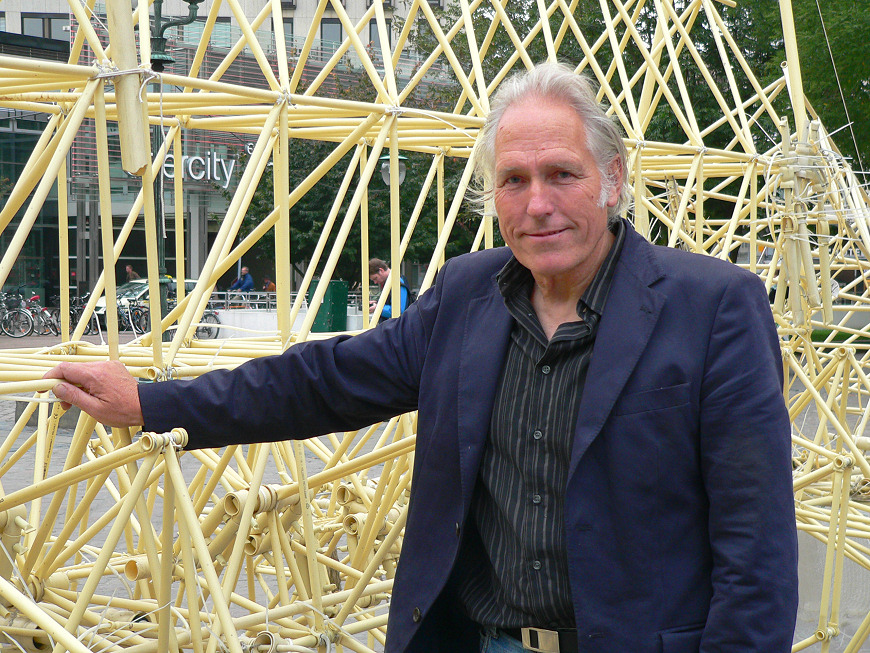
A strandbeest, exhibited by Jansen on the Linz city square during Ars Electronica, 2005
A strandbeest in action

Since 1990, Jansen has been creating strandbeesten (Dutch for "beach animals", singular strandbeest - see also English cognate strand), which are moving kinetic structures, sometimes wind-propelled, that resemble walking animals, described by Jansen as artificial life. All of his models are based on a system of triangles and connecting links which convert the rotation of an axle into a stepping motion of six or more legs. This allows the strandbeesten to travel over sand much more efficiently than if they were to travel on wheels. What was at first a rudimentary "breed" has evolved slowly, with the help of evolutionary computation techniques,[5] into a generation of kinetic sculptures that can react to their environment to some degree. According to Jansen, he was inspired by The Blind Watchmaker by Richard Dawkins.[6] Jansen has said "I make skeletons that are able to walk on the wind. Over time, these skeletons have become increasingly better at surviving the elements such as storms and water and eventually I want to put these animals out in herds on the beaches, so they will live their own lives."[7]

Constructed from PVC piping, wood, fabric airfoils, and zip ties, Jansen's sculptures are constantly being improved and are designed to function in the sandy beach environment in which Jansen releases them. The sculptures are also able to store air pressure in order to propel themselves in the absence of wind.[8] Jansen's more sophisticated creations are able to detect when they have entered water and are then able to move away from it. One model is capable of anchoring itself to the earth if an approaching storm is sensed.

A 2016 episode of The Simpsons, "The Nightmare After Krustmas", featured the strandbeesten and Jansen. He provided the voice for his cartoon character.

Evolutionary periods of Strandbeest

[edit]
  • Volantum – Flying Strandbeests; 2020–2021
  • Bruchum – Caterpillar Strandbeests; 2016–2019
  • Aurum – "Weak wind" Strandbeests; 2013–2015
  • Aspersorium – Tail-wagging Strandbeests; 2012–2013
  • Suicideem – "Suicidal"[a] Strandbeests; 2009–2011
  • Cerebrum – Simple Brained Strandbeests; 2006–2008
  • Vaporum – Pneumatic-powered Strandbeests; 2001–2006
  • Lignatum – Wood-based[b] Strandbeests; 1997–2001
  • Tepideem – Herd Strandbeests; 1994–1997
  • Calidum – "Osteoporosis"[c] Strandbeests; 1993–1994
  • Chorda – Cable-tie Strandbeests; 1991–1993
  • Gluton – Adhesive tape Strandbeests; 1990–1991
  • Pregluton – Pre-Strandbeests, beginning of ideas and drawings; 1986–1989[9]

See also

[edit]

Notes

[edit]

References

[edit]
[edit]
Revisions and contributorsEdit on WikipediaRead on Wikipedia
from Grokipedia
Theo Jansen (born 14 March 1948) is a Dutch , sculptor, and best known for creating Strandbeests, large kinetic sculptures powered by that mimic the walking motion of animals and are designed to roam beaches autonomously. These ambulatory mechanisms, constructed primarily from PVC tubing, PET bottles, and lightweight materials, represent Jansen's exploration of , , and the intersection of art and science. Jansen initially trained in physics at from 1968 to 1975, where his studies in unconventional technical constructions laid the groundwork for his later artistic pursuits. After graduating, he transitioned to in the , beginning as a painter before experimenting with mechanical installations, including a helium-filled project in the early 1980s that gained national attention in the . Inspired by and concepts from ' work, Jansen launched the Strandbeest project in 1990 with the goal of engineering self-sustaining "beach animals" capable of surviving environmental challenges like and storms, initially to help build sand dunes for coastal protection. Over three decades, Jansen's designs have evolved from car-sized prototypes like Animaris vulgaris (1991) to larger, more complex forms such as Umerus (2009), incorporating pneumatic systems, genetic algorithms, and sensory mechanisms to enable behaviors like water avoidance and in recycled bottles. His work has been exhibited internationally, including at the Palais de Tokyo in (2015), the Dubai World Expo (2021), the Chiba Prefectural Museum of Art (2023–2024), and the Strandbeesten Mortuary in (2025). It has earned accolades like the Barnett & Annalee Newman Foundation Award (2016) and the Hague Culture Prize (2018). Through these creations, Jansen continues to blur the boundaries between , , and , envisioning a future where his Strandbeests achieve full independence on the shores.

Early life and education

Childhood and early interests

Theo Jansen was born on March 14, 1948, in , a coastal in the . As the youngest of 11 children in a large farm family, he grew up in the immediate , shortly after the Allied liberation of the in 1945, during a period of national reconstruction and economic recovery. His mother operated a in the village, providing a bustling household environment near the beaches that would later profoundly influence his creative work. Jansen's early years were marked by the close proximity to the sea, where childhood memories included playful interactions with the waves, such as throwing a wooden shoe into the water and chasing it as it returned with the tide, or venturing into the cold winter sea fully clothed for the thrill of it. These experiences fostered a deep connection to the coastal landscape of Scheveningen, embedding an appreciation for natural forces and movement that shaped his inventive mindset. From a young age, he displayed a fascination with engineering, art, and the natural world, blending these interests through early experiments that explored mechanical and creative possibilities. During his teenage years, Jansen's curiosity grew toward creating devices that could operate independently, laying the groundwork for his later pursuits in autonomous mechanisms. This innate blend of scientific inquiry and artistic expression, nurtured in the Dutch environment of innovation and resourcefulness, propelled him toward formal studies in physics at .

University studies and initial experiments

Theo Jansen enrolled at the in 1968 to study physics, drawn initially by the influence of a supportive high school teacher in the subject. He pursued his studies for seven years, engaging with core areas of physics that shaped his future work. However, Jansen grew disillusioned with the rigid academic path and left the university in 1975 without earning a degree, redirecting his energies toward creative endeavors that blended scientific rigor with artistic expression. After departing the university, Jansen's initial post-academic experiments marked a pivotal shift toward applying physics artistically. In the early , he developed software-based simulations of evolving organisms, drawing inspiration from evolutionary algorithms to model adaptive behaviors and forms. This transition from theoretical study to practical, interdisciplinary exploration solidified his departure from conventional academia, channeling his physics background into innovative creations that prioritized autonomy and evolution over traditional scientific output.

Early inventions

Flying saucer project

In 1979, Theo Jansen conceived the project as a way to surprise residents of and blur the boundaries between imagination and reality, drawing on his interest in UFOs to create an object that could mimic an extraterrestrial sighting. Motivated by a desire to distract people from everyday concerns, he constructed the device shortly after abandoning his physics studies at , marking it as his first significant solo engineering endeavor. The design featured a four-meter-wide saucer-shaped frame made from inexpensive PVC pipes, painted black to enhance its ominous, UFO-like appearance against the sky, and filled with for buoyancy-based lift. Launched on a hazy day without a permit, the saucer floated steadily over the city, its flat creating an of rapid movement and immense scale, which fueled public speculation about its nature. The project encountered immediate challenges from the ensuing public uproar, as onlookers mistook it for a genuine UFO or even a nuclear threat, prompting police to liken its perceived size to that of a reactor and leading to in the streets. Although the launch succeeded technically and was filmed for broadcast, the controversy and lack of further development opportunities resulted in its abandonment after this single demonstration. This early experiment highlighted Jansen's self-taught skills in unconventional engineering and aerodynamics-inspired concepts, informed by his physics background, and served as a pivotal transition from painting to kinetic installations, earning him brief national fame in the Netherlands.

Painting machine

Theo Jansen developed his painting machine in the early 1980s as an innovative device that bridged his background in physics and his interest in visual art. The machine functioned as a light-sensitive spray gun, which reproduced three-dimensional scenes from a room onto a wall in life-size scale, creating images with an inverted perspective where closer objects appeared smaller and distant ones larger. This setup allowed the device to autonomously generate wall-sized "photographs" or abstract representations without traditional printers, relying on the spray gun activating only in low-light conditions when a light cell was shaded. The mechanism involved scanning the environment and depositing paint to mimic observed forms, effectively inverting conventional optical principles to produce disorienting yet precise outputs. Jansen described it as a tool for exploring three-dimensional , which challenged perceptual norms and highlighted the machine's capacity for independent operation. This project marked an early step in his experimentation with automated systems, revealing the creative potential—and inherent variability—of technology-driven art generation. The resulting works demonstrated the unpredictability of light-based control, as minor environmental changes could alter the final images, foreshadowing Jansen's later pursuits in autonomous kinetic sculptures.

Development of the Strandbeest

Origins and first generations

In 1990, Dutch artist and engineer Theo Jansen initiated the Strandbeest project, driven by a vision to create autonomous, wind-powered walking machines capable of traversing beaches to combat coastal erosion from rising sea levels. This concept emerged after Jansen published a speculative newspaper column on wind-driven skeletal structures that could push sand back toward dunes, prompting him to acquire PVC tubing and commit to prototyping the idea. He named these creations "Strandbeest," translating to "beach beasts" in Dutch, envisioning them as a new form of life adapted to the coastal environment. The first prototype emerged during the Gluton period (1990–1991), characterized by rudimentary constructions using PVC tubes connected solely with adhesive tape. The inaugural model, Animaris Vulgaris, featured a basic frame approximately 60 x 200 x 250 cm in size, with 28 legs formed from smaller tubes that mimicked an animal gait through wind-induced motion. However, this design was limited: it could only articulate its legs while lying on its back and lacked the stability to stand or walk upright, highlighting the initial challenges in achieving functional locomotion. To refine the leg mechanisms, Jansen employed evolutionary software based on genetic , simulating to optimize tube lengths and joint configurations for efficient walking. In 1990, he programmed this on a computer to iteratively evolve parameters, discarding inefficient designs and retaining those that improved stability and energy transfer from — a process that reduced complex multi-crank systems to a simpler 11-bar linkage per leg segment. This computational approach allowed for rapid prototyping of variations, establishing the core kinetic principles that would define subsequent iterations. Early field tests of these prototypes occurred on the sandy beaches near , , where the machines encountered variable wind conditions and unstable terrain. The Gluton-era designs often faltered due to fragile tape connections that weakened in salty air and shifting sands, while inconsistent breezes failed to generate sufficient force for sustained movement. These trials revealed critical issues, such as the need for better to prevent tipping on soft substrates and mechanisms to harness gusts without structural failure, informing refinements in material durability and aerodynamic sails.

Evolutionary periods and adaptations

Theo Jansen's Strandbeests underwent a systematic evolution across 12 distinct periods from 1990 to 2021, with each iteration building on prior designs to improve autonomy, efficiency, and environmental resilience on dynamic beach terrains. The process began with rudimentary prototypes in the early 1990s, progressing through refinements in structural integrity, energy capture, and behavioral responses, guided by Jansen's use of computer simulations mimicking to optimize leg and overall morphology. These genetic algorithm-based refinements prioritized smoother patterns and reduced energy loss, allowing later generations to traverse uneven sand with greater stability and speed. A pivotal advancement occurred in the Animaris period (1992–1997), where lightweight sails were integrated to convert wind into propulsion, marking the shift from passive to active locomotion and enabling the creatures to cover distances of up to several kilometers along coastlines. Subsequent periods, such as during the early , introduced pneumatic systems resembling muscle contractions, using stored in recycled bottles to power movements during low-wind conditions and simulate organic responsiveness. By the mid-, enhancements to joints—featuring multi-linkage designs evolved via algorithmic —produced , undulating walks that minimized sinking in soft sand and improved load distribution across 12 to 20 articulated limbs. further evolved with air compression mechanisms in later iterations, providing bursts of propulsion on calm days and extending operational time beyond wind-dependent limits. The overarching goal of these adaptations was to foster self-sustaining herds capable of autonomous migration, through modular assembly, and hazard avoidance, such as retreating from incoming via rudimentary sensory "hoses" that detect changes. In the Volantum period (2020–2021), flight elements were incorporated, with kite-like wings allowing brief aerial escapes from sandstorms, transforming the ground-bound walkers into hybrid aerial-terrestrial forms for enhanced survival. As of 2025, Jansen continues to refine the designs, with recent prototypes demonstrating ongoing adaptations to coastal conditions. These iterations not only extended the Strandbeests' lifespan in harsh coastal environments but also advanced Jansen's vision of engineered life forms adapting akin to biological .

Design and mechanics of the Strandbeest

Structural materials and locomotion

The Strandbeests are primarily constructed from PVC tubes, commonly known as yellow electrical conduits in the , which serve as the lightweight and durable "bones" of these kinetic sculptures. These tubes, typically measuring approximately 19 millimeters (three-quarter-inch) in diameter, are chosen for their resistance to harsh conditions, including exposure to saltwater, sun, wind, and sand, ensuring longevity in marine environments without corroding or degrading quickly. Theo Jansen has noted that PVC is abundant and cost-effective in his home country, where it is widely used for protecting electrical cables, making it an ideal material for building large-scale structures that must withstand the corrosive effects of . The locomotion system relies on a varying number of articulated legs, often in pairs ranging from 6 to 36 or more depending on the model, arranged along a central body, with each leg consisting of an 11-link mechanism known as . This planar linkage, connected via crankshaft-like rods and joints, converts the linear force from wind into a rotational motion that drives an elliptical walking , allowing the "feet"—often simple PVC ends or specialized shoes—to maintain prolonged contact with the uneven beach terrain for stability. The design ensures a smooth, animal-like stride, with legs phased to simulate a galloping motion, enabling the beasts to traverse sand without tipping over. Over generations, minor tweaks to leg linkage ratios have refined this for better efficiency on soft surfaces. More recent models, such as the 2020 Ader, introduce floating capabilities with towed anchors and hybrid materials for water traversal. Power for movement is derived mainly from captured by sails or kites attached to the structure, which drive the directly or air into storage systems. In calmer conditions, Strandbeests can utilize tanks—up to 96 1.5-liter plastic bottles per unit—filled via onboard wind-powered compressors, providing stored energy to sustain motion. Jansen envisions future iterations incorporating algae-derived CO2 to generate this , creating a self-sustaining cycle where the beasts "breathe" in a biological manner to power their pneumatic "muscles." Strandbeests vary in scale to suit different purposes and terrains, ranging from small tabletop models under a meter tall, suitable for indoor demonstrations, to towering giants exceeding 10 meters in length. Larger specimens, such as the Animaris Gubernare, measure up to 16 feet long, 6.5 feet wide, and 10 feet high, with weights between 77 and 330 pounds to maintain a low center of gravity for balance on shifting beach sands. This weight distribution, achieved through strategic placement of PVC frames and air bottles, prevents sinking into soft terrain while allowing wind-driven propulsion without excessive ballast.

Sensory and autonomous features

The Strandbeests incorporate a pneumatic "nervous system" that relies on air pressure signals transmitted through a network of urethane hoses and valves, mimicking biological neural pathways to facilitate reactive behaviors. This system operates on binary logic, where an open valve signifies a "1" and a closed valve a "0," allowing signals to propagate across interconnected components. Theo Jansen describes it as follows: "Real animals transmit electrical signals through the nervous system. I use air for signal transmission in my beests. In each cell, there is a signal processing unit, which can be compared to a brain cell." Special components known as "liars"—constructed from pipes, pistons, and valves—function as inverters, flipping signals from 1 to 0, while combinations of these enable equivalents of AND, OR, and NOT gates for more complex decision-making, such as counting steps or processing multiple inputs without electronic components. Obstacle detection is achieved through mechanical feelers consisting of protruding hoses that collapse or alter airflow upon contact, sending a pneumatic signal to redirect the creature's path. Jansen notes, "They have feelers now, which can say, 'Oh, there’s an ,' and then they will make a turn." Similarly, water sensors employ a trailing hose positioned just above the ground; when the hose's end contacts , it draws in , changing the air and triggering an avoidance response to prevent tidal submersion. This "water feeler" is described as "a flexible tube, two inches above the ground that detects approaching and turns the creature around." These sensors, integrated into the PVC framework, enable the Strandbeests to navigate sandy terrains autonomously while avoiding hazards. To enhance survival during adverse conditions, the Strandbeests feature autonomous mechanisms such as beach anchors—pegs that the creature drives into the sand upon sensing high winds via pressure changes in its sails, securing it against storms. Self-righting capabilities allow the structures to reorient if overturned by waves or gusts, using weighted components and leg geometry to regain stability. Energy autonomy is supported by "feeding" sails that capture wind to compress and store air in PET bottles acting as , providing a reserve for movement when breezes weaken; Jansen explains, "I made a , which is a , which can store air. And when the pressure is too high, it pushes a little stick, and that opens a , and the surplus air will go out." These features collectively allow the Strandbeests to operate independently on beaches, responding to environmental cues without external intervention. In post-2010 developments, particularly for controlled exhibitions, some prototypes integrate GPS for group coordination, enabling herding-like behaviors among multiple units, while app-based interfaces allow remote adjustments to mimic autonomous responses in windless indoor settings.

Philosophy and influences

Artistic and scientific inspirations

Theo Jansen's scientific inspirations stem from his academic background in physics at the , where he studied from 1968 to 1975, fostering a deep interest in mechanics and natural processes. This foundation enabled him to apply principles of biomimicry to his creations, designing the Strandbeest as mechanisms that emulate through , effectively treating them as emergent "new species" developed via computational simulation. A pivotal influence was ' 1986 book , which introduced Jansen to evolutionary theory and ; reading it in 1986 sparked his fascination with how complex forms arise without intelligent design, prompting him to explore algorithmic evolution in his work. Artistically, Jansen's approach draws parallels to the kinetic art traditions pioneered by and , where movement itself becomes the core medium, transforming static sculptures into dynamic entities responsive to environmental forces. , with their graceful, wind-driven oscillations, and Tinguely's chaotic, self-operating machines echo in the Strandbeest's ambulatory grace and autonomy, emphasizing interaction between art and natural elements over mere representation. In the late 1980s, Jansen transitioned from purely software-based evolutionary simulations—where he used algorithms to optimize leg mechanisms for efficient walking—to tangible physical constructions, fusing with hands-on engineering to realize his biomimetic visions on beaches. This interdisciplinary shift marked a deliberate integration of his physics training, evolutionary inspirations, and kinetic artistry, allowing abstract digital evolutions to manifest as wind-propelled, life-like structures.

Vision for new forms of life

Since , Theo Jansen has pursued the ambitious goal of engineering his Strandbeest creations into fully autonomous, self-replicating lifeforms capable of inhabiting beaches independently. He envisions releasing herds of these entities onto coastal shores, where they would navigate, survive, and propagate without human intervention, with a target timeline for full realization by around 2050 as stated in 2011. This long-term project stems from Jansen's desire to accelerate evolutionary processes, drawing brief inspiration from ' concepts of memes and genetic propagation to conceptualize the Strandbeest as evolving "brain viruses" that adapt through . Central to this vision are the Strandbeest's conceptual mechanisms for sustenance and . Jansen imagines herds that "eat" to generate , storing in plastic bottles to power movement during calm periods. would occur through physical mutations in their structures or via software-based genetic algorithms, enabling successive generations to better withstand environmental challenges like storms or . These adaptations aim to create resilient entities that reinforce dunes by displacing sand inland, directly addressing threats from rising sea levels. If global warming escalates, these wind-powered beings could inhabit eroding coastlines indefinitely, embodying a form of life that thrives amid environmental upheaval without depleting resources. This outlook underscores his belief in engineering novel species to complement human endeavors. Ongoing experiments focus on enabling reproduction through DNA-like blueprints—mathematical codes defining proportions and linkages—that allow for 3D-printed fabrication of new Strandbeest. By publishing these digital "genetic" instructions, Jansen facilitates global replication, where anyone with a 3D printer can produce variants, simulating natural propagation and accelerating the path to autonomous herds. This approach not only tests evolutionary principles but also democratizes the creation of these potential new lifeforms. As of 2025, Jansen continues annual beach sessions to test evolutionary progress, with recent exhibitions highlighting the Strandbeests' development, including a June 2025 show in the Netherlands.

Exhibitions and legacy

Major international shows

Theo Jansen's Strandbeests gained significant international recognition starting with their presentation at the festival in , , in September 2005, where live demonstrations of the kinetic sculptures captivated audiences as part of the "Hybrid Creatures and Paradox Machines" exhibition. Jansen was named a featured artist alongside Ulf Langheinrich, and the event included outdoor displays on the city square, emphasizing the sculptures' autonomous movement powered by wind. In December 2010, an of Jansen's work opened at the National Museum of Emerging Science and Innovation (Miraikan) in , , running until February 2011 and showcasing models like the Animaris Siemensis alongside interactive elements that demonstrated the evolutionary progression of the Strandbeests from early prototypes. The display highlighted the sculptures' biomimetic design, drawing large crowds interested in the intersection of , , and nature-inspired innovation. Mid-career exposure continued with installations at Miami Beach in December 2014, where Jansen presented several Strandbeests on the sands of , including skeletal frameworks that allowed visitors to observe the intricate leg mechanisms up close during the fair's outdoor activations. Sponsored by , the event featured wind-driven performances that underscored the sculptures' portability and adaptability to urban coastal environments. Post-2020 exhibitions marked a surge in global touring. In July 2024, the Miyazaki Prefectural Art Museum in hosted a comprehensive show from July 20 to September 8, displaying 14 Strandbeests of varying generations, including large-scale pieces over 10 meters long, accompanied by sketches and videos tracing their development. The exhibition emphasized the sculptures' wind-powered locomotion in a dedicated gallery space simulating beach conditions. In May 2025, the "Strandbeesten Mortuary" exhibition opened on at the Kabeldistrict, a former cable factory in , , presenting fossilized and extinct Strandbeest models in a chronological of their evolutionary periods, with access on Thursdays until November 30, 2025. This immersive show concluded with video installations documenting the creatures' "life cycles." Later that year, from October 15 to December 15, 2025, Jansen contributed to the "Flying Solo: Committing to Wind Energy" exhibition at TU Delft Library in , featuring a live Strandbeest alongside wind energy artifacts from his , with an opening reception on October 15. These displays faced environmental challenges, notably a severe on the night of September 15-16, 2025, which buried several beach-based Strandbeests under sand along the Dutch coast, leading to the cancellation of remaining public sessions for the season and requiring extensive recovery efforts.

Cultural impact and recent projects

Theo Jansen's Strandbeest have permeated popular culture through notable media appearances, beginning with his 2007 TED Talk, where he showcased the kinetic sculptures as a potential new form of life powered by wind. In 2016, Jansen guest-starred in episode "The Nightmare After Krustmas," featuring a of his Strandbeest that malfunctions during a , highlighting their whimsical yet unpredictable nature. Documentaries such as the 2016 production "Strandbeest: The Dream Machines of Theo Jansen" have further documented their creation and movement, blurring lines between art, engineering, and biology. The Strandbeest have influenced interdisciplinary fields, inspiring biomimicry in through the "Theo Jansen mechanism," a linkage system replicated in academic designs for efficient legged locomotion, as seen in MIT theses and NIH-funded research on bio-inspired robots. In STEM education, Jansen's work has been integrated into curricula via exhibits and articles, such as a 2019 STEM Magazine feature emphasizing evolutionary design principles for student projects. Eco- movements have drawn from the sculptures' sustainable, wind-driven ethos, promoting environmental awareness through kinetic forms that mimic natural adaptation. Collaborations with institutions like the IBSA Foundation and have included workshops for students and visitors to construct simplified models, fostering hands-on learning in and . From 2021 to 2025, Jansen continued evolving his creations, with exhibitions like the 2021 Contemporary Art Museum display of over ten Strandbeest, including a 10-meter-long specimen, and the 2025 Delft "Strandbeesten Mortuary" at Kabeldistrict, exploring their generational progression. In September 2025, a workshop at the Yarmonics Festival in , led by collaborator Zach Dansen, guided participants in building mini-Strandbeest inspired by Jansen's designs, accompanied by a and promenade. A severe storm on September 15-16, 2025, damaged beach sites, halting sessions and prompting Jansen to reflect on environmental resilience in his ongoing trials. As of November 2025, the Strandbeesten Mortuarium continued at Kabeldistrict until November 30. On , 2025, Jansen released a video update on the ongoing evolutionary development of the Strandbeests since . Jansen has created dozens of Strandbeest across generations since , with "fossils"—preserved remnants of earlier prototypes—displayed in to illustrate their iterative development. This legacy emphasizes an ongoing toward climate-adaptive forms, originally conceived to counter rising sea levels by autonomously managing coastal dunes.

References

Add your contribution
Related Hubs
User Avatar
No comments yet.