Hubbry Logo
Stun grenadeStun grenadeMain
Open search
Stun grenade
Community hub
Stun grenade
logo
8 pages, 0 posts
0 subscribers
Be the first to start a discussion here.
Stun grenade
Stun grenade
from Wikipedia
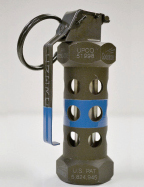
M84 stun grenade

A stun grenade, also known as a flash grenade, flashbang, thunderflash, or sound bomb,[1] is a non-lethal explosive device used to temporarily disorient an enemy's senses. Upon detonation, a stun grenade produces a blinding flash of light and an extremely loud "bang". They are often used in close-quarters combat, door breaching, and riot control, typically to stun enemies or distract them.[2]

Originally developed to simulate explosions during military training, stun grenades were first used by the British Army Special Air Service's counterterrorist wing in the late 1970s,[3][4] and have been used by police and military forces worldwide since.[5]

Despite their less-lethal nature, stun grenades are still capable of causing harm, and can injure or kill when detonating in close proximity. They are also capable of sparking fires.[6]

Effects

[edit]
A stun grenade, thrown by U.S. Marines during a training exercise, detonating in a small room

Stun grenades are designed to produce a blinding flash of light of around 7 megacandela (Mcd) and an intensely loud "bang" of greater than 170 decibels (dB).[7]

Construction

[edit]

Unlike a fragmentation grenade, stun grenades are constructed with a casing designed to remain intact during detonation and avoid fragmentation injuries, while having large circular cutouts to allow the light and sound of the explosion through. The filler comprises a pyrotechnic metal-oxidant mix of magnesium or aluminium and an oxidizer such as potassium perchlorate or potassium nitrate.[8]

Hazards

[edit]

While stun grenades are designed to limit injury, permanent hearing loss has been reported.[9][10] The concussive blast has the ability to cause injuries, and the heat generated may ignite flammable materials. The fires that occurred during the 1980 Iranian Embassy siege in London were caused by stun grenades.[11]

See also

[edit]

References

[edit]
[edit]
Revisions and contributorsEdit on WikipediaRead on Wikipedia
from Grokipedia
A stun grenade, commonly referred to as a flash-bang, is a non-lethal hand-thrown explosive device designed to disorient targets via intense sensory overload from a high-decibel blast and brilliant photoflash, enabling tactical advantage in close-quarters operations without producing shrapnel or incendiary effects. Developed initially by British special forces in the mid-20th century and later standardized in models like the U.S. military's M84, these grenades typically detonate with a sound pressure of 170–180 decibels and a light output of 6–8 million candela within a short radius, causing temporary blindness, hearing impairment, and disorientation lasting several seconds. Primarily utilized by special operations forces, SWAT teams, and military police for room clearing, hostage rescue, and crowd control, stun grenades facilitate non-kinetic suppression by denying access or compelling movement without direct confrontation. While engineered for minimal permanent harm, empirical incidents reveal risks of injury or rare lethality from overpressure, burns, or secondary effects in confined spaces or with vulnerable individuals, underscoring the need for precise deployment protocols.

History

Origins and Early Development

The stun grenade, also known as a flashbang, originated with the British (SAS) in the early 1970s, amid rising global terrorism exemplified by the 1972 Munich Olympics attack. SAS B Squadron sought a non-lethal tool to disorient targets in confined spaces, enabling hostage rescues without excessive risk to civilians or operators. This addressed limitations of lethal grenades in urban , prioritizing temporary sensory overload over fragmentation or blast damage. Development built on the Thunderflash, a pyrotechnic device used for simulating explosions in military training since the mid-20th century. Engineers at the UK's facility, a defense site, refined this into the G60 prototype by incorporating a 4.5-gram mixture of magnesium and to produce a blinding flash exceeding 7 million and a exceeding 170 decibels. The design emphasized containment to minimize shrapnel, with early testing validating its efficacy in causing hesitation and sensory disruption for 5-10 seconds. Initial refinements by SAS teams in collaboration with Enfield focused on fuse reliability, payload consistency, and operator safety, transitioning the device from simulator to operational asset. By the late 1970s, the G60 was ready for tactical integration, paving the way for its debut in high-stakes operations like the 1977 hijacking rescue. These efforts established the core principles of modern stun grenades: high-intensity light and sound pulses delivered via a throwable canister.

Adoption in Military and Law Enforcement

Stun grenades, initially developed by the British (SAS) in the early 1970s as distraction devices for counter-terrorism training and operations, marked the beginning of their military adoption. The first documented operational deployment occurred during the Israeli commando raid at Entebbe Airport in on July 4, 1976, where they served as tactical diversions to disorient hijackers during hostage rescue. The SAS employed them prominently in the in London on May 5, 1980, using the devices to stun terrorists and facilitate entry, which brought global attention to their utility in close-quarters combat. This success prompted widespread adoption among forces, including assistance in the German GSG-9's Mogadishu hijacking resolution in 1977. In the United States , stun grenades were integrated into tactics by the , evolving from earlier simulators to purpose-built models for hostage rescue and room-clearing missions. The U.S. formalized their use with the , introduced in 1995 as a non-lethal diversionary tool producing a 6-8 million flash and 170-180 bang to temporarily impair vision and hearing without fragmentation. By the 2000s, the and variants became standard issue across U.S. Armed Forces branches, particularly for in urban environments, with procurement records showing ongoing production and deployment for units like Marine Force Reconnaissance. Law enforcement adoption in the U.S. followed military precedents, with teams incorporating stun grenades in the late 1970s and 1980s for high-risk warrant services and barricade situations. The pioneered early adaptations by modifying M116A1 hand grenade simulators into functional flashbangs via their bomb squad, enabling safer entries against armed suspects. Usage proliferated through the 1990s and 2000s, with federal data indicating thousands of deployments annually by tactical units for disorienting non-compliant individuals, though reports highlight risks of burns, hearing damage, and unintended fires prompting training reforms. Internationally, agencies like French special forces adopted similar devices for operations such as the 2015 supermarket siege, reflecting a global shift toward less-lethal entry tactics.

Design and Construction

Core Components

The core components of a stun grenade, exemplified by the U.S. military's model, comprise a perforated body, a mechanical fuze assembly, and a pyrotechnic filler charge optimized for non-fragmenting . The body is a cast hexagonal tube, measuring 5.25 inches in and 1.73 inches in , with 12 vent holes along its sides to direct the emission of intense light and sound while containing the internal reaction and preventing shrapnel..pdf) This design ensures the grenade's total weight remains around 15 ounces, balancing portability and structural integrity during handling and deployment. The fuze system, such as the M201A1 or M240 series, features a spring-loaded striker released upon removal of the safety pin and lever disengagement, igniting an M42 primer followed by a first fire mix, a delay element (1 to 2.3 seconds), and a separation charge that breaches containment to expose the main pyrotechnic to air..pdf) Dual safety pins—a primary pull pin and a secondary pin with triangular ring—prevent accidental activation, with the mechanism assembled using sealants like Loctite for reliability..pdf) The pyrotechnic filler, approximately 3.5 ounces, consists of a specialized deflagrating composition that rapidly combusts to generate a flash exceeding 1 million and a pressure wave yielding 170-180 decibels at 5 feet, disorienting targets via without fragmentation. Formulations typically incorporate metal fuels (e.g., aluminum or magnesium powders) and oxidizers (e.g., perchlorates or nitrates) for high-temperature, high-light-output burning, though precise recipes remain to specifications for performance and safety. Variants may employ plastic bodies for lighter weight (around 150 grams in some non-U.S. designs) or adjusted delays (3-4 seconds), but steel-housed models like the prioritize durability in tactical environments..pdf) All components integrate to ensure single-use functionality, with the classified as Hazard Class 1.4G for transport.

Types and Variants

Stun grenades, also known as flash-bang devices, are categorized primarily by delivery method and effect profile, with hand-thrown models comprising the most common for tactical entry and disorientation. These devices typically employ pyrotechnic charges to generate intense light flashes and acoustic blasts without fragmentation, aiming to temporarily impair vision and hearing. Launched variants, compatible with 40mm grenade launchers or dedicated systems, extend operational range for standoff deployment in and scenarios. The , standard issue for the military since the , exemplifies a hand-thrown stun grenade, weighing approximately 370 grams and utilizing a M201A1 fuse with a 1- to 2.3-second delay. Upon , it produces a flash of 6 to 8 million and a sound level of 170 to 180 decibels within a 1.5-meter radius, optimized for close-quarters distraction without lethal intent. Another prominent US model, the NICO BTV-1 flash-bang grenade, incorporates safety features to reduce injury risk from premature explosion, delivering 3 to 5 seconds of flash blindness and auditory disruption for area denial or suppression. Employed in special operations, it vents radially to minimize directed blast effects. International variants include multi-effect devices, such as those integrating or irritants with flash-bang payloads for enhanced incapacitation, as utilized by units like the British SAS. French-manufactured models, like the Alsetex 410, emphasize splinterless construction for reduced collateral risk, generating 160 decibels at 15 meters to induce temporary deafness in confined spaces. Hybrid grenades, such as the former GLI-F4, combined explosive with but were discontinued in 2020 due to documented severe injuries, including amputations, during operations. Recent innovations feature compact designs, exemplified by Rheinmetall's Spectac stun grenade, unveiled in 2021 as a pocket-sized rectangular device tailored for special operators, prioritizing concealability while maintaining disorientation efficacy. Training variants, such as the reloadable M102, replicate operational effects for non-lethal simulation without pyrotechnic expenditure.

Mechanism of Action

Sensory and Physiological Effects

Stun grenades, also known as flashbangs, generate a high-intensity light flash and acoustic impulse to induce , producing temporary flash blindness, deafness, tinnitus, and loss of balance, primarily affecting vision and hearing while minimizing lethal . The flash, often exceeding 1 million for 1-2 milliseconds, saturates retinal photoreceptors, causing temporary characterized by scotomas and afterimages that impair for 5-30 seconds in direct exposure. This overload disrupts phototransduction, delaying recovery as the adapts back to ambient light levels. The auditory component produces a peak sound pressure level of 170-180 decibels within 1-5 meters, triggering a temporary threshold shift (TTS) in hearing sensitivity, often accompanied by and perceived disorientation lasting up to several minutes. Impulse noise at this intensity mechanically stresses cochlear hair cells, potentially leading to permanent threshold shift (PTS) with repeated or proximal exposures, though single distant detonations typically yield reversible effects. Physiologically, the sudden sensory barrage elicits a startle reflex, activating the and , which elevates , , and release, contributing to confusion, vertigo, and motor incoordination. Vestibular disruption from acoustic energy transmission to fluids can induce and balance loss, exacerbating disorientation through mismatched sensory inputs. Overpressure waves, while sub-lethal (typically under 1 psi at operational distances), may cause minor in confined spaces, such as perforation or pulmonary strain in vulnerable individuals. These effects collectively impair cognitive , reaction time, and threat assessment, with recovery varying by exposure distance, individual factors like age or health, and environmental conditions.

Technical Parameters and Performance

Stun grenades, such as the M84 model, typically feature a pyrotechnic charge that generates a high-intensity light flash and acoustic output upon detonation. The M84 produces a sound level exceeding 170 decibels and up to 180 decibels within 1.5 meters (5 feet) of the device, alongside a light output of 6-8 million candela in the same radius. These parameters are achieved through a magnesium-based pyrotechnic composition ignited by a time-delay fuze, such as the M201A1, which activates between 1.0 and 2.3 seconds after release. The device's mass is approximately 370 grams (13.2 ounces), with a cylindrical body designed for hand-throwing or launcher deployment in some variants. Acoustic performance varies with distance; measurements indicate peak levels ranging from 158 decibels at 2.13 (7 feet) to 178 decibels in closer proximity. Light intensity requires direct line-of-sight exposure for maximal effect, with effectiveness diminishing beyond the immediate blast area due to rapid . Sound allows auditory disorientation over greater distances, though physiological impact decreases inversely with separation from the point.
ParameterM84 Stun Grenade Specification
Sound Output170-180 dB at 1.5 m
Light Output6-8 million candela at 1.5 m
Fuze Delay1.0-2.3 seconds
Mass370 g
Performance metrics emphasize temporary rather than structural damage, with disorientation effects primarily from vestibular and auditory disruption. Empirical testing shows reliable initiation under standard conditions, though and startle responses contribute to immediate behavioral incapacitation. Variants like multibang models extend output over multiple pulses, achieving initial blasts of 165 decibels followed by secondary emissions. Overall relies on deployment in enclosed spaces to maximize reflected , limiting open-field .

Operational Use

Tactical Applications in Military Contexts

![US Marines Force Recon platoon during advanced combat tactics training][float-right] Stun grenades, such as the , are deployed by U.S. forces in close-quarters battle (CQB) to disorient and distract adversaries in confined spaces like rooms, buildings, and bunkers, enabling assault teams to gain entry with minimized lethal force application. These devices produce a flash exceeding 1 million and a bang of 170-180 decibels at 5 feet, incapacitating targets within approximately 9 meters while effects diminish beyond 1.5 meters, thus supporting that prioritize non-lethal options in scenarios involving noncombatants or hostages. In urban operations (MOUT), they facilitate forced entry and suppression of enemy fire by amplifying disorientation in enclosed areas, often integrated with smoke grenades for concealment and lethal overwatch for security. Tactical employment emphasizes immediate throwing after pin pull due to the short 1.0-2.3 second delay, avoiding "" techniques to prevent premature ; soldiers lob the grenade underhand or overhand through doors or windows, then seek cover before entering to clear the space. units, including U.S. SEALs, utilize them for dynamic entries such as ship boardings, where the non-fragmenting design permits operators to follow closely behind the blast without awaiting fragmentation clearance. Training doctrines, as outlined in Army TC 3-23.30, incorporate stun grenades into squad situational exercises for room clearing and breaching, limiting indoor detonations to two per 24 hours per individual to mitigate overexposure risks. In broader military contexts, stun grenades support missions requiring minimal , such as hostage rescue or in operational areas, with variants like the M104 nonlethal bursting grenade launched via for extended range up to 77 meters. Their use in exercises, including U.S. Marine Corps Integrated Training Exercise (IF19), demonstrates proficiency in employing them alongside pyrotechnic signals for enhanced tactical advantage in high-threat environments. Multi-service tactics stress integration with suites to confuse threats intermingled with civilians, ensuring positive target identification prior to employment.

Deployment in Law Enforcement Scenarios

Stun grenades, commonly referred to as flashbangs, are utilized by law enforcement agencies, especially specialized units like SWAT teams, to generate temporary sensory overload through intense light and sound bursts, facilitating safer tactical entries into confined spaces. Deployment occurs primarily in high-risk scenarios such as executing search warrants on barricaded or armed suspects, resolving hostage situations, and apprehending fugitives who pose immediate threats to officers. These devices are thrown into target areas via windows, doors, or breaches, with fuses typically set for 1.5 to 5 seconds to synchronize with entry team movements, allowing operators to exploit the disorientation window—lasting 5 to 10 seconds—for securing positions and subduing resistance. Federal guidelines, including those from the Bureau of Alcohol, Tobacco, Firearms and Explosives (ATF), permit law enforcement use of flashbangs classified as non-federal destructive devices (NFDDS) or explosives application training devices (EATDs) under specific exemptions for operations like warrant service and crowd control threatening public safety. The FBI incorporates flashbangs into its less-than-lethal devices policy, authorizing them for tactical applications where lethal force alternatives are deemed excessive, with mandatory training on deployment techniques, environmental assessments (e.g., avoiding flammable materials), and post-use reporting to ensure accountability. Real-world deployments illustrate their tactical integration; for example, on April 10, 2019, Police SWAT used a flashbang during a vehicle barricade standoff to disorient and extract a suspect without gunfire exchange. Similarly, in protest dispersals, such as the May 2, 2024, UCLA operation, California Highway Patrol deployed stun grenades to overcome resistance from entrenched groups, enabling arrests amid coordinated entry. Path analyses of operational data affirm their utility in reducing direct confrontations, with low lethality rates over decades of use attributed to precise timing and positioning that prioritizes distraction over physical trauma. Agencies emphasize pre-deployment risk assessments, including intelligence on occupant numbers and vulnerabilities, to align with use-of-force continuums that favor non-penetrating distractions. While empirical reviews, such as those from the Institute for Defense Analyses, indicate flashbangs enhance entry success by impairing sensory processing—disrupting balance and reaction times—protocols mandate single-device limits in enclosed spaces to control cumulative effects.

Evidence of Effectiveness in Real-World Operations

Stun grenades have exhibited effectiveness in military close-quarters combat by leveraging to disrupt adversaries' orientation, decision-making, and motor responses, thereby affording entry teams a brief but decisive initiative. Physiological path analysis reveals that the device's flash induces temporary blindness delaying visual targeting by 0.9 seconds, with the accompanying bang extending disorientation to 1.3 seconds, while the startle impairs voluntary motor actions for 0.1 to 3 seconds—or up to 10 seconds in complex scenarios—allowing operators to advance and neutralize threats with reduced resistance. This aligns with U.S. Army doctrine in FM 90-10-1, which prescribes stun grenades for startling enemies to achieve surprise in room-clearing, minimizing exposure to hostile fire during urban operations such as those in and . Empirical assessments confirm their low-lethality profile across extended tactical employment, positioning them as potential lifesavers when deployed judiciously to incapacitate without escalating to lethal force, as evidenced by sustained integration in despite inherent variables like placement and environmental factors. In broader contexts during deployments, such devices contributed to preserving both U.S. personnel and lives by enabling graduated responses in contested environments, where full-kinetic options risked or prolonged engagements. In scenarios, stun grenades facilitate safer warrant executions and hostage extractions by generating diversions that confound suspects' senses, creating opportunities for apprehension with fewer officer confrontations. Their routine use in SWAT high-risk entries—estimated at 50 to 90 percent of such operations in some U.S. jurisdictions—reflects perceived operational efficacy in neutralizing armed threats while prioritizing non-lethal outcomes, though success hinges on precise application to avoid self-inflicted hazards.

Risks and Hazards

Types of Potential Injuries

Although intended as non-lethal, stun grenades can cause burns, permanent hearing damage, fires, serious harm, or fatalities if misused, such as in confined spaces or near vulnerable individuals. Stun grenades, or flashbangs, primarily cause injury through blast overpressure, intense light flash, acoustic shock, thermal output, and occasional fragmentation, with risks amplified by proximity (typically under 2 meters), confined spaces, or repeated exposure. Overpressure from the detonation, often 1-3 psi at close range, can lead to primary blast injuries such as tympanic membrane rupture in up to 20-50% of unprotected individuals within 1-2 meters, resulting in temporary or permanent hearing loss, tinnitus, or disequilibrium. Ocular injuries stem from the high-intensity flash, rated at 5-10 million for 1-2 milliseconds, potentially causing , retinal burns, or temporary blindness lasting minutes to hours, particularly in low-light conditions or with direct eye exposure. Thermal effects from the pyrotechnic charge, reaching temperatures over 2000°C briefly, produce burns (first- to third-degree) or damage, as documented in case reports involving chest wall avulsions and volumetric muscle loss from near-contact detonations. Fragmentation, though minimized in , can cause penetrating wounds or lacerations if the grenade malfunctions or is mishandled. Less common but severe outcomes include concussive effects from blast wave transmission to the brain, manifesting as mild traumatic brain injury (mTBI) with symptoms like , vertigo, or , especially in breaching scenarios with multiple devices. Internal organ trauma, such as pulmonary contusions or abdominal hemorrhage, arises from pressure differentials in vulnerable populations (e.g., infants or those with pre-existing conditions), though flashbangs generate far lower peak pressures (under 10 psi) than lethal explosives. Psychological sequelae, including acute stress responses or exacerbation of PTSD, have been noted in tactical users but are secondary to physiological impacts.

Factors Affecting Safety and Mitigation Strategies

The safety of stun grenades, also known as flashbangs, is primarily influenced by proximity to the detonation point, where closer distances elevate risks of auditory exceeding 170 dB, causing temporary threshold shifts or permanent , and visual afterimages persisting for minutes to hours. Environmental factors, such as deployment in confined spaces, amplify effects through reflections off walls, increasing and potential for cardiorespiratory disruption or burns compared to open areas where energy dissipates exponentially. Device-specific variables, including the number of submunitions or impulses, heighten cumulative auditory injury risk—for instance, peak permanent threshold shift risk rises from approximately 2.3% with one submunition to 9.7% with 14 in modeled scenarios—while larger dispersion radii can reduce localized peak risks but distribute exposure more broadly. Operational handling errors, such as improper management or accidental pin removal, contribute to unintended detonations, with requiring adherence to federal regulations on storage and to prevent or mishandling. Individual operator exposure is minimized by limiting carrier numbers on teams and using specialized pouches with bent pins that activate only at deployment, reducing snag risks. Mitigation strategies emphasize pre-deployment visual inspections to confirm safe landing zones free of flammables or bystanders, alongside agency policies mandating authorization protocols and prohibiting use in certain exigent scenarios. Operators should don protective gear including helmets, ear and eye protection, gloves, and fire-retardant clothing to shield against incidental exposure, while bang sticks enable remote, elevated placement to avoid direct handling and enhance distance from the blast. Comprehensive training on fuze mechanics and tactical deployment, coupled with backup devices, lethal cover, and post-use medical screenings for temporary effects like tinnitus, further reduces liabilities. Selecting munitions with redundant safety features, such as those from Combined Tactical Systems, prioritizes reliability over less secure variants.

Controversies and Criticisms

Allegations of Excessive Force and Civilian Harm

In high-profile incidents during raids, stun grenades have been alleged to cause severe injuries to non-combatants, prompting claims of excessive force. On May 28, 2014, in , a flashbang grenade deployed by a joint special response team landed in the of 19-month-old Bounkham Phonesavanh during a no-knock warrant execution, resulting in third-degree burns over 25% of his body, heart complications, and over $1 million in medical costs. The child's family filed a federal lawsuit against the county and deputies, alleging and improper warrant procurement; settlements totaled $3.61 million by 2016, though no criminal charges were filed against the officer who threw the device, and a was acquitted of lying to obtain the warrant. Similar allegations have arisen in other law enforcement operations involving children and bystanders. In Kansas City, Missouri, a 2017 SWAT raid on a murder suspect's home saw a flashbang grenade injure a 2-year-old child present, leading to a lawsuit settled by the police department for an undisclosed amount in 2019, with plaintiffs arguing the device was used without sufficient threat assessment. An 8th Circuit Court ruling in a related case found the deployment unreasonable given the low risk of violence from an isolated suspect. Investigative reporting has documented at least 50 cases since 2000 where U.S. civilians suffered serious injuries, maiming, or death from flashbangs, often in scenarios critics describe as routine rather than justified by imminent danger. Protests have also featured in excessive force claims, with stun grenades blamed for permanent harm to uninvolved participants. During an August 4, 2018, demonstration in , against police violence, protester Nicole Fawcett was struck by a flashbang grenade fired by officers, causing shrapnel wounds and vision impairment; the ACLU filed suit alleging unconstitutional on non-threatening crowds. More recently, on June 14, 2025, at a "No Kings" protest in Los Angeles County, a flashbang explosion severed a man's finger, prompting a lawsuit against the Sheriff's Department for deploying the device indiscriminately amid dispersing crowds. Advocates, including those citing findings, contend that inadequate training—such as minimal hours on flashbang protocols in some departments—exacerbates risks, turning "less-lethal" tools into sources of disproportionate civilian harm when used in close quarters or populated areas.

Empirical Counterarguments and Comparative Analysis

Empirical assessments of stun grenade deployment in high-risk tactical operations indicate that these devices facilitate suspect disorientation and compliance, often averting the need for lethal force escalation. Law enforcement evaluations assert that proper use prevents unnecessary injuries to officers and suspects by creating momentary diversion during entries into barricaded or armed environments, enabling safer apprehensions without gunfire. This aligns with broader analyses of less-lethal interventions, where alternatives to physical control correlate with reduced injury odds; for instance, conducted energy devices (analogous in de-escalatory intent) decreased suspect injury rates in over 24,000 use-of-force incidents across 12 agencies. While documented severe injuries from stun grenades number approximately 50 cases of maiming or death in the United States since 2000, these incidents occur amid thousands of annual deployments in special weapons and tactics () raids and similar scenarios, suggesting a low per-use risk profile when contrasted against the baseline of firearm-involved operations. Operational feedback from tactical teams underscores that without such diversionary tools, many high-threat entries would necessitate immediate lethal options, potentially elevating fatalities; police reports attribute prevented shootings to the devices' capacity to stun armed individuals preemptively. Comparatively, stun grenades exhibit a more favorable safety-efficacy balance than kinetic projectiles or direct physical confrontations in confined spaces. Physical force alone heightened officer injury odds by 258% in analyzed use-of-force data, whereas distraction-based less-lethal methods support dynamic entries with minimal overpressure lethality under controlled conditions. Path analyses of physiological responses confirm that flash-induced startle impairs target cognition transiently without sustained structural damage in most cases, outperforming unmitigated raids where suspect resistance routinely prompts higher-force continuums. These outcomes hold despite occasional mishaps from improper placement, reinforcing that training adherence yields net reductions in overall operational harm relative to unassisted alternatives.

Domestic Regulations in Key Nations

In the United States, stun grenades, classified as destructive devices under the of 1934, require federal approval from the Bureau of Alcohol, Tobacco, Firearms and Explosives (ATF) for civilian possession, including a $200 tax stamp per device and registration. Law enforcement agencies may acquire and store noise/flash diversionary devices (NFDDs) without a federal explosives license or permit, as exempted under ATF Ruling 2012-4, though state and local variations apply for use protocols. Federal, state, and local government entities, along with contractors, typically operate under exemptions from standard licensing for special explosive devices like stun grenades. In the , possession of stun grenades falls under the Explosives Regulations 2014, which govern the manufacture, storage, and use of explosives, requiring licenses for non-authorized entities; civilian ownership is effectively prohibited as they qualify as prohibited pyrotechnic or explosive articles beyond categories. The further restricts prohibited weapons, limiting stun grenades to military and police use, with no over-the-counter variants permitted due to their as military-grade diversionary devices. , where stun grenades originated in the 1980s via Israel Military Industries, permits their use by police under protocols emphasizing reasonable force per Police Ordinance Order 18, including a 2023 update prohibiting throws within 5 meters of crowds to mitigate injury risks. possession remains barred, confined to security forces, with judicial oversight enforcing compliance, as seen in a 2025 court ruling denying promotion to an officer for improper deployment. In Germany, federal explosives laws under the Sprengstoffgesetz mandate permits for possession and transit of devices like stun grenades, which are prohibited for civilians and restricted to law enforcement with use guidelines, such as North Rhine-Westphalia's Police Law Section 66(2) barring hand grenades against crowds. Aviation security lists them among banned military explosives, reinforcing non-civilian status. regulates stun grenades via the Explosives Regulations, 2013, treating them as controlled explosives requiring authorization, with civilian import and possession prohibited under customs rules barring grenades and military devices. They are limited to federal police and military, aligning with prohibitions on shocking or immobilizing devices in transport security. In , state-level weapons acts, such as New South Wales' prohibited weapons schedule, ban devices designed to propel or deploy grenades, classifying stun grenades as illegal explosives for civilians under national transport codes. Possession incurs penalties, with use confined to authorized forces.

International Standards and Debates

The United Nations Basic Principles on the Use of Force and Firearms by Law Enforcement Officials (1990) require that force, including less-lethal options, be used only when strictly necessary and proportional to the threat, with law enforcement prioritizing de-escalation and alternatives to force. Stun grenades, classified as disorientation or distraction devices rather than less-lethal weapons, fall under this framework but lack specific binding protocols; the International Committee of the Red Cross (ICRC) emphasizes that their deployment must align with international human rights law, avoiding indiscriminate effects in crowds. The Academy of and ' Guidelines on Less-Lethal Weapons in (2018) explicitly state that pyrotechnic flash-bang grenades are not less-lethal weapons due to risks of permanent injury or death from explosions, shrapnel, or , recommending against their routine use in such capacities and urging strict testing for reliability. Similarly, the UN of the High Commissioner for (OHCHR) Guidance on Less-Lethal Weapons (2020) advises that disorientation devices should only be employed when lesser force fails, with prohibitions on direct firing at individuals to minimize burns, hearing damage, or concussive injuries documented in field reports. Debates center on the absence of a comprehensive international treaty regulating stun grenade production, trade, or export, with human rights organizations like Amnesty International arguing in their 2023 "Repression Trade" report that unregulated transfers enable protest suppression abuses, citing over 100 documented injuries from devices like the DaeKwang DK-44 in Myanmar since 2021. Physicians for Human Rights, in a 2020 analysis of crowd-control weapons, calls for global prohibitions on firing stun grenades into crowds based on evidence of severe harms including traumatic brain injuries and sensory impairments, though proponents in law enforcement contexts maintain their tactical value in high-risk entries when deployed per manufacturer specifications (e.g., 170-180 decibels at 5 meters). No consensus exists for an outright ban, as the Organisation for Security and Co-operation in Europe (OSCE) Guide on Law Enforcement Equipment (2020) permits their use post-dispersal warnings in dynamic scenarios, highlighting empirical trade-offs between operational efficacy and rare but verifiable risks.

References

Add your contribution
Related Hubs
User Avatar
No comments yet.