Hubbry Logo
Support (mathematics)Support (mathematics)Main
Open search
Support (mathematics)
Community hub
Support (mathematics)
logo
7 pages, 0 posts
0 subscribers
Be the first to start a discussion here.
Support (mathematics)
from Wikipedia

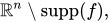
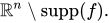
In mathematics, the support of a real-valued function is the subset of the function's domain consisting of those elements that are not mapped to zero. If the domain of is a topological space, then the support of is instead defined as the smallest closed set containing all points not mapped to zero. This concept is used widely in mathematical analysis.

Formulation

[edit]

Suppose that is a real-valued function whose domain is an arbitrary set The set-theoretic support of written is the set of points in where is non-zero:

The support of is the smallest subset of with the property that is zero on the subset's complement. If for all but a finite number of points then is said to have finite support.

If the set has an additional structure (for example, a topology), then the support of is defined in an analogous way as the smallest subset of of an appropriate type such that vanishes in an appropriate sense on its complement. The notion of support also extends in a natural way to functions taking values in more general sets than and to other objects, such as measures or distributions.

Closed support

[edit]

The most common situation occurs when is a topological space (such as the real line or -dimensional Euclidean space) and is a continuous real- (or complex-) valued function. In this case, the support of , , or the closed support of , is defined topologically as the closure (taken in ) of the subset of where is non-zero[1][2][3] that is, Since the intersection of closed sets is closed, is the intersection of all closed sets that contain the set-theoretic support of Note that if the function is defined on an open subset , then the closure is still taken with respect to and not with respect to the ambient .

For example, if is the function defined by then , the support of , or the closed support of , is the closed interval since is non-zero on the open interval and the closure of this set is

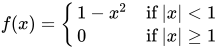
The notion of closed support is usually applied to continuous functions, but the definition makes sense for arbitrary real or complex-valued functions on a topological space, and some authors do not require that (or ) be continuous.[4]

Compact support

[edit]

Functions with compact support on a topological space are those whose closed support is a compact subset of If is the real line, or -dimensional Euclidean space, then a function has compact support if and only if it has bounded support, since a subset of is compact if and only if it is closed and bounded.

For example, the function defined above is a continuous function with compact support If is a smooth function then because is identically on the open subset all of 's partial derivatives of all orders are also identically on

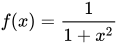
The condition of compact support is stronger than the condition of vanishing at infinity. For example, the function defined by vanishes at infinity, since as but its support is not compact.
Real-valued compactly supported smooth functions on a Euclidean space are called bump functions. Mollifiers are an important special case of bump functions as they can be used in distribution theory to create sequences of smooth functions approximating nonsmooth (generalized) functions, via convolution.

In good cases, functions with compact support are dense in the space of functions that vanish at infinity, but this property requires some technical work to justify in a given example. As an intuition for more complex examples, and in the language of limits, for any any function on the real line that vanishes at infinity can be approximated by choosing an appropriate compact subset of such that for all where is the indicator function of Every continuous function on a compact topological space has compact support since every closed subset of a compact space is indeed compact.

Essential support

[edit]

If is a topological measure space with a Borel measure (such as or a Lebesgue measurable subset of equipped with Lebesgue measure), then one typically identifies functions that are equal -almost everywhere. In that case, the essential support of a measurable function written is defined to be the smallest closed subset of such that -almost everywhere outside Equivalently, is the complement of the largest open set on which -almost everywhere[5]

The essential support of a function depends on the measure as well as on and it may be strictly smaller than the closed support. For example, if is the Dirichlet function that is on irrational numbers and on rational numbers, and is equipped with Lebesgue measure, then the support of is the entire interval but the essential support of is empty, since is equal almost everywhere to the zero function.

In analysis one nearly always wants to use the essential support of a function, rather than its closed support, when the two sets are different, so is often written simply as and referred to as the support.[5][6]

Generalization

[edit]

If is an arbitrary set containing zero, the concept of support is immediately generalizable to functions Support may also be defined for any algebraic structure with identity (such as a group, monoid, or composition algebra), in which the identity element assumes the role of zero. For instance, the family of functions from the natural numbers to the integers is the uncountable set of integer sequences. The subfamily is the countable set of all integer sequences that have only finitely many nonzero entries.

Functions of finite support are used in defining algebraic structures such as group rings and free abelian groups.[7]

In probability and measure theory

[edit]

In probability theory, the support of a probability distribution can be loosely thought of as the closure of the set of possible values of a random variable having that distribution. There are, however, some subtleties to consider when dealing with general distributions defined on a sigma algebra, rather than on a topological space.

More formally, if is a random variable on then the support of is the smallest closed set such that

In practice however, the support of a discrete random variable is often defined as the set and the support of a continuous random variable is defined as the set where is a probability density function of (the set-theoretic support).[8]


Note that the word support can refer to the logarithm of the likelihood of a probability density function.[9]

Support of a distribution

[edit]

It is possible also to talk about the support of a distribution, such as the Dirac delta function on the real line. In that example, we can consider test functions which are smooth functions with support not including the point Since (the distribution applied as linear functional to ) is for such functions, we can say that the support of is only. Since measures (including probability measures) on the real line are special cases of distributions, we can also speak of the support of a measure in the same way.

Suppose that is a distribution, and that is an open set in Euclidean space such that, for all test functions such that the support of is contained in Then is said to vanish on Now, if vanishes on an arbitrary family of open sets, then for any test function supported in a simple argument based on the compactness of the support of and a partition of unity shows that as well. Hence we can define the support of as the complement of the largest open set on which vanishes. For example, the support of the Dirac delta is

Singular support

[edit]

In Fourier analysis in particular, it is interesting to study the singular support of a distribution. This has the intuitive interpretation as the set of points at which a distribution fails to be a smooth function.

For example, the Fourier transform of the Heaviside step function can, up to constant factors, be considered to be (a function) except at While is clearly a special point, it is more precise to say that the transform of the distribution has singular support : it cannot accurately be expressed as a function in relation to test functions with support including It can be expressed as an application of a Cauchy principal value improper integral.

For distributions in several variables, singular supports allow one to define wave front sets and understand Huygens' principle in terms of mathematical analysis. Singular supports may also be used to understand phenomena special to distribution theory, such as attempts to 'multiply' distributions (squaring the Dirac delta function fails – essentially because the singular supports of the distributions to be multiplied should be disjoint).

Family of supports

[edit]

An abstract notion of family of supports on a topological space suitable for sheaf theory, was defined by Henri Cartan. In extending Poincaré duality to manifolds that are not compact, the 'compact support' idea enters naturally on one side of the duality; see for example Alexander–Spanier cohomology.

Bredon, Sheaf Theory (2nd edition, 1997) gives these definitions. A family of closed subsets of is a family of supports, if it is down-closed and closed under finite union. Its extent is the union over A paracompactifying family of supports that satisfies further that any in is, with the subspace topology, a paracompact space; and has some in which is a neighbourhood. If is a locally compact space, assumed Hausdorff, the family of all compact subsets satisfies the further conditions, making it paracompactifying.

See also

[edit]

Citations

[edit]
  1. ^ Folland, Gerald B. (1999). Real Analysis, 2nd ed. New York: John Wiley. p. 132.
  2. ^ Hörmander, Lars (1990). Linear Partial Differential Equations I, 2nd ed. Berlin: Springer-Verlag. p. 14.
  3. ^ Pascucci, Andrea (2011). PDE and Martingale Methods in Option Pricing. Bocconi & Springer Series. Berlin: Springer-Verlag. p. 678. doi:10.1007/978-88-470-1781-8. ISBN 978-88-470-1780-1.
  4. ^ Rudin, Walter (1987). Real and Complex Analysis, 3rd ed. New York: McGraw-Hill. p. 38.
  5. ^ a b Lieb, Elliott; Loss, Michael (2001). Analysis. Graduate Studies in Mathematics. Vol. 14 (2nd ed.). American Mathematical Society. p. 13. ISBN 978-0821827833.
  6. ^ In a similar way, one uses the essential supremum of a measurable function instead of its supremum.
  7. ^ Tomasz, Kaczynski (2004). Computational homology. Mischaikow, Konstantin Michael,, Mrozek, Marian. New York: Springer. p. 445. ISBN 9780387215976. OCLC 55897585.
  8. ^ Taboga, Marco. "Support of a random variable". statlect.com. Retrieved 29 November 2017.
  9. ^ Edwards, A. W. F. (1992). Likelihood (Expanded ed.). Baltimore: Johns Hopkins University Press. pp. 31–34. ISBN 0-8018-4443-6.

References

[edit]
Revisions and contributorsEdit on WikipediaRead on Wikipedia
from Grokipedia
In mathematics, the support of a function f:XRf: X \to \mathbb{R} (or more generally to C\mathbb{C}) defined on a topological space XX is the closure of the set where ff is nonzero, denoted suppf={xX:f(x)0}\operatorname{supp} f = \overline{\{x \in X : f(x) \neq 0\}}. This concept captures the "essential domain" of the function, emphasizing regions of nonzero values while accounting for topological closure to ensure the support is a closed set. The definition extends naturally to functions on metric or Euclidean spaces, where it plays a central role in analysis, such as in integration theory and approximation by compactly supported functions. Key properties of the support include its closure under the of XX, the fact that f(x)=0f(x) = 0 for all xsuppfx \notin \operatorname{supp} f, and the implication that if suppf=\operatorname{supp} f = \emptyset, then ff is the zero function. For products and sums, supp(fg)suppfsuppg\operatorname{supp}(fg) \subseteq \operatorname{supp} f \cap \operatorname{supp} g and supp(f+g)suppfsuppg\operatorname{supp}(f + g) \subseteq \operatorname{supp} f \cup \operatorname{supp} g, which facilitate algebraic manipulations in . A function has compact support if suppf\operatorname{supp} f is compact, meaning it is zero outside some bounded ; such functions are dense in spaces like Lp(Rd)L^p(\mathbb{R}^d) for 1p<1 \leq p < \infty, enabling powerful approximation techniques in Lebesgue integration and partial differential equations. The notion of support generalizes beyond functions to measures and distributions. , the support suppμ\operatorname{supp} \mu is the complement of the largest open set UXU \subseteq X with μ(U)=0\mu(U) = 0, or equivalently, the set of points xXx \in X such that every open neighborhood of xx has positive measure. This closed set concentrates the measure's mass and is crucial in probability theory (e.g., for singular continuous measures like the Cantor distribution) and ergodic theory. In the theory of distributions, the support of a distribution uD(Ω)u \in \mathcal{D}'(\Omega) (where ΩRn\Omega \subseteq \mathbb{R}^n is open) is the smallest closed set outside which uu vanishes on test functions, extending the functional definition to generalized objects like the Dirac delta. These extensions underpin applications in Fourier analysis, partial differential equations, and microlocal analysis, where singular supports further refine the notion to track wavefronts of singularities.

Definition for Functions

General Formulation

In a topological space XX, the support of a function f:XRf: X \to \mathbb{R} (or to C\mathbb{C}) is defined as the closure of the set on which the function is non-zero: supp(f)={xXf(x)0}.\operatorname{supp}(f) = \overline{\{x \in X \mid f(x) \neq 0\}}. In non-topological settings, support may be defined without closure, but in topology, this closed version is standard. The closure operation ensures that the support is always a closed subset of XX, capturing not only the points where ff explicitly vanishes but also the limit points of those non-vanishing points, which is essential for handling discontinuities and maintaining topological consistency. For instance, if ff is non-zero only at an isolated point and zero elsewhere, the set {xf(x)0}\{x \mid f(x) \neq 0\} would be that single point without closure, but the closure yields a closed support that includes it properly in the topology. The support satisfies several basic inclusion properties: supp(f+g)supp(f)supp(g)\operatorname{supp}(f + g) \subseteq \operatorname{supp}(f) \cup \operatorname{supp}(g), supp(fg)supp(f)supp(g)\operatorname{supp}(fg) \subseteq \operatorname{supp}(f) \cap \operatorname{supp}(g), and supp(αf)=supp(f)\operatorname{supp}(\alpha f) = \operatorname{supp}(f) for any scalar α0\alpha \neq 0. A representative example is the step function f:RRf: \mathbb{R} \to \mathbb{R} given by f(x)=1f(x) = 1 if x>0x > 0 and f(x)=0f(x) = 0 otherwise; here, {xf(x)0}=(0,)\{x \mid f(x) \neq 0\} = (0, \infty), whose closure is [0,)[0, \infty), so supp(f)=[0,)\operatorname{supp}(f) = [0, \infty).

Closed Support

The closed support of a function f:XRf: X \to \mathbb{R} (or C\mathbb{C}), defined on a XX, is the topological closure {xXf(x)0}\overline{\{x \in X \mid f(x) \neq 0\}} of the set where ff is non-zero. This construction ensures that the closed support, denoted supp(f)\operatorname{supp}(f), is itself a closed of XX. If the set {xXf(x)0}\{x \in X \mid f(x) \neq 0\} is already closed, then supp(f)\operatorname{supp}(f) coincides exactly with this set. For continuous functions ff, the set {xXf(x)=0}\{x \in X \mid f(x) = 0\} is closed as the preimage of the closed singleton {0}\{0\}, making {xXf(x)0}\{x \in X \mid f(x) \neq 0\} open and its closure the support. A illustrating a case where closure is necessary involves a discontinuous function, such as g(x)=1g(x) = 1 if x(a,b)x \in (a, b) and g(x)=0g(x) = 0 otherwise, on R\mathbb{R} with a<ba < b. Here, {xg(x)0}=(a,b)\{x \mid g(x) \neq 0\} = (a, b) is open, so supp(g)=[a,b]\operatorname{supp}(g) = [a, b], which properly contains the non-zero set. An example where the closed support equals the non-zero set is the step function f(x)=1f(x) = 1 if x[a,b]x \in [a, b] and f(x)=0f(x) = 0 otherwise, on R\mathbb{R}. In this case, {xf(x)0}=[a,b]\{x \mid f(x) \neq 0\} = [a, b] is closed, so supp(f)=[a,b]\operatorname{supp}(f) = [a, b]. This discontinuous function highlights scenarios where no boundary points need inclusion beyond the non-zero locus. Functions with closed support exhibit invariance under certain continuous extensions: if ff defined on a subspace is extended continuously to XX by setting it to zero outside its original domain, the closed support remains unchanged. Such functions contribute to the structure of spaces like Cc(X)C_c(X), the continuous functions on XX with compact (hence closed) support, facilitating applications in analysis where closedness aids in compactness arguments.

Supports with Topological Properties

Compact Support

In mathematics, particularly in the analysis of functions on Euclidean space, a function f:RnRf: \mathbb{R}^n \to \mathbb{R} has compact support if its support supp(f)={xRn:f(x)0}\operatorname{supp}(f) = \overline{\{x \in \mathbb{R}^n : f(x) \neq 0\}} is a compact subset of Rn\mathbb{R}^n. By the Heine-Borel theorem, compact subsets of Rn\mathbb{R}^n are precisely the closed and bounded sets, so supp(f)\operatorname{supp}(f) must be closed and contained within some ball of finite radius. This property ensures that ff vanishes outside a bounded region, distinguishing compact support from merely closed support, which may be unbounded. In Euclidean spaces, compact support thus serves as a stricter condition than closed support, guaranteeing boundedness. Key properties of functions with compact support include global integrability and controlled behavior under operations like convolution. If ff is continuous (or more generally locally integrable), then Rnf(x)dx<\int_{\mathbb{R}^n} |f(x)| \, dx < \infty, as the integral reduces to one over the bounded set supp(f)\operatorname{supp}(f). Moreover, there exists a compact set KRnK \subset \mathbb{R}^n such that supp(f)K\operatorname{supp}(f) \subseteq K. For convolution, if ff and gg both have compact support, then supp(fg)supp(f)+supp(g)\operatorname{supp}(f * g) \subseteq \operatorname{supp}(f) + \operatorname{supp}(g), where ++ denotes the Minkowski sum {x+y:xsupp(f),ysupp(g)}\{x + y : x \in \operatorname{supp}(f), y \in \operatorname{supp}(g)\}; this sum remains compact as the Minkowski sum of two compact sets. Functions with compact support play a central role in functional analysis and partial differential equations. They form the basis for the space of test functions Cc(Rn)C_c^\infty(\mathbb{R}^n), consisting of infinitely differentiable functions with compact support; this space is equipped with a topology making it suitable for defining distributions as continuous linear functionals T,ϕ\langle T, \phi \rangle for ϕCc(Rn)\phi \in C_c^\infty(\mathbb{R}^n). In the theory of Sobolev spaces, the subspace W0k,p(Ω)W_0^{k,p}(\Omega) for an open set ΩRn\Omega \subset \mathbb{R}^n is the closure of Cc(Ω)C_c^\infty(\Omega) under the Sobolev norm uWk,p=(αkΩDαupdx)1/p\|u\|_{W^{k,p}} = \left( \sum_{|\alpha| \leq k} \int_\Omega |D^\alpha u|^p \, dx \right)^{1/p}, enabling the study of weak solutions to PDEs with natural boundary conditions. These spaces were instrumental in Sergei Sobolev's development of embedding theorems in the 1930s, which relate norms in Wk,pW^{k,p} to those in Lebesgue or Hölder spaces, facilitating compactness arguments and existence results for elliptic boundary value problems. A representative example is the smooth bump function ψ:RnR\psi: \mathbb{R}^n \to \mathbb{R} defined by ψ(x)={exp(11x2)if x<1,0if x1,\psi(x) = \begin{cases} \exp\left( -\frac{1}{1 - \|x\|^2} \right) & \text{if } \|x\| < 1, \\ 0 & \text{if } \|x\| \geq 1, \end{cases} where \| \cdot \| is the Euclidean norm. This function is infinitely differentiable, nonnegative, and satisfies 0<ψ(x)10 < \psi(x) \leq 1 on the open unit ball, with supp(ψ)\operatorname{supp}(\psi) equal to the closed unit ball B(0,1)\overline{B(0,1)}, a compact set in Rn\mathbb{R}^n. Bump functions like ψ\psi are used to construct partitions of unity and mollifiers, localizing operators while preserving smoothness.

Essential Support

In measure theory and functional analysis, the essential support of a function fLp(X,B,μ)f \in L^p(X, \mathcal{B}, \mu), where 1p<1 \leq p < \infty, XX is a topological space, B\mathcal{B} its Borel σ\sigma-algebra, and μ\mu a Borel measure, is the smallest closed set outside of which f=0f = 0 μ\mu-almost everywhere. Formally, it is defined as ess-suppf=X{UX:U open,f=0μ-a.e. on U},\operatorname{ess\text{-}}\operatorname{supp} f = X \setminus \bigcup \{ U \subset X : U \text{ open}, \, f = 0 \, \mu\text{-a.e. on } U \}, This definition accounts for the equivalence class nature of LpL^p functions, where functions agreeing μ\mu-almost everywhere are identified, thus ignoring null sets in the determination of where ff vanishes. Unlike the topological support suppf={xX:f(x)0}\operatorname{supp} f = \overline{\{ x \in X : f(x) \neq 0 \}}, which depends solely on pointwise values and includes all limit points of non-vanishing points, the essential support disregards sets of μ\mu-measure zero. Consequently, ess-suppfsuppf\operatorname{ess\text{-}}\operatorname{supp} f \subseteq \operatorname{supp} f, with equality holding for continuous functions when suppμ=X\operatorname{supp} \mu = X. The essential support is always closed as the complement of an open set. If gLp(X,B,μ)g \in L^p(X, \mathcal{B}, \mu) with g0g \neq 0 μ\mu-a.e. and f/gLp(X,B,μ)f/g \in L^p(X, \mathcal{B}, \mu), then ess-supp(f/g)ess-suppfess-suppg\operatorname{ess\text{-}}\operatorname{supp}(f/g) \subseteq \operatorname{ess\text{-}}\operatorname{supp} f \cap \operatorname{ess\text{-}}\operatorname{supp} g. Moreover, if μ(ess-suppf)<\mu(\operatorname{ess\text{-}}\operatorname{supp} f) < \infty, then ff has finite measure support, which implies bounded LpL^p norms under additional regularity. A representative example illustrates the distinction: consider the Dirichlet function f:[0,1]Rf: [0,1] \to \mathbb{R} defined by f(x)=1f(x) = 1 if xx is rational and f(x)=0f(x) = 0 if xx is irrational, with Lebesgue measure λ\lambda. The topological support is [0,1][0,1], as the rationals are dense. However, f=0f = 0 λ\lambda-a.e. (since rationals have measure zero), so ess-suppf=\operatorname{ess\text{-}}\operatorname{supp} f = \emptyset. This example highlights how essential support captures the "effective" domain of integrability for LpL^p functions, recognizing that this f is the zero function in Lp([0,1],λ)L^p([0,1], \lambda) despite its pointwise behavior on a null set. In functional analysis, the essential support plays a key role in characterizing LpL^p norms, as fpp=ess-suppffpdμ\|f\|_p^p = \int_{\operatorname{ess\text{-}}\operatorname{supp} f} |f|^p \, d\mu, effectively localizing the integral to regions of positive measure contribution. In approximation theory, it facilitates the study of density results, such as the approximation of LpL^p functions by those with finite-measure essential supports in σ\sigma-finite spaces, enabling techniques like convolution with mollifiers while preserving almost-everywhere behavior.

Extensions and Generalizations

Generalizations to Other Structures

The support concept for functions generalizes to mappings with values in a topological vector space. For a function f:XVf: X \to V, where XX is a topological space and VV is a topological vector space, the support is defined as supp(f)={xXf(x)0V}\operatorname{supp}(f) = \overline{\{x \in X \mid f(x) \neq 0_V\}}, with 0V0_V denoting the zero element in VV. This closure ensures the support is a closed set and the smallest such set outside which ff vanishes identically. Properties such as compactness, when applicable, inherit from the scalar case, provided the topology on VV supports the necessary continuity conditions. In the setting of locally convex topological vector spaces, the definition aligns with the topology induced by a separating family of continuous seminorms {pα}\{p_\alpha\} on VV. Here, f(x)=0Vf(x) = 0_V if and only if pα(f(x))=0p_\alpha(f(x)) = 0 for all α\alpha, so supp(f)\operatorname{supp}(f) consists of points where at least one seminorm is positive. This compatibility preserves topological features like local convexity and ensures the support behaves consistently under operations defined via seminorms, such as convergence in the space. A concrete example arises with matrix-valued functions f:XMn(K)f: X \to M_n(\mathbb{K}), where Mn(K)M_n(\mathbb{K}) is the space of n×nn \times n matrices over a field K\mathbb{K} equipped with the standard topology. The zero element is the zero matrix, so supp(f)\operatorname{supp}(f) is the closure of the union of the supports of the scalar component functions fijf_{ij}, reflecting that f(x)f(x) vanishes precisely when all entries do. This componentwise union captures the full locus of non-vanishing. In algebraic structures, the notion extends to modules over commutative rings. For a module MM over a commutative ring RR, the support is Supp(M)={pSpec(R)Mp0}\operatorname{Supp}(M) = \{ \mathfrak{p} \in \operatorname{Spec}(R) \mid M_\mathfrak{p} \neq 0 \}, where MpM_\mathfrak{p} is the localization of MM at the prime ideal p\mathfrak{p}. This set is closed in the on Spec(R)\operatorname{Spec}(R) and underpins key results in commutative algebra, such as dimension theory and primary decomposition.

Family of Supports

The supports of an indexed family of functions {fα}αA\{f_\alpha\}_{\alpha \in A} defined on a domain form the collection {supp(fα)}αA\{\operatorname{supp}(f_\alpha)\}_{\alpha \in A}, where the support of each function fαf_\alpha is the closure of the set on which it is nonzero. This concept arises prominently in contexts where the interactions among these supports facilitate global constructions from local properties, such as covering a space or enabling decompositions. One key property of such families is exhaustiveness, where the union of the supports covers the entire domain, αAsupp(fα)=X\bigcup_{\alpha \in A} \operatorname{supp}(f_\alpha) = X, ensuring that the functions collectively span the space without gaps. In contrast, disjoint families feature non-overlapping supports, supp(fα)supp(fβ)=\operatorname{supp}(f_\alpha) \cap \operatorname{supp}(f_\beta) = \emptyset for αβ\alpha \neq \beta, which supports orthogonal decompositions by localizing contributions and simplifying computations in bases where functions are mutually orthogonal. These properties are often locally finite, meaning each point in the domain lies in only finitely many supports, which prevents infinite overlaps and aids in convergence analyses. In applications like spline theory, families of supports are controlled to achieve localization, with B-splines serving as basis functions whose supports are intervals of fixed width, allowing piecewise polynomial approximations with minimal overlap for efficient interpolation. The concept of support width or diameter, defined as the measure of the smallest set containing supp(fα)\operatorname{supp}(f_\alpha), quantifies this localization; narrower supports enhance spatial resolution but may increase oscillation. Similarly, in wavelet bases, families of dilated and translated wavelets have compact supports whose diameters scale with resolution levels, enabling multiscale analysis with controlled time-frequency localization. A representative example occurs in finite element methods, where a family of basis functions, such as piecewise linear hat functions, features small, overlapping supports confined to a few adjacent elements; this overlap ensures continuity across element boundaries while maintaining numerical stability and sparsity in the stiffness matrix. Such designs leverage the partition-of-unity property, where the functions sum to one locally, to approximate solutions over the domain. Families of supports further enable decompositions, such as refining a function's support via supp(f)=isupp(fi)\operatorname{supp}(f) = \bigcup_i \operatorname{supp}(f_i) in hierarchical bases, allowing progressive localization in approximation schemes without altering the global structure. This relation underpins refinements in both spline and wavelet constructions, where coarser supports are subdivided into finer ones for improved accuracy. In algebraic topology and sheaf theory, a family of supports on a topological space XX is an abstract collection Φ\Phi of subsets of XX that is closed under taking arbitrary unions and such that if AΦA \in \Phi and BAB \subseteq A is closed, then BΦB \in \Phi. This structure is used to define cohomology with supports in Φ\Phi, generalizing ordinary cohomology by restricting cochains to those supported in sets from Φ\Phi.

Support in Measure and Probability Theory

Support of a Measure

In measure theory, the support of a Radon measure μ\mu on a locally compact Hausdorff space XX is defined as the smallest closed set SXS \subseteq X such that μ(XS)=0\mu(X \setminus S) = 0. Equivalently, supp(μ)={xXμ(U)>0 for every open neighborhood Ux}\operatorname{supp}(\mu) = \{ x \in X \mid \mu(U) > 0 \ \text{for every open neighborhood} \ U \ni x \}, which is the of all closed sets KXK \subseteq X with μ(XK)=0\mu(X \setminus K) = 0. This set captures the points where the measure is "concentrated," in the sense that every neighborhood of such a point carries positive measure. The support of a possesses several key properties. It is always closed, as it is defined as the smallest such set or the of closed sets. For two positive s μ\mu and ν\nu on XX, the support of their sum satisfies supp(μ+ν)=supp(μ)supp(ν)\operatorname{supp}(\mu + \nu) = \overline{\operatorname{supp}(\mu) \cup \operatorname{supp}(\nu)}, reflecting how the measure concentrates on the union of the individual supports. A fundamental example is the δx\delta_x at a point xXx \in X, for which supp(δx)={x}\operatorname{supp}(\delta_x) = \{x\}, since the measure vanishes outside this singleton. When a μ\mu on Rn\mathbb{R}^n is absolutely continuous with respect to , so that μ=fdx\mu = f \, dx for some locally integrable density f0f \geq 0, the support of μ\mu coincides with the essential support of ff, defined up to sets of Lebesgue measure zero. This connection bridges the topological notion of support for functions with measure-theoretic concentration. Illustrative examples highlight these concepts. For the λ\lambda restricted to the unit interval [0,1][0,1], supp(λ)=[0,1]\operatorname{supp}(\lambda) = [0,1], as every open subinterval has positive measure. In contrast, consider the measure μ=n=1δ1/n\mu = \sum_{n=1}^\infty \delta_{1/n} on R\mathbb{R}; its support is supp(μ)={0}{1/nnN}\operatorname{supp}(\mu) = \{0\} \cup \{1/n \mid n \in \mathbb{N}\}, the closure of the points where the Dirac masses are placed, since neighborhoods of 0 and each 1/n1/n carry positive measure, while the measure vanishes elsewhere. The support plays a crucial role in advanced results like the , which decomposes a measure on a product into conditional measures supported on the fibers of a measurable , ensuring the supports align with the of the fibers.

Support of a

The support of a PP on a (Ω,F)(\Omega, \mathcal{F}) is defined as the smallest SΩS \subseteq \Omega such that P(S)=1P(S) = 1, or equivalently, the set of points xΩx \in \Omega such that every open neighborhood of xx has positive PP-measure. This notion specializes the general from to normalized measures with total mass 1. For a X:ΩRX: \Omega \to \mathbb{R}, the support of XX, denoted supp(X)\operatorname{supp}(X), is the support of its induced PX=PX1P_X = P \circ X^{-1}, the on R\mathbb{R}. In the discrete case, where XX takes values in a countable of R\mathbb{R}, the topological support is the closure of the set {xRP(X=x)>0}\{x \in \mathbb{R} \mid P(X = x) > 0\}. This coincides with the set of atoms when there are no accumulation points, as is typical for distributions like the Poisson or binomial. For instance, a on a {1,2,,[n](/page/N+)}\{1, 2, \dots, [n](/page/N+)\} has finite support exactly equal to that set. In the continuous case, where XX admits a probability density function ff with respect to , the support is the closure of the set {xRf(x)>0}\{x \in \mathbb{R} \mid f(x) > 0\}. For the uniform distribution on the interval [a,b][a, b], the density f(x)=1/(ba)f(x) = 1/(b-a) for x[a,b]x \in [a, b] and 0 otherwise yields support precisely [a,b][a, b]. A key property is that for a g:RRg: \mathbb{R} \to \mathbb{R}, the support of g(X)g(X) is contained in the image g(supp(X))g(\operatorname{supp}(X)), reflecting how transformations map possible outcomes while potentially shrinking the support. (Note: While is referenced here for the property due to lack of direct textbook PDF access, in practice, this follows from the definition of pushforward measures in standard texts like Billingsley's Probability and Measure.) Examples illustrate these distinctions: a Bernoulli random variable with success probability p(0,1)p \in (0,1) has support {0,1}\{0, 1\}, the minimal set carrying all probability mass. In contrast, the standard Gaussian distribution N(0,1)N(0,1) with density f(x)=(2π)1/2exp(x2/2)f(x) = (2\pi)^{-1/2} \exp(-x^2/2) has support R\mathbb{R}, as the density is positive everywhere. In statistics, the support delineates the possible realized values of a , guiding inference about feasible outcomes; for example, observations outside the support indicate model misspecification. Moreover, conditioning on a sub-event often reduces the support: for a uniform random variable on [0,1][0,1] conditioned on [0,0.5][0, 0.5], the conditional support shrinks to [0,0.5][0, 0.5].

Singular Support

In the of distributions, the singular support of a distribution TD(Rn)T \in \mathcal{D}'(\mathbb{R}^n), denoted sing suppT\operatorname{sing\, supp} T, is defined as the set of points xRnx \in \mathbb{R}^n such that there exists no open neighborhood UU of xx for which the restriction TUT|_U extends to a smooth (CC^\infty) function on UU. This concept captures the locations where the distribution fails to be smooth, distinguishing points of irregularity within its broader support. The definition arises naturally in the study of generalized functions, where classical criteria are insufficient, and it was formalized in the foundational work on linear partial differential operators. The singular support relates closely to the classical support of a distribution, satisfying sing suppTsuppT\operatorname{sing\, supp} T \subseteq \operatorname{supp} T, as singularities can only occur where the distribution is nonzero. For any smooth function regarded as a distribution, the singular support is empty, reflecting the absence of irregularities. Representative examples illustrate this: the Dirac delta distribution δ\delta, concentrated at the origin, has sing suppδ={0}\operatorname{sing\, supp} \delta = \{0\}, as it cannot be extended smoothly near zero. Similarly, the H(x)H(x), defined as 0 for x<0x < 0 and 1 for x0x \geq 0, exhibits a jump discontinuity at zero, yielding sing suppH={0}\operatorname{sing\, supp} H = \{0\}. A refinement of the singular support is provided by the wavefront set WF(T)TRnWF(T) \subseteq T^* \mathbb{R}^n, which encodes not only the locations but also the directions of singularities in the . The projection of WF(T)WF(T) onto the base Rn\mathbb{R}^n recovers sing suppT\operatorname{sing\, supp} T, offering a more precise tool for analyzing oscillatory behavior. In applications, the singular support plays a central role in for tracking the propagation of singularities in solutions to partial differential equations (PDEs), enabling the study of how irregularities evolve under differential operators. This is particularly useful in understanding phenomena like wave propagation and , where singularities indicate physical discontinuities or caustics.

References

Add your contribution
Related Hubs
User Avatar
No comments yet.