Hubbry Logo
Sutton CourtenaySutton CourtenayMain
Open search
Sutton Courtenay
Community hub
Sutton Courtenay
logo
8 pages, 0 posts
0 subscribers
Be the first to start a discussion here.
Sutton Courtenay
Sutton Courtenay
from Wikipedia

Sutton Courtenay is a village and civil parish in the Vale of White Horse district of Oxfordshire, England. It is situated on the south bank of the River Thames 2 miles (3 km) south of Abingdon-on-Thames and 3 miles (5 km) northwest of Didcot. The 2021 census recorded the parish's population as 3,055,[1] a rise from 2,421 in 2011.[2]

Key Information

Historically part of Berkshire until 1974 boundary changes, Sutton Courtenay is home to some important structures, such as the Abbey, the Manor House, All Saints' Church, a twelfth-century Norman hall, the Sutton Bridge, and Didcot power station.

Archaeology and history

[edit]

A Neolithic stone hand axe was found at Sutton Courtenay. Petrological analysis in 1940 identified the stone as epidotised tuff from Stake Pass in the Lake District, 250 miles (400 km) to the north. Stone axes from the same source have been found at Abingdon, Alvescot, Kencot[3] and Minster Lovell.[4] Excavations have revealed rough Saxon huts from the early stages of Anglo-Saxon settlement of Britain,[5][6][7] but their most important enduring monument in Sutton was the massive causeway and weirs that separate the millstream from Sutton Pools. The causeway was probably built by Saxon labour. In 2010 the Channel 4 Time Team programme excavated a field in the village and discovered what they then thought was a major Anglo-Saxon royal centre with perhaps the largest great hall ever discovered in Britain.[8]

Written records of Sutton's history began in 688 when King Ine of Wessex endowed the new monastery at Abingdon with the manor of Sutton. In 801 Sutton was made a royal vill,[9] with the monastery at Abingdon retaining the church and priest's house. It is believed that this was on the site of the Manor in Sutton Courtenay[10] and where Alfred the Great was married in 868.[11] The Domesday Book of 1086 shows that the manor of Sudtone ("south" of Abingdon) was owned half by William I and farmed mainly by tenants who owed him tribute. There were three mills, 300 acres (120 ha) of river meadow (probably used for dairy farming) and extensive woodlands where pigs were kept.

Most historians believe that Matilda, the elder of the two legitimate children of Henry I of England, was born in Winchester; however John M. Fletcher argues for the possibility of the royal palace at Sutton (now Sutton Courtenay) in Berkshire; the queen had been delivered of a child that died, and it seems likely that she stayed for the birth of Matilda the following year.[12] Sutton became known as Sutton Courtenay after the Courtenay family took residence at the Manor in the 1170s. Reginald Courtenay became the first Lord of Sutton after he had helped negotiate the path of the future king, Henry II, to the throne.[12]

Sutton Courtenay was involved in the marriage of Maud Holland in the 1360s. Edward the Black Prince agreed with Hugh de Courtenay, 2nd/10th Earl of Devon that Maud would marry Devon's grandson Hugh Courtenay. Devon promised to award Maud an annuity of 200 marks and the manors of Sutton Courtenay and Waddesdon in Buckinghamshire. In return Edward promised to pay Devon four lots of 1,000 marks at 6-monthly intervals. The arrangements received papal dispensation from Pope Urban V and the approval of the English king, the Black Prince's father, Edward III. The wedding had taken place by February 1365, when the manors were granted to Maud.[13]

Industry and economy

[edit]

In the past agriculture, a local paper mill (employing 25 people in 1840)[9] and domestic service were major sources of employment in the village. The Didcot power stations are in Sutton Courtenay parish. Didcot A power station closed and the de-commissioning process began on 22 March 2013. Also in the parish are several large quarries that have been used for gravel extraction and then used for landfill taking domestic refuse from London via a rail terminal. Now the main employers include local scientific establishments and Didcot Power Station. There are many commuters using Didcot railway station, London being 45 minutes away. At one time Amey plc had its head office in Sutton Courtenay.[14] In 2003 Amey had been in financial trouble and was bought by Spain's largest construction firm, Ferrovial Servicios. At the time it employed about 400 people at Sutton Courtenay.[15]

Recent events

[edit]

In August 1998 the Tudor Revival mansion Lady Place, former home of nutritionist Hugh Macdonald Sinclair, was destroyed by fire.[16] On 30 January 2008 there was an explosion and fire at Sutton Courtenay Tyres and petrol station, which led to about 100 nearby houses being evacuated for fears that acetylene cylinders might explode.[17] On 23 February 2016 a large section of the former boiler house at Didcot A power station collapsed while the building was being prepared for demolition. Four demolition workers were killed and five others were hospitalised.[18]

Buildings

[edit]

Manor houses

[edit]

In the Norman era, the oldest surviving buildings of the village were built. The Norman Hall is one of the oldest buildings in the village, being built in about 1192[12] in the reign of Richard I. Across the road from the Norman Hall is The Abbey, actually the former rectory. Its 14th-century Great Hall has an arched oak roof. The Manor House was formerly known as Brunce's Court when it was the home of the Brunce family, one of whom, Thomas Brunce, became Bishop of Norwich. It is a five-gabled, two-winged house which has had many additions over the centuries but originated as the great medieval royal hall, frequented by King Henry I and then taken over by the Courtenay family, who gave their name to the village. All Saints' parish church was also built at this time (see below), and is a fine example of local Norman and Medieval architecture.

The Norman Hall in Church Street

The Abbey

[edit]
The Abbey, a medieval courtyard house and former rectory

The Abbey is a medieval courtyard house, across the road from the Norman Hall and the Manor House, which has been recognised by Historic England as a building of outstanding historic and architectural interest.[19] It is considered to be a 'textbook' example of the English medieval manor house,[20] and is a Grade I-listed building.[21] The Abbey has its origins in the 13th century as a rectory of Abingdon Abbey. Several construction phases took place during the Middle Ages, carried out by prominent figures like Solomon of Rochester, Thomas Beckington and William Say, but it wasn't until the 17th century that the current plan was completed.[22] It was probably during the Victorian era that the house acquired the name 'The Abbey'.[23] From 1495 to 1867, The Abbey was in possession of St George's Chapel at Windsor Castle, who leased the estate among others to John Fettiplace.[22]

After being inhabited by Evelyn St. Croix Fleming, the estate was bought by David Astor in 1958, who leased it to the Ockenden Venture which offered sanctuary to refugees and displaced children. In the 70s, The Abbey was lent to the exiled Bishop Colin Winter to house the Namibia International Peace Centre. In 1978, the Astor family sold the house and in 1980 it came into possession of The New Era Centre, a charity which use it as a spiritual retreat and conference centre.[24]

Prime Minister's home

[edit]
H. H. Asquith's grave in All Saints' parish churchyard

In 1912 the then Prime Minister, H. H. Asquith, chose The Wharf (which he built in 1913) and the adjoining Walton House for his country residence. Asquith and his large family spent weekends at The Wharf where his wife Margot held court over bridge and tennis. She converted the old barn directly on the river which served for accommodation for the overflow of her many weekend parties. A painting of the period by Sir John Lavery (now in the Hugh Lane Gallery in Dublin) shows Elizabeth Asquith and her young friends lounging in boats by the riverside. Asquith signed the declaration that took Britain into the First World War here. The house has a blue plaque in honour of Asquith.[25] He and his family remained in the village after he resigned as Prime Minister. He is buried in All Saints' parish churchyard (see below).

All Saints' parish church

[edit]
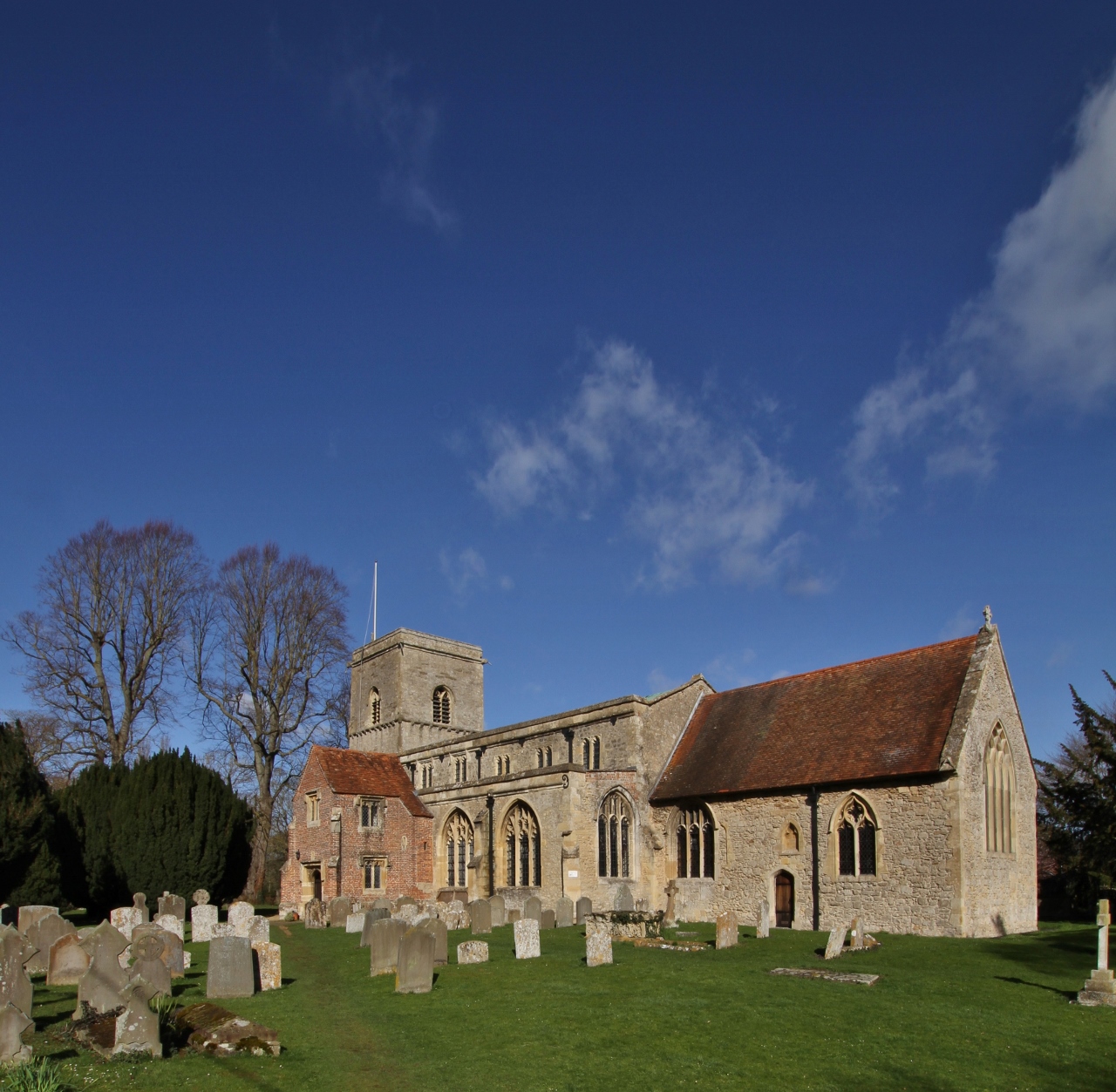
15th-century south porch and parvise of All Saints' parish church

The earliest parts of All Saints' parish church include the 12th-century Norman west tower and responds of the chancel arch.[9] The most easterly arch of the south arcade is pointed but has zig-zag ornament. On the tower door are crusader crosses inscribed by soldiers either hoping for or giving thanks for a safe return from the Crusades. The main south door has a brick south porch and parvise built with money left to the poor of the parish by Thomas Bekynton. Other fittings include a 17th-century wineglass pulpit, a carved mid-12th century font with fleur-de-lys pattern and three late 14th-century misericords. The church was nearly destroyed during the Civil War when munitions stored by the Parliamentarian vicar exploded in the church.[12][26]

George Orwell's headstone in All Saints' parish churchyard, showing his birth name

The churchyard is the burial place of Eric Arthur Blair (1903–50), better known by his pen name George Orwell. As a child he fished in a local stream. He requested to be buried in an English country churchyard of the nearest church to where he died. However, he died in London, and none of the local churches had any space in their graveyards. Thinking that he might have to be cremated against his wishes, his widow asked her friends whether they knew of a church that had space for him. David Astor was a friend of Orwell and was able to arrange his burial in Sutton Courtenay, a "classic English country village" as Orwell had specifically requested, as the Astor family owned the manor of Sutton Courtenay.[27] With approval from the local vicar and encouragement from Malcolm Muggeridge, arrangements were made. The churchyard also contains the graves of David Astor, Horace Freeland Judson and H. H. Asquith, Earl of Oxford and Asquith. Asquith so much loved the simplicity of the village that he chose to be buried there rather than in Westminster Abbey.

Notable people

[edit]

References

[edit]

Sources

[edit]
[edit]
Revisions and contributorsEdit on WikipediaRead on Wikipedia
from Grokipedia
Sutton Courtenay is a village and in the district of , , situated on the south bank of the River Thames approximately two miles south of Abingdon and twelve miles south of . With a population of around 2,500 residents, it is an ancient settlement with a historic core that includes a conservation area encompassing medieval and later buildings shaped by the fertile Thames floodplain that attracted early inhabitants. The village is particularly noted for its Church of All Saints, a Norman-era structure whose churchyard contains the tombs of former British , who died in 1928 and requested burial there over a , and author (Eric Arthur Blair), interred in 1950 per his wish for a simple English churchyard grave arranged by friend . Other defining landmarks include The Abbey, a medieval , and a twelfth-century Norman hall, contributing to its status as home to multiple exceptionally historic domestic structures unusual for such a locality.

Geography and Environment

Location and Topography

Sutton Courtenay lies in the district of , , at coordinates 51°38′31″N 1°16′37″W. The village is positioned on the south bank of the River Thames, approximately 2 miles (3.2 km) south of , 3 miles (4.8 km) northwest of , and 8 miles (12.9 km) south of . The topography of Sutton Courtenay consists of low-lying, flat to gently undulating terrain in the Upper floodplain, with an average elevation of 56 metres (184 feet) above . This fertile , shaped by the River Thames, supports arable farming and features hedgerows, scattered trees, and a mix of and crop fields. The surrounding area aligns with the Lowland Village Farmlands landscape type, characterized by open, low-elevation vistas prone to periodic flooding from the adjacent river.

River Thames and Floodplain

Sutton Courtenay is positioned on the southern bank of the in the district of , approximately 12 miles south of and adjoining low-lying meadows that extend northward to the river channel. The village's linear layout aligns with the floodplain's topography, where the Thames meets the smaller Ginge Brook, contributing to a of alluvial deposits that facilitate retention and periodic overflow. This setting supports agricultural use, primarily permanent pasture, but exposes northern sectors of the parish to recurrent inundation from riverine sources. The Thames at this location features free-draining and head formations overlain by , creating a flat with minimal variation that amplifies propagation during high discharges. Gauging occurs at the Sutton Courtenay station (NRFA 39046), where typical water levels range from 1.91 meters to 3.51 meters above , representing 90% of historical observations; exceedances trigger low-lying land , with property risks emerging above 3.51 meters. The record peak of 4.04 meters occurred on 26 July 2007, when separation by barriers complicated accurate measurement of extreme flows. Flooding remains a persistent hazard, driven by upstream rainfall accumulation and the floodplain's capacity to store excess volume, as seen in the January 2024 inundation between Culham and Sutton Courtenay, where meadows submerged following prolonged precipitation. More recently, Storm Bert in 2024 caused widespread disruption, closing roads, schools, and rail services in the vicinity due to overflow from the Thames and tributaries like the Ginge Brook. Historical precedents include the 1894 event, where over 20 cm of rain in 26 days led to severe overflows affecting riverside areas, and earlier episodes like the 1774 flood that submerged parishes such as Sutton Courtenay under meters of water. Local planning documents confirm that portions of the village, particularly adjacent to the , face elevated river flood vulnerability, necessitating assessments for development under guidelines.

Prehistory and Archaeology

Neolithic and Bronze Age Evidence

Archaeological excavations and surveys in Sutton Courtenay have revealed evidence of occupation, primarily through pits containing worked flint tools and sherds indicative of early farming communities. Fieldwalking and test-pit sieving along Drayton recovered a range of artefacts, including flint implements, suggesting localized activity in a suited to early near the River Thames . A notable feature is the Drayton Cursus, a ceremonial monument extending over 1.5 km in a north-north-east to south-south-west alignment, with portions running directly through areas of the parish, potentially linking to ritual or processional practices. An oval barrow, possibly associated with this cursus, has been identified, alongside additional pits that predate later settlements and point to structured around 4000–2350 BC. Bronze Age evidence is more extensive, featuring ring ditches interpreted as barrow cemeteries and enclosures marking or settlement sites from approximately 2350–800 BC. Excavations near Drayton Road uncovered middle field systems, comprising linear ditches that delineate plots for arable or use, reflecting organized in the environment. A large pit, potentially a waterhole, yielded alongside worked flint, with some material redeposited, indicating continuity of resource exploitation. Early artefacts from field surveys, including metalwork and ceramics, further attest to sustained habitation, while ring ditches cluster in the vicinity suggests a focus on commemorative monuments amid fertile gravels. Late features, such as enclosures, appear in geophysical surveys, underscoring the area's role in regional prehistoric networks without evidence of large-scale . These findings, derived from developer-led and research excavations by units like Oxford Archaeology, highlight Sutton Courtenay's integration into broader Upper prehistoric patterns, driven by alluvial soils conducive to early cultivation and herding.

Roman Occupation

Archaeological evidence indicates a Roman in the vicinity of Sutton Courtenay, centered on the , located approximately half a east of the later Anglo-Saxon complex. The villa site was first identified in through surface finds, with principal excavations conducted in 1966 revealing extensive structural remains, including tessellated pavements and abundant artefacts consistent with a 2nd-century AD establishment. Coins recovered from the site span the 1st to 4th centuries AD, suggesting continuous occupation through the late Roman period. Further investigations, including evaluations in the early , uncovered land boundaries, trackways, and enclosure ditches indicative of a managed agrarian extending from the late into the late Roman era. An inhumation , radiocarbon dated to the Roman period, provides evidence of funerary practices within this non-cemetery rural context, potentially linked to the estate. Additional Roman-period finds, such as stamped tiles, coins, and brooches, have surfaced in nearby Anglo-Saxon contexts, likely representing residual material from the or associated settlements rather than direct reuse. Excavations in at the Dropshort site exposed features possibly including an , reinforcing the interpretation of the area as part of a productive economy focused on and , typical of Roman estates. The settlement's proximity to the River Thames likely facilitated trade and resource exploitation, though no direct evidence of riverine , such as ports, has been confirmed at the site. Overall, these remains attest to modest but sustained Roman presence, transitioning without apparent disruption into post-Roman activity.

Anglo-Saxon Settlement

Excavations conducted by E. T. Leeds in the 1920s and 1930s at revealed the first systematically excavated early Anglo-Saxon settlement in , featuring 33 sunken-featured buildings (SFBs) dated from the fifth or early sixth century to the seventh century. These structures, typical of early Germanic-style dwellings with sunken floors, indicate a nucleated settlement pattern with evidence of domestic activities including . Associated finds included fragments of stamped Roman tile, three Roman coins, and two Romano-British brooches, likely residual materials gathered from nearby sites rather than evidence of direct continuity. Subsequent geophysical surveys and targeted excavations near Drayton Road in the early uncovered a high-status Anglo-Saxon complex overlying earlier features, including the largest timber-built hall identified to date in Anglo-Saxon , measuring approximately 30 meters in length. This complex, potentially an undocumented royal center linked to the early Kingdom of Wessex, comprised multiple large post-built structures, one of which was constructed into a prehistoric or , suggesting deliberate reuse of landscape features for symbolic purposes. The site's prominence aligns with its location in the Upper , a region dense with early Anglo-Saxon activity, though no direct has been confirmed adjacent to the settlement core. The settlement's and structural scale point to occupation, with the great hall's size and form comparable to those at known royal sites like , implying functions for feasting, , and assembly in the formation of early medieval polities. Later medieval development appears to have respected or built upon these foundations, as evidenced by the persistence of high-status land use into the documented manor period.

Historical Development

Medieval Manor and Monastery

In the of 1086, the manor of Sutton (recorded as Sudtone) was held by , comprising 74 households, three mills, 300 acres of meadow, and extensive woodlands capable of supporting 200 swine. The estate was divided, with half directly under the king and the remainder farmed by tenants owing tribute, reflecting its status as a significant royal holding in the hundred of Sutton. Prior to the , the manor had ties to monastic institutions; in 688, the king of endowed the Benedictine Abbey of with Sutton, granting it ecclesiastical oversight. By 801, Sutton had transitioned to a royal vill—a principal administrative center—with the retaining control of the church and priest's residence, maintaining a degree of monastic influence amid secular lordship. This dual structure persisted into the medieval period, underscoring the interplay between royal, manorial, and ecclesiastical authority. Between 1175 and 1180, King Henry II granted the manor to Reginald de Courtenay, a favored Norman associate, renaming the settlement Sutton Courtenay after its new lords. The Courtenay family subsequently developed the estate, with the ancient evolving from late Saxon origins—potentially the site of a royal palace where the convened in 1042—into a structure incorporating 12th- to 17th-century elements, centered around a Norman hall. Monastic presence manifested through The Abbey, constructed in the early as a grange—a working farmstead—for , exemplifying a typical English medieval with courtyard layout and clay-tiled ranges. Likely built under the oversight of figures like William Le Breton, it served administrative and agricultural functions for the distant mother house rather than as a full , though tensions arose, as evidenced by a 1278 by Hugh de Courtenay, , against over disputed rights. This grange, now Grade I listed, highlights the economic integration of monastic estates into local manorial systems during the .

Post-Medieval Changes

The under , culminating in the suppression of in 1538, resulted in the transfer of its at Sutton Courtenay—previously an administrative center for local estates and tithes—to secular hands, marking a shift from ecclesiastical to private control over significant village lands. This redistribution facilitated the adaptation of monastic structures for residential use, with the grange evolving into a incorporating post-medieval elements such as a service wing roof. In the , the , with origins in the , underwent rebuilding, followed by 17th-century alterations that included expansions reflecting emerging preferences for fortified yet comfortable residences. Several substantial timber-framed and brick houses were constructed along and Church Street during the 16th and 17th centuries, driven by economic gains from Thames river trade and early industrial activity. A paper mill established in the late 17th century produced banknotes for the until 1724 and operated until around 1880, contributing to localized prosperity amid broader agricultural reliance. By the , John Rocque's 1761 map depicted a consolidated village core with arable fields, meadows, the common at Oday, and nascent pits indicating early resource extraction. Parliamentary in transformed surviving open fields into hedged allotments—such as 35 at Oday—while promoting orchards and intensifying quarrying, altering the from communal to privatized holdings and foreshadowing 19th-century industrialization.

19th-20th Century Evolution

During the , Sutton Courtenay's economy transitioned from earlier paper milling—active since the and producing banknote paper until 1724—to its gradual decline, with the mill's chimney felled in 1910 marking the end of operations. improvements included the 1807 to Culham, which enhanced Thames-side trade until tolls ceased in 1939. Settlement densified along Church and High Streets, with new buildings such as 1820 almshouses, a National School, Independent Chapel, and Baptist Chapel added in the second half of the century. Gravel extraction emerged as a nascent industry from small pits noted on the 1804 enclosure map, while land use stayed predominantly arable with orchards and allotments. In 1886, Lord purchased the manor estate, transferring it to Colonel Harold Lindsay in 1895. The early 20th century brought ribbon development along Drayton, Milton, and Harwell Roads, including terraced and semi-detached houses, alongside expanded gravel quarrying east of the village for aggregate and later landfill. Prime Minister H. H. Asquith acquired The Wharf in 1912 as a retreat, residing there post-1916 until his 1928 death and burial in All Saints' churchyard; his wife Margot followed in 1945. The First World War claimed 32 local lives, prompting community memorials, while the Second World War took 11 more. Post-1945, a 1950s housing estate arose at the village's south end, followed by 1950s-1960s estates west of Harwell Road to address shortages, shifting patterns from linear to semi-suburban amid proximity to growing Didcot. In 1950, author George Orwell's ashes were interred in the churchyard under his real name, Eric Arthur Blair, at friend David Astor's arrangement. The 1974 boundary shift incorporated the parish into Oxfordshire from Berkshire, while late-century infill and Didcot A power station (built 1960s, visually dominant until decommissioning) reflected modernization pressures on the rural core. Population grew from under 1,000 in the mid-19th century to over 2,400 by 2011, driven by housing amid enduring agricultural ties.

Governance and Demographics

Administrative History

Sutton Courtenay originated as an ancient parish within the hundred of Ock in , encompassing the township of Sutton Wick and the chapelry of Appleford. The parish managed local poor relief through a select vestry system until the early 19th century, when it joined the Abingdon Poor Law Union established under the , with administrative oversight from the Abingdon union workhouse. began in the Abingdon registration district from 1837, with Sutton Courtenay forming one of its sub-districts. In 1875, the parish fell under the Abingdon Rural Sanitary District, transitioning to the Abingdon Rural District upon the implementation of the Local Government Act 1894, which reorganized rural administration in Berkshire. This structure persisted until the Local Government Act 1972 redrew boundaries, effective 1 April 1974, transferring Sutton Courtenay from Berkshire to Oxfordshire and integrating it into the Vale of White Horse district. The parish retained its civil parish status, now governed by the Sutton Courtenay Parish Council under Oxfordshire County Council, with responsibilities for local planning, amenities, and community services delegated from higher tiers. The Abingdon registration district, including Sutton Courtenay, was abolished on 1 October 2001 and merged into the broader Oxfordshire registration district.

Population and Community

The population of Sutton Courtenay parish was recorded as 3,056 in the 2021 United Kingdom census, marking a 26.3% increase from 2,421 in the 2011 census. The parish spans 1.15 km², resulting in a population density of 2,657 inhabitants per km² as of 2021. Demographically, the 2021 census indicated a predominantly White population (93.2%, or 2,849 individuals), with 1.8% (56) identifying as Asian, 1.1% (35) as Black, 0.4% (11) as Arab, and the remainder in mixed or other categories. The community maintains an active rural character, centered around the parish council, which coordinates local initiatives such as annual litter picks to promote , with the most recent scheduled for October 29, 2025. The Sutton Courtenay Society fosters resident engagement by hosting regular meetings with guest speakers on regional topics. All Saints Church supports communal gatherings, including bi-weekly coffee mornings and monthly worship services that draw local participation. These activities reflect a cohesive village network, supplemented by informal resident forums for sharing news on events, resources, and safety concerns.

Local Governance

Sutton Courtenay is governed at the parish level by the Sutton Courtenay Parish Council, a established in 1894 under the Local Government Act 1894, comprising 11 elected councillors representing the interests of approximately 2,500 residents. The council manages local amenities including the village hall on Hobbyhorse Lane, community events such as litter picks, and responds to issues like road closures and , operating from the village hall with meetings held periodically to discuss agendas available online. The parish council adheres to formal frameworks, including standing orders for meeting procedures, financial regulations for budgeting and procurement, and a for councillors, all aligned with statutory requirements and updated periodically (e.g., financial regulations revised in 2025). It maintains transparency through a model publication scheme for public access to documents, asset registers, and policies on complaints, , and , and has committed to the and Pledge (certificate #1716) and the Councils Charter to promote ethical local leadership. For broader services, Sutton Courtenay falls within the District Council, which oversees planning, housing, and , represented locally by district councillor Peter Stevens (Liberal Democrat), and , handling education, highways, and social care via the Drayton, Sutton Courtenay & Steventon division. The parish exercises influence on development through its Neighbourhood Plan, adopted as part of the statutory development framework following community , enabling resident-led policies on housing growth and land use within the district's local plan.

Economy and Infrastructure

Traditional Industries

Agriculture has historically dominated the economy of Sutton Courtenay, leveraging the fertile alluvial soils deposited by the River Thames and its tributaries, which supported arable cultivation, dairy farming, and livestock rearing from at least the medieval period. Domesday Book records from 1086 indicate the manor held three mills, 300 acres of meadow suitable for hay production and grazing dairy cattle, and extensive woodlands used for pannage of pigs, underscoring a mixed farming system reliant on the river valley's resources. Water-powered milling emerged as a key ancillary industry, with corn mills grinding local grain harvests along the Thames and millstreams; by the 17th century, one such mill transitioned to paper production, receiving a monopoly from the Bank of England in 1697 to manufacture banknote paper using rag-based processes fed by the river's flow. Associated trades included malting for brewing, evidenced by historical malt houses, and wharfage for transporting agricultural goods and milled products via the navigable Thames. These activities sustained a rural economy tied to land and water management until the 19th century, when enclosure and agricultural improvements intensified focus on cash crops and livestock, though gravel extraction and power-related industries later supplanted them without altering the foundational agrarian character.

Modern Employment

Sutton Courtenay's modern employment landscape features a predominance of professional, managerial, and technical occupations, driven by the village's location within the Science Vale UK area, which encompasses high-tech clusters at Milton Park, Harwell, and Culham. The 2011 Census indicated that 16.6% of working residents aged 16 and over held managerial, directorial, or senior official positions—exceeding England's 10.9% average—while 13.7% were engaged in professional, scientific, and technical activities, compared to 6.7% nationally. Self-employment was also elevated at 14.3%, versus 10.4% in England, often in small-scale or home-based operations. Unemployment remained low at 2.7% in 2011, below the national rate of 4.4%, with economic activity bolstered by to regional hubs via —reflecting 32.8% of households owning two , higher than England's 24.7%. Local jobs center on , with small businesses employing 1-5 staff comprising over half of operations; examples include veterinary services (Larkmead Vets), automotive repair (Halls Garage), retail (Costcutter), and at public houses such as The Fish, George & Dragon, and The Swan. A 2023 residents' survey showed 53% favoring more local employment opportunities, particularly in shops, creative workshops, and small offices. The Sutton Courtenay Neighbourhood Plan (made in 2024) promotes sustainable economic growth through Policy SC16, which safeguards existing businesses, encourages compatible small-scale developments within the built-up area, and supports home working to reduce pressures. While agriculture and gravel extraction persist as minor sectors—historically dominant but now secondary—former industrial sites like the Amey facility have transitioned toward mixed-use or residential redevelopment since the early , limiting large-scale local manufacturing. Overall, employment aligns with the Vale of White Horse's , where 79.3% of residents are economically active and weekly earnings average £592 (resident-based), above regional norms.

Transport and Utilities

Sutton Courtenay's road network includes local routes such as , Church Street, and Appleford Road, which connect to the A4130 trunk road providing access to (3 km southeast) and Abingdon (5 km west). These village roads often exceed capacity during peak times, leading to queues and parking pressures, with 74% of residents in a 2022 survey rating road infrastructure as needing improvement. Planned enhancements include dualling of the A4130, a new Science Bridge over the railway and A4130, and a Thames river crossing as part of the Didcot Garden Town Highways Infrastructure Fund 1 (HIF1) project, with construction anticipated from 2024 to 2026 to alleviate congestion from regional growth. Public bus services are limited but include the route 33 Thames Travel Connector, operating hourly from 5:30 a.m. to 7:30 p.m. Monday to Saturday, linking Sutton Courtenay to Abingdon, , , and Wallingford. Additional routes such as X2 and X32 serve nearby areas, with stops at key points like the and Bradstocks Way. Rail access relies on nearby stations: Appleford (2.5 km north) for local services and (6.3 km southeast), a major Great Western Railway hub offering frequent trains to (15 minutes), Reading, and London Paddington (45 minutes). Cycling and walking infrastructure features Route 5 and the National Trail along the riverbank. Utilities in Sutton Courtenay are managed by for and , serving the village through the Abingdon Sewage Treatment Works on the western boundary; however, capacity constraints have led to sewer flooding incidents, such as in , exacerbated by high and development pressures. Electricity distribution occurs via overhead lines with prominent pylons east of the village, drawing from the regional grid historically supported by the now-decommissioned Didcot A coal-fired power station (closed 2013) and operational Didcot B gas-fired station. and gas services follow standard national providers, with resident surveys indicating moderate satisfaction but calls for upgrades in connectivity and renewable integration like solar PV.

Architecture and Landmarks

All Saints' Parish Church

All Saints' Parish Church serves as the place of worship for Sutton Courtenay, , and is designated a Grade I listed building due to its exceptional architectural and historical significance, with listing effective from 9 1966. The structure incorporates elements from multiple medieval periods, beginning with late Norman (Romanesque) construction around 1150–1200, which included the lower storeys of the , a Norman chancel arch, three lancet windows in the chancel, chancel shafts, and a Norman font. Subsequent phases expanded the church: between 1310 and 1325, under Rector John Brouns, the and were widened, side aisles and a added, and an Easter sepulchre constructed in the Brouns family style. From 1480 to 1520, the aisles were raised, the roof elevated, a introduced with five windows per side, and nine additional Perpendicular-style windows installed, alongside a two-storeyed Tudor brick south porch featuring a four-centred archway. The overall layout comprises a four-bay aisled , three-bay , and four-stage tower with Romanesque lancets and later . Key interior elements include a late 13th-century recess with a re-cut effigy, 14th-century arcades, and a 1901 wine-glass , while a 20th-century portrait adds a modern touch. The church sustained damage from a 1643 gunpowder explosion overseen by rector Thomas Fitch, a Parliamentarian supporter. Its churchyard holds notable 20th-century burials, including Liberal Herbert Henry Asquith (served 1908–1916), who died on 15 February 1928 and was interred alongside his wife after constructing a village residence in 1912, marked by a chest . Author Eric Arthur Blair (pen name ) was buried here on 21 January 1950 under his real name, per his preference for the site over a cemetery, in a simple grave.

The Abbey

The Abbey is a Grade I listed building originally constructed as the Rectory House, serving as an administrative grange for Abingdon Abbey's estates in the area. The oldest sections date to the early , with the west range added around 1290 and the main hall and solar range built circa 1320, likely by William le Breton; a timber-framed hall was later clad in stone around 1330 to address structural leaning. The south and east ranges were completed in the mid-15th century, forming a layout, while rear additions occurred in the 16th and early 17th centuries. Architecturally, it exemplifies an English medieval , constructed primarily of uncoursed stone rubble with dressings and a plain-tile ; key features include a double-ended hall with a moulded jointed base-cruck , a 14th-century two-centred stone doorway, and a battlemented on the solar. Interior elements comprise crown-post ing, 18th-century winder staircases, and 19th-century and fireplaces, contributing to its designation for special architectural and historic interest rooted in its 14th-century origins and subsequent developments. The Rectory House was built around 1325 by Rector John Brouns, and following the 1485 Battle of Bosworth, it was appropriated by Henry VII from the previous lord before transfer to the Dean and Canons of Windsor by 1500. Ownership shifted to private hands in 1900 after a long lease to local squires by St. George's Chapel, Windsor, granted in 1485; in 1958, purchased the property and leased it to charitable organizations aiding refugees, including the Ockenden Venture and Centre. By 1980, it became the New Era Centre, later reorganized as , functioning as a retreat and conference facility while preserving its historic fabric. The name "The Abbey," adopted in the , reflects its early ecclesiastical ties rather than active monastic use.

Manor Houses

The Manor House, situated on Church Street in Sutton Courtenay, represents the village's principal surviving manorial residence, with architectural elements spanning from the onward. Its origins trace to the medieval period, forming part of the late Saxon manor complex that centered on the settlement's administrative and economic core, though the current structure incorporates a 16th-century rebuild and 17th-century modifications. The building exemplifies vernacular English manor architecture, featuring timber-framing and stonework adapted over centuries for residential use by local lords. It holds Grade II* listed status, recognizing its historical and architectural significance in preserving manorial traditions amid evolving systems. The manor's historical ownership reflects broader feudal dynamics in the region. Records indicate the estate's ties to from the , with a key grant in 1175–1179 by Henry II to Reginald de Courtenay, establishing the Courtenay family's influence until the . Subsequent holders included the de Sutton family, linking the property to the village's shift to Sutton Courtenay. By the post-medieval era, the house served as a gentry residence, its layout including hall, chambers, and service areas typical of manors transitioning from open to enclosed designs. Associated gardens, formalized in the under landscape designer Norah Lindsay, extend over approximately 2 hectares and include enclosed long gardens with fountain basins, columnar , herbaceous borders, and remnants of intricate box and , blending formal and wild elements. These features postdate the house's core structure but enhance its manorial character, drawing on 20th-century garden revival principles while respecting the site's riparian proximity to the River Thames. The estate's broader grounds, exceeding 40 acres, underscore its role in agrarian management historically tied to the manor's lands. No other distinct manor houses of comparable antiquity survive intact in the village, though subsidiary farmsteads and lesser homes echo manorial influences.

Other Notable Buildings

The Norman Hall, located west of All Saints' Church, is a Grade I listed building constructed in the late , circa 1190–1200, by Robert de Courtenay. Built of uncoursed stone rubble with dressings and an old plain-tile roof, it features a round-arched doorway with roll mouldings, nailhead, and dogtooth ornamentation, along with lancet windows and later . The interior includes an arch-braced collar truss roof with two tiers of wind braces. Originally part of the medieval manor complex, it stands on the site of a former royal palace associated with Queen Matilda, wife of Henry I. Sutton Courtenay features numerous other Grade II listed structures, including timber-framed and thatched cottages along and Church Street, reflecting the village's from the 17th to 19th centuries. Examples include numbers 16, 18, 20, and 22 , which exhibit jettied fronts and cob infill, preserving the rural character of the settlement. These buildings, while not as grand as the principal medieval houses, contribute to the historic clustered around the village green and .

Notable Residents and Associations

Historical Figures

![Asquith's tomb, All Saints church, Sutton Courtenay][float-right] , daughter of , was born at Sutton Courtenay around 7 February 1102. As the only surviving legitimate child of Henry I after the sinking of the White Ship in 1120, she was designated heir presumptive and later contested the English throne against her cousin Stephen in (1135–1153). Reginald de Courtenay, a Norman nobleman, received the manor of Sutton from King Henry II around 1160 in reward for loyalty, leading to the village's renaming as Sutton Courtenay. He held the estate until his death on 27 September 1194 and was succeeded by his son . Thomas Beckington, (1443–1465), served as rector of Sutton Courtenay and contributed to local architecture, including alterations to the rectory and the construction of the church's south porch around 1500, marked by his rebus of a and tun. Thomas Ford, a Catholic priest and martyr, acted as chaplain in Sutton Courtenay during the reign of before his arrest in 1581 and execution by hanging, drawing, and quartering at on 28 May 1582. Herbert Henry Asquith, Liberal Prime Minister from 1908 to 1916, established The Wharf in Sutton Courtenay as his country residence in 1912, where he died on 15 February 1928 at age 75 and was buried in All Saints' churchyard.

Literary and Cultural Connections

Sutton Courtenay holds a notable literary association through the burial of George Orwell, the pen name of Eric Arthur Blair (1903–1950), in All Saints' Churchyard. Orwell died of tuberculosis on 21 January 1950 at University College Hospital in London, and his friend David Astor, editor of The Observer, arranged for a private funeral and burial in the village churchyard rather than cremation. The choice of Sutton Courtenay stemmed from Astor's family connections to the nearby Cliveden estate, not from any prior ties Orwell had to the village itself. Orwell specified in his will a preference for burial in the nearest churchyard to his home, leading Astor to select this rural site for its quiet, traditional setting. His unpretentious gravestone bears only his birth name, Eric Arthur Blair, born 25 June 1903 and died 21 January 1950, located near the tomb of former . This has drawn literary pilgrims and scholars, underscoring the village's unexpected role in Orwell's legacy despite the absence of deeper personal links. No other prominent literary figures are directly associated with Sutton Courtenay through residence or creation, though the site's historical Anglo-Saxon heritage, including a excavated great hall complex dating to the 7th–9th centuries, contributes to its broader cultural appeal as a preserved English village landscape.

Recent Developments and Planning

Housing Expansion

The Vale of White Horse Local Plan 2031 designates land east of Sutton Courtenay as a strategic housing site for approximately 220 homes, aimed at providing a sustainable urban extension integrated with the village while addressing flood risks and infrastructure needs. This allocation, established in the plan's strategic sites policy, emphasizes masterplanning to ensure compatibility with local character and countryside interfaces. A significant development within this framework involved land north of Hobbyhorse Lane, where outline for up to 175 dwellings and associated was granted on by the Planning Inspectorate on 6 December 2023, overturning Vale of White Horse District Council's refusal. The site, bounded by existing development including the village hall, includes reserved matters except access, with conditions for 40% , open space, and sustainable drainage to mitigate environmental impacts. This permission reflects national policy pressures under the National Planning Policy Framework, prioritizing housing delivery amid local supply constraints, though it prompted concerns over cumulative traffic and services strain raised by parish council objections. The Sutton Courtenay Neighbourhood Plan, adopted on 11 April 2024 following a , shapes ongoing expansions through Policy SC9, requiring new housing to align with village character, provide adequate off-street parking (prioritized by 74% of surveyed residents), and meet evidenced local needs without exceeding sustainable limits. It identifies and small-scale developments as preferable over large greenfield schemes, influencing recent applications such as three self-build homes proposed in January 2025 on rural-themed plots to address housing shortfalls while preserving density. Additional permissions, including a site for 17 edge-of-village dwellings with pending approval, underscore incremental growth, though meetings in October 2025 highlighted risks of piecemeal intensification conflicting with plan policies.

Infrastructure Projects

The Didcot and surrounding areas infrastructure scheme, funded at £332 million primarily through grants, encompasses enhancements including the widening of the A4130 to a , construction of the Didcot Science Bridge, a Didcot to Culham river crossing, and the Clifton Hampden , aimed at alleviating congestion, improving journey reliability, and bolstering and networks to accommodate regional and expansion. Enabling works, such as fencing, vegetation clearance, archaeological surveys, and utility diversions, commenced in late 2025 with full completion targeted for autumn or winter 2026; these measures directly influence Sutton Courtenay through enhanced connectivity to and reduced local traffic pressures, as evidenced by a dedicated event held at Sutton Courtenay Village Hall on 22 October 2025. Renewable energy initiatives at the Sutton Courtenay Site represent key infrastructural advancements in sustainable power generation and storage. The Sutton Courtenay Solar Park, developed by Infinis on a 37-hectare former site with solar arrays occupying 12.3 hectares, is projected to produce 20,800 MWh of zero-carbon annually, sufficient to supply approximately 4,500 homes, while incorporating enhancements like new hedgerows and ; was under submission as of 2025, with a six-month phase leading to 35 years of operation. Complementing this, the proposed Parkway Battery Energy Storage System (BESS) by Brockwell Energy, featuring 300 MW capacity and 300 MWh storage—capable of powering 660,000 homes for two hours—seeks to stabilize by capturing excess renewable output, with project scoping in Q1 2025, public consultation in April 2025, in May 2025, construction starting Q4 2026, and operations by Q4 2027. These projects align with broader policy directives in the Sutton Courtenay Neighbourhood Plan, adopted on 11 2024, which mandates infrastructure mitigation for risks—identified as a concern in 88% of resident surveys—through developer-funded measures like sustainable drainage systems in new builds, though no standalone defence schemes have been implemented to date.

Neighbourhood Plan

The Sutton Courtenay Neighbourhood Plan is a community-led statutory document that guides development decisions in the parish until 2031, forming part of the Vale of White Horse District Council's development plan framework. It was approved by residents in a referendum on 11 April 2024, with 479 votes in favor (88.7%) and 61 against (11.3%), on a turnout of 22.9%. The plan carries full weight in determining planning applications, aligning with the Vale of White Horse Local Plan 2031 while emphasizing local priorities. The plan's vision seeks to safeguard the historic Thames-side village character, protect its rural identity, and address community needs through sustainable growth that enhances and connectivity. Objectives include preserving and heritage assets, supporting high-quality tailored to local demographics (such as 2–3 bedroom homes and options for older residents), bolstering , and promoting economic vitality via small-scale businesses and home working. It prioritizes development on brownfield sites within the settlement boundary, with policies like Core Policy 4 allocating up to 220 dwellings on a strategic site east of the village to meet requirements while mitigating impacts on and the environment. Key environmental policies designate two Green Gaps to prevent coalescence with neighboring settlements (Policy SC1), protect valued landscapes and key views (Policies SC2 and SC3), and designate Local Green Spaces such as The Green and Millennium Common (Policy SC5). enhancement is mandated through Policy SC6, requiring net gains in habitats and features, while Policy SC7 addresses flood risks via sustainable drainage systems. Heritage protections under Policy SC10 conserve listed buildings, the conservation area, and non-designated assets, ensuring new development respects the village's medieval core and riverside setting. On infrastructure and economy, the plan supports upgrades to community facilities like the Village Hall (Policy SC14) and encourages to reduce reliance on cars (Policy SC17). Policy SC16 facilitates local employment by permitting appropriate extensions to existing businesses and conversions for home working, without allocating new commercial sites. Design standards in Policies SC8 and SC9 emphasize context-sensitive, energy-efficient buildings that prioritize pedestrian-friendly layouts and renewable energy integration.

References

Add your contribution
Related Hubs
User Avatar
No comments yet.