Hubbry Logo
TacharaTacharaMain
Open search
Tachara
Community hub
Tachara
logo
8 pages, 0 posts
0 subscribers
Be the first to start a discussion here.
Tachara
Tachara
from Wikipedia

The Tachara, or the Tachar Château, also referred to as the Palace of Darius the Great,[1] was the exclusive building of Darius I at Persepolis, Iran. It is located 70 km northeast of the modern city of Shiraz in Fars province.

Key Information

History and construction

[edit]
The exterior of the Tachara and its surrounding gardens, as depicted by Charles Chipiez.

The construction dates back to the time of the Achaemenid Empire (550 BC–330 BC). The building has been attributed to Darius I,[2][3] but only a small portion of it was finished under his rule. It was completed after the death of Darius I in 486, by his son and successor, Xerxes I,[4] who called it a taçara in Old Persian, translated to "winter palace".

In the 4th century BC, following his invasion of Achaemenid Persia in 330 BC, Alexander the Great allowed his troops to loot Persepolis. This palace was one of the few structures that escaped destruction in the burning of the complex by Alexander the Great's army.

Structure

[edit]
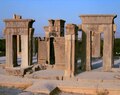
Ruins of the Tachara, Persepolis.
Tachara palace.

The Tachara stands back to back to the Apadana, and is oriented southward.[5] Measuring 1,160 square meters (12,500 square feet), it is the smallest of the palace buildings on the Terrace at Persepolis.[6]

As the oldest of the palace structures on the Terrace,[2] it was constructed of the finest quality gray stone.

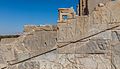
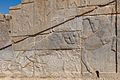
Bas-reliefs from the Tachara.

Its main room is a mere 15.15 m × 15.42 m (49.7 ft × 50.6 ft) with three rows of four columns. A complete window measuring 2.65 m × 2.65 m × 1.70 m (8.7 ft × 8.7 ft × 5.6 ft) was carved from a single block of stone and weighed 18 tons. The door frame was fashioned from three separate monoliths and weighed 75 tons.

Like many other parts of Persepolis, the Tachara has reliefs of tribute-bearing dignitaries. There are sculptured figures of lance-bearers carrying large rectangular wicker shields, attendants or servants with towel and perfume bottles, and a royal hero killing lions and monsters. There is also a bas-relief at the main doorway depicting Darius I wearing a crenellated crown covered with sheets of gold.[2]

The Tachara is connected to the south court by a double reversed stairway. Later under the reign of Artaxerxes III, a new stairway was added to the northwest of the Tachara which is connected to the main hall through a new doorway. On walls of these stairways, there are sculptured representations of figures such as servants, attendants and soldiers dressed in Median and Persian costumes, as well as gift-bearing delegations flanking carved inscriptions.[2]

Function

[edit]

The function of the building, however, was more ceremonial than residential.

[edit]

See also

[edit]

References

[edit]
[edit]
Revisions and contributorsEdit on WikipediaRead on Wikipedia
from Grokipedia
The Tachara, also known as the Palace of Darius or Taçara, is the oldest and smallest palace within of , serving as the private residence of Darius I, king of the from 522 to 486 BCE. Constructed around 515 BCE on a raised terrace south of the grand audience hall, it exemplifies early with its rectangular layout measuring approximately 40 meters by 30 meters, featuring a central hall supported by twelve columns and porticoes on all four sides. The structure's well-preserved stone elements, including door frames and staircases adorned with reliefs depicting royal guards, tribute bearers, and mythical creatures, highlight its role in imperial symbolism and daily royal life. Historical inscriptions confirm its construction under Darius I, with completion likely overseen by his successor , as noted in the DPa trilingual inscription on the palace's door sockets stating, "Darius the great king... built this palace." Additional inscriptions by Xerxes (XPc) on the southern pillars and (A3Pa) on the added western staircase underscore its ongoing royal significance into the fourth century BCE. Unlike many structures razed by in 330 BCE, the Tachara was one of the few that escaped major destruction, preserving its mud-brick and wooden elements' foundations beneath the stone facade. As part of the of , the Tachara represents the Achaemenid emphasis on monumental architecture blending Persian, , and foreign influences, such as Egyptian-style lintels, to project imperial power and cultural synthesis across the empire's vast territories from to . Its design, oriented on a north-south axis with sculpted stairways showing processions of animals and gifts, not only facilitated ceremonial functions but also reflected Zoroastrian ideals of order and kingship. Today, the palace stands as a testament to the engineering prowess of ancient Persia, with ongoing archaeological studies revealing details of its original cedar woodwork and painted decorations.

Background

Location and Context

Tachara, the Palace of Darius I, is situated on the Terrace in the plain of , , approximately 50 kilometers northeast of the city of at coordinates 29°56′04″N 52°53′22″E. The site lies at the foot of the Kuh-e Rahmat mountain, within a encircled by the southern , where the dry has aided the preservation of its ruins. Within the Persepolis complex, Tachara occupies a prominent position south of the palace, marking it as the oldest structure on the terrace platform, which is elevated 2.20 to 3.00 meters above the level of the . This placement underscores its role in the initial phase of the site's development, integrating it into the elevated ceremonial layout designed for imperial functions. Constructed during the (550–330 BCE), Tachara formed part of , the ceremonial capital established by Darius I around 515 BCE as a center for royal audiences and rituals. Today, the ruins of Tachara stand as an integral component of the Persepolis complex, designated a in 1979 for its outstanding universal value in illustrating and imperial ideology.

Etymology and Terminology

The name "Tachara" derives from the term *taçara- (also transliterated as *tačara-), which designates a type of or residential in . This term appears prominently in royal inscriptions at , where it specifically refers to the building constructed by Darius I as his personal residence. The of *taçara- remains partially unresolved, with possible Iranian roots linking it to concepts of "house" or "fortress," and cognates in Armenian suggesting associations with "temple" or "." In modern Persian, it connects to "tāzargāh" or similar forms implying a "winter house," leading many scholars to interpret *taçara- as "winter palace," a designation that highlights its distinction from grander ceremonial complexes like the , which served public and ritual functions. Linguistic evidence for *taçara- is primarily drawn from Achaemenid royal inscriptions, such as the trilingual DPa text carved on the southern door jambs of the Tachara itself. In , it reads: " king... This taçara I built; it is called taçara," confirming the structure's name and purpose as a built edifice under . The Elamite version of the inscription uses *hadiš(u)-, an equivalent term for a or residence, while in Achaemenid Babylonian (Akkadian), *tačara- functions as a approximating "house" (bītu), underscoring its connotation as a domestic or palatial space rather than a temple or . Greek sources, such as , describe the palaces of in general terms without directly employing *tačara-, but later Hellenistic accounts align the term with royal private quarters. The Tachara is also known by alternative designations that emphasize its intimate, non-ceremonial role, including the and Tachar Château (a French-influenced rendering). These names reflect its status as Darius I's exclusive private building, contrasting with the Apadana's role as a vast audience hall for imperial receptions and tribute ceremonies. This terminological distinction in Achaemenid sources highlights *taçara- as a marker for personal royal dwellings, separate from broader administrative or ritual terminology like *apadāna- for columned halls.

Historical Development

Construction under Darius I

The construction of the Tachara palace was initiated by Darius I (r. 522–486 BCE) as part of his broader project to establish Persepolis as a new imperial center following his consolidation of power after suppressing revolts in 522–521 BCE. Work on the palace began around 515 BCE, aligning with the early phases of the Persepolis terrace preparation and reflecting Darius's vision for a ceremonial capital that symbolized the Achaemenid Empire's expansion and stability. Commissioned as Darius's personal residential palace—often referred to as the "winter palace" due to its likely seasonal use—the structure was intended to embody the grandeur of the Achaemenid dynasty and serve as a private retreat for the king amid the larger complex. The initial construction focused on laying the foundation directly on the expansive terrace platform of , a massive artificial elevation spanning approximately 125,000 square meters that Darius had engineered on the rocky for defensive and symbolic purposes. This placement integrated the Tachara into the southwestern sector of the site, with planned access via a double reversed stairway linking it to the adjacent south court, facilitating movement within the emerging palace ensemble. Monolithic stone elements, including door frames and window surrounds inscribed with Darius's dedicatory texts, were among the earliest features installed, marking the palace's royal attribution from the outset. The project drew upon a diverse mobilized from across the vast , including skilled artisans, masons, and laborers coordinated through imperial administrative systems, as evidenced by contemporary foundation tablets and records detailing resource allocation for . To achieve the required scale, materials such as locally quarried from nearby sources were employed for the foundational walls and structural bases, supplemented by timber for upper elements, underscoring the logistical efficiency of Darius's building campaigns.

Completion, Modifications, and Survival

Following the death of Darius I in 486 BCE, his son and successor oversaw the completion of the Tachara, as evidenced by the royal inscription XPc on the structure's doorjambs. This marked the finalization of the palace's core construction, transforming it into a functional royal residence within the complex. In the late fourth century BCE, during the reign of (r. 358–338 BCE), modifications were made to enhance accessibility, including the addition of a western gate and an associated stairway. These alterations, documented in the inscription A3Pa, featured decorative elements such as bas-reliefs and were likely intended to integrate the palace more seamlessly with adjacent ceremonial spaces. The Tachara's survival through major historical upheavals underscores its robust stone construction. During Alexander the Great's conquest of in 330 BCE, the palace was looted for its treasures but escaped the widespread destruction and burning inflicted on other parts of the complex, leaving its structural integrity largely intact. It continued to endure with minimal additional damage during the Sassanid period (224–651 CE), where its architectural motifs influenced later Persian designs, and through the Islamic era, although some of its stones were repurposed in local buildings. Modern preservation efforts began with systematic excavations in the 1930s led by the Oriental Institute of the , first under Ernst Herzfeld (1931–1934) and then Erich F. Schmidt, which uncovered and documented the Tachara's remains as part of the broader ruins. These works facilitated ongoing protection of the site, now a World Heritage location, ensuring the palace's endurance against environmental threats and further human interference. As of 2025, the site faces threats from land and , prompting comprehensive conservation plans and ongoing archaeological work to safeguard the ruins.

Architecture

Layout and Dimensions

The Tachara, also known as the Palace of Darius, represents the smallest palace structure on the Terrace, encompassing a total area of 1,160 square meters. This compact design underscores its role as a private residential space within the larger ceremonial complex, distinguishing it from the more expansive public halls nearby. Positioned immediately south of the , the Tachara shares a back-to-back orientation with this grand audience hall, facilitating spatial integration on the terrace while maintaining functional separation. At the core of the palace lies the main hall, a rectangular chamber measuring 15.15 m by 15.42 m, which served as the primary audience and reception area. This hall was supported by 12 columns arranged in three rows of four, each rising to a height of 6.94 m and topped with distinctive double-animal capitals depicting paired bulls or similar motifs. The central hall was surrounded by side chambers and a on the south side, with two smaller columned rooms to the north, creating semi-enclosed verandas that enhanced the structure's openness and airflow, particularly suited to its designation. These features, each approximately 4.5 m deep where applicable, framed the entrances and provided transitional spaces between the interior and the exterior terrace environment. Access to the Tachara was primarily through a double reversed stairway on the southern facade, leading up from the south court to the palace platform and allowing for ceremonial ascents. This stairway, with its symmetrical design and shallow steps, accommodated processional movements, though later modifications under subsequent rulers, including additional gates and pathways added by , optimized routes for imperial processions connecting the Tachara to adjacent structures like the and the Hundred Column Hall. These features emphasize the palace's integration into the broader layout, prioritizing both privacy and ceremonial accessibility.

Materials and Techniques

Tachara was constructed primarily from local quarried from mountains surrounding the Persepolis site, with sources extending up to 40 kilometers away. This material included a bright gray bioclastic prevalent in the immediate vicinity, supplemented by darker gray varieties from more distant quarries to achieve varied aesthetic effects across the palace complex. The stone was cut into massive blocks at the quarries, with initial rough shaping performed to reduce weight for transportation; examples include lintels and door frames demonstrating the scale of required. Construction techniques emphasized dry , where blocks were laid without mortar, relying on precise fitting to ensure structural integrity. Masons achieved this through on-site fine dressing of stones after placement, using red pigment to mark joints for alignment and shallow guiding slits (2–3 mm deep) along with T-shaped or alignment marks to position blocks accurately. Blocks were initially split at quarries via the swelling wood technique, where wooden wedges were inserted into cracks and expanded with to fracture the stone along natural veins. Transportation to the site involved dragging roughly hewn blocks over inclined tracks using wheeled sledges pulled by draft animals, a method inferred from tool marks and foundation remnants across . Columns in the Tachara featured wooden shafts with characteristic bell-shaped stone bases, fluted and coated with for stability, sometimes using metal dowels, though some structural elements incorporated imported wood for roofing beams. Engineering innovations included the integration of the palace into the broader terrace, constructed with a core of compacted boulders and earth to distribute loads and enhance resistance through flexible foundation systems that prevented overturning. Wooden elements, including columns and roofing beams (likely cedar), were used alongside stone, coated with . Column spacing, typically around 6–8 meters in the central hall, was designed to balance visual grandeur and acoustic properties suitable for ceremonial gatherings. Direct records on quarrying and transport specifics for Tachara remain limited, with much knowledge derived from broader practices documented in excavation reports and tool analyses.

Decorative Elements

Sculptural Reliefs

The sculptural reliefs of the Tachara exemplify the Achaemenid artistic tradition, executed as shallow bas-reliefs in white limestone that emphasize flat surfaces and incised details for a stylized, two-dimensional effect. These carvings adorn key architectural features, including the stairways, door jambs, thresholds, facades, and risers, creating a cohesive decorative program that integrates with the palace's structure. Central motifs include figures of Persian guards and servants carrying offerings, animals, and ingredients on the stairways, depicted in orderly rows to symbolize royal provision and . On the door jambs, lance-bearers and guards are portrayed in rigid, frontal poses, holding spears and shields as symbols of royal and ; in addition, attendants with towels or bottles and a royal hero slaying lions or monsters appear. A key figure is the representation of Darius I at the main doorway, shown standing with two attendants and wearing a crenellated crown originally covered in gold sheets, underscoring his role as the divine king; the king is attended by servants bearing fans. The reliefs employ hierarchical scale, with royal and elite figures larger than attendants to denote status, alongside symmetrical compositions that mirror each other across portals and staircases for visual balance. Elements in the figures' attire reflect Persian and styles, with servants and guards in traditional costumes, emphasizing core imperial identities rather than broad multicultural tribute. Numerous such figures populate these surfaces, forming a monumental of imperial .

Inscriptions and Symbolism

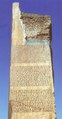
The Tachara features several types of inscriptions, primarily trilingual foundation texts in , Elamite, and Akkadian , which record the building achievements of Darius I. These include the DPa inscription near the doorways, which states: "Darius the great king, , king of countries, son of Hystaspes, the Achaemenid, who built this tačara." Another key example is the DPc inscription on the stone window frames, rendered as if the frames themselves declare: "Stone window-frames made for the royal house of King Darius." Later additions include the XPc by , noting the palace's completion, and A3Pa by . Shorter inscriptions serve as labels for figures in the reliefs, identifying attendants and dignitaries by ethnicity or role, such as "Persian" or "" to denote costume styles and cultural distinctions within the empire. These textual elements emphasize the collaborative and hierarchical nature of Achaemenid construction, often crediting workers from subject nations, though full translations of some minor labels remain incomplete due to erosion or fragmentary preservation. The decorations of the Tachara incorporate symbolic motifs that underscore Achaemenid ideology of divine kingship and imperial dominion. The king's figure, often depicted wearing a crenellated crown and holding a scepter or lotus flower, represents the monarch's god-given and role as mediator between the divine and earthly realms. Column capitals feature double-animal forms, such as bulls or griffins, symbolizing strength, , and protective vigilance over the royal space, with bulls evoking stability and griffins blending Persian and Near Eastern traditions of hybrid guardians. These elements collectively project a vision of universal rule, integrating diverse subjects under a divinely sanctioned Persian order, as interpreted in studies of Achaemenid .

Function and Significance

Ceremonial Purpose

The Tachara functioned primarily as a ceremonial and audience hall dedicated to King Darius I (r. 522–486 BCE), serving as a venue for imperial receptions and key Achaemenid rituals. Its design emphasized formality over domestic use, aligning with 's role as the empire's ceremonial capital where the king received dignitaries and oversaw symbolic events reinforcing royal authority. Archaeological evidence from the structure's layout supports this purpose: the central hall features a columned arrangement suitable for a , with doorways flanked by bull-capital columns that evoked imperial grandeur. Positioned directly south of the larger hall and elevated on a platform, the Tachara facilitated processions from the main audience spaces into more intimate ceremonial areas, enabling seamless transitions during formal gatherings. Usage patterns indicate the Tachara hosted selective activities such as presentations from provincial delegates and diplomatic audiences with high-ranking officials, rather than serving as a residence for daily living—a misconception stemming from early interpretations labeling it a "." The absence of associated or storage facilities underscores its non-residential character, focusing instead on episodic elite interactions tied to state rituals. The building's relatively modest scale limited its capacity and points to an emphasis on private elite functions, accommodating smaller groups of courtiers and envoys rather than expansive public assemblies. This design choice reflects Darius I's intent to create a space for controlled, symbolic displays of power within the broader Persepolis complex.

Role in Achaemenid Culture

The Tachara palace exemplifies the early Achaemenid synthesis of architectural traditions, integrating elements from Mesopotamian, Egyptian, and Iranian styles to create a distinctive imperial aesthetic. Its design features a compact layout with columned halls and doorways framed by cavetto moldings reminiscent of Egyptian temples, combined with Persian column bases and Elamite-influenced relief motifs, reflecting the empire's absorption of conquered cultures into a unified royal idiom. This hybrid approach, initiated under Darius I around 515 BCE, marked a departure from earlier mud-brick constructions toward more monumental stone structures, emphasizing permanence and grandeur. The Tachara's innovations influenced subsequent Achaemenid palaces, such as the expansive complex at Susa, where Darius applied similar terraced platforms and empire-wide material sourcing—cedar from Lebanon, lapis lazuli from Afghanistan—to evoke comparable symbols of universal dominion. Ideologically, the Tachara embodied Darius I's vision of an eternal empire sanctioned by divine order, with its durable construction symbolizing the king's role as protector against chaos and his alignment with Ahuramazda, the supreme deity. Trilingual inscriptions on its doorjambs, in , Elamite, and Babylonian, proclaim Darius as the mediator between god, king, and subjects, establishing a tripartite cosmology that justified imperial expansion and administrative as a perpetual mandate from the divine. These texts, such as DPa, invoke Ahuramazda's favor in warding off enemies and falsehood, reinforcing as a physical manifestation of cosmic stability and the Achaemenid ruler's unassailable legitimacy. By prioritizing stone over perishable materials, Darius ensured the Tachara's endurance as a testament to his foundational achievements, contrasting with the ephemerality of prior Near Eastern monuments. As a model of royal exclusivity, the Tachara served as Darius's private residence, accessible only to the and underscoring the Achaemenid emphasis on the king's secluded amid the broader complex. Its legacy endures in modern archaeology, where excavations since by the Oriental have revealed traces of original polychromy—blue and red pigments on sculptures—highlighting the multicultural empire's artistic integrations from Assyrian, Babylonian, and Egyptian sources. Designated a World Heritage Site in 1979, the palace provides insights into the Achaemenids' polyethnic framework, though underrepresented aspects persist, such as the absence of female figures in its official reliefs despite tablets documenting women's economic roles in professions equivalent to men's.

References

Add your contribution
Related Hubs
User Avatar
No comments yet.