Hubbry Logo
Tamika Montgomery-ReevesTamika Montgomery-ReevesMain
Open search
Tamika Montgomery-Reeves
Community hub
Tamika Montgomery-Reeves
logo
8 pages, 0 posts
0 subscribers
Be the first to start a discussion here.
Tamika Montgomery-Reeves
from Wikipedia

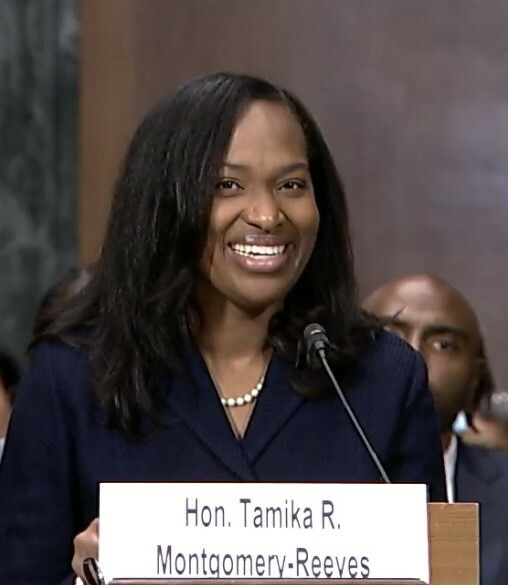
Tamika Renee Montgomery-Reeves[1] (born 1981)[2][3] is an American lawyer who serves as a United States circuit judge of the United States Court of Appeals for the Third Circuit. She previously served as an Associate Justice of the Delaware Supreme Court.[4]

Key Information

Early life and education

[edit]

Montgomery was born in Jackson, Mississippi, to Dewrey and Bettye (nee Cribbs) Montgomery.[5] She received a Bachelor of Arts, magna cum laude, from the University of Mississippi in 2003[6] and a Juris Doctor from the University of Georgia School of Law in 2006.[7]

Career

[edit]

Montgomery-Reeves practiced at Wilson Sonsini Goodrich & Rosati in Wilmington where she focused on corporate governance and commercial litigation. She also practiced at Weil Gotshal & Manges in New York City, where she focused on corporate governance and securities litigation.[7] Montgomery-Reeves was appointed Vice Chancellor of the Delaware Court of Chancery in 2015 and has worked pro bono with the Prisoners' Rights Project.[8][9] Montgomery-Reeves joined Chief Justice Collins J. Seitz Jr. on the steering committee of a group that completed a strategic plan for increasing diversity in Delaware's judiciary and legal community.[10]

Delaware judicial service

[edit]

On October 13, 2015, Delaware Governor Jack Markell nominated Montgomery-Reeves to the Delaware Court of Chancery to succeed Vice Chancellor Donald F. Parsons[6]

On October 24, 2019, Governor John Carney announced the nomination of Montgomery-Reeves to be a justice of the Delaware Supreme Court, to fill the vacancy left by the elevation of Collins J. Seitz Jr. to Chief Justice.[7] On November 7, 2019, her nomination was confirmed by the Delaware Senate. She was the first African-American justice on that court.[11] She was sworn into office on January 3, 2020.[12] In 2021, Montgomery-Reeves wrote the majority opinion holding that Senate records submitted to the University of Delaware archives by President Biden were not subject to demands under the Delaware Freedom of Information Act.[13] Her service as a justice of the Delaware Supreme Court ended on February 7, 2023, when she was elevated to the United States Court of Appeals for the Third Circuit.[14]

Federal judicial service

[edit]

On June 29, 2022, President Joe Biden announced his intent to nominate Montgomery-Reeves to serve as a United States circuit judge for the Third Circuit.[15] On July 11, 2022, her nomination was sent to the Senate. President Biden nominated Montgomery-Reeves to the seat vacated by Judge Thomas L. Ambro, who announced his intent to assume senior status upon confirmation of a successor.[16] On September 7, 2022, a hearing on her nomination was held before the Senate Judiciary Committee.[17] Montgomery-Reeves was unanimously rated "well qualified" for the judgeship by the American Bar Association's Standing Committee on the Federal Judiciary.[18]

During her confirmation hearing, Republican senators questioned Montgomery-Reeves about a strategic plan to increase diversity in Delaware's judiciary. The plan was based on recommendations made by the Delaware Supreme Court's Diversity Strategic Planning Steering Committee, which Montgomery-Reeves had co-chaired. She was asked about a recommendation that prospective lawyers be able to use clerkships and recommendations in lieu of passing the bar exam, which the committee said was a barrier to minority people. The committee also recommended that portraits of white judges and justices be removed from courthouses as a way to "reduce implicit bias and identity threat in the court environment." Montgomery-Reeves distanced herself from these recommendations by saying that she had neither written nor edited any of them despite being committee co-chair.[19] On September 28, 2022, her nomination was reported out of committee by a 13–9 vote.[20] On December 8, 2022, the United States Senate invoked cloture on her nomination by a 57–39 vote.[21] On December 12, 2022, her nomination was confirmed by a 53–35 vote.[22] She received her judicial commission on February 7, 2023.[14]

See also

[edit]

References

[edit]
[edit]
Revisions and contributorsEdit on WikipediaRead on Wikipedia
from Grokipedia
Tamika R. Montgomery-Reeves is an American jurist serving as a United States circuit judge of the United States Court of Appeals for the Third Circuit since February 2023. Prior to her federal appointment, she served as a Justice of the Delaware Supreme Court from November 2019 to February 2023 and as Vice Chancellor of the Delaware Court of Chancery from 2015 to 2019, becoming the first Black woman to hold positions on both courts. Before entering the , Montgomery-Reeves practiced as a corporate litigator, rising to partner at the , firm Morris, Nichols, Arsht & Tunnell LLP, where she handled complex business disputes. She has also taught as an adjunct professor at institutions including and Vanderbilt Law School, focusing on topics such as Delaware corporate . Nominated to the Third Circuit by President Joseph R. Biden in July 2022 to fill a vacancy created by Judge Thomas L. Ambro's retirement, she was confirmed by the U.S. Senate in December 2022. Her judicial career emphasizes rigorous application of in equity and appellate matters, reflecting her extensive experience in Delaware's specialized business courts.

Early life and education

Early years and family background

Tamika Montgomery-Reeves was born on April 29, 1981, in Jackson, Mississippi, to parents Bettye Cribbs and Dewery Montgomery. She was raised in Jackson alongside her parents, one brother, two sisters, and two step-siblings. Her parents met and married while attending college but paused their studies after her birth before resuming and earning their degrees, which instilled in the family a strong emphasis on the value of education. Montgomery-Reeves' grandmother exerted a formative influence during her childhood, repeatedly stressing the need to understand one's legal rights and to safeguard oneself and others—a principle that motivated her to decide on a in law by the second or third grade. As a young girl, she demonstrated diligence in learning by tracing her mother's handwriting to master the skill.

Academic and professional preparation

Montgomery-Reeves earned a degree, magna cum laude, from the in 2003, having graduated from the Sally McDonnell-Barksdale Honors College. She obtained her degree, cum laude, from the School of Law in 2006. Immediately after , Montgomery-Reeves clerked for William B. Chandler III of the from 2006 to 2007, where she developed expertise in equity and corporate matters central to Delaware's specialized court system. This clerkship, under a long-serving known for handling high-profile corporate disputes, equipped her with practical immersion in Chancery Court procedures and Delaware , prerequisites for advanced roles in the state's .

Private practice and bar admission

Montgomery-Reeves earned her cum laude from the School of Law in 2006. Following graduation, she entered private practice at in New York, where she specialized in and securities litigation. She was admitted to the bar in in good standing, enabling her subsequent practice in the state. In 2011, Montgomery-Reeves relocated permanently to and joined the Wilmington office of as an associate, advancing to partner by 2015. At the firm, her practice emphasized , , and commercial litigation, reflecting Delaware's prominence in . She handled matters involving fiduciary duties, shareholder disputes, and transactional advice, contributing to the firm's Delaware-focused corporate client base until her judicial nomination in 2015. During her time in private practice at Morris Nichols Arsht & Tunnell LLP in , Tamika Montgomery-Reeves engaged in extensive legal services, focusing on underserved populations. She provided representation through the Prisoners' Rights Project, assisting incarcerated individuals with civil rights and post-conviction matters, which earned her recognition from organizations for advancing access to justice. Montgomery-Reeves received the Award for Service consecutively in 2009, 2010, and 2011, honoring her sustained commitment to volunteer legal work amid a demanding corporate litigation caseload. These awards highlighted her efforts in cases involving low-income clients, including disputes and civil commitments, where she donated hundreds of hours annually. Beyond direct representation, she contributed to systemic improvements in legal access by serving as a subcommittee member of the Delaware Access to Justice Commission, which coordinates statewide initiatives to expand resources and address barriers for unrepresented litigants. Her involvement included policy recommendations to enhance court services for vulnerable communities, reflecting a broader dedication to equitable in .

Delaware state judicial service

Vice Chancellor of the Court of Chancery (2015–2019)

Tamika Montgomery-Reeves was nominated by Delaware Governor to serve as Vice Chancellor of the and received unanimous confirmation from the Delaware State on October 28, 2015. She assumed office the following month, succeeding Donald F. Parsons Jr., and became the first African American vice chancellor as well as the first woman and only the second woman overall to serve on the court since its founding in 1792. The , Delaware's court of equity, primarily adjudicates disputes involving , , duties, trusts, and other non-jury matters requiring equitable remedies. During her tenure from November 2015 to November 2019, Montgomery-Reeves handled a docket focused on these areas, issuing more than eighty opinions, including post-trial decisions in cases she presided over. Her rulings addressed procedural motions, breach claims, and contractual interpretations, consistent with the court's emphasis on principles. Among her decisions, Montgomery-Reeves dismissed shareholder claims alleging breaches of duty in the 2015 merger of Volcano Corporation with , finding that the transaction satisfied entire fairness standards under the circumstances. In another case, she granted dismissing a $300 million breach-of-contract suit by iBio Inc. against Fraunhofer-Gesellschaft as time-barred, applying Delaware's three-year . She also held in Freeman Family LLC v. Parker that a could be liable under an alter-ego theory for its manager's actions, piercing the entity's veil based on evidence of and undercapitalization. Montgomery-Reeves' service ended in November 2019 upon her appointment to the by Governor John Carney, after which she was publicly sworn in as a justice on January 3, 2020. Her tenure on the Chancery Court was noted for its efficiency and volume of output relative to her relatively brief time in the role.

Justice of the (2019–2023)

Tamika Montgomery-Reeves was nominated to the by Governor John Carney on October 13, 2019, and confirmed unanimously by the Delaware State Senate on November 7, 2019. She assumed office on December 5, 2019, and was publicly sworn in on January 3, 2020, becoming the first African American justice and the third woman to serve on the court. As a justice, Montgomery-Reeves handled appellate matters, primarily reviewing decisions from lower courts, including the known for disputes. During her tenure from 2019 to 2023, she authored 27 opinions and more than 165 orders resolving appeals. In one notable case, she wrote the holding that Delaware law permits sophisticated stockholders to waive appraisal rights in certain merger agreements, affirming the enforceability of such provisions under the state's framework. Montgomery-Reeves resigned from the on February 7, 2023, to accept her to the U.S. Court of Appeals for the Third Circuit, following her announcement to Governor Carney in December 2022. Her departure created a vacancy filled by subsequent appointment.

Federal judicial nomination and confirmation

Nomination by President Biden (2022)

On June 29, 2022, President announced his intent to nominate Tamika R. Montgomery-Reeves, then a Justice of the , to the Court of Appeals for the Third Circuit as part of the twentieth round of his federal judicial nominees. The highlighted her judicial tenure, including service as Vice Chancellor of the from 2015 to 2019 and as a Justice since 2019, along with her prior role as a partner at Morris, Nichols, Arsht & Tunnell LLP handling complex commercial litigation. The nomination filled the vacancy created by Judge , who assumed on June 30, 2022, after 27 years on the Third Circuit; Ambro, a native like Biden, had been appointed by President in 1992. Biden described Montgomery-Reeves as "extraordinarily qualified, experienced, and devoted to the and the equal ," emphasizing her commitment to impartial adjudication in her state court roles. The formal nomination was sent to the on July 11, 2022, designated as PN2315 in the 117th . At that time, Montgomery-Reeves held a J.D. from the University of Georgia School of Law (2002) and a B.A. from the (1999), with her state judicial appointments reflecting endorsements from Delaware governors across party lines: Jack Markell (Democrat) for Chancery Court in 2015 and John Carney (Democrat) for the Supreme Court in 2019.

Senate hearings and partisan debates

The Senate Judiciary Committee conducted a confirmation hearing for Tamika Montgomery-Reeves on September 7, 2022, as part of a panel including other nominees for federal judgeships. Democratic senators, including Delaware's and , introduced and praised her for her judicial experience on the and , emphasizing her unanimous state confirmations and role as the first Black woman on Delaware's high court. The committee advanced her nomination on September 29, 2022, by a party-line vote. Republican senators raised pointed questions about Montgomery-Reeves's service as co-chair of the Supreme Court's Diversity [Strategic Planning](/page/Strategic Planning) Steering , which issued recommendations in 2021 to increase racial and ethnic diversity in the and bar. Senator interrogated her on a proposal to allow supervised clerkships or recommendations in lieu of the bar exam, citing the committee's view that the exam perpetuates racial disparities; Cruz described this as implying reduced standards for minority applicants and asked if the required lowering barriers for racial reasons, to which she responded that she did not author the language and that the had not adopted it. Senator pressed her on another recommendation to remove portraits of white judges from courtrooms to mitigate "implicit " and "identity threat," noting her unfamiliarity with the latter term; she clarified that subgroups drafted such proposals without her direct input or editing. Republicans, including Hawley and Cruz, further probed her judicial in written questions for the record, asking whether she adhered to or versus a "," and if she viewed the system as systemically racist; she affirmed impartial application of and facts, disavowing or personal policy preferences. These exchanges highlighted partisan divides, with Republicans expressing concerns that the diversity initiatives reflected ideological prioritization of demographic factors over merit-based qualifications like bar passage, potentially conflicting with equal protection principles. Democrats, led by Chairman , defended her non-authorship of the recommendations and contrasted her responses with those of prior nominees. The full confirmed Montgomery-Reeves on December 12, 2022, by a 53-35 vote, largely along lines, with all Democrats present voting in favor and most Republicans opposed.

Judicial service on the Third Circuit

Swearing-in and initial tenure (2023–present)

Tamika Montgomery-Reeves received her judicial commission for the Court of Appeals for the Third Circuit on February 7, 2023. She was sworn in as a circuit judge the following day, February 8, 2023. Her appointment filled the vacancy left by Judge , who took in 2021. Upon assuming office, Montgomery-Reeves established chambers in , within the Third Circuit's jurisdiction encompassing , , , and the . She promptly integrated into the court's operations, joining panels for oral arguments and contributing to the resolution of appeals across civil, criminal, and administrative matters. In her early months, she focused on acclimating to the federal appellate workload, which involves reviewing district court decisions and agency actions under standards of legal error, abuse of discretion, and clear factual mistakes. By mid-2023, Montgomery-Reeves had begun authoring opinions, marking her active participation in the court's and panel deliberations. Her initial contributions included decisions on procedural issues, such as use in civil litigation, reflecting the circuit's emphasis on balancing with public access to judicial proceedings. Through 2025, she continued to handle a docket involving coverage disputes, sentencing, and constitutional claims, consistent with the Third Circuit's caseload of over 4,000 appeals annually.

Notable rulings and opinions

In Roberts v. Lau, Montgomery-Reeves authored the in a 2–1 decision affirming the district court's denial of absolute prosecutorial immunity to a who allegedly fabricated evidence during an investigation, leading to the plaintiff's wrongful for over a decade. The court held that the prosecutor's actions—preparing false testimony for proceedings and directing police to secure perjured affidavits—fell outside the advocative function protected by , as they occurred prior to formal charging decisions and resembled investigative police work. This ruling clarified that does not extend to preparatory investigative misconduct, even if connected to anticipated prosecution, distinguishing it from precedents like Van de Kamp v. Goldstein (2009), and remanded for further proceedings on . In v. Dow Chemical Co., Montgomery-Reeves wrote the precedential opinion affirming the district court's remand of a state environmental lawsuit alleging contamination from in products sold by Dow since the 1950s. Dow had removed the case under the federal officer removal statute (28 U.S.C. § 1442(a)(1)), claiming its compliance with U.S. specifications constituted acting "under" federal direction. The court rejected this, holding that voluntary, arms-length sales to the government—even incorporating adopted private specifications—do not demonstrate the requisite federal control or compulsion under Watson v. Morris Cos. (551 U.S. 142, ), as Dow independently designed, manufactured, and marketed the products for commercial purposes. In United States v. Walters, Montgomery-Reeves authored the precedential opinion affirming a felon-in-possession under 18 U.S.C. § 922(g)(1), ruling that defense counsel lacks authority to stipulate or concede substantive elements of the offense—such as the defendant's felon status and knowledge of firearm possession—over the accused's explicit objection, as these decisions implicate the client's autonomy under the Sixth right to counsel. The court distinguished strategic concessions from objections to core elements, citing Jones v. Barnes (463 U.S. 745, 1983), and upheld evidentiary admission of prior convictions. It further rejected the defendant's as-applied Second challenge post-New York State Rifle & Pistol Ass'n v. Bruen (597 U.S. 1, 2022), finding no plain error given Walters' history of nine convictions, including three violent drug-trafficking felonies, which distinguished the case from Range v. Att'y Gen. (No. 21-2835, 3d Cir. 2023).

Judicial philosophy and approach

Interpretive methodology and precedents

Montgomery-Reeves has described her judicial philosophy as approaching cases with an open mind, setting aside personal views to decide solely on the applicable and facts presented, while ensuring litigants are heard and issuing clear, reasoned opinions. She emphasizes as a core expectation for judges, rejecting any role in advancing personal agendas or second-guessing legislative policy choices. In , she begins with the text of the statute, applying its plain meaning if unambiguous, as that meaning controls the analysis. For ambiguous provisions—those reasonably susceptible to different interpretations—she considers the statute's structure, canons of construction, relevant precedents, and reliable legislative history, such as reports over floor debates. She prioritizes binding and circuit precedents as the starting point before resorting to these tools. For constitutional interpretation, Montgomery-Reeves adheres strictly to and Third Circuit precedents, applying the interpretive frameworks established therein even absent direct binding authority on a specific issue. She views the constitutional text as the essential starting point, with its meaning fixed at ratification and alterable only through Article V processes, though adaptable to new circumstances without altering the core meaning. Her approach aligns with methodologies emphasizing original public meaning, as seen in cases like (2008) and New York State Rifle & Pistol Association v. Bruen (2022). While she does not self-identify as an originalist, her commitment to textual fidelity and historical understanding mirrors such principles when directed by higher court guidance. Regarding precedents, Montgomery-Reeves pledges to follow all binding and Third Circuit decisions faithfully, regardless of personal agreement, as lower courts lack authority to overturn them. She applies stare decisis unless higher courts provide convincing reasons for departure, such as recent precedents, minimal reliance interests, or erosion by subsequent rulings, but defers ultimate reconsideration to the or en banc circuit panels. This fidelity extends to foundational cases like (1954) and (1967), which she regards as correctly decided. Montgomery-Reeves has described her judicial as approaching every case with an open mind, setting aside personal views, affording litigants a meaningful opportunity to be heard, preparing diligently by studying the issues, applicable law, and record, deciding based solely on the law and facts, and explaining the reasoning in opinions. She emphasized fidelity to the , stating that judges must decide matters fairly and impartially according to the applicable law and facts, rejecting and the influence of personal opinions on interpretation or application. In , she prioritizes the plain text of the statute as the starting point; if unambiguous, analysis ends there, as the text controls. For ambiguous provisions, she considers statutory structure, canons of construction, binding precedents from the or circuit courts, and, where reliable and permitted by precedent, legislative history such as committee reports. She commits to following all binding and circuit precedents without regard to personal agreement, noting that only the may overrule its own decisions, and applies the interpretive methodologies established by higher courts in constitutional matters. Regarding equity, Montgomery-Reeves defines it in terms of fairness and , aligning with dictionary meanings rather than policy-oriented interpretations. During her tenure as Vice Chancellor of the , which exercises equitable jurisdiction over corporate and disputes, she applied equitable principles through fact-specific analyses in complex cases, such as breaches of duty or contractual enforcement, while adhering to established legal standards and precedents to ensure impartial outcomes. On professional qualifications for judges, Montgomery-Reeves has stressed the importance of analytical skills, rigorous , clear writing, and the ability to manage complex records and collegial deliberations, drawing from her own experience issuing over 600 decisions and 200 opinions as a trial and appellate . She advocates for a that reflects the it serves, arguing that diversity fosters public trust and enables judges to better comprehend the lived experiences of litigants, thereby enhancing the fairness of judicial proceedings. remains a core expectation, irrespective of background, with decisions grounded in rather than personal attributes.

Reception, achievements, and criticisms

Professional accolades and historical firsts

Montgomery-Reeves earned the Award for Service in 2009, 2010, and 2011 for her contributions to efforts prior to her judicial appointments. In 2015, Governor appointed her as Vice Chancellor of the , making her the first African American to serve in that role on the state's equity court. Governor John Carney nominated her in October 2019 to the , where she was confirmed unanimously and sworn in on January 3, 2020, as the first African American justice, the first Black woman justice, and—at age 38—the youngest associate justice in the court's history. Her December 2022 confirmation by the U.S. Senate to the Court of Appeals for the Third Circuit marked her as only the second Black woman to serve on that federal circuit court since its establishment.

Controversies over qualifications and ideological leanings

Republican senators during Montgomery-Reeves' U.S. Senate Judiciary Committee confirmation hearing on September 7, 2022, scrutinized her role as co-chair of the Delaware Supreme Court's Diversity Strategic Planning Steering Committee, which in February 2022 released a report recommending alternatives to the traditional bar exam—such as clerkships or apprenticeships—to address persistent racial disparities in passage rates among Black and Hispanic applicants. The report attributed lower passage rates for minority groups to systemic biases rather than individual preparation differences, prompting critics to argue that such reforms prioritize demographic outcomes over objective competence testing essential for legal practice. Montgomery-Reeves responded that she neither drafted nor edited the recommendations, which originated from input by Delaware Bar Association members, and emphasized her role was limited to facilitating dialogue; she explicitly rejected the notion that racial or ethnic groups are inherently disadvantaged in passing the bar exam. Senators and pressed her on whether these proposals reflected a in racial differences in or a willingness to dilute standards for equity, with Hawley decrying a related suggestion to remove portraits of white male judges as a response to "implicit and identity threat" as ideologically driven rather than evidence-based. These exchanges highlighted conservative concerns that her association with (DEI) initiatives signaled a progressive judicial philosophy potentially favoring outcome-based equity over color-blind . On qualifications, opponents noted her elevation to the Delaware Supreme Court in 2020 after only four years on the Court of Chancery, arguing it demonstrated accelerated advancement under diversity emphases rather than extensive appellate experience prior to her federal nomination. Despite this, the American Bar Association's Standing Committee on the Federal Judiciary unanimously deemed her "well qualified" based on integrity, professional competence, and judicial temperament, and she was confirmed by a 54-45 Senate vote on December 12, 2022, largely along party lines. No major ethical or experiential disqualifications surfaced, though the partisan divide underscored broader skepticism from Republicans toward Biden administration nominees perceived as ideologically aligned with left-leaning reforms in legal admissions and judiciary composition.

References

Add your contribution
Related Hubs
User Avatar
No comments yet.