Hubbry Logo
Mani puliteMani puliteMain
Open search
Mani pulite
Community hub
Mani pulite
logo
8 pages, 0 posts
0 subscribers
Be the first to start a discussion here.
Mani pulite
Mani pulite
from Wikipedia

Mani pulite
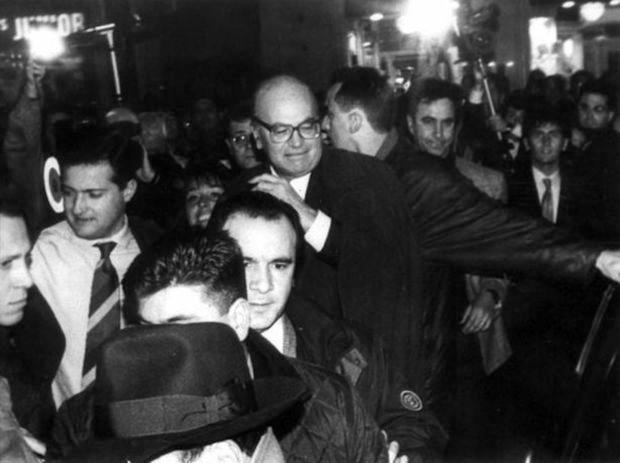
Former prime minister Bettino Craxi greeted by a salvo of coins as a sign of loathing by protesters in Rome on 30 April 1993
CountryItaly
Started17 February 1992
Judges

Mani pulite (Italian: [ˈmaːni puˈliːte]; lit.'clean hands') was a nationwide judicial investigation into political corruption in Italy held in the early 1990s, resulting in the demise of the First Italian Republic and the disappearance of many political parties. Some politicians and industry leaders committed suicide after their crimes were exposed. Antonio Di Pietro was the main judicial figure in charge of the investigation. In some accounts, as many as 5,000 public figures fell under suspicion. At one point, more than half of the members of the Italian Parliament were under indictment, while more than 400 city and town councils were dissolved because of corruption charges. The estimated value of bribes paid annually in the 1980s by Italian and foreign companies bidding for large government contracts reached US$4 billion (6.5 trillion lire).

The corrupt system uncovered by the investigation was referred to as Tangentopoli (Italian pronunciation: [tandʒenˈtɔːpoli]). The term derives from Italian tangente, which means "kickback", and in this context refers to kickbacks given for public works contracts, and Greek polis meaning "city"; it is thus sometimes translated as "Bribesville" or "Kickback City".[nb 1] Former Italian prime minister Bettino Craxi became the main figure of the scandal and defended himself by saying that all parties did what he was accused of; Craxi, who fled to Hammamet, Tunisia, in 1994, was convicted twice for corruption and illicit financing to political parties and had four more trials pending by the time of his death in 2000. The Italian Communist Party (PCI) and some of its former members, mainly of its right wing, were also investigated but were acquitted.

The media impact and the climate of public indignation that followed were such as to decree the collapse of the then political system and the beginning of the Second Italian Republic, as historical parties, such as Christian Democracy (DC) and the Italian Socialist Party (PSI), dissolved, being replaced in Parliament in subsequent elections by newly formed parties, or those that had previously been in the minority or opposition, such as the Federation of the Greens (FdV) and Lega Nord (LN). Even without a formal change of regime, there was a profound change in the party system and a turnover of part of its national representatives. Eventually, all four parties in the 1992 government disappeared, at different times in different ways: the DC, the PSI, the Italian Democratic Socialist Party (PSDI), and the Italian Liberal Party (PLI). The Democratic Party of the Left (PDS), the Italian Republican Party (PRI), and the Italian Social Movement (MSI) were the only surviving national parties; the PRI is the only one that maintained its name since.

Arrest of Mario Chiesa

[edit]

Tangentopoli, as the scandal came to be called,[1][2] began on 17 February 1992 when Antonio Di Pietro, the judge who became most associated with the investigation,[3][4][5] had Mario Chiesa, a member of the PSI, arrested for accepting a bribe from a Milan cleaning firm. The PSI distanced themselves from Chiesa, with party leader Bettino Craxi calling him mariuolo, or "villain", a "wild splinter" of an otherwise clean party.[6] Upset over this treatment by his former colleagues, Chiesa began to give information about corruption implicating them. This marked the beginning of the Mani pulite investigation; news of political corruption began spreading in the Italian press. Tangentopoli itself refers to a series of judicial investigations conducted by various judicial prosecutors' offices, in particular that of Milan, which revealed a fraudulent or corrupt system that colluded with politics and Italian entrepreneurship.[7]

Extension of anti-corruption investigations

[edit]

In the 1992 Italian general election, the DC held on to power when its coalition government kept a small majority, while leftist opposition parties gained support. The PCI split after the fall of the Soviet Union, depriving the opposition of leadership. Many votes went to the regionalist LN, which was not inclined to form alliances with other parties at the time. The resulting Parliament was therefore weak and difficult to bring to an agreement.[8]

In April 1992, many industrial figures and politicians from both the government and the opposition were arrested on charges of corruption. While the investigations started in Milan, they quickly spread to other areas as more politicians confessed. Fundamental to this increased exposure was the general attitude of the main politicians to drop support for subordinates who got caught; this made many of them feel betrayed, and they often implicated many other figures, who in turn would implicate even more. On 2 September 1992, the PSI politician Sergio Moroni, who had been charged with corruption, killed himself, leaving behind a letter declaring that his crimes were not for his personal gain but for the party's benefit.[9]

Effect on national politics

[edit]

In local elections in December 1992, held in eight comuni (municipalities), the DC lost half of their votes. The following day, Bettino Craxi was officially accused of corruption; he eventually resigned as leader of the PSI. On 5 March 1993, the government of Giuliano Amato (PSI) and his justice minister Giovanni Conso (independent) tried to find a solution with a decree, which allowed criminal charges for several bribery-related crimes to be replaced by administrative charges instead; according to popular opinion at the time, that would have resulted in a de facto amnesty for most corruption charges. Amid public outrage and nationwide rallies, the then Italian president Oscar Luigi Scalfaro (DC) refused to sign the decree, deeming it unconstitutional.[10] The following week, a US$250 million scandal involving Eni, the government-controlled energy company, was revealed. The stream of accusations, confessions, and jailing continued.

On 25 March 1993, the Parliament changed municipal electoral law in favor of a majoritarian system. Later on 18 April 1993, the public overwhelmingly backed the abrogation of the existing proportional representation system in a referendum (mixed-member proportional representation was introduced that August), causing Amato to resign three days later.[11] Still shocked by the recent events, the Parliament was unable to produce a new government. Carlo Azeglio Ciampi (independent), former governor of the Bank of Italy, was appointed head of the government; he appointed a technical government without political influences. Meanwhile, the Parliament blocked the investigation into Craxi, causing several cabinet ministers including Francesco Rutelli (FdV) and Vincenzo Visco (independent) to resign in protest after three days at their posts.[10] In new local elections on 6 June 1993, the DC lost half of its votes once again; the PSI virtually disappeared. Instead, LN became the strongest political force in northern Italy.

Cusani trial

[edit]
Milan's Palace of Justice, where the investigation began and the Cusani trial took place between 1993 and 1997

On 20 July 1993, the former Eni president Gabriele Cagliari committed suicide in jail. His wife later gave back US$3 million of illegal funds. Meanwhile, Sergio Cusani faced trial and was accused of crimes connected to Enimont, a joint venture between Eni and another energy company, Montedison. The trial was broadcast on national television and was a sort of showcase of the old politics being brought to their responsibilities. While Cusani himself was not a major figure, the connection of his crimes to the Enimont affair called in all the nation's major politicians as witnesses.[12]

A high note was reached in the Cusani trial when former head of government Arnaldo Forlani (DC), answering a question, simply said: "I don't remember."[13] He happened to be very nervous and did not notice that perspiration was accumulating on his lips, and that image was by many considered symbolic of the people's disgust for the corrupt system. Instead, Craxi admitted that his party received $93 million of illegal funds, defending his actions by saying that "everyone was doing this".[14] Even the LN was implicated in the trial; secretary Umberto Bossi and former treasurer Alessandro Patelli were convicted for receiving 200 million lire of illegal funding (approximately $100,000 at the time).[15]

A bribe to the PCI was alleged but was not established who had committed the offence. A number of Milanese members of the PDS, mainly of the migliorista wing, were charged with corruption during their time as members of the PCI but were acquitted. Prosecutor Antonio Di Pietro stated: "Penal responsibility is personal, I cannot bring here a person with the first name Party and last name Communist."[14] The Enimont trial itself was carried out after the Cusani trial, with much less public interest.

Investigations on other fronts

[edit]

In the meantime, the investigation expanded outside the political range. On 2 September 1993, the Milan judge Diego Curtò was arrested. On 21 April 1994, 80 financial regulators and 300 industry personalities were charged with corruption. A few days later, the secretary of Fiat admitted corruption with a letter to a newspaper. Media tycoon Silvio Berlusconi entered politics later that year and won the 1994 Italian general election in what many thought was a move to shield his many business concerns from possible scrutiny. This suspicion was reinforced on 11 February 1994, when his brother, Paolo Berlusconi, admitted to corruption crimes.[14] On 29 July 1994, his brother was again arrested and immediately released.[14]

Lottizzazione

[edit]

The term lottizzazione, meaning the way a terrain is divided up in minor parts or lotti,[16] came to indicate the procedure of awarding top positions in important state conglomerates, such as IRI, Enel, or Eni to political figures, or at least managers with a clear political orientation. This usually trickled down to lower levels, creating power centres depending on political parties that controlled a significant part of the production system. The available seats were usually awarded so that government parties and opposition parties like the PCI would get a share of power corresponding to their perceived influence in the government.

Impact

[edit]

A 2020 study found that

local politicians withdraw support from incumbents in parties hit by Clean Hands – inducing early government dissolutions in such municipalities ... local politicians from the implicated parties exhibit lower re-running rates and higher rates of party switching in the short term. In the medium term, we find that corruption and voter turnout are lower in competitive municipalities 'treated' with a mayor from the implicated parties during Clean Hands. Moreover, medium-term upward career mobility of local politicians from the implicated parties benefited from party switching.[17]

In modern culture

[edit]

In 2005, artist Gianni Motti created an artwork in the form of a bar of soap, named Mani pulite, based on the scandal. This piece was claimed to have been created out of the fat from a liposuction of Silvio Berlusconi. It was sold at the 36th edition of Art Basel for €15,000.[18][19] A 2015 television series titled 1992 is based on the events of Mani pulite.[20]

See also

[edit]

Notes

[edit]

References

[edit]

Further reading

[edit]
[edit]
Revisions and contributorsEdit on WikipediaRead on Wikipedia
from Grokipedia
(Italian for "clean hands") was a series of nationwide judicial investigations into systemic political corruption in Italy, initiated in Milan on 17 February 1992 with the arrest of Mario Chiesa, a Socialist Party official caught accepting a bribe from a cleaning firm. The probe, led by prosecutors including Antonio Di Pietro, uncovered Tangentopoli, a entrenched practice of politicians and business leaders exchanging kickbacks—typically 10% of contract values—for awarding public works and services, affecting virtually all major parties. Through aggressive use of plea bargains and chain-reaction confessions, the investigations implicated over 5,000 individuals, led to nearly 5,000 arrests, hundreds of convictions, and at least 31 suicides among the accused, fundamentally destabilizing Italy's post-World War II political order. This upheaval precipitated the dissolution of dominant parties such as the Christian Democrats and Socialists, the resignation of Prime Minister Giuliano Amato, and the transition to Italy's Second Republic, though subsequent analyses reveal persistent corruption challenges and debates over the operation's long-term efficacy and judicial methods.

Origins of the Investigation

Arrest of Mario Chiesa

On February 17, 1992, Mario Chiesa, a prominent member of the Italian Socialist Party (PSI) and president of the Pio Albergo Trivulzio—a major Milanese public hospice for the elderly—was arrested by Milan prosecutors led by Antonio Di Pietro on charges of corruption and fraud. The arrest stemmed from a sting operation in which Chiesa accepted a bribe of 7 million Italian lire (approximately $4,500 at the time) from Luca Magni, a representative of a cleaning services firm seeking a contract with the hospice; Magni was cooperating with authorities and recorded the transaction. Chiesa, attempting to flush the cash down a toilet upon police intervention, was apprehended in the act, marking the first high-profile seizure in what would unfold as a nationwide probe into entrenched bribery networks. Initially isolated by PSI leadership, who publicly disavowed him as a "mariuolo" (thief) and an isolated rogue rather than emblematic of party practices, Chiesa spent five weeks in prison refusing to cooperate. On March 23, 1992, however, he reversed course and began detailing a systemic "parallel tax" scheme involving kickbacks on public contracts, implicating PSI officials and contractors in Milan. This confession, driven by perceived betrayal from his party, provided prosecutors with initial leads into broader tangentopoli (kickback city) practices, where bribes typically ranged from 5-10% of contract values to secure public works and services. The arrest thus catalyzed Mani pulite, exposing how routine extortion had inflated public spending by billions of lire annually across Italy's administrations.

Initial Revelations of Systemic Corruption

Chiesa's arrest on February 17, 1992, for accepting a 7 million lire bribe from entrepreneur Luca Magni in exchange for a cleaning contract at a Milan public hospice initially appeared isolated, but his subsequent confession exposed a broader pattern of extortionate demands on contractors. Upset by the Italian Socialist Party's (PSI) refusal to intervene on his behalf, Chiesa detailed how he and other PSI officials routinely extracted kickbacks equivalent to 5-10% of contract values from businesses seeking public works awards in Lombardy. These payments, often disguised as consulting fees or campaign contributions, funneled illicit funds to party coffers and personal accounts, forming a structured mechanism for political financing rather than sporadic graft. The revelations quickly dismantled the notion of Chiesa as an outlier—"il mariuolo" (the rascal), as PSI leader Bettino Craxi initially dismissed him—revealing complicity across Milan's municipal and regional administration. Prosecutors, led by figures including Antonio Di Pietro, leveraged Chiesa's testimony to secure confessions from implicated contractors and officials, uncovering ledgers documenting tangenti (bribes) totaling hundreds of millions of lire in early 1992 alone for infrastructure and service contracts. This evidenced a symbiotic system where entrepreneurs viewed payoffs as an informal tax for market access, while politicians treated them as essential revenue streams amid Italy's fragmented party funding laws. By late February, the probe's expansion implicated PSI heavyweights and extended to rival parties like the Christian Democrats (DC), signaling corruption's cross-partisan nature in Milan's "partitocrazia" (party rule). Initial estimates from seized documents indicated that such practices had permeated public procurement since the 1980s, with bribes sustaining a patronage network that prioritized loyalty over efficiency, ultimately eroding public trust in the First Republic's institutions. These disclosures, amplified by media coverage, transformed a local inquiry into the "tangentopoli" archetype of systemic malfeasance.

Expansion and Methods of the Probe

Role of Key Prosecutors

The Mani pulite investigation was primarily driven by a specialized team of prosecutors from the Milan Public Prosecutor's Office, informally known as the "Milan pool," operating under the leadership of Chief Prosecutor Francesco Saverio Borrelli. This group coordinated efforts to uncover a vast network of bribery and kickbacks, employing innovative investigative techniques such as leveraging confessions from arrested individuals to implicate higher-level figures. Key members included Antonio Di Pietro, Gherardo Colombo, Piercamillo Davigo, and Francesco Greco, whose combined expertise in financial crimes and aggressive interrogation methods propelled the probe's expansion from local scandals to national systemic corruption. Antonio Di Pietro emerged as the most visible figure in the pool, initiating the inquiry following the February 17, 1992, arrest of Socialist Party official Mario Chiesa, which revealed patterns of routine bribe-taking known as tangenti. As a lead investigator, Di Pietro conducted high-profile interrogations, often televised, that pressured suspects into becoming pentiti (informants) through plea bargains, thereby generating a cascade of evidence against politicians and business leaders. His strategy involved confronting suspects with detailed evidence from prior confessions, minimizing judicial delays and maximizing revelations of interconnected corruption schemes spanning parties like the Christian Democrats and Socialists. Di Pietro's role extended to over 5,000 interrogations by 1994, though he resigned amid allegations of procedural irregularities, later entering politics. Gherardo Colombo focused on tracing financial flows and systemic patterns within the corruption web, contributing to the dismantling of illicit funding mechanisms in public contracts and state enterprises. His work emphasized the structural nature of the graft, linking bribes to political party financing and business advantages, which helped extend investigations beyond Milan to other regions. Colombo's persistence in pursuing leads from initial arrests amplified the probe's scope, resulting in thousands of charges by the mid-1990s. Piercamillo Davigo played a crucial role in legal strategy and courtroom advocacy, advocating for a rigorous interpretation of corruption laws to hold public officials accountable without leniency for "customary" practices. He co-authored analyses framing corruption as a pervasive institutional failure rather than isolated acts, influencing public perception and judicial outcomes in major trials. Davigo's emphasis on evidentiary rigor and resistance to political interference sustained the investigation's momentum despite threats and backlash from implicated elites. Francesco Greco supported the pool's operational framework, handling coordination of evidence and prosecutions against business figures tied to political bribery rings. His contributions ensured the integration of complex financial data into cohesive cases, facilitating convictions that exposed the symbiosis between politicians and entrepreneurs in sectors like construction and healthcare. The collective efforts of these prosecutors led to over 1,300 convictions by 1996, fundamentally reshaping Italy's political landscape.

Use of Plea Bargains and Investigative Techniques

The Mani pulite investigation heavily relied on Italy's patteggiamento procedure, a form of plea bargaining introduced in the 1989 Code of Criminal Procedure, which allowed defendants to admit guilt in exchange for reduced sentences, typically one-third less, and expedited trials via rito abbreviato. This mechanism incentivized cooperation, as suspects who confessed and implicated higher-level figures received leniency, creating a cascading effect where initial admissions exposed broader networks of bribery known as tangenti. Out of approximately 4,520 individuals investigated, around 620 opted for plea bargains, significantly accelerating the probe by generating evidence against politicians, business leaders, and party officials without prolonged full trials. Prosecutors, led by figures like Antonio Di Pietro, strategically combined patteggiamento with preventive custody under Article 273 of the Code of Criminal Procedure, detaining suspects for up to six months without bail to intensify pressure for confessions during interrogations. This approach, adapted from techniques used against organized crime, included extensive wiretapping of telephone lines and environmental bugs in suspected locations, authorized under expanded judicial powers for corruption cases following 1980s reforms. Di Pietro's team conducted marathon questioning sessions, often isolating detainees from lawyers initially to elicit details on systemic kickback schemes, which yielded unprecedented documentation of illicit funding flows to parties like the Christian Democrats and Socialists. These methods formed a "domino" strategy, where lower-tier confessions via pleas fueled arrests of superiors, unraveling the clientelistic "lottizzazione" in public contracts and state enterprises. While effective in amassing over 5,000 indictments by 1994, the techniques drew criticism for potential coercion, as prolonged custody correlated with higher confession rates, though empirical data from the era shows no widespread evidence of fabricated testimony due to the corroboration required across multiple deponents. Prosecutors also selectively engaged media to publicize revelations, bolstering public support and deterring interference, which amplified the investigation's momentum beyond traditional judicial bounds.

Key Events and Trials

The Cusani Trial

![Palazzo di Giustizia, Milan][float-right] The Cusani trial, formally known as the Enimont trial, commenced on October 28, 1993, in , focusing on Sergio Cusani, a financier associated with the Ferruzzi Group, accused of orchestrating and distributing bribes in connection with the Enimont between state-owned and private Montedison. The scandal involved kickbacks estimated at up to $280 million from the and operations of Enimont, with $96 million disbursed from a Montedison to . Cusani served as the intermediary, channeling funds to influence the deal's approval and protect business interests. The trial gained national prominence due to its live television broadcast, drawing massive audiences and serving as a public spectacle that illuminated the breadth of political corruption. Key testimonies from high-profile politicians underscored the systemic nature of bribery. On December 17, 1993, former Prime Minister Bettino Craxi, leader of the Socialist Party (PSI), admitted under oath that his party had received approximately $93 million in illicit funds over 13 years, describing such practices as a longstanding, quasi-institutional feature of Italian politics rather than isolated crimes. Craxi denied personal involvement in the Enimont bribes but justified party financing as essential for electoral competition, implicating a bipartisan network including Christian Democrats and others. Numerous witnesses, including parliament members and party officials, corroborated the routine exchange of tangenti (kickbacks) for contracts and favors, transforming the proceedings into an indictment of the First Republic's political class. The televised format amplified public outrage, with Craxi's testimony marking a pivotal moment that eroded trust in established parties. In April 1994, Cusani was convicted of bribery and related offenses, receiving an eight-year prison sentence and ordered to pay $98 million in restitution. The verdict reinforced the Mani pulite prosecutors' narrative of entrenched corruption, though subsequent appeals reduced his effective time served, with release in 2001. The trial's exposure of institutionalized bribe-taking contributed to the rapid decline of traditional parties, paving the way for political realignment.

Extension to Major Political Figures

As the Mani pulite probe progressed through plea bargains and confessions from lower-level officials and business executives, it uncovered a hierarchical system of kickbacks extending to the uppermost echelons of Italy's political establishment, particularly leaders of the Christian Democracy (DC) and Italian Socialist Party (PSI). By February 1993, over 400 politicians nationwide had been arrested or placed under investigation, with the focus shifting from municipal graft to national-scale illicit financing that sustained party machines through systematic 5-15% tangenti (bribes) on public contracts. Former Prime Minister Bettino Craxi, PSI secretary from 1976 to 1993, emerged as the scandal's most prominent target, accused of orchestrating a network that funneled tens of millions of lire in bribes to his party, including direct receipts documented in Milanese probes. Craxi publicly acknowledged that political parties routinely accepted such funds but framed it as a necessary practice across the spectrum, a defense that failed to mitigate charges of corruption and influence peddling in at least 16 trials. In April 1994, amid mounting evidence from cooperating witnesses, he fled to Tunisia, evading arrest; subsequent in-absentia convictions resulted in over 27 years of cumulative sentences for crimes including bribery and embezzlement, though he died in exile in 2000 without serving time. Christian Democratic figures faced parallel scrutiny, with former Prime Minister Arnaldo Forlani, DC secretary in the 1980s, charged in 1993 with corruption tied to ENI and IRI state enterprise bribes, leading to a conviction for illicit financing that was later commuted to community service. Forlani's testimony in the 1994 Cusani trial—marked by over 100 instances of "I don't remember" in response to questions about party slush funds—exemplified the elite's reliance on deniability amid revelations of DC's dominant role in allocating contracts for payoffs. Giulio Andreotti, seven-time premier and DC stalwart, was indicted in multiple Milanese inquests for receiving bribes via intermediaries in public works schemes, though some charges intertwined with separate Mafia association probes; these investigations eroded his influence without immediate incarceration, as statutes of limitations and appeals prolonged outcomes. The probe's reach extended to other luminaries, including PSI Foreign Minister Gianni De Michelis and DC's Ciriaco de Mita, both convicted on corruption counts involving party financing from construction and energy sectors, contributing to the arrest of roughly 5% of Italy's parliamentarians by mid-1993. These cases, substantiated by wiretaps, bank records, and pentiti (repentant) testimonies from over 1,200 entrepreneurs, demonstrated how corruption formed a causal pillar of the First Republic's stability, binding business to politics through enforced reciprocity rather than isolated malfeasance.

Political Ramifications

Collapse of the First Republic Parties

The revelations from the Mani pulite investigations implicated a broad spectrum of leaders from Italy's dominant First Republic parties, particularly the Christian Democrats (DC) and Italian Socialists (PSI), in a system of kickbacks and bribery known as Tangentopoli, which fundamentally undermined their legitimacy. By mid-1993, over 400 politicians had been arrested, including five former prime ministers and key figures from the governing coalitions that had ruled since 1948, exposing how these parties had sustained power through illicit financing and clientelism rather than ideological appeal. This cascade of confessions and indictments, amplified by media coverage, fueled public outrage and demands for systemic change, rendering the parties' traditional voter bases—rooted in post-war reconstruction and Cold War alignments—irreparably alienated. Electoral results accelerated the unraveling: in the June 1993 local and regional elections, the DC's vote share halved from previous levels, while the PSI's support plummeted to near irrelevance, signaling a collapse in public confidence that traditional mechanisms of patronage could no longer mitigate. The DC, which had governed uninterruptedly for nearly five decades, fragmented under the weight of scandals involving leaders like Arnaldo Forlani and Giulio Andreotti; the party formally dissolved in early 1994, splitting into the moderate Italian People's Party (PPI) and the conservative Christian Democratic Centre (CCD), neither of which retained its predecessor's dominance. Smaller coalition partners, such as the Italian Democratic Socialists (PSDI) and Liberals (PLI), similarly faded, their infrastructures hollowed out by prosecutions and defections. The PSI suffered an even more precipitous fall, with its leader Bettino Craxi facing charges of corruption totaling millions in illicit funds; Craxi fled to Tunisia in 1994 to evade arrest, and the party disbanded later that year, dissolving a entity that had risen from marginal status to coalition kingmaker in the 1980s. Approximately 23% of sitting parliamentarians faced corruption-related charges by 1994, disproportionately from these centrist and center-left formations, which had embodied the "partitocrazia" system of interlocking political and economic interests. This judicial onslaught, combined with voter repudiation in the March 1994 general elections—where the DC garnered just 11% and the PSI 2%—marked the definitive end of the First Republic's party system, paving the way for bipolar competition without restoring pre-scandal levels of trust in institutions.

Emergence of New Political Forces

The investigations of Mani pulite eroded public trust in the entrenched parties of Italy's First Republic, particularly the Christian Democrats (DC) and Italian Socialist Party (PSI), which had dominated coalitions since 1948, leading to their effective dissolution by 1994 and creating opportunities for novel political entrants. Over 5,000 politicians and officials faced charges, with the PSI alone seeing its leadership decimated, including the conviction of former Prime Minister Bettino Craxi in absentia for corruption in 1994, which accelerated voter disillusionment and party fragmentation. This vacuum was swiftly filled by Silvio Berlusconi, who on January 18, 1994, launched Forza Italia as a center-right party promising economic liberalization, reduced bureaucracy, and a break from the corrupt "partitocrazia" system exposed by the scandals. Leveraging his media empire for rapid mobilization, Forza Italia allied with the Northern League (Lega Nord) and National Alliance in the "Polo delle Libertà" coalition, capturing 21% of the proportional vote in the March 27, 1994, general elections and enabling Berlusconi to become prime minister. The Lega Nord, a federalist party founded in 1991 through regional mergers, capitalized on northern resentment toward perceived southern-dominated corruption and fiscal transfers, boosting its parliamentary seats from 18 in 1992 to 117 in 1994 as voters sought regional autonomy and anti-establishment reform. These forces marked a shift toward bipolar competition, with Forza Italia embodying entrepreneurial populism and Lega Nord emphasizing territorial grievances, reshaping Italy's party system amid the transition to the Second Republic.

Broader Scope of Corruption Exposed

Lottizzazione in State Enterprises

Lottizzazione, the partisan allocation of executive and board positions in state-owned enterprises, exemplified the entrenched political control over Italy's public sector during the First Republic. Major holding companies such as the Istituto per la Ricostruzione Industriale (IRI), Ente Nazionale Idrocarburi (ENI), Ente Nazionale per l'Energia Elettrica (ENEL), and Ente Partecipazioni e Finanziamento Industrie Manifatturiere (EFIM) were divided among coalition parties in the pentapartito governments (1981–1991), with Democrazia Cristiana (DC) dominating IRI, Partito Socialista Italiano (PSI) controlling ENI, and Partito Socialista Democratico Italiano (PSDI) influencing EFIM. This system prioritized loyalty over competence, enabling parties to extract resources through rigged public contracts and illegal financing. The practice facilitated systemic corruption by embedding party intermediaries in enterprise management, who demanded tangenti (kickbacks) typically amounting to 3–10% of contract values, estimated at 10,000 billion lire annually across the economy. In state enterprises, this manifested in inflated procurement costs for public works, where bribes funded party activities rather than improving efficiency; for instance, IRI, ENI, and EFIM accumulated debts totaling over 38,000 billion lire by late 1992, exacerbating fiscal strain amid distorted market competition. Investigations under Mani pulite, beginning in February 1992, uncovered these networks through confessions like that of Silvano Larini, who admitted delivering 7–8 billion lire in bribes from Milan Metro contractors (1987–1991) to PSI leader Bettino Craxi via state-linked channels. Mani pulite probes extended to enterprise executives, revealing how lottizzazione ensured complicit leadership that overlooked or enabled bribery in sectors like energy and infrastructure; ENI scandals, for example, involved multimillion-lire payoffs for fuel and construction deals tied to political quotas. This exposure highlighted causal links between politicized appointments and economic inefficiency, as enterprises prioritized patronage over profitability, contributing to Italy's public debt crisis. Post-scandal reforms, including the 1993 Andreatta-Van Miert agreement with the European Commission, accelerated privatizations to dismantle these structures, though remnants of clientelism persisted.

Connections to Organized Crime and Other Sectors

The Mani pulite investigations revealed extensive intersections between political corruption networks and organized crime, particularly mafia groups in southern Italy, where bribery systems facilitated mafia infiltration into public procurement and infrastructure projects. Prosecutors documented how politicians exchanged kickbacks for awarding contracts to mafia-affiliated firms, enabling groups like Cosa Nostra in Sicily and the Camorra in Campania to dominate sectors such as construction and waste disposal. For instance, examinations targeted links between the Sicilian Mafia and over 400 members of parliament, resulting in charges against 160 individuals for collusion in rigged tenders and protection rackets. These ties were evidenced by confessions from turned mafia bosses, who described negotiating electoral support and campaign financing in return for policy leniency, including delays in anti-mafia legislation. High-profile cases underscored these connections, notably the prosecution of former Prime Minister Giulio Andreotti, accused of longstanding mafia association and protection of criminal activities from the 1970s onward. Mafia turncoats like Tommaso Buscetta and Giovanni Brusca testified to Andreotti's role in shielding Cosa Nostra operations, including facilitating business deals and influencing judicial outcomes, though his conviction on mafia association charges ultimately failed on appeal despite substantial testimonial evidence. The inquiries also extended to southern organized crime syndicates' use of national corruption webs for money laundering and contract monopolization, with over 1,300 convictions or plea bargains involving officials tied to such groups by 1994. This overlap was particularly pronounced in regions where mafia enforcement mechanisms underwrote bribe compliance, blurring lines between political graft and violent extortion. Beyond direct mafia-politics pacts, the probes exposed corruption's reach into other sectors, including healthcare and defense procurement, where organized crime leveraged insider bribes to secure supplies and services. In hospital construction and pharmaceutical tenders, for example, southern syndicates infiltrated northern supply chains via intermediaries, using tangentopoli-style kickbacks to politicians for preferential access, as revealed in Milan-based extensions of the investigations. Financial institutions faced scrutiny for facilitating laundering of mafia proceeds through corrupt bank officials complicit in party financing schemes, while media and advertising sectors showed ties through sponsored content and influence peddling. These revelations highlighted how endemic bribery created vulnerabilities exploited by organized crime across the economy, though northern-focused probes initially underestimated southern mafia entrenchment.

Immediate Impacts

Judicial and Legislative Responses

The judicial apparatus in Italy responded to the Mani pulite investigations by expanding prosecutorial resources and adopting aggressive tactics, including the creation of specialized pools of magistrates in Milan and other cities to coordinate inquiries into bribery networks. These teams, starting with the Milan Pool in February 1992, utilized plea bargaining and the testimony of repentant suspects (pentiti) to dismantle corruption schemes, leading to the arrest of over 1,200 individuals in the initial years and the uncovering of systemic tangenti (kickbacks) across political and business spheres. This approach marked a departure from prior fragmented efforts, enabling rapid chain confessions that exposed involvement of high-ranking officials. However, the investigations faced internal challenges, such as overburdened courts resulting in protracted trials, with many convictions appealed successfully or nullified due to expired statutes of limitations by the mid-1990s. In June 1995, the Italian Senate passed legislation restricting pre-trial detention for corruption suspects, a measure viewed by Mani pulite prosecutors as a direct impediment to their leverage tactics and a concession to political pressures. Judicial independence came under scrutiny, with allegations of politicization as some magistrates aligned with public sentiment against the establishment, contributing to what critics termed "judicial populism." Legislatively, responses were predominantly reactive and aimed at mitigating the investigations' scope rather than bolstering anti-corruption frameworks. In 1993, amendments to the penal code depenalized minor instances of false accounting, intending to differentiate administrative irregularities from outright bribery but criticized for potentially obscuring corrupt practices through inflated invoices. Further reforms in the mid-1990s, including shortened statutes of limitations for certain offenses, were enacted amid political backlash, effectively weakening enforcement tools and allowing numerous cases to lapse without resolution. These measures reflected efforts by surviving political forces to reassert control over the judiciary, though they failed to prevent the collapse of traditional parties. No comprehensive anti-corruption legislation emerged immediately, leaving systemic vulnerabilities unaddressed and paving the way for recurring scandals.

Economic and Social Disruptions

The investigations under Mani pulite triggered immediate economic disruptions through the mass arrest and indictment of over 4,000 individuals by mid-1994, including numerous business executives whose detentions paralyzed decision-making in key sectors like construction and state-owned enterprises. In the Enimont affair, for instance, the 1993 suicide of Ferruzzi Group chairman Raul Gardini amid bribery probes destabilized the conglomerate, threatening hundreds of thousands of Montedison stockholders and saddling over 1,000 banks with debts exceeding 20 billion lire (approximately $12 million at the time). Public procurement, rife with the estimated $4 billion in annual bribes during the 1980s, ground to a halt as contracts were scrutinized, inflating short-term costs and delaying infrastructure projects while firms navigated legal uncertainties. These probes exacerbated Italy's concurrent 1992 currency crisis, as political instability from Tangentopoli—unveiling systemic graft in public works and licensing—eroded investor confidence, contributing to the lira's devaluation and a spike in bond yields that strained fiscal policy. Although corruption deterrence eventually lowered public project costs, the transitional chaos fostered economic stagnation, with industrial output in affected regions dipping amid frozen investments and supply chain interruptions from detained managers. Socially, Mani pulite precipitated profound distress, including at least 31 suicides between 1992 and 1994 among implicated politicians, officials, and tycoons, reflecting the psychological toll of exposure and pre-trial detention practices that often exceeded legal limits. High-profile cases, such as the 1993 deaths of Socialist leaders Gabriele Cagliari and Sergio Moroni, underscored familial and reputational devastation, with investigations shattering elite networks and amplifying public cynicism toward institutions. The scandal eroded social cohesion by fueling widespread disillusionment, as initial moral outrage gave way to fears of judicial excess, fostering long-term anti-establishment sentiments that persisted beyond the probe's peak.

Controversies and Criticisms

Allegations of Judicial Overreach and Bias

Critics of the Mani pulite investigations alleged that prosecutors, particularly Antonio Di Pietro and his team in Milan, employed coercive tactics including prolonged detentions without formal charges, media leaks of investigative details, and heavy reliance on plea bargains to extract confessions, creating a self-perpetuating cycle of accusations that prioritized speed over due process. These methods, while uncovering widespread bribery under the Tangentopoli system, were said to pressure suspects into implicating others to secure reduced sentences, leading to over 5,000 individuals under suspicion by the mid-1990s and contributing to at least 31 suicides between 1992 and 1994, including cases of business leaders and officials who faced reputational ruin before full exoneration. Allegations of judicial bias centered on claims that the investigative pool harbored an antipolitical class animus, imposing harsher scrutiny on elected officials and traditional parties like the Christian Democrats and Socialists while showing leniency toward private-sector actors or emerging political forces. Politicians, including Silvio Berlusconi, accused "red judges"—a term for allegedly left-leaning magistrates—of abusing their authority for partisan ends, framing the probes as a "political witch-hunt" rather than impartial enforcement, with tensions peaking as media coverage shifted from corruption revelations to judicial politicization by the mid-1990s. This perception was exacerbated by the investigators' public profiles, as Di Pietro transitioned into politics, founding the Italy of Values party, which critics viewed as evidence of ulterior motives to dismantle the First Republic's establishment. By 1995, backlash intensified with formal investigations into Di Pietro and fellow prosecutor Piercamillo Davigo for alleged attempts at a "judicial coup d'état," including overstepping bounds in coordinating probes across jurisdictions and influencing legislative responses to corruption laws. Such charges highlighted concerns over unchecked prosecutorial power, with only about 1,300 convictions from thousands of arrests, suggesting that the emphasis on volume undermined evidentiary rigor and fueled perceptions of selective justice aimed at reshaping Italy's political landscape.

Selectivity in Targeting and Political Motivations

Critics of the Mani pulite investigations alleged selectivity in prosecutions, contending that the probes disproportionately targeted figures from the Christian Democratic Party (DC) and Italian Socialist Party (PSI)—the dominant parties in Italy's post-war governing coalitions—while opposition groups, particularly the Democratic Party of the Left (PDS), the reformed successor to the Italian Communist Party (PCI), encountered fewer indictments and convictions. By mid-1993, over 400 arrests had been made, with the vast majority involving DC and PSI affiliates in the tangentopoli bribery networks centered in Milan and other northern cities, whereas PDS leaders such as Achille Occhetto faced minimal scrutiny despite evidence of similar clientelist practices in PCI-affiliated cooperatives. This disparity fueled claims that the Milan prosecutorial pool, perceived as left-leaning within Italy's judiciary, shielded post-communist forces to facilitate their electoral ascent amid the First Republic's collapse. Such accusations of partisanship were amplified by the judiciary's strategic use of media to cultivate public support, framing the effort as a populist battle against a corrupt elite, which prosecutors leveraged to insulate their actions from political interference. Lead investigator Antonio Di Pietro, whose aggressive tactics including plea inducements unraveled the bribery chains, resigned from the judiciary in December 1995 following probes into alleged procedural abuses and conflicts of interest, such as his undisclosed meetings with political figures. Di Pietro's subsequent entry into politics—founding the anti-corruption Italia dei Valori party in 1998 and securing a Senate seat—lent credence to assertions that personal ambition motivated the operation's intensity, with some analysts viewing it as a vehicle for reshaping Italy's party system to favor new entrants untainted by the old regime. Multiple tangentopoli judges, including Di Pietro, transitioned to political roles or advisory positions for emerging parties, raising concerns that the investigations served not just legal accountability but also the strategic elimination of centrist rivals. Defenders of the probes countered that targeting reflected the evidentiary chain starting from Mario Chiesa's 1992 arrest—a PSI official whose confession implicated higher-ups in the governing parties—rather than deliberate bias, noting that systemic corruption was densest among power-holders with access to public contracts. Nonetheless, the perceived uneven application contributed to backlash, including parliamentary immunity reforms in 1993 that prosecutors criticized as obstructive, and later convictions of some Mani pulite magistrates for abuse of office, underscoring tensions between judicial activism and accusations of overreach with political undertones. By 1994, as investigations waned amid evidentiary challenges and witness fatigue, the operation's legacy included not only dismantled patronage networks but also eroded trust in the judiciary's impartiality, with right-wing critics decrying it as a "left-oriented" purge that paved the way for PDS dominance in the Second Republic's early coalitions.

Long-term Legacy

Achievements in Exposing Corruption

The Mani pulite investigations, commencing with the arrest of Milanese Socialist Party official Mario Chiesa on February 17, 1992, for accepting a bribe, initiated a cascade of confessions that unveiled Tangentopoli, a nationwide network of systemic bribery in public contracting. Chiesa's detention prompted revelations of routine kickbacks, typically 5 to 15 percent of contract values, funneled to political parties as illicit financing, affecting sectors from infrastructure to healthcare. This exposed how the dominant parties of the First Republic, including the Christian Democrats (DC) and Socialists (PSI), had institutionalized corruption to sustain patronage networks, with bribes estimated in the billions of lire annually across Italy. The probe's scope expanded rapidly, implicating nearly 5,000 individuals—including over 400 members of parliament, seven prime ministers, four former presidents, and dozens of cabinet ministers—through coordinated judicial efforts in Milan and other cities. By the mid-1990s, it yielded approximately 1,300 convictions for corruption-related offenses, dismantling entrenched elites and revealing the fragility of party loyalty under legal scrutiny. Notable exposures included former Prime Minister Bettino Craxi's flight to Tunisia in 1994 amid charges of receiving millions in illicit funds, and convictions of DC leaders like Arnaldo Forlani for similar schemes. Beyond political figures, Mani pulite illuminated corporate complicity, with firms like Fiat and ENI executives admitting to colluding in bid-rigging and over-invoicing to generate slush funds, thereby quantifying the economic distortion caused by graft in state-owned enterprises. The investigations also traced some bribe flows to organized crime, particularly in southern Italy, though the core revelations centered on non-violent political financing rather than mafia infiltration. These outcomes provided empirical documentation of corruption's scale, shifting public and institutional awareness from anecdotal suspicions to verifiable patterns of elite capture.

Failures in Systemic Reform and Persistent Issues

Despite the widespread arrests and convictions during the Mani pulite investigations, which implicated over 5,000 individuals including nearly half of Italy's parliamentarians by 1994, the operation did not translate into enduring structural reforms to dismantle entrenched clientelistic networks and patronage systems. Root causes such as lottizzazione—the partisan allocation of positions in state enterprises and regulatory bodies—persisted, as subsequent governments prioritized short-term political survival over comprehensive institutional overhauls, including electoral reforms or independent oversight mechanisms for public procurement. Italy's Corruption Perceptions Index (CPI), compiled by Transparency International, reflects this stagnation: from a low of 29.9 points in the mid-1990s (on a 0-100 scale where higher indicates less perceived corruption), scores fluctuated around 40-50 through the 2000s and 2010s, reaching a peak of 56 in 2021 before settling at 54 in 2024—still ranking Italy among the lowest in Western Europe and the Eurozone. This lack of marked improvement stems from "corruption displacement," where exposed practices shifted to more opaque forms, such as influence peddling in privatized sectors or EU-funded projects, rather than being eradicated, as judicial scrutiny waned amid political backlash and resource constraints. Anti-corruption efforts remained disorganized, lacking a coordinated national strategy; for instance, post-Mani pulite legislation like the 1993 law on false accounting was undermined by lenient sentencing and amnesties, while cultural norms viewing bribery as a "normal" lubricant for bureaucratic inefficiencies endured among elites. Subsequent scandals, including those involving regional administrations and mafia-influenced contracts in the 2000s, demonstrated that electoral accountability gains from 1992 were temporary, with voter disillusionment fostering populism rather than sustained vigilance. Neo-institutional analyses attribute this to path-dependent failures, where veto players in fragmented coalitions blocked reforms, allowing corrupt equilibria to reemerge under new guises. Long-term scarring effects exacerbated these issues: regions most exposed to Tangentopoli scandals exhibited persistently lower institutional trust and higher populist voting by the 2010s, indicating that while Mani pulite disrupted the First Republic's parties, it entrenched cynicism without fostering robust preventive institutions like merit-based civil service recruitment or whistleblower protections. By the 2020s, Italy's public procurement processes continued to score poorly in EU audits for collusion risks, underscoring the operation's role in exposing rather than resolving systemic vulnerabilities.

Cultural Representations

Depictions in Media and Literature

The Italian television series 1992 (2015), directed by various filmmakers including Claudio Cupellini, dramatizes the early 1990s political crisis triggered by the Mani pulite investigations, intertwining fictional characters' stories with real events such as the February 17, 1992, arrest of Socialist politician Mario Chiesa, which ignited the Tangentopoli scandal exposing widespread bribery and illicit party financing. The series portrays the investigations' impact on Italian society, including the involvement of prosecutors like Antonio Di Pietro and the targeting of figures such as Prime Minister Bettino Craxi, while highlighting the emergence of Silvio Berlusconi's political ascent amid the collapse of traditional parties. Critics have noted its blend of historical accuracy with sensational elements, such as personal intrigues and media influence, though it fictionalizes individual motivations to underscore themes of corruption and systemic failure. Documentary representations include the 1997 four-part television series Mani pulite, which chronicles the Milan prosecutors' operations from 1992 to 1994, detailing arrests of over 5,000 individuals, including politicians and business leaders, for offenses like corruption and extortion that dismantled the post-World War II political establishment. A 2004 documentary of the same title offers a non-partisan reconstruction of the affair, emphasizing judicial procedures and societal repercussions without retrospective bias, drawing on archival footage and interviews to illustrate the scale of the tangentopoli system. Additionally, the 2008 episode "Tangentopoli" from the investigative series Blu notte examines the investigations' uncovering of a pervasive bribery network, attributing the scandal's origins to Chiesa's arrest and its ripple effects across Italy's regions. In literature, non-fiction accounts predominate, such as Mani pulite: la vera storia (2012) by journalists Marco Travaglio and Gianni Barbacetto, which analyzes the investigations' timeline, key confessions, and long-term political fallout two decades later, arguing that the probes revealed entrenched clientelism but failed to eradicate it. Fictional depictions are rarer; the 2023 novel Il corrotto: Una storia di tangenti negli anni di Mani Pulite by Italian author follows a Treviso law professor entangled in local bribe schemes amid the national scandal, using the era's atmosphere to explore personal ethical compromises under systemic pressure. Graphic novels, like Alex Boschetti's Mani pulite (2018) published by Becco Giallo, illustrate the investigations through visual storytelling, focusing on prosecutorial tactics and public outrage to convey the events' dramatic intensity. These works collectively reflect Mani pulite's enduring role as a symbol of judicial reckoning, though some analyses critique media portrayals for amplifying prosecutorial heroism while underplaying judicial inconsistencies documented in subsequent inquiries.

Influence on Public Perception

The investigations comprising Mani pulite, commencing with the arrest of Socialist Party official Mario Chiesa on February 17, 1992, initially galvanized public outrage against entrenched political corruption, framing the political elite as systematically venal through revelations of widespread bribery in public contracts known as Tangentopoli. This sparked spontaneous protests, with citizens decrying the "rotten system" and bestowing celebrity status on lead prosecutor Antonio Di Pietro, evidenced by public demonstrations and merchandise like "we love Di Pietro" badges reported in contemporary media. Prosecutors actively leveraged media leaks to sustain momentum, fostering a narrative of judicial heroism that aligned with public demands for accountability and contributed to the rapid dissolution of established parties like the Christian Democrats and Socialists. Public support peaked in the mid-1990s, with surveys indicating near-universal recognition of corruption's severity; a 1996 ITANES poll found 91.8% of respondents viewing it as a very or quite important issue, while magistrates reported "solid backing of public opinion" and "general and unconditional" media endorsement. This perception shift eroded trust in the First Republic's institutions, accelerating voter disillusionment and paving the way for electoral reforms and the emergence of figures like Silvio Berlusconi, who capitalized on anti-establishment sentiment. Over 3,000 indictments by the operation's height reinforced the image of a profoundly compromised political class, yet also sowed seeds of skepticism as suicides among implicated officials—estimated at around 40—highlighted the human toll and intensified media scrutiny. Support waned by the late amid perceptions of prosecutorial excess and politicization, with public protests diminishing and media coverage contracting sharply by 2007-2008, reflecting to . Legislative pushback, including Silvio Berlusconi's 1994 media campaigns and decrees shortening statutes of limitations, further portrayed the as partisan, eroding the operation's heroic aura. In the long term, Mani pulite entrenched a view of corruption as endemic rather than eradicated, with subsequent polls showing persistent pessimism: 50% of citizens in 2005 believed levels had risen since 2002, and 69% in 2009 deemed governments ineffective against it. By 2008, Eurobarometer data indicated 84% saw corruption as a major issue, linked increasingly to organized crime, fostering cynicism toward systemic reform and contributing to populist surges, though corruption's salience in rankings declined from top-tier concerns in 1996 (30.6% priority) to marginal by 2008 (0.2%). This duality—initial catharsis yielding enduring distrust without proportional ethical uplift—underscores how the scandal recalibrated expectations, prioritizing exposure over sustainable deterrence.

References

Add your contribution
Related Hubs
User Avatar
No comments yet.