Hubbry Logo
TarapithTarapithMain
Open search
Tarapith
Community hub
Tarapith
logo
8 pages, 0 posts
0 subscribers
Be the first to start a discussion here.
Tarapith
Tarapith
from Wikipedia

Tarapith is a town and Hindu pilgrimage site located in Rampurhat subdivision of Birbhum district of the Indian state of West Bengal. The town is particularly known for the Tarapith Temple and its adjoining Hindu crematory ground.[1] The tantric Hindu temple is dedicated to the goddess Tara.[2][3]Every day, thousands of pilgrims visit the renowned Tarapith Temple. Devotees arrive not only from various parts of West Bengal, but also from neighboring states and different regions across India, to seek blessings at this sacred shrine.

Key Information

Tarapith is also famous for Tantric saint Bamakhepa, who worshipped in the temple and resided in the cremation grounds.[4] His ashram is also located in bank of Dwaraka river and close to the Tara temple.[5]

Geography

[edit]

Tarapith is a village of Sahapur Gram Panchayat, located on the banks of the Dwarka River in West Bengal.[6] Situated in the Tarapith Police Station circle, it is surrounded by the green paddy fields on the flood plains. It looks like a typical Bengali village with thatched roof huts and fish tanks.[7] The town is located 6 km from Rampurhat Sub-Division in the Birbhum district. "Rampurhat" and "Tarapith Road" are the nearest Railway stations.[8]

References

[edit]

Bibliography

[edit]
[edit]
Revisions and contributorsEdit on WikipediaRead on Wikipedia
from Grokipedia
Tarapith (Bengali: তারাপীঠ) is a revered Hindu temple town located in the Birbhum district of West Bengal, India, approximately 224 kilometers northwest of Kolkata and 80 kilometers from Bolpur, situated on the banks of the Dwarkeswar River adjacent to a cremation ground. It centers around the Tarapith Temple, dedicated to Goddess Tara, a fierce tantric manifestation of the Divine Mother and one of the ten Mahavidyas, and is recognized as one of the 51 Shakti Pithas where the third eye (or eyeball) of Goddess Sati is believed to have fallen after her self-immolation. This site holds profound significance in Tantric Hinduism as a powerhouse for mystical practices, spiritual enlightenment, and wish fulfillment, drawing sadhus, tantriks, and devotees year-round. The temple's origins trace back to ancient times, linked to legends involving Sage Vashishta, who sought mastery over Tantric arts through worship of Tara at this spot, and it is associated with the 51 Shakti Pithas mythos where Sati's body parts fell across the following Shiva's cosmic dance of destruction. While worship at Tarapith has roots potentially dating to the , the current temple structure was constructed in 1818, featuring a distinctive with the idol of Tara Ma depicted in a three-eyed form, tongue extended, holding a and blue lotus, adorned in red and positioned against a white marble backdrop. The site gained further prominence through the 19th-century Tantric saint , known as the "Mad Saint" of Tarapith, whose unconventional rituals and deep devotion to Tara Ma revolutionized local worship practices, emphasizing themes of mortality, transcendence, and the integration of cremation ground rituals into daily sadhana. Tarapith's cultural and religious importance extends beyond the temple to its role as a living Tantric center, where rituals such as animal sacrifices (though increasingly symbolic), midnight pujas, and meditations on Tara's fierce yet compassionate form are performed to invoke protection, destroy ego, and achieve liberation. The adjacent Tarapith cremation ground (Mahashmashan) serves as a key site for Tantric rites, underscoring the temple's association with themes of death and rebirth in . Annual festivals like Tara Jayanti amplify its vibrancy, with thousands of pilgrims converging for elaborate celebrations, while the site's accessibility via road and rail from nearby enhances its status as a pivotal destination in eastern . In February 2025, visited the temple, highlighting its continued national significance.

Overview

Location and Access

Tarapith is situated at approximately 24°07′N 87°47′E in the Rampurhat II of , , . It lies about 8 km east of town, 80 km northwest of , and roughly 220 km northwest of . The town is positioned on the eastern banks of the Dwarka River, which shapes the surrounding landscape and plays a role in local geographical features as well as traditional practices. Reaching Tarapith is facilitated by well-established transport networks. The nearest railway station is Junction, approximately 8 km away, which connects to major lines including those from and , with frequent trains serving the route. For air travel, the closest airport is in , about 110 km southeast, offering domestic flights and taxi or bus connections onward; alternatively, Netaji International Airport in is 220 km away but provides more flight options. Road access is via National Highway 19 (NH 19), linking to state highways, with regular bus services from 's or terminals taking 5-6 hours to cover the distance. Within Tarapith, local mobility relies on auto-rickshaws, cycle-rickshaws, and taxis for short trips around the town and temple area, as there is no direct airport serving Birbhum district. Visitors from nearby areas like Rampurhat can also use shared tempos or private cabs for the quick 15-20 minute journey to the site.

Religious and Cultural Significance

Tarapith is recognized as one of the 51 Shakti Peethas in , sacred sites where parts of the goddess Sati's body are believed to have fallen, with this location associated with the goddess's . Dedicated to Goddess Tara, the second of the ten Mahavidyas in , the site embodies her as a fierce manifestation of divine feminine energy. Tara symbolizes supreme power through her control over cosmic forces and , offering protection to devotees while guiding them toward Tantric enlightenment and spiritual transformation. As a pivotal center of and , Tarapith draws a diverse array of devotees, sadhus, and scholars seeking the integration of devotional worship with esoteric Tantric paths. The site's Tantric heritage emphasizes the exaltation of , the feminine divine power, distinguishing it from Vedic traditions and fostering practices that blend ritualistic devotion with mystical pursuits. This association is exemplified by the 19th-century saint , whose visualizations of Tara at Tarapith highlight the site's role in Tantric conceptualization of and liberation. Tarapith profoundly shapes Bengali folk traditions and literature, particularly through references in songs that invoke Tara's imagery within Birbhum's syncretic spiritual landscape. These mystical folk compositions, rooted in the region's Vaishnava and Shakta influences, reinforce Tarapith's contribution to local and the broader heritage of Bengal's heterodox devotional expressions. The pilgrimage site attracts thousands of visitors daily, with numbers surging during festivals, underscoring its enduring communal and spiritual resonance.

Mythology and Legends

Origin as a Shakti Peetha

Tarapith is recognized in Shakta traditions as one of the Shakti Peethas, sacred sites formed from the dismembered body of Goddess Sati following her during the Daksha Yagna, as described in the . According to the myth, , Sati's father, organized a grand sacrificial ritual excluding Lord , Sati's husband, leading her to attend uninvited and ultimately immolate herself in the yagna fire out of humiliation and rage. Enraged, Shiva carried her charred body across the cosmos in a destructive dance, prompting to intervene with his to dismember the corpse and calm Shiva; the 51 parts that fell to became powerful energy centers known as Shakti Peethas, each embodying aspects of the divine feminine Shakti. In the case of Tarapith, located in West Bengal's , tradition holds that Sati's —or eyelid—fell at this site, establishing it as a potent locus of Tara Ma's worship. This association is rooted in Puranic narratives and local Shakta lore, where the symbolizes the fiery destruction of ignorance and the emergence of divine insight, transforming the site into a center for Tantric practices aimed at spiritual liberation. The fallen eye is believed to have manifested as the goddess Tara in her fierce yet compassionate form, offering protection from malevolent forces and granting devotees mystical vision. Tarapith's position within the network of Peethas is highlighted by its proximity to nearby sites, such as Bakreswar Temple, approximately 50 kilometers away, where Sati's is said to have fallen, emphasizing the regional clustering of these sacred abodes in eastern that collectively represent the fragmented yet omnipresent .

Legend of Sage Vashishta

According to traditions, Sage Vashishta, renowned for his Vedic scholarship, sought to attain mastery over the esoteric practices of to harness divine powers for the welfare of the universe. Despite repeated attempts at austerities, he faced failure in invoking Goddess Tara, leading him to a moment of despair. In one version of the , Tara appeared to him in a dream, directing him to perform at the precise location where her eye had fallen during the dismemberment of Sati's body, which is identified as Tarapith, thereby linking the site to its Shakti Peetha origins. Upon arriving at Tarapith, Vashishta undertook rigorous sadhana, incorporating elements of left-hand , including the rituals—symbolizing wine, meat, fish, parched grain, and ritual union—to transcend conventional boundaries and achieve spiritual union with the divine. He recited the Tara mantra 300,000 times with intense devotion, pleasing the goddess who manifested before him. Tara bestowed upon him , empowering him with supernatural abilities to promote universal harmony, and instructed him to install her idol at the site, marking the establishment of Tarapith as a sacred Tantric center. This act of installation is credited with formalizing the site's role as a for Tantric practitioners. Variations in the legend appear in certain accounts, where instead of a dream, Vashishta receives guidance from a divine voice advising him to seek counsel from —regarded as an incarnation of —in the land of Mahachina (), who then directs him to Tarapith as Tara's abode. These narratives, drawn from oral Tantric lore and texts like the Tantrasara of Krishnananda Agamavagish, emphasize Vashishta's transformation from a Vedic sage to a Tantric adept, solidifying Tarapith's enduring reputation as a premier venue for profound sadhana and enlightenment.

History

Ancient and Medieval Periods

Tarapith's ancient origins are tied to its status as a Shakti Peetha, one of the 51 sacred sites where portions of Goddess Sati's dismembered body are believed to have fallen following her , as recounted in Hindu scriptures. The specifically identifies Tarapith as the location where Sati's descended, manifesting as Goddess Tara and symbolizing divine insight and cosmic vision; the name "Tarapith" itself derives from "tara," denoting both eye and star in . This association with ocular symbolism suggests possible links to pre-Puranic Vedic-era worship practices involving eye motifs as representations of perception and enlightenment, though direct archaeological evidence remains elusive. During the medieval period, spanning the 8th to 15th centuries, Tarapith gained prominence as a hub for Tantric sadhana amid the flourishing of esoteric sects in . The Kaula and Nath traditions, emphasizing ritualistic practices in cremation grounds (smashanas), drew wandering ascetics ( and sadhus) to the site's forested environs for intense and recitation aimed at spiritual liberation. These practices integrated with indigenous tribal of spirits and deities among local communities, blending animistic elements with Shakta to form a syncretic framework. The Pala dynasty (8th–12th centuries), which governed and , extended patronage to Shakta and Tantric institutions, fostering the construction and maintenance of goddess temples across the region and elevating sites like Tarapith within the broader cultural landscape. Historical evidence for early shrines derives primarily from oral traditions and sectarian hagiographies, which describe rudimentary hermitages used by ascetics, rather than monumental inscriptions. By the 13th century, these narratives indicate a shift from isolated forest retreats to structured destinations, marking Tarapith's evolution into a recognized center of devotional activity.

Construction and Modern Developments

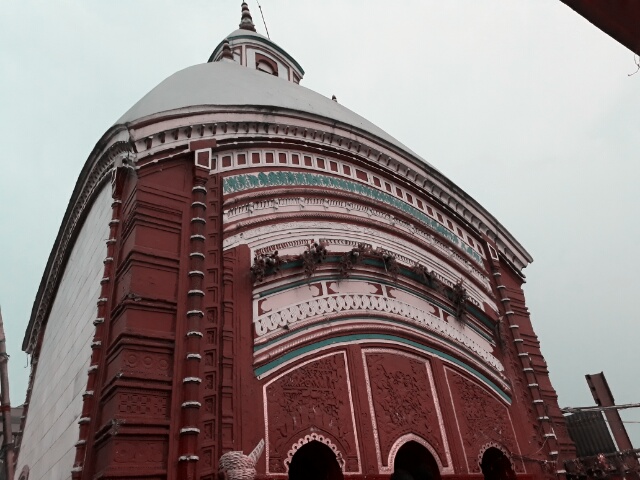
The current Tarapith temple structure, featuring eight roofs and constructed primarily from brick, was built in the Bengali year 1225 (approximately 1818 CE) by Ray, a devotee from the nearby village of Mallarpur, replacing an earlier temple that had suffered damage. Local legends also attribute significant patronage or renovation efforts in the late 18th century to , the queen of Natore, who funded religious constructions across , including contributions to Tarapith. A pivotal figure in the temple's 19th-century development was Bamakhepa (1837–1910), revered as the "mad saint" and a devoted Tantric practitioner of Goddess Tara. Born Bamacharan Chattopadhyay in the village of Atla near Tarapith, he renounced worldly life early, residing in the adjacent cremation ground (smashan) where he immersed himself in intense sadhana. Known for his unconventional behavior and reputed miracles—such as reviving dead birds and animals through divine intervention—Bamakhepa popularized Tara worship among the masses, emphasizing devotion over ritual orthodoxy. His samadhi shrine, a simple structure, stands close to the main temple and draws devotees seeking his intercession. In the post-independence era, Tarapith emerged as a prominent pilgrimage hub, with visitor numbers surging due to improved connectivity and growing spiritual tourism in West Bengal. The 20th century saw incremental expansions to handle increasing crowds, including structural reinforcements and auxiliary facilities in the 1990s. More substantial modernizations occurred in the 2010s and 2020s, with a major renovation phase costing ₹10.5 crore that involved marbling the inner floors, painting walls, tiling the roof, and erecting a new boundary wall; this was followed by a second phase of ₹6 crore in 2021 for restoring four subsidiary temples within the complex. Infrastructure enhancements, such as the development of a ring road by the Tarapith Rampurhat Development Authority, were initiated in the 2010s to alleviate traffic congestion and improve access for pilgrims, reflecting broader efforts to sustain the site's role as a key religious destination.

Geography and Environment

Physical Setting

Tarapith lies on low-lying plains in the of , , at an elevation of approximately 38 meters above . The area encompasses the , covering about 2.63 square kilometers, and is bordered to the south by the Dwarkeswar River, which serves as a vital water source for local rituals and agricultural activities. This features gentle slopes and flat terrain characteristic of the region's transitional landscape. The soil in and around Tarapith is predominantly alluvial in the Gangetic zone, with deep, medium-textured layers that are neutral to mildly alkaline and well-suited for rice cultivation, a staple crop in the region. Nearby semi-arid deciduous forests include species such as sal (Shorea robusta) and teak (Tectona grandis), contributing to the local ecosystem. The Dwarkeswar River supports a riverine habitat that fosters biodiversity, including aquatic flora and fauna adapted to seasonal flows. Lateritic soils also occur in parts of Birbhum, reflecting the district's varied pedology. Environmental challenges include occasional flooding from the Dwarkeswar River, with significant events in 2000, 2017, and 2024 impacting low-lying areas through overflow and sediment deposition. Conservation efforts for the river and surrounding aquifers have been implemented since 2015, focusing on groundwater management, , and sustainable resource use to mitigate these risks. Tarapith forms part of Birbhum's plateau, which gradually transitions eastward into the broader Gangetic plains, influencing its hydrological and geomorphic features.

Climate and Ecology

Tarapith lies within a zone, classified as Aw under the Köppen-Geiger system, featuring a pronounced and a prolonged dry period. The average annual temperature hovers around 25.9°C, with seasonal extremes ranging from a mild winter low of approximately 10°C to summer highs exceeding 40°C, where and intensify discomfort. Annual precipitation totals about 1,476 mm, concentrated almost entirely during the months of to September, when heavy downpours dominate the weather pattern. These seasonal dynamics significantly influence local practices and accessibility. Intense rains often cause flooding along the nearby Dwarkeswar River, disrupting river-based rituals and pilgrim movements, as seen in instances where inundations reduced temple attendance during key observances. In contrast, the dry winter season from to offers cooler, more stable conditions conducive to festivals and outdoor activities, making October through March the optimal period for visits when rainfall is minimal and temperatures remain comfortable. Ecologically, the Dwarkeswar River sustains diverse aquatic and avian life, including various species typical of southern Bengal's riverine systems—such as carps and catfishes—and birds like the , which thrive along its banks. However, the surrounding habitat contends with pressures from for and urban expansion, alongside river from agricultural runoff and . Conservation measures, spearheaded by the Tarapith temple and regional authorities since the early 2000s, include recycling programs to curb floral offerings' environmental impact and to preserve tree cover and mitigate ecological degradation. The prevailing humidity exacerbates temple maintenance issues, fostering growth on stone surfaces that requires regular intervention to prevent structural wear.

Demographics and Society

Population and Composition

Tarapith, located within Tarapur village, recorded a population of 5,143 in the 2011 Census of India. Based on Birbhum district's annual growth rate of about 1.5%, the resident population is estimated at approximately 6,300 as of 2025, supported by the local pilgrimage economy. With a land area of 3.05 square kilometers, the town reflects a population density of approximately 1,700 individuals per square kilometer amid its rural surroundings. The demographic composition is predominantly Hindu, reflecting the town's role as a key Hindu center. Residents are predominantly Bengali speakers, aligning with the linguistic profile of . The sex ratio is 958 females per 1,000 males (2011 ), while the literacy rate stands at 69.5%, slightly below the Birbhum district average of 70.7% (2011 ). Despite its village status, Tarapith maintains a blend of urban and rural traits, with substantial temporary influxes of pilgrims and sadhus periodically expanding the effective population during religious peaks.

Social Structure

The social structure of Tarapith revolves around its role as a prominent center, where religious duties and economic activities intertwined with devotion shape . The priestly community holds a dominant position, serving as the primary managers and performers of temple rituals, including the dressing and worship of the Tara. This Brahmin oversight extends to administrative functions within the temple complex, reflecting traditional hierarchies adapted to the site's Shakta focus. Complementing this are service castes involved in ancillary roles essential to rituals, such as purification and preparation services, alongside traders who sustain the local economy by supplying goods to pilgrims. A distinctive feature of Tarapith's social fabric is the semi-permanent residency of Tantric sadhus and Aghoris, who are drawn to the site's ground for esoteric practices and . These ascetics, often from diverse or marginalized backgrounds, contribute to a fluid social dynamic that contrasts with the structured temple hierarchy, fostering an environment where tantric traditions challenge conventional caste boundaries. Women play an active role in devotional expressions, particularly through participation in singing, which serves as a communal form of and emotional outlet amid the pilgrimage crowds. Since the early 2000s, there has been a noticeable rise in female pilgrims, reflecting broader trends in women's mobility and spiritual agency in Shakta sites. Social issues in Tarapith are tempered by the inclusive ethos of Shakta worship, which minimizes overt tensions by emphasizing devotion over rigid hierarchies; tantric elements further promote transcendence of norms, allowing participation from lower castes historically sidelined in orthodox settings. However, economic pressures lead to significant out-migration, particularly of young males aged 15–40, to urban centers like in search of employment opportunities beyond temple-related activities. Community governance is facilitated by the Tarapith Rampurhat Development Authority (TRDA), a that coordinates development, , and social awareness initiatives around the temple area, ensuring coordinated management of pilgrimage impacts. In recent years, modern transformations have emerged through initiatives led by local NGOs, which have gained momentum since 2010 and focus on enhancing women's status through skill-building and programs. These efforts address gender disparities by promoting access to and , gradually shifting traditional roles and integrating women more fully into community decision-making.

The Tarapith Temple

Architecture and Design

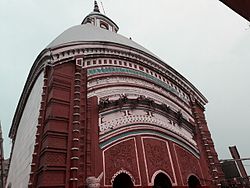
The Tarapith Temple exemplifies traditional Bengali temple , characterized by the do-chala style featuring a two-sloped that evokes the form of a thatched , adapted into a more elaborate structure rising to approximately 20 meters in height. Constructed primarily from locally sourced red bricks and mortar, the temple's is crowned with terracotta tiles that provide both aesthetic appeal and weather resistance, reflecting the regional adaptation to Bengal's humid climate. This design draws influences from the nava-ratna style, evident in the nine-spired configuration that adds vertical emphasis and symbolic multiplicity to the skyline. The temple's facades are richly ornamented with terracotta plaques, showcasing intricate carvings of scenes from the and alongside floral and geometric motifs, which serve to narrate epic narratives while enhancing the visual texture of the brickwork. At the core lies the , or inner sanctum, a compact chamber housing an ancient idol of Goddess Tara, positioned in a posture symbolizing maternal protection, with the idol's dark material underscoring its ancient and austere presence. The structure's elevated plinth, raised several feet above ground level, aids in mitigating flood risks during the monsoon season, contributing to the temple's enduring stability. Surrounding the main shrine is a spacious courtyard that includes subsidiary shrines, notably one dedicated to Lord Shiva, integrated seamlessly into the complex to complement the primary deity's . In the , the temple board oversaw the addition of protective boundary walls, enhancing security while preserving the site's historical integrity without altering its core architectural form. The overall design, maintained by the temple management committee, balances ornate detailing with functional simplicity, allowing the structure to withstand environmental challenges while retaining its cultural significance.

Deity Worship and Rituals

The central deity of the Tarapith Temple is Maa Tara, a manifestation of the Divine Mother revered as one of the ten Mahavidyas in Hindu Tantric traditions. The temple features two idols: an ancient stone image portraying Maa Tara in a nurturing form suckling Lord Shiva, and a metal idol depicting her in the traditional fierce form with a complexion symbolizing infinite space and transcendence, bulging eyes representing intense vigilance and mystical vision, and four arms holding symbolic items: a and scissors as weapons against ignorance and ego, a lotus signifying purity and enlightenment, while seated or standing upon a supine corpse that embodies victory over death and the cycle of samsara. This representation underscores her role as a protective savior who grants liberation and spiritual wisdom to devotees. The stone idol is often adorned with silver elements including prominent eyes, a protruding tongue, and ornate jewelry to emphasize her fierce yet compassionate nature. Daily worship rituals at the temple commence with the Aarti in the early morning; as of September 2025, the temple opens at 4:00 AM with the Aarti shortly after. Temple priests, adhering to Tantric customs, conduct a comprehensive 16-step puja known as Shodasha Upachara, which includes (avahana), ritual bathing (), offerings of paste, flowers, , lamps, (naivedya), and , culminating in aarti and distribution of sacred ash. Bhog offerings form a key part of these rituals, consisting of preparations, sweets like payesh, and non-vegetarian items such as mutton derived from sacrifices, presented as a gesture of complete surrender to the deity's tantric preferences. Animal sacrifices, primarily of goats, are an integral tantric practice symbolizing the offering of ego and impurities, performed daily but intensifying on auspicious days like Tuesdays, Fridays, and to invoke Maa Tara's blessings for protection and fulfillment of vows. The goats are ritually purified before the , with the meat later incorporated into communal bhog shared among devotees. Among the sacred items in the temple's sanctum is an eye-shaped , representing the third eye of cosmic insight and the origin myth of Tarapith as the site where Sati's eye fell, used in meditative worship to channel the goddess's visionary power. drawn from the nearby Dwarkeswar River, revered for its purifying qualities, is employed in ablutions during puja to cleanse the idol and devotees, believed to carry the river's healing and sanctifying essence despite modern purification efforts to address . Pilgrims seeking darshan of Maa Tara typically join queues that last 1-2 hours, especially during peak morning or evening hours, allowing time for reflection amid the temple's vibrant atmosphere of chants and bells. After darshan, prasad—often comprising blessed sweets, fruits, and portions of the offered bhog—is distributed to visitors, serving as a tangible to carry the goddess's grace into daily life. This structured experience fosters a deep communal bond, with the temple's housing the idol in a that enhances the intimacy of the encounter.

Tantric Traditions

Tantric Practices and Beliefs

Tarapith is renowned as a center for the worship of Goddess Tara in her fierce manifestation as Ugra-Tara, embodying the principles of or left-hand , which emphasizes the transgression of conventional boundaries to achieve spiritual liberation. In this tradition, Tara is revered as the bestower of , or supernatural powers, through disciplined practices that integrate the material and divine realms, aiming for the transcendence of ego and duality. Core beliefs center on the awakening of energy, visualized as a coiled serpent at the base of the spine, which rises through chakras via meditative visualization and ritual to unite with , symbolizing ultimate enlightenment. Tantric methods at Tarapith incorporate the , the five "M"s—madya (wine), mamsa (meat), (fish), (parched grain or gestures), and (sexual union)—employed either literally or symbolically to dissolve attachments and realize non-duality. Sadhana, or spiritual discipline, often occurs in isolated, liminal spaces conducive to intense , drawing from the tradition where practitioners use kapalas (skull bowls) for offerings to confront mortality and impurity directly. Key practices include japa recitation of Tara's bija , such as Om Hrīṁ Strīṁ Hūṁ Phaṭ, typically chanted 108 times daily with focus on a diagram representing the goddess's energetic form to invoke her presence and power. A pivotal historical figure in Tarapith's Tantric legacy is (1837–1910), the "Mad Saint" whose unorthodox methods challenged societal norms, such as consuming temple offerings intended for the goddess to demonstrate her all-pervading nature and the irrelevance of ritual purity. His approach exemplified Vamachara's emphasis on direct, ecstatic union with the divine, often through antinomian acts that integrated the profane into the sacred. In contemporary times, Tantric practices at Tarapith have adapted through regulated programs and courses offered by resident gurus, making aspects of sadhana accessible to sincere devotees while issuing warnings against superficial or exploitative misuse of esoteric . These modern frameworks emphasize ethical guidance and psychological to ensure safe pursuit of , preserving the tradition's depth amid growing pilgrimage traffic.

Role of the Cremation Ground

The Mahashmashan, or great ground, of Tarapith is located adjacent to the main temple, situated on the banks of the Dwarkeswar River, serving as an active Hindu site where pyres burn continuously around the clock. This perpetual activity underscores its role as a liminal space between , integral to the site's Tantric heritage. In Tantric traditions, the cremation ground holds profound symbolic importance, representing the impermanence of the material world and facilitating the mystical union of and Tara, where the goddess embodies transformative power over destruction and renewal. ascetics, known for their extreme practices, meditate here, incorporating human ashes into rituals to transcend dualities of purity and impurity, seeking direct communion with the divine through confrontation with mortality. The site was also the lifelong residence of the 19th-century Tantric saint , whose (memorial shrine) stands within the grounds, marking his legacy of unconventional devotion to Tara amid the pyres and shadows. Tantric sadhana at the Mahashmashan primarily occurs at night, often under ancient trees that provide seclusion for meditative practices and invocations, including offerings to wandering spirits (bhuta) to appease forces believed to inhabit the area. Daytime access is generally discouraged for non-practitioners and tourists to maintain sanctity and prevent disruptions to ongoing cremations or unregulated activities. This has positioned the site as a focal point for , drawing those intrigued by its eerie atmosphere and esoteric aura, though emphasis remains on respectful observance rather than intrusion.

Culture and Festivals

Major Festivals

Tarapith, a prominent Peetha dedicated to Goddess Tara, hosts several major annual festivals that draw massive crowds of devotees seeking her blessings for protection and spiritual fulfillment. These celebrations blend intense Tantric rituals with communal fervor, emphasizing the goddess's role in dispelling fear and granting wisdom. The most significant events occur during Kali Puja, Durga Puja and Navaratri, Tara Jayanti, and Kaushiki Amavasya, each marked by elaborate pujas, offerings, and cultural expressions that highlight the temple's Tantric heritage. Kali Puja, observed in October or November on the new moon night of Kartik, transforms Tarapith into a vibrant hub of devotion with night-long vigils and grand aarti ceremonies that illuminate the temple complex. Devotees participate in Tantric rituals, including animal sacrifices as per longstanding temple traditions—though increasingly symbolic in some practices—to invoke Maa Tara's fierce protective energy. The festival attracts lakhs of pilgrims, creating an atmosphere of collective ecstasy and spiritual intensity. Durga Puja and , celebrated in September or October during the waxing moon phase of Ashwin, feature nine days of special rituals honoring Maa Tara as a manifestation of Durga's power. The festivities culminate in idol immersions in the nearby Dwarkeswar River, accompanied by cultural programs such as and performances that reflect Bengal's artistic traditions. These events underscore Tara's compassionate aspects, drawing families and artists to the site for immersive worship. Tara Jayanti, marking the goddess's birthday in March or April on Chaitra Shukla Navami, involves joyous birthday celebrations with temple adornments, fairs, and devotional music that fill the air around the cremation grounds. Special pujas and processions honor her emergence as a Mahavidya, attracting crowds eager for her liberating grace. Throughout the year, Amavasya nights, particularly Kaushiki Amavasya in August or September, host intensified rituals like midnight offerings and Tantric meditations, believed to open portals for spiritual enlightenment. Kaushiki Amavasya stands out as the temple's largest gathering, with four to five lakh devotees converging for these nocturnal ceremonies. To manage the massive influx during these peaks, authorities have implemented enhanced measures since the , including temporary camps for pilgrims, increased police deployment, and traffic controls following earlier challenges. The district administration coordinates with the temple committee to ensure , providing medical aid stations and regulated access routes.

Local Customs and Arts

Devotional and sessions form a vital part of daily life in Tarapith, where local communities and pilgrims gather to sing hymns praising Goddess Tara, fostering a sense of communal devotion. Pilgrims routinely perform purifying baths in the nearby (also known as the Dwarka River), believing the waters cleanse the body and spirit before temple visits; this practice draws hundreds of thousands annually, especially during auspicious periods like Kaushiki Amavasya. Oral folk tales recounting Tara's miracles, such as granting boons to devoted saints like , are shared among residents and visitors, reinforcing the site's mystical legacy through generational storytelling. Terracotta crafting thrives in the region, with artisans creating intricate plaques for temple decorations that depict scenes from Puranic lore, exemplifying Birbhum's vernacular architectural heritage. Baul music, a wandering folk tradition of , often incorporates Tara themes in its mystical lyrics, as performed by singers like Kanai Das Baul near the temple, blending devotion with poetic expressions of inner seeking. Local markets around Tarapith feature , mat , and basketry crafted by Birbhum artisans, offering practical and decorative items that sustain community livelihoods and cultural identity. Ritual cuisine emphasizes khichuri, a simple rice-lentil dish served as vegetarian prasad to pilgrims, alongside non-vegetarian options like derived from offerings, prepared in traditional Bengali styles to symbolize shared blessings. Preservation efforts shine during community festivals like the local Rath , where traditional dances accompany processions, celebrating Tara's grace and maintaining folk amid modern influences.

Economy and Tourism

Local Economy

The local economy of Tarapith is predominantly shaped by the pilgrimage activities centered around the Tara temple, which generates substantial employment in the services sector, including hotels, shops for puja items, and tourist guides. Numerous puja item dealers operate in the area, supplying essentials like , beads, and accessories to pilgrims, contributing to daily trade and livelihoods. A 2012 study on highlights that such activities significantly boost employment, with 80% of local respondents reporting high positive impacts and over 58% of the community participating directly in tourism-related roles. This sector also promotes female employment, noted by 46% of respondents as a key benefit. These activities provide alternatives to traditional agrarian work. Agriculture remains a foundational pillar, engaging a substantial portion of the workforce and supporting for residents. In Rampurhat II (which includes Tarapith), agricultural laborers comprise about 57.3% of workers as per the 2011 census, focusing on paddy cultivation, which dominates 94% of the kharif-season cropped area in . are grown along the fertile riverbanks of the Dwarkeswar River, while small-scale in the same river supplements incomes, particularly during off-seasons for pilgrimage. These primary activities ensure year-round sustenance but face limitations in scalability due to land constraints and reliance on monsoon patterns. Trade in souvenirs, such as small idols of Goddess Tara and , thrives in local markets, catering primarily to visiting devotees and adding to the service-oriented economy. Remittances from migrant workers, many of whom seek opportunities in urban centers during lean periods, provide additional to households. However, the economy grapples with seasonal fluctuations tied to peaks during festivals like , leading to inconsistent incomes for service providers and underutilization of infrastructure otherwise. Development initiatives, supported by temple funds and infrastructure grants, aim to mitigate these challenges through enhancements like improved roads and facilities in the 2020s, fostering more stable . The Tarapith Rampurhat Development Authority oversees such projects to bolster both pilgrimage services and agricultural support systems.

Tourism and Visitor Facilities

Tarapith serves as a prominent spiritual hub, drawing visitors primarily for darshan at the Tara Temple, where devotees seek blessings from the goddess. Guided tours to the nearby Maha Smashan cremation ground offer insights into its tantric significance, while excursions to the Bakreswar Temple, approximately 50 km away, provide additional historical and religious exploration. enthusiasts can partake in serene walks along the banks of the Dwarkeswar River, enhancing the pilgrimage with tranquil natural surroundings. Accommodation options in Tarapith exceed 50, encompassing budget dharamshalas and mid-range hotels such as and , catering to diverse traveler needs with basic amenities. Local eateries specialize in authentic Bengali thalis featuring rice, fish , and vegetarian dishes, ensuring accessible and culturally immersive dining. For medical assistance, the nearest facilities are located in , about 6 km away, supporting visitor health requirements. Visitors are advised to follow a modest , covering shoulders and knees to respect temple , and to avoid venturing alone at night, particularly near the cremation ground, for . Advance bookings are essential during peak seasons like festivals to secure lodging, while eco-tourism efforts, initiated in 2015 through the Birbhum heritage circuit, promote sustainable practices around sites like Tarapith. Tourism in Tarapith has seen steady growth, with thousands of non-pilgrim visitors annually, augmented by digital booking apps and organized tour packages that facilitate easier access via nearby routes from and .

References

Add your contribution
Related Hubs
User Avatar
No comments yet.