Hubbry Logo
YatraYatraMain
Open search
Yatra
Community hub
Yatra
logo
8 pages, 0 posts
0 subscribers
Be the first to start a discussion here.
Yatra
Yatra
from Wikipedia

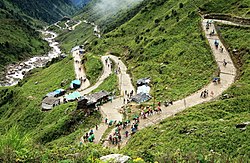
Pilgrimage to Kedarnath

Yatra (Sanskrit: यात्रा, lit.'journey, procession', IAST: Yātrā), in Indian-origin religions, Hinduism, Buddhism, Jainism and Sikhism, generally means a pilgrimage[1] to holy places such as confluences of sacred rivers, sacred mountains, places associated with Hindu epics such as the Mahabharata and Ramayana, and other sacred pilgrimage sites.[2] Visiting a sacred place is believed by the pilgrim to purify the self and bring one closer to the divine.[3] The journey itself is as important as the destination, and the hardships of travel serve as an act of devotion in themselves.[4]

A tīrtha-yātrā is a pilgrimage to a sacred site.[5] Yatri is the term for anyone who undertakes the yatra.[5]

In present times, yatras are highly organized affairs, with specialized tourism companies catering to yatris. State governments are sometimes involved in the organization of annual yatras, stipulating numbers, registering yatris, and regulating yatri traffic.[6][7] The Hindu sacred month of Shravan is also the time of the annual Kanwar Yatra, the annual pilgrimage devotees of Shiva, known as Kanwaria, make to Hindu pilgrimage places of Haridwar, Gaumukh and Gangotri in Uttarakhand to obtain water from the Ganges River. In 2003, 55 lakh (5.5 million) pilgrims visited Haridwar.[8] Other Tirtha pilgrimages are Char Dham Yatra, which involves Badrinath, Kedarnath, Gangotri, and Yamunotri; Amarnath yatra in Jammu and Kashmir.

There are numerous pilgrimage sites in India[9] and elsewhere.

Types of yatras

[edit]

Reasons for going on a yatra may be in response to one's prayers being fulfilled.[10]

In order of importance, in India there are 7 Sapta Puri holy cities, 4 Dhams (Char Dham) and 12 Jyotirlings devoted to Shiva, 51 Shakti Pithas devoted to the feminine manifestation of the god, and the important Rama circuit (Ayodhya, Chitrakoot, Hampi and Rameswaram) and Krishna circuit (Braj, Kurukshetra and Dwarka).

Holiest cities: Sapta Puri are Ayodhya, Mathura, Haridwar, Varanasi, Kanchipuram, Ujjain and Dwarka.[citation needed] Kurukshetra, includes Jyotisar where Bhagavad Gita was revealed, is another holy city.[citation needed]

Holy rivers: The ghats of holiest rivers are sacred, including Ganges, Yamuna, Sarasvati River (Ghaggar River), Narmada etc.[citation needed]

Holy mountains: such as Mount Kailash,[11] Badrinath, Kedarnath, Gangotri, and Yamunotri, Sarasvatotri, etc.

Holy tirthas (places): such as Char Dham and Himalayan Chota Char Dham (Badrinath, Kedarnath, Gangotri, and Yamunotri),[12] and Varanasi, Prayagraj, Haridwar-Rishikesh, Mathura-Vrindavan, Ayodhya, Ujjain, Dwarka and Rameswaram.[13] See also Tirtha and Kshetra. Shakambhari temple Saharanpur, Uttar Pradesh

Holy fairs and Hindu festivals: The Kumbh Mela (the "pitcher festival") is one of the holiest of Hindu pilgrimages that is held four times every 12 years[14] rotating among the four cities of Prayagraj, Haridwar, Nashik, and Ujjain. The Mahamaham in temple town of Kumbakonam is also celebrated once in 12 years. Annual Gita Mahotsav at Kurukshetra, Shravani Mela at Deoghar, and Pitrapaksha Mela at Gaya are also notable holy fairs.

Holy temples: Examples are the Char Dham of Rameswaram, Dwarka, Puri and Badrinath; Katra, home to the Vaishno Devi temple; Puri home to Vaishnava Jagannath temple and Rath Yatra celebration;[15] Tirumala - Tirupati, home to the Tirumala Venkateswara Temple; Sabarimala home to Swami Ayyappan; the 108 Divya Desams; the Shakti Peethas; the twelve Maha Jyotirlingas; the seven Sapta Puri; the Pancha Bhoota Stalam.

Holy processions: 'Yatra' can also be described as a procession, or any festival which figures a procession, such as Kanwar Yatra and Rath Yatra. In Rath Yatra, chariots are pulled in parade down the streets of Puri in Orissa. In modern times the word can be used to denote marches or demonstrations, for political, environmental or societal causes.[16][17][18] The terms 'jatra' and 'zatra' are derived from yatra.

Holy deities: Kuladaivat Hindu families have their own family patron deity.[19] This deity is common to a lineage, a clan or a locality.

Samadhis (shrines) of Sadhus (Saints): Alandi, Samadhi of Dnyaneshwar: Mantralayam, samadhi of Raghavendra Tirtha, Belur Math which enshrine that Holy remains of Sri Ramakrishna, Sri Sarada Devi, Swami Vivekananda Puri, and other direct Disciples of Sri Ramakrishna, Tulsi Ghat, Varanasi where Saint Tulsidas left his mortal coil, Samadhi Mandir of Saint Kabir at Gorakhpur, near Varanasi, Panchaganga Ghat, Varanasi where Trailanga Swami lived and left his mortal body, Karar Ashram, Puri where Swami Sri Yukteswar Giri, attained the Mahasamadhi.[20]

Important national pilgrimage circuits of Indic-religions

[edit]

A yatra or pilgrimage across a much larger area covering multiple faraway cities or sites, related to a specific deity or theme, are called the "circuit". Three most important Hindu-Buddhist "Rahtriya yatra" (national pilgrimage circuit) are related to the important figures such as Rama, Krishna, Buddha, and Guru Nanak, where they had personally visited are as follows.

Famous yatras

[edit]

48 kos parikrama of Kurukshetra

[edit]
48 kos parikrama route related to Krishna and Mahabharata in and around Kurukshetra in Haryana.

48 kos parikrama of Kurukshetra, phrase meaning a 48 kos circumambulation parikrama of various Mahabharata-related and other pilgrimage sites, around the holy city of Kurukshetra in the state of Haryana, India.[21][22][23][24] Within Kurukshetra, along with Brahma Sarovar, other important sites are Jyotisar (place of "Gitaupadesha" - the first Upadeśa or discourse of Bhagavad Gita by Krishna)[25][26] and Sannihit Sarovar (Hindu genealogy registers of Kurukshetra are kept here).[27] Since this is a site associated with the Mahabharata, it is an important place of pilgrimage for Hindus. It is one of 3 main pilgrimage sites related to "Krishna" circuit. The other two being, "Braj parikarma" in Mathura, Uttar Pradesh and "Dwarka parkarma" (Dwarkadish yatra) at Dwarkadhish Temple in Gujarat.

84 Kosi Parikrama

[edit]

The 84-Kosi Yatra is a tradition in Hindu religion that has been there for thousands of years with the belief that it gives deliverance to the performer from the cycle of 84-Lakh Yonis (the cycle of birth and death). According to Hindu belief, the king of Ayodhya performed the "yagna" in the "treta period" at a place in Makhurha in Basti district of Uttar Pradesh which included circumnavigating the six districts in the region. Some religious leaders believe that the right place to start the parikrama should be Basti instead of Ayodhya. According to some, the dates for 84-Kosi Yatra are fixed and takes place in the month of Chaitra.

Mithila Madhya Parikrama

[edit]

Mithila Madhya Parikrama is an annual fifteen days journey of the central part of ancient Mithila. It is the ancient circular circuit of the capital city of Mithila. In Treta Yuga, Lord Rama and Princess Sita took a circle journey of the capital of Mithila after their marriage in the court of King Janaka in Mithila. This Yatra is held every year in the month of Falgun in Hindu calendar.

Sitamarhi Dham Parikrama

[edit]

Sitamarhi Dham Parikrama is an annual nineteen days spiritual journey of some Hindu religious destinations in the region of the Sitamarhi district. It is organised to aware the importance of the Janaki Navami festival.

Amarnath Yatra

[edit]
Pilgrims crossing a narrow bridge to the holy shrine of Amarnath.

The Amarnath Temple in Jammu and Kashmir is dedicated to Shiva, one of the trinity of gods. The temple is on Amarnath Peak, and is among the most famous shrines in Hinduism. Every year inside the main Amarnath cave an ice Shiva lingam forms, along with two other ice formations representing Ganesha and Parvati. Amarnath yatra is held every year to pay homage to Shiva and Parvati. The temple is a very popular yatra destination for Hindus; about four lakh people visit during the season.

Brij Yatra

[edit]
Kesi Ghat in vrindavan in the Yamuna River.

Vraja Parikrama circuit of pilgrimage was formally established by the 16th century sadhus of vaishnava sampradaya with fixed routes, itinerary and rituals. The circuit covers is spread across 2500 km2 area with 84 kos or 300 km long periphery extending 10 km to east and 50 km to north and west. Braj has two main types of pilgrimage circuits, the traditional longer "Braj Yatra" encompassing the whole circuit, and the other shorter significantly modified contemporary point-to-point pilgrimage to visit the main sites at Mathura, Vrindavan, Gokul, Govardhan. The former, longer traditional pilgrimage route, also includes additional sacred sites Nandgaon and Barsana with travel on foot.[28]

Char Dham Yatra

[edit]

The Chardham or "four divine abodes" includes four major pilgrimage places in India. These include Badrinath in the Himalayas, Dwarka in the west, Jagannath Puri in the east, and Rameshwaram in the south.[5] The Char Dham is often considered the most revered sites for Hindus that have to be visited in one's lifetime. There is a Chota Char Dham as well includes Yamunotri, Gangotri, Badrinath, and Kedarnath situated in Garhwal Himalayas.

Deoghar Yatra

[edit]

Deoghar means abode of the gods and goddesses. It is also known as Baidyanath Dham or Baba Dham situated on the eastern side of Jharkhand. The Baidyanath Temple is located here containing one of the twelve Shiva Jyothirlingams in India.[5] The pilgrims carry the holy water of holy river Ganges from Sultanganj's and offered to the Jyotirlingam of Shiva at Deoghar. These pilgrims called Kanwariya, reciting Bol Bam on the way of walk 109 km, The march of Kanwariya start during the holy month of Shravan the wet season each year in India. Shravani Mela is the most celebrated 30-day festival in Baidyanath Temple Temple of Jharkhand.

Kailash-Mansarovar Yatra

[edit]

Mansarovar is a fresh-water lake in Tibet near Mount Kailash, and both are places of pilgrimage attracting religious people from India and neighboring countries. The mountain is considered a sacred place in four religions: Hinduism, Buddhism, Jainism, and Bon. According to Hindu mythology mount Kailash is the abode of Shiva and circumambulating Mount Kailash on foot is a holy ritual.[5] Another lake called Lake Rakshastal lying close to the west of Lake Manasarovar and The Great Mount Kailash. These lakes are the source of the Brahmaputra River and the Karnali River, a tributary of the river Ganges.

Kanwar Yatra

[edit]

The Kanwar Yatra is an annual pilgrimage of devotees of Shiva, known as Kānwarias, to Hindu pilgrimage places of Haridwar, Gaumukh and Gangotri in Uttarakhand and Sultanganj in Bihar to fetch holy waters of Ganges River. Millions of participants gather sacred water from the Ganga and carry it across hundreds of miles to dispense as offerings in their local Śhiva shrines, or specific temples such as Pura Mahadeva and Augharnath temple in Meerut, and Kashi Vishwanath, Baidyanath, and Deoghar in Jharkhand.[29]

Kashi yatra

[edit]

At Kashi Yatra, it is customary for every Hindu to undergo Kashi yatra on barefoot. Pilgrims also visit Gaya to do Gaya Shraddha to their ancestors. Details regarding how to perform various rituals, the greatness of Kashi Kshetra.[30] Importance of Kashi yatra is said in Kasi-Khand of Skanda Purana.[clarification needed]

Pandharpur yatra of Maharashtra

[edit]

Pandharpur yatra is one of the most popular festivals in India.[citation needed] The annual yatra to the famous Vithoba temple at Pandharpur is held every year during the month of June and July. Thousands of pilgrims come to Pandharpur carrying litters with the images of Jñāneśvar from Alandi, Tukaram from Dehu, Eknath from Paithan, and Nivruttinath from Trimbakeshwar. These pilgrims are referred to as Varkaris.

Ratha Yatra

[edit]

Among the Ratha Yatra at various sacred sites, the most popular one is Jagannath Rath jatra at Puri in Odisha. Other popular Rath Yatras are Dhamrai Jagannath Roth, Rathayatra of Mahesh, Manipur Ratha Yatra in Manipur which was started in 19th century and ISKCON Ratha Yatra in more than 100 places across the world.

The Festival of Chariots of Jagannatha is held every year at Puri in the state of Orissa. The ten-day ratha yatra commemorates Jagannath's annual visit to Gundicha Mata's temple a short distance away. Thousands of pilgrims come to Puri during the festival with a desire to help pull Jagannath's chariot with ropes. This is the only day when devotees who are normally not allowed in the temple premises, such as non-Hindus and foreigners, can get their glimpse of the deities.

[edit]

See also

[edit]

References

[edit]
[edit]
Revisions and contributorsEdit on WikipediaRead on Wikipedia
from Grokipedia
Yatra (Sanskrit: यात्रा, lit. 'journey') refers to a sacred in Indic religions, particularly , undertaken by devotees to holy sites known as tirthas, which are often associated with rivers, mountains, or temples believed to possess spiritual potency for purification and divine connection. These journeys, termed tirthayatra, symbolize a metaphorical crossing from the mundane to the sacred, fostering inner transformation and atonement for sins through rituals such as bathing in holy waters and offerings at shrines. Historically rooted in Vedic traditions, yatras have served as a unifying force across India's diverse regions, preserving cultural and religious practices while testing the pilgrim's faith through arduous travels. The practice is considered a punya karma (meritorious act), promoting mental , spiritual growth, and proximity to the divine, with scriptures emphasizing its role in elevating and fulfilling vows. Prominent examples include the Char Dham Yatra encompassing , , , and , representing the four cardinal directions, and the , a massive gathering at sites like and for ritual bathing to cleanse karma. Other significant circuits feature the 12 Jyotirlingas, self-manifested forms of , and the Amarnath Yatra to a Himalayan ice , drawing hundreds of thousands of pilgrims annually (over 500,000 in 2024) despite environmental challenges. In contemporary times, yatras blend tradition with modern logistics, such as organized tours, while retaining their core emphasis on devotion and self-discipline.

Overview and Etymology

Definition and Meaning

Yatra, derived from the word yātrā, fundamentally denotes a "journey" or "" undertaken to sacred sites known as tirthas, which are revered as fords or crossings facilitating spiritual transition in . This practice centers on devotion and inner transformation, where the act of traveling to these holy locales serves as a means of spiritual purification, allowing pilgrims to cleanse accumulated sins (paapa) and foster a deeper connection with the divine. Unlike secular tourism focused on leisure or sightseeing, Yatra demands intentional and disciplined conduct, all oriented toward accumulating punya (merit) that advances the soul toward (liberation from the cycle of rebirth). Central to the Yatra experience are ritualistic elements that enhance its sacred nature, such as to discipline the body and mind, chanting of mantras to invoke , and —the clockwise circumambulation of temples, mountains, or rivers to symbolize the soul's encircling reverence for the cosmos. These practices underscore Yatra's role as a holistic endeavor, blending physical exertion with meditative focus to transcend worldly attachments and attain mental purity (chitta shuddhi). While rooted in Hinduism, the term and tradition of Yatra find parallels in Buddhism and Jainism, where analogous pilgrimages to shared sacred destinations like Mount Kailash promote ethical reflection, karmic purification, and enlightenment. Forms of Yatra vary, from solitary foot journeys (padayatra) emphasizing endurance to communal processions, each reinforcing the pilgrimage's devotional essence.

Historical and Linguistic Origins

The term yatra originates from the root , signifying "to go" or "to proceed," which by the had expanded to encompass not only physical travel but also ritualistic journeys and sacred processions associated with spiritual merit. This evolution reflects the integration of mobility with devotional practices in early Indic traditions, where yātrā denoted both mundane marches and festivals honoring deities, as seen in texts like the Bṛhatsaṃhitā. In linguistic terms, the -trā reinforces the notion of a structured path or instrument of progression, distinguishing it from mere wandering to purposeful traversal toward holiness. Earliest textual references to yatra as ritual journeys appear in the Rigveda, where the praise of the "wanderer" (caran) evokes nomadic ascetics traversing sacred landscapes, and in the , which conceptualize tirtha—a key element of yatra—as a metaphorical "crossing over" from worldly existence to spiritual realization. These foundational Vedic hymns, dating to around 1500 BCE, highlight the Sapta Sindhu—the seven rivers of the northwest—as focal points for such journeys, underscoring rivers' role in purification rites. The concept gains elaboration in the 's , where , in discourse with , details the virtues of visiting numerous tirthas, portraying yatra as a means to accumulate punya (merit) through immersion at holy fords and shrines. The yatra notion influenced adjacent linguistic traditions, with adoption in for Buddhist concepts, as evidenced in the where yatra functions adverbially to denote spatial or causal journeys akin to doctrinal travels to enlightenment sites. This cross-linguistic permeation facilitated shared pilgrimage frameworks across Indic religions, adapting the root to vernacular expressions of devotion. Prehistoric contexts suggest proto-tirthas emerged at natural confluences and elevated terrains, where archaeological evidence from sites along ancient river systems—like the Sarasvati basin—indicates ritual gatherings predating Vedic codification, linking early human settlements to emergent sacred geographies. peaks and river forks, revered in later traditions, likely served as proto-sanctuaries for communal rites, as inferred from Indus Valley artifacts showing of water sources and highlands.

Religious and Cultural Significance

Role in Hinduism

In Hinduism, yatra, particularly tirthayatra, holds profound spiritual significance as a means to accumulate punya (merit) and facilitate progress toward moksha (liberation from the cycle of rebirth). Pilgrims believe that visiting sacred sites, known as tirthas, allows for darshan (auspicious sighting of the divine), which purifies the soul and removes accumulated sins (papa nashana), thereby enhancing spiritual growth and averting negative karma. For instance, bathing in holy rivers like the Ganga is thought to absolve sins equivalent to those washed away by a thousand lifetimes of austerity, as described in ancient texts. Socially, yatra fosters community bonding and transcends barriers, enabling participants from diverse backgrounds to share rituals and journeys, which promotes cultural exchange and social cohesion. During processions and group travels, such as those in the Mela, pilgrims form temporary communities that emphasize equality, allowing lower castes to participate more freely and challenging rigid social hierarchies through shared devotion. This communal aspect strengthens interpersonal ties and reinforces collective Hindu identity beyond everyday divisions. Ritualistically, Hindu yatra incorporates practices like snana (sacred bathing), (mantra repetition), and dana (acts of charity), often guided by gurus who provide spiritual direction and ensure adherence to traditions. At tirthas, pilgrims perform snana to cleanse both body and spirit, followed by for meditative focus and dana to offer gifts to priests or the needy, amplifying the journey's purifying effects. Gurus play a pivotal role in interpreting scriptures and leading groups, as seen in historical assemblies like those organized by . These elements are prescribed in texts such as the and , which detail their efficacy at sacred sites. Philosophically, yatra aligns with dharma (righteous duty) and bhakti (devotional love), serving as a practical expression of Hindu cosmology where physical travel mirrors the soul's journey toward divine union. The Puranas, including the Brahma Purana, extol yatra as a superior form of worship that fulfills one's dharma by generating punya and advancing bhakti, ultimately aiding in the transcendence of worldly attachments for moksha. This framework underscores yatra not merely as a ritual but as an integral path to ethical living and spiritual enlightenment.

Significance in Buddhism and Jainism

In Buddhism, yatra, or pilgrimage, serves as a profound practice for tracing the key events of the Buddha's life, fostering and reflection on the impermanence of all phenomena. Pilgrims visit sites such as , where the Buddha attained enlightenment under the Bodhi tree, to inspire personal awakening and recognize the inherent potential for liberation within oneself. This journey emphasizes ethical conduct and meditative contemplation over mere ritual accumulation of merit, aligning with the 's teachings on personal effort toward ending suffering. The himself recommended visiting four primary sites—Lumbini, , , and —to cultivate devotion and merit leading to positive rebirths, yet the core focus remains on internal transformation through awareness of dukkha (suffering) and anicca (impermanence). In Jainism, yatra takes on a distinctive role centered on commemorating the footprints of the tirthankaras, the enlightened ford-makers, to reinforce the principle of ahimsa (non-violence) and facilitate the purification of the soul. These pilgrimages encourage practitioners to embody non-violence toward all living beings, viewing the journey itself as a disciplined act that burns away karmic particles through austerity and self-reflection. Circuits to Siddha Kshetras, sacred locales where tirthankaras achieved final liberation, symbolize the ultimate shedding of karma (nirjara), allowing the soul to ascend to a state of eternal bliss free from rebirth. Unlike more ritualistic approaches, Jain yatras demand strict asceticism, often incorporating contemplation of rigorous practices for karmic purification. While rooted in shared ancient Indian concepts of tirtha as sacred fords across samsara, yatras in adapt these for lay devotees beyond monastic confines, promoting interfaith harmony through multi-faith journeys like the Kailash yatra. , revered in both traditions— as a site of Demchok in and liberation for the first in —draws pilgrims from diverse backgrounds, underscoring unity in the pursuit of spiritual elevation. Doctrinally, Buddhist yatras prioritize ethical living and to realize , contrasting with Jain emphases on rigorous (austerities) for karmic purification, yet both extend devotional access to ordinary practitioners seeking transcendence.

Historical Development

Ancient References in Scriptures

The , one of the earliest Vedic texts, contains allusions to sacred river pilgrimages, where rivers like the Sarasvati are invoked as divine entities and crossing points (tirthas) symbolizing spiritual purification and merit accumulation. The term tirtha appears in various Rigvedic hymns, referring to fords on rivers as sites of and divine encounter, laying foundational concepts for later yatra traditions. In the epic , the Vana Parva's Tirtha-yatra Parva provides detailed accounts of pilgrimage circuits, narrating the ' journey to over 200 tirthas across , emphasizing their spiritual rewards and the merits of visiting rivers, mountains, and forests. This section, spanning chapters 80–117, catalogs tirtha mahatmyas (glorifications) that prescribe parikramas, including the of described as a sacred encompassing Vedic-era sites linked to the events, conferring immense punya (merit) to pilgrims. Puranic literature expands these ideas, with the narrating the manifestation of the 12 Jyotirlingas as self-arisen lingas of , serving as primary yatra destinations for devotees seeking liberation through darshana (vision) and ritual circuits. Similarly, Puranic literature, particularly the and , elaborates on the 51 Shakti Peethas, sites where parts of Devi's body fell, forming a network of yatra goals that integrate Shaiva and Shakta traditions, as detailed in extensive tirtha-khandas glorifying southern and eastern pilgrimages. Regional texts further illustrate ancient yatra practices; Tamil Sangam literature, such as the and Akananuru, references southern journeys to sacred hills like Tiruparankunram and riverine shrines dedicated to Murugan and Kotravai, portraying devotional travel as integral to heroic and ethical life. In Buddhist traditions, the recount the Bodhisattva's past-life journeys, such as the Vessantara Jataka's depiction of exile and moral wanderings to remote realms, inspiring later Buddhist pilgrimage routes to sites of the Buddha's previous births.

Evolution Through Medieval and Modern Periods

In the medieval period, Adi Shankaracharya played a pivotal role in consolidating yatra practices during the 8th century by establishing the pilgrimage circuit—comprising , , , and Rameshwaram—to foster unity among diverse Hindu sects amid fragmentation from Buddhist and Jain influences. He further institutionalized this unification by founding four mathas (monasteries) at strategic locations corresponding to the sites, serving as centers for propagation and organizing monastic orders like the Dashanami Sampradaya to standardize rituals and pilgrimage routes across . These initiatives transformed yatras from sporadic local journeys into structured networks that reinforced Hindu philosophical coherence and cultural integration. During British colonial rule, restrictions on mass gatherings curtailed large-scale yatras, shifting emphasis to localized practices to maintain public order and prevent potential unrest. Policies such as pilgrim taxes at sites like the Temple in and surveillance of crowds exemplified this control, reducing the scale of pan-Indian circuits while imposing bureaucratic oversight on religious mobility. In the , reformers like revived yatra traditions through the movement, emphasizing Vedic purity and rational worship to counter colonial-era dilutions, thereby encouraging pilgrimages as vehicles for social reform and Hindu resurgence. In the modern era, the Indian government has facilitated yatras through infrastructure enhancements, notably the PRASHAD (Pilgrimage Rejuvenation and Spiritual Heritage Augmentation Drive) scheme launched in 2014-15 by the Ministry of to develop amenities at over 40 sites, including better roads and . For Himalayan yatras like and Amarnath, helipad constructions since the early 2000s have enabled services, reducing trek durations and accommodating elderly pilgrims amid challenging terrain. Online registration portals, mandated by state governments such as Uttarakhand's since 2016, streamline access and manage crowds via e-permits, enhancing safety and logistics for millions of annual participants. As of 2025, the Kailash Mansarovar Yatra has reopened for Indian pilgrims after a five-year suspension, while the 2024 Yatra saw over 4 million participants, highlighting continued growth amid infrastructure improvements. Contemporary yatras face significant challenges, including from , which has led to and waste accumulation along routes like the . , driven by operators, has inflated costs and commodified sacred sites, eroding traditional spiritual focus. Safety issues persist, exemplified by the 2013 Kedarnath floods that devastated yatra infrastructure, killing over 5,000 and necessitating route reconstructions that highlighted vulnerabilities to climate-induced disasters.

Types of Yatra

Tirtha Yatra and Pilgrimage Circuits

Tirtha Yatra refers to structured to sacred fords or crossings, known as tirthas, which are revered in as liminal spaces where the earthly realm intersects with the divine, enabling spiritual purification and transcendence. The term "tirtha" derives from roots meaning "ford" or "crossing place," symbolizing a passage across a river or metaphorical boundary to access heightened spiritual efficacy, particularly at sites like river confluences where waters merge to amplify ritual potency. These locations, such as the at , are believed to concentrate cosmic energies, allowing pilgrims to wash away sins and accumulate multiplied merit from religious acts performed there. Tirthas are classified into categories based on their nature, with sthavara tirthas denoting fixed, immovable sites like rivers, mountains, or temples that serve as permanent anchors of sanctity, and jangama tirthas referring to movable embodiments of holiness, such as gurus or wandering ascetics who carry spiritual power to various locales. This distinction underscores the dynamic geography of Hindu , where sthavara sites provide stable destinations for yatra, while jangama elements personalize the journey through encounters with living teachers. A third category, manasa tirthas, encompasses mental or internal pilgrimages focused on devotion without physical travel, though tirtha yatra emphasizes corporeal movement to these physical thresholds. Pilgrimage circuits, or multi-site loops, form the core structure of tirtha yatra, linking networks of sacred places to yield comprehensive spiritual merit equivalent to visiting a single supreme tirtha. The circuit encompasses seven holy cities—, , , Kashi (), , , and —each associated with divine manifestations and believed to collectively grant , or liberation from the cycle of rebirth, upon completion. Pilgrimages to the 18 Ashtadasha Shakti Peethas, shrines dedicated to forms of marking locations where parts of Sati's body fell, which devotees visit for protection, prosperity, and divine communion. These circuits encourage systematic traversal, often spanning regions of , to harness the cumulative sanctity of interconnected tirthas rather than isolated visits. Ritual protocols in tirtha yatra emphasize sequential visits to circuit sites, culminating in , or , which reinforces the journey's sanctity through directional symbolism. is performed , aligning with the sun's path in the to invoke auspiciousness and facilitate energy absorption from the , symbolizing the devotee's encircling devotion around the divine center. This , integrated into the circuit's progression, purifies the pilgrim's body and mind, enhancing the merit accrued from in tirtha waters or offering prayers at each stop. Walking remains a prevalent mode for these circuits, underscoring physical as a meditative practice. Interfaith circuits emerge in regions where Indic religions overlap, allowing shared access to tirthas that hold significance across traditions. For instance, the Kailash Mansarovar circuit in the serves as a unified pilgrimage route for , Buddhists, Jains, and adherents, with the mountain and lake embodying cosmic centers that transcend sectarian boundaries for collective spiritual renewal. Such shared paths highlight the inclusive of tirtha yatra, where overlapping sacred narratives foster interreligious during sequential visits.

Padayatra and Processional Forms

Padayatra, or foot pilgrimage, is a revered form of in that embodies humility, devotion, and self-imposed , allowing pilgrims to traverse sacred paths on foot as an act of spiritual discipline and purification. This mode of travel underscores the belief that physical exertion mirrors inner renunciation, fostering a deeper connection to the divine through endurance and simplicity. A prominent example is the 13.5-kilometer trek from Katra to the Bhawan in Jammu and Kashmir, where millions of devotees annually undertake the uphill journey, often fasting or chanting mantras to accumulate merit. Ratha yatra represents a spectacular processional variant, featuring massive wooden chariots bearing deities that are ritually pulled by throngs of devotees through streets, symbolizing the god's earthly journey to unite with humanity and facilitate cosmic renewal. This communal pulling of ropes enacts tales of divine travel, emphasizing themes of accessibility and grace extended to all participants. The origins of ratha yatra are rooted in Puranic narratives, particularly those in the Skanda Purana, which describe the festival's rituals and the deities' annual procession to a relative's abode, blending mythology with public devotion. Historical yatras in royal and temple contexts incorporated animal-mounted processions, such as those on horseback or , which conveyed regal authority and sacred prestige during ceremonial travels to holy sites. , adorned with ornate caparisons and carrying deity idols in golden howdahs, featured prominently in festivals like , where up to 30 such animals formed divine assemblies amid percussion ensembles, a practice tracing back to 18th-century royal patronage in . In contemporary settings, yatras have adapted to vehicular modes like buses, cars, and helicopters to improve accessibility for the elderly, disabled, and remote participants, enabling broader participation while preserving the pilgrimage's essence. Communal elements enrich these yatras, transforming individual journeys into collective expressions of faith through group singing of s—devotional hymns that invoke divine presence and unity—and the establishment of temporary camps or langars where pilgrims from diverse backgrounds share meals and rest, promoting by transcending and class barriers. Such practices, evident in processions like the , cultivate fraternity as devotees walk together, chanting abhangs (a form of ) and offering mutual support, reinforcing the yatra's role in fostering egalitarian spiritual bonds.

Major Pilgrimage Circuits in Indic Religions

Hindu Circuits

Hindu pilgrimage circuits form interconnected networks of sacred sites dedicated to major deities, emphasizing spiritual purification, devotion, and cosmic harmony within . These circuits encourage yatris to traverse multiple locations, fostering a sense of pan-Indian religious unity and lifelong merit through ritual immersion in rivers, temple worship, and meditative practices. Predominantly focused on , , and traditions, they represent archetypal journeys toward , with routes often spanning diverse geographical regions from the to coastal shrines. The circuit encompasses four cardinal abodes— in the north, in the west, in the east, and in the south—symbolizing the comprehensive embrace of Hindu sacred geography. Established in the 8th century by , this yatra promotes doctrinal unity across India's diverse regions by linking Vaishnava and Shaiva centers, where pilgrims perform ablutions and darshan to attain spiritual renewal. The circuit's design reflects 's vision of integrating philosophical schools through monastic establishments at each site, drawing millions annually for its promise of holistic redemption. Sapta Puri refers to the seven ancient holy cities—, , , , , Kashi, and —revered for granting and accumulating lifelong merit to devotees who complete the pilgrimage. Rooted in Puranic traditions, these urban tirthas embody key events from Hindu epics, such as divine births and cosmic interventions, with rituals involving and scriptural recitations to invoke eternal liberation. Pilgrims often undertake the circuit sequentially, bathing in sacred waters like the at to cleanse karmic impurities, underscoring the cities' role in sustaining Hindu cultural continuity. The Jyotirlinga Yatra centers on twelve prominent Shiva shrines housing self-manifested lingams, as enumerated in the , each radiating divine light symbolizing 's infinite form. These sites, including Somnath, Mallikarjuna, and Mahakaleshwar, emerged spontaneously to resolve devotees' crises, with the yatra involving arduous travel to offer bilva leaves and chant stotras for absolution from sins. The circuit's spiritual potency lies in its representation of Shiva's , enabling yatris to experience transformative visions of unity between the self and the absolute. The Peetha circuit comprises fifty-one sacred locations where parts of body fell, as per mythological accounts in texts like the , embodying the cosmic feminine energy of creation and sustenance. Each peetha, paired with a form of , marks a fragment such as an eye at Jwalamukhi or a foot at , inviting tantric worship to harness Shakti's dynamic power for and . This network highlights the shakta tradition's emphasis on the goddess's dismembered yet pervasive essence, guiding pilgrims through rituals that affirm the interdependence of masculine and feminine divine principles.

Buddhist Circuits

Buddhist circuits in primarily revolve around sacred sites associated with the life and teachings of Siddhartha Gautama, , forming routes that emphasize historical and doctrinal significance. These circuits trace the key events in the Buddha's biography, allowing devotees to connect with his enlightenment journey and core principles of . The routes are concentrated in northern and , with extensions into for , and are visited by pilgrims seeking spiritual renewal through contemplation of impermanence and liberation from . The foundational Buddhist circuit, often called the "Buddha's Life Circuit," encompasses four primary sites designated by the Buddha himself as essential places of pilgrimage. These include in , the birthplace of the Buddha around the 6th century BCE; in , , where he attained enlightenment under the Bodhi Tree; near in , the site of his first sermon; and in , where he entered , marking the final liberation from the cycle of rebirth. This designation originates from the Mahaparinirvana Sutta, in which the Buddha instructs his disciple Ananda that pious followers should visit these locations with reverence to generate and devotion, ensuring the continuity of his teachings even after his passing. Extended networks broaden this circuit to include sites of monastic learning and architectural heritage, such as and Nalanda in , which served as ancient centers for Buddhist scholarship and meditation practices from the CE onward. , with its , is revered for the Buddha's second sermon on , while represents a pinnacle of Buddhist education, attracting scholars until its destruction in the 12th century. Further south, the Sanchi Stupa in exemplifies early stupa architecture from the 3rd century BCE, commissioned by Emperor Ashoka, and the in feature rock-cut Buddhist monasteries dating to the 6th–9th centuries CE, showcasing vihara complexes and intricate carvings that highlight the evolution of . In modern times, the Indian Ministry of Tourism has facilitated these circuits through the Swadesh Darshan scheme, developing integrated tourism infrastructure along the Buddhist Circuit to connect sites like Bodh Gaya, Rajgir, Nalanda, Sarnath, and Kushinagar with improved roadways, signage, and heritage hotels since 2014. This includes sustainable development initiatives, such as eco-tourism promotion in Bihar and Uttar Pradesh, to preserve archaeological integrity while accommodating growing international pilgrim traffic. The spiritual objectives of these yatras center on meditation and reflection, particularly contemplating the Four Noble Truths—suffering, its origin, its cessation, and the path to end it—which were first expounded by the Buddha at Sarnath, enabling pilgrims to internalize these doctrines amid the historical settings of his life events.

Jain Circuits

Jain circuits, known as tīrtha-yātrā, encompass pilgrimage routes connecting sacred sites associated with the lives of the 24 Tīrthaṅkaras, the enlightened ford-makers of , including their birthplaces, sites of renunciation, enlightenment, and liberation (mokṣa or nirvāṇa). These circuits emphasize visiting multiple locations to accumulate spiritual merit (puṇya) and reflect on the Tīrthaṅkaras' teachings of non-violence (ahiṃsā) and . Unlike singular journeys, these networks form interconnected paths that pilgrims traverse over days or months, often guided by temple circuits (caitya-paripāṭī) within each site to honor all relevant Tīrthaṅkaras. A prominent example is the circuit centered on Sammed Shikharji (also called Pārśvanāth Hill) in Jharkhand, India, revered as the site where 20 of the 24 Tīrthaṅkaras attained nirvāṇa, including the 23rd Tīrthaṅkara, Pārśvanāth. However, the site has been at the center of controversies, including disputes between Jains and local Adivasi communities over its management and cultural significance, with protests against proposed tourism developments in 2023 and ongoing tensions as of 2025. Pilgrims undertake a rigorous circumambulation (parikramā) of approximately 54 km (34 miles) around the hill's base after ascending to 26 shrines, each dedicated to a specific Tīrthaṅkara's liberation, fostering deep meditation on impermanence and karma. Other major networks include the Gujarat-based route linking Girnar and Palitana (Śatruñjaya), where the 22nd Tīrthaṅkara, Nemināth, attained nirvāṇa at Girnar, and the 1st Tīrthaṅkara, Ṛṣabha (Ādināth), is commemorated at Palitana's vast complex of over 900 temples spread across nine enclosures. In northern India, the Hastināpur-Saṅkheśvar circuit covers birthplaces and key events for multiple Tīrthaṅkaras, such as Hastināpur as the birthplace of the 16th (Śāntināth), 17th (Kūṇṭhunāth), and 18th (Araṇāth) Tīrthaṅkaras, connected to Saṅkheśvar's temple dedicated to Pārśvanāth, emphasizing his teachings on non-possession. These circuits are designed around mahātīrthas—preeminent sites—with an ascetic focus that mirrors Jain monastic vows, requiring pilgrims to observe strict lacto-vegetarianism (avoiding root vegetables to minimize harm to microorganisms), complete non-violence in thought, word, and deed, barefoot walking, and minimal comforts like sleeping on the floor. Such practices during s, often lasting weeks and involving physical hardships like hill climbs, cultivate detachment and ethical discipline, with thousands of pilgrims annually performing rituals like and to emulate the Tīrthaṅkaras' . Jain circuits play a vital role in cultural preservation by promoting unity between the Digambara and Śvetāmbara sects through shared yatras to common sites, where both groups venerate the Tīrthaṅkaras despite differences in iconography—Śvetāmbaras depicting them clothed and Digambaras as nude—thus reinforcing collective identity and doctrinal harmony. For instance, at Sammed Shikharji and Girnar, pilgrims from both sects participate in joint rituals, bridging historical schisms and sustaining Jain traditions across regions. Some circuits intersect briefly with Hindu sites, such as Girnar's shared hill with Nṛsiṃha temples, highlighting broader Indic spiritual synergies.

Notable Individual Yatras

Char Dham Yatra

The Char Dham Yatra, a revered Hindu pilgrimage circuit encompassing four cardinal shrines, represents one of the most sacred journeys in , symbolizing spiritual purification and devotion to Lord Vishnu. Established in the 8th century by the philosopher-saint Adi Shankaracharya, this yatra aimed to revitalize amid the prevailing influence of by organizing monastic centers (mathas) at these sites and promoting unified worship practices. The four dhams—Badrinath in the north, in the west, in the east, and in the south—form a pan-Indian network, with the pilgrimage traditionally undertaken in a clockwise direction to align with cosmic order and geographical symbolism. As a form of tirtha yatra, completing the circuit is believed to bestow immense punya, granting liberation from the cycle of rebirth. The Himalayan segment, often referred to as the and the most popularly traversed portion, follows a specific route through Uttarakhand's Garhwal region, starting from (source of the River), proceeding to (source of the Ganga), then (a of ), and concluding at (abode of ). This counter-clockwise progression, spanning approximately 1,600 kilometers from , involves arduous treks and road travel through rugged terrain, with pilgrims typically dedicating 10-12 days to the journey. The full pan-Indian circuit extends this by incorporating travel to (Gujarat), Puri (), and (Tamil Nadu), often requiring 15-20 days or more, emphasizing a comprehensive traversal of India's diverse landscapes from the to coastal plains. Seasonally, the Himalayan dhams are accessible only during summer months, from May to or , as heavy snowfall renders the high-altitude paths impassable in winter, with temples closing in a ceremonial where deities are moved to lower villages for worship. Rituals at these sites are overseen by the Rawal priesthood, drawn from South Indian Namboothiri communities, who perform daily Vedic ceremonies, including (ritual bathing of idols) and aarti, following ancient tantric traditions imported by Adi to ensure continuity of Shaiva and Vaishnava practices. At , the Rawal, selected through a rigorous hereditary and merit-based system, leads the thekedar (caretaker) duties, such as opening the shrine and conducting nocturnal vigils, underscoring the yatra's blend of regional and pan-Indian devotional elements. Annually, the attracts an estimated 4-5 million pilgrims, drawn by its spiritual allure despite the physical demands of altitudes exceeding 3,000 meters, where challenges like acute mountain sickness, cardiac strain, and respiratory issues pose significant risks, particularly for the elderly and those unacclimatized. In 2024, official records noted over 4.7 million visitors, with health-related fatalities highlighting the need for mandatory medical screenings and oxygen support along the route. In 2025, the yatra set a new record with over 5 million pilgrims. The yatra's scale underscores its role as a communal expression of faith, fostering endurance and devotion amid natural adversities.

Amarnath Yatra

The Amarnath Yatra is a revered Hindu pilgrimage to the Amarnath Cave in the of Jammu and Kashmir, , situated at an elevation of 3,888 meters (12,756 feet) above . The cave, a natural ice cavern approximately 40 meters tall, houses a of ice that forms naturally from freezing water droplets dripping from the roof, revered by devotees as the sacred Shiva symbolizing . This ice formation waxes to its full size during the summer months from May to , coinciding with the pilgrimage season, and wanes thereafter, drawing thousands of pilgrims annually to witness and worship it as a manifestation of divine . According to , the cave holds profound significance as the site where revealed the secrets of , known as the Amar Katha, to his consort in absolute seclusion. To ensure privacy, is said to have chosen this remote Himalayan cavern, causing all living creatures along the path—including snakes, birds, and animals—to flee, though a pair of pigeons overheard the and attained , often spotted by pilgrims near the site today. The cave's discovery is attributed to a local named Buta in the , who, guided by a divine dream, stumbled upon the ice lingam and shared it with others, leading to its establishment as a destination; in gratitude, the shepherd's family receives offerings from the Shri Amarnathji Shrine Board to this day. The pilgrimage involves a demanding high-altitude trek, with two primary routes originating from base camps in Baltal and . The Baltal route, starting about 93 kilometers from , covers approximately 16 kilometers over steep, rugged terrain and can be completed in one to two days, often using ponies, palanquins, or helicopters for assistance. The longer route, around 48 kilometers from the base camp 96 kilometers southeast of , passes through scenic valleys like Chandanwari, , and Panchtarni over three to five days, offering a more gradual ascent but requiring greater endurance. Following security and environmental reforms after the 2017 terror incident, the has implemented daily pilgrim limits, typically capping registrations to manage crowds at around 30,000 per day across both routes, with mandatory certificates and RFID tracking for . The Yatra presents significant challenges due to its harsh terrain and external threats, including the risk of avalanches and landslides in the fragile Himalayan ecosystem, which have prompted measures like declaring the cave a "silence zone" to minimize noise-induced disturbances. Terrorist threats have repeatedly targeted , with over 36 documented attacks since 1990, including the deadly 2017 assault that killed seven pilgrims, necessitating extensive multi-layered security involving thousands of personnel, drone surveillance, and route fortifications. Despite these perils, the 2024 Yatra achieved a record turnout of over 5.12 pilgrims across its 52-day duration, underscoring the unwavering devotion of participants amid heightened protections.

Kailash Mansarovar Yatra

The Kailash Mansarovar Yatra is a revered trans-Himalayan pilgrimage undertaken by devotees to Mount Kailash and Lake Mansarovar in Tibet, drawing participants from multiple faiths due to the site's profound spiritual resonance. For Hindus, Mount Kailash is regarded as the eternal abode of Lord Shiva, where he resides in meditation with Parvati, symbolizing the axis mundi and a place of ultimate purification. In Buddhism, the mountain is identified as the mythical Mount Meru, the cosmic center, and serves as the dwelling of Demchok (Chakrasamvara), a tantric deity embodying supreme bliss and enlightenment. Jains venerate it as Ashtapada, the peak where the first Tirthankara, Rishabhanatha, attained nirvana, marking the culmination of his spiritual journey and the site's role in the cycle of liberation. Followers of the indigenous Tibetan Bön tradition view Kailash as a nine-story swastika-shaped mountain, the seat of spiritual power and home to the sky goddess Sipaimen, representing the origin of their shamanistic practices. This multi-faith convergence underscores the yatra's unique interreligious harmony, with pilgrims from these traditions converging annually to circumambulate the sacred sites. The pilgrimage route for Indian participants typically begins via the in , , serving as the primary entry point into under bilateral agreements. From there, the journey proceeds overland to Lake Mansarovar for initial rituals, followed by the arduous 52 km (circumambulation) around , which commences at Yam Dwar and spans three days of trekking at altitudes exceeding 4,600 meters. The full itinerary, organized by India's Ministry of External Affairs, lasts approximately 22 days, encompassing acclimatization stops in and advanced bases like Gunji, before crossing into at and reaching the sacred sites via Saga and Paryang. This path demands physical endurance, with pilgrims navigating high-altitude terrain, river crossings, and variable weather, often requiring yaks or ponies for support during the kora. Access to the Kailash Mansarovar region was severely restricted following China's assertion of control over in 1950, culminating in a complete ban on Indian pilgrims after the 1962 , which closed border routes and halted the traditional pilgrimage for nearly two decades. The yatra resumed in after diplomatic negotiations, including a pivotal agreement during the June 1981 meeting between Chinese Foreign Minister Huang Hua and Indian External Affairs Minister , allowing limited group travel via . Since then, participation has been capped at around 1,000 pilgrims annually to manage logistical and environmental constraints, with selection conducted through a computerized system overseen by the Indian government to ensure fairness among applicants. However, the Yatra was suspended from 2020 to 2024 due to the and geopolitical tensions. It resumed in 2025 with 750 pilgrims selected through the lottery system. Key rituals during the yatra emphasize devotion and symbolic renewal, beginning with a holy dip or ablution at Lake Mansarovar, believed to cleanse sins and grant spiritual merits, though direct bathing has been curtailed since the early to preserve the lake's fragile . The starts at Yam Dwar, the "Gateway of " (lord of death), where pilgrims offer prayers and prostrate to mark the transition from worldly to divine realms, invoking protection for the trek. Throughout the 52 km circuit, participants chant such as "" for Hindus or Buddhist invocations like the , fostering meditative focus amid the harsh landscape and accumulating spiritual merit with each step—equivalent to 12 years of in traditional belief. Environmental guidelines, formalized in initiatives like the Kailash Sacred Landscape Conservation program since the , mandate pilgrims to follow "" principles, prohibiting littering, off-trail wandering, and overuse of resources to safeguard the high-altitude .

Kanwar Yatra

The is an annual Hindu pilgrimage undertaken during the sacred month of Shravan (July–August), primarily in the states of and , where devotees known as Kanwariyas carry from the River in earthen pitchers balanced on poles called kanwars to offer at Shiva temples. Participants vow to walk barefoot for distances often exceeding 100 kilometers, ensuring the pitchers do not touch the ground to preserve the water's sanctity, a practice symbolizing unwavering devotion to Lord . This mobile form of emphasizes physical endurance and ritual purity, with Kanwariyas often or adhering to strict vegetarian diets throughout the journey. The pilgrimage's mythological origins trace back to Hindu legends, particularly the story of Goddess Parvati fetching Ganga water to cool Lord 's throat after he consumed the deadly poison during the Samudra Manthan (churning of the ocean). Another tradition attributes the inaugural yatra to Parashuram, a devoted follower of , who carried Ganga jal from the river at Pura Mahadev near to offer at a lingam. Historically, the yatra began as a modest ritual performed by saints and ascetics in the early , but it expanded into a mass movement in the late , facilitated by improved transportation infrastructure like railways that connected remote areas to sources, enabling broader participation from rural communities. One of the most prominent routes spans from Sultanganj in Bihar—where Kanwariyas collect Ganga jal from the Ajgaivinath temple area—to the Baidyanath Dham temple in Deoghar, Jharkhand, covering approximately 105 kilometers over rugged terrain. This path, among the oldest and most revered, attracts pilgrims who complete the journey in groups, often resting at makeshift camps along national highways. The yatra's scale has grown dramatically, with estimates of 10–20 million participants annually in recent years, though Uttar Pradesh officials projected up to 60 million devotees, including around 7 million women, for the 2025 event, underscoring its status as one of India's largest religious gatherings. Socially, the Kanwar Yatra is predominantly youth-led, with a majority of participants being young men from lower and middle castes in northern , who view it as an expression of masculine devotion and bonding. The features vibrant elements like devotional music played on loudspeakers, including bhajans and modern remixes, creating a festive atmosphere that energizes the marchers. Temporary markets emerge along the routes, offering essentials such as kanwars, colorful flags, tridents, and refreshments tailored to the pilgrims' vows, boosting local economies but also straining resources. However, has faced for social disruptions, including widespread road blockages that halt traffic for hours and occasional outbreaks of , such as assaults on or shops perceived to violate pilgrims' sentiments, with over 170 cases registered in alone during the initial week of the 2025 yatra. Authorities often deploy extensive security to mitigate these issues, yet the pilgrimage's scale amplifies tensions between devotion and public order.

Ratha Yatra of Puri

The Ratha Yatra of Puri is an annual Hindu festival held in the coastal city of , , during the month of , typically in or according to the . It features a grand procession where the wooden idols of Lord —a form of the deity —along with his siblings and , are placed on three massive, elaborately decorated chariots and pulled by thousands of devotees from the Jagannath Temple through the temple's (Singhadwara) to the , approximately 3 kilometers away. The chariots, newly constructed each year from specific woods like phassi and dhausa, measure up to 14 meters in height: Nandighosa for (45.6 feet tall with 18 wheels), Taladhwaja for (44.6 feet with 16 wheels), and Darpadalana or Padmadhwaja for (43.5 feet with 12 wheels). This procession, known as the Gundicha Yatra, symbolizes the deities' annual visit to their aunt's residence at the , where they reside for seven to nine days before returning to the main temple in the Bahuda Yatra. The festival's mythology draws from ancient texts such as the and , reenacting Lord Krishna's journey from to to visit his aunt, with embodying Krishna as the divine charioteer. Legend holds that the deities, originally manifested as sacred relics (including the enigmatic Brahma Padartha within 's idol), were enshrined in wooden forms by King of ancient , and the represents the home of Queen Gundicha, the king's wife and symbolic aunt. The 12-day cycle includes key rituals beginning with the (bathing ceremony) three days prior, where the deities are bathed in 108 pots of herbal water on an elevated platform called Snana Mandap, followed by the deities "falling ill" and recovering with herbal pastes—a unique observance reflecting human-like vulnerability. The Pahandi ritual then ensues, in which the heavy idols ( weighing around 1 ton) are carried shoulder-to-shoulder by teams of servitors in a swaying to the s, often taking hours amid chants and drums. On the return journey, the deities halt at the for offerings of poda pitha (baked pancakes), and a distinctive practice involves the partial demolition or symbolic breaking of elements, such as wheels, during the Brahmaghar rituals at the temple kitchen, signifying renewal and the transient nature of material forms. The festival culminates in Niladri Bije, the deities' re-entry into the sanctum after a 12-day absence. Historically, the traces its formalized origins to the 12th century under the , when King Deva (r. 1078–1147 CE) initiated the construction of the Temple around 1134–1135 CE, integrating the festival as a unifying cultural event for the and drawing from earlier tribal, Buddhist, and Jain influences in the region's syncretic worship of . Earlier references appear in texts like the 9th-century Kapila Samhita, but the chariot procession as known today solidified during this period, with the temple's completion under Anangabhima Deva III in the early . During British colonial rule in the , the festival faced attempts at suppression due to its massive gatherings, which authorities viewed as potential sites of unrest; officials like Claudius Buchanan in 1807 described the event with alarm, leading to and restrictions, though the scale and devotion prevented full control, as evidenced by continued celebrations despite interventions by figures like the Collector in the 1860s. The holds profound cultural impact as a of inclusivity, equality, and communal harmony, transcending and social barriers as devotees from all backgrounds pull the ropes, fostering a sense of shared devotion in 's spiritual landscape. It attracts over 1 million participants annually, with estimates reaching 1.5 million in 2025, supported by extensive security measures including 10,000 personnel, AI surveillance, and drone monitoring to manage crowds along the 3-km Bada Danda route. Unique practices, such as the Gajapati King of performing Chhera Panhara—sweeping the chariots with a golden broom to emphasize servitude—underscore themes of , while the post-festival dismantling of chariots for temple use reinforces . The government has pursued recognition as an of Humanity since 2011, highlighting its global significance in preserving living traditions of and .

Kashi Vishwanath Yatra

The Kashi Vishwanath Yatra centers on the pilgrimage to , revered as Kashi or the "city of ," where devotees seek spiritual liberation from the cycle of birth and death. This sacred journey is considered a lifelong aspiration for many , as dying in Kashi is believed to grant immediate moksha, freeing the soul from . The focal point is the , which enshrines one of the twelve Jyotirlingas—a manifestation of Lord as an eternal pillar of light—symbolizing divine energy and offering devotees purification through devotion and knowledge. Kashi forms part of the , the seven holy cities in that promise salvation to pilgrims. Key rituals during the yatra emphasize devotion and ancestral homage along the Ganges River. Pilgrims typically begin with darshan of the at the temple, followed by the mesmerizing Ganga Aarti at , a ceremonial worship involving conch shells, Vedic chants, bells, and offerings of fire, flowers, and incense to honor the river as a divine mother. Many undertake the of the 84 ghats—sacred riverfront steps symbolizing the 84 yonis (forms of life) in —walking or boating to circumambulate key sites for purification and merit accumulation. rituals, offering water mixed with sesame seeds to ancestors at ghats like Manikarnika, invoke peace for departed souls and fulfill pitru rin (debt to forebears), often performed during auspicious periods like . Historically, the temple has faced repeated destruction, underscoring its enduring resilience; records indicate multiple demolitions over centuries, including a notable razing in 1669 on orders from Mughal Emperor , after which a was constructed on the site. The current structure was rebuilt in 1780 by Maharani of , a devout patron of Hindu temples, restoring its centrality to Shaivite worship. In 2021—inaugurated in December by Prime Minister —the Kashi Vishwanath Corridor was developed at a cost of approximately ₹800 to enhance pilgrim access by connecting the temple directly to the ghats via a widened pathway, addressing congestion and facilitating smoother crowd flow for darshan and rituals. The yatra draws 5 to 10 million pilgrims annually in recent years, with footfall surging post-corridor to over 25 visitors since 2021, reflecting its growing appeal as a spiritual hub. It particularly attracts elderly devotees who relocate to Varanasi's salvation homes, such as Mumukshu Bhavan, to spend their final days in anticipation of upon death, viewing the city's sacred aura as a gateway to eternal peace.

Pandharpur Wari

The is an annual , or walking , undertaken by devotees known as warkaris in , , to honor Lord at the in . This tradition forms a central pillar of the Varkari sect within the , emphasizing devotion, equality, and communal harmony through a rigorous foot journey. The pilgrimage originates from the 13th-century , initiated by saint-poet (1275–1296 CE), who authored the and promoted accessible devotion to , and later popularized by (1608–1650 CE), a 17th-century poet whose abhangs (devotional verses) became integral to the wari. While the practice of annual pilgrimages to dates back over 800 years to Dnyaneshwar's era, the specific tradition of carrying padukas (symbolic sandals) of these saints in palkhis (palanquins) was formalized in 1685 by Tukaram's son, Maharaj Narayan. The wari occurs four times yearly—, Ashadh, Kartik, and —but the Ashadhi Wari, culminating on Ashadhi Ekadashi, is the most prominent, drawing the largest crowds. The journey spans approximately 250 kilometers over 21 days, beginning from (samadhi of ) and (samadhi of ), with the two main palkhis leading processions that merge en route. Warkaris travel entirely on foot in dindis (groups), singing abhangs composed by saints like and , fostering a spiritual atmosphere of and self-discipline. Participants, numbering around one million in recent years, hail from diverse rural backgrounds across , reflecting the tradition's caste-inclusive ethos that transcends social hierarchies. Women form dedicated groups, often carrying tulsi plants or water pots as symbols of devotion, actively integrating into the procession alongside men. The wari culminates in on Ashadhi , typically in , where warkaris perform darshan (sacred viewing) of Lord and participate in temple rituals until . In contemporary times, organizers provide modern aids such as medical camps, refreshment stations, and GPS-based tracking apps like the app to monitor palkhi locations, ensure safety, and manage traffic diversions for the large gatherings.

Other Regional Yatras

The is a sacred circuit encompassing approximately 240 kilometers around the holy land of in , linking 48 villages and over 367 pilgrimage sites associated with the epic. This parikrama, situated between the and Drishadvati rivers, includes tirthas connected to deities, yakshas, and key events from the , such as the battlefield where the unfolded. Devotees undertake the journey on foot or by vehicle to visit sites like (where Krishna delivered the ) and Sannihit Sarovar, fostering spiritual reflection on and karma. The 84 Kosi forms a devotional loop around in , covering sites tied to Lord Rama's life and the temple, spanning multiple districts with 21 key stops. Starting traditionally from Makhauda Dham in , the circuit extends about 84 kos (roughly 252 kilometers) and integrates into the broader pilgrimage path, emphasizing Rama's exile and return. Pilgrims perform the yatra during auspicious months like , visiting temples and ghats to invoke blessings for righteousness and devotion. Braj Yatra, centered in the Mathura-Vrindavan region of , traces the divine pastimes of Lord Krishna across an 84 kos (approximately 252 kilometers) expanse, incorporating 12 forests, 24 groves, and numerous leela sthalas. Key segments include the , a 21-kilometer of the , where devotees recall Krishna's lifting of the hill to protect the villagers from Indra's wrath. The yatra connects sites like , , and Nandgaon, with pilgrims often completing it over several days by foot, chanting bhajans to immerse in Krishna's rasa lila and traditions. The Yatra in revolves around the Baidyanath Jyotirlinga, one of the 12 sacred shrines, where devotees trek to offer Ganga water during the Shrawani Mela. Integrated with the , participants carry kanwars (bamboo frames with pitchers) over 109 kilometers from Sultanganj in , walking barefoot to symbolize 's and Ravana's legendary offering. Held in the month of Shravan, the pilgrimage draws millions, culminating in abhishekam rituals at the temple, blending physical endurance with Shaivite devotion. Among modern regional yatras exemplifying devotion, the Yatra in involves a 13-kilometer uphill trek from Katra to the Bhawan cave shrine, where the goddess manifests as three pindis representing her aspects. Managed by the Shri Mata Vaishno Devi Shrine Board, it attracts over 8 million pilgrims annually, requiring a mandatory yatra registration slip and emphasizing purity through and . Similarly, the Sabarimala Yatra in , though centered on Lord Ayyappa, incorporates elements through its legendary ties to the goddess's protection, drawing devotees for a rigorous 41-day and 5-kilometer forest climb to the hilltop sanctum.

References

Add your contribution
Related Hubs
User Avatar
No comments yet.