Hubbry Logo
Operation Gothic SerpentOperation Gothic SerpentMain
Open search
Operation Gothic Serpent
Community hub
Operation Gothic Serpent
logo
8 pages, 0 posts
0 subscribers
Be the first to start a discussion here.
Operation Gothic Serpent
from Wikipedia

Operation Gothic Serpent
Part of the Somali Civil War and the UNOSOM II mission

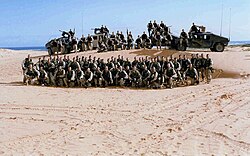
Bravo Company, 3rd Battalion, 75th Ranger Regiment in Somalia, 1993.
Date22 August – 13 October 1993
(1 month and 3 weeks)
Location02°02′N 45°20′E / 2.033°N 45.333°E / 2.033; 45.333
Result

Somali National Alliance victory[1]

  • TF Ranger withdrawal on 20 October 1993[2][3]
  • Captured SNA personnel released by January 1994[4]
  • US forces withdrawal on 3 March 1994
  • UNOSOM II withdrawal on 28 March 1995[5]
Belligerents
Commanders and leaders
William F. Garrison Mohamed Farrah Aidid
Units involved
B Co., 3rd Bn., 75th Ranger[6]
C Sqn, 1st SFOD-D[6]
1st Bn., 160th SOAR[7]
DEVGRU[6]
24th STS[8]
ISA[9]
SNA militia
Strength
441 troops[10]
8 MH-60 Black Hawks
4 AH-6
4 MH-6 Little Birds[7]
3 OH-58 Kiowas
1 P-3 Orion[6]
9 HMMWVs
3 M939 5-ton 6x6 trucks[11]
Several thousand militiamen and volunteers[12]
Multiple technicals
Casualties and losses

Malaysia[15]
1 killed
7 wounded
Pakistan[5]
2 wounded

6 October:
1 killed, 13 wounded[16]


Est. (combatant and civilian):
  • 315 killed
  • 812 wounded[17]
  • 24 captured (3 killed, 1 wounded during extraction)[18]
  • Mult. technicals disabled/destroyed
Mogadishu is located in Somalia
Mogadishu
Mogadishu
Location of the operation within Somalia
Mogadishu is located in Africa
Mogadishu
Mogadishu
Mogadishu, Somalia, shown relative to the rest of Africa

Operation Gothic Serpent was a military operation conducted in Mogadishu, Somalia, by an American military force code-named Task Force Ranger during the Somali Civil War in 1993. The primary objective of the operation was to capture Mohamed Farrah Aidid, leader of the Somali National Alliance who was wanted by the UNOSOM II in response to his attacks against United Nations troops. The operation took place from August to October 1993 and was led by US Joint Special Operations Command (JSOC).

On 3 October 1993, the task force executed a mission to capture two of Aidid's lieutenants. The mission ultimately culminated in what became known as the Battle of Mogadishu. The battle was extremely bloody and the task force inflicted significant casualties on Somali militia forces, while suffering heavy losses themselves. The Malaysian, Pakistani, and conventional US Army troops under UNOSOM II which aided in TF Ranger's extraction suffered losses as well, though not as heavy. The intensity of the battle prompted the effective termination of the operation on 6 October 1993. This was followed by the withdrawal of TF Ranger later in October 1993, and then the complete exit of American troops in early 1994.[2][3][1]

The repercussions of this encounter substantially influenced American foreign policy, culminating in the discontinuation of the UNOSOM II by March 1995.[5] At the time, the Battle of Mogadishu was the most intense, bloodiest single firefight involving US troops since Vietnam.[19][20]

Background

[edit]

Intervention in Somalia

[edit]

In December 1992, US President George H. W. Bush ordered the military to join the UN in a joint operation known as Operation Restore Hope, with the primary mission of restoring order in Somalia. The country had collapsed into civil war in 1991 and the following year a severe famine, induced by the fighting, broke out. Over the next several months, the situation deteriorated.[7]

During the early months of 1993, all the parties involved in the civil war agreed to a disarmament conference held in Addis Ababa, Ethiopia. Enactment of the agreed upon terms, however, was not so easily achieved.[21] One powerful faction, the Somali National Alliance (SNA) led by Gen. Mohamed Farah Aidid, formed in late 1992 and had become particularly anti-UNOSOM.[22] Major disagreements between the UN and the Somali National Alliance began soon after the establishment of UNOSOM II in March, centering on the perceived true nature of the operation's political mandate. By May 1993, relations between the SNA and UNOSOM would rapidly deteriorate.[23]

UNOSOM II - SNA conflict

[edit]

On 5 June 1993, one of the deadliest attacks on UN forces in Somalia occurred when 24 Pakistani soldiers were ambushed and killed in an SNA controlled area of Mogadishu.[24] Any hope of a peaceful resolution of the conflict quickly vanished. The next day, the UN Security Council issued Resolution 837, calling for the arrest and trial of those who carried out the ambush. US warplanes and UN troops began an attack on Aidid's stronghold. Aidid remained defiant, and the violence between Somalis and UN forces escalated.[25] A significant number of Somali civilians also resented international forces following incidents such as the June 1993 UN mass shooting of protesters and the 12 July 1993 Bloody Monday raid. These events and other incidents led significant numbers of civilians, including women and children, to take up arms and actively resist US and UNOSOM II forces during fighting in Mogadishu.[26]

Following the 12 July 1993 raid carried out by the US QRF force for UNOSOM II, the conflict began sharply escalating and SNA forces began deliberately targeting American forces in Somalia for the first time. According to US special envoy to Somalia Robert B. Oakley, "Before July 12th, the US would have been attacked only because of association with the UN, but the US was never singled out until after July 12th."[27] For the remainder of July firefights between the SNA and UNOSOM began occurring almost daily.[28] The SNA would put out a bounty for any American soldier or UN personnel killed, leading to a doubling of attacks against UNOSOM II forces.[27]

Task Force Ranger

[edit]

On 8 August 1993, Somali National Alliance militia detonated a remote controlled bomb against a US Army vehicle, killing four military policemen.[29] On 19 August, a second bomb attack injured four more soldiers.[30] And on 22 August, a third attack occurred, injuring 6 US soldiers.[31] In response, President Clinton approved Operation Gothic Serpent, which would deploy a 441 man special task force, named Task Force Ranger, to hunt down and capture Aidid.[10][32] By this time, however, circumstances on the ground had changed significantly and Aidid was in hiding, no longer appearing publicly.[33]

On 22 August, advance forces were deployed to Somalia followed shortly after by the main force on 25 August.[34] TF Ranger, led by Major General William F. Garrison, was under JSOC. Thus, it was not under UN command or the command of US General Thomas M. Montgomery, the deputy commander of UNOSOM II forces as well as commander of US forces in Somalia. Instead, Garrison and TF Ranger received orders directly from CENTCOM.[35][36][37]

The force consisted of:

The task force had intelligence support from a joint effort between CIA officers and Intelligence Support Activity.[9]

Early missions

[edit]

In Mogadishu, the task force occupied an old hangar and construction trailers under primitive conditions, without access to potable water.[40]

Only days after arriving, on 28 August, Somali militia launched a mortar attack on the hangar at 19:27 which injured four Rangers.[10] These mortar attacks became a regular occurrence but rarely caused any further significant injuries.[41]

The task force launched its first raid at 03:09 on 30 August, hitting the Lig Ligato house. There, they captured 9 individuals along with weapons, drugs, communications gear, and other equipment.[10] They were highly embarrassed, however, when it was found out that the prisoners they had taken were actually UN employees. Regardless of the fact that the employees were in a restricted area and were found with weapons and drugs, the incident was ridiculed in the media. Colin Powell, the Chairman of the Joint Chiefs of Staff, was reportedly so upset he "had to screw myself off the ceiling".[42]

Missions followed on 6 September, with a raid on an old Russian compound; 14 September, when they raided the Jialiou house/police station; 17 September, with a raid on Radio Mogadishu; 18 September, a raid on the garages of Osman Atto's (the Somali National Alliance's chief financier); and 21 September when they captured Osman Atto himself.[10] Local intelligence assets had given Atto a cane that concealed a hidden locating beacon. Delta operators tracked his vehicle convoy via helicopter and disabled Atto's vehicle with shots to its engine block before taking him into custody. This was also the first known takedown of a moving vehicle from a helicopter.[12]

To obfuscate when exactly a mission would occur, Garrison had the 160th SOAR conduct flights with soldiers aboard multiple times per day so militia could not rely solely on seeing helicopters to know that a raid was going to occur.[43][44] They also varied their insertion and extraction tactics, using various permutations of ground vehicle and helicopter-based infil and exfil.

At approximately 0200 on 25 September, Aidid's men shot down a Black Hawk with an RPG and killed three crew members at New Port near Mogadishu, though the two pilots, who were both injured, managed to escape and evade to reach friendly units. Pakistani and US forces secured the area and were able to evacuate the casualties.[45] The helicopter and crew were from 9th Battalion, 101st Aviation Regiment and 2nd Battalion, 25th Aviation Regiment,[46][47][48] and not part of the Task Force Ranger mission, but the helicopter's destruction was still a huge psychological victory for the SNA.[49][50]

Battle of Mogadishu

[edit]
Task Force Ranger under fire in Somalia – 3 October 1993

On the afternoon of 3 October 1993, informed that two lieutenants of Aidid's clan were at a residence in the "Black Sea" neighborhood in Mogadishu,[51] the task force sent 19 aircraft, 12 vehicles, and 160 men to capture them. The two Somali lieutenants alongside 22 others were quickly captured and loaded on a convoy of ground vehicles. However, armed militiamen and civilians, some of them women and children, converged on the target area from all over the city. Shortly before the mission was to be concluded, an MH-60 Black Hawk, Super Six One, was shot down by SNA forces using a rocket-propelled grenade (RPG). Both of the pilots were killed on impact, but the crew survived the crash landing. An American force made their way to the crash site to assist with recovery and rescue.[4]

Shortly afterward, another Black Hawk helicopter, Super Six Four, was shot down by an RPG fired from the ground. No rescue team was immediately available, and the small surviving crew, including one of the pilots, Michael Durant, couldn't move. Two Delta snipers, Master Sergeant Gary Gordon and Sergeant First Class Randy Shughart, provided cover from a helicopter and repeatedly volunteered to secure the crash site. After a 10th Mountain relief force from the Mogadishu airport was halted and turned back by an SNA ambush, Shughart and Gordon were finally granted permission to be inserted. They made their way to the crash site, quickly establishing a perimeter, and securing the surviving crew. The Black Hawk wreck came under heavy attack from the Somali militia, despite attempts from the 160th helicopters overhead to hold back the crowd. After losing close air support to damage from RPG-7 fire, MSG Gordon, SFC Shughart, and the surviving crew of Super 64 were overrun and killed, save for CW3 Durant who was taken hostage. Shughart and Gordon were both posthumously awarded the Medal of Honor for their actions.[52][53][4]

Meanwhile, the remaining Rangers and Delta operators fought their way to the first crash site. Repeated attempts by the Somalis to overrun US positions were beaten back with heavy small arms fire accompanied by fierce close air support from helicopters. US gunships constantly engaged hostile forces throughout the night, eventually expending nearly 80,000 rounds of ammunition.[54] The Little Birds were equipped with 2.75- inch rockets and miniguns and repeated strafing runs held many insurgents at bay during the battle.[55] According to American pilots interviewed in the 1994 book Mogadishu: Heroism and Tragedy, tens of thousands of rockets had been fired from AH-6 Little Birds during the battle.[56][57] Consequently the helicopters have been credited with saving US forces from being overrun.[58]

A rescue convoy nearly 70 vehicles long was organized and bolstered by hundreds of UNOSOM II forces,[59] including the 19th Battalion, Royal Malay Regiment (Mech);[15] Pakistani 15 FF Regiment and a squadron of M48 Pattons from 19th Lancers;[60] and US Army 2nd Battalion, 14th Infantry, 10th Mountain Division (which included elements of 1st Battalion, 87th Infantry; 41st Engineer Battalion; and 2nd Battalion, 25th Aviation).[61][62][63] After hours of heavy combat with the Somalis, the rescue convoy broke through and extracted the besieged forces.

Casualties

[edit]

The mission's objective of capturing Aidid's associates was accomplished, but the battle turned out to be the most difficult close combat that US troops had engaged in since the Vietnam War. In the end, four MH-60 Black Hawks were shot down by SNA forces with two crashing in hostile territory. [18] 18 Americans were killed and 85–97 wounded along with dozens of UNOSOM troops.[13][14][5][16] In total, the US forces would suffer an estimated 70% casualty rate from the battle.[64]

Two days after the battle's end, a Somali mortar strike on their compound killed one Delta Force operator and injured another 12–13 members of TF Ranger.[16][5]

Somali casualties were estimated to be 314 killed and 812 wounded (including civilians), though figures greatly vary.[19] Most of the Somali fighter's death toll is attributed to the attack helicopters, in particular AH-6 Little Bird helicopters providing continuous support to the US ground forces.[65][66] The Somali National Alliance had claimed 133 of their fighters had been killed during the Battle of Mogadishu.[67] Aidid himself claimed that 315—civilians and militia—were killed and 812 wounded, figures which the Red Cross considered 'plausible'.[68] Mark Bowden's book Black Hawk Down claims 500 Somalis killed and more than 1,000 wounded.[69]

Termination and US withdrawal

[edit]

The American public, outraged at the losses sustained, demanded a withdrawal.[19]

On 6 October 1993, U.S. President Bill Clinton would personally order General Joseph P. Hoar to terminate all combat operations against Somali National Alliance, except in self defence. General Hoar would proceed to relay the stand down order to Generals William F. Garrison of Task Force Ranger and Thomas M. Montgomery of the American Quick Reaction Force. The following day on 7 October, Clinton publicly announced a major change in course in the mission.[70]

Substantial U.S. forces would be sent to Somalia as short term reinforcements, but all American forces would be withdrawn from the country by the end of March 1994.[71] He would firmly defend American policy in Somalia but admitted that it had been a mistake for American forces to be drawn into the decision "to personalize the conflict" to Aidid. He would go on to reappoint the former U.S. Special Envoy for Somalia Robert B. Oakley to signal the administrations return to focusing on political reconciliation. The stand down order given to U.S. forces in Somalia led other UNOSOM II contingents to effectively avoid any confrontation with the SNA. This led to the majority of UNOSOM patrols in Mogadishu to cease and numerous checkpoints in SNA controlled territory to be abandoned.[70]

On 9 October 1993, Special Envoy Robert B. Oakley arrived in Mogadishu to obtain the release of captured troops and to consolidate a ceasefire with the Somali National Alliance.[70][72] Oakley and General Anthony Zinni would both engage in direct negotiations with representatives of the SNA. It was made clear that the manhunt was over, but that no conditions put forward by the SNA would be accepted for the release of prisoners of war. On 14 October, Aidid announced in a brief appearance on CNN the release of Black Hawk pilot Michael Durant.[70]

Three months later all SNA prisoners in U.N. custody were released including Aidid's lieutenants Omar Salad Elmi and Mohamed Hassan Awale, who had been the targets of the 3 October raid.[4] It was unknown at the time, but revealed later on that Osama bin Laden and Al Qaeda had a hand in training and equipping the Somali militiamen who inflicted the worst day of casualties in the history of U.S. Special Operations Forces since the Vietnam War.[73]

Legacy

[edit]

US Secretary of Defense Les Aspin resigned his post late in 1993. He was specifically blamed for denying the US Army permission to have its own armor units in place in Somalia, units which might have been able to break through to the trapped soldiers earlier in the battle. US political leaders had, at the time, felt the presence of tanks would taint the peacekeeping image of the mission.[37]

Clinton expressed surprise that the Battle of Mogadishu had even occurred,[74] and later claimed that he had decided on a diplomatic solution before the incident. Despite his apparent reservations there had been no direct orders previously given to TF Ranger to halt operations against the SNA.[70]

The Somali National Alliance viewed the Battle of Mogadishu as a victory against the United States and UNOSOM II.[75] The victory ensured the pullout of US and UN forces and the end to the humanitarian aid which had rescued the country from famine.[76][77] Osama bin Laden, who was living in Sudan at the time, cited this operation, in particular the US withdrawal, as an example of American weakness and vulnerability to attack.[78]

Reluctance to commit large numbers of U.S. troops to Somalia after the battle led the CIA to use warlords as proxies against the Islamic Courts Union in the 2000s.[79] It also drove U.S. support for the subsequent Ethiopian invasion, which marked the first deployment of American special forces since 1993.[80]

Notes

[edit]

References

[edit]

Bibliography

[edit]
Revisions and contributorsEdit on WikipediaRead on Wikipedia
from Grokipedia
Operation Gothic Serpent was a U.S. military campaign conducted in , , from August to October 1993, aimed at capturing Somali warlord and his top commanders to disrupt their attacks on peacekeepers and humanitarian operations during the . Task Force Ranger, the operation's core unit, integrated elite elements including the for perimeter security and , the 1st Special Forces Operational Detachment-Delta for high-value target raids, the 160th Special Operations Aviation Regiment for insertion and extraction, and Army assets like MH-60 Black Hawks and Little Birds for . Arriving on August 23, 1993, the task force executed six prior raids with minimal resistance, successfully detaining key Aidid subordinates and gathering intelligence, demonstrating effective small-unit tactics in urban environments. The operation's defining event unfolded on October 3 during a seventh raid targeting two of Aidid's lieutenants at the Olympic Hotel, when Somali armed with rocket-propelled grenades downed two U.S. helicopters, sparking 18 hours of close-quarters combat across the city. U.S. forces secured the crash sites, extracted downed pilots and captured targets including the intended high-value individuals, but sustained 18 fatalities and 73 wounded and one pilot captured amid superior enemy numbers bolstered by local irregulars. Somali casualties ranged from 300 to over 1,000 killed, reflecting the disproportionate firepower and resilience of the American contingent despite being outnumbered and isolated. While tactically extracting all personnel and achieving several mission elements, the battle exposed vulnerabilities in assumptions, such as underestimating anti-air capabilities and overreliance on air mobility for quick in-and-out operations. Operation Gothic Serpent concluded after 54 days without capturing Aidid himself, prompting a strategic pivot as graphic footage of the fight—including a dragged U.S. body—fueled domestic opposition and led President to limit U.S. commitments, resulting in full American withdrawal from by March 25, 1994. The campaign underscored causal risks in escalating from humanitarian stabilization to warlord hunts, where partial successes in degrading enemy leadership failed to alter broader clan-based power dynamics or secure lasting stability, influencing subsequent U.S. policy toward avoiding indefinite ground engagements in failed states. Post-operation reviews upgraded valor awards for over 60 participants, affirming the units' proficiency under duress, though it catalyzed doctrinal refinements in planning for hybrid threats.

Prelude to Intervention

Somali Civil War and Aidid's Atrocities

The erupted following the overthrow of President on January 26, 1991, by forces of the (USC), a clan-based alliance, which captured and ejected Barre's regime after decades of authoritarian rule marked by clan favoritism and repression. This collapse created a profound , as no unified emerged; instead, clan militias fragmented along sub-clan lines, transforming into predatory armed groups that vied for territorial control through relentless inter-clan warfare. Barre's ouster, driven by accumulated grievances against his clan's dominance, unleashed retaliatory violence, with militias dismantling state institutions and imposing extortion rackets on surviving civilians, setting the stage for anarchy that persisted into 1992. Mohamed Farrah Aidid, a senior USC commander from the Habr Gedir sub-clan of the , rapidly consolidated power in southern by mid-1991, directing his fighters to systematically loot urban resources, execute rivals, and terrorize opposing sub-clans such as the Abgal, led by . Aidid's forces engaged in targeted killings of civilians perceived as loyal to competitors, including summary executions and reprisal massacres during street battles that ravaged the capital; documented patterns of arbitrary arrests, , and deliberate destruction of property to deny sustenance to enemy groups. These tactics exacerbated clan divisions, as Aidid's imposed blockades on food supplies and markets controlled by rivals, employing as a coercive tool in the escalating conflict over dominance. Inter-clan fighting under Aidid's influence contributed to staggering civilian casualties, with estimates from Africa Watch (a affiliate) and Physicians for Human Rights indicating at least 14,000 deaths in alone by early 1992, many from indiscriminate shelling, sniper fire, and militia raids on neighborhoods. Aidid's gunmen were implicated in blocking access to nascent relief efforts in southern regions, seizing grain stores and livestock from vulnerable Digil and clans, whose pastoral economies collapsed amid the violence, forcing mass displacements and amplifying famine risks through enforced scarcity. Such actions, rooted in zero-sum clan resource grabs rather than ideological motives, underscored the causal link between warlord predation—including Aidid's—and the humanitarian catastrophe, as militias prioritized plunder over governance.

Famine, Clan Warfare, and Humanitarian Collapse

The overthrow of President in January 1991 precipitated a that intensified clan-based warfare across , particularly among subclans in and southern regions, leading to the systematic destruction of agricultural lands and essential for food production. Warlords, including Mohamed Farah Aidid of the Habr Gidr clan, imposed blockades on fertile areas like the Bay region, looted harvests, and targeted farming communities to consolidate territorial control, rendering previous self-sufficient agrarian systems inoperable. This human-induced devastation, rather than drought alone, formed the primary causal chain for the ensuing , as combatants prioritized military advantage over civilian sustenance, destroying systems and granaries in protracted inter-clan skirmishes. By mid-1991, the had claimed an estimated 300,000 lives, with southern 's population—previously reliant on local —facing acute as militias diverted or withheld food resources to weaken rival clans. International Committee of the Red Cross (ICRC) assessments documented child rates exceeding 70% in displaced populations near conflict zones, such as Hiran region, where clan fighting displaced hundreds of thousands and halted normal planting cycles. Relief efforts were severely hampered as warlords hijacked convoys en route to starving areas, selling looted aid for profit or using it to sustain fighters, with reports indicating systematic robbery and diversion that compounded mortality rates among vulnerable groups. Over 2 million Somalis became internally displaced by early 1992, fleeing clan strongholds where governance had devolved into predatory fiefdoms devoid of any coordinated famine mitigation. The absence of effective local authority post-1991 allowed clan elders and to exploit for leverage, blockading trade routes and aid distribution points to starve out opponents, a tactic that empirical data from humanitarian monitors attributes as the dominant driver of excess deaths over climatic factors. In regions like , under-five mortality rates among displaced children reached 30% or higher due to these interdictions, underscoring how failed governance transformed a manageable into a catastrophic of systems. This interplay of warfare and resource predation displaced nearly one million to neighboring countries and left 1.5 million at immediate risk, highlighting the causal primacy of inter- predation in 's humanitarian unraveling.

Operation Restore Hope

US Deployment and Relief Efforts

Operation Restore Hope commenced on December 9, 1992, when U.S. Marines landed unopposed in , following 794 adopted on December 3, 1992, which authorized member states to use "all necessary means" to establish a secure environment for humanitarian relief operations in . The operation was led by U.S. Marine Corps Lieutenant General as commander of the (UNITAF), which included approximately 28,000 U.S. troops supported by coalition forces from over 20 nations. The primary objective was to safeguard the delivery of international aid by securing major transportation nodes and distribution points previously disrupted by armed militias. U.S. forces quickly established control over critical infrastructure, including the ports and airfields of , , and , which allowed humanitarian organizations to resume operations effectively. UNITAF facilitated the delivery of more than tons of food and water relief supplies, reversing the that had claimed an estimated 350,000 lives by early 1992 and enabling the distribution of aid to millions in need. This intervention markedly reduced starvation-related deaths, with official assessments crediting the operation with saving hundreds of thousands of lives by spring 1993 through the restoration of secure aid corridors. Combat incidents remained minimal during the initial deployment phase, as Somali clan leaders and warlords largely refrained from confrontation in response to the overwhelming U.S. military presence and Johnston's emphasis on restrained aimed at fostering cooperation rather than escalation. This approach garnered voluntary compliance from local factions, who permitted unhindered access to sites, thereby prioritizing humanitarian outcomes over kinetic operations.

Stabilization Achievements and Handover Challenges

The (UNITAF) under Operation Restore Hope secured major population centers in southern , including , , and , by late December 1992, establishing safe zones that protected distribution from and factional interference. Heavy weapons were restricted to designated areas by January 1993, with thousands of technicals and armaments seized or neutralized, which curtailed open clan warfare and enabled cooperation from non-Habir Gedir factions through localized security pacts. These efforts neutralized major factional threats by 28 January 1993, fostering a permissive environment for relief operations across the UNITAF . Humanitarian outcomes were pronounced, with aid convoys operating unhindered by January 1993, reviving local markets and commerce in previously -ravaged regions. UNITAF oversaw the delivery of nearly 80,000 tons of relief supplies and medical treatment for over 500,000 , contributing to a decline to one-third of pre-December 1992 levels within 60 days and effectively ending mass starvation by March 1993. The handover to UNOSOM II on 4 May 1993 encountered resistance from Mohamed Farah Aidid's , which rejected full adherence to the March 1993 Addis Ababa disarmament accords and portrayed the transition as a continuation of foreign occupation through . Initial post-handover skirmishes, including ambushes on UN patrols, highlighted Aidid's non-cooperation and the fragility of gains against his network. UNOSOM II's operational shortfalls, including headquarters staffing at only 22% of authorized levels, compounded clan frictions and undermined the establishment of transitional governance mechanisms, as rival factions maneuvered for advantage amid perceived UN overreach.

UNOSOM II Mandate and Conflicts

Expansion from Relief to Nation-Building

UN Security Council Resolution 814, adopted on March 26, 1993, authorized the establishment of UNOSOM II with an expanded mandate under Chapter VII of the UN Charter, shifting from humanitarian relief to comprehensive efforts including political reconciliation, of factions, restoration of law and order, and economic rehabilitation across .) This overambitious scope aimed to re-establish national institutions in a fragmented, clan-dominated society lacking broad consensus, but presupposed a level of coercive authority that exceeded the mission's practical capabilities. The resolution set an initial operational period ending October 31, 1993, with UNOSOM II tasked to deploy up to 28,000 personnel, though full staffing lagged significantly.) The transition from the U.S.-led (UNITAF) to UNOSOM II occurred on May 4, 1993, following a handover marked by inadequate preparation and reduced U.S. troop commitments. UNITAF, which peaked at approximately 25,000-28,000 troops including 20,000 Americans, had stabilized relief distribution but withdrew most U.S. forces by early May, leaving UNOSOM II with a initially understrength at around 22,000 troops total, hampered by slow national contributions and logistical gaps. This drawdown reflected U.S. reluctance to sustain a large presence for open-ended tasks, exposing the UN mission to risks without the robust capacity of prior operations. UNOSOM II's nation-building pivot emphasized coercive through vehicle checkpoints, weapons inspections, and patrols to neutralize threats, yet these measures proved ineffective against entrenched warlords due to insufficient troop numbers and prioritizing de-escalation over decisive action. Factional resistance intensified as the mandate's imposition of centralized authority clashed with Somalia's decentralized structures, fostering perceptions of external overreach without addressing underlying power vacuums. Mohamed Farah Aidid's (SNA), formed in mid-1993, explicitly rejected UNOSOM II's legitimacy, framing the mission as neocolonial interference that undermined Somali sovereignty and favored rival clans. The SNA's defiance stemmed from Aidid's control over key districts and militias numbering in the thousands, which evaded by exploiting porous UN perimeters and local alliances, rendering governance initiatives untenable without broader . This rejection highlighted a causal mismatch: the UN's top-down approach ignored empirical realities of clan-based legitimacy, prioritizing institutional blueprints over adaptive .

Aidid's Attacks on Peacekeepers and UN Failures

On June 5, 1993, forces of the (SNA), led by Mohamed Farah Aidid, ambushed a Pakistani contingent of UNOSOM II tasked with inspecting and seizing an SNA arms cache in , killing 24 peacekeepers and wounding over 50 others. The attack involved coordinated small-arms fire, rocket-propelled grenades, and positioned militiamen, marking a deliberate escalation against UN enforcement of provisions under UNOSOM II's mandate. Aidid's SNA subsequently denied direct responsibility but continued harassing UN positions through road mining, sniper fire, and mortar attacks on compounds housing international troops. The UN Security Council responded swiftly with Resolution 837 on June 6, 1993, condemning the "unprovoked armed attacks" as premeditated and authorizing UNOSOM II to use "all necessary measures" to apprehend and prosecute those responsible, including Aidid, whom UN officials identified as the instigator.) This enabled retaliatory airstrikes by AC-130 gunships on SNA weapons depots, command centers, and Aidid's radio station, alongside a $25,000 bounty for information leading to his capture. However, enforcement proved inconsistent; political sensitivities among UN member states, restrictive , and concerns over civilian casualties permitted Aidid to evade capture and regroup his forces after initial strikes. UNOSOM II's diplomatic efforts to negotiate with Aidid faltered, as his faction viewed the mission's expanded role—encompassing and political reconciliation—as a direct threat to SNA control over . Critics, including U.S. military assessments, highlighted the UN's underestimation of SNA resolve, noting that repeated failed raids and half-measures emboldened Aidid rather than deterring him, allowing sustained low-level attacks that eroded peacekeeper morale and operational effectiveness. This reactive posture, prioritizing de-escalation over decisive elimination of Aidid's network, exposed systemic weaknesses in UNOSOM II's transition from humanitarian relief to coercive enforcement amid factional intransigence.

Establishment of Task Force Ranger

Strategic Objectives: Neutralizing Aidid's Network

President authorized Operation Gothic Serpent in August 1993 following escalating attacks by Mohamed Farrah Aidid's (SNA) militia on U.S. and UN forces, including sniper fire that wounded or killed in July and August. The operation's core strategic objective was to capture Aidid and his top lieutenants—identified as high-value targets essential to his —to dismantle the SNA's operational network and thereby neutralize its capacity to undermine UNOSOM II stabilization efforts in . This targeted strategy rested on the assessment that Aidid's faction, controlling significant portions of southern and deriving power from hijacked humanitarian supplies converted into armament stockpiles, represented the primary barrier to restoring order, as his forces routinely ambushed convoys and peacekeepers to maintain territorial dominance. By focusing on surgical raids rather than broad , the U.S. aimed to achieve decisive disruption of Aidid's without entangling American forces in protracted urban policing, which had proven ineffective under UNOSOM II's expanded mandate. Aidid's elimination was viewed as a prerequisite for any semblance of stability, given his role in perpetuating clan-based violence and obstructing relief distribution; his network's heavy armament, including rocket-propelled grenades and technicals amassed through aid diversion, enabled sustained asymmetric threats that conventional UN responses could not counter efficiently. The operation integrated loosely with UNOSOM II—providing quick-reaction force support—but maintained U.S. operational autonomy to bypass the bureaucratic constraints and veto risks inherent in multilateral command structures, allowing for agile intelligence-driven strikes. This approach prioritized causal disruption of Aidid's leadership over vague goals, reflecting a recognition that his unchallenged power perpetuated famine-exacerbating warfare.

Force Composition, Training, and Rules of Engagement

Task Force Ranger, established for Operation Gothic Serpent in August 1993, comprised elite U.S. units totaling approximately 450 personnel. The core assault elements included C Squadron of the 1st Operational Detachment-Delta (), providing operators for target entry and capture, and B Company, 3rd Battalion, , responsible for securing the objective area and perimeter defense. Aviation support was furnished by the 160th Special Operations Aviation Regiment (SOAR), known as the Night Stalkers, operating MH-60 Black Hawk and MH-6 Little Bird helicopters for rapid insertion, extraction, and . These units were supported by a Quick Reaction Force (QRF) drawn from the , providing conventional infantry reinforcements if needed, along with limited intelligence and command elements. The task force's small footprint emphasized surgical precision over large-scale occupation, aligning with objectives to neutralize key figures without broader escalation. SEAL elements participated in some reconnaissance but were not central to the raid structure. Prior to deployment, Task Force Ranger conducted intensive training at Fort Bragg, , focusing on military operations in urban terrain (MOUT) using mockups replicating Mogadishu's dense, hostile environments. Exercises stressed speed of execution, with rehearsals for fast-roping, building assaults, and exfiltration under fire, aiming to complete raids in minutes to minimize exposure. Upon arrival in Somalia on August 24, 1993, further in-theater rehearsals refined these tactics, validating techniques for close-quarters combat and convoy security in clan-dominated urban settings. This preparation underscored the force's high readiness for high-risk, time-sensitive missions. Rules of engagement (ROE) for Task Force Ranger were highly restrictive, shaped by the context of UNOSOM II, permitting fire only in response to a hostile act or demonstrated hostile intent, such as being fired upon or facing an imminent threat. This mandate prohibited preemptive engagement against potentially armed crowds or militias unless they initiated action, complicating operations in Mogadishu's fluid, weapon-permeated streets where technicals and RPGs proliferated among civilians. Critics, including post-mission analyses, noted these ROE prioritized political sensitivities over operational flexibility, potentially endangering forces by delaying responses to gathering threats in a non-permissive urban .

Operational Execution

Initial Captures and Intelligence Operations

Task Force Ranger arrived in on August 23, 1993, initiating Operation Gothic Serpent with a focus on intelligence-driven raids to dismantle Mohamed Farrah Aidid's (SNA) command structure. Early efforts leveraged (SIGINT) for communications intercepts and (HUMINT) from rival clan informants coordinated via CIA-led teams, identifying SNA safe houses and leadership movements despite the urban environment's challenges to technical collection. These operations prioritized precision strikes to capture mid-level operatives, yielding actionable data from post-raid interrogations that mapped Aidid's compounds and disrupted command networks. Between late August and September 1993, Task Force Ranger executed at least six raids, capturing over 20 SNA personnel, including key lieutenants and aides. On , forces detained 17 SNA militia members in downtown ; on September 14, General Ahmed Jialow and 38 associates were arrested in the General Jialow area, though Jialow was later released. The September 21 raid near Digfer Hospital netted Osman Ato, Aidid's chief financier and advisor, along with three bodyguards, significantly impairing SNA funding and logistics. Additional strikes, such as the assault on Lig Ligato House and operation at the Old Russian Compound, secured sites without detailed capture tallies but confirmed SNA operational hubs. These actions uncovered weapons caches and yielded interrogation-derived intelligence that refined targeting, correlating SNA radio traffic with physical locations to expose Aidid's evasion tactics. SNA-initiated attacks on UN forces declined temporarily as leadership losses fragmented coordination, demonstrating forces' effectiveness in asymmetric urban settings with zero U.S. fatalities in these initial phases. The captures eroded Aidid's inner circle, forcing reliance on lower-tier proxies and highlighting HUMINT's primacy over SIGINT in clan-based insurgencies.

Escalating Risks and Pre-Raid Planning

As Task Force Ranger accumulated successes in prior operations, including the capture of over 1,400 (SNA) personnel across six raids without major casualties, commanders developed overconfidence in their tactical superiority and the perceived impotence of Aidid's forces against U.S. air and assets. This mindset contributed to underestimating the SNA's capacity to rapidly adapt tactics, such as coordinating armed civilians and technicals in dense urban terrain. Human intelligence (HUMINT) on October 3, 1993, pinpointed a meeting of Aidid's top lieutenants—targeting figures like his chief and commander—at a specific building adjacent to the Olympic Hotel in Mogadishu's Bakara Market district, prompting immediate raid approval despite the high-risk location. Planning emphasized speed and minimal footprint, with assaulters slated for rooftop insertion via four MH-6 Little Bird helicopters to secure the objective before ground elements established a cordon. Risk assessments acknowledged Mogadishu's labyrinthine streets and civilian-militia intermingling as complicating factors for extraction and , yet planners discounted the velocity of SNA response times, assuming prior raid patterns of delayed opposition would hold amid the city's 2.5 square kilometers of hostile density. Contingency measures included a Quick Reaction Force (QRF) from the , augmented by Pakistani armor, but anticipated delays in armored deployment stemmed from persistent mine threats along routes and the challenges of maneuvering tanks through debris-strewn alleys.

Battle of Mogadishu

Launch of the October 3 Raid

Task Force Ranger initiated the raid at approximately 3:32 PM local time on October 3, 1993, when MH-60 Black Hawk helicopters lifted off from their Mogadishu base, carrying Delta Force assaulters, snipers, and 75th Ranger Regiment blocking forces toward the target building in the Bakara Market district. The assault teams fast-roped onto the roof of the Olympic Hotel, where intelligence indicated two of Mohamed Farah Aidid's top lieutenants were meeting, while Rangers descended to street level to secure the perimeter. Delta operators rapidly cleared the structure, capturing 24 suspects—including the primary targets—with minimal initial resistance, securing the objective within minutes of insertion. Coordination occurred via a command-and-control Black Hawk orbiting overhead, directing the ground elements and ground convoy en route to extract the prisoners. As forces consolidated at the site, Somali civilians and militia began gathering in adjacent streets, drawn by the helicopter noise and gunfire, with sporadic rocket-propelled grenade fire emerging from the growing crowds, marking the early stirrings of organized opposition.

Helicopter Losses and Urban Combat Dynamics

At approximately 4:20 PM local time on October 3, 1993, the Black Hawk helicopter designated Super Six-One, piloted by Chief Warrant Officers Cliff Wolcott and Donovan Briley, was struck by an RPG-7 rocket-propelled grenade fired from the ground, causing it to crash roughly four blocks north of the raid's target building in Mogadishu. Ground elements of Delta Force operators and 75th Ranger Regiment soldiers, initially focused on securing the objective, pivoted to the crash site, advancing methodically block by block under heavy suppressive fire from Somali militiamen positioned in alleys, rooftops, and behind barricades. Somali forces exploited the urban terrain by employing RPG teams that targeted low-hovering helicopters from concealed positions, coordinating with waves of armed irregulars advancing on foot and in technicals—pickup trucks mounted with machine guns—to overwhelm isolated US positions. This tactic shifted the operation from a swift capture raid to a protracted firefight, as the dense of narrow streets and multi-story buildings provided defenders with cover to launch ambushes while limiting the effectiveness of US aerial overwatch. Approximately 20-30 minutes later, at around 4:40 PM, a second Black Hawk, Super Six-Four piloted by , suffered a similar RPG hit to its , crashing deeper into hostile territory about two miles from the first site and further fragmenting US response efforts. Surviving Rangers and Delta personnel at the initial crash site maintained a defensive perimeter, using M249 squad automatic weapons and Mk 19 grenade launchers to suppress advancing militia, but the urban cover dynamics prolonged the engagement, turning blocks into kill zones where Somali fighters blended with civilians to close distances rapidly. Overhead Black Hawks continued providing minigun and 40mm grenade support to pin down attackers, yet the combination of RPG volume and human-wave assaults tested the limits of maneuver in confined spaces, escalating casualties on both sides.

Ground Convoy Struggles and Somali Tactics

The Quick Reaction Force (QRF) from the , comprising elements of the 2nd Battalion, 14th Infantry Regiment and supported by Pakistani and Malaysian armor, launched around 1724 hours on October 3, 1993, to reinforce Task Force Ranger at the crash sites but immediately grappled with navigational chaos in Mogadishu's labyrinthine streets. Delayed nearly an hour from initial alert due to orders for a longer, safer route skirting (SNA) enclaves, the convoy bogged down amid heavy civilian traffic, narrow winding alleys clogged with debris and stalled vehicles, and rudimentary road conditions that slowed Humvees and five-ton trucks to a crawl. Intensifying the transit woes, SNA militias unleashed sustained volleys of small-arms fire and rockets from concealed positions in buildings, alleys, and rooftops, with the relief convoy under Matthew McKnight absorbing hits that wounded personnel and damaged vehicles while struggling to advance just 300 yards to the first crash site in 45 minutes. By approximately 1810 hours, the QRF reached the K4 traffic circle but became pinned under withering crossfire, suffering two killed and 22 wounded in one company alone, forcing a tactical retreat without linking up at the second crash site due to unyielding resistance and coordination shortfalls. Somali fighters, numbering in the thousands and drawn from Aidid's SNA, leveraged the urban terrain through improvised barricades of earthen berms, rocks, and burning tires at key intersections to funnel convoys into ambushes and deny rapid maneuver. These tactics were augmented by deliberate intermingling with civilians—fighters shielding behind women and children or embedding in mobs of up to 1,000 non-combatants who surged toward positions—exploiting restrictive U.S. that mandated positive identification of threats before firing, thereby sowing hesitation and enabling continued attacks with grenades, knives, and small arms from protected vantage points. U.S. troops exhibited discipline by withholding fire on unarmed crowds despite the tactical disadvantages, though the ROE's emphasis on minimizing civilian harm amplified frustrations as militias exploited the restraint to prolong engagements and inflict attrition.

Night Extraction and Heroic Actions

Throughout the night of October 3-4, 1993, U.S. Rangers and operators fortified defensive positions around the crashed Black Hawk Super 61 site in , repelling repeated Somali militia assaults under sustained small-arms and fire. Approximately 90 personnel established a perimeter amid urban terrain, treating wounded comrades and maintaining vigilance against probing attacks that intensified after dark. At the second crash site of Super 64, Delta Force snipers Master Sergeant and Sergeant First Class volunteered for insertion despite high risks, landing about 100 yards from the wreckage to secure the area and extract surviving crew. They fought their way to the helicopter, extracted from the wreckage, and established a defensive position, engaging waves of militiamen with precise fire and close-quarters combat until overwhelmed and killed. Their actions enabled Durant's temporary survival before his capture, earning both posthumous Medals of Honor for conspicuous gallantry. As dawn broke on , a relief convoy comprising elements of the U.S. , supported by Malaysian forces equipped with armored personnel carriers and Pakistani troops equipped with tanks, pushed through heavy resistance to link up with the pinned-down Americans. The multinational force broke through Somali barricades and firing positions, enabling the consolidation and medevac of personnel from both crash sites. By approximately 0630 hours, all surviving U.S. forces had been extracted to safety, concluding the overnight defense.

Casualties and Immediate Repercussions

US and Allied Losses

forces suffered 18 and 73 wounded during the October 3–4, 1993, raid in . The fatalities included personnel from the , 1st Special Forces Operational Detachment-Delta (), Navy SEALs, and Pararescuemen, with wounds primarily resulting from small-arms fire and (RPG) fragments during prolonged urban combat and crash site recoveries. No U.S. civilians were among the dead, though the operation involved embedded journalists who documented the intense fighting. Coalition partners under UNOSOM II contributed to rescue efforts and incurred losses: one Malaysian soldier from the 19th was killed and seven wounded while securing crash sites, and one Pakistani soldier was killed during the extended extraction operations. These allied casualties occurred amid efforts to reinforce Ranger convoys amid heavy militia resistance. Equipment losses comprised two MH-60 Black Hawk helicopters destroyed after strikes caused them to crash in hostile territory—Super 61 piloted by 3 Cliff Wolcott and Super 64 by 3 —while three additional Black Hawks and several Little Bird observation helicopters sustained combat damage from ground fire. The downings highlighted the effectiveness of s against hovering aircraft in dense urban settings, where low-altitude operations increased exposure to unguided anti-armor weapons rather than sophisticated man-portable air-defense systems. Multiple ground vehicles, including Humvees and five-ton trucks, were also disabled or destroyed by RPG hits and sustained small-arms fire during convoy movements.

Somali Estimates and Aidid's Propaganda Victory Claims

Somali casualty figures from the Battle of Mogadishu remain disputed, with U.S. military assessments estimating between 500 and 1,500 deaths among fighters and civilians, reflecting the intensity of urban combat involving RPG ambushes and small arms fire. Aidid's (SNA) minimized these losses, officially claiming only 315 killed and 812 wounded to sustain a narrative of limited damage despite evidence of widespread mobilization. Independent observers, including UN personnel on the ground, corroborated higher tolls in the range of several hundred combatants and non-combatants, attributing discrepancies to Aidid's incentives to underreport for and purposes. Following the battle on October 3–4, 1993, leveraged clandestine radio broadcasts to proclaim a jihadist victory, framing the downing of two U.S. Black Hawk helicopters with RPG-7s as proof of Somali technological ingenuity and divine favor against "U.S. ," drawing parallels to historical insurgent triumphs. These declarations, aired from SNA-controlled stations evading prior UN strikes, exaggerated U.S. losses—initially claiming hundreds of American dead—to rally support and deter further raids, while ignoring the capture of key lieutenants Omar Salad Elmi and Abdirashid Hassan Awale. Aidid's propaganda intensified through the public of fallen U.S. soldiers' bodies, which SNA militias dragged through Mogadishu's streets on October 4, 1993, in scenes filmed by local cameramen and disseminated globally via footage. This spectacle, intended to humiliate U.S. forces and symbolize clan resilience, contrasted sharply with the raid's tactical success but amplified perceptions of defeat in , bolstering Aidid's stature among supporters despite his forces' disproportionate casualties. Such tactics, rooted in traditions, prioritized psychological impact over factual accounting, as Aidid's broadcasts omitted Somali dead to project invincibility.

Termination and Withdrawal

Policy Shifts Under Clinton Administration

Following the Battle of Mogadishu on October 3–4, 1993, which resulted in 18 American fatalities and graphic imagery of U.S. soldiers' bodies being desecrated broadcast widely on television, U.S. media coverage emphasized the casualties and setbacks, largely overshadowing the prior humanitarian achievements of Operation Restore Hope, such as the delivery of aid that averted famine for approximately one million Somalis. Public opinion shifted rapidly against continued involvement, with polls indicating majority opposition to U.S. troops remaining in Somalia by early October. In response to mounting congressional pressure for an expedited withdrawal, including bipartisan resolutions demanding U.S. forces leave by January 1994, President addressed the nation on October 7, 1993, defending the initial humanitarian mission while announcing a policy review to limit U.S. objectives to supporting UN-led political reconciliation rather than aggressive pursuit of warlord Mohamed Farah Aidid. rejected escalatory measures, explicitly stating that the U.S. would not send additional combat forces or armor, and drew contrasts to by insisting the Somalia engagement was limited and not a quagmire, though critics in invoked Vietnam-era lessons of and futile escalation to argue against further commitment. Internally, U.S. Central Command's General Joseph Hoar advocated caution against deploying more troops or intensifying operations, citing risks of urban entanglement, while elements of U.S. Forces reportedly favored persisting in the hunt for Aidid to neutralize the threat posed by his ; however, on October 6, 1993, directed Hoar to cease all offensive actions against Aidid's faction, marking a decisive pivot toward and handover to multilateral UN efforts.

Full US and UN Exit from Somalia

Following the intense fighting of the Battle of Mogadishu on October 3–4, 1993, Operation Gothic Serpent, the U.S.-led effort to capture , effectively ceased, with American forces shifting to a quick reaction force (QRF) role in support of UNOSOM II. President directed the full withdrawal of U.S. combat troops by March 31, 1994, a timeline accelerated by domestic political pressure after the battle's casualties. The last U.S. forces departed on March 25, 1994, leaving behind approximately 20,000 UN troops tasked with stabilization amid ongoing factional violence. UNOSOM II's mandate, which had expanded to include and , persisted until its scheduled termination on March 31, 1995, with the withdrawal of remaining UN military and police personnel completed by March 28, 1995. This exit marked the end of international involvement initiated in 1992, as no Somali factions requested mandate extension despite persistent instability. The phased drawdown, prioritizing U.S. disengagement over sustained enforcement, allowed Aidid's to regroup without the threat of decisive intervention. The departures enabled Aidid's resurgence, as he leveraged propaganda from the Mogadishu battle—where supporters rallied in November 1993 declaring his victory over U.S. forces—to bolster recruitment and territorial control in southern . Without UN security guarantees, clan-based warfare intensified, reverting the country to pre-intervention dominance; Aidid proclaimed himself president in 1995 and expanded operations until his death on August 2, 1996, from complications of wounds sustained in intra-clan fighting. This facilitated renewed conditions by late 1995, as marauding militias looted aid convoys and blocked distributions amid , exacerbating displacement of over 1 million Somalis. The withdrawals were interpreted by leader as evidence of American fragility, with him publicly boasting in the mid-1990s that U.S. forces fled after "minor battles" costing a handful of lives, portraying the as a "weak " vulnerable to prolonged irregular resistance. This perception drew jihadist influxes to 's ungoverned spaces, viewing the exit as validation for asymmetric tactics against Western interventions.

Controversies and Debates

Tactical and Intelligence Shortcomings

Intelligence assessments prior to the October 3, 1993, raid underestimated the Somali National Alliance's (SNA) adaptation of launchers for use against low-altitude , despite earlier incidents including an RPG strike on a Quick Reaction Force on August 25, 1993, and the downing of a Black Hawk on September 25, 1993, which killed three. This gap persisted as planners failed to implement sufficient countermeasures, such as modified flight profiles or patterns, allowing SNA fighters to employ RPGs in a de facto role, resulting in two UH-60 Black Hawks being hit during the operation—one at approximately 1620 hours. Similarly, intelligence did not fully account for the SNA's rapid mobilization capabilities, with armed militias and supporting crowds assembling in minutes rather than the anticipated hours, enabling swift encirclement of the target site and downed aircraft. Tactical planning overly emphasized air insertion and extraction, forgoing robust ground contingencies like prepositioned armored elements, which were hampered by delays in route clearance and mechanized force integration under UNOSOM II constraints. A request for one Bradley company and one tank platoon, submitted on September 14, 1993, was not fulfilled until after the battle, leaving the Quick Reaction Force reliant on unarmored or lightly protected vehicles vulnerable to RPG and small-arms fire in urban chokepoints. No immediate action drill existed to reposition helicopters beyond RPG effective range following the initial crash, prolonging exposure and complicating . These elements compounded an evident lack of preparation for military operations in urban terrain (MOUT), as Ranger's and focus prioritized rapid snatch-and-grab tactics over sustained block-to-block fighting, with units lacking specialized urban combat training and equipment for prolonged engagements amid civilian-militia intermingling. Despite these deficiencies, the initial assault demonstrated tactical proficiency, with operators securing the objective building and capturing 24 high-value targets—including two of Mohamed Farah Aidid's top lieutenants—within roughly one hour of insertion, inflicting significant SNA casualties estimated at 300 to 1,000 killed. After-action reviews, including the U.S. Forces report, attributed many shortcomings to unadjusted raid templates that permitted SNA observation and countermeasure development, underscoring the need for dynamic intelligence fusion and adaptive urban tactics in future operations.

Mission Creep, ROE Constraints, and Political Hesitation

The transition from Operation Restore Hope's humanitarian focus in December 1992 to UNOSOM II's broader enforcement mandate in March 1993 exemplified , as the 814 expanded responsibilities to include disarming factions, rebuilding governance, and neutralizing threats without sufficient resources or clear escalation protocols. This vagueness enabled (SNA) leader to defy UN authority, particularly after his forces' June 5, 1993, ambush on Pakistani troops, prompting Resolution 837 to authorize his pursuit but diluting the original relief objectives into protracted urban policing. Critics contend this incremental expansion eroded operational focus, transforming a logistics-heavy mission into one demanding combat proficiency against entrenched militias, with U.S. forces absorbing undefined roles under UN command structures ill-suited for decisive action. Rules of engagement (ROE) under UNOSOM II imposed significant constraints, prioritizing de-escalation and proportionality in Mogadishu's dense urban terrain, where forces were directed to fire only on confirmed threats—such as aimed weapons—rather than preemptively against armed gatherings that could include non-combatants. During Operation Gothic Serpent's raids, these limited rapid suppression of SNA roadblocks and mobs, as commanders required higher approval for area fire or heavy support, complicating maneuvers amid asymmetric threats from technicals and RPG ambushes. Military analyses highlight how such restrictions, intended to minimize civilian casualties and align with UN political sensitivities, hindered tactical flexibility, with Ranger operators later reporting delays in responding to evolving perils due to layered approval chains. The Clinton administration's political hesitation amplified these issues, driven by post-inauguration casualty aversion amid domestic fiscal debates and pressures in 1994, which manifested in reluctance to authorize reinforcements or escalate during the October 3–4, 1993, battle despite requests for assets like AC-130 gunships. Critics, including congressional reviews, attribute this to —such as direct NSC oversight of raid approvals—undermining field commanders' and prolonging vulnerability after two Black Hawks were downed. Defenders counter that SNA's deliberate escalation, blending combatants with civilians, necessitated measured responses to preserve international legitimacy and avoid broader entanglement, though empirical outcomes suggest overly cautious ROE and resourcing correlated with heightened U.S. risks in prolonged fights.

Aidid's Use of Civilians and Warlord Accountability

During the conflict in , forces loyal to Mohammed Farah Aidid, operating under the (SNA), frequently embedded militia fighters within densely populated civilian areas, complicating UN and US military operations by increasing the risk of . This tactic effectively utilized the urban environment to shield combatants, as SNA gunmen positioned themselves among non-combatants, launching attacks from residential neighborhoods and markets. The UN Security Council explicitly condemned such practices by Somali factions on June 18, 1993, following incidents where women and children were used to protect perpetrators of violence against UNOSOM personnel. These embedding strategies imposed significant restraints on coalition forces, bound by that prioritized minimizing civilian casualties, thereby allowing Aidid's militias to exploit the moral and operational hesitancy of international troops. Interrogations of captured SNA fighters and after-action analyses confirmed that this integration was deliberate, with militiamen often discarding uniforms to blend into crowds and using civilian infrastructure for cover during ambushes. Aidid's forces thereby transformed civilian populations into inadvertent human shields, a method that prolonged engagements and amplified narratives portraying UN actions as indiscriminate. Aidid bore direct responsibility for multiple war crimes, including the orchestration of attacks on UN peacekeepers that violated international humanitarian law. On June 5, 1993, SNA militias ambushed a Pakistani peacekeeping convoy in Mogadishu, killing 24 soldiers and wounding 57 in a premeditated assault involving small arms fire, rocket-propelled grenades, and booby-trapped bodies—tactics that the UN later cited as grounds for Aidid's arrest and prosecution. Earlier, Aidid's faction had contributed to the exacerbation of Somalia's famine by systematically looting humanitarian aid convoys and imposing extortion rackets on relief distributions, actions that diverted food supplies and prolonged civilian suffering in Habr Gidr clan territories under his control. These practices, documented in contemporaneous UN reports, reflected a pattern of prioritizing militia sustenance over population welfare, with Aidid's radio broadcasts inciting further obstructions. Despite these atrocities, Aidid evaded formal accountability due to the absence of robust international mechanisms in the early , with the UN's efforts limited to a $25,000 bounty and failed capture operations rather than to a . The SNA was never designated as a terrorist under emerging international frameworks, a status that might have enabled asset freezes or targeted sanctions akin to those later applied to non-state actors; instead, Aidid was treated primarily as a factional in a civil conflict, allowing impunity amid shifting UN priorities. This legal shortfall, debated in post-mission analyses, underscored failures in applying conventions like the Protocols to asymmetric urban warfare, where warlord agency went unprosecuted even after Aidid's death on August 2, 1996, from complications following clan-inflicted wounds.

Legacy and Long-Term Effects

Military Lessons in Urban Warfare and SOF Integration

The Battle of Mogadishu highlighted the vulnerabilities of lightly armed forces in dense , where Somali militias exploited narrow streets, roadblocks, and RPG ambushes to neutralize U.S. technological advantages. Ranger's reliance on unarmored Humvees and helicopters exposed ground elements to sustained fire, prompting post-operation recommendations for armored quick reaction forces (QRF) to enable secure and convoy mobility. Following the engagement on 3-4, 1993, which resulted in two Black Hawk helicopters downed and prolonged fighting, the U.S. Army enhanced Military Operations in Urban Terrain (MOUT) training, integrating close-quarters battle drills into Ranger marksmanship programs to address deficiencies in room-clearing and under urban constraints. Intelligence fusion emerged as a critical shortfall, with fragmented (SIGINT) and failing to anticipate militia adaptations from prior raids, such as rapid street blockades. The emphasized integrating multinational SIGINT assets earlier to support real-time targeting and threat assessment, reducing reliance on unilateral U.S. capabilities that hampered coalition responses during the QRF delays exceeding eight hours. These empirical insights drove doctrinal shifts toward fused centers for urban , informing preparations for subsequent conflicts like and where urban SIGINT informed precision raids. Despite tactical setbacks, Operation Gothic Serpent validated the integration of forces (SOF), particularly the synergistic Delta Force-Ranger teamwork, where Delta operators secured objectives while Rangers established blocking positions and responded to crash sites amid intense fire. This collaboration enabled the initial capture of key targets before escalation, demonstrating effective structures under Task Force Ranger. Lessons formalized SOF-joint roles through enhanced command coordination and coalition support teams, ensuring seamless conventional-SOF interplay in future urban missions and influencing joint doctrine for rapid insertions and extractions.

Mogadishu Syndrome's Impact on US Interventions

The Somalia Syndrome, emerging from the U.S. withdrawal following the October 3–4, 1993, Battle of Mogadishu, instilled a profound aversion among U.S. policymakers to committing ground forces in humanitarian or nation-building operations where casualties could provoke domestic backlash. This hesitance manifested immediately in the Clinton administration's refusal to reinforce UN peacekeepers or intervene decisively during the Rwandan genocide from April to July 1994, where approximately 800,000 Tutsis and moderate Huts were killed; U.S. officials explicitly cited fears of "another Somalia" in blocking Security Council resolutions for troop reinforcements or safe zones. Similarly, in the Balkans, the syndrome delayed robust U.S. engagement in Bosnia until after the Srebrenica massacre in July 1995, with initial Clinton administration policies prioritizing air power over ground troops to avoid urban combat risks akin to Mogadishu. The withdrawal signaled vulnerability to adversaries, with publicly citing the U.S. retreat after 18 American deaths in as evidence of superpower fragility, boasting that inflicting minimal casualties could force abandonment of objectives and emboldening al-Qaeda's strategy of protracted asymmetric attacks. Mohamed Farrah Aidid's militia tactics—employing urban ambushes, RPGs against helicopters, and civilian shields to exploit restrictive —demonstrated a replicable model for outlasting technologically superior forces, which later insurgents adapted in prolonged conflicts. In Somalia itself, the U.S. and UN exit by March 1995 left a that perpetuated warlord dominance, stalling state reconstruction until the Transitional Federal Government in 2004 and enabling the rise of Islamist groups; this instability directly contributed to al-Shabaab's emergence in 2006 from the remnants of the , transforming into al-Qaeda's most capable affiliate by exploiting ungoverned spaces and clan fractures. The syndrome's overcaution thus fostered a causal chain of perceived irresolution, where empirical deterrence—through sustained presence—might have curtailed atrocities like Rwanda's or contained jihadist growth, instead yielding policies that prioritized casualty aversion over strategic resolve.

Cultural Depictions and Recent Reassessments

The Battle of Mogadishu, central to Operation Gothic Serpent, received prominent cultural depiction in Mark Bowden's 1999 book Black Hawk Down: A Story of Modern War, which chronicled the experiences of Ranger personnel, emphasizing their tactical execution and endurance during the 18-hour engagement on October 3–4, 1993. The 2001 film adaptation, directed by , further amplified this narrative, portraying the forces' heroism against Somali militia forces, with U.S. Army Command providing technical support for authenticity, including script reviews and actor training. These works contrasted sharply with initial coverage, which prioritized the 18 U.S. fatalities, 73 wounded, and two downed Black Hawk helicopters, often framing the operation as a humiliating reverse rather than a tactical success in capturing 24 targets despite the chaos. Around the 30th anniversary in 2023, veterans reassessed the battle as a testament to forces' resilience, with participants like retired Command Sgt. Maj. Brad Thomas of the 3rd , , praising the "tremendous job" done by young soldiers under fire, achieving mission objectives amid communication failures and urban intensity. Reflections highlighted enduring bonds and adaptive lessons, such as applying Vietnam-era survival tactics to helicopter crashes, though some noted the film's dramatic liberties in compressing events. Annual commemorations, including the organized by the Three Rangers Foundation, honor the Rangers' valor in Operation Gothic Serpent, replicating the mile-long extraction under fire and supporting transitioning veterans while invoking the Ranger Creed to remember the 18 killed and one captured pilot, Mike Durant. Recent analyses, informed by declassified insights and jihadist admissions, critique the U.S. withdrawal in early 1994 as contributing to a that jihadist networks exploited; al-Shabaab's 2023 video claimed an instrumental role in the battle, portraying it as a defeat that exposed American fragility to casualties, potentially encouraging subsequent global attacks by signaling resolve limits without full commitments. Early media and academic narratives, often skeptical of interventions, amplified perceptions of failure, but empirical reviews affirm the forces' effectiveness while questioning if sustained pressure on warlord Mohamed Farah Aidid, absent expansive , could have deterred radical Islamist ascendance in the ensuing instability.

References

Add your contribution
Related Hubs
User Avatar
No comments yet.