


Community hub
Recent from talks
Contribute something
Nothing was collected or created yet.
Texas hold 'em
View on Wikipedia
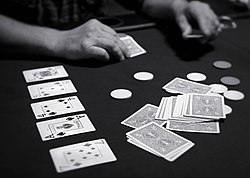
 Texas hold 'em involves community cards available to all players. | |
| Alternative names | Hold 'em |
|---|---|
| Type | Community card poker |
| Players | 2+, usually 2–10, theoretically up to 22 |
| Skills | Probability, psychology, game theory, strategy |
| Cards | 52 |
| Deck | French |
| Rank (high→low) | A K Q J 10 9 8 7 6 5 4 3 2 (A when used in a Straight) |
| Play | Clockwise |
| Chance | Medium |
Texas hold 'em (also known as Texas holdem, hold 'em, and holdem) is the most popular variant of the card game of poker.[1] Two cards, known as hole cards, are dealt face down to each player, and then five community cards are dealt face up in three stages. The stages consist of a series of three cards ("the flop"), later an additional single card ("the turn" or "fourth street"), and a final card ("the river" or "fifth street"). Each player seeks the best five-card poker hand from any combination of the seven cards: the five community cards and their two hole cards. Players have betting options to check, call, raise, or fold. Rounds of betting take place before the flop is dealt and after each subsequent deal. The player who has the best hand and has not folded by the end of all betting rounds wins all of the money bet for the hand, known as the pot. In certain situations, a "split pot" or "tie" can occur when two players have hands of equivalent value. This is also called "chop the pot". Texas hold 'em is also the H game featured in HORSE and HOSE.
Objective
[edit]In Texas hold 'em, as in all variants of poker, individuals compete for an amount of money or chips contributed by the players themselves (called the pot). Because the cards are dealt randomly and outside the control of the players, each player attempts to control the amount of money in the pot based on the hand they are holding,[2] and on their prediction as to what their opponents may be holding and how they might behave.
The game is divided into a series of hands (deals); at the conclusion of each hand, the pot is typically awarded to one player (an exception in which the pot is divided between two or more is discussed below). A hand may end at the showdown, in which case the remaining players compare their hands and the highest hand is awarded the pot; that highest hand is usually held by only one player, but can be held by more in the case of a tie. The other possibility for the conclusion of a hand occurs when all but one player have folded and have thereby abandoned any claim to the pot, in which case the pot is awarded to the player who has not folded.[2]
The objective of winning players is not to win every individual hand, but rather to win over the longer term by making mathematically and psychologically better decisions regarding when and how much to bet, raise, call or fold. Winning poker players work to enhance their opponents' betting and maximize their own expected gain on each round of betting, to thereby increase their long-term winnings.[2]
History
[edit]
Although little is known about the invention of Texas hold 'em, the Texas Legislature officially recognizes Robstown, Texas, as the game's birthplace, dating it to the early 20th century.[3]
After the game spread throughout Texas, hold 'em was introduced to Las Vegas in 1963 at the California Club by Corky McCorquodale. The game became popular and quickly spread to the Golden Nugget, Stardust and Dunes.[4] In 1967, a group of Texan gamblers and card players, including Crandell Addington, Doyle Brunson, and Amarillo Slim were playing in Las Vegas. This is when "ace high" was changed from the original form in which aces were low.[5] Addington said the first time he saw the game was in 1959. "They didn't call it Texas hold 'em at the time, they just called it hold 'em.… I thought then that if it were to catch on, it would become the game. Draw poker, you bet only twice; hold 'em, you bet four times. That meant you could play strategically. This was more of a thinking man's game."[6]
For several years the Golden Nugget Casino in Downtown Las Vegas was the only casino in Las Vegas to offer the game. At that time, the Golden Nugget's poker room was "truly a 'sawdust joint,' with…oiled sawdust covering the floors."[7] Because of its location and decor, this poker room did not receive many rich drop-in clients, and as a result, professional players sought a more prominent location. In 1969, the Las Vegas professionals were invited to play Texas hold 'em at the entrance of the now-demolished Dunes Casino on the Las Vegas Strip. This prominent location, and the relative inexperience of poker players with Texas hold 'em, resulted in a very remunerative game for professional players.[7]
After a failed attempt to establish a "Gambling Fraternity Convention", Tom Moore added the first ever poker tournament to the Second Annual Gambling Fraternity Convention held in 1969. This tournament featured several games, including Texas hold 'em. In 1970, Benny and Jack Binion acquired the rights to this convention, renamed it the World Series of Poker, and moved it to their casino, Binion's Horseshoe, in Las Vegas. After its first year, a journalist, Tom Thackrey, suggested that the main event of this tournament should be no-limit Texas hold 'em. The Binions agreed and ever since no-limit Texas hold 'em has been played as the main event.[7] Interest in the main event continued to grow steadily over the next two decades. After receiving only eight entrants in 1972, the numbers grew to over one hundred entrants in 1982, and over two hundred in 1991.[8][9][10]
During this time, B & G Publishing Co., Inc. published Doyle Brunson's revolutionary poker strategy guide, Super/System.[11] Despite being self-published and priced at $100 in 1978, the book revolutionized the way poker was played. It was one of the first books to discuss Texas hold 'em, and is today cited as one of the most important books on this game.[12] In 1983, Al Alvarez published The Biggest Game in Town, a book detailing a 1981 World Series of Poker event.[13] The first book of its kind, it described the world of professional poker players and the World Series of Poker. Alvarez's book is credited with beginning the genre of poker literature and with bringing Texas hold 'em (and poker generally) to a wider audience.[14] Alvarez's book was not the first book about poker. The Education of a Poker Player, by Herbert Yardley, a former U.S. government code breaker, was published in 1957.
Interest in hold 'em outside of Nevada began to grow in the 1980s as well. Although California had legal card rooms offering draw poker, Texas hold 'em was deemed to be prohibited under a statute that made illegal the (now unheard of) game "stud-horse". But in 1988 Texas hold 'em was declared legally distinct from stud-horse in Tibbetts v. Van De Kamp,[15] and declared to be a game of skill.[16] Almost immediately card rooms across the state offered Texas hold 'em.[17] It is often presumed that this decision ruled that hold 'em was a game of skill,[18] but the distinction between skill and chance has never entered into California jurisprudence regarding poker.[19]
After a trip to Las Vegas, bookmakers Terry Rogers and Liam Flood introduced the game to European card players in the early 1980s.[citation needed]
Popularity
[edit]Texas hold 'em is currently the most popular form of poker.[20][21] Texas hold 'em's popularity surged in the 2000s due to exposure on television, the Internet and popular literature. During this time, hold 'em replaced seven-card stud as the most common game in U.S. casinos.[22] The no-limit betting form is used in the widely televised main event of the World Series of Poker (WSOP) and the World Poker Tour (WPT).
Hold 'em's simplicity and popularity have inspired a wide variety of strategy books that provide recommendations for proper play. Most of these books recommend a strategy that involves playing relatively few hands but betting and raising often with the hands one plays.[23] In the first decade of the twenty-first century, Texas hold 'em experienced a surge in popularity worldwide.[22] Many observers attribute this growth to the synergy of five factors: the invention of online poker, the game's appearance in film and on television, invention and usage of the "hole card cam" (which allowed viewers to see hole cards played in the hand as a means of determining strategy and decision-making during gameplay), the appearance of television commercials advertising online cardrooms, and the 2003 World Series of Poker championship victory by online qualifier Chris Moneymaker.[24]
Television and film
[edit]Prior to poker becoming widely televised, the movie Rounders (1998), starring Matt Damon and Edward Norton, gave moviegoers a romantic view of the game as a way of life despite the poker portrayed being often criticized by more serious players.[citation needed] Texas hold 'em was the main game played during the movie and the no-limit variety was described, following Doyle Brunson, as the "Cadillac of Poker". A clip of the classic showdown between Johnny Chan and Erik Seidel from the 1988 World Series of Poker was also incorporated into the film.[25] More recently, a high-stakes Texas hold 'em game was central to the plot of the 2006 James Bond film Casino Royale, in place of baccarat, the casino game central to the novel of the same name on which the film was based. In 2008, an acclaimed short film called Shark Out of Water was released on DVD. This film is unique in that it deals with the darker, more addictive elements of the game, and features Phil Hellmuth and Brad Booth.
Hold 'em tournaments had been televised since the late 1970s, but they did not become popular until 1999, when hidden lipstick cameras were first used to show players' private hole cards on the Late Night Poker TV show in the United Kingdom.[26] Hold 'em exploded in popularity as a spectator sport in the United States and Canada in early 2003, when the World Poker Tour adopted the lipstick cameras idea. A few months later, ESPN's coverage of the 2003 World Series of Poker featured the unexpected victory of Internet player Chris Moneymaker, an amateur player who gained admission to the tournament by winning a series of online tournaments. Moneymaker's victory initiated a sudden surge of interest in the series (along with internet poker), based on the egalitarian idea that anyone—even a rank novice—could become a world champion.[27]
In 2003, there were 839 entrants in the WSOP main event,[28] and triple that number in 2004.[29] The crowning of the 2004 WSOP champion, Greg "Fossilman" Raymer, a patent attorney from Connecticut, further fueled the popularity of the event among amateur (and particularly Internet) players.[30] In the 2005 main event, an unprecedented 5,619 entrants vied for a first prize of $7,500,000. The winner, Joe Hachem of Australia, was a semi-professional player.[31] This growth continued in 2006, with 8,773 entrants and a first place prize of $12,000,000 (won by Jamie Gold).[32]
Beyond the series, other television shows—including the long running World Poker Tour—are credited with increasing the popularity of Texas hold 'em.[33] In addition to its presence on network and general audience cable television,[34] poker has now become a regular part of sports networks' programming in the United States.[35]
Literature
[edit]The English journalist and biographer Anthony Holden spent a year on the professional poker circuit from 1988 to 1989 and wrote about his experiences in Big Deal: A Year as a Professional Poker Player. The follow-up book, Bigger Deal: A Year Inside the Poker Boom covers the period 2005–2006 and describes a poker world "changed beyond recognition".[36]
Twenty years after the publication of Alvarez's groundbreaking book, James McManus published a semi-autobiographical book, Positively Fifth Street (2003), which simultaneously describes the trial surrounding the murder of Ted Binion and McManus's own entry into the 2000 World Series of Poker.[37] McManus, a poker amateur, finished fifth in the no-limit Texas hold 'em main event, winning over $200,000.[38] In the book McManus discusses events surrounding the series, the trial of Sandy Murphy and Rick Tabish, poker strategy, and some history of poker and the world series.
Michael Craig's 2005 book The Professor, the Banker, and the Suicide King details a series of high-stakes Texas hold 'em one-on-one games between Texas banker Andy Beal and a rotating group of poker professionals. As of 2006, these games were the highest stakes ever played, reaching $100,000–$200,000 fixed limit.[39]
Online poker
[edit]
The ability to play cheaply and anonymously online has been credited as a cause of the increase in popularity of Texas hold 'em.[27] Online poker sites both allow people to try out games (in some cases the games are entirely free to play and are just for fun social experiences) and also provide an avenue for entry into large tournaments (like the World Series of Poker) via smaller tournaments known as satellites. The 2003 and 2004 winners (Chris Moneymaker and Greg Raymer, respectively) of the World Series no-limit hold 'em main event qualified by playing in these tournaments.[40][41]
Although online poker grew from its inception in 1998 until 2003, Moneymaker's win and the appearance of television advertisements in 2003 contributed to a tripling of industry revenues in 2004.[42][43]
Rules
[edit]Betting structures
[edit]
Hold 'em is normally played using small and big blind bets—forced bets by two players. Antes (forced contributions by all players) may be used in addition to blinds, particularly in later stages of tournament play. A dealer button is used to represent the player in the dealer position; the dealer button rotates clockwise after each hand, changing the position of the dealer and blinds. The small blind is posted by the player to the left of the dealer and is usually equal to half of the big blind. The big blind, posted by the player to the left of the small blind, is equal to the minimum bet. In tournament poker, the blind/ante structure periodically increases as the tournament progresses. After one round of betting is done, the next betting round will start with the person in the small blind.
When only two players remain, special "head-to-head" or "heads up" rules are enforced and the blinds are posted differently. In this case, the person with the dealer button posts the small blind, while their opponent places the big blind. The dealer acts first before the flop. After the flop, the dealer acts last and continues to do so for the remainder of the hand.
The three most common variations of hold 'em are limit hold 'em, no-limit hold 'em and pot-limit hold 'em. Limit hold 'em has historically been the most popular form of hold 'em found in casino live action games in the United States.[22] In limit hold 'em, bets and raises during the first two rounds of betting (pre-flop and flop) must be equal to the big blind; this amount is called the small bet. In the next two rounds of betting (turn and river), bets and raises must be equal to twice the big blind; this amount is called the big bet.
No-limit hold 'em has grown in popularity and is the form most commonly found in televised tournament poker and is the game played in the main event of the World Series of Poker. In no-limit hold 'em, players may bet or raise any amount over the minimum raise up to all of the chips the player has at the table (called an all-in bet). The minimum raise is equal to the size of the previous bet or raise. If someone wishes to re-raise, they must raise at least the amount of the previous raise. For example, if the big blind is $2 and there is a raise of $6 to a total of $8, a re-raise must be at least $6 more for a total of $14. If a raise or re-raise is all-in and does not equal the size of the previous raise (or half the size in some casinos), the initial raiser cannot re-raise again (in case there are other players also still in the game). In pot-limit hold 'em, the maximum raise is the current size of the pot (including the amount needed to call).
Some casinos that offer hold 'em also allow the player to the left of the big blind to post an optional live straddle, usually double the amount of the big blind. This causes that player to act as the big blind and the player has an option to raise when it comes to their turn again. (Some variations allow for straddle on the button). No-limit games may also allow multiple re-straddles, in any amount that would be a legal raise.[11]
Play of the hand
[edit]
Following a shuffle of the cards, play begins with each player being dealt two cards face down, with the player in the small blind receiving the first card and the player in the button seat receiving the last card dealt. (As in most poker games, the deck is a standard 52-card deck containing no jokers.) These cards are the players' hole or pocket cards. These are the only cards each player will receive individually, and they will (possibly) be revealed only at the showdown, making Texas hold 'em a closed poker game.
The hand begins with a "pre-flop" betting round, beginning with the player to the left of the big blind (or the player to the left of the dealer, if no blinds are used) and continuing clockwise. A round of betting continues until every player has folded, put in all of their chips, or matched the amount put in by all other active players. See betting for a detailed account. Note that the blinds are considered "live" in the pre-flop betting round, meaning that they are counted toward the amount that the blind player must contribute. If all players call around to the player in the big blind position, that player may either check or raise.
After the pre-flop betting round, assuming there remain at least two players taking part in the hand, the dealer deals a flop: three face-up community cards. The flop is followed by a second betting round. This and all subsequent betting rounds begin with the player to the dealer's left and continue clockwise.
After the flop betting round ends, a single community card (called the turn or fourth street) is dealt, followed by a third betting round. A final single community card (called the river or fifth street) is then dealt, followed by a fourth betting round and the showdown, if necessary.
In all casinos, the dealer will burn a card before the flop, turn, and river. Because of this burn, players who are betting cannot see the back of the next community card to come. This is done for traditional reasons, to avoid any possibility of a player knowing in advance the next card to be dealt due to its being marked.[11]
The showdown
[edit]
If a player bets and all other players fold, then the remaining player is awarded the pot and is not required to show their hole cards. If two or more players remain after the final betting round, a showdown occurs. On the showdown, each player plays the best poker hand they can make from the seven cards comprising their two hole cards and the five community cards. A player may use both of their own two hole cards, only one, or none at all, to form their final five-card hand. If the five community cards form the player's best hand, then the player is said to be playing the board and can only hope to split the pot, because each other player can also use the same five cards to construct the same hand.[11]
If the best hand is shared by more than one player, then the pot is split equally among them, with any extra chips going to the first players after the button in clockwise order. It is common for players to have closely valued, but not identically ranked hands. Nevertheless, one must be careful in determining the best hand; if the hand involves fewer than five cards (such as two pair or three of a kind), then kickers are used to settle ties (see the second example below). The card's numerical rank is of sole importance; suit values are irrelevant in hold 'em.
Hand values
[edit]The following table shows the possible hand values in increasing order.
| Name | Description | Example |
|---|---|---|
| High card | Simple value of the card. Lowest: 2 – Highest: Ace (King in the example) |     
|
| Pair | Two cards with the same value |   
|
| Two pairs | Two times two cards with the same value | 
|
| Three of a kind | Three cards with the same value | 
|
| Straight | Sequence of 5 cards in increasing value (Ace can precede 2 or follow up King, but not both), not of the same suit |    
|
| Flush | 5 cards of the same suit, not in sequential order |   
|
| Full house | Combination of three of a kind and a pair |
|
| Four of a kind | Four cards of the same value |    
|
| Straight flush | Straight of the same suit |  
|
| Royal flush | Highest straight of the same suit |    
|
Misdeal
[edit]If the first or second card dealt is exposed, then this is considered a misdeal. The dealer then retrieves the card, reshuffles the deck, and again cuts the cards. However, if any other hole card is exposed due to a dealer error, the deal continues as usual. After completing the deal, the dealer replaces the exposed card with the top card on the deck, and the exposed card is then used as the burn card. If more than one hole card is exposed, a misdeal is declared by the dealer and the hand is dealt again from the beginning.[44] A misdeal is also declared if a player receives more than two hole cards by mistake (e.g. two cards stuck together).
Examples
[edit]Sample showdown
[edit]Here is a sample showdown:
Board 
| |||
|---|---|---|---|
Bob
  |
Carol
  |
Ted
|
Alice
|
Each player plays the best five-card hand they can make with the seven cards available. Below is the list of best hands each player has.
| Bob |
|
Three of a kind: fours |
| Carol |
|
Flush: Ace high |
| Ted |
|
Full house: Kings full of fours |
| Alice |
|
Straight: Four to eight |
In this case, Ted wins as he has the best hand (full house). If arranged in order of hand strength from the strongest, it would be Ted's full house, Carol's flush, Alice's straight, and Bob's three of a kind.
Sample hand
[edit]
Here is a sample game involving four players. The players' individual hands will not be revealed until the showdown, to give a better sense of what happens during play:
Compulsory bets: Alice is the dealer. Bob, to Alice's left, posts a small blind of $1, and Carol posts a big blind of $2.
Pre-flop: Alice deals two hole cards face down to each player, beginning with Bob and ending with herself. Ted must act first, being the first player left to the big blind. Ted cannot check, because the $2 big blind plays as a bet, and so folds. Alice calls the $2. Bob adds an additional $1 to the $1 small blind to call the $2 total. Carol's blind is "live" (see blind), so there is the option to raise here, but Carol checks instead, ending the first betting round. The pot now contains $6, $2 from each of three players.
Flop: Alice now burns a card and deals the flop of three face-up community cards, . On this round, as on all subsequent rounds, the player on the dealer's left begins the betting. Bob checks, Carol opens for $2, and Alice raises another $2 (puts in $4, $2 to match Carol and $2 to raise), making the total bet now facing Bob $4. Bob calls (puts in $4, $2 to match Carol's initial bet and $2 to match Alice's raise). Carol calls as well, putting in $2. The pot now contains $18, $6 from the last round and $12 from three players this round.
Turn: Alice now burns another card and deals the turn card face up. It is the . Bob checks, Carol checks, and Alice checks; the turn has been checked around. The pot still contains $18.
River: Alice burns another card and deals the final river card, the , making the final board . Bob bets $4, Carol calls, and Alice folds (Alice's holding was and was hoping the river card would be a club to make a flush).
Showdown: Bob shows his hand of , so the best five-card hand possible is , for three nines, with a king-queen kicker. Carol shows her cards of , making a final hand for two pair, kings and nines, with a jack kicker. Bob wins the showdown and the $26 pot.
Kickers and ties
[edit]Because of the presence of community cards in Texas hold 'em, different players' hands can often run very close in value. As a result, it is common for kickers to be used to determine the winning hand and also for two hands (or maybe more) to tie. A kicker is a card that is part of the five-card poker hand, but is not used in determining a hand's rank. For instance, in the hand A-A-A-K-Q, the king and queen are kickers.
The following situation illustrates the importance of breaking ties with kickers and card ranks, as well as the use of the five-card rule. After the turn, the board and players' hole cards are as follows.
Board (after the turn)
| |
|---|---|
Bob
 |
Carol
 |
At the moment, Bob is in the lead with a hand of , making two pair, queens and eights, with a king kicker. This beats Carol's hand of by virtue of the king kicker.
Suppose the final card is the , making the final board . Bob and Carol still each have two pair (queens and eights), but both of them are now entitled to play the final ace as their fifth card, making their hands both two pair, queens and eights, with an ace kicker. Bob's king no longer plays, because the ace on the board plays as the fifth card in both hands, and a hand is only composed of the best five cards. They therefore tie and split the pot. However, if the last card is a jack or lower (except an eight, which would make a full house, or a ten, which would give Carol a higher second pair), Bob's king stays in the game and Bob wins.
Strategy
[edit]Most poker authors recommend a tight-aggressive approach to playing Texas hold 'em. This strategy involves playing relatively few hands (tight), but betting and raising often with those that one does play (aggressive).[23] Although this strategy is often recommended, some professional players successfully employ other strategies as well.[23]
Almost all authors agree that where a player sits in the order of play (known as position) is an important element of Texas hold 'em strategy, particularly in no-limit hold'em.[2] Players who act later have more information than players who act earlier. As a result, players typically play fewer hands from early positions than later positions.
Because of the game's level of complexity, it has received some attention from academics. One attempt to develop a quantitative model of a Texas hold'em tournament as an isolated complex system has had some success,[45] although the full consequences for optimal strategies remain to be explored. In addition, groups at the University of Alberta and Carnegie Mellon University worked to develop poker playing programs utilizing techniques in game theory and artificial intelligence.[46][47] In January 2015, the AAAS journal Science reported that the group at the University of Alberta had succeeded in coding a computer program called Cepheus that can learn from its playing experience to optimize its CFR algorithm and approach playing perfection when opposing strong players in the variant known as heads-up limit Texas Hold 'em, which involves only two players. Although it does not win every hand, it is unbeatable on average over a large number of hands. The program exhibits more variation in its tactics than professional players do, for instance bluffing with weak hands that professional players tend to fold.[48][49][50] Public web access to observe and play against Cepheus is available.[51]
Starting hands
[edit]
Because only two cards are dealt to each player, it is easy to characterize all of the starting hands. There are (52 × 51)/2 = 1,326 distinct possible combinations of two cards from a standard 52-card deck. Because no suit is more powerful than another, many of these can be equated for the analysis of starting-hand strategy. For example, although and are distinct combinations of cards by rank and suit, they are of equal value as starting hands.
Because of this equivalence, there are only 169 effectively different hole-card combinations. Thirteen of these are pairs, from deuces (twos) to aces. There are 78 ways to have two cards of different rank (12 possible hands containing one ace, 11 possible hands containing one king but no ace, 10 possible hands containing one queen but no ace or king, etc.). Both hole cards can be used in a flush if they are suited, but pairs are never suited, so there would be 13 possible pairs, 78 possible suited non-pairs, and 78 possible unsuited ("off-suit") non-pairs, for a total of 169 possible hands.[52] Suited starting hands are stronger than their unsuited counterparts, although the magnitude of this strength advantage in different games is debated.[53]
Because of the limited number of starting hands, most strategy guides include a detailed discussion of each of them. This distinguishes hold 'em from other poker games where the number of starting card combinations forces strategy guides to group hands into broad categories. Another result of this small number is the proliferation of colloquial names for individual hands.
Strategic differences in betting structures
[edit]Texas Hold'em is commonly played both as a "cash" or "ring" game and as a tournament game. Strategy for these different forms can vary.
Cash games
[edit]Before the advent of poker tournaments, all poker games were played with real money where players bet actual currency (or chips that represented currency). Games that feature wagering actual money on individual hands are still very common and are referred to as "cash games" or "ring games".
The no-limit and fixed-limit cash-game versions of hold 'em are strategically very different. Doyle Brunson claims that "the games are so different that there are not many players who rank with the best in both types of hold 'em. Many no-limit players have difficulty gearing down for limit, while limit players often lack the courage and 'feel' necessary to excel at no-limit."[11] Because the size of bets is restricted in limit games, the ability to bluff is somewhat curtailed. Because one is not (usually) risking all of one's chips in limit poker, players are sometimes advised to take more chances.[11]
Lower-stakes games also exhibit different properties than higher-stakes games. Small-stakes games often involve more players in each hand and can vary from extremely passive (little raising and betting) to extremely aggressive (many raises). This difference of small-stakes games has prompted several books dedicated to only those games.[54]
Tournaments
[edit]Texas hold 'em is often associated with poker tournaments largely because it is played as the main event in many of the famous tournaments, including the World Series of Poker's Main Event, and is the most common tournament overall.[55] Traditionally, a poker tournament is played with chips that represent a player's stake in the tournament. Standard play allows all entrants to "buy-in" for a fixed amount and all players begin with an equal value of chips. Play proceeds until one player has accumulated all the chips in play or a deal is made among the remaining players to "chop" the remaining prize pool. The money pool is redistributed to the players in relation to the place they finished in the tournament. Only a small percentage of the players receive any money, with the majority receiving nothing. "The percentages are not standardized, but common rules of thumb call for one table" (usually nine players) "to get paid for each 100 entrants," according to poker author Andrew Glazer, in his book, The Complete Idiot's Guide to Poker.[56] A good rule of thumb is that close to 10% of players will be paid in a tournament. As a result, the strategy in poker tournaments can be very different from a cash game.
Proper strategy in tournaments can vary widely depending on the amount of chips one has, the stage of the tournament, the amount of chips others have, and the playing styles of one's opponents.[23] Although some authors still recommend a tight playing style, others recommend looser play (playing more hands) in tournaments than one would otherwise play in cash games. In tournaments the blinds and antes increase regularly, and can become much larger near the end of the tournament. This can force players to play hands that they would not normally play when the blinds were small, which can warrant both more loose and more aggressive play.[57]
Evaluating a hand
[edit]One of the most important things in Texas hold'em is knowing how to evaluate a hand. The strategy of playing each hand can be very different according to the strength of the hand. For example, on a strong hand, a player might want to try to appear weak in order to not scare off other players with weaker hands, while on a weak hand, a player might try to bluff other players into folding.
There are several ways to evaluate hand strength; two of the most common are counting outs and using calculators.
Counting outs
[edit]This method consists of counting the cards still in the deck, which in combination with the cards the player already has can give the player a potentially winning hand. Such cards are called "outs", and hand strength can be measured by how many outs are still in the deck (if there are many outs then the probability to get one of them is high and therefore the hand is strong). The following chart[58] determines the probability of hitting outs (bettering the player's hand) based on how many cards are left in the deck and the draw type.
| Outs | One Card % | Two Card % | One Card Odds | Two Card Odds | Draw Type |
|---|---|---|---|---|---|
| 1 | 2% | 4% | 46 | 23 | Inside Straight Flush |
| 2 | 4% | 8% | 22 | 12 | Pocket Pair to Set |
| 3 | 7% | 13% | 14 | 7 | One Overcard |
| 4 | 9% | 17% | 10 | 5 | Inside Straight / Two Pair to Full House |
| 5 | 11% | 20% | 8 | 4 | One Pair to Two Pair or Trips |
| 6 | 13% | 24% | 6.7 | 3.2 | No Pair to Pair / Two Overcards |
| 7 | 15% | 28% | 5.6 | 2.6 | Inside Straight & One Overcard |
| 8 | 17% | 32% | 4.7 | 2.2 | Open Straight |
| 9 | 19% | 35% | 4.1 | 1.9 | Flush |
| 10 | 22% | 38% | 3.6 | 1.6 | Inside Straight & Two Overcards |
| 11 | 24% | 42% | 3.2 | 1.4 | Open Straight & One Overcard |
| 12 | 26% | 45% | 2.8 | 1.2 | Flush & Inside Straight / Flush & One Overcard |
| 13 | 28% | 48% | 2.5 | 1.1 | |
| 14 | 30% | 51% | 2.3 | 0.95 | Open Straight & Two Overcards |
| 15 | 33% | 54% | 2.1 | 0.85 | Flush & Two Overcards / Flush & Open Ended Straight / Flush & Inside Straight & One Overcard |
| 16 | 34% | 57% | 1.9 | 0.75 | |
| 17 | 37% | 60% | 1.7 | 0.66 |
Multiplying the number of outs by two or four (the Two Times Rule or Four Times Rule) gives a reasonable approximation to the One Card % or Two Card %, respectively, in the above table.[59] For example, an open straight draw on the flop has 8 outs so the odds to hit the straight on the turn is 16% (8 x 2) and the odds on the river is 32% (8 x 4).
Calculators
[edit]Calculators are poker tools that calculate the odds of a hand (combined with the cards on the table if there are any) to win the game. Calculators provide precise odds but they cannot be used in live games and are therefore mostly used on Internet poker games. The first known commercial poker calculator was marketed by Mike Caro. Michael Shackleford, the Wizard of Odds, later made one available to the public free of charge on his website.[60]
Similar games
[edit]There are several other poker variants that resemble Texas hold 'em. Hold 'em is a member of a class of poker games known as community card games, where some cards are available for use by all the players. There are several other games that use five community cards in addition to some private cards and are thus like Texas hold 'em. Royal hold 'em has the same structure as Texas hold 'em, but the deck contains only Aces, Kings, Queens, Jacks, and Tens.[61] Pineapple and Omaha hold 'em both vary the number of cards an individual receives before the flop (along with the rules regarding how they may be used to form a hand), but are dealt identically afterward.[62][63] In Double Texas Hold'em, each player receives 3 hole cards and establishes a middle common card that plays with each of the other cards, but the outer cards don't play with each other (each player has two 2-card hands).[64][65][66] Alternatively, in Double-board hold'em all players receive the same number of private cards, but there are two sets of community cards. The winner is either selected for each individual board with each receiving half of the pot, or the best overall hand takes the entire pot, depending on the rules agreed upon by the players.[67]
Another variant is known as Greek hold 'em which requires each player to use both hole cards and only 3 from the board instead of the best five of seven cards.[68][self-published source?][69]
Manila is a hold'em variant that was once popular in Australia. In Manila, players receive two private cards from a reduced deck (containing no cards lower than 7). A five-card board is dealt, unlike Texas hold 'em, one card at a time; there is a betting round after each card. Manila has several variations of its own, similar to the variants listed above.[70]
Six-plus hold 'em (also known as Short-deck hold 'em) is a community card poker game variant of Texas hold 'em, where cards 2 through 5 are removed. Each player is dealt two cards face down and seeks to make his or her best five-card poker hand using from any combination of the seven cards (five community cards and their own two hole cards).[71]
See also
[edit]References
[edit]- ^ "Texas Holdem Rules - Play Free Texas Hold'em Poker Games". September 5, 2015. Archived from the original on September 5, 2015. Retrieved December 13, 2024.
- ^ a b c d Sklansky, David (2005). The Theory of Poker (Fourth ed.). Las Vegas: Two plus two.
- ^ Texas State Legislature – House (May 11, 2007). "80(R) HCR 109". House Resolution. Archived from the original on February 9, 2012. Retrieved May 12, 2007.
- ^ Sam Farha; Storms Reback (October 2007). Farha on Omaha: Expert Strategy for Beating Cash Games and Tournaments. Triumph Books. pp. 8–. ISBN 978-1-61749-920-3. Archived from the original on April 14, 2024. Retrieved June 1, 2018.
- ^ Brunson, Doyle (2005). Doyle Brunson's Super System II. Cardoza.
- ^ Ghosts at the Table by Des Wilson – Page 119–122
- ^ a b c Addington, Crandell (2005). "The History of No-Limit Texas Hold'em". In Doyle Brunson (ed.). Super/System 2. New York: Cardoza Publishing. pp. 75–84. ISBN 978-1-58042-136-2.
- ^ "3rd World Series of Poker (WSOP) 1972". The Hendon Mob Poker Database. Archived from the original on January 5, 2008. Retrieved May 14, 2007.
- ^ "13th World Series of Poker (WSOP) 1982". The Hendon Mob Poker Database. Archived from the original on January 5, 2008. Retrieved May 14, 2007.
- ^ "22nd World Series of Poker (WSOP) 1991". The Hendon Mob Poker Database. Archived from the original on March 26, 2021. Retrieved May 14, 2007.
- ^ a b c d e f Brunson, Doyle (1978). Super/System: A course in power poker. B&G Publishing Company., emphasis in original
- ^ Blount, Chuck (May 25, 2006). "ON POKER; Brunson's first book shed light on poker's secrets". San Antonio Express-News.
- ^ Alvarez, Al (1983). The Biggest Game in Town. Houghton Mifflin. ISBN 978-0-395-33964-0.
- ^ Christenson, Nick. "Biggest Game in Town Reviewed". Ready Bet Go!. Archived from the original on July 22, 2019. Retrieved January 8, 2007.
- ^ Tibbetts v. Van De Kamp, 271 Cal. Rptr. 792 (1990)
- ^ "History of Texas Hold 'Em" in Roya, Will (2021). Card Night: Classic Games, Classic Decks, and the History Behind Them. Black Dog & Leventhal Publishers. p. 210. ISBN 9780762473519.
- ^ Singsen, Michael Pierce (1988). "Where Will the Buck Stop on California Penal Code 330? Solving the Stud-Horse Conundrum". Hastings Communications and Entertainment Law Journal. 11: 95–148.
- ^ Junker, Matthew (December 8, 2004). "Legal questions surround Texas hold 'em". Tribune-Review Publishing Co. Archived from the original on October 22, 2006. Retrieved September 13, 2007.
- ^ Humphrey, Chuck. "California Lottery v. Gambling". Gambling-law-US.com. Archived from the original on July 23, 2007. Retrieved May 13, 2007.
- ^ "PokerStars.com: Texas Holdem Poker". Archived from the original on March 1, 2016. Retrieved January 4, 2008.
- ^ PokerPages.com: The History of Texas Hold'em Archived October 21, 2008, at the Wayback Machine
- ^ a b c Clark, Bryan (September 2006). "The Dying Days of Las Vegas 1–5 Stud". Two Plus Two Internet Magazine. Two Plus Two Publishing. Archived from the original on November 23, 2006. Retrieved October 4, 2006.
- ^ a b c d Harrington, Dan and Bill Robertie (2004). Harrington on Hold'em: Expert Strategy For No-Limit Tournaments; Volume I: Strategic Play. Two Plus Two Publications. ISBN 978-1-880685-33-4.
- ^ Chechitelli, John. "World Series of Poker, A Young Man's Affair?". All In Magazine. All In. Archived from the original on August 5, 2007. Retrieved June 25, 2007.
- ^ "Rounders (1998)". IMDb. Archived from the original on November 9, 2006. Retrieved October 27, 2006.
- ^ "Late Night Poker: About the Show". Channel 4. Archived from the original on May 27, 2010. Retrieved October 27, 2006.
- ^ a b Krieger, Lou (July 30, 2004). "How Big Can the World Series of Poker Become?". Card Player Magazine. 17 (16): 36–38.
- ^ "$10,000 World Championship Event". Hendon Mob. Archived from the original on June 4, 2023. Retrieved October 27, 2006.
- ^ "$10,000 World Championship Event". Hendon Mob. Archived from the original on July 4, 2023. Retrieved October 27, 2006.
- ^ "Greg Raymer". Poker Stars. Archived from the original on October 14, 2006. Retrieved October 27, 2006.
- ^ "$10,000 No Limit Texas Hold'em: World Championship Event". Hendon Mob. Archived from the original on January 4, 2023. Retrieved October 27, 2006.
- ^ "$10,000 No Limit Texas Hold'em: World Championship Event". Hendon Mob. Archived from the original on August 20, 2006. Retrieved October 27, 2006.
- ^ Stutz, Howard (July 20, 2006). "WPT hit with lawsuit". Knight-Ridder Tribune Business News: Lexis–Nexis.
- ^ Examples of poker on general audience television include Poker After Dark (NBC), High Stakes Poker (GSN), and the aforementioned World Poker Tour (formerly the Travel Channel, now GSN)
- ^ Lewis, Christian (September 5, 2006). "FSN Bulks Up on Bowls". Multichannel News: 24.
- ^ Casey, Susan (May 6, 2007). "Raise You One". The New York Times. New York. Archived from the original on July 1, 2017. Retrieved February 23, 2017.
- ^ McManus, James (2003). Positively Fifth Street: Murderers, Cheetahs and Binion's World Series. Farrar, Straus and Giroux. ISBN 978-0-374-23648-9.
- ^ "James McManus: Hendon Mob Poker Database". The Hendon Mob Poker Database. Archived from the original on October 22, 2018. Retrieved January 8, 2007.
- ^ Craig, Michael (2005). The Professor, the Banker, and the Suicide King: Inside the Richest Poker Game of All Time. Warner Books. ISBN 978-0-446-57769-4.
- ^ Kaplan, Michael (2006). "People Profile – Greg Raymer". Cigar Aficionado. Archived from the original on February 3, 2007. Retrieved January 8, 2007.
- ^ Moneymaker, Chris. "Chris Moneymaker Poker Biography". ChrisMoneymaker.com. Archived from the original on January 6, 2007. Retrieved January 8, 2007.
- ^ Cook, Steve (January 12, 2005). "Punters warm to online poker". The Register. Archived from the original on January 6, 2007. Retrieved January 5, 2007.
- ^ "Poker History: Online Poker". PokerTips. Archived from the original on September 23, 2020. Retrieved October 27, 2006.
- ^ "Texas Hold'em Rules". WorldSeriesOfPoker.com. Archived from the original on August 4, 2009. Retrieved August 16, 2009.
- ^ Christopher Mims (2007). "Physicist Unlocks Secrets of Texas Hold 'Em". Science News. Scientific American, Inc. Archived from the original on August 14, 2020. Retrieved August 6, 2020.
- ^ A list of publication from this group can be found at [1] Archived May 13, 2021, at the Wayback Machine.
- ^ "Carnegie Mellon Computer Poker Program Sets Its Own Texas Hold'Em Strategy". Carnegie Mellon University, Media Relations. July 6, 2006. Archived from the original on February 27, 2009. Retrieved May 24, 2008.
- ^ Emily Conover (January 8, 2015). "Texas Hold 'em poker solved by computer". ScienceNow. AAAS. Archived from the original on August 1, 2022. Retrieved January 10, 2015.
- ^ Sharon Begley (January 8, 2015). "Know when to fold 'em: computer aces Texas hold 'em poker". Reuters. Thomson Reuters. Archived from the original on December 13, 2015. Retrieved January 11, 2015.
- ^ Bowling, Michael; Burch, Neil; Johanson, Michael; Tammelin, Oskari (January 9, 2015). "Heads-up limit hold'em poker is solved". Science. 347 (6218): 145–9. Bibcode:2015Sci...347..145B. CiteSeerX 10.1.1.697.72. doi:10.1126/science.1259433. PMID 25574016. S2CID 3796371.
- ^ "Computer Poker Research Group". Archived from the original on May 19, 2015. Retrieved January 12, 2015.
- ^ Alspach, Brian (2005). "Counting starting poker hands" (PDF). Archived (PDF) from the original on June 29, 2006. Retrieved May 19, 2006.
- ^ Cloutier, T.J. and Tom McEvoy (1997). Championship No-Limit & Pot-Limit Hold'em. Cardoza. ISBN 978-1-58042-127-0.
- ^ Miller, Sklansky, and Malmuth op cit. and Jones, Lee (1994). Winning Low-Limit Hold-em. Conjelco. ISBN 978-1-886070-15-8.
- ^ Gregorich, Mark (April 27, 2005). "The Future of Tournaments". Card Player Magazine. 18c (8c): 26, 110.
- ^ . Glazer, Andrew N.S. (2004). The Complete Idiot's Guide to Poker (First ed.). Indianapolis, Indiana: Alpha.
- ^ Sexton, Mike (February 5, 2005). "Tournament Tips". Card Player Magazine. 18c (3c): 18.
- ^ Odds Chart. "How to play texas holdem poker". Howtoplaytexasholdempoker.org. Archived from the original on May 5, 2010. Retrieved February 22, 2010.
- ^ Flynn. Professional No-Limit Hold 'em: Volume I.
- ^ Shackleford, Michael. "Texas Hold'em Calculator". Wizardofodds.com. Archived from the original on April 4, 2020. Retrieved January 5, 2020.
- ^ "Royal Hold'em Poker Rules". PokerTips.org. Retrieved January 8, 2007.
- ^ "Crazy Pineapple Poker Rules". PokerTips.org. Retrieved January 8, 2007.
- ^ Arneson, Erik. "Omaha Hold 'Em Poker Rules". About.com. Archived from the original on February 4, 2007. Retrieved January 8, 2007.
- ^ "Double Hold'em – Basic Tips". PokerNewsDaily.com. Archived from the original on May 27, 2011. Retrieved October 15, 2010.
- ^ "PartyPoker Introduces Double Hold'em". PokerStrategy.com. Archived from the original on November 20, 2012. Retrieved September 20, 2010.
- ^ "Online Strategy Guide (YouTube video)". Poker Strategy. Archived from the original on March 15, 2016. Retrieved September 29, 2010.
- ^ "Double Flop Holdem Rules". Pokernews.com. Archived from the original on January 20, 2013. Retrieved January 8, 2007.
- ^ Alex Scott (April 1, 2011). What I Know about Poker: Lessons in Texas Hold'em, Omaha and Other Poker Games. Lulu.com. pp. 63–. ISBN 978-0-9567151-3-5. Archived from the original on April 14, 2024. Retrieved August 28, 2017.[self-published source]
- ^ "Texas Holdem Strategy For 2020". April 3, 2020. Archived from the original on June 6, 2020. Retrieved June 6, 2020.
- ^ Honest Casinos. "Manila Poker". Pokerpistols.com. Archived from the original on August 29, 2012. Retrieved January 8, 2007.
- ^ "Six Plus Hold'em". PokerVIP. June 13, 2015. Archived from the original on August 28, 2017. Retrieved August 28, 2017.
External links
[edit] Media related to Texas hold 'em at Wikimedia Commons

| Overview | |||||
|---|---|---|---|---|---|
| Play |
| ||||
| Variations | |||||
| Strategy | |||||
| Computing | |||||


Texas hold 'em
View on GrokipediaTexas hold 'em is a community card poker variant played with a standard 52-card deck, in which each player receives two face-down hole cards and shares five face-up community cards to form the best possible five-card hand.[1][2] The game proceeds through four betting rounds: pre-flop after hole cards are dealt, flop with three community cards, turn with one additional card, and river with the final card, with players able to bet, raise, or fold based on hand strength and position.[1] Originating in Texas around the early 1900s, likely in Robstown, the game spread to Las Vegas casinos in the 1960s and gained traction through tournaments like the World Series of Poker (WSOP), established in 1970, where it became the signature no-limit event.[3][4] Its popularity surged in the early 2000s due to televised WSOP coverage, online poker platforms, and the 2003 WSOP Main Event win by amateur Chris Moneymaker, which drew millions to the game via accessible satellite qualifiers and broadcast hole-card reveals.[5][6] Today, no-limit Texas hold 'em dominates professional play, home games, and online formats, prized for its blend of skill, psychology, and probabilistic decision-making under incomplete information.[7][8]
Fundamentals
Objective and Basic Setup
Texas hold 'em is a community card poker variant in which the primary objective is to win the pot by either forming the best five-card poker hand from a combination of two private hole cards and five shared community cards or by inducing opponents to fold their hands through betting.[1][9] The game employs a standard 52-card deck without jokers and typically involves 2 to 10 players seated around a table.[1][10] To establish betting order and ensure initial stakes, a dealer button—a disc marker—designates the nominal dealer position, rotating clockwise after each hand among participants.[10][1] The player immediately to the left of the button posts the small blind, a forced bet usually half the minimum big bet, while the next player posts the big blind, equal to the minimum bet amount; these compulsory wagers create action and prevent collusion in heads-up play.[1][10] In casino settings, a house dealer handles cards while the button rotates for fairness, but in home games, players may alternate dealing duties.[10] The blinds structure promotes aggressive play from the outset, with the small blind acting first pre-flop and the big blind last, mirroring post-flop positions where the button enjoys positional advantage by acting final in betting rounds.[1] Pot-limit or no-limit betting formats are common, capping raises at the pot size or allowing unlimited wagers, respectively, though fixed-limit variants exist with predefined bet increments.[11]Hand Rankings
In Texas hold'em, players evaluate hand strength by selecting the best five-card poker combination from their two private hole cards and the five shared community cards, with rankings determined by standard poker hierarchy where higher categories always beat lower ones regardless of specific card ranks.[12][13] Ties within the same hand category are resolved by comparing the highest relevant card ranks sequentially, using remaining cards as kickers if necessary; suits are not used for ranking or ties, ensuring all suits remain equal.[12][14] The hand rankings, from strongest to weakest, are:- Royal flush: The highest straight flush, consisting of ace, king, queen, jack, and ten all in the same suit (e.g., A♥ K♥ Q♥ J♥ 10♥). This is the rarest and unbeatable hand.[12][13]
- Straight flush: Five consecutive cards of the same suit, excluding the royal flush (e.g., 9♦ 8♦ 7♦ 6♦ 5♦); the highest card determines rank, with ace-high (but not wrapping around) being strongest after the royal.[12][14]
- Four of a kind (quads): Four cards of the same rank, plus one unrelated kicker (e.g., K♠ K♥ K♦ K♣ 7♦); ties break first by the quad rank, then the kicker.[12][13]
- Full house: Three cards of one rank and two of another (e.g., Q♣ Q♦ Q♥ 4♠ 4♥); ties break by the three-of-a-kind rank, then the pair.[12][14]
- Flush: Five non-consecutive cards of the same suit (e.g., A♠ J♠ 8♠ 5♠ 2♠); ties break by the highest card, then descending order.[12][13]
- Straight: Five consecutive cards of mixed suits (e.g., 10♣ 9♥ 8♦ 7♠ 6♣); ace can rank high (A-K-Q-J-10) or low (A-2-3-4-5, wheel straight), but straights do not wrap (e.g., Q-K-A-2-3 invalid); ties break by the highest card.[12][14]
- Three of a kind (trips or set): Three cards of the same rank, plus two unrelated kickers (e.g., J♦ J♣ J♠ 9♥ 3♣); ties break by the triplet rank, then kickers in descending order.[12][13]
- Two pair: Two cards of one rank, two of another, and one kicker (e.g., K♥ K♠ 7♦ 7♣ A♠); ties break by the higher pair, then lower pair, then kicker.[12][14]
- One pair: Two cards of the same rank, plus three unrelated kickers (e.g., 10♠ 10♥ Q♣ 8♦ 4♣); ties break by the pair rank, then kickers descending.[12][13]
- High card (no pair): Five unrelated cards, none forming a higher hand (e.g., A♦ K♣ 10♥ 7♠ 4♦); ties break by the highest card, then descending order; ace ranks highest.[12][14]
History
Origins in the Early 20th Century
Texas hold 'em is widely regarded as having originated in Robstown, Texas, around 1900, though definitive records of its invention are lacking.[16] The game emerged as a variant of existing poker forms, incorporating two private hole cards and five community cards to form the best hand, distinguishing it from stud or draw poker prevalent at the time.[4] Local accounts and historical consensus place its initial play among gamblers in this small Nueces County town, where it remained a regional pastime confined primarily to Texas communities for decades.[17] In 1925, player Blondie Forbes documented unambiguous rules for the game in Robstown, providing one of the earliest written references, though this postdates its informal development.[7] No single creator is credited, reflecting the organic evolution of poker variants through player experimentation rather than formal invention.[18] The Texas Legislature formalized this attribution in a 1977 resolution, officially designating Robstown as the birthplace and affirming its early 20th-century roots, a recognition reiterated in later proclamations.[19] Early play likely occurred in private homes and informal gatherings, with the game's structure—featuring a flop, turn, and river—allowing for strategic depth through shared community cards, which appealed to skilled players over pure luck-based games.[20] Its obscurity beyond Texas until the mid-20th century underscores a gradual, grassroots dissemination, unaccompanied by widespread documentation or commercialization in this period.[21]Post-World War II Spread and Standardization
Following World War II, Texas hold 'em gained traction in Texas gambling establishments, where it was played in private clubs and roadhouses under varying local rules. The game's spread accelerated in the 1950s and early 1960s as Texas gamblers traveled, but it remained regionally confined until professional players brought it to Las Vegas. In 1963, Corky McCorquodale and other Texas card players introduced hold 'em at the California Club casino, marking its initial entry into Nevada's gambling scene.[4] By the mid-1960s, the game appeared in more Las Vegas casinos, with the Golden Nugget becoming a primary venue after its adoption around 1967 by figures including Doyle Brunson, Amarillo Slim Preston, and Crandell Addington. Initially offered in limit formats, hold 'em's appeal grew due to its blend of skill and community cards, leading other establishments like the Dunes and Stardust to include it by the late 1960s. Casino environments necessitated consistent rule enforcement to manage house games, fostering early standardization of procedures such as blind structures, betting rounds, and hand rankings, which varied less than in informal Texas settings.[22][16] The inaugural World Series of Poker in 1970, organized by Benny Binion at the Horseshoe Casino, further propelled hold 'em's adoption and rule uniformity. Although early WSOP events featured multiple poker variants, Texas hold 'em was prominently included, with Johnny Moss winning the first championship via player vote; by 1971, no-limit hold 'em emerged as the signature event, solidifying standardized tournament protocols that influenced global play. These developments shifted hold 'em from a Texas novelty to a casino staple, with fixed rules on dealing, betting limits, and showdown procedures becoming normative across venues.[3]2000s Boom and Mainstream Adoption
The 2000s marked a transformative period for Texas hold 'em, propelled by the 2003 World Series of Poker (WSOP) Main Event victory of amateur player Chris Moneymaker. An accountant from Tennessee, Moneymaker qualified for the tournament through a $39 satellite entry on PokerStars, ultimately defeating 838 competitors to claim the $2.5 million first prize in a televised heads-up against professional Sam Farha.[23][24] This event, dubbed the "Moneymaker Effect," ignited widespread interest by demonstrating accessible paths to high-stakes success via online qualifiers, drawing novices to the game.[25] Television coverage amplified the boom, with ESPN's broadcast of the WSOP featuring hole-card cameras that revealed players' strategies, making the game visually engaging for mainstream audiences. The World Poker Tour (WPT), launching in 2003 on the Travel Channel, further popularized Texas hold 'em through dramatic editing and celebrity participants, such as Ben Affleck's 2004 win.[26][27] WSOP Main Event participation surged accordingly, expanding from 512 entrants in 2000 to 8,773 by 2006, reflecting heightened public engagement and casino expansions dedicated to hold 'em tables.[28][29] Online platforms fueled adoption, as sites like PokerStars and PartyPoker, which debuted real-money games around 2001, capitalized on the hype with satellite tournaments mirroring Moneymaker's path. This accessibility contributed to exponential growth in player bases, with online poker revenues rising from $82.7 million in 2001 to $2.4 billion by 2005, driven by hold 'em's dominance.[30] Mainstream integration followed, with home games proliferating, corporate sponsorships emerging, and the game appearing in popular media, cementing Texas hold 'em as a cultural phenomenon beyond traditional casino settings.[31]Online Expansion, Regulations, and Recent Trends
The advent of online poker in the late 1990s marked a pivotal expansion for Texas hold'em, with Planet Poker launching the first real-money games in 1998 using this variant as its primary offering.[32] Accessibility via early internet platforms drew initial players, but explosive growth occurred in the early 2000s as broadband improved and sites like PartyPoker, established in 2001, scaled to millions of users by offering low-stakes cash games and tournaments.[33] Texas hold'em dominated online formats due to its strategic depth and alignment with televised WSOP events, which popularized no-limit structures.[34] By 2005, the global online poker market had surged, with Texas hold'em accounting for over 70% of traffic on major sites, fueled by amateur entry via satellite qualifiers.[35] Regulatory interventions profoundly shaped the industry's trajectory, particularly in the United States, the largest market at the time. The Unlawful Internet Gambling Enforcement Act (UIGEA), enacted on October 13, 2006, prohibited financial institutions from processing transactions for unlawful online gambling, effectively starving offshore poker sites of U.S. payments and contracting the player pool.[36] This led to a temporary exodus of major operators, though unregulated play persisted until "Black Friday" on April 15, 2011, when the U.S. Department of Justice indicted executives from PokerStars, Full Tilt Poker, and Absolute Poker on charges including bank fraud and money laundering, resulting in domain seizures and the abrupt exclusion of U.S. players.[37] Full Tilt's subsequent revelation as operating a Ponzi scheme, misappropriating over $400 million in player funds, underscored vulnerabilities in unregulated environments.[38] In response, states like Nevada (2013), New Jersey (2013), Delaware (2013), Pennsylvania (2019), and Michigan (2019) legalized and regulated intrastate online poker, forming interstate compacts such as the Multi-State Internet Gaming Agreement in 2018 to pool liquidity.[39] Federal UIGEA constraints persist, limiting national operations and favoring offshore sites in gray markets, though enforcement has prioritized financial processors over individual players.[40] Recent trends reflect recovery and innovation amid fragmented regulations. The global online poker market, valued at $5.3 billion in 2024, is projected to reach $11.4 billion by 2030, growing at a 13.7% CAGR, driven by expansion in Asia-Pacific and Latin America where Texas hold'em variants thrive under looser rules.[41] Mobile apps have captured over 60% of traffic by 2024, enabling micro-stakes play and real-time tournaments, while cryptocurrency integrations on platforms like those using blockchain enhance anonymity and speed transactions in restricted jurisdictions.[42] AI-driven tools for hand analysis and opponent modeling have become standard for serious players, with live streaming on Twitch and YouTube boosting viewer engagement and sponsorships.[43] The COVID-19 pandemic accelerated shifts to online formats, sustaining post-2021 growth despite live event resumptions, though U.S. legalization stalls at the state level amid debates over poker as a skill-based game versus gambling.[44] Emerging private clubs and gamified apps target younger demographics, emphasizing social features over pure rake competition.[45]Rules of Play
Betting Structures and Blinds
In Texas hold'em, blinds are mandatory forced bets posted by two players to initiate action and ensure a pot exists for each hand. The small blind is placed by the player immediately to the left of the dealer button, while the big blind is posted by the next player counterclockwise, typically equal to twice the small blind (e.g., $1 small blind and $2 big blind in a 2 game).[1] These blinds rotate clockwise around the table with each hand, as the button moves to the next player, simulating a fair dealing position.[1] The blinds serve to stimulate betting before cards are dealt, with the preflop betting round beginning with the player to the left of the big blind (under the gun). Players act in turn, with options to fold, call the big blind, or raise; the blinds themselves have the option to check, call additional raises, or reraise when action returns to them.[1] In cash games, blinds remain fixed throughout play, whereas in tournaments, they increase at regular intervals to escalate pressure and force decisions as stacks diminish relative to blinds.[1] Texas hold'em employs three primary betting structures, which dictate the amounts players can wager during betting rounds: fixed-limit, pot-limit, and no-limit. In fixed-limit hold'em, bets and raises are restricted to predefined amounts, often equal to the big blind on preflop and flop rounds, doubling to twice the big blind on turn and river (e.g., 4 structure allows $2 bets preflop/flop and $4 thereafter).[1] Pot-limit hold'em caps raises at the current size of the pot plus the bet facing the player, permitting larger but controlled aggression.[1] No-limit hold'em, the most prevalent variant especially in high-stakes tournaments like the World Series of Poker, allows players to bet or raise any amount from the minimum raise (typically twice the previous bet or big blind) up to their entire stack, enabling all-in wagers at any point.[1] Minimum raise requirements apply across structures: in no-limit and pot-limit, a raise must be at least the size of the preceding bet or raise; in fixed-limit, raises follow the fixed increments with a cap of four raises per betting round unless fewer players remain.[46] These structures influence game dynamics, with no-limit favoring skill in stack management and bluffing due to unlimited betting potential.[46]Dealing Procedure and Betting Rounds
The dealing procedure in Texas hold 'em begins with the dealer shuffling a standard 52-card deck and positioning the dealer button before the player designated as the nominal dealer for that hand.[10] The player immediately to the left of the button posts the small blind, and the next player clockwise posts the big blind, establishing the forced bets that initiate the pot.[1] Two hole cards are then dealt face down to each player, starting with the player to the left of the button (the small blind) and proceeding clockwise, with cards distributed one at a time in two rounds to complete each player's hand.[47] A preflop betting round follows, commencing with the player to the left of the big blind (under the gun) and continuing clockwise until all active players have acted, with options to fold, call the current bet, or raise.[1] After preflop betting resolves, the dealer burns one card face down from the top of the deck and deals three community cards face up in the center of the table, known as the flop.[48] The flop betting round begins with the first active player to the left of the button and proceeds clockwise, allowing checks if no bet has been made, or bets, calls, raises, or folds.[10] Subsequent rounds involve the dealer burning another card and dealing the fourth community card (the turn), followed by a betting round starting from the same position as post-flop.[48] The dealer then burns one more card and deals the fifth and final community card (the river), initiating the last betting round in the same manner.[48] These burning procedures, applied before each community card stage, prevent players from gaining an advantage through marked cards or predictable dealing patterns.[48] The button advances one position clockwise after the river betting concludes, setting up the next hand.[1]Showdown and Hand Evaluation
In Texas Hold'em, the showdown occurs after the final betting round on the river if two or more players remain in the hand.[1] The player who made the last aggressive action—defined as the final bet or raise—on the river must reveal their hole cards first, followed by remaining players in clockwise order.[49] Players who folded earlier are not eligible to win the pot, and those who check through the river without further action reveal in turn order starting from the first active player to the left of the dealer button.[50] To claim any portion of the pot, a player must fully expose both hole cards face up; failing to do so results in mucking the hand and forfeiting eligibility, though the dealer verifies the best hand privately if necessary to prevent disputes.[51] Hand evaluation at showdown determines the winner by comparing the best possible five-card poker hand each player can form from their two private hole cards and the five shared community cards.[1] Community cards are identical for all players, so the strength of a hand depends on how the hole cards improve or complete combinations with them; players may use zero, one, or both hole cards in their final five-card hand.[13] Standard hand rankings, from highest to lowest, are as follows:| Rank | Hand Type | Description |
|---|---|---|
| 1 | Royal Flush | Ace-high straight flush (A-K-Q-J-10, all same suit). |
| 2 | Straight Flush | Five consecutive cards of the same suit (e.g., 9-8-7-6-5 of hearts). |
| 3 | Four of a Kind | Four cards of the same rank (e.g., four 7s), plus one kicker. |
| 4 | Full House | Three of a kind plus a pair (e.g., three 10s and two 4s). |
| 5 | Flush | Five cards of the same suit, not consecutive. |
| 6 | Straight | Five consecutive cards of mixed suits. |
| 7 | Three of a Kind | Three cards of the same rank, plus two kickers. |
| 8 | Two Pair | Two different pairs, plus one kicker. |
| 9 | One Pair | One pair, plus three kickers. |
| 10 | High Card | No qualifying hand; highest card wins. |
Irregularities and House Rules
In Texas hold'em, irregularities refer to procedural errors during dealing or betting that can disrupt fair play, with standardized resolutions drawn from rules like those of the Tournament Directors Association (TDA) or Robert's Rules of Poker to maintain integrity. A misdeal occurs if the first or second hole card is exposed due to dealer error, requiring the dealer to retrieve the card, reshuffle the deck, and recut before redealing without advancing the button.[56] Multiple boxed cards—those dealt face up within the deck during the initial deal—or dealing to the wrong seat before substantial action also constitute a misdeal, prompting a full redeal.[50] Substantial action, defined as a full bet and caller or multiple callers, prevents declaring a misdeal post-occurrence, allowing the hand to proceed unless the deck is fouled.[50] Exposed cards beyond initial hole cards are handled differently based on timing and fault. If additional hole cards are exposed inadvertently, play continues, with the exposed card replaced by the top deck card and designated as the burn.[56] For community card errors, such as a premature flop or four-card flop, the floor manager scrambles the exposed cards, burns one, and deals the remainder, or reshuffles premature turn or river cards into the stub for redealing without an extra burn.[50] Dead hands arise from fouled cards, accidental kills, or insufficient cards to the button; such hands are ruled dead with no refund of called bets, though uncalled wagers may be returned.[50] Betting irregularities include string bets, where a player makes multiple chip movements—with a return to their stack—without verbal declaration, rendering only the initial forward motion valid as the bet or call.[50] TDA Rule 56 explicitly prohibits this to prevent deception, requiring players to announce raises or push chips in one motion; violations result in the bet standing at the first amount, with penalties possible for repeated infractions.[50] [57] House rules supplement core regulations in casinos and home games, often addressing local variations like rake collection—up to 10% of pots with caps—or chip visibility requirements, where all chips must remain on the table.[58] Common cash game allowances include optional straddles from under-the-gun or button positions to increase action, though tournaments typically restrict them unless specified.[1] Home games may relax string bet enforcement or permit unlimited buy-ins, but reputable hosts standardize via TDA guidelines to avoid disputes, prioritizing clear pre-game agreements on buy-ins, blind increases, and etiquette like no chip passing.[59] These variations reflect venue discretion but must not contradict fundamental fairness principles.[50]Illustrative Examples
Sample Hand Walkthrough
In a standard no-limit Texas hold'em cash game with 2 blinds and six seated players, the small blind posts $1 and the big blind posts $2 before cards are dealt.[10] The dealer then distributes one card face down to each player, followed by a second card face down, creating each player's two private hole cards.[1] Preflop betting begins with the player to the left of the big blind (under the gun), who may fold, call the $2 big blind, or raise; action proceeds clockwise, with players able to raise any amount up to their stack in no-limit format.[10] Suppose the under-the-gun player folds, the next two players call the $2, the cutoff raises to $6, the button calls $6, the small blind folds, and the big blind calls $4 more to complete the raise, creating a pot of $20.[1] The dealer discards the top card (burn card) and deals three community cards face up (the flop): the 7 of diamonds, 5 of spades, and 2 of clubs.[10] Postflop betting starts with the first active player left of the button (here, the big blind), who checks; the cutoff bets $10, the button calls $10, and the big blind folds, building the pot to $50.[1] The dealer burns another card and reveals the turn: the King of clubs.[10] With the button now acting first, they check; the cutoff bets $25, and the button folds.[1] The dealer burns once more and deals the river: the 4 of hearts.[10] The cutoff, acting last with no further opponents, mucks their hand without showdown, winning the $75 pot uncontested.[1] This illustrates how many hands end before showdown through folds induced by bets representing hand strength, avoiding the need for full hand evaluation.[10] If contested, the best five-card hand using any combination of the two hole cards and five community cards determines the winner, ranked by standard poker hierarchy from royal flush downward.[1]Handling Ties and Kickers
In Texas hold'em, ties at showdown occur when multiple players form hands of the same rank using their best five-card combination from hole cards and community cards; if the hands are identical in all five cards, the pot is split equally among tied players.[53][1] Otherwise, ties are broken by systematically comparing the cards in descending order of rank, starting with the highest card in each player's five-card hand, with no suit precedence used for resolution.[60][61] This process relies on kickers, defined as the highest-ranking cards not contributing to the primary hand strength (such as pairs or flushes), which serve to differentiate otherwise equivalent hands.[60][62] For straight flushes, straights, flushes, and high-card hands, tiebreakers proceed by ranking the highest card first, then the next highest, and so on until a difference is found; identical sequences result in a split.[63][61] In contrast, hands involving multiples—such as one pair, two pair, three of a kind, full house, or four of a kind—first compare the rank of the primary multiple (e.g., the pair or three of a kind), then evaluate kickers in descending order to break deadlocks.[53][62] For instance, in a one-pair tie, the higher-ranking pair wins outright; if pairs match, the highest kicker decides, followed by the second kicker if needed, with the pot splitting only if all relevant cards align perfectly.[61] Two-pair ties compare the higher pair first, then the lower pair, then the kicker; three-of-a-kind ties rank the trips, then the two highest kickers sequentially.[63][62] Full houses prioritize the three of a kind over the pair, while four of a kind compares the quads before the single kicker.[53] Kickers derive from the seven available cards, prioritizing the strongest possible five-card hand, which can include community cards shared by all players.[60] If a player uses both hole cards for the main hand strength, community cards may provide kickers; conversely, playing the board entirely (using zero or one hole card) can lead to ties if opponents match it.[62] These rules ensure deterministic outcomes without randomness, as confirmed in tournament standards where electronic evaluation software replicates manual comparisons by sorting card ranks numerically (e.g., ace high as 14).[63][61] Side pots in multi-way all-ins follow the same process independently for each contested portion.[53]Strategic Elements
Preflop Considerations and Starting Hands
Preflop decisions in Texas hold 'em hinge on assessing the relative strength of the two private hole cards against positional disadvantages, effective stack sizes, blind structures, and inferred opponent ranges. These factors dictate whether to fold marginal holdings, limp (rare in modern play), call, raise for value or isolation, or three-bet as a bluff or premium. Empirical simulations show that preflop errors compound postflop losses, making selective hand selection foundational to equity realization.[64] Among the 1,326 distinct starting hand combinations, pocket aces (AA) rank highest, dominating approximately 85% of random hands due to their top-pair potential and set-mining value.[13] Conversely, 7-2 offsuit performs worst, winning under 30% against average ranges owing to poor connectivity and domination risks.[13] Starting hands fall into categories: premium pairs (AA-JJ) for set value and domination; suited aces (AKs-A2s) for flush and straight draws; broadway cards (KQs, QJs) for high-card strength; and speculative suited connectors (e.g., 87s) for implied odds in multi-way pots.[65] Table position profoundly influences playable ranges, as early actors face multi-player postflop fields without action information, necessitating tightness to avoid reverse implied odds.[66] In full-ring games, under-the-gun (UTG) openings typically comprise 10-15% of hands, such as 88+, AJo+, ATs+, KQs, to withstand potential reraises from eight trailing players.[66] Middle positions expand to 20-25%, adding 66-77, KJo, suited connectors like JTs; late positions, including the button, widen to 40-60%, incorporating small pairs (22+), suited aces (A2s+), and gappers (e.g., T8s) for blind steals.[67] Small blind defenses adjust dynamically but often involve 40-50% raises or calls to counter big blind isolation.[67] Stack depth modulates these ranges: deep stacks (100+ big blinds) favor speculative hands for postflop multi-street play, while short stacks (under 20 BB) shift toward push-fold charts emphasizing premium pairs and ace-high for fold equity.[67] Opponent tendencies further refine choices—tight tables permit wider stealing, whereas loose-aggressive dynamics demand premium-heavy ranges to counter three-bets.[65] Game-theoretic optimal (GTO) solvers, calibrated via millions of iterations, validate these positional gradients, showing late-position equity edges of 10-20% over early spots in unopened pots.[64]| Position | Approximate Range Percentage | Example Hands |
|---|---|---|
| UTG (Early) | 10-15% | 88+, AJo+, ATs+, KQs [66] |
| Middle | 20-25% | 66+, KJo+, 98s+, ATo [68] |
| Button (Late) | 40-60% | 22+, A2s+, K9s+, QTs, 76s [66] |
Postflop Decision-Making
Postflop decision-making in Texas Hold'em encompasses the strategic choices players make after the flop, turn, and river community cards are revealed, integrating assessments of hand equity, opponent ranges, board texture, and positional dynamics to maximize expected value. Equity represents the share of the pot a hand is likely to win on average against an opponent's range, calculated via combinatorial analysis or simulation tools, and serves as a foundational metric for calls, bets, or folds.[69] Pot odds, the ratio of the current pot size to the bet required, must exceed a player's equity threshold for profitable calling; for instance, if pot odds offer 3:1 and equity stands at 30%, the decision favors continuation.[70] Implied odds extend this by factoring future bets from stronger hands, particularly relevant for draws on coordinated boards.[71] Position profoundly influences postflop play, granting late-position players information from opponents' actions to refine range estimates and exploit imbalances. In position, players can control pot size and realize equity more efficiently, often c-betting 50-70% of flops as the preflop aggressor to deny equity or extract value, with frequencies adjusted by board dryness—higher on dry flops like K-7-2 rainbow, lower on wet draws-heavy boards.[70] Out of position, caution prevails: overpairs warrant smaller bets for protection against draws, while marginal hands may check to induce bluffs or pot control. Effective stack sizes dictate commitment levels; shallow stacks (under 20 big blinds postflop) pivot toward all-in shoves with strong draws or top pairs to deny odds, whereas deep stacks enable nuanced semi-bluffing with hands like flush draws, raising to fold out better but vulnerable holdings.[72] Board texture categorizes flops into dry (few draws, e.g., rainbow high cards) versus dynamic (connected, suited cards enabling straights/flushes), dictating action frequencies. On dry boards, value betting strong made hands like top pair top kicker extracts thin value, while checking weak top pairs risks free cards; draws here fold to aggression absent fold equity. Dynamic boards demand balanced ranges: value bet nuts or near-nuts, semi-bluff medium strength draws, and check marginal showdown value to avoid overexposure. Opponent modeling refines these—tight players warrant more bluffs, loose-passive ones invite value overbets—supported by tracking software data showing exploitative adjustments yield higher win rates than rigid game theory optimal play in live settings.[73] Turn and river amplify these principles, with thinner value bets and larger bluff sizes as pot grows, always benchmarked against realized equity from solvers like PioSolver, which quantify optimal bet sizings (e.g., 33% pot on turns for polarization).[74]- Key Postflop Evaluation Checklist:
- Assess personal range strength and blockers to opponent draws.
- Estimate villain's polarized or capped range based on preflop action and history.
- Compute equity via outs (e.g., open-ended straight draw: 8 outs, ~32% vs. random hand) against plausible holdings.
- Factor SPR (stack-to-pot ratio) for post-turn commitment.
- Balance actions to prevent exploitation, blending value and bluffs at frequencies mirroring equity distributions.[70][69]
Format-Specific Tactics
In cash games, players typically employ deeper stack strategies emphasizing implied odds and multi-street value extraction, as participants can reload chips equivalent to the buy-in at any time, allowing for wider preflop ranges and postflop maneuvers without the pressure of elimination.[75] Tactics focus on long-term expected value (EV) calculations, with position dictating aggressive play such as isolating limpers or continuation betting frequently against wide calling ranges, given the ability to sustain variance through bankroll management rather than chip preservation.[76] Unlike tournaments, cash game blinds remain static, enabling consistent pot odds assessment without escalating antes forcing short-stack shoves.[77] Tournament formats demand adjustments for finite chip stacks and rising blind levels, where early stages prioritize survival with tighter ranges to avoid unnecessary confrontations, transitioning to accumulation as antes increase effective stack pressures.[78] In multi-table tournaments (MTTs), players exploit bubble dynamics by tightening up short-stacked ranges to reach payouts, while applying the Independent Chip Model (ICM) for fold equity calculations near money jumps, often stealing blinds more aggressively from late position to build stacks without full commitment.[79] Sit-and-go (SNG) tournaments, starting upon registration of a fixed number of players (typically 6-9), favor quicker push-fold equilibria in late stages due to shallower stacks relative to blinds, with turbo variants accelerating this via faster blind increases, rewarding Nash equilibrium-based charts for all-in decisions over nuanced postflop play.[80] Online Texas hold'em variants necessitate faster decision-making and software-assisted tactics, such as using heads-up displays (HUDs) to track opponent statistics like voluntary put money in pot (VPIP) and aggression factors, enabling multi-tabling and volume-based edge exploitation against recreational players.[81] Live games, conversely, reward physical tell observation and patience amid slower hand rates (around 25-30 per hour versus 60+ online), with tactics shifting toward value betting thinner against passive fields exhibiting wider preflop ranges but weaker postflop defenses, while reducing bluff frequency due to observable discomfort cues.[82] Heads-up formats across both amplify positional aggression, with button raises exceeding 50% of hands viable under game theory optimal (GTO) solvers, prioritizing range balancing to counter exploitative overfolding.[83]Advancements from AI and Game Theory Optimal Play
Game theory optimal (GTO) strategies in Texas Hold'em seek to approximate Nash equilibria, where no player can unilaterally improve their expected value by deviating from the policy, rendering the approach unexploitable regardless of opponent actions. Due to hidden private cards and the continuous action space in no-limit variants, exact solutions remain computationally infeasible, but iterative algorithms like counterfactual regret minimization (CFR)—formalized in a 2007 paper—converge to near-optimal play by minimizing accumulated regrets over self-play iterations in abstracted game representations.[84] Practical GTO computation advanced with poker solvers, software that applies CFR variants to simplify vast decision trees via bucketing similar hands and actions. PioSOLVER, released in March 2015, marked a breakthrough by enabling users to solve postflop scenarios on consumer hardware, outputting mixed strategies with precise frequencies for bets, raises, and bluffs tailored to stack sizes and positions.[85] These tools quantify balanced ranges, such as defending wide against polarized bets to prevent exploitation, and have become standard for professional study, shifting play from intuitive heuristics to data-driven equilibria approximations. Landmark AI systems validated GTO scalability in unabstracted, full-scale games. In January 2017, Libratus—developed by Carnegie Mellon University researchers Tuomas Sandholm and Noam Brown—defeated four elite professionals, including Dong Kim and Jason Les, in heads-up no-limit Texas Hold'em over 120,000 hands, securing a win rate of 37.8 milli-big blinds per hand despite human adaptations.[86] Libratus combined CFR for blueprint strategies with real-time endgame solving and counterfactually weighted regrets to dynamically adjust against observed opponent tendencies. Extending to multiplayer dynamics, Pluribus in July 2019—also by Brown and Sandholm, with Facebook AI Research—became the first system to outperform professionals in six-player no-limit Hold'em, posting positive results against players like Chris Ferguson across 10,000-hand sessions with win rates exceeding human benchmarks.[87] It innovated by precomputing abstracted "blueprint" strategies, then refining via single-threaded search trees that modeled multi-opponent uncertainty, often favoring small bet sizes (e.g., 0.25-0.33 pot) for flexibility and inducing higher variance through selective overbluffing.[88] These AIs have empirically refined human tactics by exposing optimal mixing, such as bluff frequencies matching pot odds in river spots (e.g., ~33% for minimum defense), and emphasizing range balancing over pure value maximization. Professionals now hybridize GTO baselines from solvers with exploitative adjustments, as pure GTO yields breakeven against perfect counterparts but edges suboptimal fields; post-Pluribus analyses show pros adopting its limping and small-bet motifs in multiway pots to mask strength.[89] Ongoing solver evolutions, including Monte Carlo CFR for faster convergence, continue elevating baseline proficiency, though human creativity in meta-game exploitation persists as a differentiator.Skill Versus Chance
Defining Skill and Variance in Poker
In poker, particularly Texas Hold'em, variance refers to the short-term statistical fluctuations in outcomes arising from the random distribution of cards and other chance elements, such as opponents' unpredictable actions influenced by their own luck.[90] These deviations cause results to diverge from a player's long-term expected value (EV), where EV represents the average profit achievable under optimal play over infinite trials.[91] For instance, a skilled player may experience downswings—prolonged losses despite correct decisions—due to unfavorable card runs, with variance quantifiable through metrics like standard deviation of win rates across hand samples.[92] Skill, by contrast, encompasses the expected profit derived from strategic actions during betting rounds, including bet sizing, folding, bluffing, and value extraction based on probabilistic assessments of hand strength relative to the community cards and opponents' ranges.[90] In Texas Hold'em, skill manifests in equity adjustments—shifts in a player's share of the pot's expected value—gained through informed decisions, such as raising with a strong draw to build the pot or folding marginal hands to avoid losses.[90] Empirical quantification often attributes skill to the differential returns of expert players, who outperform novices by exploiting informational asymmetries and game-theoretic equilibria, independent of immediate card outcomes.[91] The interplay between skill and variance in Texas Hold'em underscores that while individual hands or sessions are heavily variance-dominated—due to the game's incomplete information and discrete card events—skill predominates over sufficiently large samples, as random fluctuations regress to the mean per the central limit theorem, allowing superior strategies to yield consistent positive EV.[92] This separation is evident in analyses of equity changes: luck drives initial pot equity from deals (e.g., a favorable flop increasing a player's win probability), whereas skill amplifies or preserves it through post-deal actions, with studies showing skilled players capturing 47-55% of total profit variation via betting alone in simulated or tournament data.[90][91]Empirical Studies and Long-Term Data
Empirical analyses of large-scale poker datasets reveal that Texas hold 'em outcomes are characterized by high short-term variance attributable to random card distributions and incomplete information, but skill—manifested through superior decision-making in betting, bluffing, and hand assessment—predominates over extended sequences of play, enabling consistent profitability for adept players. A 2011 study examining 2010 World Series of Poker (WSOP) data from 32,496 participants across 57 tournaments found that 720 players classified as highly skilled, based on proxies such as prior rankings and earnings, achieved an average return on investment (ROI) of 30.5% and $1,200 profit per event, compared to -15.6% ROI and $400 losses for others; these differences held excluding the high-variance Main Event, with skilled ROI at 9.8%.[93] Online platforms provide even larger longitudinal evidence, as a 2015 analysis of 456 million hands from 611,484 players in No Limit Texas hold 'em ring games over 12 months (2009–2010) demonstrated performance persistence: top-decile players in initial periods correlated strongly (ρ ≈ 0.93) with superior results in subsequent ones across stake levels, with skill overtaking chance after roughly 1,500 hands, where simulations showed skilled players outperforming unskilled opponents over 75% of the time. Theoretical models quantifying skill's leverage, such as the Chance Reduction Factor (CRF)—which assesses how repeated plays diminish luck's relative impact—applied to empirical online Texas hold 'em data from thousands of sessions yield CRF values exceeding 1, indicating skill's dominance in long-run outcomes relative to single-hand variance.[94] Complementary simulations of hand histories attribute 56.2% of expected profits to skill gained via betting decisions versus 43.8% to luck from card dealing, confirming that while luck influences individual pots, aggregate results favor strategic proficiency.[90] These findings from tournament and high-volume online data contrast with smaller-scale quasi-experiments suggesting chance prevalence in isolated low-stakes settings, but the latter's limited samples (often n < 100) fail to capture variance stabilization over thousands of hands.[95]Legal and Regulatory Implications
In the United States, the classification of Texas hold'em as a game predominantly of skill rather than chance has significant regulatory implications, potentially exempting it from prohibitions on gambling in jurisdictions that distinguish between the two under the "dominant factor" test. Courts assess whether skill or luck predominates in determining outcomes, with skill encompassing elements like probabilistic calculation, psychological insight, and strategic decision-making.[96] Where skill is deemed dominant, as in a 2012 New York federal ruling on Texas hold'em, the game may not constitute illegal gambling under statutes targeting chance-based wagering.[97] However, appellate reversals, such as in the DiCristina case where the Second Circuit held poker violates the Illegal Gambling Business Act despite trial findings of skill, illustrate inconsistent application, often treating poker as gambling for enforcement purposes.[98] Federally, the Unlawful Internet Gambling Enforcement Act (UIGEA) of 2006 prohibits financial institutions from processing transactions for unlawful online gambling, effectively curtailing online poker operations despite arguments that skill predominates in Texas hold'em. The statute does not explicitly exempt skill-based games, leading to the 2011 "Black Friday" shutdown of major sites like PokerStars and Full Tilt Poker, which processed billions in U.S. player funds.[40] Skill advocates have pushed for carve-outs, but the U.S. Supreme Court's 2014 denial of certiorari in a related case left poker vulnerable to UIGEA enforcement without clarifying its skill status.[99] Consequently, online Texas hold'em remains federally restricted, though states like New Jersey and Pennsylvania have legalized intrastate platforms via legislation affirming regulatory oversight rather than relying solely on skill exemptions.[100] At the state level, recognition of skill in Texas hold'em influences licensing and operations; for instance, Pennsylvania courts have ruled poker a skill game exempt from certain gambling bans, enabling private clubs in some areas.[101] In contrast, states like Texas classify card betting, including hold'em, as a criminal offense regardless of skill, prohibiting even non-house-banked games.[102] This variance drives legal challenges and industry lobbying, with skill-based classifications potentially reducing criminal liability, easing taxation as non-gambling income in some contexts, and facilitating expansion into skill-permissive venues like skill game arcades. Empirical data on long-term player profitability supports these arguments but has not uniformly swayed regulators, who prioritize consumer protection from variance-driven losses over first-principles skill assessments.[40] Internationally, similar dynamics appear, as in India's high court rulings deeming poker skill-dominant and thus non-gambling, informing global regulatory debates.[103]Cheating and Controversies
Methods of Cheating in Texas Hold 'em
Cheating in Texas Hold'em poker involves deliberate manipulations to subvert fair play, often exploiting the game's reliance on hidden information and player interactions. These methods range from rudimentary physical alterations to advanced technological interventions, with perpetrators targeting live casino, tournament, or private settings. Detection relies on vigilant floor staff, surveillance, and player reports, though sophisticated schemes can evade scrutiny for extended periods. Empirical evidence from casino busts and indictments underscores the prevalence of these tactics, particularly in high-stakes environments where losses incentivize risk-taking.[104][105] Marked CardsOne of the most persistent cheating techniques is marking playing cards to reveal their identities covertly, enabling cheaters to identify opponents' hole cards or anticipate community cards. Marks can be applied via subtle bends, crimps, nail scratches, or poker chip impressions during play, or through pre-applied invisible inks visible only under infrared lenses or specialized lighting. In Texas Hold'em, where hole cards remain concealed until showdown, this provides a decisive edge in assessing hand strength preflop or postflop. Card marking has been documented in numerous casino incidents, with decks often sourced from unregulated suppliers.[106][107][108] Collusion and Soft Play
Collusion entails multiple players coordinating to share information or manipulate outcomes against non-colluders, a violation amplified in multi-table tournaments. Partners may signal hole card values through coded gestures, verbal cues, or device-assisted transmissions, allowing one to fold weak hands or bluff aggressively while the other exploits the intel. "Soft play," a subtler variant, involves accomplices avoiding confrontations with each other—such as checking down strong hands—to preserve stacks, effectively redistributing value from independent opponents. This method thrives in anonymous or under-monitored games, as evidenced by player testimonies in professional circuits.[104][109][110] Chip Manipulation and Dumping
Fraudulent chip handling includes palming extras during bets, shorting pots by undercounting wins, or outright stealing from unattended stacks. Chip dumping, often tied to collusion, sees a player deliberately losing pots to a partner to consolidate chips for tournament survival or cash game evasion of house rake. These tactics exploit the tactile nature of physical chips, with sleight-of-hand experts concealing denominations in sleeves or laps. In 2024 analyses of casino fraud, chip dumping was flagged as recurrent in poker rooms due to its low detectability without video review.[111][107][108] Technological Aids
Modern cheating incorporates electronics, such as RFID-embedded cards paired with hidden readers to scan hole cards wirelessly, bypassing visual inspection. In June 2025, Legends Poker Room in Texas apprehended a player using an RFID device to read opponents' cards, confessing to deploying it across multiple sessions. High-tech schemes have escalated to X-ray-equipped tables revealing face-down cards from below, rigged automatic shufflers predetermining deck order, and concealed cameras in chip trays transmitting feeds to accomplices. A October 2025 federal indictment detailed a mafia-linked ring employing these in private high-stakes games, defrauding participants of millions before arrests. Such innovations, often imported from illicit markets, challenge traditional safeguards like manual shuffles.[105][112][113] Sleight-of-Hand Dealing
Skilled operators employ false shuffles, bottom or second dealing to deliver desired cards from the deck's underside or second position, or "cooling" the deck by palming high-value cards pre-deal. In Texas Hold'em's structured betting rounds, these manipulations can force specific community boards or protect hole cards. Though requiring years of practice, such mechanics have been exposed in training exposés and casino trainings, with practitioners often posing as legitimate dealers in private games.[108][104]