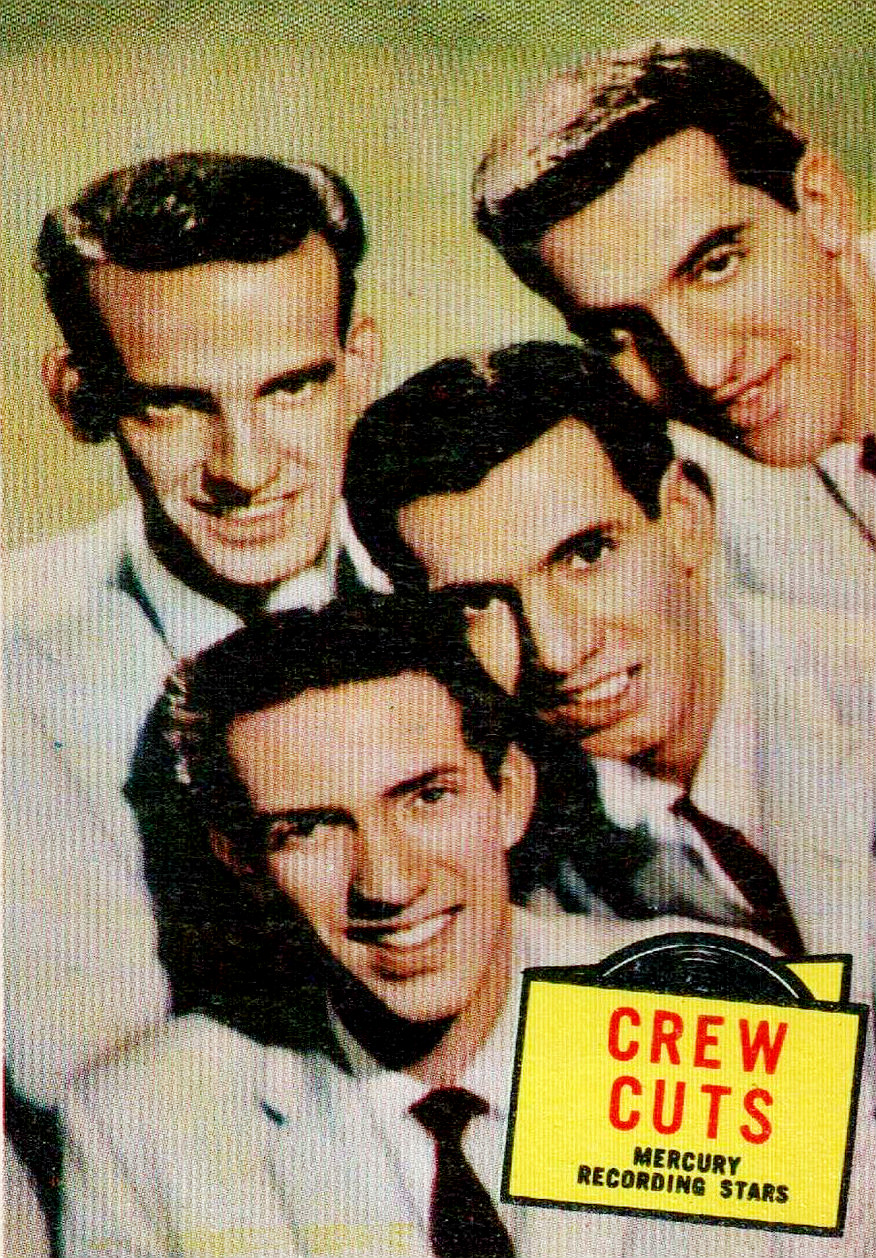

The Crew-Cuts
View on Wikipedia | This article needs additional citations for verification. (January 2008) |
The Crew-Cuts (sometimes spelled Crew Cuts or Crewcuts) were a Canadian vocal and doowop quartet, that made a number of popular records that charted in the United States and worldwide.[2] They were most famous for their recording of The Chords' hit record, "Sh-Boom".[3]
Key Information


The Crewcuts along with The Four Lads and The Diamonds were an inducted into the Canadian Hall of Fame in 1984. All the originals were on stage.
Group members
[edit]- Rudi Maugeri (né Rudolph Peter Maugeri; January 27, 1931 – May 7, 2004) (lead and baritone)
- John Perkins (born August 28, 1931) (lead and tenor)
- Ray Perkins (born November 24, 1932) (bass) (John Perkins' brother)
- Pat Barrett (September 15, 1933 – July 27, 2016) (lead and tenor)[3]
Biography
[edit]They all had been members of the St. Michael's Choir School in Toronto,[3] which also spawned another famous quartet, The Four Lads. Maugeri, John Perkins, and two others (Bernard Toorish and Connie Codarini) who later were among the Four Lads first formed a group called The Jordonaires (not to be confused with a similarly named group, The Jordanaires, that was known for singing backup vocals on Elvis Presley's hits) and also The Otnorots ("Toronto" spelled backwards being "Otnorot"), but they split from the group to finish high school. When the Four Lads returned to Toronto for a homecoming concert, John Perkins and Maugeri ran into each other and decided that they could themselves have a musical future. They joined with Barrett and Ray Perkins in March 1952. The group was originally called The Four Tones (not to be confused with The Four Tunes, a group on the borderline between pop music and rhythm and blues).
A Toronto disk jockey, Barry Nesbitt, put them on his weekly teen show, whose audience gave the group a new name, The Canadaires. All four of the members were at the time working at jobs with the Ontario government, but quit their jobs to sing full-time. They worked clubs in the Niagara Falls, Ontario, and Niagara Falls, New York area, but saved up their money and drove to New York City, so they could appear on Arthur Godfrey's television and radio program, Talent Scouts, where they came in second to a comedian. While they did get a record with Thrillwood Records and recorded a song titled "Chip, Chip Sing A Song Little Sparrow", this led to no improvement in their fortune, however, and they continued playing minor night clubs.
In March 1953, they returned to Toronto and appeared as an opening act for Gisele MacKenzie at the Casino Theatre. She was impressed with them and commented favorably to her record label, but could not remember the group's name.
They were playing in a Sudbury, Ontario, night club in a sub-zero Canadian winter when they received notice that they had been invited to appear as a guest on a Cleveland television program. They drove 600 miles in -40° temperatures to appear on the Gene Carroll show, where they remained for three appearances. While in Cleveland, they met local disc jockey Bill Randle.[4] On his show, on Cleveland radio station WERE (1300 AM), he coined the name that would, from that point on, belong to the group. In addition, Randle arranged for them to audition with Mercury Records, who liked them enough to sign the quartet to a contract.[4]
Although their first hit, "Crazy 'Bout You, Baby", was written by Maugeri and Barrett themselves, they quickly became specialists in cover recordings of originally-R&B songs.[2] Their first cover, "Sh-Boom" (of which the R&B original was recorded by The Chords) hit number one on the U.S. charts in 1954.[4] It sold over a million copies.[3] A number of other hits followed including "Earth Angel" which rose to the number 2 spot on the charts and had great success in the UK and Australia.[4] Many of the non-cover songs of theirs that became hits in Canada were unknown in the United States, while it was only their covers that had great success in the United States.
In the week beginning 19 September 1955, they played six nights at Liverpool Empire, in Liverpool, United Kingdom. A 12-year-old George Harrison was among the crowd on one of those nights, and a 13-year-old Paul McCartney got an autograph from them.[5]
The group moved from Mercury to RCA Records in 1958 and eventually broke up in 1964,[4] but they all moved to the U.S. and reunited in Nashville, Tennessee, in 1977. In the 1990s they were inducted into the Juno Hall of Fame. In recent years, the three remaining members (Rudi Maugeri died in 2004) appeared on a Public Broadcasting Service special filmed at Atlantic City's Trump Taj Mahal. The program, "Magic Moments: The Best of '50s Pop", continues to air as part of the fundraising efforts for PBS.
A remix of their version of the song "Sh-Boom" was featured in the credits of the video game Destroy All Humans!. The original recording of their song "Sh-Boom" can also be heard on one of the in-game radio stations in Mafia II.
In later years, Rudi Maugeri became a music director of one of the music syndication companies, Radio Arts in Burbank, California. The company supplied music on ten-inch reels of audiotape for use in radio station automation systems and for "Live Assist" use, around the world. Maugeri selected and issued a playlist every week for the company. His record of picking hit songs for syndication was in the upper 90% and record promoters had Radio Arts on their list of 'must see' companies because Radio Arts provided music to hundreds of stations weekly. Interviewed in 1979 on the syndicated radio show ShBoom Radio Show, Maugeri was quoted, "We came along at a time when the big bands were almost finished and we were the new... and yet we toured with Ralph Marterie's big band as the opening act and were quite well accepted by both the adults and the teens of the day. It wasn't until we hit the charts with "Crazy 'Bout Ya Baby" that the teens adopted us as their own and after that tour we became the headliners."[citation needed]
Discography
[edit]Singles
[edit]| Year | Single | Chart positions | ||||
|---|---|---|---|---|---|---|
| US | CB | UK | AU | BE | ||
| 1953 | "Twinkle Toes" | - | - | - | - | - |
| 1954 | "The Barking Dog" | - | 19 | - | - | - |
| "I Spoke Too Soon" | 24 | 49 | - | - | - | |
| "Crazy 'Bout Ya Baby" | 8 | 11 | - | - | - | |
| "Oop Shoop" | 13 | 13 | - | - | 8 | |
| "Sh-Boom" | 1 | 1 | 12 | 1 | 3 | |
| 1955 | "The Whiffenpoof Song" | - | - | - | - | - |
| "Earth Angel" | 3 | 2 | 4 | - | - | |
| "Ko Ko Mo (I Love You So)" | 6 | 3 | - | 13 | 3 | |
| "Two Hearts, Two Kisses" | - | - | - | 9 | - | |
| "Chop Chop Boom" | flip | 41 | - | - | - | |
| "Carmen's Boogie" | - | 42 | - | 4 | - | |
| "Angels in the Sky" | 11 | 10 | - | 36 | - | |
| "Don't Be Angry" | 14 | 9 | - | - | - | |
| "A Story Untold" | 16 | 14 | - | - | - | |
| "Song of the Fool" | - | - | - | 46 | - | |
| "Gum Drop" b/w "Present Arms" | 10 | 10 | - | 25 | - | |
| "Slam Bam" | - | 48 | - | - | - | |
| "Are You Havin' Any Fun?" | - | 49 | - | - | - | |
| "Unchained Melody" | - | - | - | - | - | |
| "Mostly Martha" | 31 | 33 | - | - | - | |
| 1956 | "Seven Days" b/w "That's Your Mistake" | 18 | 21 | - | - | - |
| "Tell Me Why" | 45 | 38 | - | - | - | |
| "Bei Mir Bist Du Schon" | - | - | - | - | - | |
| "Out of the Picture" | - | 49 | - | - | - | |
| "Love in a Home" | - | - | - | - | - | |
| "The Halls of Ivy" | - | - | - | - | - | |
| 1957 | "Young Love" | 17 | - | - | - | - |
| "Whatever, Whenever, Whoever" | - | - | - | - | - | |
| "Susie Q" | - | - | - | - | - | |
| "I Sit in the Window" | - | - | - | - | - | |
| "I Like It Like That" | - | - | - | - | - | |
| "Be My Only Love" | - | - | - | - | - | |
| 1958 | "Hey, Stella (Who Zat Down Your Cellar?)" | - | 82 | - | 85 | - |
| 1959 | "Over the Mountain" | - | - | - | - | - |
| "The Legend of Gunga Din" | - | - | - | - | - | |
See also
[edit]
.svg)
References
[edit]- ^ "CANOE - JAM! Music - Pop Encyclopedia - Crew Cuts". Jam.canoe.ca. Archived from the original on 2012-07-17. Retrieved 2015-08-17.
- ^ a b Colin Larkin, ed. (1997). The Virgin Encyclopedia of Popular Music (Concise ed.). Virgin Books. p. 320. ISBN 1-85227-745-9.
- ^ a b c d Murrells, Joseph (1978). The Book of Golden Discs (2nd ed.). London: Barrie and Jenkins Ltd. p. 68. ISBN 0-214-20512-6.
- ^ a b c d e Colin Larkin, ed. (2002). The Virgin Encyclopedia of Fifties Music (Third ed.). Virgin Books. p. 91. ISBN 1-85227-937-0.
- ^ Lewisohn, Mark. The Beatles - All These Years - Extended Special Edition: Volume One: Tune In. London: Little, Brown. p. 226-227. ISBN 978-1-4087-0478-3.
External links
[edit]- The Crew-Cuts at Doo Wop Heaven
- Crew-Cuts page on Black Cat Archived 2011-07-24 at the Wayback Machine
- The Crew-Cuts discography at Discogs
- The Crew-Cuts at IMDb
- Article at thecanadianencyclopedia.ca
- Article at canadianbands.com
| International | |
|---|---|
| National | |
| Artists | |
| Other | |

The Crew-Cuts
View on GrokipediaGroup Members
Original Lineup
The original lineup of The Crew-Cuts consisted of four vocalists who came together in Toronto, all alumni of St. Michael's Choir School, where they developed their skills in sacred music and choral harmony.[7] This foundation in liturgical singing influenced their tight-knit ensemble style before transitioning to popular music. Rudi Maugeri (born January 27, 1931, in Toronto, Ontario) served as the baritone and occasional lead vocalist, as well as the group's arranger, contributing essential harmonic depth to their arrangements.[8][7] Pat Barrett (born September 15, 1933, in Toronto, Ontario) handled tenor duties, delivering high-range vocals that added brightness to the harmonies, drawing from his choir school background.[9][7] John Perkins (born August 28, 1931, in Toronto, Ontario) provided lead and tenor vocals, often taking primary melodies on key tracks and shaping the group's melodic core.[7] His younger brother, Ray Perkins (born November 24, 1932, in Toronto, Ontario), anchored the bass line, ensuring the low-end stability that grounded their vocal blends.[7][4] The quartet solidified in 1952 after initial experiments under the name The Four Tones, with the members uniting post-choir school to perform in local church shows and on radio, leveraging their shared roots in sacred music for a seamless transition to secular harmony groups.[7][1]Later Careers and Deaths
Following the group's effective disbandment in 1964, the original members pursued individual paths, with sporadic reunions for performances into the 1980s, including a 1977 show in Nashville and their 1984 induction into the Canadian Music Hall of Fame where all four originals performed together.[5][3][1] Rudi Maugeri, the baritone and arranger, transitioned into radio after the split, working in broadcasting in New York and Los Angeles for 15 years, including as music director for the syndication company Radio Arts in Burbank, California, where he curated playlists for broadcast. He co-wrote the Crew-Cuts' 1954 single "Crazy 'Bout Ya Baby" with Pat Barrett, which became their first chart entry. Maugeri died of pancreatic cancer on May 7, 2004, at his home in Las Vegas, Nevada, at age 73.[10][5][11][12] Pat Barrett, the high tenor, took a job in New Jersey's auto industry but rejoined the others for select reunion gigs, such as the 1977 Nashville appearance and the 1984 Hall of Fame event. He passed away on July 27, 2016, at his home in Little Egg Harbor, New Jersey, at age 82.[5][1][13] John Perkins, a lead tenor during the group's run, relocated to the New Orleans area in 1964 with his wife Gilda, where he raised a family, engaged in community activism, and directed the choir at St. Margaret Mary Catholic Church in Slidell for more than 50 years; he made occasional appearances at nostalgia events tied to the Crew-Cuts' legacy. As of 2025, Perkins is alive at age 94.[6][14][13] Ray Perkins, John's brother and the group's bass, opted for a low-profile retirement in Washington state after 1964, limiting his involvement to brief reunion spots like the 1977 and 1984 events. As of 2025, he is alive at age 92.[13][15][1]Career
Formation and Early Years
The Crew-Cuts originated in 1952 at St. Michael's Choir School in Toronto, where Rudi Maugeri, John Perkins, Ray Perkins, and Pat Barrett—fellow students trained in choral music—formed the group initially known as The Four Tones.[7][1] Their early rehearsals emphasized barbershop quartet techniques and close vocal harmonies, building directly on the rigorous choir discipline they had developed at the school.[7] By late 1952, following a performance on a Toronto radio program, the group adopted the name The Canadaires at the suggestion of the station's audience, highlighting their Canadian identity.[1] They began making initial public appearances that year, including spots in Toronto church variety shows and broadcasts on radio station CKFH, which helped them gain modest local exposure.[7] In 1953, the quartet expanded their reach with key performances outside Toronto, driving 600 miles through harsh winter weather to appear three times on Cleveland's Gene Carroll Show, where their polished harmonies started generating regional interest.[1] Back in Toronto, they placed second in an amateur contest on Arthur Godfrey's Talent Scouts and opened for singer Gisele MacKenzie at the Casino Theatre, further building buzz among audiences and industry contacts.[1]Rise to Fame
In 1954, while performing as The Canadaires in Cleveland, Ohio, the group caught the attention of a Mercury Records executive during a live show, leading to their signing with the label.[7] This discovery marked their shift from regional gigs to a professional recording career, capitalizing on the growing popularity of vocal harmony groups in the mid-1950s.[16] Following the signing, the quartet adopted the name The Crew-Cuts, drawing inspiration from the short, military-style crew cut hairstyle that was emblematic of the era's youth culture and emerging doo-wop aesthetic.[7] Their first single for Mercury was "Crazy 'Bout Ya Baby," which reached #8 on the Billboard charts in May 1954. Their breakthrough came with their second single, a cover of "Sh-Boom," originally recorded by the African American R&B group The Chords earlier that year. Released in July 1954, the Crew-Cuts' polished, harmony-driven version propelled them to national stardom, reaching number one on the Billboard pop chart for seven weeks and significantly outselling the original by achieving broader mainstream appeal.[17][18] Building on this momentum, the group released a cover of "Earth Angel" in late 1954, another R&B tune originally by The Penguins, which peaked at number three on the Billboard pop chart in 1955 and solidified their approach of adapting Black-originated songs into accessible, white-friendly pop arrangements. These early hits established the Crew-Cuts as rising stars, with their clean-cut image and tight vocals resonating in the post-war American market. Their visibility surged through television appearances, including performances on American Bandstand in 1954, where their "Sh-Boom" helped introduce R&B elements to a wider teenage audience despite some resistance from the show's regulars.[19] They also debuted on The Ed Sullivan Show that December, further cementing their breakthrough.[20]Peak Success and Decline
Following the breakthrough success of their 1954 cover of "Sh-Boom," The Crew-Cuts experienced their commercial peak in 1955 with a string of hits that solidified their status as one of the top vocal groups of the era. That year, "Ko Ko Mo (I Love You So)" reached #6 on the Billboard Hot 100, while "Gum Drop" peaked at #5, and the group amassed over ten Top 40 entries by the end of 1956, including "Earth Angel" at #3, "Oop-Shoop" at #13, and "Angels in the Sky" at #11. "Seven Days" followed in early 1956, charting at #18. These releases, primarily covers of rhythm and blues songs adapted for pop audiences, propelled the group to widespread popularity, with sales exceeding millions of records.[21] The height of their fame coincided with intensive touring schedules across the United States and internationally from 1955 to 1956, where they frequently sold out major venues and appeared on high-profile television programs. Notable performances included multiple guest spots on The Ed Sullivan Show during the 1955-1956 season, exposing them to millions of viewers and boosting their mainstream appeal. The stable original lineup—Rudi Maugeri, Pat Barrett, John Perkins, and Ray Perkins—maintained tight vocal harmonies throughout this period, though members later expressed creative frustrations over being typecast as a "cover-only" act, limiting opportunities for original compositions. Despite this, their clean-cut image and polished style resonated with audiences amid the burgeoning rock 'n' roll scene.[1] By the late 1950s, the group attempted a shift toward original material to evolve beyond their cover-heavy catalog, but they faced stiff competition from the raw energy of rock 'n' roll pioneers like Elvis Presley, whose dominance on the charts after 1957 overshadowed vocal harmony groups. Their chart performance declined sharply post-1957, with "Young Love" marking their final Top 40 entry at #17 in early 1957. Activity tapered off by 1960, leading to an effective disbandment in 1964 as musical trends favored edgier sounds. Sporadic reunions occurred in the 1970s and 1980s, including a 1977 performance in Nashville and a 1984 induction into the Canadian Music Hall of Fame with all original members present, though these were limited to occasional live dates rather than a full revival.[22][23][1][5]Musical Style and Influences
Doo-Wop Covers and Adaptations
The Crew-Cuts gained prominence in the mid-1950s by specializing in covers of rhythm and blues (R&B) and doo-wop songs originally recorded by Black artists, adapting them with polished, pop-infused vocals to broaden appeal to white mainstream audiences and bridge racial divides in the music industry.[24] Their breakthrough came with the 1954 cover of "Sh-Boom" by The Chords, followed by renditions of tracks like "Earth Angel" by The Penguins and "Oop Shoop" by Shirley Gunter and the Queens, which transformed raw R&B energy into accessible harmony-driven pop.[25] This approach not only introduced doo-wop elements to wider listeners but also highlighted the era's racial dynamics, as their versions often secured greater radio play and sales due to less resistance from conservative programmers.[26] The band's practice exemplified the controversial "cover wars" of the 1950s, where white artists like The Crew-Cuts frequently overshadowed Black originals on the pop charts, diverting royalties and recognition away from the original performers and composers.[27] For instance, their "Sh-Boom" reached number one on the Billboard pop chart for seven weeks, vastly outselling The Chords' version, which peaked at number five on the R&B chart but struggled on pop airwaves.[26] This pattern limited economic opportunities for Black artists, as major labels prioritized white covers for their perceived marketability, perpetuating inequities in the burgeoning rock and roll scene.[24] In adapting these songs, The Crew-Cuts typically softened the original rhythms, incorporated orchestral backing for a smoother texture, and prioritized tight vocal harmonies over the improvisation and emotional intensity of the R&B sources.[28] A prime example is their 1955 cover of "Ko Ko Mo (I Love You So)" by Gene and Eunice, where they replaced the duo's playful, innuendo-laden R&B bounce with refined orchestration and layered group vocals, stripping away much of the original's flirtatious edge to suit pop sensibilities.[28] Similar modifications appeared in covers like "Don't Be Angry" by Nappy Brown and "Gum Drop" by The Charms, emphasizing melodic clarity and barbershop-style precision.[25] Overall, The Crew-Cuts' catalog featured numerous such covers between 1954 and 1956, playing a key role in the commercialization of doo-wop by integrating its harmonic innovations into the pop mainstream while diluting its cultural roots.[26] This strategy yielded nine Top 20 pop hits between 1954 and 1955, accelerating doo-wop's transition from urban Black communities to national popularity but at the expense of the genre's authentic origins.[25][29]Vocal Harmony Techniques
The Crew-Cuts specialized in four-part close harmonies, a technique that formed the core of their vocal style, with tenors Pat Barrett and John Perkins delivering the melody and high harmonies, baritone Rudi Maugeri filling the inner voices and serving as the primary arranger, and bass Ray Perkins providing the foundational low notes for rhythmic and tonal stability.[30][1] This structure allowed for a balanced, interlocking sound where each voice contributed distinctly yet seamlessly, emphasizing precision in blending and intonation to create a unified choral effect.[1] Drawing from barbershop quartet traditions and gospel music, the group honed techniques such as tight pitch control and ensemble synchronization during their formative years at St. Michael’s Choir School in Toronto, where rigorous choral training instilled a discipline that prioritized vocal purity over instrumental accompaniment.[30][1] Their harmonies avoided reliance on instrumental solos, instead spotlighting the a cappella-like interplay of voices to maintain focus on the group's collective timbre and dynamics.[30] In adapting doo-wop elements, the Crew-Cuts incorporated call-and-response patterns and nonsense syllables—such as the iconic "sh-boom" refrains—originally popularized by street-corner "bird groups" like the Orioles and Penguins, but refined them with a polished clarity suited for mainstream radio broadcasts.[1][31] This approach transformed raw R&B influences into accessible pop harmonies, enhancing the group's commercial appeal while preserving the rhythmic vitality of gospel-derived vocal exchanges.[30]Discography
Singles
The Crew-Cuts achieved their initial commercial breakthrough with a series of doo-wop covers released as singles on Mercury Records during the mid-1950s, many of which crossed over from R&B origins to top the pop charts. These 45 RPM releases emphasized tight vocal harmonies and helped popularize the genre among broader audiences, with several attaining high positions on the Billboard Hot 100.[23]| Year | A-Side / B-Side | Label & Catalog | Peak Position |
|---|---|---|---|
| 1954 | "Sh-Boom" b/w "I Spoke Too Soon" | Mercury 70404 | #1 Hot 100 (7 weeks) [32] |
| 1955 | "Ko Ko Mo (I Love You So)" b/w "Earth Angel" | Mercury 70529 | #6 Hot 100 (A-side); #3 Hot 100 (B-side) [23] [33] |
| 1955 | "Gum Drop" b/w "Song of the Fool" | Mercury 70668 | #10 Hot 100 [34] [35] |