Hubbry Logo
The Fighting KentuckianThe Fighting KentuckianMain
Open search
The Fighting Kentuckian
Community hub
The Fighting Kentuckian
logo
8 pages, 0 posts
0 subscribers
Be the first to start a discussion here.
The Fighting Kentuckian
from Wikipedia

The Fighting Kentuckian
Original cinema poster
Directed byGeorge Waggner
Written byGeorge Waggner
Produced byJohn Wayne
StarringJohn Wayne
Vera Ralston
Philip Dorn
Oliver Hardy
Marie Windsor
John Howard
Hugo Haas
Grant Withers
Odette Myrtil
Paul Fix
CinematographyLee Garmes
Edited byRichard L. Van Enger
Music byGeorge Antheil
Production
company
Republic Pictures
Distributed byRepublic Pictures
Release date
  • September 15, 1949 (1949-09-15) (United States)
Running time
100 minutes
CountryUnited States
LanguageEnglish
Budget$1,334,664[1]
Box office$1,550,000[2] or $1,750,518 (as at 27 March 1953)[1]
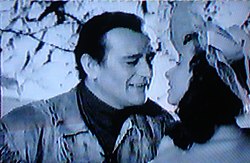
John Wayne and Vera Ralston in The Fighting Kentuckian (1949)

The Fighting Kentuckian is a 1949 American adventure Western film written and directed by George Waggner and starring John Wayne, who also produced the film. The supporting cast featured Vera Ralston, Philip Dorn, Oliver Hardy (of Laurel & Hardy) portraying Wayne's portly sidekick, Marie Windsor, John Howard, Hugo Haas, Grant Withers, and Odette Myrtil.

Plot

[edit]

Returning home from the War of 1812, John Breen, a Kentucky militiaman, falls in love with French exile Fleurette de Marchand. He discovers a plot to steal the land on which Fleurette's exiles plan to settle. Breen is mistaken for a land surveyor and is presented with a theodolite, and sets out with Willie to look as if they are surveying (they do not actually know what to do). A further pretense occurs when Breen sits on stage with a group of fiddlers and feigns being able to play.

Throughout the film, Breen's soldiers sing:

Only 600 miles more to go (2x)
And if we can just get lucky
We will end up in Kentucky
Only 600 miles more to go.

When the song is first heard, 800 miles (1,300 km) remain (the tune is "She'll Be Coming 'Round the Mountain").

Cast

[edit]

Historical setting

[edit]

The story is set in Alabama in 1818, including the city of Demopolis, which was founded by Bonapartists. The Bonapartists had been exiled from France, after the defeat of Napoleon I at the Battle of Waterloo. Congress authorized the sale of four townships in the Alabama Territory in March 1817 at two dollars per acre, and Marengo County was created on February 7, 1818, from lands that had been taken from the Choctaw Nation, under the Treaty of Fort St. Stephens. It was named after Spinetta Marengo, Italy, where Napoleon defeated Austria in 1800, at the Battle of Marengo. The county seat, Linden, Alabama, was named after Hohenlinden, Bavaria, where Napoleon won another victory against the Austrians. The Bonapartist colony did not succeed overall, in part due to surveyance issues that contribute to the plot of the film and in part due to practical difficulties in establishing the vineyards.[3][4][5]

Production notes

[edit]

See also

[edit]

References

[edit]
[edit]
Revisions and contributorsEdit on WikipediaRead on Wikipedia
from Grokipedia
The Fighting Kentuckian is a 1949 American Western film directed and written by , produced by , and starring Wayne as John Breen, a militiaman who falls in love with a French exile and helps protect her community's land from greedy opportunists in early 19th-century . The film blends romance, action, and frontier adventure, drawing on the historical U.S. grant of four townships in to Napoleon's defeated officers and their families following the War of 1812. In the story, Breen encounters Fleurette DeMarchand (), daughter of General Paul DeMarchand (), while marching with his regiment through the region. Engaged to the scheming Blake Randolph (), Fleurette becomes entangled in a plot by Randolph and his associate George Hayden () to seize the French settlers' land through forged documents and violence. Breen, with the aid of his bumbling but loyal companion Willie Paine () and Colonel Georges Geraud (), uncovers the conspiracy, leading to brawls, chases, and a climactic confrontation to secure the settlers' future. Released by Republic Pictures on September 15, 1949, the black-and-white production runs 100 minutes and was filmed primarily in Agoura, California, under cinematographer Lee Garmes. Notable for Hardy's rare dramatic supporting role in one of his final film appearances before his death in 1957, the movie highlights Wayne's dual role as actor and producer during his transition from Republic's B-westerns to major stardom. Its working title was A Strange Caravan, reflecting the film's depiction of the exiled French group's journey.

Story and Characters

Plot Summary

In 1818 Alabama, following the War of 1812, Kentucky militiaman John Breen leads his regiment on an 800-mile march homeward after the Battle of New Orleans. While passing through Mobile, Breen encounters Fleurette de Marchand, the spirited daughter of exiled French General Paul de Marchand, when he playfully commandeers her carriage during a rainstorm, sparking an immediate romantic attraction between them. Despite Fleurette's prior engagement to the suave but scheming land speculator Blake Randolph, Breen is smitten and decides to detour his entire unit to the French settlement of Demopolis to pursue her, where the de Marchand family and other Napoleonic exiles have been granted land by Congress to establish a new community. Upon arriving in Demopolis, Breen's courtship of Fleurette faces obstacles from local tensions, including a raucous brawl at her engagement party where resentful American frontiersmen clash with the refined French settlers. Breen, portrayed as a heroic frontiersman, enlists of his bumbling but loyal , Willie Paine, whose comedic antics provide levity amid the growing conflict. Meanwhile, the central antagonism emerges as Randolph, aided by his ruthless associate George Hayden and a corrupt surveyor, hatches a plot to falsify land records and seize the French grant through intimidation and violence, aiming to exploit the settlers' vulnerability. Breen, suspicious of Randolph's intentions, accepts a covert job from the vengeful widow Ann Logan—who seeks on Hayden for murdering her husband—to pose as a surveyor alongside Willie, allowing him to infiltrate the area and gather evidence of the conspiracy. As Breen delves deeper, he uncovers documents proving the land fraud and confronts Randolph, who begins to show flickers of due to his affection for Fleurette. Tensions escalate when Hayden's of river men ambushes the French convoy en route to Demopolis, leading to a fierce skirmish where Breen is wounded while defending the settlers. Arrested on false charges of trespassing, Breen escapes with Willie's help during a chaotic horse chase through the swamps, pursued by Hayden's men. The plot intensifies as Hayden launches a full on the Demopolis settlement, burning cabins and driving the French toward eviction. In the climactic battle, Breen rallies the beleaguered French forces, with Willie comically but effectively sounding the bugle to summon Breen's returning regiment for reinforcements. Amid the gunfire and , Randolph redeems himself by sacrificing his life to shield Breen from a fatal shot. Breen then engages Hayden in a brutal , ultimately killing him and dismantling the land grab scheme. With the villains defeated and the fraudulent surveys exposed, the French settlers secure their claim to Demopolis. Breen and Fleurette, having overcome all barriers, marry in a joyous ceremony, symbolizing the union of and French resilience.

Cast

The principal cast of The Fighting Kentuckian is led by as Col. John Breen, the rugged Kentucky militiaman who emerges as the romantic hero and steadfast protector of the beleaguered French settlers against land encroachment. Vera Ralston plays Fleurette de Marchand, the poised daughter of a French exile leader and Breen's primary love interest, embodying grace amid the frontier's hardships. portrays Col. Georges Geraud, a disciplined Napoleonic who commands the settlers' defenses and represents enduring French aristocratic honor. Oliver Hardy appears as Willie Paine, Breen's hapless but loyal companion whose clumsy antics deliver physical comedy and lighthearted support throughout the adventure; this marked one of Hardy's few solo roles following his long partnership with Stan Laurel. John Howard takes the role of Blake Randolph, the cunning land speculator and chief antagonist driven by avarice to undermine the French colony. Grant Withers as George Hayden, Randolph's ruthless associate in the land scheme. Hugo Haas is cast as Gen. Paul de Marchand, the exiled officer overseeing the settlers and father to Fleurette, symbolizing resilient Napoleonic nobility. The supporting ensemble includes as Ann Logan, a determined woman seeking revenge on Hayden for her husband's murder, who aids Breen in exposing the land scheme. Additional key supporting players feature Fred Graham as Cassels, the dishonest surveyor complicit in the villains' plot. Notably, , who frequently starred in productions, was married to studio president Herbert Yates during filming.

Production

Development

George Waggner served as both writer and director of The Fighting Kentuckian, crafting the script around a fictionalized land dispute inspired by the historical Vine and Olive Colony, a short-lived settlement established in 1817 near present-day , by French Bonapartist exiles granted land by the U.S. Congress following Napoleon's defeat at Waterloo. John Wayne took on the role of producer through his newly formed John Wayne Productions, established in 1949, in partnership with Republic Pictures; this marked his second such credit after Angel and the Badman (1947), driven by ongoing frustrations with the studio's modest production scales and desire for greater creative control amid his escalating fame. Development progressed swiftly in the late 1940s, with the script finalized in 1948 and Republic greenlighting production in early 1949, leveraging Wayne's breakthrough success in Howard Hawks' Red River (1948), which elevated his status from B-western star to major leading man. Key casting decisions reflected studio dynamics and opportunities for comedic relief: was selected as the romantic lead, Fleurette de Marchand, owing to her close personal and professional ties to president , with whom she had been romantically involved since signing with the studio in 1943 and whom she would marry in 1952. , seeking solo roles after the dissolution of his long-running comedy duo with in 1940, was chosen to portray Wayne's bumbling , Willie Paine, adding levity to the Western-adventure blending romance and action. The production prioritized authenticity through investments in period-accurate costumes and sets depicting early 19th-century frontier life, with Donald Overall-Hatswell credited for uniforms.

Filming

for The Fighting Kentuckian commenced in early March 1949 and wrapped by late April, taking place primarily at studios in Hollywood, with exterior scenes filmed in Agoura, , to evoke the Southern wilderness setting of early 19th-century . These locations allowed for the depiction of forested and rural environments central to the film's Kentucky militiamen and French settler sequences, substituting for the historical Demopolis area without on-location shooting in the . Cinematographer Lee Garmes employed black-and-white film stock with the RCA Sound System to achieve a period-appropriate aesthetic, emphasizing dramatic in interior studio shots and natural contrasts in the outdoor action. The production's action focused on hand-to-hand fights and the film's climactic battle, showcasing John Wayne's physical prowess under director George Waggner's guidance, which prioritized authentic frontier combat over stylized violence. Challenges arose in managing large-scale crowd scenes involving extras as militiamen and , requiring precise coordination to simulate group movements and skirmishes amid the limited of a feature. , cast as Wayne's sidekick at age 57 and weighing over 300 pounds, encountered physical strain during these demanding sequences owing to his longstanding weight issues, though he completed his role without major interruptions. Post-production editing by Richard L. Van Enger finalized the 100-minute cut in time for a September 1949 premiere, while composer crafted the score, blending orchestral elements with folk-inspired and martial motifs to underscore the film's themes of pioneering conflict.

Historical Context

Real-Life Basis

The Vine and Olive Colony was established in 1817 near present-day Demopolis in , by a group of French exiles, including some former Napoleonic officers but primarily middle-class refugees from the fearing persecution and economic hardship, following Napoleon's defeat at Waterloo in 1815 and the subsequent . These settlers sought refuge in the United States to establish an agricultural community focused on cultivating grapes and olives. The initiative originated in , where French émigrés formed the Colonial of French Emigrants in 1816 to lobby for land grants and support relocation efforts. In response to petitions from the society, the U.S. passed an act on March 3, 1817, authorizing the sale of four contiguous townships—totaling approximately 92,000 acres—in the at $2 per acre, with a 14-year grace period for payment and a requirement to plant a reasonable proportion of the land in vines and olives. This policy reflected American goodwill toward as a post-War of 1812 ally against Britain, as well as a broader effort to populate and develop western territories with skilled European settlers. Prominent figures included General Charles Lallemand, the society's president and a Napoleonic commander, and General Charles Lefebvre-Desnouettes, a under who served as an early leader of the expedition. Other officers, such as Henri Lallemand and Count , also participated in organizing the venture. The settlers began arriving in 1817, with an initial group of about 40 landing at before proceeding up the ; by early 1818, around 150 of the 347 grantees had reached the site, founding the town of Demopolis (meaning "people's city" in Greek). A surveying error initially placed the settlement outside the granted boundaries, prompting a relocation to nearby Aigleville in 1818. The colonists faced severe challenges, including rampant , crop failures due to the unsuitable for Mediterranean plants like olives and grapes, high transportation costs for supplies, and disputes with American land speculators who contested titles and encroached on claims. These hardships led to food shortages and financial strain, diverting some resources toward unrelated military expeditions, such as Charles Lallemand's failed 1818 incursion into . By the early 1820s, the had largely collapsed, with most settlers abandoning their allotments due to ongoing failures and legal battles over land patents; relaxed terms in 1831, reducing the price to $1.25 per acre and dropping the cultivation requirements, but this came too late for the original French group. Many returned to France, integrated into American society elsewhere, or shifted to farming on smaller plots; by 1830, no Napoleonic veterans remained in the area, and Demopolis evolved into a standard American river town, fading as a distinct French enclave.

Fictional Elements

The film introduces the militiamen, under the leadership of the protagonist John Breen, as heroic rescuers who intervene to protect the French settlers from land speculators, a complete invention that contrasts sharply with the historical reality of the Vine and Olive Colony, where settlers operated in relative isolation without significant aid from American military forces. In actuality, the colony's French expatriates, granted 92,000 acres by in 1817, contended with legal disputes, poor soil, and environmental challenges largely on their own, with no documented involvement of troops in their defense. Central to the narrative is the romantic subplot, where Breen serves as a composite heroic figure embodying amplified —courting the aristocratic Fleurette DeMarchand amid perilous adventures—without correspondence to any particular historical individual from the era. This device heightens dramatic tension and aligns with the film's emphasis on personal valor over factual precision, allowing the story to blend adventure with sentimental appeal. The portrayal of antagonists like Blake Randolph fictionalizes real encroachments by land speculators on the colony's grant but amplifies them through personal vendettas, deceitful schemes, and comedic interludes involving bumbling henchmen, transforming historical economic pressures into a more theatrical conflict. Such serves the needs of a post-World War II audience, prioritizing moral clarity and humor over the nuanced legal battles that plagued the actual settlement. Cultural depictions in the film over-romanticize the French settlers as elegant nobility and uniformed Napoleonic officers, diverging from their true makeup as mostly middle-class refugees from and Europe, while idealizing Kentuckians as rugged, honorable frontiersmen to evoke 1940s ideals of and cultural harmony. These stereotypes blend for broad appeal, fostering a mythic of cross-cultural alliance absent from the colony's documented struggles. The story's 1818 setting incorporates minor anachronisms by compressing the colony's establishment and the ensuing events of land disputes and relocations through 1820 into a tighter timeline, streamlining the plot for cinematic pacing without regard for chronological fidelity.

Release and Reception

Distribution

The film premiered in the United States on September 15, 1949, and was distributed nationwide by . Marketing efforts highlighted the pairing of in a rugged adventure role with providing , alongside themes of romance, action, and post-War of historical drama, as seen in promotional posters featuring bold taglines like "Rougher! Tougher! More Romantic than Ever!" Wayne's involvement as helped elevate the promotional push, leveraging his rising star power within Republic's slate of Westerns. With a budget of $1,334,664, the picture achieved solid commercial performance for a mid-budget release and was considered a success, though it did not match the blockbuster earnings of Wayne's subsequent major hits. Internationally, distribution was limited, with releases in in the early 1950s, including on February 9, 1951, and on December 31, 1951, often featuring dubbed versions to appeal to local audiences amid Wayne's emerging global popularity. Home media availability evolved over decades, starting with releases in the late , such as the 1989 edition from Home Video. A DVD version followed in 2005 as part of Lionsgate's collection sets, preserving the black-and-white print for home viewers. By the , the film became accessible via free streaming platforms, including , expanding its reach to modern audiences.

Critical Response

Upon its release in 1949, The Fighting Kentuckian received mixed reviews from contemporary critics, who appreciated its entertaining elements while pointing out its conventional storytelling. Critics commended John Wayne's ability to balance the demands of producing and starring, highlighting the film's action sequences and Oliver Hardy's comedic contributions as strengths that elevated the predictable plot. The light-hearted tone and Hardy's role as were frequently noted as highlights, providing relief amid the frontier adventure. Critics also offered pointed criticisms, particularly regarding the film's lightweight nature compared to Wayne's more serious Westerns and the performance of leading lady . Ralston's portrayal was described as wooden, hampered by her noticeable Czech accent, which some reviewers felt undermined the romantic elements. The overall narrative was seen as formulaic, lacking depth in its exploration of post-War of 1812 tensions. In modern reception, as of November 2025, the film has an audience score of 63% on based on over 2,500 ratings, with no Tomatometer score due to limited reviews (2), and the consensus praising its knockabout tone, the easygoing chemistry between Wayne and Hardy, and Wayne's charismatic, humorous lead performance. It is often appreciated as a fun, nostalgic B-Western, valued for its black-and-white visuals and Hardy's effective in one of his later roles before his death in 1957. On , it maintains a user rating of 6.4 out of 10 from over 3,800 votes, reflecting enduring appeal for fans of classic Westerns. Scholarly discussions in John Wayne biographies frame The Fighting Kentuckian as a significant early effort in his producing career, demonstrating his growing desire for creative control at after successes like . The film is cited as a vehicle tailored to Wayne's persona as a rugged yet romantic frontiersman, marking his shift toward behind-the-scenes influence while showcasing Hardy's final major screen appearance in a supporting comic role.

References

Add your contribution
Related Hubs
User Avatar
No comments yet.