Hubbry Logo
The GumpsThe GumpsMain
Open search
The Gumps
Community hub
The Gumps
logo
8 pages, 0 posts
0 subscribers
Be the first to start a discussion here.
The Gumps
The Gumps
from Wikipedia
The Gumps
Sidney Smith's The Gumps (September 30, 1923)
AuthorSidney Smith (1917–1935)
Gus Edson (1935–1959)
Current status/scheduleEnded
Launch dateFebruary 12, 1917
End dateOctober 17, 1959
Syndicate(s)Chicago Tribune Syndicate
Publisher(s)Charles Scribner's Sons
IDW Publishing
Genre(s)Comedy, melodrama

The Gumps is a comic strip about a middle-class family. It was created by Sidney Smith in 1917, launching a 42-year run in newspapers from February 12, 1917, until October 17, 1959.

According to a 1937 issue of Life, The Gumps was inspired by Andy Wheat, a real-life person Smith met through his brother. "Born forty-seven years ago [i.e., in 1890] in Bay St. Louis, Mississippi, Andy Wheat acquired his unusual physiognomy as the result of an infection following the extraction of a tooth, which eventually necessitated the removal of his entire lower jaw. Through Dr. Thomas Smith of Bloomingdale, Illinois, a dentist and a brother of Sidney Smith, Wheat met the cartoonist, who saw in him an ideal comic character. Wheat subsequently had his surname legally changed to "Gump" to match the cartoon character. His wife's name is Min, and he has two children, Chester and Goliath, now living in San Francisco, and an Uncle Bim who lives in Georgia. Gump's home is in Tucson, Arizona, but he also has a farm near his birthplace in Mississippi."[1]

Characters and story

[edit]

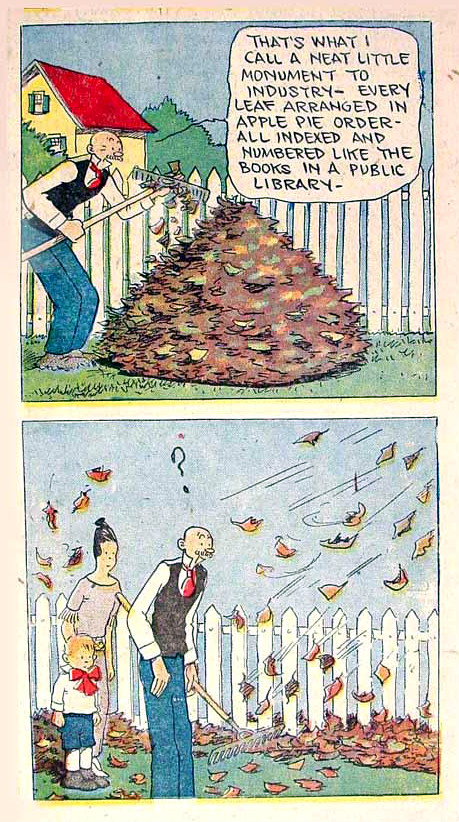
The Gumps were utterly ordinary: chinless, bombastic blowhard Andy Gump (short for Andrew), who is henpecked by his wife, Min (short for Minerva); their sons Chester and baby Goliath (plus an unnamed daughter in college and an unnamed son in the Navy); wealthy Uncle Bim; and their annoying maid Tilda. They had a cat named Hope and a dog named Buck. The idea was envisioned by Joseph Patterson, editor and publisher of the Chicago Tribune, who was important in the early histories of Little Orphan Annie and other long-run comic strips. Patterson referred to the masses as "gumps" and thought a strip about the domestic lives of ordinary people and their ordinary activities would appeal to the average American newspaper reader. He hired Smith to write and draw the strip, and it was Smith who breathed life into the characters. Smith was the first cartoonist to kill off a regular character: His May 1929 storyline about the death of Mary Gold caused a national sensation.[2]

The Sunday page also included several toppers over the course of the run: Old Doc Yak (Dec 7, 1930 – Feb 25, 1934), Cousin Juniper (Jan 2, 1944–1955) and Grandpa Noah (1955).[3]

Debut

[edit]
Sidney Smith's The Gumps (February 12, 1917).

The Gumps made its debut in an unusual way. Cartoonist Sidney Smith had previously drawn and written Old Doc Yak, a talking-animal strip that sustained only a brief run. The very last Old Doc Yak strip depicted Yak and his family moving out of their house, while wondering who might move into the house next. On Thursday, February 8, 1917, the last panel showed only the empty house. On Monday, February 12, 1917, after the Gumps were introduced in the space formerly occupied by Old Doc Yak, they moved into the house formerly occupied by the Yak family. (Old Doc Yak would reappear as a topper for The Gumps Sunday page from 1930 to 1934.)

The Gumps had a key role in the rise of syndication when Robert R. McCormick and Patterson, who had both been publishing the Chicago Tribune since 1914, planned to launch a tabloid in New York, as comics historian Coulton Waugh explained:

"So originated on June 16, 1919, the Illustrated Daily News, a title which, as too English, was almost at once clipped to Daily News. It was a picture paper, and it was a perfect setting for the newly developed art of the comic strip. The first issue shows but a single strip, The Gumps. It was the almost instant popularity of this famous strip that directly brought national syndication into being. Midwestern and other papers began writing to the Chicago Tribune, which also published The Gumps, requesting to be allowed to use the new comic, and the result was that the heads of the two papers collaborated and founded the Chicago Tribune New York News Syndicate, which soon was distributing Tribune-News features to every nook and cranny of the country".[4]

Films

[edit]

As one of the earliest continuity strips, The Gumps was extremely popular, with newspaper readers anxiously following the convoluted storylines. By 1919, this popularity prompted an interest in film adaptations, and in 1920–21, with writing credited to Smith, animation director Wallace A. Carlson produced and directed more than 50 animated shorts, some no longer than two minutes, for distribution through Paramount.[5]

Between 1923 and 1928, Universal Pictures produced at least four dozen Gumps two-reel comedies starring Joe Murphy (1877–1961), one of the original Keystone Cops, as Andy Gump, Fay Tincher as Min and Jack Morgan as Chester. Many of these shorts were directed by Norman Taurog, later famed as the leading director of Elvis Presley movies.

In the comic strip, Sidney Smith had Andy run for Congress in 1922 and for President in 1924 and in practically every succeeding election, one of the first of many comic strip and cartoon characters to run for office. In 1924, Smith wrote his characters into a novel, Andy Gump: His Life Story, published in Chicago by Reilly & Lee. In 1929, when Smith killed off Mary Gold, she was the first major comic strip character to die, and the Chicago Tribune had to hire extra staff to deal with the constant phone calls and letters from stunned readers.

The strip and its merchandising (toys, games, a popular song, playing cards, food products) made Smith a wealthy man. On his way home from signing a $150,000 a year contract in 1935, he crashed his new Rolls-Royce and died. Patterson replaced Smith with sports cartoonist Gus Edson. In the late 1940s and early 1950s, when actor Martin Landau was a cartoonist, he worked as Edson's assistant on The Gumps, eventually drawing the Sunday strips for Edson.

Radio

[edit]
Comic strip within a strip: Min reads The Gumps in Gus Edson's The Gumps page with Edson's Cousin Juniper strip at bottom (January 23, 1955).

The Gumps launched a craze for continuity strips in newspapers. It also influenced radio and television programming. Radio/TV sitcoms and serialized dramas can all be traced back to The Gumps, as detailed by broadcast historian Elizabeth McLeod in the "Andy Gump to Andy Brown" section of her popular culture essay,[6] and her book, The Original Amos 'n' Andy: Freeman Gosden, Charles Correll, and the 1928–43 Radio Serial (McFarland, 2005).

At the Chicago Tribune's radio station WGN, Freeman Gosden and Charles Correll signed on as staffers in 1925. WGN executive Ben McCanna believed that a dramatic serial could work on radio just as it did in newspapers. The Gumps first aired on WGN in 1931, then moved to CBS Radio for a four-year run (1934–1937), produced and directed by Himan Brown with scripts by Irwin Shaw.

In the early programs, Jack Boyle portrayed Andy Gump with Dorothy Denvir as Min, Charles Flynn as their son Chester and Bess Flynn, born 1899 in Tama, Iowa, as Tilda the maid. Flynn scripted for soap operas, including Bachelor's Children, Martha Webster and We, the Abbotts, and she also portrayed the title role on Martha Webster. In 1935, Wilmer Walter played Andy Gump with Agnes Moorehead portraying Min during the last two years of the series when Lester Jay and Jackie Kelk were heard as Chester.[7]

Reprints

[edit]
Sidney Smith's The Gumps (1926)

Herb Galewitz assembled a selective compilation of the comic strips for the book, Sidney Smith's The Gumps, published in 1974 by Charles Scribner's Sons. However, the strips in this book were assembled in a slipshod manner with no apparent restoration.

In 2012, IDW's imprint The Library of American Comics announced a new series reprinting daily strips, in the LoAC Essentials. A Gumps volume titled The Saga of Mary Gold (1928–29) was published in March 2013.

Tributes

[edit]

A gift from the Tribune management to Smith was a large statue of Andy Gump, which stood on Smith's Lake Geneva, Wisconsin, estate. After Smith died in 1935, the statue was moved to a city park. In 1943, the statue was acquired by the city of Lake Geneva, but it was destroyed in 1967 during a drunken riot. It was replaced with a new statue, which was stolen in 1989 and again replaced. A plaque honoring Smith was also stolen from Lake Geneva in 1952, but it was later found.[8] The statue is currently on display at the Lake Geneva Museum.[9]

Andy Gump was the favored comic of Harry S. Truman he enjoyed it so much that he based his license plate off the strip

Hockey great Gump Worsley, born Lorne Worsley, was nicknamed for his resemblance to Andy Gump.

Jazz musician Min Leibrook, born Wilford Leibrook, received his nickname from Andy Gump's wife, Min.

The town of Bim, West Virginia is named for Uncle Bim Gump.

A bunker on the 16th hole of the Hinsdale Golf Club in Clarendon Hills, IL is shaped in the likeness of Andy Gump.

The surgical removal of the mandible can result in a dysmorphism referred to as the Andy Gump deformity due to his character design apparently lacking a jaw.[10]

References

[edit]

Further reading

[edit]
[edit]
Revisions and contributorsEdit on WikipediaRead on Wikipedia
from Grokipedia
The Gumps was an American comic strip created by Sidney Smith that ran from February 12, 1917, to October 17, 1959, depicting the everyday struggles and melodramatic escapades of a middle-class family while pioneering continuity storytelling with extended, soap opera-style narratives in the daily newspaper format. The strip originated from an idea by Joseph Medill Patterson, editor of the Chicago Tribune, who sought a realistic portrayal of ordinary American family life to appeal to a broad readership; Smith, a former cartoonist for the Bloomington Pantagraph, illustrated it and quickly turned it into a syndicated hit that boosted the Tribune's circulation nationwide. Smith worked with assistants like Sol Hess for dialogue and Stanley Link for Sunday pages, but tragically died in a car accident on October 20, 1935, shortly after signing a lucrative contract renewal worth $150,000 per year with the Tribune; Gus Edson then took over scripting and drawing until the strip's end. At its core, The Gumps revolved around protagonist Andrew "Andy" Gump, a bald, chinless president of a hairbrush company often entangled in get-rich-quick schemes; his pragmatic wife, "Min" Gump; their son, "Bim" Gump (named after a relative); the scheming millionaire Uncle Bim Boothby; and the sharp-tongued maid Tilda Haskins, whose antics provided comic relief amid the family's financial woes and social aspirations. A pivotal storyline introduced young orphan Mary Gold in 1921, whose adoption by the Gumps and tragic death from in 1929 marked the first permanent killing of a major recurring character in a , eliciting massive public outcry and thousands of mourning letters from fans. The Gumps achieved widespread cultural impact through innovative adaptations, becoming the first broadcast on radio in 1931 via Chicago's WGN station, where it aired daily until 1937 and featured voice actors like ; it also inspired silent animated shorts starting in 1920 and spawned extensive merchandising, including toys, games, , playing cards, and even branded foods. The strip's popularity propelled Smith to millionaire status, with Andy Gump running satirical campaigns for U.S. in 1922 and the presidency in 1924 and 1928, reflecting its satirical edge on American ambitions; its influence on serialized comics endured, inspiring creators like and . By the , however, its audience dwindled to fewer than 20 newspapers, leading to its conclusion amid shifting tastes in humor.

Creation and Publication History

Sidney Smith and Origins

Robert Sidney Smith, known professionally as Sidney Smith, was born on February 13, 1877, in , to Dr. T. H. Smith and Frances A. Shafer Smith. As a high school dropout with a penchant for , he began his as a at age 18, contributing to the Bloomington Eye in 1895 before moving to larger outlets such as the News and . By 1908, Smith had joined the Examiner, where he created early comic features, and in 1911, he transitioned to the , launching his signature billy goat character in the strip Old Doc Yak on February 5, 1912. His work during this period established him as a prominent figure in Chicago's burgeoning newspaper comics scene, blending whimsical humor with relatable everyday scenarios. The concept for The Gumps originated in 1916 when Patterson, editor of the and co-founder of the , approached Smith with the idea for a daily strip depicting the mundane lives of an ordinary middle-class American family, aiming to appeal to what Patterson termed the "gumps"—the uneducated masses. Smith drew inspiration for the central character, the chinless Andy Gump, from Andy Wheat, a real-life native and local businessman whom Smith encountered through his brother; Wheat's distinctive appearance stemmed from a childhood infection that required surgical removal of his lower jaw. Development progressed rapidly, with the strip debuting on , 1917, in the as a direct replacement for Old Doc Yak, whose final daily installment featured the goat selling his house to Andy Gump. This transition marked a shift from Smith's earlier gag-oriented animal antics to serialized human drama. Smith collaborated with assistants, including Sol Hess for dialogue and Stanley Link for the Sunday pages. Smith's artistic style in The Gumps emphasized realistic depictions of domestic settings, using clean lines and expressive faces to capture the quirks of suburban life, which resonated deeply with readers seeking escapism in post-World War I America. The humor centered on the foibles of middle-class existence—financial woes, family squabbles, and aspirational schemes—portrayed through Andy's well-meaning but hapless philosophy, avoiding overt controversy while highlighting universal relatable struggles. By 1919, the strip's popularity prompted its syndication through the Chicago Tribune Syndicate, which grew to over 400 newspapers worldwide by the 1930s during Smith's tenure, solidifying Smith's role in pioneering the model of nationally distributed comic strips. Smith's contributions laid the foundation for The Gumps' enduring 42-year run, though he continued as its primary creator until his death in a car accident on October 20, 1935.

Debut and Early Run

The Gumps debuted as a daily comic strip on February 12, 1917, in the Chicago Tribune, created by Sidney Smith at the behest of editor Joseph Medill Patterson to fill the space left by Smith's previous feature, Old Doc Yak. The strip initially featured humorous vignettes centered on the middle-class Gump family, quickly capturing reader interest and contributing to the Tribune's circulation growth. Within two years, it expanded into national syndication through the Chicago Tribune-New York News Syndicate, appearing in the inaugural edition of the New York Daily News on June 16, 1919, marking an early milestone in the syndication of comic strips beyond local papers. By the early 1920s, The Gumps had achieved widespread distribution, appearing in more than 100 newspapers across the United States, which helped solidify the model of nationally syndicated comics and influenced the expansion of similar features in the industry. Smith introduced a Sunday page on June 29, 1919, enhancing the strip's format with larger, more elaborate installments that complemented the daily continuity. A key innovation was Smith's shift from standalone gags to ongoing, serialized storylines, transforming The Gumps into a pioneering soap opera-style narrative in comics, where plot developments carried across installments and engaged readers with familial dramas and social commentary. This approach not only boosted daily readership but also set a precedent for continuity-driven strips like Gasoline Alley. Under Smith's direction through , The Gumps reached its peak popularity, becoming one of the most widely read comic strips in the world and appearing in approximately 400 newspapers, including international editions. The strip generated substantial fan engagement, including massive volumes of mail—exemplified by the outpouring of responses following major plot events—and inspired public tributes such as commissioned statues of the character Andy Gump, one of which was placed on Smith's estate in before becoming a municipal landmark. This level of cultural penetration underscored The Gumps' role as a top-tier feature, with merchandising like and board games further amplifying its influence during Smith's tenure until his death in 1935.

Transition and Conclusion

On October 20, 1935, Sidney Smith was killed in a head-on automobile collision near , while driving to his farm. Following his death, the quickly transitioned the strip to Smith's assistant, Gus Edson, a sports cartoonist whose work on The Gumps began appearing on December 16, 1935. Edson continued the strip until its conclusion in 1959, introducing subtle changes to the art style while striving to emulate Smith's original approach, though his rendition lacked the same dynamic energy. Under Edson, the narrative incorporated more adventure-oriented elements alongside the core family dynamics, sustaining the middle-class household focus that defined the series. Despite these efforts, the strip's popularity waned in the 1950s amid rising competition from newer comic strips like Peanuts and Beetle Bailey. By the late 1950s, readership had dwindled to fewer than 20 newspapers, leading to the strip's cancellation on October 17, 1959. Over its 42-year run, The Gumps produced more than 15,000 daily and Sunday installments and reached a peak syndication of approximately 400 newspapers worldwide.

Characters and Narrative

Core Family Members

Andy Gump serves as the and of the family in The Gumps, depicted as a chinless, bombastic with a distinctive physical appearance where his neck merges seamlessly into his upper lip, rendering him one of the least imposing figures in early comic strips. Often portrayed as a dreamer and aspiring inventor prone to ill-fated get-rich-quick schemes, Andy is frequently unemployed and henpecked by his wife, embodying the ordinary struggles of middle-class life. His character draws inspiration from a real-life individual named Andy Wheat, whom creator Sidney Smith encountered and whose unusual —resulting from a botched dental procedure—influenced Andy's iconic lack of ; Wheat even legally adopted the name Gump amid the strip's fame. Min Gump, short for Minerva, functions as the practical homemaker and emotional core of the household, acting as a steadfast foil to Andy's impulsive and bombastic tendencies. Responsible for managing family finances and maintaining domestic stability, Min often expresses exasperation through scolding but ultimately offers unwavering support during her husband's frequent mishaps, highlighting the strip's domestic comedy dynamic. Chester "Bim" Gump is the eldest son, portrayed as a youthful, adventurous, and occasionally rebellious figure who injects energy and mischief into family interactions through various subplots. Named after a relative, as the more outgoing sibling, Chester frequently navigates teenage escapades that contrast with his parents' routines, contributing to the narrative's exploration of generational dynamics. Gump represents the younger son, introduced early in the strip as an and evolving into a more reserved, studious counterpart to his brother Chester's adventurous spirit. While less central to the main action in the initial years, Goliath embodies level-headedness within the family unit, occasionally participating in storylines that underscore sibling contrasts and household growth.

Supporting Cast and Animals

Uncle Bim Boothby, the wealthy uncle of Andy Gump, serves as a semi-regular visitor to the family, bringing excitement through his eccentric, globetrotting lifestyle as a two-fisted millionaire. Often entangled in romantic escapades and schemes, such as a 1933-1934 storyline involving Townsend , kidnap, , and a tumultuous wedding to Millie De Stross, Bim frequently disrupts the Gump household with his adventurous pursuits and interactions with opportunistic figures like Millie's social-climbing mother. His visits inject tension and humor into the family's middle-class routine, contrasting their domestic stability. Tilda Haskins functions as the Gump family's maid and cook, embodying through her nosy, tart-tongued personality and frequent mishaps in household duties. Described as fearsome and elderly, she is notorious for her poor cooking skills, which exacerbate the family's comedic domestic chaos. Her insufferable demeanor and vignettes of bungled tasks, such as ill-advised beauty treatments, highlight her role as a source of exasperation and laughter within the home. The Gump household includes two animal companions that add to the family's lively dynamics: the cat Hope and the dog Buck. , the sly family cat, engages in playful interactions that underscore the strip's humorous portrayal of everyday pet ownership. Buck, the loyal dog often depicted as brawling or mischievous, features prominently in chase sequences, such as evading the dog catcher, and loyalty-driven escapades like overzealous fetching lessons for young . These pets enrich the narrative by mirroring the human characters' quirks in the Gump family's core interactions.

Key Story Arcs and Themes

One of the most pivotal story arcs in The Gumps was the "Saga of Mary Gold," which began with her introduction as a young orphan in 1921 and culminated in her tragic death from in . Mary Gold, taken in by the family, developed into a central figure whose romance with Tom Carr drove extended narratives involving drama and peril. In , the arc escalated when Tom was wrongfully convicted of robbery in "The Vindication of Tom Carr," prompting intense reader engagement and outcry that made front-page news. The storyline reached its emotional peak with Mary's off-panel death from on April 30, , marking the first death of a major character in a continuing comic strip and sparking national mourning among readers who flooded the with mournful letters and threats to cancel subscriptions. Recurring themes in The Gumps centered on middle-class life, including everyday domestic humor, among relatives, and the pitfalls of get-rich-quick schemes. Andy Gump's bumbling pursuits of wealth through ill-fated ventures highlighted the aspirations and frustrations of ordinary Americans, often leading to comedic mishaps that underscored familial bonds and resilience. These elements blended lighthearted with relatable struggles, such as marital spats and household chaos, providing emotional depth through character-driven conflicts. The strip's storytelling evolved significantly under creator Sidney Smith, transitioning from standalone format to serialized soap-opera narratives that emphasized continuity and character development. This shift, pioneered in , allowed for multi-week arcs blending humor, melodrama, and occasional adventure, influencing the medium's move toward long-form plotting. After Smith's death in 1935, Gus Edson assumed control, maintaining the family focus but incorporating more adventurous elements amid declining readership until the strip's end in 1959. The Gumps resonated culturally by mirroring 1920s-1950s American experiences, from Prohibition-era evasions—like Andy's humorous attempts to skirt alcohol bans—to post-Depression themes of and recovery through family perseverance. The strip's portrayal of middle-class tribulations and social captured the era's economic shifts and domestic realities, contributing to its global syndication and adaptations that amplified its impact on popular entertainment.

Adaptations

Film Series

The film adaptations of The Gumps began with an produced by Wallace A. Carlson for Celebrated Players Film Corporation and distributed by . Between and 1921, Carlson directed over 50 short films featuring the Gump family, capturing the strip's domestic humor in simple, caricatured styles typical of the era. These shorts, licensed directly from creator Sidney Smith, often depicted everyday mishaps and family dynamics, with titles like Andy Spends a Quiet Day at Home (1920) emphasizing Andy Gump's bungling antics. While innovative for their time, the series experimented with early techniques, though remaining silent overall, and contributed to the growing popularity of comic strip-to-film transitions in the . Transitioning to live-action, produced 48 two-reel comedies from 1923 to 1928, starring Joe Murphy as the chinless, hapless Andy Gump and Fay Tincher as his wife Min. Directed by figures including and Erle C. Kenton, the series leaned heavily into humor, with plots involving absurd predicaments like beach outings gone wrong in Oh! What a Day! (1923) or political farces in Andy's Stump Speech (1924). Also licensed by Smith, the films aimed to translate the strip's relatable family chaos to the screen, often incorporating supporting characters like son (played by Jack Morgan) and Uncle Bim (Slim Hamilton). These adaptations were popular in theaters, drawing crowds familiar with the syndicated strip and helping extend its cultural reach during the silent film boom. However, preservation efforts have been limited; only a handful of prints survive today, including Oh! What a Day! and Andy's Stump Speech, restored by the National Film Preservation Foundation for archival viewing. Critics noted that the films sometimes strayed from the original storylines, prioritizing broad comedy over the strip's narrative depth, though they succeeded in amplifying the Gumps' fame among audiences.

Radio Program

The radio adaptation of The Gumps debuted on WGN in in 1931, becoming the first comic strip transitioned to a radio serial format. The program later moved to the network on November 5, 1934, airing as a 15-minute daily drama until 1937. Sponsored by Karo Syrup and Pebico or tooth powder, it was produced and directed by Himan Brown with scripts by , emphasizing serialized storytelling drawn directly from the comic strip's narrative continuity. In its soap-opera style, the series featured a cast of voice actors portraying the Gump family and their circle, dramatizing everyday domestic tribulations, mishaps, and adventures to mirror the strip's blend of humor and pathos. During the initial WGN run, Jack Boyle voiced the impulsive Andy Gump, Dorothy Denvir played his long-suffering wife Min, and Charles Flynn portrayed their son Chester. On CBS, the roles shifted to Wilmer Walter as Andy, Agnes Moorehead as Min, Jackie Kelk as Chester, and supporting performers including Lester Jay and George Graham. Episodes faithfully adapted ongoing comic storylines, such as the family's comedic escapades and relational dynamics, while occasionally revisiting popular earlier arcs like the tragic romance and loss in the Mary Gold saga for dramatic effect. Running for six years in total, The Gumps set a precedent for adapting print to broadcast media, establishing the daily serial as a viable format for family-centered narratives and influencing later radio programs with its intimate, continuity-driven approach to character development. As the inaugural daytime serial derived from a , it helped shape the evolution of soap operas, demonstrating how audio dramatizations could sustain listener engagement through relatable, evolving plots akin to those in shows like Vic and Sade.

Legacy and Cultural Impact

Reprints and Modern Collections

Early reprint efforts for The Gumps comic strip were limited, with the first significant collection appearing in 1974 from . Titled Sidney Smith's The Gumps and edited by Herb Galewitz, the volume compiled a selection of daily and Sunday strips primarily from Sidney Smith's original run (1917–1935), spanning key story arcs and character developments. Modern collections have emphasized high-fidelity reproductions and thematic focuses. In 2013, issued The Gumps: The Saga of Mary Gold as part of its Library of American Comics Essentials series, reprinting the complete 1928–1929 storyline known as "The Saga of Mary Gold," which follows the adopted daughter Mary Gold's romance and tragic death from , marking a milestone in . This edition features enhanced scans of the original newsprint , accompanied by historical essays on the strip's influence. Pre-1930 strips entered the in the United States on January 1, 2025, enabling broader access without restrictions. Digital archives of the full run, including both public domain and licensed material, are accessible via databases such as Newspapers.com, which host scanned pages from various periodicals. Occasional retrospectives appear in newspapers, reprinting classic sequences to highlight the strip's historical significance. Archival challenges persist due to Sidney Smith's sudden death in 1935, which halted his personal oversight, and Gus Edson's stylistic shifts thereafter until the strip's end in 1959; as a result, comprehensive collections prioritize available high-quality source material from institutional holdings. One notable physical tribute to The Gumps is the Andy Gump in , commissioned by the in the 1920s and sculpted by Michele Bernardini for strip creator Sidney Smith. After Smith's death in 1935, the was relocated to Flatiron Park, where it was officially acquired by the city in 1943; it has since undergone multiple replacements due to vandalism, including a plaque theft in 1952 (later recovered), destruction in a 1967 drunken riot, and a full theft in 1989. The current bronze replica, depicting the chinless character with one foot on a globe, overlooks Geneva Lake and serves as a lasting symbol of the strip's early 20th-century popularity. The Gumps has inspired naming conventions in sports, most famously with NHL Lorne "Gump" , who acquired the moniker as a in due to his facial resemblance—particularly the prominent and lack of —to the Andy Gump. , who played from 1952 to 1974 and won two Stanley Cups with the , embraced the nickname after listing it on a junior hockey registration form, cementing its association with throughout his career. The strip's influence extended to other media parodies, such as E.C. Segar's 1922 Thimble Theatre sequence "Great Gobs of Gold," which mimicked The Gumps' narrative style with exaggerated labels and family drama setups. Additionally, the 1920s strip The Nebbs by Sol Hess and W.A. Carlson began as a direct imitation of The Gumps' domestic comedy format, focusing on everyday family antics in a middle-class setting. The enduring cultural footprint of The Gumps is evident in its linguistic legacy, where the term "gump"—defined in early 20th-century dictionaries as a foolish or simpleton-like person—became synonymous with the bumbling yet affable Andy Gump, reinforcing the character's in public discourse. This connection amplified the strip's impact on serialized storytelling, as its radio adaptation (1931–1937) pioneered continuity-driven family narratives that influenced later programs like *, which adapted similar comic-strip formats for broadcast. By modeling everyday domestic conflicts and character arcs, The Gumps laid foundational elements for radio soap operas and, in turn, television sitcoms, emphasizing relatable middle-class humor over episodic gags.

References

Add your contribution
Related Hubs
User Avatar
No comments yet.