Hubbry Logo
Time evolutionTime evolutionMain
Open search
Time evolution
Community hub
Time evolution
logo
7 pages, 0 posts
0 subscribers
Be the first to start a discussion here.
Contribute something
Time evolution
Time evolution
from Wikipedia

Time evolution is the change of state brought about by the passage of time, applicable to systems with internal state (also called stateful systems). In this formulation, time is not required to be a continuous parameter, but may be discrete or even finite. In classical physics, time evolution of a collection of rigid bodies is governed by the principles of classical mechanics. In their most rudimentary form, these principles express the relationship between forces acting on the bodies and their acceleration given by Newton's laws of motion. These principles can be equivalently expressed more abstractly by Hamiltonian mechanics or Lagrangian mechanics.

The concept of time evolution may be applicable to other stateful systems as well. For instance, the operation of a Turing machine can be regarded as the time evolution of the machine's control state together with the state of the tape (or possibly multiple tapes) including the position of the machine's read-write head (or heads). In this case, time is considered to be discrete steps.

Stateful systems often have dual descriptions in terms of states or in terms of observable values. In such systems, time evolution can also refer to the change in observable values. This is particularly relevant in quantum mechanics where the Schrödinger picture and Heisenberg picture are (mostly)[clarification needed] equivalent descriptions of time evolution.

Time evolution operators

[edit]

Consider a system with state space X for which evolution is deterministic and reversible. For concreteness let us also suppose time is a parameter that ranges over the set of real numbers R. Then time evolution is given by a family of bijective state transformations

.

Ft, s(x) is the state of the system at time t, whose state at time s is x. The following identity holds

To see why this is true, suppose xX is the state at time s. Then by the definition of F, Ft, s(x) is the state of the system at time t and consequently applying the definition once more, Fu, t(Ft, s(x)) is the state at time u. But this is also Fu, s(x).

In some contexts in mathematical physics, the mappings Ft, s are called propagation operators or simply propagators. In classical mechanics, the propagators are functions that operate on the phase space of a physical system. In quantum mechanics, the propagators are usually unitary operators on a Hilbert space. The propagators can be expressed as time-ordered exponentials of the integrated Hamiltonian. The asymptotic properties of time evolution are given by the scattering matrix.[1]

A state space with a distinguished propagator is also called a dynamical system.

To say time evolution is homogeneous means that

for all .

In the case of a homogeneous system, the mappings Gt = Ft,0 form a one-parameter group of transformations of X, that is

For non-reversible systems, the propagation operators Ft, s are defined whenever ts and satisfy the propagation identity

for any .

In the homogeneous case the propagators are exponentials of the Hamiltonian.

In quantum mechanics

[edit]

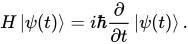
In the Schrödinger picture, the Hamiltonian operator generates the time evolution of quantum states. If is the state of the system at time , then

This is the Schrödinger equation.

Time-independent Hamiltonian

[edit]

If is independent of time, then a state at some initial time () can be expressed using the unitary time evolution operator is the exponential operator as

or more generally, for some initial time

[2]

See also

[edit]

References

[edit]
Revisions and contributorsEdit on WikipediaRead on Wikipedia
from Grokipedia
Time evolution refers to the deterministic change in the state of a over time, as prescribed by the fundamental equations of the relevant physical theory. In , while the state evolves deterministically, measurement outcomes are probabilistic. In , it describes how the positions and momenta of particles evolve under the influence of forces, governed by Newton's second law or, equivalently, Hamilton's equations derived from the Hamiltonian function. In , time evolution governs the development of the wave function, ensuring unitary transformation of the system's state vector via the time-dependent . In , the evolution is fully deterministic: given initial conditions of position and velocity, the trajectory in is uniquely determined by solving the ordinary differential equations of . The Hamiltonian formulation provides a symplectic structure, preserving phase space volume through , which implies long-term recurrence behaviors in bounded systems. Symmetries in the Lagrangian or Hamiltonian lead to conserved quantities via , such as for time-independent systems. Quantum time evolution, in contrast, is inherently linear and unitary, preserving probabilities and allowing reversible dynamics in the absence of measurement. For time-independent Hamiltonians, stationary states evolve by acquiring a phase factor eiEt/e^{-iEt/\hbar}, where EE is the energy eigenvalue, while general states as superpositions exhibit interference and spreading, as seen in wave packet dynamics. The Heisenberg picture shifts the time dependence to operators, with their evolution given by commutators with the Hamiltonian, bridging to classical limits through Ehrenfest's theorem for expectation values. These frameworks underpin predictions for dynamical processes, from planetary orbits to atomic spectra and quantum scattering.

Classical Mechanics

Newtonian Formulation

In classical mechanics, the Newtonian formulation of time evolution originates from Isaac Newton's Philosophiæ Naturalis Principia Mathematica, published in 1687, where time is conceptualized as absolute and uniform, flowing equably without relation to external changes or measurements. This absolute time provides a universal parameter for describing the motion of bodies, independent of relative measures like the apparent duration of days or hours. Newton's second law of motion, expressed as F=ma\mathbf{F} = m \mathbf{a} for a particle of constant mass mm, where F\mathbf{F} is the and a\mathbf{a} is , forms the core equation governing time evolution. Substituting a=d2r/dt2\mathbf{a} = d^2 \mathbf{r}/dt^2, where r(t)\mathbf{r}(t) is the position vector, yields a system of second-order ordinary differential equations: md2r/dt2=F(r,r˙,t)m d^2 \mathbf{r}/dt^2 = \mathbf{F}(\mathbf{r}, \dot{\mathbf{r}}, t). These equations describe the deterministic evolution of the particle's trajectory over time, given the force as a function of position, velocity, and time. For constant forces, such as uniform gravity near Earth's surface, the equations integrate explicitly to yield position as a quadratic function of time. The general solution for one-dimensional motion under constant acceleration aa is x(t)=x0+v0t+12at2x(t) = x_0 + v_0 t + \frac{1}{2} a t^2, where x0x_0 and v0v_0 are initial position and velocity. In two dimensions, this applies separately to horizontal and vertical components; for projectile motion launched with initial speed v0v_0 at angle θ\theta above the horizontal, the horizontal position is x(t)=v0cosθtx(t) = v_0 \cos \theta \, t (with zero acceleration), and the vertical position is y(t)=v0sinθt12gt2y(t) = v_0 \sin \theta \, t - \frac{1}{2} g t^2, where g9.8m/s2g \approx 9.8 \, \mathrm{m/s}^2 is the gravitational acceleration downward. In the phase space representation, the state of a particle is specified by its position r\mathbf{r} and p=mr˙\mathbf{p} = m \dot{\mathbf{r}}, forming a 6N6N-dimensional for NN particles. Initial conditions in this uniquely determine the system's evolution forward and backward in time, ensuring under standard assumptions where forces satisfy conditions for solution uniqueness, such as . This framework underpins the predictability of classical trajectories, with solutions extending indefinitely along characteristics in .

Hamiltonian and Lagrangian Approaches

Lagrangian mechanics provides a reformulation of using , particularly suited for systems with constraints, where the dynamics are derived from the principle of least action. The Lagrangian function is defined as L=TVL = T - V, with TT representing the and VV the , both expressed in terms of qiq_i and their time derivatives q˙i\dot{q}_i. The follow from the Euler-Lagrange equation, given by ddt(Lq˙i)Lqi=0,\frac{d}{dt} \left( \frac{\partial L}{\partial \dot{q}_i} \right) - \frac{\partial L}{\partial q_i} = 0, for each coordinate ii, which arises from varying integral S=LdtS = \int L \, dt to extremal values along the system's path. This variational approach, introduced by in his seminal work Mécanique Analytique, transforms Newton's force-based laws into energy-based differential equations, simplifying analysis for complex systems like rigid bodies or particles under . Hamiltonian mechanics extends the Lagrangian framework by introducing conjugate momenta pi=Lq˙ip_i = \frac{\partial L}{\partial \dot{q}_i}, leading to the Hamiltonian H=ipiq˙iLH = \sum_i p_i \dot{q}_i - L, which typically equals the total energy T+VT + V for time-independent potentials. The time evolution is governed by Hamilton's canonical equations: q˙i=Hpi,p˙i=Hqi,\dot{q}_i = \frac{\partial H}{\partial p_i}, \quad \dot{p}_i = -\frac{\partial H}{\partial q_i}, formulating dynamics as a flow in phase space (qi,pi)(q_i, p_i). Developed by William Rowan Hamilton in his 1834 paper "On a General Method in Dynamics," this approach treats time evolution through canonical transformations that preserve the form of the equations, enabling powerful tools like action-angle variables for integrable systems. For unconstrained particles, it reduces to Newtonian laws via H=p22m+V(q)H = \frac{p^2}{2m} + V(q). A key feature of is its symplectic structure, which ensures the preservation of volume under time evolution, as stated by : the density of points in remains constant along trajectories, implying the reversibility of motion for conservative systems. This theorem, proved by in 1838, follows from the divergence-free nature of the (q˙,p˙)=0\nabla \cdot (\dot{q}, \dot{p}) = 0, underpinning and long-term predictability in classical dynamics. As an illustrative example, consider the one-dimensional harmonic oscillator with Hamiltonian H=p22m+12mω2q2,H = \frac{p^2}{2m} + \frac{1}{2} m \omega^2 q^2, where mm is mass and ω\omega is angular frequency. Hamilton's equations yield q˙=p/m\dot{q} = p/m and p˙=mω2q\dot{p} = -m \omega^2 q, whose solutions are q(t)=Acos(ωt+ϕ)q(t) = A \cos(\omega t + \phi) and p(t)=mωAsin(ωt+ϕ)p(t) = -m \omega A \sin(\omega t + \phi), describing elliptical orbits in phase space with constant energy H=12mω2A2H = \frac{1}{2} m \omega^2 A^2. This periodic motion exemplifies how the Hamiltonian encodes conserved quantities and generates time evolution via Poisson brackets.

Quantum Mechanics

Schrödinger Equation

The time-dependent Schrödinger equation governs the evolution of the wave function ψ(r,t)\psi(\mathbf{r}, t) in non-relativistic quantum mechanics, providing a differential equation for how quantum states change over time. It takes the form iψt=H^ψ,i \hbar \frac{\partial \psi}{\partial t} = \hat{H} \psi, where \hbar is the reduced Planck's constant, ii is the imaginary unit, and H^\hat{H} is the Hamiltonian operator representing the total energy of the system. The Hamiltonian H^=22m2+V(r,t)\hat{H} = -\frac{\hbar^2}{2m} \nabla^2 + V(\mathbf{r}, t) typically includes the kinetic energy term and a potential energy function VV, with the operator correspondence to classical mechanics occurring through the replacement of momentum pp by i-i\hbar \nabla. Erwin formulated this equation in 1926 as part of his development of wave mechanics, introducing a continuous description of quantum phenomena that complemented the discrete of Heisenberg, Born, and . In a subsequent paper that year, demonstrated the mathematical equivalence between wave mechanics and , unifying the two rival formulations and solidifying the foundations of modern quantum theory. The derivation of the time-dependent follows from the de Broglie hypothesis, which associates particles with waves via relations p=kp = \hbar k and E=ωE = \hbar \omega, and the correspondence principle linking classical and quantum descriptions. Assuming a plane-wave form ψ(r,t)ei(krωt)\psi(\mathbf{r}, t) \propto e^{i(\mathbf{k} \cdot \mathbf{r} - \omega t)} for the wave function, the classical Hamiltonian H=p22m+VH = \frac{p^2}{2m} + V is quantized by replacing observables with operators, yielding the differential equation that ensures consistency with energy conservation and wave propagation./09:_Partial_Differential_Equations/9.08:_The_Schrodinger_Equation) A key property of the Schrödinger equation is its unitarity, arising when the Hamiltonian is Hermitian (H^=H^\hat{H}^\dagger = \hat{H}), which guarantees that the time evolution operator preserves the inner product of states. This leads to conservation of probability, as the norm ψ(r,t)2d3r=1\int |\psi(\mathbf{r}, t)|^2 d^3\mathbf{r} = 1 holds for all tt if initially normalized, ensuring the wave function's squared modulus remains a valid probability density without loss or gain of total probability./06:_Time_Evolution_in_Quantum_Mechanics/6.01:_Time-dependent_Schrodinger_equation) For a free particle, where V=0V = 0, the Hamiltonian simplifies to H^=22m2\hat{H} = -\frac{\hbar^2}{2m} \nabla^2, and the general solution is a superposition of plane waves: ψ(x,t)=ϕ(k)ei(kxωt)dk,\psi(x, t) = \int_{-\infty}^{\infty} \phi(k) e^{i(kx - \omega t)} \, dk, with the dispersion relation ω=k22m\omega = \frac{\hbar k^2}{2m} determining the time dependence and illustrating wave packet spreading due to differing phase velocities for different kk./05%3A_Translational_States/5.01%3A_The_Free_Particle)

Time Evolution Operator

In , the time evolution operator U(t)U(t) describes how quantum states propagate forward in time under the dynamics governed by the Hamiltonian H^\hat{H}. For a time-independent Hamiltonian, the operator is defined as U(t)=eiH^t/U(t) = e^{-i \hat{H} t / \hbar}, which satisfies the idUdt=H^Ui \hbar \frac{dU}{dt} = \hat{H} U with the U(0)=I^U(0) = \hat{I}, the identity operator. This form arises as the exponential map of the generator of time translations, ensuring the state ψ(t)=U(t)ψ(0)|\psi(t)\rangle = U(t) |\psi(0)\rangle. A key property of the time evolution operator is its unitarity, satisfying U(t)U(t)=I^U^\dagger(t) U(t) = \hat{I}, which guarantees that the evolution is reversible and preserves the norm of quantum states, thereby conserving probabilities and leading to symmetries associated with conservation laws via in the quantum context. For evolution between arbitrary times, the operator composes multiplicatively as U(t2,t1)=U(t2)U(t1)U(t_2, t_1) = U(t_2) U^\dagger(t_1), reflecting the group structure under time shifts. When the Hamiltonian is time-dependent, H^(t)\hat{H}(t), the time evolution operator takes the form of a time-ordered exponential: U(t)=Texp(i0tH^(t)dt)U(t) = \mathcal{T} \exp\left( -\frac{i}{\hbar} \int_0^t \hat{H}(t') \, dt' \right), where T\mathcal{T} denotes the time-ordering operator that arranges non-commuting operators in chronological order to account for the non-commutativity of H^\hat{H} at different times. This expression, known as the when expanded perturbatively, provides the general solution for U(t)U(t) in the . Physically, the time evolution operator acts on the density matrix ρ^\hat{\rho} of a quantum system as ρ^(t)=U(t)ρ^(0)U(t)\hat{\rho}(t) = U(t) \hat{\rho}(0) U^\dagger(t), transforming mixed states while preserving the trace and hermiticity of ρ^\hat{\rho}. This unitary transformation leaves the von Neumann entropy S(ρ^)=Tr(ρ^logρ^)S(\hat{\rho}) = -\operatorname{Tr}(\hat{\rho} \log \hat{\rho}) invariant, reflecting the absence of decoherence or information loss in closed quantum systems. A representative application is the precession of a spin-12\frac{1}{2} particle in a uniform magnetic field B=Bz^\mathbf{B} = B \hat{z}, where the Hamiltonian is H^=γBS^z/=12γBσ^z\hat{H} = -\gamma \hbar B \hat{S}_z / \hbar = -\frac{1}{2} \gamma \hbar B \hat{\sigma}_z, with γ\gamma the gyromagnetic ratio and σ^z\hat{\sigma}_z the Pauli matrix. The time evolution operator is U(t)=eiωtσ^z/2U(t) = e^{i \omega t \hat{\sigma}_z / 2}, where ω=γB\omega = \gamma B is the Larmor frequency, which rotates the Bloch vector around the magnetic field axis at angular frequency ω\omega, illustrating the operator's role in generating coherent dynamics.

Time-Independent Hamiltonians

In , systems governed by a time-independent Hamiltonian operator H^\hat{H} allow for the separation of the wave function in the time-dependent into spatial and temporal components. Specifically, solutions take the form ψ(r,t)=ϕ(r)eiEt/\psi(\mathbf{r}, t) = \phi(\mathbf{r}) e^{-i E t / \hbar}, where ϕ(r)\phi(\mathbf{r}) satisfies the time-independent H^ϕ=Eϕ\hat{H} \phi = E \phi and EE represents the eigenvalue. This arises from assuming the Hamiltonian commutes with itself at different times, enabling the factorization of the evolution into stationary spatial modes and a that encodes the . Such solutions correspond to stationary states, where the expectation value of any A^\hat{A} remains constant over time, A^t=ϕA^ϕ\langle \hat{A} \rangle_t = \langle \phi | \hat{A} | \phi \rangle, due to the unitary phase evolution. Moreover, the probability density ψ(r,t)2=ϕ(r)2|\psi(\mathbf{r}, t)|^2 = |\phi(\mathbf{r})|^2 is independent of time, reflecting the absence of dynamical changes in the system's configuration space for these eigenstates. The time-independent Hamiltonian possesses a complete set of orthonormal energy eigenstates n|n\rangle, allowing its spectral decomposition H^=nEnnn\hat{H} = \sum_n E_n |n\rangle \langle n|. This decomposition facilitates the expansion of any initial state ψ(0)=ncnn|\psi(0)\rangle = \sum_n c_n |n\rangle, with coefficients cn=nψ(0)c_n = \langle n | \psi(0) \rangle, enabling the full time evolution to be constructed from the eigenbasis dynamics. A representative example is the one-dimensional infinite square well potential of width aa, where the particle is confined between x=0x=0 and x=ax=a with zero potential inside and infinite barriers outside. The energy eigenvalues are given by En=n2π222ma2,n=1,2,3,E_n = \frac{n^2 \pi^2 \hbar^2}{2 m a^2}, \quad n = 1, 2, 3, \dots and the corresponding eigenfunctions are ϕn(x)=2asin(nπxa)\phi_n(x) = \sqrt{\frac{2}{a}} \sin\left( \frac{n \pi x}{a} \right)
Add your contribution
Related Hubs
Contribute something
User Avatar
No comments yet.