Hubbry Logo
TorberniteTorberniteMain
Open search
Torbernite
Community hub
Torbernite
logo
8 pages, 0 posts
0 subscribers
Be the first to start a discussion here.
Torbernite
Torbernite
from Wikipedia
Torbernite
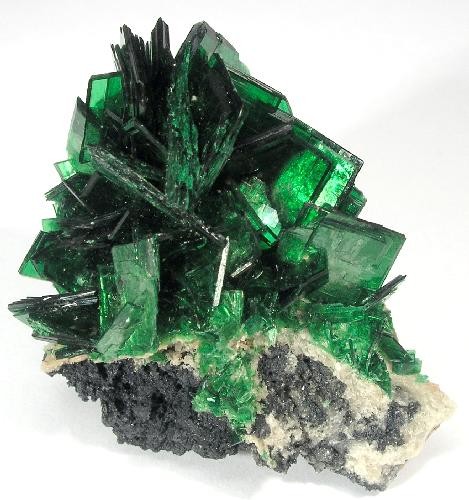
Torbernite crystals from Mashamba West Mine, Kolwezi, Katanga Province, Democratic Republic of the Congo
General
CategoryPhosphate minerals
FormulaCu[(UO2)(PO4)]2(H2O)12[1]
IMA symbolTor[2]
Strunz classification8.EB.05
Crystal systemTetragonal
Crystal classDitetragonal dipyramidal (4/mmm)
H-M symbol: (4/m 2/m 2/m)[3]
Space groupI4/mmm[4]
Identification
Formula mass641 – 713 g/mol, depending the degree of water loss
ColorEmerald green to apple green[5]
Crystal habitTabular crystals; Foliated to earthy masses and encrustations
TwinningRare on [110]
Cleavage[001] Perfect; [100] Distinct[5]
FractureBrittle[5]
Mohs scale hardness2–2.5[5]
LusterVitreous; pearly[5]
StreakPale green
DiaphaneityTransparent to subtranslucent
Densitymeasured: 3.22; calculated: 3.264(1)[5]
Optical propertiesUniaxial (−)
Refractive indexnω = 1.590 – 1.592 nε = 1.581 – 1.582[3]
Birefringenceδ = 0.009 – 0.010[3]
PleochroismVisible
Melting pointDecomposes before
FusibilityDecomposes before
Other characteristics Radioactive and Poisonous

Torbernite, also known as chalcolite,[6] is a relatively common mineral with the chemical formula Cu[(UO2)(PO4)]2·12H2O.[1] It is a radioactive, hydrated green copper uranyl phosphate, found in granites and other uranium-bearing deposits as a secondary mineral. The chemical formula of torbernite is similar to that of autunite in which a Cu2+ cation replaces a Ca2+ cation. Torbernite tends to dehydrate to metatorbernite with the sum formula Cu[(UO2)(PO4)]2·8H2O.

Etymology and history

[edit]
Torbern Olof Bergman

Torbernite was found for the first time at Georg Wagsfort Mine near Johanngeorgenstadt in the Ore Mountains in Saxony. It was first mentioned in 1772 by Ignaz von Born in his work Lythophylacium Bornianum, calling it "mica viridis crystallina, ibid." (green crystalline mica from Johanngeorgenstadt, Sax.; ibid. = "as the item above"). In 1780 Abraham Gottlob Werner uses Born's work and describes the mineral in more detail, calling it at first "grüner Glimmer" (green mica), later naming it "torbernite" in honour of the Swedish mineralogist and chemist Torbern Olof Bergman (1735–1784).[7]

Classification

[edit]

According to the International Mineralogical Association (IMA), which last updated its list in 2009,[8] the Nickel-Strunz system lists torbernite in the section of "uranyl phosphates and arsenates". There it is part of the sub-section "UO2 : RO4 = 1 : 1", forming the autunite group along with autunite, heinrichite, kahlerite, kirchheimerite, metarauchite, nováčekite-I, nováčekite-II, saléeite, uranocircite I, uranocircite II, uranospinite, xiangjiangite and zeunerite with system number 8.EB.05.

Dana groups the mineral into the class "phosphates, arsenates and vanadates", into the section "hydrated phosphates etc." into an unnamed group with metatorbernite, number 40.02a.13.

Crystal structure

[edit]
Packing of torbernite. Colour code: uranium, copper, phosphorus, oxygen, water, hydrogen

Torbernite crystallises in the tetragonal space group I4/mmm with the lattice parameters a = 7.0267(4) Å und c = 20.807(2) Å and 2 formula units per unit cell.[1]

In a study in 2003, using fresh, synthetic crystals, Locock and Burns have compared the crystal structures of the copper uranyl phosphates torbernite, Cu[(UO2)(PO4)]2(H2O)12 and metatorbernite, Cu[(UO2)(PO4)]2(H2O)8 with those of the copper uranyl arsenates zeunerite, Cu[(UO2)(AsO4)]2(H2O)12, and metazeunerite, Cu[(UO2)(AsO4)]2(H2O)8. In these studies they were able to finally analyse the crystal structure of torbernite for the very first time, and to get a significantly more precise analysis for the structure of metatorbernite, compared with previous studies (Makarov and Tobelko R1 = 25%,[9] Ross et al. R1 = 9.7%,[10] Stergiou et al. R1 = 5.6%,[11] Calos and Kennard R1 = 9.2%[12] vs. Locock und Burns R1 = 2.3%).

The study shows that torbernite is isostructural to zeunerite, and metatorbernite is isostructural to metazeunerite. All four compounds are of the layered autunite type with the [(UO2)(XO4)] structural motif (with X = P or As). The Cu2+ ions are coordinated in a square-planar fashion by water molecules in all these compounds, and further coordinate to the uranyl oxygen atoms, forming octahedra with Jahn-Teller distortion. The additional water molecules are held in the crystal structure only by hydrogen bridges.

Metatorbernite

[edit]
Metatorbernite from Margabal Mine, Entraygues-sur-Truyère, France (Size: 4 cm × 3 cm × 1.8 cm)

Torbernite dehydrates readily to metatorbernite with the sum formula Cu[(UO2)(PO4)]2(H2O)8. It forms as torbernite withers, and can also be obtained by artificially heating torbernite above 75 °C.[13] The crystals are rather opaque and only weakly translucent with a glassy lustre.[14]

Metatorbernite crystallises tetragonally-dipyramidally in space group P4/n with the lattice parameters a = 6.9756(5) Å and c = 17.349(2) Å and 2 formula units per unit cell.[1]

Packing of metatorbernite. Colour code: uranium, copper, phosphorus, oxygen, water, hydrogen

The crystal structure of metatorbernite is different from torbernite as every second uranyl phosphate layer is moved about one half of the length of the crystallographic a-axis in the directions [100] and [010].[1] The analysis by Locock and Burns confirms the finding by Stergiou et al., that the Cu2+ ions only have an 88% crystallographic occupancy. The authors assume that by protonation of some of the water molecules there is a charge compensation for electronic neutrality, as it is discussed with the mineral chernikovite.[1] The same is postulated by the same authors for autunite.[15] Due to the limitations of X-ray diffraction this postulate is practically not verifiable with this method.

The analysis by Locock and Burns shows eight molecules of water per formula unit in metatorbernite. This is in accord with the works by Arthur Francis Hallimons[13][16] and Kurt Walenta,[17] who show that the different steps of hydration between torbernite and metatorbernite have clear boundaries, and the water content of each compound remains constant and does not vary, in contrast for instance, as seen in minerals of the zeolite group. Therefore, sum formulae indicating varying degrees of water for torbernite and metatorbernite must not be used.[1]

Properties

[edit]
A pyramidal torbernite crystal from Brest, France
(Field of view: 7 mm × 5 mm)
Intergrowth of dipyramidal crystals of metatorbernite in a geode from Les Montmins Mine (Ste Barbe Ader), Échassières, Kanton Ébreuil, Département Allier, Auvergne, France (Field of view: 1 mm × 1 mm)

Morphology

[edit]

The mineral is often encountered as small thin tabular crystals, but may also be flaky or powdery. More rare are thicker plates, resembling a stacked deck of cards. More frequent than these are dipyramidal forms.

Physical and chemical properties

[edit]

Because of its uranium content of about 48% the material is strongly radioactive. According to the sum formula a specific activity of 85.9 kBq/g[3] can be given (for comparison: natural potassium: 0.0312 kBq/g).

Contrary to its calcium analogue autunite the mineral does not fluoresce.[6] The mineral is very brittle. Its hardness (Mohs) is between 2 and 2.5.

Occurrence and localities

[edit]
Paragenesis of kasolite (yellow, acicular) with torbernite (green, platy)

Torbernite forms as a secondary mineral on the oxidation zone of uranium ores. It is often found in paragenesis with autunite, metatorbernite, uraninite, zeunerite and, very rarely, with gauthierite.[18]

Torbernite is relatively common, and world-wide there are more than 1100 documented localities known by 2022.[19] In Germany it is known not only from its type locality Johanngeorgenstadt, but also from other areas in the Ore Mountains, as well as from the Black Forest, Fichtel Mountains, Bavarian Forest, Thuringian Forest. Further localities are in Argentina, Australia, Austria, Belgium, Bolivia, Brazil, Canada, Chile, China, Czech Republic, Democratic Republic of the Congo, France, Gabon, Ireland, Italy, Japan, Madagascar, Mexico, Namibia, Norway, Poland, Portugal, Romania, Slovakia, Slovenia, Spain, South Africa, Switzerland, Tajikistan, Uzbekistan, the United Kingdom and the United States.[20]

Precautions

[edit]
A torbernite specimen from the Margabal Mine in the Midi-Pyrénées, France

Because of the inherent toxicity of uranium compounds, samples of this mineral should be kept in air tight glass jars.

See also

[edit]

References

[edit]
[edit]
Revisions and contributorsEdit on WikipediaRead on Wikipedia
from Grokipedia
Torbernite is a radioactive, secondary mineral belonging to the autunite group of uranyl phosphates, with the chemical formula Cu(UO₂)₂(PO₄)₂·12H₂O. It forms as vibrant emerald-green to apple-green tabular crystals or foliated masses in the oxidized zones of uraniferous copper deposits, often dehydrating to the related mineral metatorbernite under low-humidity conditions. Named after the Swedish chemist Torbern Olof Bergman (1735–1784), torbernite was first described in 1793 and serves as an important indicator of uranium mineralization due to its high uranium content, approximately 47% by weight. Torbernite crystallizes in the tetragonal system with P4/nnc, featuring a = 7.0267(4) and c = 20.807(2) . Its physical properties include a Mohs of 2–2.5, perfect cleavage on {001}, and a specific gravity of 3.22, making it brittle and micaceous in texture. The mineral exhibits a vitreous to pearly luster, a pale green streak, and transparency that ranges from transparent to translucent. Optically, it is uniaxial negative with refractive indices nω = 1.590–1.592 and nε = 1.581–1.582, showing visible from dark green to sky-blue. Torbernite forms through the alteration of primary uranium minerals like in phosphate-rich, oxygenated environments within copper-uranium bodies. It is commonly associated with , zeunerite, kasolite, and , and occurs worldwide in localities such as Jáchymov in the , Schneeberg in , in , and the Musonoi mine in the . Due to its radioactivity, torbernite requires careful handling and is not used commercially for uranium extraction, though it has in early uranium . In modern contexts, torbernite is primarily valued in mineral collections and geological research as a indicator and for studies in effects on structures. Its sheet-like structure, composed of layers linked by cations and molecules, exemplifies the autunite-type architecture common in many secondary minerals.

Etymology and History

Naming Origin

Torbernite was formally named in 1793 by the German mineralogist Abraham Gottlob Werner. Werner bestowed the name to honor the Swedish chemist and mineralogist Torbern Olof Bergman (1735–1784), a prominent figure in 18th-century science whose work advanced the understanding of mineral chemistry. Bergman, born on March 20, 1735, in Katharinberg, Sweden, and who passed away on July 8, 1784, in Medevi, served as Professor of Chemistry, Pharmacy, and Mineralogy at Uppsala University. His key contributions included the publication of Sciagraphia Regni Mineralis (1779), a systematic classification of minerals based on chemical properties, as well as pioneering research in quantitative chemical analysis, the study of chemical affinities, and the characterization of elements like nickel and bismuth. These efforts established him as a foundational influence in mineralogy, making him a fitting honoree for a uranium-bearing phosphate mineral. The name "torbernite" derives linguistically from Bergman's first name, "Torbern," adapted to the standard mineralogical "-ite," which denotes a distinct . Prior to this formal , the mineral was described under earlier German terms such as "Kupfer-Uranit," reflecting its composition involving and , as noted in 19th-century mineralogical .

Discovery and Early Research

Torbernite was first identified in the late from specimens collected at the Georg Wagsfort Mine near Johanngeorgenstadt in the of , . It was first mentioned in 1772 by Ignaz von Born in his work Lythophylacium Bornianum, calling it "mica viridis crystallina" ( crystalline ). In 1780, described the mineral in more detail as "grüner Glimmer" ( ). In 1789, German chemist analyzed a sample of this , -like mineral at his in Berlin's Apotheke zum Bären, isolating a new element he named after the recently discovered planet ; he initially termed the mineral "Grüner Uranglimmer" ( ) based on its composition. This analysis marked the initial recognition of torbernite's content, though it was initially viewed as a secondary alteration product of primary ores like pitchblende. Early studies encountered confusion with other green uranium-bearing minerals, such as uranite and members of the group, due to similar appearances and associations in oxidized zones of copper-uranium deposits; these distinctions were not fully resolved until later classifications. In 1793, , director of the Mining Academy in , , formally named the mineral torbernite in honor of Swedish chemist Torbern Olof Bergman, acknowledging Bergman's foundational contributions to mineral chemistry. Throughout the , further analyses solidified torbernite's identity as a distinct species amid growing European uranium prospecting, particularly in Saxony's silver-copper mines. These efforts established torbernite as a key indicator in uranium exploration, though its full structural details awaited later advancements.

Classification and Composition

Mineral Classification

Torbernite is classified as a within the group of the uranyl phosphate subclass, according to the Strunz classification system under category 08.EB ( phosphates and arsenates). This placement reflects its layered structure composed of sheets, characteristic of the group minerals. The International Mineralogical Association (IMA) recognizes torbernite as a valid under the grandfather clause, as it was described and approved prior to 1959. This status confirms its established role in mineral taxonomy without requiring subsequent validation. Torbernite is closely related to its arsenate analog, zeunerite, where the ions are substituted by , resulting in similar crystal structures and occurrences but distinct chemical compositions. Unlike primary uranium minerals such as , torbernite forms as a secondary through alteration processes in oxidized zones of uranium-bearing deposits.

Chemical Formula and Variations

Torbernite is a hydrated with the ideal Cu(UO₂)₂(PO₄)₂ · 12 H₂O. This end-member composition corresponds to the following elemental percentages by weight: 6.29%, 47.15%, 6.14%, oxygen 38.05%, and 2.38%. However, the mineral commonly exhibits variability in its hydration state, with the number of molecules ranging from 8 to 12 per , often expressed as Cu(UO₂)₂(PO₄)₂ · nH₂O where n = 8–12; specimens typically contain 10–12 molecules depending on environmental conditions such as relative humidity. to the 8 H₂O variant results in metatorbernite, but intermediate hydration levels are frequently observed in natural samples. In natural occurrences, torbernite may incorporate minor impurities, including substitutions of Fe²⁺ or other divalent metals (such as Ni²⁺ or Co²⁺) for Cu²⁺ in the interlayer cation site, which can slightly alter the unit cell parameters without fundamentally changing the structure. Torbernite belongs to the autunite group, sharing structural similarities with other phosphates.

Crystal Structure

Symmetry and Unit Cell

Torbernite crystallizes in the , characterized by a high degree of that reflects its layered architecture. The is P4/nnc (No. 126), which accommodates the mineral's pseudo-symmetric arrangement of ions, tetrahedra, and interlayer copper-water complexes. The parameters for the fully hydrated form, Cu[(UO₂)(PO₄)]₂(H₂O)₁₂, are a = 7.0267(4) Å and c = 20.807(2) Å, with a volume of 1027.3(1) ų and Z = 2 formula units per cell. These dimensions arise from the stacking of phosphate sheets along the c-axis, separated by hydrated layers. The calculated density, based on the unit cell volume and the formula for the dodecahydrate, is 3.264(1) g/cm³. This value aligns with measured densities around 3.22 g/cm³, confirming the structural model's accuracy for the hydrated phase.

Structural Layers and Bonding

Torbernite possesses a layered crystal structure characterized by sheets of uranyl phosphate composition [(UO₂)(PO₄)]⁻ that lie parallel to the (001) plane. These sheets are formed by the polymerization of (UO₂²⁺) cations and (PO₄³⁻) anions, where the uranyl ions adopt square bipyramidal coordination with two axial oxygen atoms and four equatorial oxygen atoms shared with the phosphate tetrahedra. The phosphorus atoms within the sheets are tetrahedrally coordinated by four oxygen atoms, contributing to the overall rigidity of the layer through vertex-sharing with the uranyl polyhedra. In the interlayer regions, (Cu²⁺) cations occupy distorted octahedral sites, coordinated by four short bonds to molecules and two longer bonds to oxygen atoms from the groups, approximating Cu(H₂O)₆ octahedra. The bonding between these sheets and the interlayer copper-water complexes is primarily weak, involving bonds from the coordinated and interstitial molecules to the sheet oxygens, as well as van der Waals interactions that maintain the overall stacking. Dehydration of torbernite results in the loss of four molecules per , transforming it into metatorbernite and causing a contraction along the c-axis by approximately 16% due to the removal of interstitial and reconfiguration of hydrogen bonding networks in the interlayer space. This process alters the sheet stacking arrangement while preserving the fundamental layer topology.

Physical Properties

Crystal Morphology

Torbernite crystals typically exhibit a tabular or platy , appearing as thin to thick tablets flattened parallel to the {001} face, often with square or rectangular outlines that may appear octagonal due to the development of prism faces. These crystals are influenced by the . The dominant crystal forms include the basal pinacoid {001}, prisms {110}, and pyramids {011}, with {013} pyramids occasionally modifying edges; more complex forms like {111} pyramids are rare. Lateral faces are frequently striated or serrated, contributing to a rough or dull appearance. Twinning in torbernite is rare and occurs as contact or penetration twins on {110}, sometimes producing re-entrant angles. In massive occurrences, torbernite commonly forms aggregates such as foliated, micaceous, or scaly masses, including subparallel, fan-like, sheaf-like, or lamellar groups, as well as crusts and coatings.

Density, Hardness, and Cleavage

Torbernite exhibits a Mohs of 2 to 2.5, rendering it a soft that can be easily scratched by a fingernail or . This low reflects its layered , which contributes to its fragility in bulk form. The specific gravity of torbernite is measured at 3.22 g/cm³ (calculated 3.264 g/cm³), with values varying slightly based on the degree of hydration, as the 's fluctuates with environmental . Less hydrated specimens approach higher densities, while fully hydrated forms are lower. Cleavage in torbernite is perfect on the {001} plane, yielding thin, , while is uneven. This prominent basal cleavage facilitates the mineral's separation into flexible lamellae, aiding identification in hand samples. In terms of tenacity, torbernite is brittle, though thin plates produced by cleavage may exhibit some flexibility. The tabular further accentuates this behavior, allowing sheets to bend without breaking.

Optical and Chemical Properties

Color, Luster, and Optical Characteristics

Torbernite displays a distinctive coloration ranging from emerald-green to grass-green, with variations including leek-green, siskin-green, and apple-green. This vibrant hue arises from its content and structure, though the color may darken or fade to a duller tone upon as it transforms into metatorbernite. The streak is pale , providing a subtle indicator of its composition under testing. The mineral's luster is vitreous to subadamantine, often appearing waxy, and it takes on a pearly sheen on cleavage surfaces. This luster can diminish to dull upon exposure to air, coinciding with loss of hydration. Torbernite is transparent to translucent, allowing light to pass through fresh crystals while thicker or altered specimens appear more opaque. These optical traits contribute to its aesthetic appeal in mineral collections, though dehydration effects can alter transparency over time. Optically, torbernite is uniaxial negative, consistent with its . The refractive indices are nω = 1.590–1.592 and nε = 1.581–1.582, yielding a birefringence of δ = 0.009–0.010. Pleochroism is visible and notable, with the ordinary ray (O) appearing dark green to sky-blue and the extraordinary ray (E) showing green; this color shift under polarized light highlights the mineral's anisotropic nature. Torbernite typically exhibits no fluorescence under light, though epitaxial intergrowths with other uranyl micas may fluoresce, distinguishing it from some other uranium-bearing minerals.

Stability, Solubility, and Reactivity

Torbernite exhibits limited stability under ambient conditions, readily undergoing in air to form metatorbernite by losing four molecules from its of Cu(UO₂)₂(PO₄)₂·12H₂O. This transformation occurs even at and is accelerated under low or varying , rendering torbernite prone to alteration during storage or transport. In high- environments, the is more stable, and partial rehydration can occur if previously dehydrated. Upon , torbernite often alters to a paler hue. The of torbernite is low in neutral water, with gradual leaching of primarily as ions under prolonged exposure, contributing to trace mobilization in aqueous systems. increases significantly in dilute acids, such as (HCl), where facilitates the release of and components. This acid-enhanced dissolution underscores torbernite's role in transport within acidic leachates or waste environments. Torbernite displays slow oxidation under atmospheric conditions, as its uranium is already in the hexavalent (U(VI)) state, limiting further reactivity. release is primarily driven by dissolution in acidic , where below 6 promotes breakdown and mobilization of species. The shows no significant reactivity with bases, maintaining low and structural integrity in alkaline media due to the stability of its framework at higher . Torbernite precipitation and stability are -dependent, favoring formation in mildly acidic to neutral conditions ( 4–7) within oxidizing environments that support ion availability. At circumneutral under oxidizing potentials, solubility minima enhance its persistence as a secondary phase.

Metatorbernite

Metatorbernite is the principal alteration product of torbernite, recognized as a distinct within the meta-autunite group due to its dehydrated nature and structural differences. Named in , its is Cu(UO₂)₂(PO₄)₂ · 8 H₂O, reflecting lower water content compared to the more hydrated torbernite. Physically, metatorbernite differs from torbernite in several key ways, including a paler coloration, greater , and a contraction of the c-axis by approximately 17%, resulting from the loss of water molecules and closer packing of layers. These changes alter its optical properties, with refractive indices typically ranging from ω = 1.618–1.631 and ε = 1.622–1.628, and a vitreous to pearly luster. Metatorbernite forms through the natural of torbernite in arid conditions, where exposure to low causes progressive loss of water, or via drying methods such as heating above 75°C. This process is often reversible under high environments, allowing rehydration to torbernite when increases, though the transformation may depend on and relative levels (e.g., slopes of ~0.8°C per 1% change in relative ). The resulting pseudomorphs preserve the tabular of torbernite but exhibit reduced basal spacing, from ~10.4 per layer in torbernite to ~8.65 in metatorbernite.

Other Autunite Group Members

The autunite group consists of layered phosphate and arsenate minerals characterized by autunite-type sheets composed of cations [(UO₂)²⁺] linked to or arsenate tetrahedra [XO₄]³⁻ (X = P or As), forming anionic sheets of composition [(UO₂)(XO₄)]⁻ through the sharing of equatorial vertices of uranyl square bipyramids and oxygen atoms of the tetrahedra; these sheets are interleaved with layers containing divalent cations and water molecules. The interlayer cations, such as Ca²⁺ or Cu²⁺, balance the charge and coordinate with water molecules, resulting in tetragonal or pseudo-tetragonal symmetry and a flaky, tabular common to the group. Autunite, the calcium end-member, has the formula Ca(UO₂)₂(PO₄)₂·10–12 H₂O and typically appears as bright yellow to yellow-green tabular crystals that exhibit strong under light due to the . It serves as the analog to torbernite, which is the copper prototype of the group. Zeunerite represents the substitution variant with the formula Cu(UO₂)₂(AsO₄)₂·10–12 H₂O, featuring the same sheet structure as but with tetrahedra instead of , leading to minor differences in dimensions and . It occurs in green to dark green crystals, often as a secondary in uranium-bearing deposits. Meta-autunite is the dehydrated form of , with a variable Ca(UO₂)₂(PO₄)₂·2–8 , formed through loss of interlayer that causes sheet puckering and a transition to lower symmetry, while retaining the core framework. This dehydration product maintains the yellow coloration and of its parent mineral but is less stable under humid conditions.

Occurrence and Formation

Geological Formation Processes

Torbernite is a secondary that forms through the oxidation of primary uranium minerals, such as (UO₂) and coffinite (USiO₄), in near-surface environments. This process involves the of these primary minerals, where is mobilized as the ion (UO₂²⁺) by descending meteoric waters in oxidizing conditions. The mineral precipitates via enrichment in phosphate-rich waters that circulate through fractured host rocks under acidic to near-neutral conditions, which favors the solubility of uranyl species while allowing their eventual combination with ions. In copper-bearing systems, torbernite commonly occurs with , requiring the presence of Cu²⁺, UO₂²⁺, and in solution for its as hydrated sheets. The source of phosphate ions is often derived from the dissolution of primary minerals like in surrounding rocks or from organic , though it remains unclear in many deposits. These ions derive from the dissolution of primary minerals and surrounding country rocks, leading to torbernite's deposition as green coatings or crystals in veins and fractures. Formation occurs at low temperatures in shallow zones where and concentration promote . Torbernite is commonly associated with granitic pegmatites or hydrothermal uranium deposits that provide the initial primary mineralization subject to later oxidation.

Associated Minerals and Environments

Torbernite commonly forms in paragenetic association with other secondary uranyl phosphate minerals, including , meta-autunite, saléeite, and uranophane, as observed in oxidized granite-hosted deposits where these minerals precipitate sequentially from oxidizing groundwater interacting with primary uranium sources like . It also co-occurs with accessory phases such as , hydrous iron oxides, , and , which stabilize in similar conditions. The mineral is primarily hosted in the oxidized zones of granitic intrusions, including fractionated granites and associated pegmatites, where it develops through of primary minerals along joints and cavities. Torbernite further appears in hydrothermal vein systems, often within sulfide-quartz veins cutting crystalline rocks, and in sedimentary deposits embedded in fluvial sediments like sandstones and claystones. In terms of zonal distribution, torbernite is concentrated in the upper profiles of oxidation zones, typically extending to depths of up to 150 feet, where it manifests as thin coatings on fractures or disseminations in altered wallrocks near veins. Rarely, torbernite associates with secondary copper minerals such as and in oxidized copper-uranium ores within granites and dikes, reflecting localized enrichment in polymetallic settings.

Notable Localities

Type and Historical Sites

Torbernite lacks a formally designated type locality according to the International Mineralogical Association, but the mineral's initial scientific description and naming are tied to specimens collected from the Georg Wagsfort Mine near Johanngeorgenstadt in the of , , around 1793. These early samples formed the basis for Abraham Gottlob Werner's recognition of the species, whom he described as a distinct green copper-uranyl phosphate mineral. Werner named torbernite in 1793 to honor the Swedish chemist and Torbern Olof Bergman (1735–1784), whose analytical work on influenced European ; this naming occurred shortly after Bergman's death and reflected the era's tradition of commemorating key figures in the field. Concurrently, German chemist conducted chemical analyses on similar specimens from Saxon -bearing deposits, identifying as a new element in 1789 within what he termed "grüner Uranglimmer" (green mica), a description that aligned closely with torbernite's composition and confirmed its uraniferous nature. Klaproth's work on these Johanngeorgenstadt samples marked one of the earliest detailed chemical characterizations of a mineral, linking the site directly to foundational advancements in . In the , significant historical collections of torbernite emerged from oxidized zones in Cornish mining districts, , including specimens from the Old Gunnislake Mine and other uranium-enriched veins in the region, which were documented in early British mineralogical handbooks and contributed to comparative studies of European uranium phosphates. These Cornish examples, often exhibiting tabular green crystals, were prized in collections for their aesthetic and scientific value, underscoring torbernite's role in 19th-century explorations of secondary uranium mineralization.

Major Global Deposits

Torbernite occurs primarily as a secondary mineral in the oxidized zones of uranium-copper deposits, where it is generally uncommon and rare in large quantities, though exceptional specimens with well-formed tabular crystals have been recovered from select sites. The hosts some of the world's premier torbernite deposits in the , particularly at the and Musonoi mines, yielding large, vibrant green crystals up to several centimeters across from uranium-rich veins. In , significant occurrences are documented in the Front Range of , USA, including areas near , where torbernite coats fractures in Precambrian granites and pegmatites within uranium-bearing lodes. European deposits include the Margnac uranium mine in , , a key site for phosphate-rich secondary minerals like torbernite, which forms disseminated coatings in altered granites. In the , the Krásno ore district near Horní Slavkov features torbernite in Sn-W deposits, associated with oxidized accumulations in the Huber and Schnöd stocks. Torbernite is often found alongside in these environments. More recent collections of torbernite have come from Australia's Radium Hill area in , where post-2000 explorations of historic and outcrops have yielded specimens from the former mine's secondary zones. Overall, the finest collector-grade material derives from these secondary uranium-copper settings, emphasizing the mineral's scarcity beyond trace occurrences.

Uses and Safety

Industrial and Scientific Uses

Torbernite is not a primary target for commercial extraction due to its secondary nature and relatively low content compared to primary ores like . However, it can serve as an indicator of deposits and may be processed incidentally in some low-grade uraniferous ores using general acid leaching methods, such as treatment. In scientific , torbernite is utilized as a reference material for studying complexes through spectroscopic techniques, particularly near-infrared (NIR) and , which reveal details about its hydration states and vibrational modes. These analyses help characterize the mineral's structure and aid in identifying similar uranium-bearing phases in environmental samples. Additionally, torbernite supports geochronological studies via U-Pb of secondary minerals, providing insights into the timing of mineralization events in deposits, as demonstrated by isotopic analyses yielding ages such as 4.55 ± 0.02 Ma in specific localities. Torbernite holds value among mineral collectors for its vibrant green, tabular , which are prized for display in cabinets due to their aesthetic appeal and rarity. Due to its , torbernite has no applications as a or in non- industrial processes.

Radioactivity Hazards and Precautions

Torbernite exhibits primarily due to its content, derived from the U-238 , where it acts as an alpha emitter. The mineral's is approximately 86,000 Bq/g in secular equilibrium, reflecting the total activity from its roughly 47% composition and decay daughters, with gamma emissions being negligible compared to alpha particles. The main health risks associated with torbernite stem from internal exposure via or of fine dust particles, which can deliver alpha radiation directly to lung tissue or the , potentially causing long-term cellular damage and increased cancer risk. External exposure to beta particles may irritate skin or eyes upon prolonged contact, while low-level poses a cumulative but lesser threat to surrounding tissues; children and pregnant individuals face heightened vulnerability due to greater sensitivity. Safety precautions for handling torbernite include storing specimens in sealed, labeled containers to contain dust and minimize gas buildup, wearing protective gloves and respiratory masks, and ensuring adequate ventilation during examination or preparation. Exposure should be limited to below 1 mSv per year for non-occupational handlers such as collectors, using principles of time, distance, and shielding—such as acrylic barriers for beta radiation—to reduce dose rates. Upon disposal, torbernite must be treated as following local environmental regulations to prevent environmental contamination. Torbernite is categorized as (NORM) under international standards, subjecting it to regulatory oversight for safe management. The (IAEA) provides guidelines emphasizing through justification, optimization (keeping doses as low as reasonably achievable), and dose limits, with public exposure not exceeding 1 mSv annually from controlled sources.

References

Add your contribution
Related Hubs
User Avatar
No comments yet.