


Community hub
Recent from talks
Contribute something
Nothing was collected or created yet.
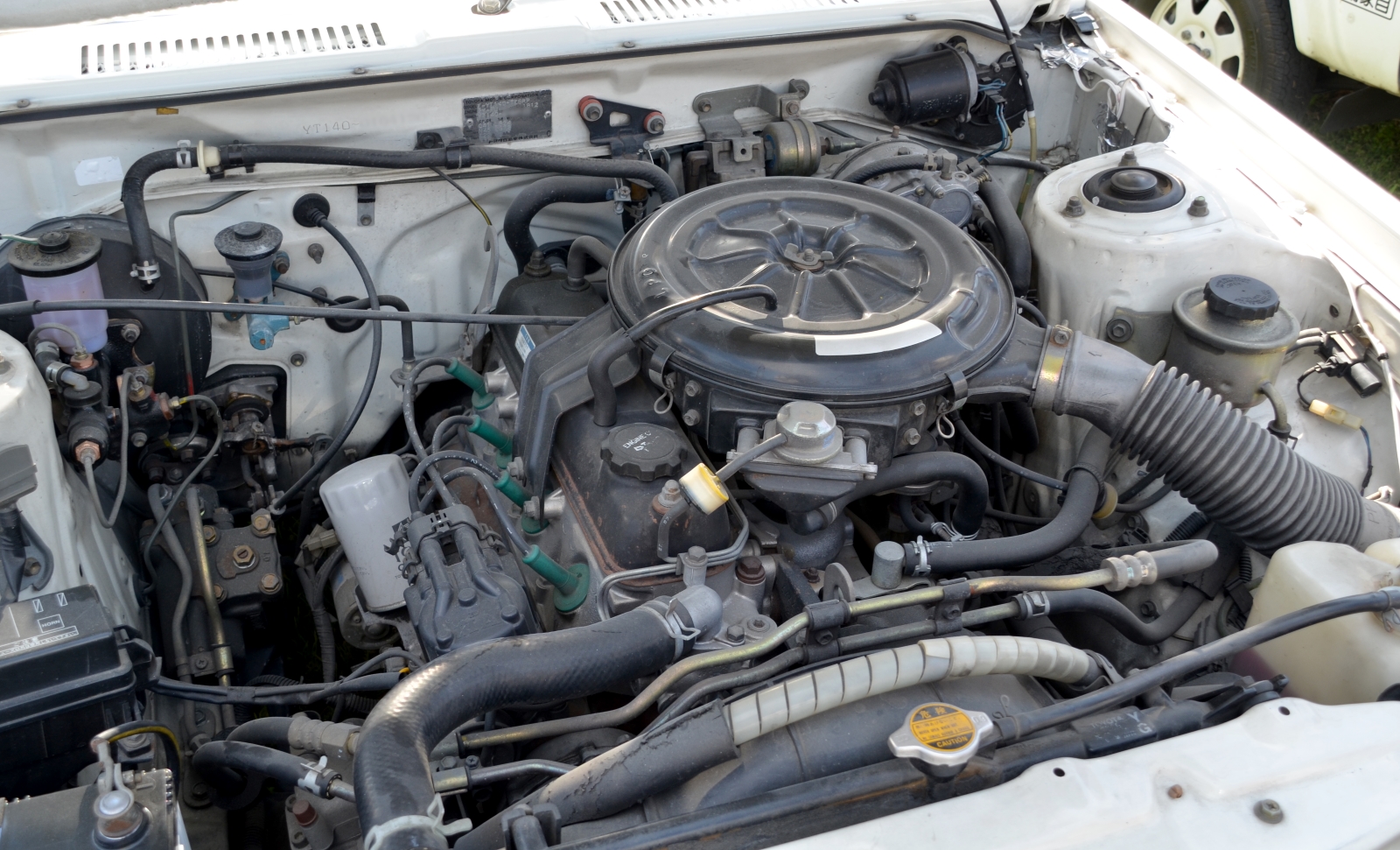
Toyota Y engine
View on Wikipedia
| Y engine | |
|---|---|
 | |
| Overview | |
| Manufacturer | Toyota |
| Production | 1982–1996 |
| Layout | |
| Configuration | Naturally aspirated straight-four |
| Valvetrain | OHV 2 valves per cylinder |
| Combustion | |
| Fuel system | Carburettor Multi-port fuel injection |
| Fuel type | Petrol |
| Oil system | Wet sump |
| Cooling system | Water-cooled |
| Output | |
| Power output | 70–95 PS (69–94 hp; 51–70 kW) (net) |
| Torque output | 135–182 N⋅m (14–19 kg⋅m; 100–134 lb⋅ft) (net) |
| Chronology | |
| Successor | Toyota TZ engine |
The Toyota Y engine is a series of overhead valve straight-four petrol engines manufactured by Toyota from 1982 through 1996. The Y engine has mostly been used in commercial and off-road vehicles.
The valve arrangement from the Toyota K engine is interchangeable with this engine.
Translated from Japanese Wiki ja:トヨタ・Y型エンジン
1Y
[edit]There is also the 1Y-J, with the "J" suffix meaning that the engine is built to meet emission standards for light commercial vehicles.
- OHV, eight valves
- Displacement: 1.6 L (1,626 cc)
- Bore × stroke: 86 mm × 70 mm (3.39 in × 2.76 in)
- Reference output: 84 PS (62 kW), 13.8 kg⋅m (135 N⋅m; 100 lbf⋅ft) (gross figures, apply to both 1Y and 1Y-J)
Applications:
- Toyota HiAce truck
- Toyota LiteAce (YM20, first generation)
- Toyota ToyoAce
- Toyota TownAce (YR10)
2Y
[edit]The 2Y engine is an OHV, eight valve construction just like the 1Y. It shares that engine's 86 mm (3.39 in) bore, but stroke is increased to 78 mm (3.07 in) for a displacement of 1.8 litres (1,812 cc). There are also 2Y-J and 2Y-U engines with differing emissions control equipment.
- OHV, eight valves
- Displacement: 1.8 L (1,812 cc)
- Bore × stroke: 86 mm × 78 mm (3.39 in × 3.07 in)
- Compression ratio: 8.8:1
- Reference output (2Y): 79 PS (58 kW) at 5,000 rpm, 14.3 kg⋅m (140 N⋅m; 103 lbf⋅ft) at 3,200 rpm (net)
95 PS (70 kW), 15.5 kg⋅m (152 N⋅m; 112 lbf⋅ft) (gross)
Applications:
- 5th generation Toyota Mark II Van (YX76V, 2Y-J)[1]
- 3rd generation Toyota HiAce van (YH50V/60V)
- Toyota Hilux[2]
- Toyota TownAce van (YR25V)
- Toyota LiteAce wagon (YM20/30G)
- Volkswagen Taro (a rebadged Hilux)
2Y-P
[edit]- OHV 8 valve (LPG)
- Displacement: 1.8 L (1,812 cc)
- Bore × stroke: 86 mm × 78 mm (3.39 in × 3.07 in)
- Specifications: 70 PS (51 kW) 4,600 rpm 13.5 kg⋅m (132 N⋅m; 98 lbf⋅ft) 2,200 rpm (net)
85 PS (63 kW) 5,000 rpm 14.5 kg⋅m (142 N⋅m; 105 lbf⋅ft) 3,000 rpm (gross) - LPG
Applications:
- Toyota Corona (YT140)
- Toyota Mark II (YX70)
3Y
[edit]
There is also the emissions cleaned 3Y-U engine. A version of the 3Y is built by the Shenyang Xinguang-Brilliance Automobile Engine Co. in China as the 4G20B; this engine meets the Euro IV emissions standards.
- OHV 8 valve, carburetted
- Displacement: 2.0 L (1,998 cc)
- Bore × stroke: 86 mm × 86 mm (3.39 in × 3.39 in)
- Compression ratio: 8.8:1
- Reference output: 88 PS (65 kW) at 4,800 rpm, 15.8 kg⋅m (155 N⋅m; 114 lbf⋅ft) at 3,400 rpm
Applications:
- 3rd generation Toyota HiAce truck/van/wagon (YH51G/61G/71G)
- Hilux
- Dyna/ToyoAce
- Aug 1983–Aug 1987 Crown (YS120, export models)
3Y-C
[edit]This is the low emissions carburetted motor with catalytic converter exhaust system.
- OHV 8 valve
- Displacement: 2.0 L (1,998 cc)
- Inside Bore × Stroke: 86 mm × 86 mm (3.39 in × 3.39 in)
- Compression ratio: 8.8:1
- Reference output: 85 PS (63 kW) at 4600 rpm, 15.8 kg⋅m (155 N⋅m; 114 lbf⋅ft) at 3400 rpm
Applications:
- LiteAce XTRA TRACK Wagon (YM40-RGMDSQ), (YM41-RVMDSQ)
- Toyota Townace Van (YR39)
3Y-E
[edit]- OHV 8 valve, fuel injection
- Displacement: 2.0 L (1,998 cc)
- Bore × stroke: 86 mm × 86 mm (3.39 in × 3.39 in)
- Compression ratio: 8.8:1
- Reference output: 97 PS (71 kW) at 4,800 rpm, 16.3 kg⋅m (160 N⋅m; 118 lbf⋅ft) at 3,800 rpm
Applications:
- Feb 1993–Apr 1997 Toyota Mark II (YX78V, fifth generation)
- Aug 1988–Dec 1995 Mark II (YX80)
- Apr 1989–Aug 1991 Hilux Surf (YN130G)
- Daihatsu Rocky F80, F85 (Australia 1988 model year only)
- 1996 Toyota Classic
3Y-EU
[edit]- OHV 8 valve, fuel injection and emissions equipment
- Displacement: 2.0 L (1,998 cc)
- Bore × stroke: 86 mm × 86 mm (3.39 in × 3.39 in)
- Reference output: 115 PS (85 kW) at 5000 rpm, 18.3 kg⋅m (179 N⋅m; 132 lbf⋅ft) at 3600 rpm (gross)
97 PS (71 kW) at 4800 rpm, 16.3 kg⋅m (160 N⋅m; 118 lbf⋅ft) at 3800 rpm (net)
Applications:
- Aug 1986–Mar1989 Hilux Surf/4Runner (YN61G)
- TownAce Wagon/MasterAce Surf (YR21G)[3]
- Daihatsu Delta Wagon (YB21G)[4]
3Y-P
[edit]- OHV 8 valve (LPG)
- Displacement: 2.0 L (1,998 cc)
- Bore × stroke: 86 mm × 86 mm (3.39 in × 3.39 in)
- Output: 79 PS (58 kW) at 4,600 rpm, 15 kg⋅m (150 N⋅m; 110 lbf⋅ft) at 3,000 rpm
Applications:
- Sep 1987–Aug 1989 Crown Sedan (YS130)
- Aug 1988–Dec 1995 Mark II sedan (YX80)
3Y-PU
[edit]- OHV 8 valve (LPG, emissions equipment)
- Displacement: 2.0 L (1,998 cc)
- Bore × stroke: 86 mm × 86 mm (3.39 in × 3.39 in)
- Reference output: 90 PS (66 kW) at 5,000 rpm, 16 kg⋅m (160 N⋅m; 120 lbf⋅ft) at 3,000 rpm (gross)
79 PS (58 kW) at 4,600 rpm, 15 kg⋅m (150 N⋅m; 110 lbf⋅ft) 2,000 rpm (net)
Applications:
- Aug 1983–Aug 1987 Crown (YS120)
- Aug 1986–??? Mark II (YX72/YX78V)
3Y-PE
[edit]- OHV 8 valve (LPG, fuel injection)
- Displacement: 2.0 L (1,998 cc)
- Bore × stroke: 86 mm × 86 mm (3.39 in × 3.39 in)
- Compression ratio: 10.5:1
- Reference output: 82 PS (60 kW) at 4600 rpm, 16 kg⋅m (160 N⋅m; 120 lbf⋅ft) at 2400 rpm (August 1989 until November 1995)
79 PS (58 kW) at 4400 rpm, 16.3 kg⋅m (160 N⋅m; 118 lbf⋅ft) at 2400 rpm (1995 December)
Applications:
4Y
[edit]- OHV eight-valve
- Displacement: 2.2 L (2,237 cc)
- Bore and stroke: 91 mm × 86 mm (3.58 in × 3.39 in)
This engine was available either carburetted (4Y) or fuel injected (4Y-E, called the GW491Q/LJ491Q and also 4G22B for Chinese manufacture). As fitted to a 1989 Daihatsu Delta truck, the carburetted 4Y produces 70 kW (95 PS; 94 hp) at 4400 rpm (SAE net)[5] and 18.6 kg⋅m (182 N⋅m; 135 lbf⋅ft) at 3000 rpm.[6]
- Applications
- 1987.09 - 1995.12 Toyota Crown (YS132, overseas specifications)
- Toyota Van (Town Ace overseas specification, Tarago in Australia)
- Hiace third generation (overseas specification)
- 1979-1988 Toyota Stout (YK110)[citation needed]
- Daihatsu Delta
- 1993-1995 Daihatsu Rocky F95
- Toyota Industries forklifts
- Toyota 4Runner (Australia)
- Volkswagen Taro
- 1985–1997 Toyota Hilux fourth and fifth generation
References
[edit]- ^ All Trucks & Vans (catalog) (in Japanese), Japan: Toyota, August 1985, p. 18, 021011-6008
- ^ Rex, Rainer, ed. (July 1989), Lastauto Omnibus Katalog 1990 [Truck and bus catalog] (in German), vol. 19, Motor-Presse-Verlag GmbH und Co. KG, p. 151, 81531/89001
- ^ 自動車ガイドブック [Japanese Motor Vehicles Guide Book 1983/1984] (in Japanese), vol. 30, Japan: Japan Automobile Manufacturers Association, 1983-10-28, p. 238, 0053-830030-300
- ^ Automobile Guide Book 1983/1984, p. 244
- ^ Delta (brochure), Osaka, Japan: Daihatsu Motors, p. 8, 1 098-00191
- ^ Delta (brochure), p. 24
Toyota Y engine
View on GrokipediaOverview
General characteristics
The Toyota Y engine family consists of straight-four petrol engines with an overhead valve (OHV) configuration and two valves per cylinder. These naturally aspirated, water-cooled engines employ wet sump lubrication and were produced from 1982 to 1998. Derived from the Toyota K engine family, the Y series prioritizes durability and reliability over high performance, making it suitable for rugged applications.[4][1] Displacements across the family span 1.6 L to 2.2 L, delivering power outputs in the range of 70–115 PS (51–85 kW) and torque from 135–190 N⋅m. This performance envelope supports efficient operation under load without emphasizing speed.[2][7] The engines found primary application in commercial vehicles, light trucks, and vans, such as the Hilux, HiAce, and TownAce models, where their robust construction excels in demanding conditions like frequent heavy-duty use and off-road environments. The Y series was succeeded by the TZ engine.[4]Development history
The Toyota Y engine family was introduced in September 1982 as a successor to older inline-four engines in Toyota's commercial vehicle lineup, serving as an alternative to the T and 18R truck engines to provide a more cost-effective and maintainable option.[1] This series derived its valve train design from the earlier K engine but featured simplifications aimed at reducing production costs and easing maintenance requirements.[8] The initial 1Y variant marked the launch of the family that year, establishing its role in powering light commercial vehicles.[9] Throughout the 1980s and 1990s, the Y engine evolved to address tightening emissions standards and growing demands for fuel efficiency in Japanese domestic markets and international exports.[10] A key advancement came with the 3Y-C variant in the mid-1980s, which integrated an early catalytic converter exhaust system to comply with emerging low-emissions regulations.[11] The lineup expanded around this period with the 3Y engine, broadening its applicability while maintaining the shared overhead valve (OHV) configuration across variants for reliability in commercial use. In the 1990s, further adaptations included LPG-compatible versions, such as those based on the 3Y and 4Y, to meet alternative fuel compliance requirements amid rising environmental pressures.[12] Production of the Y engine family concluded in September 1998 at the Kamigo Plant, driven by increasingly stringent global emissions regulations that favored more advanced overhead camshaft (OHC) designs, with a total of 2.76 million units manufactured for worldwide commercial applications.[1]Design and technology
Core mechanical features
The Toyota Y engine series utilizes a cast iron cylinder block, providing exceptional durability and resistance to wear under heavy commercial use, complemented by an aluminum alloy cylinder head that aids in weight reduction and improved heat dissipation.[13][14] Bore dimensions remain consistent at 86 mm across the 1Y, 2Y, and 3Y variants, while the 4Y employs a 91 mm bore; differences in piston stroke—such as 70 mm for the 1Y, 78 mm for the 2Y, 86 mm for the 3Y, and 86 mm for the 4Y—determine the overall displacement from 1.6 L to 2.2 L.[15][16] A defining architectural element is the overhead valve (OHV) valvetrain, featuring pushrods, rocker arms, and eight valves total, which prioritizes mechanical simplicity and facilitates routine maintenance like valve adjustments, though it inherently limits peak rotational speeds relative to overhead camshaft alternatives.[17][18] Compression ratios for carbureted models generally fall between 8.5:1 and 9.5:1 to accommodate regular unleaded fuel and ensure reliable ignition, whereas LPG-adapted versions like the 3Y-PE achieve higher ratios up to 10.5:1 for enhanced thermal efficiency and power output with those fuels; gasoline fuel-injected models retain ratios around 8.5:1 to 9.0:1.[19][15] The cooling system operates on a water-cooled principle, employing a radiator, thermostat, and circulating pump to maintain optimal operating temperatures and prevent overheating during prolonged duty cycles.[20] Lubrication is handled by a full-pressure wet sump system with a gear-driven oil pump, delivering pressurized oil to critical components like bearings and the valvetrain for consistent protection and longevity.[20] Contributing to the family's emphasis on reliability, the Y engines incorporate a robust ductile iron crankshaft and steel connecting rods engineered to endure high torsional loads and vibrations typical in commercial vehicles, eschewing complexities like variable valve timing or turbocharging in favor of proven, low-maintenance construction.[21][22]Fuel and emissions systems
The Toyota Y engine family initially relied on carbureted fuel delivery systems, with early models such as the 1Y and 2Y utilizing single or twin carburetors to mix air and fuel for combustion. These systems were simple and cost-effective, suitable for the engine's overhead valve design and intended applications in light commercial vehicles. As environmental regulations tightened, Toyota transitioned to more advanced fuel management in later variants; the 3Y-E and 3Y-EU introduced multi-point electronic fuel injection (EFI), which provided precise control over fuel atomization and delivery, enhancing throttle response and reducing fuel waste compared to carburetion. For alternative fuel use, the -P variants like the 3Y-PE were adapted for liquefied petroleum gas (LPG), replacing the carburetor with a vaporizer to convert liquid LPG to gas and a mixer to blend it with intake air, optimizing combustion for gaseous fuel properties such as higher octane rating. This configuration was employed in models like the Crown series, where the 3Y-PE delivered 82 PS at 4,600 rpm while maintaining reliability in taxi and fleet applications. Certain LPG variants, such as the 3Y-PE, continued production until 2008 for commercial applications, incorporating updates to meet evolving Japanese emissions requirements.[23][24] Emissions control evolved across the Y family to meet Japan's stringent standards. Starting with the 3Y-C variant, three-way catalytic converters were integrated into the exhaust system to oxidize hydrocarbons and carbon monoxide while reducing nitrogen oxides. EU-designated models, such as the 3Y-EU, incorporated exhaust gas recirculation (EGR) valves to recirculate a portion of exhaust gases back into the intake, lowering combustion temperatures and NOx formation. Emissions-controlled variants like the 3Y-U from the 1990s complied with Japan's 1994-1997 standards through refined air-fuel ratios and enhanced catalyst efficiency. Ignition systems in the Y engine series were consistently distributor-based, featuring electronic advance mechanisms to adjust spark timing based on engine speed and load, ensuring stable operation without the complexity of coil-on-plug setups even in final iterations. The integration of the OHV cylinder head with the intake manifold facilitated compact fuel and emissions component placement. Carbureted versions typically delivered 8–10 km/L in urban driving conditions, while EFI upgrades in models like the 3Y-E improved this to 10–12 km/L by optimizing fuel metering and reducing idle consumption.Engine variants
1Y engine
The 1Y engine served as the entry-level model in Toyota's Y engine family, with a displacement of 1.6 L (1,626 cc), achieved through a bore of 86 mm and a stroke of 70 mm, along with a compression ratio of 9.0:1.[25] It features a shared overhead valve (OHV) configuration, cast-iron block and aluminum cylinder head, and a timing belt-driven valvetrain.[26] Designed for efficiency in compact applications, the engine delivered 84 PS (62 kW) at 4,800 rpm and 135 N⋅m of torque at 3,000 rpm.[2][27] The base 1Y variant was equipped with a carburetor for standard operation, while the 1Y-J version was specifically tuned for emissions compliance in Japan, incorporating a catalytic converter to meet domestic regulations.[2] Both variants maintained identical power and torque figures, emphasizing reliability over high performance. Production of the 1Y engine spanned from 1982 to the early 1990s, with primary deployment in the Japanese market.[25] As the smallest in the Y family, the 1Y was the lightest and most compact, making it particularly suited for small vans and light commercial vehicles.[15] Fuel economy typically ranged around 9–11 km/L in real-world use, depending on vehicle configuration and driving conditions.[25]2Y engine
The 2Y engine is a 1.8-liter (1,812 cc) inline-four gasoline engine from Toyota's Y family, featuring an overhead valve design with eight valves, a cast-iron block, and an aluminum head.[3] It has a bore of 86 mm and a stroke of 78 mm, with compression ratios ranging from 8.5:1 to 9.0:1 depending on the application.[3] The base 2Y variant, which is carbureted, produces 79 PS (58 kW) at 4,800 rpm and 140 N⋅m of torque at 2,800 rpm, providing balanced performance suited for light-duty commercial vehicles.[28] This engine was produced from 1982 to 1996, emphasizing durability and torque delivery for trucks and vans.[3] Several variants of the 2Y were developed to meet evolving emissions standards and fuel requirements. The 2Y-J is an emissions-tuned version with modifications for cleaner operation, delivering 95 PS at 5,200 rpm and 152 N⋅m at 3,400 rpm.[29] The 2Y-U represents an updated iteration for later regulatory compliance, maintaining similar output to the base model around 78 PS at 5,000 rpm and 136 N⋅m at 2,800 rpm while incorporating minor refinements for longevity.[30] The 2Y-P, designed for liquefied petroleum gas (LPG) use, outputs 70 PS at 4,600 rpm and 132 N⋅m, optimized for alternative fuel compatibility in commercial fleets.[2] Distinct from the smaller 1Y, the 2Y offers improved low-end torque response, making it more suitable for load-carrying light trucks where acceleration from low speeds is prioritized over peak power.[5] It shares the same bore size with the larger 3Y engine, facilitating some parts commonality in the Y family. Fuel economy typically ranges from 8 to 10 km/L in mixed driving conditions, with optimized setups achieving up to 14.6 km/L at constant 60 km/h speeds.[29] The 2Y is renowned for its simple maintenance, relying on straightforward carburetion and robust components that support easy servicing in field conditions.[3]3Y engine
The 3Y engine family is a mid-sized displacement variant in Toyota's Y series, with a 2.0 L (1,998 cc) capacity achieved via a square bore and stroke of 86 mm × 86 mm. Compression ratio is 8.8:1. Produced from 1984 to 1996, the 3Y stands as the most versatile member of the family, offering carbureted, electronic fuel injection (EFI), and liquefied petroleum gas (LPG) options tailored to diverse global markets, while delivering the highest power outputs in the series. Like smaller Y engines, it employs an overhead valve (OHV) design with an 8-valve aluminum cylinder head and cast-iron block. The base 3Y is a carbureted model producing 88 PS (65 kW) at 4,800 rpm and 155 N⋅m of torque at 2,800 rpm. Fuel economy typically ranges from 9–12 km/L, varying by fuel system and vehicle application, with official figures for early models reaching up to 14.2 km/L in highway conditions with a 5-speed manual transmission. Subvariants expand the 3Y's adaptability. The 3Y-C, designed for catalytic converter compliance, outputs 85 PS while maintaining similar torque characteristics to the base model. The EFI-equipped 3Y-E and 3Y-EU enhance emissions control and performance, yielding 97 PS at 4,800 rpm and 160 N⋅m at 2,800 rpm. For certain markets, the 3Y-U delivers 88 PS with updated fueling for reduced emissions and unleaded fuel compatibility. LPG-specific versions include the carbureted 3Y-P and 3Y-PU, rated at 79 PS and 150–160 N⋅m, and the EFI 3Y-PE, producing 79–82 PS for improved efficiency in alternative fuel applications.| Variant | Fuel System | Power (PS) | Torque (N⋅m) | Key Features |
|---|---|---|---|---|
| 3Y | Carbureted | 88 @ 4,800 rpm | 155 @ 2,800 rpm | Base gasoline model |
| 3Y-C | Carbureted | 85 @ 4,800 rpm | 155 @ 2,800 rpm | Catalytic converter compatible |
| 3Y-E/EU | EFI | 97 @ 4,800 rpm | 160 @ 2,800 rpm | Emissions-optimized injection |
| 3Y-U | Carbureted | 88 @ 4,800 rpm | 155 @ 2,800 rpm | Unleaded fuel and emissions compliance |
| 3Y-P/PU | Carbureted (LPG) | 79 @ 4,600 rpm | 150–160 @ 2,800 rpm | LPG conversion |
| 3Y-PE | EFI (LPG) | 79–82 @ 4,600 rpm | 150 @ 2,800 rpm | Injected LPG variant |